Japan Mission Report October 2016

jhs-2016

Mission Objectives:

  1. Attend the Japan Home Show Oct 26-28 Completed
  2. Research Japan Housing Agencies and Associations (see below)
  3. Confirm Forestry Details for Minister Bilious Japan (Made contact with Canada Wood and Alberta japan Office. Information passed onto AFPA delegates on Minister Bilious Delegation.
  4. Market Report (see below)

Japan Home Show

visitors-to-jhs

Attendance to 2016 show was up 12% compared to 2015 attendance. There were 107 visitors to the booth up 30% from last year. The number of foreign visitors were also up, especially from South Korea.

alberta-booth-jhsbcwood


Overview of Japanese Housing Associations and Agencies

Japan has a large and varied number of organizations that influence Japan’s housing policy

The Japan Federation of Housing Organizations, Judanren, is the leading organization in the housing industry in Japan.

Authorized by the Ministry of Land, Infrastructure and Transport, Judanren was established in 1992 by housing and housing-related associations to serve its members, the housing industry, and the public at large.

Our activities focus primarily on the following field relative to the production and supply of homes:

  • 1.Coordination of and research on building systems
  • 2.Coordination among housing associations
  • 3.International exchanges
  • 4.Supply of information and submittal of proposals and recommendations
  • 5.All other related matters to carry out Judanren’s mission

jpa

JPA Purpose and History

The association was founded in January 1963 and in 1964 became incorporated under the jurisdiction of the Ministry of Land, Infrastructure, Transport and tourism (MILT) and the Ministry of Economy, Trade and Industry (METI).

In October 2013, the association refocused and changed direction and now focus development on prefab architecture as well as its construction and propagation.

Projects

  1. Independent certification activities related to prefab housing and construction (certifying precast concrete (PC) component quality, inspecting PC structures, certifying PC construction welding qualifications, certifying qualifications of PC building construction management engineers, certifying qualifications of prefab housing coordinators)
  2. Disaster countermeasures (support for construction of temporary emergency housing, and investigation and research into related technology)
  3. Public relations (publication of journals, and surveys of prefab housing sales results)

 jpa2

Warranties and insurance against defects

  1. Housing exhibition (discontinued from August 2013)
  2. Projects involving first-class architects’ offices
  3. Investigation and research into prefab housing and buildings
  4. Presentation of opinions and suggestions on measures involving housing and residential land

Organizational Structure

jpa3-jpg

About Prefab Housing and Buildings

  • The “prefab” in prefab housing and buildings is abbreviated from “prefabricated,” and indicates a system of producing housing structural members, such as columns, beams, roof trusses and walls, in a factory and assembling them at the construction site.
  • In prefab housing and buildings, the main components are produced under thorough quality control, so there is no deviation in quality and a high degree of precision is achieved. In addition, less effort is required at the construction site and it is possible to greatly reduce the amount of time spent on construction.

Housing Committee

japanese-prefab-house

The Housing Committee comprises 20 prefab housing manufacturers.

Playing a leading role in the industry, it engages in activities with the aim of creating high-quality living spaces and residential environments and realizing a rich society full of vitality, through both construction and R&D of industrialized housing.

It also strives to create an axis for joint efforts among the member companies to quickly adapt to government policies and changes in the environment surrounding the housing industry.

Activities of the Housing Committee

Promoting the spread of advanced housing and technology, and coping with laws and standards

The Housing Committee aims to create new technology, cultivate new fields and promote a high-quality supply system in industrialized housingan area of expertiseand it is playing an active leading role in promoting and popularizing housing that can be actively utilized into the future. It is also striving for technological ways to meet the challenges of revisions in the Building Standards Act and certification regarding industrialized housing.

Pursuing a supply service system for highquality housing

The Housing Committee is working to raise the supply service level and quality of housing by drawing up supply service management standards for prefab housing. It is also drawing up a medium-term Customer Satisfaction (CS)/quality plan in order to achieve CS over the long term, and working to raise the CS/quality level further among each of its member companies.

Promoting the spread of good housing stock

 high-quality

The Housing Committee is promoting the creation of a market for good stock and aiming to introduce leading technology and high-quality supply systems into the field of housing stock through its efforts to promote the spread of long-term high-quality housing, favorable local environments and town planning.

Strengthening environmental measures

The Housing Committee is aiming for the realization and spread of netzero-energy housing. It is also drawing up an environmental action plan Eco-Action 2020 for the purpose of contributing to the realization of a sustainable society through efforts in consideration of preservation of biodiversity to promote sustainable wood sourcing and greening and to promote the reduction of waste and CO2 emissions throughout the housing life cycle. It is making steady progress toward achieving these goals.

Promoting educational activities for raising the level of housing life

In order to create better housing and an improved living environment, the Housing Committee is proactively providing appropriate information to residents, aiming for establishment of mechanisms for achieving safe and secure living over the long term. It is proactively holding lectures and symposiums, and releasing the results of its surveys and research.

high-quality-2

1) Holding lectures and symposiums

  • Housing Committee seminars
  • Environmental symposiums
  • Household and town planning symposiums

2) Announcing survey and research results

  • Development and announcement of a method for determining earthquake resistance of industrialized housing
  • Announcement of achievements based on the environmental action plan, Eco-Action 2020, each fiscal year
  • Creation and announcement of supply service management standards
  • Creation and announcement of Housing Life Improvement Plan
  • Creation and announcement of maintenance guidelines
  • Formulation and announcement of design guidelines for a favorable housing environment
  • Formulation and announcement of “Proposal for townscape scenery appraisal”japan-2x4

 japan-2x4-logo-gif

about-us

“Japan Two-by-Four Home Builders Association” is the incorporated organization of wood frame building contractors, building materials suppliers and architect’s offices. It was established in 1976 and officially recognized by the Government to be of public interest, and now it consists of more than eight hundreds of member companies/professionals from almost everywhere in Japan. This association has a long history working with Canada Wood on the promotion of 2X4 house building, especially in Hokkaido Prefecture.

Overview

Regional Offices

Find your nearest regional office here.

Contact Us

The inquiry and the guide chart to the society secretariat are here.

what-we-do

Continuously striving to achieve quality homes and comfortable living.


japan-2x4-pamphlet   Pamphlet Download

The Machinami Foundation

(Machinami = townscape) was established in 1979, at a time when the focus of the government’s housing policy was shifting from quantity to quality. Its mission is to work toward improvement in the quality of housing and residential environments. (Ministry of Construction approval received on July 19, 1979)

machi

Planning and administration are the core activities of the Machinami Foundation. The Foundation collaborates with and organizes housing-related organizations, including the Urban Renaissance Agency, regional housing supply corporations, rezoning associations, private sector developers and other residential land companies, housing manufacturers, home builders and general construction contractors, to supply high-quality housing and townscapes. To achieve these goals, they bring together experts and businesses with the necessary skills in such areas as planning, market research and technical expertise. The role of the Machinami Foundation is to coordinate these elements.

National Housing Industry Association

The National Housing Industry Association was founded in April 2013, when the Japan Housing Construction Industry Association and National Association of Housing Construction Industry Association were newly consolidated and established. The association has 1,500 companies concentrated in The Tokyo Metropolitan area, Okinawa and Hokkaido Prefectures. They plan to expand into the rest of the country overtime.

Goals of the Association:

  • Contribute to the sound development of the housing industry;
  • improvement of living standards of the citizen;
  • promotion of public welfare by promoting business development for the supply and distribution of houses and residential land,
  • and promotion of good living environment.

Association’s business:

  • Plan and promote adequate supply levels and distribution of housing and residential land;
    • Conduct research through surveys in order to achieve rationalization of business versus the environmental sustainable supply of housing and residential land;
    • Research problems between residential land development project and urban planning;
    • Survey and research technology and construction methods concerning leading to quality and functionality of housing;
    • Guidance and advice on quality assurance on housing projects;
    • Investigation and consultation service on housing consumer protection;
    • Public outreach through media and publications.


Wooden Home Building Association of Japan

Established by the Ministry of Construction (now the Ministry of Land, Infrastructure and Transport) in April 1986.

Association Functions:

  • Technological development and survey research on wooden post and beam assembly method;
  • R & D and public awareness for:
    • improvement of performance, quality etc. of wooden houses;
    • production technology and market distribution of wooden houses etc.
  • Build awareness leading to expanded demand for wooden houses;
  • Develop human resources wooden house construction and maintenance;
  • Survey and build awareness of housing defects and defect warranty responsibilities and defect insurance;
  • And build awareness of Government organizations, and sister building organizations that promote wooden building construction.

Association of Living Amenity

Living amenity association (ALIA) arose from the reorganizing the BL promotion council founded in 1976 to promote the development and dissemination of high quality residential parts (BL parts) in a progressive development in October 1990 , It became a general incorporated association corporation from April 2012.

The association objectives:

  • To improve comfortable housing life by dissemination of excellent housing components;
  • To promote housing comprised of functional and high quality housing components and to create a comfortable living spaces.
  • To promote research and information exchange. In example, that anticipates Japan’s aging population, declining birth rates, safety and security (earthquake resistance), energy efficiency, etc.;
  • To promote the revitalization of housing and living industries by transforming into a housing stock utilization type market.
  • Promote rigorous and standardized inspections focused on defects, deterioration and abnormalities. Repair and maintenance systems are evaluated for effectiveness.

The New Urban Housing Association

Founded in September 1996 with the aim of contributing to technology development, guidance and dissemination of CFT (Concrete Filled Steel Tube) construction and realization of a new urban apartment house It was.

Typical members of the association include; are general construction industry, design office, steel and steel frame processing, building materials / equipment, energy supply, and real estate., and companies of various industries cooperate, building ·

The association celebrated the 20th anniversary of establishment in September, 2016. In order to respond to the new era and to further develop, they changed our articles of incorporation and reviewed the “New City Housing Association Vision”.

Basic principle    The Association will organize groups and individuals that create safe, comfortable and sustainable urban residential environments, and work together to create richer and more vibrant cities, and fulfill a social mission as a public interest group.

Core Activities       (1) Research and Development of technology that:

  • Promotes research on technologies related to earthquake resistance, disaster prevention and energy conservation of high-rise, high-rise apartment houses.
  • Promotes technology development related to the improvement of performance of fire-resistant coating and fire-resistant coating made by CFT.
  • Promotes technological development such as pre-stressed concrete construction and building basic structure, and try to develop new design methods and improve longevity.

IMPORTED HOUSE INDUSTRIAL ORGANIZATION (IHIO)

ESTABLISHMENT OF IHIO

Today, in the Japanese housing market, the perception of “Imported Houses” is well recognized, and an increasing number of consumers are willing to take a closer look at the advantages of building or buying imported house. This trend is because more Japanese consumers are becoming familiar with the design concept of imported houses which are very different from traditional Japanese designs, and because more consumers understand the advantages in quality and performance of imported houses. In April 1995, companies and organizations that have a role in the imported housing business joined hands to establish a promotional organization, Imported House Industrial Organization (IHIO).

OBJECTIVES OF IHIO

For future prosperity of the imported housing industry, it is essential to win consumer confidence in the quality of imported houses and to develop new markets for imported houses. The IHIO aggressively tackles obstacles hindering construction of more imported houses, and strives to contribute to the improvement of the housing industry in Japan.

ACTIVITIES OF IHIO

For further development of imported housing industry and for the prosperity of the business, the IHIO is currently tackling the following challenges.

Deregulation (Relaxing of Regulations and Restrictions):

It is important to improve the market environment for healthy growth of the imported housing industry under the free market system. For example, relaxing of some regulations and restrictions will lead to freer and more practical economic activities. This will improve the competitiveness of imported housing. The IHIO promotes deregulation by lobbying governmental and municipal authorities.

Cost Reduction:

Also important is to reduce the cost of constructing imported houses to be competitive in the market place. In order to provide good quality imported houses at a reasonable price to homebuyers, the cost of imported building materials, the cost of ocean freight and local delivery, and the actual construction cost which weigh greatly in home building, need to be evaluated closely.

After-Construction Maintenance and Care:

Life of houses is long, and maintenance and care for the houses are required. Because of this the imported housing industry has to look at the maintenance and care of the imported houses thoroughly. The challenges are not limited to the above mentioned, and the IHIO aims to address each of these existing as well as future challenges in order to bring about healthy growth in the industry.

Public Relations and Promotion of Imported Houses:

pr

For further development of the Imported Housing market, it is essential to let it be known about the advantages of living in imported houses. For this objective, the IHIO holds the following activities on a regular basis. Open House Events, Seminars and Symposium Active networking with overseas suppliers Publication of various books and booklets Management of a library dedicated to imported houses.

Promotion of Overseas Products and Suppliers:

As an important part of the IHIO, networking opportunities are held aiming to discover or develop excellent building materials suitable for the Japanese market. From time to time, such prospecting missions overseas are organized and carried out.

Information Source:

One of most important functions is to be the information source in the field of Imported Housing. For the members of IHIO, there is “I-House” magazine, that is filled with up to date and timely professional information and photos.

Promotion of Better Quality Products, Better House Building Technologies:

The constant improvement of the quality of products and services, as well as building skills and technologies is important. The IHIO is the leading organization in promoting these through numerous study and training sessions.

Research and Surveys

rs

Up to date information on the market trend and governmental regulations is very important for the members of IHIO, as well as those in the housing industry. The IHIO conducts studies and surveys to maintain the latest data in the field and share them among the members and authorities.

Relations with Government Authorities:

The IHIO has been the key provider of opinions and feedbacks towards governmental policy changes and revisions in regulations.


Mandatory House Quality Assurance Insurance:

On the 1st of October, 2009, a law was enacted that all houses built and sold must be assured of minimum quality requirements. The IHIO provides insurance to guarantee that these requirements are met for homeowners who purchase houses built by the members of IHIO.

IHIO Residential Lot Security Insurance:

Although, the new regulation requires newly built houses to meet the minimum requirements, it does not apply when the problems lie in the performance of the residential lots. This insurance covers for damages in such cases.

IHIO ORGANIZATION

The main body of the IHIO is the “GENERAL ASSEMBLY” by all members. The day-to-day operation of the organization is directed by “IHIO Steering Committee”, and conducted by various committees which report to the Steering Committee. Listed hereunder are committees that are currently active.

General Affairs Committee:

Manages overall activities of the IHIO, led by its committees, and plans annual activities, annual budgets and compiles reports

Planning & Public Relations Committee:

Plans and executes public relations activities in promoting imported houses in the market. Intelligence gathering and managing, research and development for the benefit of the imported housing business fall under this committee.

Quality Improvement Committee:

Plans and executes activities promoting proper interpretation and application of the laws and regulations relating to building of imported houses. Also this committee is responsible for planning and execution of quality assurance, maintenance of quality standards, and after-construction services by the members. Another important function of this committee is to plan and execute activities in acquiring higher standard of construction technologies.

Life Style Planner Committee:

Manages Life-Style Planner Certification Program to train human resources to promote benefits and advantages of living in imported houses. It also provides consultation to people in fulfilling their life style from a view point of house planning.

IHIO MEMBERSHIP (revised June 2002)

IHIO is made of the members in the following categories:

Regular Membership:

  1. Sweden House Co., Ltd. http://www.swedenhouse.co.jp/ 2. Hokuyo Koeki Co., Ltd. http://www.hokuyo-koeki.co.jp/ 3. Selco Home Inc. http://selcohome.jp/ 4. Machida Hiroko Interior Coordinator Academy http://www.machida-academy.co.jp/ 5. Fronville Home Chiba Co., Ltd. http://www.fronville.co.jp/ 6. Santa Tsusho Co., Ltd. http://www.santatsusho.co.jp/ 7. Fujino Home Co., Ltd. http://www.fujino-group.com/ 8. Tokyu Homes Corporation http://www.tokyu-homes.co.jp/ / http://www.millcreek.jp/ 9. Mitsubishi Corporation http://www.mitsubishicorp.com/jp/ja/ 10. Housing Yamachi Co., Ltd. http://www.housing-yamachi.com/ 11. Donna House Co., Ltd. http://www.donna-house.com/ 12. Bruce Japan Co., Ltd. http://www.bruce.co.jp/ 13. Kuroda House Co., Ltd. http://www.kurodahouse.jp/

Associate Membership:

Other Organizations

    • JAPAN BUILDERS NETWORK
    • JAPAN CONSTRUCTION MATERIAL & HOUSING EQUIPMENT INDUSTRIES FEDERATION
    • THE REAL ESTATE COMPANIES ASSOCIATION OF JAPAN
    • JAPAN BUILDING OWNERS AND MANAGERS ASSOCIATION
    • FUDOSAN RYUTU KEIEI KYOKAI
    • JAPAN BUILDING MAINTENANCE ASSOCIATION
    • INSTITUTE FOR BUILDING ENVIRONMENT AND ENERGY CONSERVATION
    • JAPAN SUSTAINABLE BUILDING CONSORTIUM
    • ASSOCIATION FOR RESILIENCE JAPAN
    • JAPAN CROSS LAMINATED TIMBER ASSOCIATION

Japan Market Reports

From BC Investment and Innovations

Canada Wood Today | The Canada Wood Group

Japan Economy, Housing Starts & Lumber Shipments

By Shawn Lawlorshawn-lawlor

Director, Canada Wood Japan

December 8, 2016

Posted in: Japan

Japan Economic Update

downtown-tokyo

Japan’s third quarter GDP beat expectations by registering a 2.2% increase on an annualized basis. So far this year Japan’s GDP expanded 0.5% between January and March and 0.2% April to June. Although consumer spending remained flat, third quarter GDP growth was boosted by an increase in exports. Meanwhile, Japanese equities and the yen exchange rate abruptly reversed trends after the surprising results of the U.S. presidential elections. The Japanese yen registered gains and equities fell on the political uncertainty leading up to the elections. However, in a post-election environment the Japanese weakened from 102yen to the dollar to 110 yen to the dollar. As a result the Nikkei 225 index surged from the low 16,000 level to over 18,000 in the past month.

Despite the results of the US election, the Japanese government continues to advocate implementation of the TPP agreement. Japan’s lower house passed the TPP in early November and ratification in the LDP majority upper house is merely a formality. Japanese officials also met with the 11 other TPP signatory nations in Lima, Peru to push for the formalization of the agreement. According to Japanese government estimates, the TPP would create 800,000 jobs and sustain GDP growth of 2.5%. Although the prospects for TPP remain uncertain given president elect Trump’s opposition, the Japanese government continues to advocate a pro-trade stance.

Japan Housing Starts Summary 

August total housing starts increased 2.5% to 82,242 units. Single family owner occupied housing registered growth of 4.3% for the 7th consecutive monthly gain. Rental housing posted strong growth of 9.9%. However, the mansion condominium market declined 12.7%.

Total wooden housing increased by 7.9% to 48,717 units. Post and beam starts improved 7.6% to 36,470 units. Wooden pre-fab starts were down 12.3% to 1,143 units. Two by four starts posted an 11.7% gain to 11,104 units. By housing type 2×4 custom ordered single family homes increased 8.1% to 3,110 units; rentals surged 16.0% to 6,877 units and built for sale 2×4 spec housing declined 4.4% to 1,086 units. 

BC Wood Exports Summary 

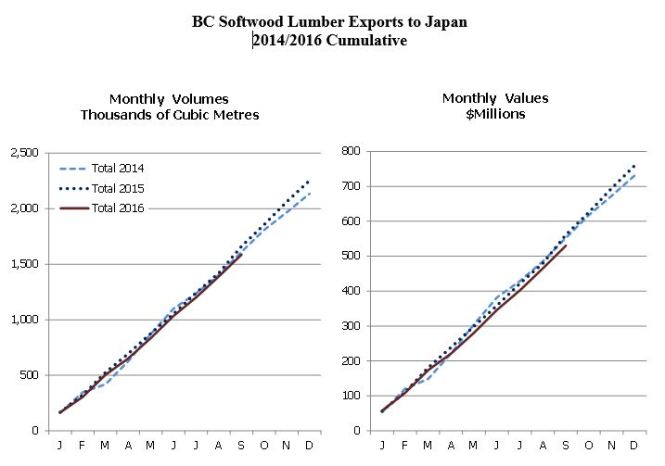
As of the end of September British Columbia year to date softwood lumber exports to Japan totaled 1,586,815m3: a decrease of 4.5% compared to year prior figures. By value year to date exports totaled $530.1 million – a decrease of 5.4%. By species groups, SPF shipments remained comparatively stable with a 0.1% decline to 1,150,578m3. In contrast between January and September Hemlock decreased 12.1% to 199,715m3, Douglas Fir fell 14.1% to 156,586m3 and Yellow Cedar fell 22.8% to 48,728m3. 

Canadian Lumber School Symposium Held in Nagoya

On November 10th Canada Wood held our second Canadian Lumber School Symposium for the year in Nagoya. A total of 52 participants from forest product trading and distribution companies, housing companies and lumber processing end user companies attended. All attendees found the event to be either useful or very useful according to participant survey responses. Four presentations were delivered over a half day event covering topics such as sustainable Canadian forest practices, forest product manufacturing as well as species and product specific discussions on Canadian SPF, Hem Fir (N) and Coastal species as well as OSB.  Participant survey responses included the following comments, “I was able to better understand about the history behind Canadian Wood and the changes in the Japanese market.” and “You conveyed the main points of Canadian Forestry in a very easy to understand manner”.

MLIT Officers Visit Wooden 6-Storey Residences in Vancouver


By Hidehiko Fumoto

hf

Deputy Director and Manager Technical Services, Canada Wood Japan

October 11, 2016

Posted in: Japan

6-storey

Building officials from Japan visit Wesbrook Village on the UBC campus.

To support the development of midrise wood construction in Japan, Canada Wood’s Fumoto-san led a group of building officials from Japan, who participated in the Canada-US-Japan trilateral meetings in Montreal September 26 to 28, on a recent visit to Wesbrook Village at the University of British Columbia campus – a typical wood 6-storey residential community.  Up until recently 6-storey wood buildings were impossible in Japan due to the 2-hour fire resistive performance requirement. But thanks to the joint efforts of COFI and the Japan 2×4 Home Builders Association conducting a series of fire testing, we have successfully obtained the 2-hour fire resistive approvals from Ministry of Land, Infrastructure, Transport and Tourism (MLIT). Now that the 2-hour fire resistive approvals have been obtained, it is extremely important to educate code and building officials on the popularity of midrise wood buildings in Canada. The visitors to Wesbrook Village included the Director of Wood Housing Promotion Office in MLIT and Chief Research Engineer of Department of Fire Engineering in Building Research Institute.


 time-shares

Updates from Ministry of Land, Infrastructure, Transport and Tourism

Outline of the Initiative promoting Time-Share Dwellings in Japan

  • While purchasing complete ownership of a dwelling might amount to several times one’s annual income, purchasing a real property right or any other right relating to the use of a specific time-share dwelling for a specified period of time each year could be quite affordable.
  • Time-share dwellings have become quite popular in foreign countries. For instance, around 4% of the households in the U.S. held a right-of-use of a time-share dwelling in 2007.
  • While the supply of time-share dwellings could promote multi-habitation, local tourism and housing-related investment, there are several problems related to consumer protection.
  • Therefore, in order to examine the need to promote time-share dwellings in Japan and to discover effective schemes to protect the rights of purchasers, the Ministry of Land, Infrastructure, Transport and Tourism (MLIT) initiated a Research Group on promoting the supply of time-share dwellings in May 2008.
  • In August 2008, MLIT issued a report summarizing the work of the Research Group (please refer to <http://www.mlit.go.jp/report/press/house03_hh_000004.html> for the report (only available in Japanese).
  • In fiscal year 2009, MLIT earmarked 15 million yen to support those who develop effective schemes for the provision of time-share dwellings, and called for proposals from May 20th to June 19th. Among the five proposals forthcoming, three were chosen by the evaluating committee.
  • The sponsors of the three proposals chosen developed model schemes to supply time-share dwellings and submitted their results at the end of fiscal year 2009. The main reports, model contracts, etc., which were submitted by these companies, as well as the evaluation of the results by the committee, can be downloaded from the MLIT homepage.
  • Moreover, one of the companies has proposed a model contract in English, which is intended to expand the marketing scope to foreign consumers, investors, etc., and to mitigating the seasonality impact of the domestic tourism market. For this model contract in English by Reproject Partners Co, Ltd, please refer to: http://www.mlit.go.jp/common/000113429.doc


Third Quarter 2016 Economic and Wood Product News


abe

Japan’s Prime Minister and leader of the ruling Liberal Democratic Party (LDP) Shinzo Abe attends a debate with rival party leaders ahead of July 10 upper house election in Tokyo, Japan, June 21, 2016. (THOMAS PETER/REUTERS)

Japan’s cabinet launches stimulus package to boost growth

Tetsushi Kajimoto

TOKYO — Reuters

Published Tuesday, Aug. 02, 2016 5:31AM EDT

Last updated Tuesday, Aug. 02, 2016 7:59AM EDT

Japanese Prime Minister Shinzo Abe’s cabinet approved 13.5 trillion yen ($132.04-billion) in fiscal measures on Tuesday as part of efforts to revive the flagging economy, with cash payouts to low-income earners and infrastructure spending.

The package includes 7.5 trillion yen in spending by the national and local governments, and earmarks 6 trillion yen from the Fiscal Investment and Loan Program, which is not included in the government’s general budget.

Japan cabinet approves $132-billion spending boost (Reuters)

The stimulus spending is part of a renewed government effort to coordinate its policy with the Bank of Japan, but growing concerns that the BOJ policy has reached its limit triggered the worst sell-off in government bonds in three years.

“We compiled today a strong economic package draft aimed at carrying out investment for the future,” Abe told a meeting of cabinet ministers and ruling party executives on Tuesday morning.

“With this package, we’ll proceed to not just stimulate demand but also achieve sustainable economic growth led by private demand.”

The headline figure for the package totals 28.1 trillion yen, but it includes public-private partnerships and other amounts that are not direct government outlays and thus may not give an immediate boost to growth.

Abe ordered his government last month to craft a stimulus plan to revive an economy dogged by weak consumption, despite three years of his “Abenomics” mix of extremely accommodative monetary policy, flexible spending and structural reform promises.

The package comes days after the Bank of Japan eased policy again and announced a plan to review its monetary stimulus program in September, which has kept alive expectations for “helicopter money,” printing money for government debt.

The review has spooked investors, who are unsure how BOJ policy will change in the future. The price of 10-year JGB futures closed down 0.91 point on Tuesday to 151.33, having fallen 2.47 points in the last three sessions, their biggest three-day fall since May 2013.

The expected appointment of Toshihiro Nikai, an advocate of big public works spending, to the No. 2 post of Abe’s ruling party in tandem with a cabinet reshuffle on Wednesday underscores Abe’s shift toward his “second arrow” of fiscal policy amid concerns monetary easing is reaching its limits.

Precisely how the spending will be financed is unclear, although the government is considering issuing construction bonds when compiling a supplementary budget later this year. The stress on fiscal steps is raising doubts about Japan’s ability to fix its already massive debt.

The government estimates the stimulus would push up real gross domestic product (GDP) by around 1.3 per cent in the near term. The package will be implemented over several years, officials added.

SMBC Nikko Securities’ analysts expect the package will push up real GDP growth by just 0.4 percentage point this fiscal year to March 2017 and 0.04 percentage point next year.

“As effects of public works and cash payouts fade later in fiscal 2017, Japan will likely face a fiscal cliff,” said Koya Miyamae, senior economist at SMBC Nikko Securities, referring to the contraction in spending after the package wears off.

“To prevent a fiscal cliff, the government will likely repeat large-scale stimulus. Considering that a general election must be held by late 2018, direct government spending would become larger, which could further delay Japan’s fiscal consolidation goal.”


yen-usd

A currency dealer smiles in front of an electronic board showing the exchange rates between Euro and Japanese yen at Ueda Harlow, a foreign exchange trading company in Tokyo June 29, 2016.

(Shuji Kajiyama/AP)

Bonds shaken by BOJ stimulus doubts; dollar in decline

Wayne Cole

SYDNEY — Reuters

Published Tuesday, Aug. 02, 2016 8:59PM EDT

Last updated Tuesday, Aug. 02, 2016 9:05PM EDT

Asian shares bowed lower on Wednesday while the yen lorded over a weakened U.S dollar as talk the Bank of Japan may retreat from its massive bond-buying campaign twigged a shakeout in debt markets globally.

Worryingly for energy shares, the broad-based decline in the dollar was still not enough to spare U.S. crude oil from its first finish under $40 a barrel since April.

Adding to the jittery mood was a renewed selloff in bank stocks following stress-tests in Europe.

MSCI’s broadest index of Asia-Pacific shares outside Japan slipped 0.4 percent, backing away from its recent one-year peak. Japan’s Nikkei lost 1.4 percent as the rising yen pressured exporter stocks while financials slid 2.7 percent.

The sharpest moves were in sovereign bond markets where a sudden spike in yields stirred speculation that a multi-year bull run in prices might finally be nearing its end.

Japanese bonds have suffered their worst sell-off in more than three years as investors feared the BoJ was out of easing ammunition and might leave it to fiscal policy to stimulate the economy.

Tokyo on Tuesday approved 13.5 trillion yen ($132 billion) in fiscal measures and the IMF urged Japan to better coordinate fiscal stimulus with central bank action.

Bond bulls were now worried the Bank of England might also under-deliver at its policy meeting on Thursday, putting the onus on debt-funded government spending to support growth.

“With Japan and the UK set to ease fiscal policy, it will be important to watch whether we are at the beginning of a global policy re-pivot away from monetary easing,” wrote analysts at ANZ in a note.

The ripples spread all the way to U.S. Treasuries where 30-year yields hit their highest since July 21 even though domestic data were generally soft.

Disappointing auto sales slugged shares in Ford and General Motors, which both dropped more than 4 percent.

The Dow Jones Industrial Average fell 0.49 percent, while the S&P 500 lost 0.64 percent and the NASDAQ 0.9 percent.

The recent spate of weaker U.S. data has further pushed back expectations for when the Federal Reserve might hike its rates — the market is not fully priced for a move until 2018 — and taken a heavy toll on the dollar.

The dollar touched a five-week trough against a basket of currencies, while the euro reached its highest since mid-July around $1.1230.

Against the yen, the dollar fell to 101.16 yen having fled from 105.33 in just four sessions.

In commodity markets, oil prices were undermined by worries about a glut in both crude and refined product.

Brent crude was near four-month lows on Wednesday at $41.86 a barrel. NYMEX crude edged up 15 cents but at $39.66 was still under the psychological $40 level.


Japan household spending stubbornly weak even as jobless rate hits 21-year low

japanese-shoppers

Shoppers line up in front of cashiers at the Don Quixote’s central branch store in Tokyo May 28, 2014. REUTERS/Yuya Shino/File Photo

By Sumio Ito and Leika Kihara | TOKYO

TOKYO Japanese household spending fell less than expected in July and the jobless rate hit a two-decade low, offering some hope for policymakers battling to pull the world’s third-largest economy out of stagnation.

But with the economy barely growing and inflation sliding further away from the Bank of Japan’s 2 percent target, a majority of economists expect the bank to ease further next month, when it conducts a comprehensive review of the effects of its existing stimulus program.

Household spending fell 0.5 percent in July from a year earlier, less than a median market forecast for a 0.9 percent drop and much smaller than a 2.3 percent decline in June, data from the Internal Affairs Ministry showed on Tuesday.

Separate data showed retail sales slid 0.2 percent in July from a year earlier, less than a median market forecast for a 0.9 percent drop.

The jobless rate fell to 3.0 percent in July from 3.1 percent in June, hitting the lowest rate in more than 21 years and hovering near levels considered to be full employment.

“Consumption is showing signs of a pickup, though it’s too early to judge whether the trend has changed,” said Yoshika Shinke, chief economist at Dai-ichi Life Research Institute.

“While today’s data may encouraging for the BOJ, that doesn’t necessarily mean it can stand pat as inflation remains weak,” he said.

Japan’s economy ground to a halt in April-June and analysts expect any rebound in the current quarter to be modest as weak global growth and the yen’s 20 percent rise against the dollar this year hurt exports and capital expenditure.

Consumption has stagnated even as a shrinking working-age population and gradual improvements in the economy led to a tightening job market, as companies remain wary of boosting wages for permanent workers for fear of irreversibly increasing fixed costs.

That reluctance has proved a hindrance for policymakers struggling to end two decades of deflation with aggressive monetary and fiscal stimulus measures, hoping these policies would spur expectations of future inflation and prompt households to spend more now rather than save.

Despite three years of heavy money printing by the BOJ, soft household spending and a strong yen pushing down import costs have kept inflation distant from the bank’s 2 percent target.

Core consumer prices fell in July by the most in more than three years as more firms delayed price hikes due to weak consumption, keeping the BOJ under pressure to expand an already massive stimulus program.

(Additional reporting by Izumi Nakagawa, Editing by Chang-Ran Kim; Editing by Shri Navaratnam and Eric Meijer)

By afp

Published: 13:14 GMT, 4 October 2016 | Updated: 13:14 GMT, 4 October 2016

The International Monetary Fund Tuesday lifted its outlook for Japan’s economy this year and in 2017, pointing to huge government stimulus spending, but warned the country’s longer-term prospects were bleak.

The Washington-based IMF upgraded its growth projections for the world’s number three economy to 0.5 percent in 2016 and 0.6 percent next year, up from a July forecast of 0.3 percent and 0.1 percent, respectively.

But the upgrade was largely due to an expected shot in the arm from a whopping 28-trillion yen ($273 billion) government spending package announced in August, as well as a decision to delay a consumption tax hike, the Fund said.

downtown-tokyo

Business District Tokyo

The International Monetary Fund has lifted its outlook for Japan’s economy this year and in 2017 but warns the country’s longer-term prospects are bleak

©Kazuhiro Nogi (AFP/File)

“Japan’s medium-term prospects remain weak, primarily reflecting a shrinking population,” the IMF said in its latest World Economic Outlook.

“The probability of deflation has increased in Japan owing to weak momentum in consumer prices and the recent appreciation of the yen,” it added.

Officials are under intense pressure to deliver a boost to the economy as economists increasingly write off Prime Minister Shinzo Abe’s spend-for-growth policies, dubbed Abenomics.

Weakness in economies overseas and a strong yen, which is bad for Japan’s exporters, are weighing down growth, the Fund said.

The Bank of Japan’s huge monetary easing — a cornerstone of Abenomics — will help prop up growth for now, but would do little to fix broader problems, it added.

Among them, Japan is grappling with low birthrates and a shrinking labour force while a soaring population of old people squeezes the public purse.

Wages are stagnant, spending is faltering, and consumer prices are way below the central bank’s two-percent inflation target.

The Fund said it expected consumer prices to stay “well below” the BoJ’s inflation target for the time being.

It repeated calls for reforms including bringing more women into the workforce, boosting near-zero immigration, and trying to convince cautious firms to start spending their massive cash piles.

The Fund also called for Tokyo to rein in a national debt that is now more than two times the size of the economy — one of the world’s biggest debt loads.

strong-yen

A stronger yen could make emerging Asian assets relatively less attractive

© Bloomberg

October 3, 2016

Anyone who believes that the rower of the boat cannot rock it as well has not met those who run Japanese shipbuilder Kawasaki Heavy Industries.

Late last week, as part of a sharp downward revision in future earnings, the company hinted that it would shut its offshore vessels division. This would be big news — Shozo Kawasaki founded KHI 138 years ago to build ships — but it will not make a big difference. Moving more operations outside of Japan will.

KHI makes not just ships but machinery such as aerospace equipment, gas turbines and motorcycles. More than half of profits come from aerospace; shipbuilding was expected to lose money this year.

Looking at the revision — operating profits cut in half from ¥70bn — the damage from a stronger yen represents the primary cause. Almost 60 per cent of revenues come from outside Japan. Those from the US and Europe have been rising at mid-teen percentage rates annually, far better than the 1 per cent KHI gets from its home country.

KHI does make some of its goods abroad, such as rolling stock and jet skis, but it needs to do more to balance its currency risks. To be fair, its joint venture in Brazil to produce offshore drilling equipment may have been agreed with this goal in mind. Instead, a global depression for oil services coupled with the Petrobras corruption scandal killed off any hopes for a profitable business.

The Japan-based offshore marine division has become the target for change, even though the unit’s drag on profits is small. Decade-high profits in shipbuilding evaporated in 2013. Group profits, driven by aerospace, have doubled since then. Even so there is little love for KHI. That is partly because of its shipbuilding unit, which on Nomura’s forecasts will lose money until at least March 2019.

Whether KHI scuttles its offshore division is unimportant. What it really needs is to diversify its manufacturing base to more overseas locations.


abe-and-putin

Abe vows economic support to Russia; Putin to visit Japan Dec 15

Politics Sep. 03, 2016 – 06:30AM JST ( 26 )

Russian President Vladimir Putin, right, and Japanese Prime Minister Shinzo Abe shake hands as they pose for a photo during their meeting in Vladivostok, Russia, Friday. Kremlin Pool Photo via AP

VLADIVOSTOK, Russia —

Japanese Prime Minister Shinzo Abe vowed economic support to Russian President Vladimir Putin on Friday, in the hope of advancing a decades-old territorial dispute that has prevented the two countries from signing a post-World War II peace treaty.

Putin will make an official visit to western Japan’s Yamaguchi, Abe’s home prefecture, on Dec 15, Abe told reporters following his meeting with Putin on the sidelines of the Eastern Economic Forum in the Russian Far East port city of Vladivostok.

Abe, seeing his talks with Putin as the only way to achieve any breakthrough in the isles row, added they plan to meet again on the sidelines of the Asia-Pacific Economic Cooperation summit in November in Peru.

“I had substantially deep discussions about a peace treaty (with Putin),” Abe said. “To achieve a breakthrough in the abnormal situation where a peace treaty has never been concluded for over 70 years, there is no other way than finding a solution based on the leaders’ trust.”

Abe’s trip to Vladivostok was a rare visit to Russia by a leader from the Group of Seven economies, which continue to impose sanctions on Moscow, condemning Russia’s annexation of Crimea and its military intervention in the eastern part of Ukraine.

Putin’s visit to Japan was initially eyed for 2014 but was postponed after Russia’s annexation of Crimea, deteriorating ties with Western countries and Japan.

With Tokyo hoping an economic cooperation offer will prompt the Kremlin to soften its stance in the dispute over a group of Russian-controlled isles off Japan’s main northernmost island of Hokkaido, Abe laid out details of the eight-point Japanese economic cooperation plan he presented to Putin in May in the Russian Black Sea resort city of Sochi.

“I believe the development of the Far East region with big potential is Russia’s top priority issue,” Abe said at the outset of his meeting with Putin. “The growth of the Asia-Pacific leads the global economy. Japan, as Russia’s neighbor, will promote Japan-Russia cooperation in the region strongly.”

Putin said, “It is important that the governments support the initiatives of the private sector.”

The plan focuses on Japanese assistance in developing the Russian Far East, a resource-rich but underdeveloped region to which Putin attaches importance to spur growth. The Russian economy has been sluggish, hit by sanctions by Western countries and falling oil prices.

As part of the Abe government’s initiative for economic cooperation, the government-backed Japan Bank for International Cooperation and Japanese trading house Mitsui & Co signed a memorandum of understanding on Friday to acquire a 4.88% stake in Russia’s state-owned power utility RusHydro.

The move is hoped to expand opportunities for Japanese firms to make infrastructure and other deals with the Russian power sector.

In their previous meeting in Sochi, Abe said he and Putin agreed on achieving a peace treaty with a “new approach, free of any past ideas.” He did not, however, reveal any specifics regarding the path ahead.

Japanese officials said the “new approach” did not mean a change in Tokyo’s stance of claiming all of the disputed isles—Etorofu, Kunashiri, Shikotan and the Habomai islet group. The isles are called the Northern Territories in Japan and the Southern Kirill’s in Russia.

Putin has previously admitted the validity of the 1956 Japan-Soviet Joint Declaration that says Russia will return the two islands—Shikotan and the Habomai—after concluding a peace treaty with Japan.

Japan and Russia are far apart over the territorial issue. Tokyo maintains that ownership of the isles must be resolved before a peace treaty can be concluded.

Russia says the territorial and peace treaty issues are not directly connected and that it took control of the isles legitimately at the end of World War II. Moscow has strengthened its control of the islands and developed their infrastructure.

In April 2013, Abe, who took office in December 2012, became the first Japanese prime minister to officially visit Russia in 10 years, agreeing with Putin to revive territorial talks.

Since then, while Abe has made several trips to Russia, there has been no reciprocal visit by the Russian leader to Japan.

Among other matters, the two leaders also discussed issues related to the humanitarian crisis in Syria, implementation of a cease-fire agreement in Ukraine and North Korea’s missile and nuclear threats, according to a Japanese government official.

© KYODO

And when it all falls apart, some creative finger-pointing will take place. Abe can just shrug and cite sanctions if he does not get everything he wants and at bargain prices. Unless Putin does something truly daring, he will come out of this looking worse. But hey, at least he can keep hopes up through December by doing absolutely nothing. That is good work for a politician, if you can get it, and I would imagine that things have been getting a little uncomfortable for Putin lately.

Putin’s best move? Give back Habomai and Shikotan to Japan unconditionally, for free. No strings. No explanation. Just as a grand gesture of goodwill and friendship. It would literally change the world and improve EVERY SINGLE dispute and problem that Russia has today. It would literally be a new beginning for Russia.

Japan Economy, Housing Starts & Lumber Shipments

shawn-lawlor

By Shawn Lawlor

Director, Canada Wood Japan

October 11, 2016

Posted in: Japan

business-district-tokyo

Japan Economic Update

On the surface, with 1.37 jobs available for every worker and an unemployment rate of 3.1%, Japan’s labour market is in a relatively sweet spot globally. But the growth of temporary non-regular employment since the end of the “salaryman” lifetime employment model in the early 1990s is one of the key factors in explaining chronic sluggishness in Japanese consumption. Despite government efforts to spur growth, household consumption fell 4.6% in August – for the sixth consecutive month.

Today part-timers and non-regular contract workers represent 40% of Japan’s workforce. While average wages for private sector regular workers average 4.8 million yen annually, part-time and contract non-regular annual wages average 1.7 million. Remediating the gap in regular versus non-regular employment is key to rebuilding Japanese consumer confidence. A government panel of labour reforms is now looking at drafting recommendations for labour market reform to address this gap in benefits as well as measures to increase workforce participation of women, the elderly as well as skilled foreign laborers such as nurses and construction workers. The panel tabled its recommendations to the end of the fiscal year.

Japan Housing Starts Summary 


korea-wood-building-stats

tokyu-homes

In July, total housing starts increased 8.9% to 85,208 units. Single family owner occupied housing increased 6.0% and rental housing jumped 11.1%. The mansion condominium market improved 5.9%.

Total wood housing increased by 11% to 48,693 units. Post and beam starts improved 10.9% to 36,206 units. Wood pre-fab starts were up 11.4% to 1,383 units. Thanks to particular strength in multi-family, platform frame starts posted an 11.3% gain to 11,104 units. By housing type 2×4 custom ordered single family homes edged up 2.2% to 2,945 units; rentals surged 18.3% to 6,956 units and built for sale 2×4 spec housing declined 0.3% to 1,192 units.

BC Wood Exports Summary BC Investment and Innovation

japan-bc-lumber-exports

japanese-construction-site

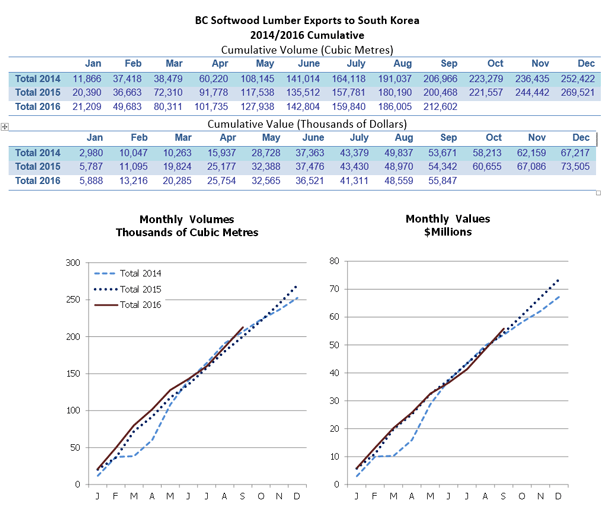
As of the end of August, British Columbia year to date softwood lumber exports to Japan totaled 1,389,931m3: an increase of just under 1%. By value, year to date exports totaled $465.1 million – a decrease of 2.14% compared to year prior results. By species groups, SPF fared comparatively well. Between January and August, SPF shipments increased 6.2% to 1,088,275m3; Hemlock decreased 4.1% to 174,098m3, Douglas Fir fell 15.6% to 138,184m3 and Yellow Cedar fell 22.1% to 41,474m3.

bc-lumber-exports-japan-2015-16

China’s Macroeconomy: Time Series Data from Center for Quantitative Research

federal-bank-atlantachinas-macroeconomy

Federal Bank of Atlanta https://www.frbatlanta.org/cqer/research/china-macroeconomy.aspx?panel=1

Since the late 1990s, China’s investment share of gross domestic product (GDP) has increased while the corresponding shares for consumption and both labor and household income have declined (Chart 1). These changes in trends have been accompanied by sharp changes in cyclical patterns as well; as shown in Chart 2, the strong positive correlation between investment and household consumption broke down in the late 1990s. The model laid out in “Trends and Cycles in China’s Macroeconomy,” by Chun Chang, Kaiji Chen, Daniel F. Waggoner, and Tao Zha, can account for these facts. The authors argue that these changes began in March 1996, when the Eighth National People’s Congress passed a historic long-term plan to adjust the industrial structure for the next 15 years in favor of strengthening heavy industries. Preferential credit policies to heavy industries—where local governments have made implicit guarantees of long-term bank loans to that sector—have crowded out short-term loans to smaller firms. Consistent with this crowding-out effect, Chart 3 shows that the correlation between short-term loans and medium- and long-term loans as shares of GDP has been negative since the early 1990s.

This webpage hosts the annual and quarterly macroeconomic datasets for China used by Chang, Chen, Waggoner, and Zha. Technical details on sources and methods used to construct the datasets are described in the manuscript “China’s Macroeconomic Time Series: Methods and Implications,” by Patrick Higgins and Tao Zha. A readme file includes variable names and descriptions as well as instructions on how to use the datasets. We plan to make regular semi-annual updates to the datasets and maintain earlier vintages.

Related Resources

  •  


china-chart1

china-chart2

china-chart3

Bad loan growth slows at China banks as write-offs accelerate

Big lenders brace for fallout from government efforts to rein in debt

icbc

August 30, 2016

by: Gabriel Wildau in Shanghai

Growth in bad loans slowed at Chinese banks in the second quarter as lenders stepped up writedowns and the economy of the country’s prosperous east coast showed signs of stabilising.

After years of fast profit rises driven by aggressive lending in support of China’s manufacturing and construction booms, the big four lenders are pulling in their horns as they brace for fallout from government efforts to rein in debt and cut rampant overcapacity in basic material sectors.

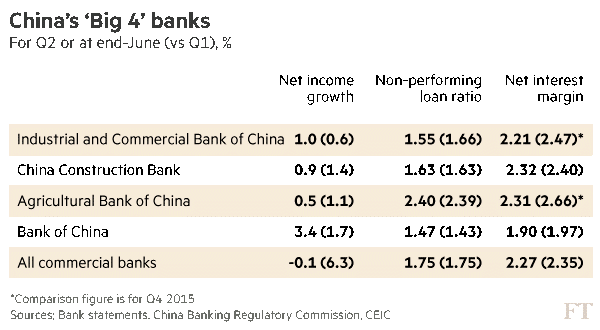
Industrial & Commercial Bank of China, the country’s largest lender by assets, on Tuesday reported net profit growth of 1 per cent for the second quarter, little changed from 0.6 per cent growth in the first quarter.

Industry-wide profits fell 0.1 per cent in the second quarter from a year earlier, compared with 6.3 per cent growth in the first quarter and 2.4 per cent in 2015. Small banks have maintained fast profit growth as they expand assets more aggressively than larger rivals.

But growth in non-performing loans moderated. The NPL ratio for China’s commercial banking system was 1.75 per cent at the end of June, unchanged from three months earlier, while ICBC’s ratio actually fell to 1.55 per cent from 1.66 per cent three months earlier. (A nonperforming loan (NPL) is the sum of borrowed money upon which the debtor has not made his scheduled payments for at least 90 days. A nonperforming loan is either in default or close to being in default.)

China’s three other largest banks — Bank of China, Agricultural Bank of China and China Construction Bank — each reported NPL ratios at end-June that were little changed from three months earlier. Bad loans continued to rise in volume terms, hitting 1.44tn ($215bn) for all commercial banks at end-June, up by Rmb44bn since March.

“The NPL formation rate was slower than people thought. That’s the biggest surprise in these figures,” said Ma Kunping, banks analyst at China Merchants Securities in Shanghai. “The economy in the east coast has basically hit bottom. Most of the problem companies have already been exposed.”

Banks’ net interest margin — which measures the difference between what lenders pay for deposits and what they collect on loans — fell to the lowest on record in the second quarter at 2.27 per cent. China’s benchmark lending rate is at an all-time low of 4.35 per cent for one-year loans, and interest rate deregulation has also forced lenders to compete with each other on deposit and loan pricing.

china-big-4

Analysts warn that NPLs will probably resume rising in the coming quarters, with north-east China’s coal and steel industries a major source of delinquencies. That will show up not only in rising NPLs, but also in loan restructurings and debt-for-equity swaps that will help troubled companies but impair bank balance sheets.

In addition to slower NPL formation, lenders have become more aggressive in writing down and selling off bad loans.

AgBank, the country’s third-largest, said on Friday that it had disposed of Rmb60bn in bad loans in the first half, which is equivalent to 28 per cent of the bank’s outstanding NPLs at the end of 2015.

“Though credit quality pressure is likely to persist for some time … [AgBank’s] strong capacity in NPL digestion should help to alleviate concerns about book impact from NPLs,” Richard Xu, China financials analyst at Morgan Stanley, said in a note.

china-bank-profitability

Investors remain concerned about a further rise in NPLs, with shares of all of the big four banks currently trading below book value in both Hong Kong and Shanghai, reflecting scepticism about the reported numbers.

Regulators are preparing new rules to curb banks’ ability to package loans into wealth management products, which will help to reduce systemic risk but add to pressure on bank profits.

 modi-jingping

NSG, China-Pakistan economic corridor on table during Narendra Modi-Xi Jinping meeting

By IANS | Sep 03, 2016, 01.41 PM IST

Narendra Modi will once again try to persuade Xi Jinping to back India for membership of the 48-member NSG — an exclusive grouping that controls global nuclear trade.

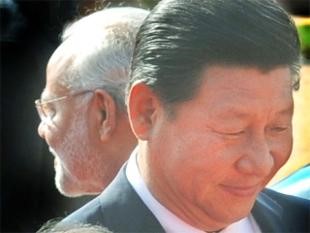
HANGZHOU: India’s entry into the Nuclear Suppliers Group (NSG) and its concern over the China-Pakistan Economic Corridor (CPEC) are expected to be raised by Prime Minister Narendra Modi when he meets with Chinese President Xi Jinping on the sidelines of the G20 Summit in Hangzhou here on Sunday. Though India is set to push for structural reforms to shore up the flagging global economy, poverty and green finance among others in the forum of the world’s largest 20 economies, Modi will once again try to persuade Xi to back India for membership of the 48-member NSG — an exclusive grouping that controls global nuclear trade. In June, Modi had, during a meeting with Xi in Tashkent on the sidelines of the Shanghai Cooperation Organisation summit, asked for China’s backing for India’s NSG membership. But China, leading a group of 10 countries, blocked India’s entry at the plenary of the NSG in Seoul in June, citing New Delhi’s non-signatory status to the Nuclear Proliferation Treaty. Beijing has, however, been a keen backer of Islamabad’s entry to the bloc. Intransigent then, Beijing now looks amenable to India’s admission into the elite grouping. Modi is to reach Hangzhou, the capital and most populous city of Zhejiang Province in east China, on Saturday evening to attend the two-day summit that begins on Sunday.

Chinese experts hope the meeting between the two leaders would be “good”. “We are not against India’s entry into the NSG. After the Chinese Foreign Minister’s (Wang Yi) visit to India (in August), the two sides have agreed to establish a new channel to touch upon all these kind of issues,” Hu Shisheng, director, Institute of South and Southeast Asian and Oceanian Studies at the China Institute of Contemporary International Relations, a government think tank, told IANS. He was referring to the new “mechanism” between India and China under which Joint Secretary of Disarmament Division Amandeep Singh Gill and Ambassador Wang Qun, Director-General of the Arms Control Division of the Chinese Foreign Ministry, will discuss the NSG issue. “It’s because not to let these issues bother the top leaders (Modi and Xi). Earlier, they could not reach understanding because of lack of information. I hope the meeting would be good,” he added. Asked if China would be more open to India’s admission to the NSG, Hu said: “Of course”. The change in Beijing’s stance may also have to do with a UN court ruling on the South China Sea dispute in July. The rejection of Beijing’s claims over the so-called Nine Dash line — almost 90 per cent of the disputed South China Sea — was a blow to China in its dispute with the Philippines, as also Vietnam, Malaysia, Taiwan and Brunei. China has rejected The Hague Court’s ruling. India asking the “parties concerned to show utmost respect to the UN Convention on the Law of the Sea (UNCLOS) has sort of miffed China”, which is worried about its image being sullied in the world. It has been suggested that Chinese Foreign Minister Wang Yi’s visit to India last month was to ensure that New Delhi does not raise the South China Sea issue at the G20, in a sort of quid pro quo deal — which could see Beijing giving its backing for the NSG membership. However, even if India keeps quiet on the issue, the US and Japan are highly likely to bring it up, much to the embarrassment of China which has said an emphatic no to “political discussion” at the G20. The $46 billion China-Pakistan Economic Corridor is also likely to figure in the meeting between the two leaders. India has strongly opposed the proposed economic corridor which will pass through Pakistan-held Kashmir and Gilgit-Baltistan, which New Delhi claims as its own. Modi’s reference to the two regions, as well as Baluchistan, in his Independence Day speech has Beijing worried. Beijing fears New Delhi’s tacit support to the separatist sentiment in the region — a charged levelled by Islamabad and denied by New Delhi — may hit the already-delayed project. Chinese experts have warned that China may come to Pakistan’s aid if India creates trouble in these regions. Besides, global structural reforms, inclusive growth and climate financing will be the major issues to be brought up by India at the summit. “There will be emphasis on appealing to the countries to carry forward the commitment to the issue of climate change and climate change finance. There was a $100 billion commitment which has been made by developed countries — that $100 billion is nowhere near sight. We would like to again stress the importance of developed nations making available that $100 billion,” Shakitanka Das Economic Affairs Secretary told IANS earlier.

cool-prices

China’s Southern Megacities Roll Out Measures to Cool the Property Market

China’s southern megacities of Guangzhou and Shenzhen are the latest centers to impose new measures to cool their overheated real estate markets, including higher mortgage down payments and home purchase restrictions.

A property boom has given a welcome boost to China’s economy this year, fueling demand for everything from construction materials to furniture, but a growing buying frenzy is adding to worries about ever-rising debt and risks to the banking system.

The new measures are the latest steps to tighten credit flowing into the property sector as the government tries to balance the need to prevent bubbles while stimulating economic growth.

Prices for new homes in the booming tech centre of Shenzhen rose 36.8% from a year ago in August, while Guangzhou’s new home prices rose 21.1% over that period, National Bureau of Statistics (NBS) data showed.

Other cities including Chengdu, Jinan, Wuhan and Zhengzhou have already announced new restrictions on property purchases as the government tries to dampen prices stoked by property speculators in second- and third-tier cities across the country.

The average new home price in 70 major cities climbed an annual 9.2% in August, up from 7.9% in July, according to the National Bureau of Statistics.

Nomura analysts said the new measures were expected to help cool frothy prices in the biggest cities and should prevent the market frenzy from spilling over into smaller cities.

“We also believe it unlikely that the latest tightening measures will cause the bubble to burst, sparking a collapse of home prices. We envision a more likely scenario to be a mild retreat or prolonged flattening of home prices in tier-1 cities,” they said in a note on Tuesday.

First-time home buyers in Shenzhen will face minimum down payments of 30%, but deposits for others will be raised to no less than 50%, state news agency Xinhua quoted a government document as saying.

Down payments for second-home buyers in China’s southern Guangdong province near Hong Kong will be increased to no less than 70%, Xinhua said without giving further details.

For more on real estate, watch Fortune’s video:

China’s southern city of Guangzhou has limited local residents to purchasing a maximum of two properties, according to a statement posted late on Tuesday on the Guangzhou government’s website.

Non-local residents will be allowed to buy one property, if they can prove they have paid appropriate levels of tax or social security.

Separatel

Risk of hard landing persists

brad-spencer

By Brad Spencer

Senior Director, Support Services

October 13, 2016

Posted in: China

Economic forecasting is a challenging task at the best of times. For a non-standard economy like China, it is even more difficult; the government has more levers of influence, policy changes are not part of the public dialogue and indicators are less transparent.

Some of the best insights we have available come from the Economist Corporate Network and the affiliated Economist Intelligence Network. We recently attended several events in Shanghai, where analysts from the Economist explained their views on China’s GDP growth, the property markets and exchange rates.

GDP Growth

The Economist trimmed their prediction for 2016 from 6.7% to 6.6%. They see growth slowing further in 2017 and again in 2018. The reason for this pessimistic forecast is that China has not implemented the promised economic or political reforms. These reforms are necessary to buoy productivity. In particular, reform of state owned enterprise (SOE) has not taken place nor is it likely to happen with so many political obstacles. SOE’s control and limit the opportunities for private investment. Private investment always has better ROI than government investment. Debt is another factor, and over investment in property and in steel are yet another factor.

china-real-gdp

china-gdp-growth-table

China’s economy is growing at two speeds: the manufacturing sector is struggling to expand, but the consumer driven services sector is thriving. As the engine of growth shifts from manufacturing to services further periods of volatility are certain. The Economist puts the risk of a hard landing at some point in the next five years at 40%. A hard landing is defined as a drop of 2 + percentage points in annual economic growth compared to the previous year.

Economic activity so far in 2016 has been driven by strong housing market activity and investments in SOE’s, but neither driver is expected to perform strongly in the second half of the year.

Property

Top tier cities continue to boom while smaller cities are flat. Rising values in Shanghai and Beijing are driven by demand for investments, not demand for accommodation. This is not a new trend, but the trend has continued beyond what was expected.

Bank lending is increasing, as is the level of speculation and risk. Some analysts are expecting government intervention to calm the over-heated markets. In the meantime, this investment is driving property development growth in select cities.

Exchange rate

The RMB is expected to weaken between now and 2020. There are interesting forces at play with new policies in place to prevent currency from flowing out of the country, and resourceful investors constantly seek loopholes. The government aims to maintain a stable currency, but the forces of gravity are pulling at the RMB.

2016 forecast RMB/USD 6.55

2017 forecast RMB/USD 6.76

China just made a key preparation for disaster in its economy

September 23, 2016

china-bunker

china bunker

(Reuters) China has given its bond traders the go-ahead to begin trading credit default swaps, an indication that the government is preparing for more big corporate bankruptcies, Bloomberg reports.

Credit default swaps allow investors to insure themselves against the default of a given security.

Earlier this month, the government for the first time allowed a major state-owned organization, Guangxi Nonferrous Metals Group, to make preparations for bankruptcy.

It was a special moment. Never before had the country allowed a big, state-run industrial company to go bust. Past bankruptcies involved only bank or corporate debt — this one involves 108 creditors.

That news, combined with the trading of credit default swaps, has analysts believing that many so-called zombies — China’s unproductive, massive industrial companies that need debt to survive — may soon be put out of their misery.

Credit default swaps “will help investors mitigate the risk and alleviate market sentiment if investors face more defaults or suffer more losses after defaults,” Ivan Chung, head of Greater China credit research at Moody’s Investors Service, told Bloomberg.

In other words, investors can now bet on whether a zombie is about to go bankrupt, giving themselves a little extra protection if a company fails. And the government opening up the market for credit default swaps suggests more willingness to let zombies die.

China has had the zombies in its crosshairs for some time now. In 2015, the government said supply-side reform would become central to its economic policy. This is because China is trying to take its economy through the delicate transition from one based on industry and manufacturing sectors to one based on domestic consumption and services like banking and retail.

That means indebted companies in flailing industries like coal and steel must be restructured and their overcapacity dealt with. Unleashing a market for credit default swaps means that investors can hedge this transition and better navigate a world of rapidly deteriorating corporate credit quality.

We might be about to see some real winners and losers here, people.

 China economy, construction & lumber shipments

eric-wong

By Eric Wong

Managing Director, Canada Wood China

November 9, 2016

Posted in: China

CHINA ECONOMIC UPDATE

September economic highlights

  • China’s economy remained steady in September
  • Real estate investments up compared to same period last year
  • In September, China’s overall wood imports increased compared to the same period last year, but Canadian imports fell.

China economic overview

The Chinese GDP growth rate in Q3 2016 remained at 6.7%, meeting market expectations, which pegged GDP growth at 6.6%. Analysts believe steady growth was spurred by increased government spending (12.5% growth year-on-year), larger asset investments (8.2% growth year-on-year) and an increase in retail sales (10.7% growth year-on-year).[i]

China Caixin PMI increased to 51.2 in October 2016 compared to 50.1 in September, marking the fourth consecutive month of growth and the highest number since July 2014[ii]; this was also the fastest improvement since March 2011. The government’s official services PMI reached 54.0 in October, showing a steady increase compared to September (53.7) and August (53.5). It appears China’s economic performance is currently surpassing expectations.

china-economy-exports-and-manufacturing

China exports declined 10% year-on-year to USD 184.51 billion[iii] and imports fell 1.9%; this set the September trade surplus at USD 41.99 million. In Yuan terms exports declined 5.6% compared to the same period last year and imports were up 2.2%. “Domestic demand is equally weak as global demand,” said Yifan Hu the chief investment officer at UBS Wealth Management, mentioned without the increase in the price of oil from USD 30 a barrel in September 2015 to USD 50 last month imports could be even weaker, and a small depreciation does not help China’s exports.[iv]

China’s September Consumer Price Index (CPI) bounced back to average levels at 101.90 Index Points after August (101.30), which marked the lowest in a year.

The USD exchange rate against the RMB decreased 0.08% to 6.7673 on November 4th 2016 from 6.7729 in the previous trading session. Overall USD/CNY increased steadily this year, starting from 6.58 (January) and decreased slowly to 6.47 (April) and then brought back to 6.77 (October)[v], it added 6.82% during the last year.[vi] On the other hand in 2016 CADCNY kicked off by 4.71 (January) and reached all the way to 5.16 (April) but then dropped almost continuously to 5.09 (July and August) and 5.05 (October)[vii].

REAL ESTATE CONSTRUCTION MARKET

The first three quarters of 2016 reached RMB 7,460 billion, marking a 5.8% growth (year-on-year) in real estate investments. Investments in residential were RMB 4,993 billion (+5.1% year-on-year), accounting for 66.9% of total real estate investments. In September 2016, RMB 1,021 billion was invested in national real estate industry including RMB 686 billion for residential sector.

Construction: floor area started

construction-floor-area-started

From January to September 2016 floor area of newly built buildings (floor area started) reached 1.23 billion m2 (+6.8% year-on-year), of which 847 million m2 was in residential sector (+6.7% year-on-year).[viii] In the same period, total floor area of finished buildings grew to 571.12 million m2 (+12.1% year-on-year), of which 420.68 million m2 was in the residential sector (+11.3% growth year-on-year).

In September floor area of newly built buildings (floor area started) nationwide reached 158 million m2 including 111 million m2 for residential buildings. In the same month floor area of finished buildings nationwide increased to 65 million m2 including 48 million m2 for residential buildings.

china-demand-for-wood-sept-oct

Policy developments

China’s housing frenzy is still on, concluded by Business Insider in September 2016. Even though 53.7% respondents in a survey conducted by People’s Bank of China believed home prices in China are “high and hard to accept” the percentage of residents willing to buy a place in the next three months still increased 1.3% from the third quarter and reached 16.3%.[ix] The property price of China’s 100 major cities rises 14% year-on-year which is above GDP growth or urban income growth in the past 12 months, not all of those cities have many new migrants to consume new housings either.[x]

china-demand-for-wood-total-imports

China’s Central Economic Work Conference will hold a meeting in December 2016 to provide further signal of policy direction, may be an answer to the extent China can tolerate continuously rising housing prices. There might not be any major intervention in the property market in the next several months until the late 2017 when the 19th Party Congress Session begins. The plan drafted by policy makers from Beijing to expand investment channels to transfer investment away from property market may not work because hard correction could cause a major financial crisis. The Economist Intelligence Unit predicts China property market will grow much slower in 2018 declining to 4.2%.[xi]

Building material prices

Regarding common building materials, price for cement in China increased 2.32% from RMB 279.83 per metric ton on October 1st to RMB 286.33 per metric ton on October 31st [xii]; rebar steel was worth RMB 2,336 per metric ton on October 1st and then increased 4.08% to RMB 2,431.33 per metric ton on October 31st [xiii].

WOOD EXPORT TO CHINA

In September, China’s wood imports increased compared to the same period last year, including:

  • In September log imports were 4.26 million m3 (+15.41% year-on-year); the total for January to September was 36.59 m3, which marks a 6.95% increase compared to the same period last year.
  • September imports of lumber amounted to 2.53 million m3 (+17.4% year-on-year). Total imports of lumber January to September amounted to 23.73 million m3, marking a 19.43% increase compared to the same period last year. However, imports of Canadian softwood lumber are down 10.99%.[xiv]

WOOD MARKETS predicts that the total volume of China softwood lumber imports will be 14,098,000 m3 in 2016 with 20.2% change YTD; 42.4% change YTD for Russian softwood lumber and -11.6% change YTD for Canadian softwood lumber. Regarding the price of SPF lumber (S4S, KD) CIF Taicang (Shanghai), #2 grade in 2X4 stays at $201/ m3 to $206/ m3 for over 4 months but Utility grade (#3) and #2 grade both in 2X6 increased $17/ m3 and $20/ m3 to $187/ m3 and $216/ m3 respectively dramatically in just one month.[xv]


[i] Trading Economics (October 2016). China GDP Annual Growth Rate

[ii] Trading Economics (October 2016). China Caixin Manufacturing PMI

[iii] Trading Economics (October 2016). China Exports

[iv] Leslie Shaffer (October 12th, 2016). China’s September exports and imports tumble amid weak demand, yuan decline.

[v] Finance Sina (October 2016). USDCNY

[vi] Trading Ecnomics (October 2016). Chinese Yuan

[vii] Finance Sina (October 2016). CADCNY

[viii] National Bureau of Statistics ( October 19th, 2016)

[ix] Business Insider (September 25th, 2016). China’s housing frenzy is still on.

[x] Economist Corporate Network 2016 (October, 2016). Up in the air, China’s property market

[xi] Economist Corporate Network 2016 (October, 2016). Up in the air, China’s property market

[xii] Sunsirs (October 2016). Spot Price: Monthly for Cement

[xiii] Sunsirs (October 2016). Spot Price: Monthly for Rebar

[xiv] BOABC (November 4th, 2016). China Wood and its products market monthly report Issue 213

[xv] WOOD MARKETS (October 2016). China Bulletin

BC Forest Investment and Innovation China Data to September 2016 compared to 2014, 2015 1nd 2016

bc-lumber-exports-to-china-2015-16

bc-lumber-exports-to-china

IMF cuts GDP growth forecast for Taiwan

2016/10/04 22:33:09

 taiwan-cars

CNA file photo

Washington, Oct. 4 (CNA) The International Monetary Fund (IMF) has adjusted downward its economic growth forecast for Taiwan for this year and next, to 1.0 percent and 1.7 percent, respectively. In its World Economic Outlook (WEO) released Tuesday, the IMF cut its 2016 and 2017 forecast for Taiwan by 0.5 percent from its previous respective forecasts of 1.5 percent and 2.2 percent, which was released in April. With such lackluster performance, Taiwan’s economy will do better than only Japan and Macau in Asia, while lagging behind its former “Asian Dragon” rivals — South Korea, Hong Kong and Singapore. The IMF’s forecasts for these Asian Dragons this year and next are 2.7 percent and 3 percent for South Korea, 1.4 percent and 1.9 percent for Hong Kong, and 1.7 percent and 2.2 percent for Singapore. Japan’s economy will grow only 0.5 percent and 0.6 percent this year and in 2017 mainly because of its shrinking population, according to the IMF. The WEO report noted that the Philippines will outshine its Association of Southeast Asian Nations partners by achieving growth of 6.4 percent and 6.7 percent in 2016 and 2017, outdoing Indonesia, Thailand, Malaysia and Vietnam. (By Rita Cheng and S.C. Chang) ENDITEM/J

Australia’s economy

Good on you

Australia has weathered the China slowdown and commodities slump well. What has it done right?

australia

Sep 3rd 2016 | SYDNEY | From the print edition

Girder on you, too

THE last time Australia was in recession, Mikhail Gorbachev led the Soviet Union and Donald Trump had filed for Chapter 11 only once. Barring unforeseen catastrophe, late next year Australia will pass the Netherlands’ modern record of 26 years of consecutive growth—despite the slowdown of its biggest trading partner, China. Unlike most of the rich world, it sailed through the global financial crisis, and unlike most commodity exporters, it has weathered the raw-materials price slump. Its GDP growth rate of 3.1% dwarfs that of America and the euro zone.

Australia is often called “the lucky country”, and luck, particularly in geology and geography, has played a part in its success. But it has deftly played both sides of the China boom: the surging demand for raw-material imports while that lasted; more recently, the desire of the Chinese middle-class to eat well, travel and educate their children in English. Yet every silver lining has a cloud. Not only does Australia have one of the most expensive housing markets in the world, it remains overexposed to the fortunes of China.

The story of Australia’s success starts with what its government did not do: spend beyond its means. Tight budgets in the late 1990s and early 2000s, combined with improving terms of trade, meant that when the financial crisis hit, the government was running budget surpluses (though the country as a whole has a long-running current-account deficit). It could thus afford stimulus packages in late 2008 and early 2009 worth more than A$56.6 billion ($42.8 billion). Only China provided greater stimulus as a share of GDP.

Australia was then in the middle of the biggest mining boom in its history, stemming from increased demand in China. In the decade to 2012, the value of its mined exports tripled; mining investment rose from 2% of GDP to 8%. From January 2003 to February 2011 the price of iron ore, which these days comprises 17% of Australia’s exports by value, rose from $13.8 to $187.2 a tonne. Australian thermal coal, which accounts for 12% of its exports, rose from $26.7 to $141.9 (down from a peak in 2008 of $192.9).

The Reserve Bank of Australia (RBA) estimates that, during that period, mining raised real disposable household income by 13% and wages by 6%, boosting domestic purchasing power. Saul Eslake, an independent economist, argues that “except for the Chinese people, no country derived more benefit from the growth and industrialization of China” than Australia. The value of the Australian dollar also rose, which dented non-mining exports. But since demand from Asia kept prices high for Australia’s agricultural commodities (such as beef and wheat), and because it exports relatively few manufactured goods, the damage was contained.

As China rebalanced and commodity prices tumbled, other exporters such as Russia, South Africa and Brazil fell into recession. In Australia, although business investment has fallen sharply, GDP growth remains near its 25-year average of 3% (and as a side benefit, the commodity-price fall quelled rising inflation).

For that, thank two factors. First, the rise in mining investment during the fat years led to increased production. Commodity exports have continued to grow (albeit modestly and less profitably). Though prices of iron ore and coal are well below the past decade’s peaks, they remain above pre-boom levels.

More important, Australia let the dollar depreciate, which made its exports more appealing. Today Australia benefits from a growing number of Chinese consumers, who buy Australian food products that are widely seen as safer than their home-grown equivalents.

Middle-class Asian students have been flocking for English-language education to Australian universities, which are closer and cheaper than their American and British counterparts. Between June 2015 and June 2016 the number of international students enrolled in Australian colleges and universities rose by 11%, and the number of international visitors rose by 13.7%. Today education and tourism together account for 14% of Australia’s export value. Graduates are eligible to work for up to four years, and some stay longer, giving Australia a relatively young, well-educated, multicultural workforce.

Those workers will need places to live, which has helped increase house construction. According to Paul Bloxham, the chief Australia and New Zealand economist at HSBC, Australian builders completed almost 200,000 new dwellings last year, and will probably do the same this year and next. Construction has absorbed some of the employment losses as mining investment has waned (building a mine requires more people than running one).

Yet that has failed to stop an alarming rise in house prices, particularly on Australia’s east coast. In 2015 the median house price in Sydney was 12.2 times the median income, up from 9.8 in 2014. Melbourne’s multiple rose from 8.7 to 9.7 in that period. Some argue that house prices have peaked, and that as residential construction continues prices will moderate (except perhaps in central Sydney). But if prices collapse, that could not just harm Australia’s otherwise healthy banks, but also dampen domestic consumption for years.

Some argue that government debt, which has hit a record 36.8% of GDP, up from a low of 9.7% in 2007, is another worry, because it provides less policy room to deal with the next crisis. It remains lower than in most developed countries. But given the risks of a housing bust or deeper slowdown in China, such worries reflect a healthy lack of complacency. After all, one day the luck will run out.

y, local media reported on Tuesday that Suzhou in China’s eastern Jiangsu province had unveiled fresh measures steps, including higher down payment requirements, to cool the housing market.

Hanjin Shipping: decked

hanjin-ship

Even state-backed lenders are now wary of the container shipper

© Getty

August 30, 2016

It is quite a moment. Korea’s state-backed development bank has declined to support the restructuring plan of the country’s biggest shipping company. Bankruptcy looms. Anyone hoping this heralds an outbreak of common sense in the oversupplied container shipping market will be disappointed.

Korea Development Bank said on Tuesday that Hanjin Shipping’s restructuring plan would not solve its cash crunch. Hanjin’s shares shed another quarter before being suspended. It now has until September 4 to get its finances in order or enter creditor protection.

Hanjin could yet be salvaged. Smaller rival Hyundai Merchant Marine is already in the process of a debt-for-equity swap, and shipping is a politically important industry in Korea. But Hanjin’s predicament is arguably worse than Hyundai’s. The former has not made a net profit (after minority interests) since 2010 and debt — much of which falls due in the coming year — is more than seven times its equity. Shaky finances mean Hanjin could be excluded from THE Alliance, a new group of shipping lines set to form next March, which wants to share vessels and cut costs. Ideally, Hanjin would be allowed to fail and many of its ships would be scrapped.

That is unlikely, even if it does go bust. About half of its fleet is chartered, according to Alphaliner, so the owners of those ships will simply offer them elsewhere, even if that means accepting lower rates. And in the global pecking order Hanjin is low with just 3 per cent of global capacity — small on the surplus deck space of the wider industry.

Consolidation is unlikely to help either. The recent combinations of Hapag-Lloyd with UASC and CMA CGM with Neptune Orient were more about bigger fleets and lower costs than reducing tonnage.

That leaves the industry waiting for demand to catch up with supply, which could take several years. Three crumbs of comfort: there has been a slight improvement in rates, fuel costs remain subdued, and the supply of ultra-cheap money that financed frantic overbuilding has finally been curtailed — as Hanjin may now discover to its cost.

South Korea Injects 65 Trillion Won To Revitalize Economy in 2017

by Karen Lydelle Linaja / Sep 03, 2016 09:21 AM EDT

south-korea

South Korea Injects 65 Trillion Won To Revitalize Economy in 2017

South Korea will inject more than 65 trillion won to revitalize the momentum of the economy in 2017 due to rising uncertainties and faltering exports in the global market.

The Korean government set aside more than 16 percent of the total budget of 400.7 trillion won to revitalize the economy, boost exports and support small- and mid-sized enterprises (SMEs).

Some of the 600 billion won which increased by 42.5 percent from the previous year was assigned for boosting exports according to the ministry of Trade, Industry and Energy.

Advertisement

There is a record of 19 consecutive months of losing streak in January last year. However, the outbound shipments of South Korea increased a 2.6 percent in August.

Because of the slowdown of the world economy and financial turmoil appeared in a US rate hike, experts remained alarmed in the situation. The South Korean government plans to create an export voucher program worth 177.8 billion won that will give consulting services and other benefits to the troubled local exporters in the country.

Moreover, a total of 8.1 trillion won will be set aside to foster SMEs in 2017 with 2.4 trillion won for the start-ups and venture firms. Some of the 15 billion won will be used to advertise exports of potential sectors like fashion, cosmetics, and pharmaceutical.

Hyundai Heavy Industries Co. and Daewoo Shipbuilding & Marine Engineering Co., who are the industry leaders, will lead the local shipbuilding sector with a budget of 1.7 trillion won that faces massive layoffs and contracted demand.

The bulk of the 2017 budget will be spend on expanding the transportation network, providing jobs, and creating urban re-development projects.

IMF: S. Korean Economy to Grow 3% Next Year

imf

The International Monetary Fund (IMF) has predicted that South Korea will recover to the three percent economic growth level next year. In its latest World Economic Outlook report released on Tuesday, the IMF said the South Korean economy will grow two-point-seven percent this year and three percent next year. They are the same figures suggested for the country in an IMF report released in July ahead of the G-20 Finance Ministers and Central Bank Governors’ Meetings. The South Korean government also forecast earlier that its economy will grow three percent next year, although it is more positive about this year’s expansion than the IMF, offering a two-point-eight percent growth target. The Organization for Economic Cooperation and Development (OECD) also predicted an expansion of three percent for South Korea next year.

Korean Economy, Housing Starts & Lumber Shipments

tai-jeong

By Tai Jeong

Technical Director, Canada Wood Korea

November 17, 2016

Posted in: Korea

Economic Update

The South Korean economy, internally constrained by sluggish consumption and investment, is also surrounded by growing external risks.  The export-driven economy, in particular, is significantly dependent on its two biggest trading partners, the US and China.  The most immediate point of uncertainty for the Korean economy, especially on trade, is the US presidential election.

South Korea posted a trade surplus for 57 straight months in October as imports fell at a faster pace than exports.  Exports fell 3.2% on-year to US$42 billion in October, while imports retreated 4.8% to US$35 billion resulting in a US$7 billion trade surplus, up 5.7% from a year earlier.


South Korea’s consumer prices rose 1.3% on-year in October, marking the highest monthly gain since February amid concerns over potential deflation.

South Korea’s unemployment rate rose 3.4%, the highest for the month since 2005, in October from a year earlier, with the unemployment for young people still remaining high on a lingering economic slump.

The exchange rate for Canadian Dollar averaged at 849.90 won in October, 2016, down by 3.14% from 877.42 in October, 2015 and slightly up by 0.32 % from 847.18 in one month earlier.

korea-lumber-stats

Housing Starts

South Korea’s housing starts in year-to-date September of 2016 increased 3.7% to 86,726 buildings from a year earlier 83,640 buildings.  Housing permits in the same period also increased 7.1% to 98,123 buildings from a year earlier 91,613 buildings, amid the South Korean government’s continuous efforts to prop up the local real estate market.

The number of wood building permits and wood building starts year-to-date September of 2016 also increased 10.6% to 12,517 buildings and 11.5% to 11,116 buildings, respectively, compared with those in 2015. The noticeable things are both total floor areas of wood building permits and starts in the same period of 2016, remarkably increased to 14.8% and 16.1% to 1,108,219 m2 and 1,000,772 m2, respectively, from a year earlier.

South Korea’s home transactions gained 2.2% from a year earlier in October amid an apparent rise in demand triggered by a government plan to limit the supply of new homes.

The number of home transactions came to 108,601 in October, compared with 106,274 in the same month last year.

By housing type, home transactions involving apartment units gained 5.8% on-year to 74,208, while those involving row houses slipped 1.6% to 20,202, with transactions involving detached houses plunging 9.1% to 14,191.


Lumber Shipments

BC softwood lumber export volume to South Korea for the first nine months of 2016 increased 6% to 212,602 cubic meters as compared to 200,468 cubic meters for the same period of 2015.

Export value for the same period of 2016 also increased 2.8% to CAD$55.847 million as compared to CAD$54.342 million in 2015.

For the year-to-date to September of 2016, BC’s SPF shipment to South Korea increased 7% to 202,322 cubic meters while shipments of Hemlock, Western Red Cedar and Douglas-Fir plunged 27.8%, 55.8% and 68.6% to 4,985m3, 862m3 and 657m3, respectively.

indian-school-children


Indian schoolchildren stand in front of a store window offering discounts in Mumbai on August 3, 2016. (INDRANIL MUKHERJEE/AFP/Getty Images)

Indian parliament passes GST law, causing companies to panic

MANOJ KUMAR and DOUGLAS BUSVINE

NEW DELHI — Reuters

Published Wednesday, Aug. 03, 2016 4:57PM EDT

Last updated Wednesday, Aug. 03, 2016 5:00PM EDT

Throughout years of political gridlock, the risk that India might pass its biggest tax reform since independence appeared reassuringly remote for many businesses.

Until now.

Suddenly, the prospect that a new Goods and Services Tax (GST) could enter force next year has bosses panicking at the likely impact and seeking advice on how to cope.

The passage by parliament on Wednesday of a key constitutional amendment would resolve crucial issues needed to transform India’s $2-trillion economy and 1.3 billion consumers into a single market for the first time.

Yet the vote will only fire the starting gun in a legislative marathon in which the national parliament and India’s 29 federal states have to pass further laws determining the – still unknown – rate and scope of the tax.

At the same time, a huge IT system needs to be set up, tax collectors trained and companies brought up to speed on a levy that experts say will force them to overhaul business processes from front to back.

One boss who isn’t ready is G.R. Ralhan, head of Roamer Woollen Mills in the northern city of Ludhiana.

“Companies, particularly smaller ones, are apprehensive,” Mr. Ralhan told Reuters, calling for more time to adjust and saying a high rate of GST could put his firm out of business.

Countries that have introduced GST in the past have often faced a relative economic slowdown before the benefits of a unified tax regime feed through.

India is already the world’s fastest growing large economy, expanding by 7.9 per cent year on year in the March quarter. Economists at HSBC forecast a boost of 0.8 percentage points from the GST within three to five years.

Tax experts say that only 20 per cent of – mostly big – firms are getting ready for the GST. The rest are taking things as they come in a country where coping with a changing tax regime has been a way of life for decades.

Yet even those actively preparing must contend with a series of unknowns as the national and state parliaments tackle the task of transforming a “model” GST law into the real thing.

The first hurdle will be for a majority of state parliaments to pass the GST amendment, which would establish a GST Council to finalize key terms of the new tax.

That could take until November and mean that the legislation to put the GST into force would only come before the national parliament’s winter session.

Hitting the government’s target launch date of next April 1, the start of the fiscal year, looks ambitious. Slippage to July or October, 2017, is increasingly likely, say experts.

Mr. Modi’s government favours a GST rate of 18 per cent but states are lobbying for more. While goods producers have become inured to high tax rates, service companies now paying 15 per cent would take a hit that they would either have to absorb or pass on to customers.

“I don’t think a rate beyond 20 per cent would fly politically – if they do that it would be inflationary,” said Harishankar Subramanian, head of indirect tax at EY India.

Add to that a lack of clarity on where deals are transacted for tax purposes and telecoms, financial services and e-commerce players are worried.

“Services companies are looking at the GST as you would look at a snake,” said Amit Kumar Sarkar, head of indirect tax at Grant Thornton.

The question for Mr. Modi will be whether the boost to economic growth materializes in time for his expected bid for a second term.

“If the tax regime stabilizes, Mr. Modi can stand up in 2019 and say: ‘I’ve passed the biggest tax reform in Indian history,’” said EY’s Mr. Subramanian.


India’s economy

One nation, one tax

A tax overhaul will have welcome, if unpredictable, consequences

Aug 6th 2016 | MUMBAI | From the print edition

lighten-the-load

Time to lighten the load

GIVEN how few voters enjoy paying them, politicians rarely trumpet the advent of new taxes. But the passage of a new goods-and-services tax (GST) in India’s upper house on August 3rd is a deserved exception. Well over a decade in the making, the new value-added tax promises to subsume India’s miasma of local and national levies into a single payment, thus unifying the country’s 29 states and 1.3 billion people into a common market for the first time. The government of Narendra Modi, never averse to over-hyping what turn out to be modest policy tweaks, has enacted its most important reform to date.

Few countries are fiddlier than India when it comes to paying taxes; the World Bank ranks it 157th out of 189 for simplicity. Both the central government and powerful state legislatures impose a dizzying array of charges. Because the rates differ between states, making stuff in one and selling it in another is often harder within India than it is in trade blocs such as NAFTA or the European Union. Queues of lorries idle at India’s state boundaries much in the same way they do at international borders.

That should change with the GST, essentially an agreement among all states to charge the same (still to be decided) indirect tax rates. Businesses are thrilled at the idea of being able to distribute their products from a single warehouse, say, rather than replicating supply chains in each state. Thick, exception-riddled tax codes—car sales are liable to six different levies at various rates, depending on the length of the vehicle, engine size and ground clearance, for example—are to be replaced with a single GST rate to be applied to all goods and services.

Better yet, the GST will be due on the basis of value added. That avoids businesses being thwacked by taxes on the entire value of the products they buy and sell rather than just the value they create—a situation that often made it cheaper to import stuff rather than make it locally. Just as importantly, by requiring businesses to document the prices at which they buy inputs and sell products (unless they wish to pay higher taxes), it will force vast swathes of the economy into the reach of the taxman.

Economists and technocrats have long backed the GST, which they think could boost economic output by 1-2 percentage points a year. Their calls were insufficient to overcome India’s petty politics: GST proposals stalled under governments of left and right since it was first mooted in 2000. Mr Modi, as chief minister of Gujarat state until 2014, helped thwart the previous government’s GST plans and has faced retaliatory obstructionism since. A committee of various states’ finance ministers helped convince regional parties in the upper house, which Mr Modi’s government does not control, to clear the blockage.

Because the tax overhaul requires a new amendment to the constitution, and therefore the backing of at least 15 state legislatures, it will take several months to enact. Few expect it to be derailed, but a deadline of April 2017 seems unlikely to be met. Though efforts to water down the bill (for example by exempting petrol) appear to have been overcome, its precise workings remain undecided. Even the GST rate is unknown; a government study mooted 17-18% but some states (which will receive the cash raised) would like it to be higher.

Such nitty-gritty will be fought over in the “GST council”, a novel body which will represent both state and federal executive branches but looks likely to be dominated by ministers sitting in New Delhi. Arvind Subramanian, the government’s chief economic adviser, calls the whole construct “a voluntary pooling of sovereignty in the name of co-operative federalism”, borrowing freely from the lexicon once used by the builders of the EU’s common market a generation ago. Such projects do occasionally run into bouts of difficulty.

Indeed, the new council and the tax it will administer go against a recent trend for decentralising power from New Delhi to the various state capitals. Powerful chief ministers sitting in the provinces will be more dependent on revenue collected federally and less on purse-strings they control themselves. Money will shift from (richer) states that make things towards (poorer) ones that consume them, too. The advent of a single tax to rule them all may come to shape Indian politics as much as it does the economy. 

India’s central bank

Reserve player

Will the new governor be a clone of the old one?

Aug 27th 2016 | MUMBAI | From the print edition

rajan


Patel-tale signs of orthodoxy

CENTRAL banks need the confidence of investors to function well, so questions about their leadership and independence are seldom welcome. On August 20th Narendra Modi, India’s prime minister, belatedly appointed a new head of the Reserve Bank of India (RBI), nine weeks after Raghuram Rajan, the incumbent, and surprised everyone by announcing he was stepping down. The new man, Urjit Patel, was an understudy to Mr. Rajan—prompting plenty to wonder why the original cast member was, in effect, forced out.

Beyond the usual way stations for central bankers—Yale, Oxford, a period at the IMF—Mr. Patel was once a management consultant and an executive at Reliance Industries, a group headed by Mukesh Ambani, India’s richest man. He has been a deputy governor of the RBI since 2013.

India’s newish inflation-targeting framework, which has been successful in stemming rising prices (helped by outside factors such as falling oil prices), is as much his as Mr. Rajan’s. So is the upcoming arrangement whereby interest rates will be set by a panel comprising government and RBI appointees, rather than the governor alone. Though he lacks the stature of Mr. Rajan, a former IMF chief economist, his hawkish credentials will help fend off calls for lower rates from ministers and industrialists.

His appointment should alleviate fears that Mr. Rajan’s untimely exit—all recent RBI governors have served more than a single three-year term—was a ploy by Mr. Modi to hobble the central bank’s independence. Insiders suspect that it was Mr. Rajan’s sideline as a public intellectual, pontificating on matters far removed from economics that undermined him in Mr. Modi’s eyes. Mr. Patel is unlikely to stray so far from his bailiwick.

If monetary policy is expected to remain unchanged, the regulation of banks, the RBI’s other main remit, is a more open question. The state-owned lenders, some 70% of the industry, are struggling with dud loans they extended to industry and infrastructure firms five years ago. Mr. Rajan had forced the banks to recognize the holes in their balance-sheets, indirectly taking on the tycoons who had benefited from the forbearance of bank bosses.

Mr. Patel’s views on bank regulation are not known. Some of the sensible stuff enacted in recent years, such as making it easier for newcomers to obtain banking licenses, will surely stay in place. But whether Mr. Patel keeps up the same pressure on the banks will be a big test in the early stages of his three-year mandate. Many hope the new governor will be a clone of the man he replaces—while wondering why Mr. Modi didn’t just stick with the original.

BC Forest Investment and Innovation Data for India Comparing 2014, 2015 and 2016

bc-lumber-exports-to-india

bc-lumber-exports-to-india-2015-16

PM Modi ‘to boost economic ties’ with Vietnam

Sep 03, 2016 |

modi

Prime Minister Narendra Modi (Photo: PTI)

Prime Minister Narendra Modi on Friday said India will engage constructively on all pressing international priorities and challenges with world leaders as he looks forward to “a productive and outcome-oriented” G20 Summit in China’s Hangzhou that begins from Sunday. The Prime Minister, left for Vietnam on Friday evening before he heads for China after that, said his government attaches a high priority to bilateral relations with Vietnam and the partnership between the two countries will benefit Asia and the rest of the world. PM Modi will be in Vietnam till Saturday after which he will be in China on Sunday and Monday before returning to India later that day. Vietnam is a strategic partner of India in Southeast Asia and is said to be keen on acquiring the 290 km-range BrahMos supersonic cruise missile from India.

“Today evening, I will reach Hanoi in Vietnam, marking the start of a very important visit that will further cement the close bond between India and Vietnam,” Modi said. “We wish to forge a strong economic relationship with Vietnam that can mutually benefit our citizens. Strengthening the people-to-people ties will also be one of my endeavors during the Vietnam visit,” he said in a Facebook post.

During the Vietnam visit, Modi will hold extensive discussions with Vietnam’s Prime Minister Nguyen Xuan Phuc. “We will review complete spectrum of our bilateral relationship,” he said. According to news agency reports, he will also meet the President of Vietnam, Tran Dai Quang, and the General Secretary of the Communist Party of Vietnam, Nguyen Phu Trong; and the Chairperson of the National Assembly of Vietnam, Nguyen Thi Kim Ngan.

“In Vietnam, I will have the opportunity to pay homage to Ho Chi Minh, one of 20th century’s tallest leaders. I will lay a wreath at the Monument of National Heroes and Martyrs as well as visit the Quan Su Pagoda,” the Prime Minister said.

He also greeted people Vietnam on their National Day today. “Vietnam is a friendly nation with whom we cherish our relationship,” Modi said.

India’s ONGC Videsh Limited is engaged in oil exploration projects in Vietnam for over three decades and there may be announcements about new projects in the sector during the bilateral visit, which is taking place after a gap of 15 years. Modi will leave for Hangzhou from Vietnam tomorrow.

Modi said he will have an opportunity to engage with other world leaders on pressing international priorities and challenges during the G20 Summit. “We will discuss putting the global economy on the track of sustainable steady growth and responding to emerging and entrenched social, security and economic challenges. India will engage constructively on all the issues before us and work towards finding solutions and taking forward the agenda for a robust, inclusive and sustainable international economic order that uplifts the socio-economic conditions of people across the world, especially those who need it most in developing countries,” the Prime Minister said. Modi said he looks forward “to a productive and outcome oriented Summit”.

At the G20 Summit, India is likely to raise a host of issues ranging from choking terror funding and checking tax evasion to cutting cost of remittances and market access for key drugs. “I will visit Hangzhou, China … for the Annual G-20 Leaders Summit. I will arrive in Hangzhou from Vietnam where I would have concluded an important bilateral visit,” he said in another Facebook post.

cut-or-thrust

Cut or thrust: India’s economy

Few doubt that interest rates in India will be cut soon—either today or at the central bank’s next policy meeting, scheduled for December. The interest-rate decision is the first under the Reserve Bank of India’s new governor, Urjit Patel. It is also, coincidentally, the first taken by a six-strong monetary-policy committee which the governor chairs but does not control. A decision to keep rates steady at 6.5% would signal continuity at a central bank with a strong recent record for taming inflation. A cut would be interpreted by some as a sign that Mr Patel or the committee members are less hawkish than his recently departed predecessor, Raghuram Rajan. Given regular demands by ministers and industrialists for lower interest rates, a cut would also raise questions about whether the central bank had lost some of its prized independence in the transition.

patels-plate


Does India’s booming economy need a rate cut?

Reserve Bank of India cut rates Tuesday

rate-cut

By RISHI IYENGAR

Posted: 7:19 AM, October 04, 2016Updated: 8:26 AM, October 04, 2016

HONG KONG (CNNMoney) – India cut interest rates Tuesday, citing growing risks to the world’s fastest growing major economy.

The surprise move by the Reserve Bank of India left some experts worrying that cheaper money could make it harder to bring inflation down. The RBI cut rates to 6.25%, their lowest level in nearly six years.

India’s economy grew by just over 7% in the quarter to June. That was slower than the previous quarter, but still much faster than China and other leading economies.

But the central bank’s six-member Monetary Policy Committee, newly instituted under Governor Urjit Patel after he took the helm in September, appears to have decided not to take any chances with growth.

It warned that the outlook for the economy was darkening due to a slump in global trade, rising protectionism, banking stress in Europe and the risks associated with Britain’s exit from the European Union.

At the same time, inflation — it argued — was under control, and would be helped by a good monsoon season that should result in a record harvest.

However, by stoking demand in the economy the central bank could be making it harder to achieve its 4% inflation target. Consumer price inflation stood just above 5% in August.

The policy statement “seems to be supporting growth even at the risk of missing targets for inflation,” wrote Shilan Shah, India Economist at Capital Economics.

He said it suggested that Patel was taking a more “dovish” stance on inflation than his “rock star” predecessor Raghuram Rajan.

“This suggests that we could see further modest, loosening over the coming months,” Shah said. “But the scope for aggressive rate cuts is limited.”

Most-Improved Bond Risk as Vietnam Defies Region’s Slowdown

Y-Sing Liau

Nguyen Dieu Tu Uyen ndt_uyen

vietnam-bonds

October 4, 2016 — 1:00 PM EDT Updated on October 5, 2016 — 5:04 AM EDT

Nation’s exports have increased every month since March 2015

  • Fitch says there remain threats to the nation’s credit rating

Vietnam’s bond risk is falling at the fastest pace in Asia as buoyant exports and rising foreign direct investment bolster Southeast Asia’s second-best performing economy.

The cost of insuring the nation’s five-year notes using credit default swaps has dropped one percentage point since the end of December and shrank to 1.5 percentage points last month, the least since before the global financial crisis in 2008. That compares with declines of 81 basis points in Indonesia and 61 basis points in Malaysia.

Vietnam’s exports are rising amid a regional slump as the nation’s diverse export base, which ranges from textiles to mobile phones and coffee, enables it to weather global weakness in manufacturing and commodities. While Fitch Ratings says there remains risks to Vietnam’s credit rating, the country’s gross domestic product has grown at least 5 percent each year since the start of the millennium, while foreign direct investment rose to a record in 2015.

“The decline in bond risk reflects improving macroeconomic fundamentals,” said Trinh Nguyen, senior economist for emerging-market Asia at Natixis SA in Hong Kong. “Vietnam’s credit cycle is on the upswing, exports are expanding and GDP improving. All this means that its likelihood of default has been reduced according to the markets’ perception.”

Quicker Growth

Vietnam’s annual economic growth accelerated to 6.4 percent last quarter, from 5.78 percent in the previous three months, the General Statistics Office said Sept. 29, behind only the Philippines in Southeast Asia. The government has forecast the GDP to expand between 6.3 and 6.5 percent in 2016. Exports have climbed every month since March 2015, advancing 8.6 percent in September from a year earlier.

“Having the most diversified export production base, Vietnam continues to buck the regional contraction in exports,” said Eugenia Victorino, an economist at Australia & New Zealand Banking Group Ltd. in Singapore. “Vietnam’s economy has improved remarkably over the past three years. Yet, it was only in the past 12 to 18 months that the market has taken notice of the sustainability of the improvements in its macro environment.”

Record Investment

Foreign direct investment climbed to $14.5 billion in 2015 as companies such as South Korea’s Samsung Electronics Co. and LG Electronics Inc. shifted smartphone and television manufacturing to Vietnam to take advantage of competitive labor costs. Total disbursed investments in 2016 are likely to surpass last year’s level based on pledged projects, state-owned Dau Tu newspaper reported Sept. 21.

“To maximize the economic benefits from a large and skilled workforce, Vietnam has been highly open to foreign investment,” said Donghyun Park, a principal economist at the Asian Development Bank in Manila. “The combination of structural advantages and a government with a clear and sensible long-term economic strategy largely explains the optimism of many foreign investors that Vietnam will be the next Asian tiger.”

Vietnam’s five-year credit default swaps declined 40 basis points in the three months through September and were at 185 basis points Tuesday, according to prices from CMA. The yield on the government’s 10-year bonds fell to 6.46 percent Monday, the lowest level since March 2015. The VN Index of the nation’s shares has jumped 19 percent this year.

Challenges Remain

Fitch sees threats to Vietnam’s BB- credit rating, the third-highest junk grade, after the National Assembly said public debt may breach the government’s ceiling of 65 percent of GDP in the second half of the year.

“Challenges to Vietnam’s rating profile remain, and include a rapid re-acceleration in credit growth and rising public debt, which is already higher than the median of ‘BB’ Fitch-rated sovereigns,” said Andrew Fennell, a director at Fitch Ratings in Hong Kong.

Official data show banks in Vietnam have recorded lending growth of 11 percent this year through September, below the government’s goal of as much as 20 percent. The share prices of most Vietnamese lenders have dropped in 2016 amid concern they are undercapitalized and have substantial bad loans on their books. The economy is overly dependent on unsustainable loan growth, Credit Suisse Group AG said in an Aug. 31 research note.

State Sector

The current positive picture is very different from the aftermath of the global financial crisis, when Vietnam lagged behind its peers, held back by an inefficient state-controlled sector.

Vietnam embarked on a drive in the 1990s to cut holdings in state-owned firms to bolster economic growth. The government’s privatization plan fell short of its target in 2015, with 289 state-owned companies selling stakes compared with a goal of 514.

“While the rest of the region enjoyed cheap capital inflows post the financial crisis, Vietnam went through a severe economic slowdown in which it was forced to deal with the inefficiency of its state-owned sector,” Natixis’s Trinh said. “There is still a lot of work to be done, but it has made progress.”

Photographer: Luong Thai Linh/Bloomberg

Vietnam’s Economy Remains Outperformer as GDP Climbs 6.4%

Nguyen Dieu Tu Uyen ndt_uyen

September 28, 2016 — 8:01 PM MDT Updated on September 28, 2016 — 10:09 PM MDT

Manufacturing surges on the back of electronic exports

  • Nation recovering from drought with farm output rising

Vietnam’s economic growth accelerated this quarter, boosted by foreign investments and rising exports.

Key Points

  • Gross domestic product rose 6.4 percent in the third quarter from a year earlier, up from 5.78 percent in the previous three months, the General Statistics Office said in Hanoi Thursday.
  • In the nine months through September, the economy grew 5.93 percent, compared with the median estimate of 5.83 percent in a Bloomberg survey of four economists.

vietnams-gdp

Big Picture

Growth is being buoyed by rising foreign direct investment and exports, stronger credit demand and a slight recovery in agriculture following a crippling drought. Vietnam’s economy has benefited in the past five years from companies such as Samsung Electronics Co. setting up plants in the country, transforming it into a manufacturing hub for electronics goods, including smartphones.

Economist Takeaways

  • “We expect Vietnam to remain a growth outperformer, bucking regional weakness in trade,” said Eugenia Victorino, an economist at Australia & New Zealand Banking Group Ltd. in Singapore. “Reforms are slowly instituted which should prop up potential growth further in the medium term.”
  • “The jump comes from a rebound of the agriculture sector after a drought suppressed growth,” said Trinh Nguyen, a senior economist for emerging-market Asia at Natixis SA in Hong Kong. “The industrial sector remains a key bright spot, with construction, manufacturing and electricity pulling through. Vietnam manufacturing is indeed a regional bright spots – exports are expanding despite the regional and global gloom. Wage cost competitiveness is the key region that it is attracting capital from countries that have worsening demographic transitions in East Asia.

Other Details

  • Manufacturing rose 11 percent in January to September from a year earlier, while agriculture rose 0.05 percent. In the first half of the year, farm output shrank
  • Disbursed foreign direct investment rose 12 percent in January to September from a year earlier
  • Exports increased 9 percent in September from a year earlier, with sales of electronics surging 29 percent
  • Vietnam posted a trade deficit of $100 million for September. For the first nine months of the year, it had a trade surplus of $2.77 billion

G20 GDP and Trade Data

g20-trade

g20-gdp

From The Economist December 5 2016

Third Quarter 2016 North American Housing

Canada’s Housing Markets A Dichotomy of Messy Extremes

housing-bubble_square_thumbreduced

Canada Housing News

canada-housing

Canada’s largest banks warm to sharing mortgage risks

Tim Kiladze and Tamsin McMahon

The Globe and Mail

Published Thursday, Oct. 06, 2016 6:00AM EDT

Last updated Thursday, Oct. 06, 2016 10:07AM EDT

Canada’s largest banks are quietly embracing Ottawa’s new mantra to share some risk in the country’s mortgage system, a fundamental shift that would alter the way the country’s $1.4-trillion mortgage market operates.

This week, federal Finance Minister Bill Morneau said he would begin discussions with the financial industry on a government plan to introduce risk-sharing into the taxpayer-backed insurance market that covers mortgages when the customer does not have a down payment of at least 20 per cent.

Canada is unique among advanced economies in that a large share of its mortgage market is covered by government-backed insurance, meaning taxpayers could have to cover the banks’ losses for large-scale mortgage defaults during a housing crash. Risk-sharing would reduce the amount of public money that the Canada Mortgage and House Corp. and other institutions could have to pay to the lenders.

Read more: Canada’s banks brace for mortgage overhaul

Related: Ottawa’s housing reforms target foreign buyers, mortgage debt

Related: Alternative lenders face ‘major changes’ in wake of new housing rules

Publicly, the banking community’s message is that risk-sharing is unnecessary because there is no indication that a crisis would overwhelm the mortgage insurance system. They also say a change could severely damage the big banks’ profits by forcing them to devote more capital to their mortgage portfolios. “We have concerns that it could have negative side effects on a housing finance system that has worked smoothly, simply and efficiently and served Canada’s economy well,” the Canadian Bankers Association said in a statement.

But in private, many banks have embraced the idea, according to conversations with people familiar with the evolution. “Philosophically, people aren’t all that fussed,” one executive said.

The banks’ change of heart comes amid growing worries about elevated levels of household debt in Canada and soaring prices for homes in Toronto and Vancouver. “All lenders concern themselves when they see eye-watering [price] increases in urban markets,” said John Webster, head of real-estate-secured lending at Bank of Nova Scotia, because they force buyers to borrow more.

The announcement from the Liberal government is a marked departure from the Conservative government’s position that risk-sharing would be too “dramatic” a change to Canada’s housing finance system.

Federal officials held informal talks with the financial industry on risk-sharing at the start of the year, but announced their intentions only this week. Ottawa now appears intent on enacting a plan to reduce taxpayers’ exposure to the housing market, and make the banks pick up some of the slack.

Internal documents from the Department of Finance obtained by The Globe and Mail under Access to Information show that Ottawa has been considering a variety of approaches.

Government officials are studying three scenarios, according to the heavily redacted draft report of a meeting involving Finance officials in July, 2015. The first is a system where lenders would absorb a fixed percentage of the value of a defaulted loan, known as “first loss.”

Another option is a “split loss,” in which lenders pay a percentage of the total losses associated with a defaulted mortgage.

The third is “fee-based approach” in which insurers cover the full claim on mortgage defaults and charge lenders a fee. The fee option is one way the government has sought to address concerns that lender risk-sharing would affect CMHC’s $426-billion mortgage-backed securities programs, which the government also guarantees.

The document also outlines “key considerations” the government is studying, including how risk-sharing might affect competition and pricing in the mortgage market, and capital requirements for lenders.

“We must recognize that lender risk sharing would represent a fundamental reorientation of Canada’s housing finance framework, a framework that has served us very well for decades, with potential consequences that we need to fully understand,” the document states.

The Department of Finance is set to release the consultation paper in coming weeks that will more directly detail how Ottawa hopes to implement risk-sharing in the mortgage market.

Finance officials declined to discuss the options until then. “It would be inappropriate to speculate on the content before the paper is released and accessible to all stakeholders,” the department said in an e-mail.

Another proposal is putting a time limit on mortgage insurance. Currently, insurance backed by Ottawa lasts for a loan’s entire lifetime – up to 25 years on new mortgages. One option is for government backing to end at a fixed point – maybe 15 years. That could reduce taxpayers’ current exposure by 20 to 40 per cent.

As it stands, a large portion of the Big Six banks’ portfolios of insured mortgages are deemed risk-free by the Office of the Superintendent of Financial Institutions, their federal watchdog. These comprise about 70 per cent of the total market, which means taxpayers are on the hook for a large share in the event of a decline in housing prices due to a recession. The CMHC and its two private sector competitors, Genworth and Canada Guaranty, have insured more than $900-billion worth of mortgage debt as of the second quarter.

In an interview Monday, Mr. Morneau said Ottawa is committed to a gradual and modest approach to moves that could disrupt the country’s housing-finance system.

“Any changes we’ll make will be in consultation with the financial institutions,” he said. “But I think it would be fair to say that we think that we need to look at where the risk is placed in the market and do it in a way that acknowledges how well the market has worked, acknowledges how sound our housing market has been for the long-term and also recognizes that you’ve constantly got to stay on top of it.”

Stuart Levings, CEO of Genworth, CMHC’s the largest private-sector competitor, was not surprised the government is going ahead with formal consultations. But he said risk-sharing is not needed because current stringent regulations have kept mortgage defaults low and prevented the kind of bad loans that hurt the mortgage insurance industry. “There’s nobody just throwing a loan at the wall and seeing if it sticks so to speak,” he said.

People in the financial industry say Ottawa seems sincere about wanting a constructive dialogue rather than pushing a particular proposal, and that banks would not tolerate a heavy-handed shift in the mortgage market.

In the same way that they discourage sudden Bank of Canada interest rate hikes, they fear too strong an approach could harm the housing sector, which is crucial to the Canadian economy, and to the banks’ and the governments’ finances.

There is also still some frustration in the bank corner. The lenders have said they are willing to be proactive, but they still expect a bit of a game to be played before a final proposal is drafted, with each side staking out their territory. What’s become clear, however, is that multiple proposals are floating around, many of which are much more nuanced than the widespread assumption that any risk sharing would come in the form of a deductible on mortgage insurance.

Mr. Levings has suggested to Ottawa that it implement a two-tiered system for risk-sharing, requiring a higher deductible for CMHC mortgage insurance than what lenders would pay if they insured their mortgages with the private sector. “That would automatically shift a little more risk over to the private sector,” he said.

Still, he said, any shift toward risk-sharing might make lenders less likely to lend to home buyers in riskier housing markets such as remote and rural communities and those that are highly dependent on the fortunes of a single industry, such as oil or forestry.

“I don’t think we’ve really put a lot more thought into what we would prefer to see,” he said, “just because we’re still hoping that this would never need to be done.”


Housing market sees third-largest August gain since 1999

Canada’s home prices rose 1.5 per cent in August, marking the third-largest gain for that month since the index series launched in 1999.

Toronto led the way in month-over-month increases, according to new data from the Teranet-National Bank House Price Index. Seven of the 11 metropolitan markets surveyed experienced month-over-month price gains.

— Brent Jang

year-over-year

Go to this hyperlink (IF YOU SUBSCRIBE..)  http://www.theglobeandmail.com/real-estate/house-price-data-centre-march-surge-largest-in-8-years/article29697029/

calgary-real-estate


Calgary’s real estate picture continues to diverge from the hot markets in Toronto and Vancouver with a 20th consecutive month of declining home sales in July. (Jonathan Hayward/THE CANADIAN PRESS)

What real estate boom? Calgary home sales drop to 1996 levels

Tamsin McMahon – REAL ESTATE REPORTER

The Globe and Mail

Published Tuesday, Aug. 02, 2016 6:40PM EDT

Last updated Wednesday, Aug. 03, 2016 8:24AM EDT

Calgary’s housing market is bracing for more pain as persistently weak oil prices, mounting layoffs and slowing population growth continue to keep buyers on the sidelines.

Home resales in the city fell 12.6 per cent in July from the same time last year, the Calgary Real Estate Board reported. It was the 20th consecutive month of annualized sales declines as purchases of detached homes dropped to their lowest level since 1996.

“We’ve certainly got a softer market than we did a year ago,” said Diane Scott, a broker with Royal LePage.

Benchmark resale prices dropped 4.2 per cent from last July and were down more than 5 per cent from their peak in October, 2014. Detached home prices fell 3.4 per cent from last year to $502,300.

ANALYSIS: Out of Alberta, a look at the trend that is reshaping the geography of Canada’s labour force (Subscribers)

Among condos, a surge of new listings has left the market with more than six months’ worth of supply, pushing the benchmark price down 6.6 per cent from a year earlier to $277,000. Condo sales were down 21 per cent from a year earlier and were 53 per cent below peak levels in 2014. Properties in the city centre have been hit the hardest, the real estate board said, with overall benchmark price declines of 5.1 per cent, compared to 0.8 per cent for the city’s more affordable northeast quadrant.

Signs of continued slowdown in the housing market come as the City of Calgary released updated census data showing that net migration dropped in the last 12 months ended in April.

It was a sharp reversal of long-term trends that saw workers from Canada and abroad flock to jobs in Alberta.

Net migration – the difference between the number of people who moved to Calgary and the number who left – fell by more than 6,500 in April from the same time last year, the city’s figures show, mirroring the population plunge seen during the region’s last recession in 2010.

Census figures show there are now more than 20,800 vacant homes in the city, an 8,300 increase from the previous year, as the epicentre of Canada’s oil industry grapples with a recession that economists at Toronto-Dominion Bank said recently “is likely to go down in history as one of the most severe.” The bank predicted that average household disposable income in Alberta, a measure of living standards, would fall 5 per cent this year, a fact that is also weighing on Calgary’s housing market.

“The number of unemployed workers keeps rising and when you combine job losses with declining net migration, the result is going to be weaker housing demand,” said the real estate board’s chief economist, Ann-Marie Lurie.

The exodus of workers from Calgary has meant fewer new buyers in the city’s housing market and those who are shopping for homes are taking longer to make an offer, said Royal LePage’s Ms. Scott. “There are fewer buyers to start with and those that would be in the market are sitting on the fence, waiting for the prices to come down some more,” she said.

RELATED: Heritage Beltline house could be saved or sunk by unique zoning

Where buyers might have previously looked at a handful of listings before purchasing a home, many are now looking at 14 to 15 properties, she said. “They look an awful lot more than they buy these days.”

The market for more affordable detached houses and townhouses, those priced below $500,000, as well as the luxury housing market above $1-million have fared relatively well, Ms. Scott said. But the market for mid-priced homes, those between $600,000 and $800,000, has suffered from a lack of move-up buyers, while rising vacancy rates have scared off many investors who would normally have purchased condos.

In one bit of good news, the number of listings on the resale market dropped more than 10 per cent from a year earlier, led by a near 14-per-cent drop in listings of detached houses. That has helped ease pressure on prices, the real estate board said.

out-of-alberta


SIGNS OF CHANGE: CANADA’S NEW ECONOMIC REALITY

OUT OF ALBERTA

For years, workers from coast to coast flocked to Alberta to cash in on the province’s oil boom. Now, with crude prices languishing, labourers are on their way out. As Canadians embrace a new willingness to move for work, Kelly Cryderman and Brent Jang report on a trend that is reshaping the geography of Canada’s labour force.

Kelly Cryderman AND Brent Jang

CALGARY AND SURREY, B.C. The Globe and Mail Last updated: Friday, Jul. 15, 2016 7:11PM EDT

This is part of an occasional series on Canada’s economy and its shift away from resources.

Lee Cronin saw the end of his time in Alberta coming. In 2015, he made a base wage of $42 an hour on the rigs, but the lucrative overtime pay he collected as a derrickhand started to dry up as the lower oil price became more entrenched.

After spending the better part of seven years flying from his home in British Columbia to his jobs in the oil patch, Mr. Cronin, 42, saw his hours dwindle and the frequency of his flights significantly decrease.

The pickup truck he kept at the airport park-and-ride in Edmonton was suddenly doing little more than racking up parking fees. After one particularly long spell away from Alberta, he recalls paying more than $800. Then, in January, the work came to a halt altogether.

“It’s feast or famine out there. I knew that,” Mr. Cronin said during a break from his new job in B.C. “We were making very good money. Then things slowed right down to a snail’s pace.”

mr-cronan

Mr. Cronin has left Alberta for work in Surrey, B.C.

Darryl Dyck for The Globe and Mail

Now Mr. Cronin works at the Teal-Jones lumber mill in the Vancouver suburb of Surrey, along with others who have left Alberta’s oil bust. But he makes less than half of the base wage he earned on the rigs.

He and his co-workers are part of a small but growing contingent who are leaving Alberta for other, more economically robust provinces. The low price of crude and the resulting loss of tens of thousands of oil-patch jobs has now set off a new wave of interprovincial migration that is reshaping the configuration of Canada’s labour force.

“We’re right at the turning point now,” as Canadians uproot in search of work wherever they can find it, said BMO Nesbitt Burns senior economist Robert Kavcic.

“You tend to see changes like this happen about six months to a year after you see big shifts in the labour market,” such as the extensive job cuts in Alberta, he said.

The current migration from Alberta is part of a broader trend of Canadians becoming increasingly mobile in the search for work, according to the Bank of Canada.

“Labour is being more efficiently reallocated to the regions of the country that have the tightest labour markets and away from those with excess labour supply,” said the central bank’s recent report, Canadian Labour Market Dispersion: Mind the (Shrinking) Gap.

The excess labour supply is currently concentrated in Alberta, where long-time residents are contemplating packing up and moving out – sometimes back to hometowns they haven’t lived in for decades. Fly-in/fly-out workers from B.C., Saskatchewan and Atlantic Canada who once earned big Alberta paycheques are setting aside their nomadic lifestyle to find what often more modest-paying jobs are closer to home. Some are just waiting until their children finish school or they sell their home before heading to strong labour markets in British Columbia and Ontario.

While the province once attracted migrants from across the country, and immigrants from around the world, economic heft has – at least for the time being – shifted elsewhere.

“It’s just a complete turnaround from what we’ve been used to over the past decade or so,” Mr. Kavcic said.

Alberta today is a province humbled by low global commodity prices – particularly for oil, which began its price slide in mid-2014. The Conference Board of Canada says the price slump means the province will remain in recession this year, with its economy contracting by 2 per cent in 2016. The wildfires that hit the Fort McMurray region in May could add to the economic woes of the province. Longer term, concerns about the ability to build new pipelines, having access to international crude and natural gas markets beyond the United States, and the restraint that could be placed on the energy industry in an increasingly low-carbon world, also weigh on the province.

People have voted with their feet. Alberta’s long-standing status as a net gainer of people from other provinces officially ended late last year.

According to Statistics Canada, Alberta had a net loss of 977 people to all the other provinces in late 2015, and another 1,788 in the first three months of this year. This is the first time the province has been a net loser in recent memory, save for several months during the global financial crisis in 2009 – and that was really just a blip in the long-term trend of people moving to Alberta. When it comes to significant numbers, Alberta hasn’t lost people to other parts of the country since the early 1990s, a time when energy prices just started to rise out of the deep hole of the previous decade. Alberta was a net loser of tens of thousands of people between 1983 and 1988.

Booms, busts and migration

Alberta’s migration patterns are inextricably linked to the oil industry’s fortunes. During boom times, thousands of Canadians pile into the province in search of jobs, but the population rush often slows or reverses after crude prices drop. Typically, shifts in migration lag changes in the jobs market.

ab-net-immigration

But now that the province has seen two years of lower energy prices, the question is whether this is the thin edge of a wedge, and the beginning of a larger movement of people to other provinces.

British Columbia, with jobs in forestry, construction, transportation and real estate, is becoming a destination of choice, and employment statistics show why. B.C.’s unemployment rate is 5.9 per cent, the lowest provincially. In June, the number of people employed grew by 70,000, or a 3-per-cent increase, the fastest growth among the provinces.

More B.C. residents moved to Alberta than the other way around from 2011 to 2013, but the trend began reversing in the third quarter of 2014 as the B.C. economy stayed steady. Last year, as Alberta’s economy slumped, British Columbia saw a net gain of about 5,400 people from its next-door neighbour.

ab-net-immigration-with-bc

In many Alberta communities with strong ties to the resource sector, there are significant numbers of relative newcomers – drawn to the province for work during the boom years. For those without strong ties to the province, the end of their employment could mean there’s nothing to keep them in Alberta. “People will head back to where they came from,” said University of Western Ontario sociologist Michael Haan, who studies migration.

“It’s not just about oil. Because some of the biggest movements in and out of Alberta were not necessarily oil workers – they were people who were working in construction,” Prof. Haan said.

Work of all sorts has dried up. In Statistics Canada’s Wood Buffalo-Cold Lake region, which includes Fort McMurray and oil sands production, the unemployment rate for all of 2015 was 7.9 per cent, compared with 4.7 per cent in 2014. Alberta as a whole has continued to see its unemployment rate creep up, going to 7.9 per cent in June from the 5.8 per cent registered one year earlier.

ab_bc-employment

Layoffs have become a weekly norm. The provincial government, which requires Alberta-based companies to report plans to lay off 50 or more employees at once, says the number of group termination notices was 27 in 2013, 35 in 2014, and hit 116 in 2015. So far in 2016, there have been 50 notices. May was an especially brutal month, with 2,460 Alberta workers laid off in just nine group terminations.

For Alberta’s energy sector, and those industries reliant on it, there might be some light at the end of the tunnel. The Conference Board says the slow recovery in oil prices should ease the number of layoffs and cuts to capital budgets in the oil and gas sectors in the coming months. The wildfire that burned a tenth of Fort McMurray and temporarily shuttered oil sands operations in the region could add to the march out of Alberta as some people choose not to go back to the region. However, the rebuilding effort will likely boost the number of jobs available in the province, and help with the modest economic recovery predicted for 2017, if commodity prices stabilize or rise.

But interprovincial migration numbers reported by Statistics Canada likely understate the magnitude of the shift taking place.

During the boom years, Alberta’s work force included a sizable “shadow population” of people living in camps or in other temporary accommodation while working long hours in energy sector jobs. Like Mr. Cronin, after days or weeks of work, they would fly back home for a break at their primary residences in other provinces.

mr-cronan-2

Mr. Cronin was among many “interprovincial employees” affected by the oil crash.

Darryl Dyck for The Globe and Mail

Frequent flights, including charters, between Atlantic Canada and Fort McMurray – the fly-in/fly-out capital of Canada – made a mobile work force possible. But now those trips have plummeted. For instance, Fort McMurray’s international airport reported a 62-per-cent decrease in charter flights between March 2015 and February 2016.

“People were doing the three weeks on, one week off. Well, they’re just not going out any more,” says New Brunswick Premier Brian Gallant, whose province’s unemployment rate has gone up to about 10 per cent in recent months – a trend he attributes in part to some of his province’s residents losing their Alberta-based jobs.

This year has also seen reports about a seemingly inexplicable jump in Kelowna, B.C.’s unemployment rate, while building permits, housing starts and other economic indicators are up. The Okanagan Lake city’s unemployment rate sat at 7.5 per cent in June but earlier in the year had topped Edmonton and Calgary.

Kelowna’s mayor and others say the uptick in unemployment is due at least in part to the downturn in Alberta, and the potentially thousands of B.C. southern interior residents who lost their commuter jobs in the oil patch.

Statistics Canada says the number of “interprovincial employees” working in Canada (those who live in one province but work in another) at any given time is directly linked to the price of oil. In 2011, the most recent year that numbers are available, Statistics Canada reported that about three per cent of Canada’s paid work force were interprovincial employees, with more than a quarter of those at work in Alberta.

Alberta’s unemployed now includes another restless group: Those who have lost their jobs and want to leave but have to wait. Some don’t want to leave the home they know, some can’t sell their house for a price they like and some wanted to see their children finish the school year.

For most of the seven years that Grande Prairie, Alta. was her home, Crystal-Dawn Dolen, 34, had never had trouble finding work. She worked as a pit boss at a casino and then was a sales rep for a company that provides car breathalyzers. But in January she was laid off. A few months later, still unable to find steady work, she and her 13-year-old son packed up and moved to her brother’s home in Edmonton.

crystal-dawn-dolen

Crystal-Dawn Dolen, 34, is hoping to find stable work outside Alberta.

Kelly Cryderman/The Globe and Mail

There, Ms. Dolen has found a part-time retail job. But the situation isn’t permanent. With her son done the school year in Alberta, she is preparing to move next month to the Langley area in British Columbia – to stay with a friend until they get settled.

She knows housing costs are significantly higher in the Lower Mainland, but she believes with B.C.’s strong economy she will be able to find some kind of customer service-oriented job.

“Working and not getting laid off – and being stable – that’s what I’m looking for.”

Just a couple of decades ago, the country saw big differences between employment rates in different provinces. These differences between regions and jurisdictions were more pronounced here than they were in other countries, such as the United States.

But according to a March report from the Bank of Canada, differences between provincial labour markets have levelled. And the central bank said it’s not about stronger employment growth in previously weak regions of the country; it’s because regional population growth has increasingly taken place in response to labour market conditions.

“Despite the impacts of commodity price booms from 2003 to 2008 and 2010 to 2014, the 2008 Great Recession, and the recent sharp decline in commodity prices on the Canadian economy, Canada’s provincial labour markets are less dissimilar today than at any point in at least the past 35 years,” said the report by Bank of Canada economists David Amirault and Naveen Rai.

In London, Ont., Prof. Haan notes that while most people prefer to remain in the province of their birth, there are a number of factors that make moving away, or travelling regularly for work in another province, more palatable today.

Flights are significantly less expensive, when adjusted for inflation, than they were in past decades. Technology allows people to easily research job postings on the other side of the country, as well as keep in touch with family members and friends living far away. These considerations are especially relevant for younger workers, whose roots might not be as deep as those of older workers, he said.

While that labour mobility once saw Alberta gaining people at the expense of other provinces, economic forces are now pushing people toward Ontario and B.C. – the provinces that will lead Canada’s economic growth this year.

Ian Pohanke, 31, graduated from high school in Surrey in 2003 before he moved to Alberta and worked his way up and ran his own welding business based in Calgary.

“Never been so rich, never been so broke,” he said. “I had this dream of chasing the oil money in Alberta. I have some older cousins and family that live up in northern Alberta, and heard their stories.”

Mr. Pohanke has moved back into his parents’ Surrey home, returning to his old bedroom that had been converted into a guest room. Seven of his B.C. friends also flocked to Alberta after high school. Mr. Pohanke is the last to return. “I made it the longest and everyone else is back,” he said. He’s now a mill worker along with Mr. Cronin.

Asked whether they would return to Alberta, Mr. Cronin and Mr. Pohanke joked that they couldn’t really say, given that their boss was within earshot.

logan-jones

Logan Jones, 26, also a former energy-sector worker, is now the general manager of a small unit at Teal-Jones that is producing shingle-siding panels from western red cedar, hoping to find a niche in the U.S. market by making a higher-quality product.

Mr. Jones, who graduated from high school in B.C.’s Fraser Valley, spent 18 months at rigs in Alberta and B.C. The former roughneck moved back to his home province in April, 2014 – before the energy industry downturn.

Praising the work ethic of Mr. Cronin and Mr. Pohanke, Mr. Jones said their time in Alberta helped shape his two employees.

“You learn how to work hard, and in the cold.”

Alberta hit hard

imagess490ffwe

Alberta is in the midst of one of its “most severe recessions” ever, Toronto-Dominion Bank says, warning of a cumulative contraction of a sharp 6.5 per cent in economic activity by the end of this year.

TD chief economist Derek Burleton and economists Diana Petramala and Warren Kirkland said in a new forecast they expect Alberta’s gross domestic product to shrink by 3 percentage points this year, coming on the heels of what the province has already suffered from the oil shock.

“Based on our revised forecasts, the 2015-16 recession is likely to go down in history as one of the most severe using the GDP benchmark,” the TD economists said.

“Compared to the average of the past four recessions, declines in both real and nominal [GDP] are expected to be double the magnitude.”

The hit to jobs, though, suggests an “average” recession, and the current slump probably would have been uglier still but for some offsetting reasons, including low interest rates, the sinking Canadian dollar and a “moderately growing” U.S. economy.

“That said, to the extent that these factors have been blunting the downside, the recovery anticipated in Alberta starting next year is likely to lack the typical punch that has characterized those in the past,” they said, projecting average economic growth of 3.2 per cent between 2017 and 2018.

As TD put it, Alberta can’t catch a break. Just as oil “provided a decent whiff of recovery,” along comes the uncertain trade threats from Britain’s decision to leave the European Union. That comes on top of the Alberta wildfires that ripped through the Fort McMurry area.

Looking at four previous recessions starting in the early 1980s, TD found this:

ab-econmic-indicators

Note the hit to personal disposable income. And while unemployment is well below the levels of those past recessions, it is forecast to remain elevated through the end of the year.

It’s also worth noting that while TD forecasts Alberta won’t get back to its 2014 levels until 2018, GDP per capita will still top that of other provinces even during the slump.

“Regarding Alberta’s longer-term prospects, much will depend on how the province tackles many of the challenges on its doorstep – sizable budget deficits, inadequate oil and gas pipeline capacity, competition from the U.S. shale industry for investment, and addressing climate change, to name a few,” the TD economists said.

vancouver

B.C.’s decision to impose an extra tax on Vancouver-area home purchases by international buyers surprised many. (DARRYL DYCK For The Globe and Mail)

The loonie could be a victim of B.C.’s foreign buyer tax

David Parkinson

The Globe and Mail

Published Wednesday, Aug. 03, 2016 5:09PM EDT

Last updated Wednesday, Aug. 03, 2016 7:15PM EDT

British Columbia’s new tax on foreigners’ home purchases may cool more than just the white-hot Vancouver housing market. The chill could extend to the Canadian dollar.

In a research report last week after the B.C. government announced a 15-per-cent transaction tax on purchases of real estate in Greater Vancouver by people who are not citizens or permanent residents, economist and foreign-exchange strategist Charles St-Arnaud of Nomura Securities in London made a case that the inflows of foreign money into Canada’s housing “are likely sufficiently significant to influence the value of the Canadian dollar.” (Mr. St-Arnaud was an economist at both the Bank of Canada and the federal finance department before joining Nomura in 2010.)

The logic is pretty straightforward. When foreigners buy residential real estate in Vancouver (and elsewhere in Canada), they purchase Canadian currency to do so. That demand for Canadian dollars has become substantial, as the booming markets in Metro Vancouver and the Greater Toronto Area have become magnets for foreign investors. And like anything else, rising demand for the currency pushes up its value.

It is hard to say just how much foreign money has been flowing into Canada’s real-estate market – indeed, this has become a crucial question for policy makers trying to tackle the increasingly concerning market excesses in Vancouver and Toronto, and the available data have barely scratched the surface. But Mr. St-Arnaud has extrapolated from some numbers recently collected by the B.C. government to try to come up with a rough estimate.

B.C.’s Ministry of Finance reported last week that between June 10, when it launched its collection of data on foreign purchases, and July 14, foreigners spend $1.02-billion on B.C. residential real estate, including $885-million in Greater Vancouver alone, representing about 10 per cent of the city’s sales. Assuming this was fairly representative of current demand, Vancouver and its surrounding areas attract something approaching $1-billion a month in foreign investment.

We do not have comparable information for the GTA market, but the Toronto Real Estate Board reported $9.66-billion in home resales in June. Sales of new homes totalled roughly another $2.7-billion, based on data from the Building Industry and Land Development Association. Even if you assume foreigners are not as enamoured with Toronto as they are with Vancouver, you could comfortably estimate that Toronto would account for between $500-million and $1-billion a month of foreign housing investment.

Toss in the rest of the country, which certainly attracts some foreign buying despite having generally much less exciting conditions than the Vancouver and Toronto markets, and “maybe total flows into Canadian real estate is $2-billion [a month], and maybe even slightly higher,” Mr. St-Arnaud said via e-mail.

To put it in perspective, net inflows of foreign investment in Canadian securities (stocks, bonds and the like), which certainly have a significant effect on the currency, have averaged about $15-billion a month this year. Inflows from the export of energy products – always a big deal for currency traders, who grossly oversimplify the Canadian dollar as a petro-currency and thus reflexively link its value closely with the price of oil – have been about $5-billion a month. The foreign inflows in the housing market might not be big enough to be driving the currency’s gains this year (up 12 per cent against the U.S. dollar since mid-January), but in a year when Canada’s overall exports have generally struggled (down 3.4 per cent year over year), they are big enough to be providing meaningful support.

So if B.C.’s new tax puts the intended serious dent in foreign demand that could certainly put the Canadian dollar under pressure – at a time when the currency is already facing another downturn in oil prices. So far, the loonie has weathered oil’s recent skid admirably, thanks in part to the country’s relative attractiveness as an investment haven (economic and financial stability, proximity to U.S. growth, interest rates that still look unlikely to decline.) But add in shrinking foreign inflows in the housing sector, and that resilience could give way to a new downturn in the currency.

For some, especially in the export sector, that might be for the best, providing a renewed competitive shot in the arm. Still, it might not happen. As Mr. St-Arnaud points out, the new home-buying tax affects only one attractive Canadian real-estate market (albeit a big one); foreign investors could merely move their attention to Toronto, or Victoria, where hot markets remain unfettered by such a tax.

Still, given the level of concern expressed by all levels of government as well as the Bank of Canada at the housing-market frenzies on the B.C. coast and in Ontario’s Golden Horseshoe, it is hard to imagine that such a shift would last for long without further measures being imposed to cool foreign investors’ enthusiasm. Which might pave the way for the soft landing in housing for which policy makers have long prayed.

Just don’t be surprised if the ultimate fallout includes a somewhat lower-altitude currency, too.

Report Typo/Error

Follow David Parkinson on Twitter: @ParkinsonGlobe

Greater Vancouver home sales tumble in August following foreign homebuyers tax

Defaults Done Has the ulta-hot real estate market frozen solid?

161013_ur4gs_rci-m-chine_sn635

Home sales in Metro Vancouver took a sharp drop in August, as expected, one month after the introduction of the 15-per-cent foreign homebuyers tax.

The Real Estate Board of Greater Vancouver says sales fell 26 per cent compared to the same month last year. Residential property sales totalled 2,489 in August, compared with 3,362 sales in August 2015.

The numbers also represent a 22.8 per cent decline compared with July sales.

As sales slowed, the price of a house, condo or townhouse in Metro Vancouver continued to rise. The benchmark price for detached properties, according to the report, increased 35.8 per cent over August 2015 to $1,577,300, a 4.2 per cent increase over the last three months.

An apartment property increased 26.9 per cent over that same period to $514,300, and the price of townhouse jumped 31.1 per cent to $677,600.

“The record-breaking sales we saw earlier this year were replaced by more historically normal activity throughout July and August,” said board president Dan Morrison in a statement Friday.

“Sales have been trending downward in Metro Vancouver for a few months. The new foreign buyer tax appears to have added to this trend by reducing foreign buyer activity and causing some uncertainty amongst local home buyers and sellers.”

The sales-to-active listings ratio for August 2016 is 29.3 per cent, indicating it remains a seller’s market.

Analysts had predicted a sharp decline following the tax, which came into effect on Aug. 2.

Realtor Steve Saretsky said sales of detached homes dropped 50 per cent in Richmond, Vancouver and Burnaby compared to the average number of sales in August between 2010 and 2014. He left August 2015 out of his calculation because it was an abnormally hot month.

RBC senior economist Robert Hogue said a number of data sources confirmed a sharp drop-off for the first half of August but it will take months to see whether the initial blow will be sustained. He said the market had already begun to cool after an all-time high in February for a number of reasons, including a lack of affordable homes that was hurting demand.

Areas covered by the Real Estate Board of Greater Vancouver report include Whistler, Sunshine Coast, Squamish, West Vancouver, North Vancouver, Vancouver, Burnaby, New Westminster, Richmond, Port Moody, Port Coquitlam, Coquitlam, New Westminster, Pitt Meadows, Maple Ridge, and South Delta.

Meantime, on Vancouver Island, sales hit record-breaking numbers in Greater Victoria. August saw 883 properties sold through the Victoria Real Estate Board’s multiple listing service, leading to a total sales value of $496 million.

That’s up by 19.2 per cent from the 741 properties sold in August 2015 and sets the sixth consecutive monthly sales record, the Victoria Real Estate Board said Friday.

The benchmark price for a typical single-family house in the Victoria core area is now at $746,900. A year ago, it was $603,200. For those who look at average prices, the average for a single-family house throughout Greater Victoria came in at $752,509 and the median (mid-way) price was $645,000.

ticrawford@postmedia.com

With files from The Times Colonist and The Canadian Press

Related


September home sales plunge nearly 33% in Metro Vancouver

sc-chart

Tiffany Crawford More from Tiffany Crawford

Published on: October 4, 2016 | Last Updated: October 4, 2016 7:48 AM PDT

The Real Estate Board of Greater Vancouver says home sales in Metro Vancouver plunged by nearly 33 per cent per cent in September over last year, as uncertainty continues in the housing market. Gerry Kahrmann / Vancouver Sun

ShareAdjustCommentPrint

The Real Estate Board of Greater Vancouver says home sales in Metro Vancouver plunged by nearly 33 per cent in September over last year, as uncertainty continues in the housing market.

In a report Tuesday, the board said the number of sales dipped below the 10-year monthly sales average last month for the first time since May 2014.

There were 2,253 sales last month, a decrease of 32.6 per cent from the 3,345 sales recorded in September 2015 and a decrease of 9.5 per cent compared to August 2016 when 2,489 homes sold.

Last month’s sales were 9.6 per cent below the 10-year sales average for the month, according to the report.

As for the cost of a home in Metro Vancouver, prices remained stable, with a slight decline month to month.  The composite benchmark price for all residential properties in Metro Vancouver, according to the board, is $931,900, a 0.1 per cent decline compared to August. Year over year, however there is still an increase of 28.9 per cent increase.

The cost of a detached home remained steady at nearly $1.6 million, which increased by 33.7 per cent over last September, but represents a small decline of 0.1 per cent compared with August.

Board president Dan Morrison says changing market conditions are easing upward pressure on home prices in the region.  August was the second month that a 15 per cent tax applied to foreign buyers.

“There’s uncertainty in the market at the moment and home buyers and sellers are having difficulty establishing price as a result,” he said, in a statement Tuesday.

The biggest hit was in the sales of detached properties compared with last year, which decreased 47.6 per cent to just 666 homes sold.  Townhomes were down 32.2 per cent and sales of condos declined by 20.3 per cent.

New listings for detached, attached and apartment properties were down one per cent to 4,799 in September, and down 11.8 per cent since August.

The report says the total number of homes currently listed for sale is 9,354, a 13.4 per cent decline compared to September 2015 and a 10 per cent increase compared to August 2016.

The sales-to-active listings ratio for September 2016 is 24.1 per cent, the lowest since February 2015.

Canadian Housing Corporation Statistics

canada-starts

canada-mls

canada-mls-price


canada-starts-2

fig-5

fig-6

United States News

Summertime blues about Christmas

yellin

Michael O’Neill, Agility Forex Senior Analyst, Special to Financial Post | August 11, 2016 7:39 PM ET More from Special to Financial Post

(Mark Wilson/Getty Images) Federal Reserve Board Chairwoman, Janet Yellen

Forget “Summertime Blues.” Global financial markets are already singing Christmas songs despite a heatwave in large swaths of the Northern Hemisphere.

Unfortunately, those songs are of the less cheery variety and include “Blue Christmas”, by Elvis Presley and “The Season’s Upon Us” by Dropkick Murphys.

It’s not actually Christmas that has markets down in the dumps, it’s the lack of clarity surrounding the Federal Open Market Committee (FOMC) interest rate decision due December 14 and the increasing belief that Fed Chair Janet Yellen and the FOMC members have lost their way.

That sentiment isn’t new. Last December, the Fed raised the target funds rate by a quarter point, from 0.0%-0.25% to 0.25%-0.50%, the first rate increase in seven years. In fact, at the time, the decision was viewed as a “doveish” hike and one that was made almost reluctantly. China’s August 2015 equity market meltdown and currency devaluation had triggered a stampede into risk aversion trades and underscored the fragility of the global economic recovery. Deflation was a major concern due to the impact from falling oil prices. Still, the FOMC made a decision.

Today’s issues with the Fed stem from the December 2015 FOMC Economic Projections. Back then, they forecast that the Fed Funds rate would be 1.4% in 2016, 2.6% in 2017 and 3.4% in 2018.

Markets being markets, became convinced that those projections translated into four rate increases in 2016, slotting one increase per quarter, in March, June, September and December.

Then a whole lot of things happened. China equities melted down, again. China devalued the yuan, again. Bank of Japan stimulus initiatives not only failed to devalue the yen, but precipitated a huge rally (From 125.60 to 100.00). The European Central Bank (ECB) ran into the same problem. ECB President Mario Draghi announced a massive stimulus program in March 2016, but the expected EURUSD decline fizzled when he did a Looney Tunes impression and said “That’s all folks.”

In between, Daesh was terrorizing Europe, China had imperialistic sights on the South China Seas and Europe was attempting to deal with a gargantuan refugee and humanitarian crisis, all of which contributed to global economic downgrades by the likes of the World Bank, the International Monetary Fund and the Organization for Economic Cooperation and Development.

And to make matters worse, the United Kingdom held a referendum and voted to leave the European Union.

Despite all the global turmoil, China issues, failed stimulus programs, Brexit risks, and a reduction in global growth forecasts, the erstwhile Committee members of the FOMC fanned the rate hike flames.

Kansas City Fed President Esther George said on July 20, that “the current level of interest rates is too low relative to the performance of the economy.”

Philadelphia Fed President Patrick Harker was even more direct on July 13 when he said “it may be appropriate for up to two more rate hikes in 2016.”

San Francisco Fed President John Williams said that “the very low interest rates that we have today are not normal.”

And FOMC Vice Chairman Stanley Fischer went as far as to imply that if Brexit hadn’t happened rates would have increased in June.

More recently, in early August, Chicago Fed President Charles Evans said he was open to one interest rate increase in 2016 while the Atlanta Fed President wouldn’t even rule out a September rate hike.

Then came the August 5 nonfarm payrolls report. The surprisingly robust 255,000 increase in jobs combined with a bump in average hourly earnings is just the data that the FOMC said they needed to pull the trigger on a rate hike.

Except the financial markets don’t believe it is. The CME FEDWatch tool indicated that the probability for a September rate hike only jumped to 18% from 9% immediately after the data, but it has since declined to 12%. The December probability is only 34.3%.

FX traders apparently agree with the FEDWatch tool. Already, EURUSD and the Canadian dollar have recovered all of Friday’s post NFP losses while USDJPY is only slightly higher.

Ben Bernanke, Fed Chairman from 2006 to 2014, wrote an article for the Brookings Institute suggesting that “with policymakers sounding more agnostic and increasingly disinclined to provide clear guidance, Fed-watchers will see less benefit in parsing statements and speeches and more from paying close attention to the incoming data.”

And therein lies the problem. The data is muddled and sending mixed signals. The employment report may have been strong, but Q2 GDP missed forecasts and was a weak 1.2%. The current Atlanta Fed GDP Now indicator attempts to show current levels of GDP and, as of August 9, U.S. GDP for Q3 is at 3.7%.

Still, the FOMC statement noted concerns about soft business investment and inflation that “continued to run below the Committee’s 2% longer-run objective.”

Janet Yellen has continually stressed, since last December’s meeting, that rate hikes will be data dependent. At the same time, the FOMC still has at least one rate hike forecast for 2016.

As long as the U.S. economic data releases continue to be mixed and inflation remains low, markets should heed Mr. Bernanke’s advice about ignoring Fed speakers and just concentrate on the data.

When Santa comes, he may not have a rate hike in his bag of toys.

 Home size increases, but lumber usage down

construction-lumber

The average size of new, single-family homes in the U.S. has grown larger in recent decades. Homes being bL1iJ.t now are more than 2.5 times larger than houses built in 1950. However, the volume of timber used in new homes has been in a gradual declines since 1990.

Industry analyst Tack Lutz with the Forest Research Group, a Maine-based firm providi.ng forest economics and timberland investment consulting services, offers several observations.

In a recent report, Lutz noted that house size has been growing faster than wood use per unit. TI1e amount of wood used per square-foot of house has declined from 8.9 board feet per square foot of house in 1950, to 5.6 board feet per square foot in 2010 (a 37% decrease).

As the average new home is getting bigger, rooms are getting bigger – and larger rooms require less lumber per square foot of room. As an example: a 10 x 10 room has 100 square feet of floor space and 40 linear feet of wall, with studs every 16 inches plus top and bottom plates. This adds up to about 235 board feet of 2x4s. A 12x 12 room has 144 square feet f floor ·pace and 48 linear feet of wall, and just over 275 board feet of 2×4. ‘The floor space is 44% higher, but the volume of2x4s is only 18% greater.

As houses have gotten bigger, they have become a tor more open, with fewer walls. Fewer walls and door means less lumber – but in multilevel homes, stronger materials are required to keep the second level floor from sagging.

Engineered products have replaced solid wood in some applications. Some of these engineered products u e le wood. For example, I-joists that replaced solid-sawn 2xl0s and 2x12s as floor joists use less wood.

Lutz reported that vinyl and wood composites have re­placed wood in exterior siding on many homes, and vinyl has surpassed wood usage in windows. Wood composites are also being used on decks and railings.

When doves cry? America’s economy

doves-cry

Today’s jobs report is the only one falling between the Federal Reserve’s most recent monetary-policy meeting and its next, in early November. Analysts reckon payrolls swelled by 168,000 in September—just a little below the average monthly gain this year. That is unlikely to be enough to make the Fed raise rates at its November meeting, which falls just days before the presidential election. Rate-setters do say the case for tightening monetary policy has strengthened, though; traders are betting on rates rising in December. Core inflation, which excludes volatile food and energy prices, is 1.7%, a little below the Fed’s 2% target. But hawks are keen to slow the labour market as they approach their goal, lest they overshoot it. Doves think that a dose of above-target inflation would be a good way to raise inflation expectations, which have sagged in recent years. Come December, the hawks will probably get their way­.

Random Lengths “Through the Knot Hole” September 19 2016

unemployment

emp-pop-ratio

starts-and-permits

construction-projection


new-homes-sold


Abe’s Arrows, ASEAN Tigers, China’s Middle Class,Second Quarter 2016 Wood Product and Economic News

Japan

Housing starts rise 9% in April

May 31, 2016

Source:

Fordaq/MLIT

Housing starts in Japan achieved a ten months high in April, according to data released today by the Japanese Ministry of Land, Infrastructure, Transport and Tourism.

Japan’s housing starts increased by 9 percent year-on-year in April, the highest growth since June 2015. Economists had expected 4.1 percent growth after posting 8.4 percent increase in March.

Annualized housing starts rose to 995,000 from 993,000 a month ago. It was forecast to rise to 950,000.

Construction orders received by 50 big contractors declined 16.9 percent on a yearly basis in April after expanding for the first time in three months in March.

This was the biggest fall since last October. Orders had increased 19.8 percent annually in March.

Abe Poised to Delay Unpopular Tax Hike Before Japan Election

abe

Prime minister to put off increase for 2 1/2 years, allies say

  • About-face is blow to efforts to contain Japan’s debt burden

Japanese Prime Minister Shinzo Abe is poised to delay an increase in Japan’s sales tax until 2019, and may also outline plans for a new economic stimulus package, complicating the government’s efforts to tame the world’s largest debt burden.

Abe is expected to confirm at a press conference in Tokyo at 6 p.m. his decision to postpone for a second time an increase in the consumption tax to 10 percent from eight percent.

The tax decision will mark an about-face for Abe, who had previously said only an economic shock on the scale of the Lehman Brothers collapse or a major earthquake would prompt a delay. The ruling parties approved the postponement Tuesday, after some expressions of doubt from senior officials.

QuickTakeAbenomics

While putting off the increase in the unpopular tax may improve Abe’s prospects in the July election, the decision will fan doubts over the government’s ability to rein in a debt set to reach almost 2 1/2 times the size of the economy. Postponing the hike also will remove a source of funding for ballooning social security costs in one of the world’s most rapidly aging countries.

“Even though many people wanted the postponement, there were a lot of voices against it as well,” said Jun Okumura, a visiting scholar at the Meiji Institute for Global Affairs. “And people who were for the postponement would also realize that Abe was eating his words by deciding to postpone it.”

Abe laid the groundwork for the delay at Group of Seven summit in Japan last week. In a presentation to his fellow G-7 leaders, Abe put the case that the major economies needed to act to avert the danger of a major economic crisis. The G-7 leaders rejected his efforts to have language warning of the risk of a crisis included in the final communique of the meeting.

Tepid Growth

With economic growth tepid in Japan as consumers are reluctant to spend, Abe has opted to put off the increase before facing voters in an upper-house election in July. He had inherited the plan for the tax rise from the previous government.

The economy fell into recession when the tax was raised to 8 percent in 2014 in the first phase of the plan. The second increase initially was set for October 2015, before being delayed by Abe’s government.

“For Japan, the biggest problem is that private consumption hasn’t risen,” Finance Minister Taro Aso, who had previously opposed a delay, said Tuesday. “That’s 60 percent of GDP that isn’t increasing, and so to deal with that, now isn’t the time to raise the sales tax again.”

Fixing Finances

Aso added that Japan still must fix its finances and that there has been no change to the government’s target of achieving a primary balance surplus in the fiscal year starting April 2020. After being reported as saying last weekend that an election must also be called in the lower house to consult the people if the tax increase was delayed, Aso said Tuesday that election timing was entirely up to the prime minister.

Abe’s government is set to propose a stimulus package of 5-10 trillion yen ($45-$90 billion) in a special legislative session after the July election, the Nikkei newspaper reported Saturday.

Japan’s benchmark Topix index added 1 percent Tuesday to 1,379.80, its highest in a month, after Aso and other lawmakers confirmed the delay. It slid about 0.6 percent in early trade on Wednesday.

Almost two thirds of respondents to a poll published by the Nikkei newspaper Monday said they opposed the consumption tax increase.

yen under abe

Japan’s lower house rejected a no-confidence motion against Abe’s cabinet, submitted by opposition parties who said the Abenomics policy program had failed. Support for Abe’s cabinet rose to 56 percent in a poll published by the Nikkei newspaper Monday.

After Abe took office in 2012, drastic monetary easing weakened the yen, bolstering exporters’ profits and share prices, until the yen strengthened again in 2016. The economy has zigzagged between contraction and some growth, consumer spending is weak and inflation data last week showed that prices are falling again. Data released Tuesday showed a modest increase in factory output and a decline in household spending.

Diet control

Shinzo Abe may have the two-thirds majority he needs to change the constitution. But fixing the economy is more urgent

Jul 16th 2016 | TOKYO | From the print edition

abe2

AS THE results of the election for the Diet’s upper house rolled in on July 10th, Japan’s prime minister, Shinzo Abe, beamed. And why not? This was his third sweeping election victory since he and his Liberal Democratic Party (LDP) returned to power in late 2012. It was won despite a sputtering economy and mounting doubts about how Mr. Abe might fix it. And it moves him a big step closer to achieving a lifelong political ambition: unshackling Japan from the constitution imposed by America on a defeated country after the second world war.

With its junior partner, Komeito, the LDP won 70 out of the 121 seats up for grabs (half the upper house), admittedly on a low turnout. It nevertheless gives the ruling coalition firm control over the upper house. And, with support from like-minded parties and independents, Mr. Abe can now claim a two-thirds majority in both upper and lower houses. That, in theory, gives him the long-coveted supermajorities to present constitutional changes to voters for approval by referendum.

First, though, Mr. Abe must turn to boosting the economy. For all the trumpeted “Abenomics” of the past three years, including monetary and fiscal stimulus, output is forecast to grow at just 0.9% this year. Business confidence is flat, wages are stagnant and, though jobs are easy enough to find, consumption is sluggish. Not for the first time, Abenomics needs a reboot.

In the circumstances, it is remarkable that the opposition Democratic Party (DP) landed so few punches. It lost 15 seats. Post-Brexit turmoil in Europe may have spurred voters to cling to the stability that the LDP represents. The DP’s tactical agreement to co-ordinate fielding candidates with three disparate opposition parties unsettled many voters. Gambling all on its opposition to constitutional change, the DP had few economic proposals.

Having postponed a planned rise in the consumption tax, Mr. Abe has instructed the finance ministry to draw up a “supplementary” budget to be passed in a special session of the Diet, expected in mid-September. The fresh stimulus may amount to as much as ¥10 trillion ($99 billion), or 2% of GDP—to be added to the current budget deficit and national debt of about 6% and 250% of GDP respectively. Mr. Abe remains wedded to the old LDP recipe of construction projects and high-speed trains. Some of the money will be raised through investment bonds which, like nearly all the finance ministry’s debt issuance these days, will be bought by the central bank, in a tight fiscal-monetary tango. There is also talk of direct cash transfers to boost consumption among targeted groups, notably the young, the working poor, women and pensioners—a variant on “helicopter money” that seems destined to be called “drone money”.

glass full

A cabinet reshuffle is likely in August, and any Buggins’-turn appointments will be presented as bringing in new reformist blood. It is possible that the finance minister, Taro Aso, will want to go. But Mr Abe knows he has to do more than change faces and push yet more stimulus. One measure hinted at for the autumn Diet session is to reform the labour market. The prime minister, his advisers say, has come to believe that the economy’s problems are structural and to do with a shrinking population and rigid work practices. Japan has a two-tier labour market of cosseted permanent staff and less-protected employees on non-regular contracts—many of them young.

That said, the political will for labour reform, or indeed much structural change of any sort, has eluded Mr Abe to date. And the Diet session has other urgent business, including passing legislation to join the Trans-Pacific Partnership, a free-trade deal that has yet to be passed by America’s Congress and is opposed by both presidential candidates (though Hillary Clinton’s precise views are hard to pin down).

The prime minister sees economic strength and his nationalist agenda to restore Japanese power and prestige as one combined objective. But for all the opposition’s efforts, Mr Abe ducked the debate on constitutional change during the campaign—for good reason. A pre-election survey by NHK, the public broadcaster, found only 11% of respondents thought the constitution of greater concern to them than bread-and-butter issues.

With victory in the bag, he has now called for a debate on changing the constitution, saying it is his “duty” as president of his party. Setsu Kobayashi, a constitutional scholar at Keio University in Tokyo, says that on security and constitutional matters, Mr Abe has form in pushing ahead with unpopular measures, such as a controversial law that now allows Japan to take part in collective defense with allies.

An LDP draft for a revised constitution calls for, among other things, rewriting Article 9, which renounces war, to recast the country’s “self-defense forces” as regular armed forces. Getting that draft passed will require the “art of politics”, Mr. Abe said this week. China may yet prove his best ally: it reacted furiously to an international ruling on July 12th dismissing its territorial claims in the South China Sea (see page 47), while its navy and air force have increased their probing of the waters and air space around Japan. At present, though, the hurdles to constitutional change remain high. Natsuo Yamaguchi, Komeito’s leader, for one, has warned against tampering with the constitution’s pacifist clause.

Close advisers suggest that Mr Abe will not push for early change. Brexit, they say, has come as a stark reminder to him of how, without laying the groundwork, a referendum can divide a country and produce an unexpected and “wrong” outcome. Besides, no consensus exists on what the changes should be. While some would-be amenders (including in the DP) care about Article 9, others are more concerned with enshrining human rights or simply revamping the procedures for amending the constitution. Still others talk of a new amendment giving the prime minister and self-defense forces emergency powers after a natural disaster.

So no immediate drive for constitutional reform, perhaps. All the more reason, then, to judge Mr. Abe by his promise to transform the economy.

Abenomics

Overhyped, underappreciated

What Japan’s economic experiment can teach the rest of the world

Jul 30th 2016 | From the print edition

abe3

IN THE 1980s Japan was a closely studied example of economic dynamism. In the decades since, it has commanded attention largely for its economic stagnation. After years of falling prices and fitful growth, Japan’s nominal GDP was roughly the same in 2015 as it was 20 years earlier. America’s grew by 134% in the same time period; even Italy’s went up by two-thirds. Now Japan is in the spotlight for a different reason: its attempts at economic resuscitation.

To reflate Japan and reform it, Shinzo Abe, prime minister since December 2012, proposed the three “arrows” of what has become known as Abenomics: monetary stimulus, fiscal “flexibility” and structural reform. The first arrow would mobilize Japan’s productive powers and the third would expand them, allowing the second arrow to hit an ambitious fiscal target. The prevailing view is that none has hit home. Headline inflation was negative in the year to May. Japan’s public debt looks as bad as ever. In areas such as labour-market reform, nowhere near enough has been done.

Compared with its own grand promises, Abenomics has indeed been a disappointment. But compared with what preceded it, it deserves a sympathetic hearing (see article). And as a guide to what other countries, particularly in Europe, should do to cope with a greying population, stagnant demand and stubborn debts, Japan again repays close attention.

This arrow points up

Take monetary policy. The lesson many are quick to draw from Abenomics is that the weapons deployed by the Bank of Japan (BoJ)—and, by extension, other central banks—since the financial crisis do not work. The BoJ has more than doubled the size of its balance-sheet since April 2013 and imposed a sub-zero interest rate in February; still more easing may be on the way (the BoJ was meeting as The Economist went to press). Yet its 2% inflation target remains a distant dream.

The naysayers have it wrong. Unlike other countries, Japan includes energy prices in its core inflation figure. Excluding them, core consumer prices have risen, albeit modestly, for 32 months in a row. Before Abenomics, Japan’s prices had fallen with few interruptions for over ten years; they are now about 5% higher than they would have been had that trend continued. Japan has increased inflation while it has fallen in Australia, Britain, France, Germany, Italy and Spain.

If central banks have more sway than some pundits allow, Abenomics also shows the limits of their power. The BoJ has buoyed financial assets, but it has failed to drum up a similar eagerness on the part of consumers or companies to buy real assets or consumer goods. Household deposits are high. And despite bumper corporate profits, firms doubt such plenty will persist. They have been happy to raise prices but less eager to lift investment or base pay (which are harder to reverse). Japan’s non-financial firms now hold more than ¥1 quadrillion ($9.5 trillion) of financial assets, including cash.

Herein lies another lesson of Abenomics: monetary policy is less powerful when corporate governance is lax and competition muted. Mr Abe has handed shareholders greater power. In 2012 only 40% of leading companies had any independent directors; now nearly all of them do. But if Japan’s equity culture were more assertive still, shareholders might demand more of the corporate cash hoard back—to spend or invest elsewhere. And if barriers to entry were lower, rival firms might expand into newly profitable industries and compete away these riches. They might also pay more. In theory, reflating an economy should be relatively popular, because wage rises should precede price increases. In reality, the price rises came first and pay has lagged behind. That is why the IMF has pushed for Japan to adopt an incomes policy that spurs firms to raise wages.

Someone must spend

If companies are determined to spend far less than they earn, some other part of the economy will be forced to do the opposite. In Japan that role has fallen to the government, which has run budget deficits for over 20 years. Mr Abe set out intending to rein in the public finances. But after a rise in a consumption tax in 2014 tipped Japan into recession, he has backed away from raising the tax again. This week he signaled a large new fiscal-stimulus package worth ¥28 trillion, or 6% of GDP (although it was unclear how much of that money will be new).

Abenomics has not only demonstrated how self-defeating fiscal austerity can be, particularly when it comes in the form of a tax on all consumers. It has also shown that, in Japanese conditions, sustained fiscal expansion is affordable. Without any private borrowers to crowd out, even a government as indebted as Japan’s will find it cheap to borrow. Japan’s net interest payments, as a share of GDP, are still the lowest in the G7. Politicians in Europe make fiscal rectitude a priority. Abenomics shows that public thrift and private austerity do not mix.

Many people argue that Mr Abe’s monetary and fiscal stimulus has served only as an analgesic, masking the need for radical structural reform. To be sure, greater boldness is needed—to encourage more foreign workers into the country, for example, and to enable firms to hire and fire more easily. But a revival in demand has encouraged supply-side improvement, not simply substituted for it. Stronger demand for labour has drawn more people into the workforce, despite the decline in Japan’s working-age population. The increased presence of women in the labour force has prompted the government to create 200,000 extra places in nurseries, and to make life harder for employers who discriminate against pregnant employees. In recognizing that reflation and reform go hand in hand, Abenomics is an unusually coherent economic strategy.

Abenomics has fallen short of its targets and its overblown rhetoric. That makes it easy to dismiss as a failure. In fact, it has shown that central banks and governments do have the capacity to stir a torpid economy. And in some senses, the hype was needed. Japan’s stagnation had become a self-fulfilling prophecy; Abenomics could succeed only if enough people believed it would. This is a final lesson that Japan’s economic experiment can impart to the rest of the world. Aim high.

July 13, 2016 11:57 am

Fitch lowers outlook on Japan

Robin Harding

bullet train

©AFP

Fitch Ratings on Monday lowered its outlook on the world’s most indebted country to negative, saying it doubted Japan’s commitment to fixing the public finances.

The decision makes Fitch the first credit rating agency to change its position on Japan following prime minister Shinzo Abe’s decision to delay a rise in consumption tax that was scheduled for April next year.

Fitch’s move highlights a fierce debate about how to interpret the tax delay. Some analysts say Mr. Abe has given up on balancing the budget while others argue the delay will help Japan escape deflation, and so boost its finances in the long run.

“The outlook revision primarily reflects Fitch’s decreased confidence in the Japanese authorities’ commitment to fiscal consolidation,” the agency said.

“Fitch no longer expects the consumption tax to rise in its base case,” it said, predicting that the ratio of government debt to gross domestic product will now keep rising by 1 or 2 percentage points a year until 2024, instead of peaking at 247 per cent in 2020 as it previously forecast.

Mr Abe delayed the rise in consumption tax from 8 per cent to 10 per cent by two and a half years until October 2019, warning that raising it could prompt a “relapse in domestic demand” and a slide back into deflation.

Fitch’s credit rating for Japan remains A, its sixth-highest level and lower than that of Malta, Estonia or China. A negative outlook indicates Fitch is likely to cut Japan’s rating in the next year or two.

Japan presents an extreme test of methodology for the rating agencies. On the one hand, its growth prospects are weak and gross public debt is the largest in the world at about 240 per cent of GDP.

On the other, Japan is one of the world’s richest and most productive economies, most of its debt is held domestically and all of it is denominated in yen — which Tokyo could print if it ever needed to.

Moody’s, which rates Japan one notch higher than Fitch at A1, took a similar view but has not changed its outlook so far.

“The combined move is credit negative as it raises further questions over the government’s ability and willingness to meet its stated fiscal consolidation goals,” Moody’s said after the consumption tax move was announced.

By contrast, Standard & Poor’s was more upbeat. “The postponement of the consumption tax hike increases household disposable income next year, and is therefore positive for near-term expenditure and growth,” said Paul Gruenwald, the agency’s Asia-Pacific chief economist.

Fixing Japan’s chronic budget deficits is one of the main goals of Abenomics, the prime minister’s signature economic programme.

However, a previous rise in consumption tax from 5 per cent to 8 per cent in 2014 plunged the economy into recession, prompting Mr Abe’s caution about the further rise scheduled for next year.

South Korea

May 22, 2016 12:17 pm

South Korea economy pays price for China slowdown and cheap oil

incheon port

©Bloomberg

South Korea’s Busan port: the global trade slowdown has hit the country’s exports

When Park Geu-yen, South Korea’s president, visited Tehran this month, the size of the commercial delegation was a sign of the importance of winning business for her country’s moribund economy.

The contingent comprised 236 executives, including heads of major conglomerates such as SK, GS and KT, keen to tap opportunities in Iran following the recent lifting of western sanctions — and hopeful that the three-day visit would provide a breakthrough for South Korea’s slowing economy.

About Won42tn ($35bn) worth of preliminary deals were signed during the visit, but such non-binding agreements will not be enough to jump-start South Korea’s export-driven economy in the absence of a global pick-up.

South Korea pushes for developed market status

seoul

China’s growing dominance threatens to squeeze other emerging markets

Economic growth halved in the first quarter this year compared with the previous quarter, with exports falling for 16 consecutive months — the longest such decline on record. Exports were down 13.3 per cent in the first four months of 2016, following an 8 per cent fall last year, amid weak global demand and low commodity prices.

A slowing China and cheap oil — which has slashed the spending power of South Korea’s major emerging markets customers — are taking a toll on an economy seen as a bellwether for global trade given its heavy reliance on imports of raw materials and exports of goods ranging from electronics and cars to ships and petrochemicals.

“Korea is a critical part of the global supply chain. Its performance reflects the global state of play, which is still weak,” says Raymond Yeung at ANZ Research.

China is the main source of Seoul’s latest trade woes on two fronts. It is South Korea’s biggest trading partner, taking a quarter of its overseas shipments, but South Korea’s exports to its large neighbor fell 15.8 per cent in January-April. In addition, China’s slowdown has hit many commodity exporting nations that rely on Chinese demand and which buy Korean products.

“What Korea’s economy is experiencing is actually a global problem. Korea’s economy is very sensitive to global trends,” says Frederic Neumann at HSBC. “The problem of the global economy today is that commodity exporters are no longer spending.”

Exports account for about half of South Korea’s gross domestic product. Nearly 60 per cent head to emerging markets, where the country’s shipments dropped 15 per cent this year after a 9 per cent fall last year.

“The overall picture seems to be worsening this year as falling exports to emerging markets outweigh any positive effects [on Korea as a crude importer] from cheaper oil,” says Kwon Young-sun at Nomura.

south korea economy

South Korean shipbuilders and shipping companies have been at the forefront of the global trade downturn.

The country is home to the world’s three biggest shipbuilders — Hyundai Heavy Industries, Daewoo Shipbuilding & Marine Engineering and Samsung Heavy Industries — which suffered billions of dollars of net losses last year and have seen few new orders this year. South Korea’s two biggest shippers — Hanjin Shipping and Hyundai Merchant Marine — are under creditor-led debt restructuring programmes.

“It is difficult to win new orders amid slowing global trade,” says a Hyundai Heavy spokesman. “Things are unlikely to get any better this year with the global economy still in the doldrums.”

Exports of electrical goods and electronics, which account for a third of the country’s outbound shipments, dropped 11 per cent in January-April as US consumers cut hardware purchases, while auto exports plunged 15.7 per cent on slowing demand from China and other emerging markets.

south korea exports

Hyundai Motor reported its lowest annual profits in five years last year and saw sales fall 22.3 per cent in the first three months of this year from the previous quarter.

The carmaker’s weak performance has also hurt domestic parts suppliers.

“Sales are falling further this year not because we are doing something wrong but because the global economy is bad. So there is not much we can do about it,” says Choi Moon-suk, director at Korea Auto Industries Coop Association.

South Korea’s exports to China are mostly composed of intermediate capital goods, so China’s economic rebalancing away from investment towards domestic spending has dimmed Korea’s export outlook. Meanwhile, the rapid rise of Chinese manufacturers in the global value chain bodes ill for Korean exporters.

“China is working off excess capacity in manufacturing and becoming more vertically specialized. Both effects decrease demand for Korea’s mix of exports in particular,” says Tom Byrne, president of the Korea Society and former sovereign risk manager for Asia Pacific at Moody’s.

Experts say a more vibrant and productive services sector could help offset such downward pressure and that global exporters such as South Korea, faced with the growing competitiveness of China’s manufacturers, and should focus on tapping into rising Chinese demand for services.

“Korea faces the same challenges as other OECD economies. . . [We] need to learn how we can sell more brands into China, how we can tap into tourism, how we can expand software expertise, how we can expand leisure and entertainment,” says Mr Neumann.

“The problem is [Chinese demand for services is] not big enough yet to carry the Korean economy. Probably the trend is going towards more sophisticated technologies just to stay ahead of Chinese competitors.”

June 8, 2016 10:08 am

Seoul in $9.5bn effort to calm shipping sector storm

Song Jung-a in Seoul

seoul ship builders logo

South Korea will pump $9.5bn into state-run policy lenders reeling from huge losses on loans made to the beleaguered shipbuilding and shipping sectors to help them deal with further corporate distress.

Corporate restructuring has emerged as the top priority of President Park Geun-hye’s administration as losses balloon in major export industries and the country’s industrial titans struggle to stay afloat under mountains of debt and amid slowing economic growth.

The government and the Bank of Korea will set up a Won11tn fund to buy hybrid bonds issued by two policy lenders — Korea Development Bank and Export Import Bank of Korea, which have played a key role in funding troubled companies. The banks have combined exposure of $47bn to shipbuilders and shippers.

“Our key industries, like shipping and shipbuilding, are being aggressively caught up by countries such as China and management conditions have worsened due to weak global trade,” finance minister Yoo Il-ho told reporters.

Shipbuilding, a key plank of the country’s $1.38tn economy and a sector that employs about 200,000 people, is suffering globally from overcapacity and waning trade flows. South Korea, home to the world’s three biggest shipbuilders, has been further buffeted by costly restructuring and legacy issues. An accounting scandal has emerged at third-ranked Daewoo Shipbuilding & Marine Engineering in recent months.

Prosecutors raided the offices of Daewoo Shipbuilding on Wednesday after the shipbuilder restated its earnings from 2013 on its auditors’ advice to better reflect write-offs from lossmaking overseas energy projects in its financial statement.

The country’s three largest shipbuilders — Hyundai Heavy Industries, Samsung Heavy Industries and Daewoo, which together once controlled nearly 70 per cent of the global market, suffered combined net losses of $4.9bn last year as demand was crushed by oil prices that have halved in the past two years. They plan to raise a combined $7.3bn through asset sales and job cuts as they suffer from a liquidity crunch amid a dearth of new orders.

“The economy needs help. Shipbuilders and their lenders are most impacted by a subdued global trade cycle,” Trinh Nguyen, economist at Natixis, said in a report on Wednesday. “While this is not a Korean specific story, this is no respite as their real debt is rising as orders wane. And their underperformance is impacting other sectors such as banking.”

The country’s state-run lenders have already injected billions of dollars into some beleaguered shipbuilders, including Daewoo, that are deemed too big to fail.

South Korea is one of a handful of economies where corporate debt has continued to pile up since the global financial crisis, even as most other developed countries have deleveraged. Generous government subsidies have kept ailing companies in business as Seoul has delayed restructuring, fearful of denting economic growth and of the expected job losses.

Shares of Korea’s two biggest container lines — Hanjin Shipping and Hyundai Merchant Marine — fell sharply on Wednesday on worries about likely debt-for-equity swaps. The government said Hyundai Merchant was likely to complete talks with global ship owners this week to cut charter rates.

28, 2016 8:05 am

South Korea plans stimulus boost in wake of Brexit

Song Jung-a in Seoul

seoul shopping center

©Reuters

A Seoul shopping mall. The extra stimulus comes amid sluggish consumption

South Korea is planning a Won20tn ($17bn) stimulus package including a Won10tn supplementary budget to boost sluggish economic growth and cushion risks from the UK’s decision to leave the EU.

The government has faced growing calls for stimulus measures, with the corporate restructuring in the shipbuilding and shipping industries expected to spark many lay-offs and the Brexit referendum increasing market volatility this week.

“Unrest in global financial markets has been growing from Brexit,” President Park Geun-hye told economic officials and lawmakers on Tuesday. “Uncertainties over the Chinese economy and geopolitical risks from North Korea are still pressuring our economy.”

“The economic situation inside and outside our country is more serious than ever,” she added. “If we do not take extraordinary measures there are concerns growth and employment will contract in the second half of the year.”

Seoul’s finance ministry cut its growth outlook for this year to 2.8 per cent from its December forecast of 3.1 per cent. It also lowered its projections for inflation from 1.5 per cent to 1.1 per cent, well below the Bank of Korea’s 2 per cent target.

The country’s economic growth fell by nearly half to 0.5 per cent in the first quarter as exports declined amid waning global trade and the commodity slump, while domestic consumption has been held back by high household debt.

The country’s exports, which account for about half the country’s $1.38tn gross domestic product, fell for a 17th consecutive month in May. The government forecasts a 4.7 per cent decline this year compared with 2015.

Seoul expects the stimulus package to boost GDP growth this year by 0.2-0.3 percentage points. It includes measures to spur domestic consumption such as tax benefits for replacing older diesel cars and rebates on purchasing home appliances.

Unrest in global financial markets has been growing from Brexit. Uncertainties over the Chinese economy and geopolitical risks from North Korea are still pressuring our economy

– Park Geun-hye, South Korea president

Kwon Young-sun, an economist at Nomura, said that while the Won10tn extra budget plan fell short of market expectations of Won15tn, the stimulus package should boost domestic consumption and the job market. However, he still expected the country’s economic growth to slow to 2.2 per cent this year from 2.6 per cent in 2015 because of flagging exports and weak business investment amid the Brexit fallout.

He expects the Bank of Korea to make two more 25 basis point interest rate cuts this year to 0.75 per cent, after cutting it to a record low of 1.25 per cent this month. The government has said it will have spent almost 60 per cent of the 2016 budget in the first half of the year.

Buoyed by the stimulus plans, South Korean shares rebounded on Tuesday with the Kospi benchmark index up 0.5 per cent and the Korean won gaining 0.8 per cent against the dollar.

China

June 14, 2016 11:02 pm

China rows back on state-sector reforms

Lucy Hornby in Beijing

petrochina

©AFP

Xi Jinping’s anti-corruption drive has decimated the management of SOEs such as Petro China

China’s Communist party is moving to tighten its grip on state-owned enterprises, reversing nearly two decades of attempts to remodel them along the lines of western corporations.

The new push, outlined in recent state media articles and party documents, comes amid a tightening of controls over civil society, the military and media as President Xi Jinping seeks to consolidate power within the party.

IN Chinese Economy

By giving greater power to the party cells within every SOE, the new direction undermines efforts to establish boards of directors to push SOEs to make decisions based on market conditions, profitability and hard budget constraints.

It flies in the face of policies aired as recently as September to make SOEs more efficient and market-oriented. On Tuesday the International Monetary Fund recommended China create a task force that would help restructure debt-laden SOEs, in line with a government drive this spring to recognize and address industrial overcapacity.

“All the major decisions of the company must be studied and suggested by the party committees,” according to an article by the State-owned Assets Supervision and Administration Commission in the influential party magazine Qiushi, or Seeking Truth. “Major operational management arrangements involving macro-control, national strategy and national security must be studied and discussed by the party committees before any decision by the board of directors or company management.”

“It’s effectively returning to the pre-reform times,” says Hu Xingdou, economics professor at Beijing Institute of Technology, arguing that the move violates Chinese corporate law.

“It’s the institutionalization of non-institutional politics,” another Chinese political observer added.

China’s state sector dates from the early-1950s, when private businesses as well as any infrastructure that survived the previous decades of war were nationalized by the Communist party under Soviet tutelage.

In the 1980s and 1990s local factories, steel mills, oil refineries and power plants were spun off from powerful ministries while most consumer-oriented state groups were privatized or went bankrupt.

After reforms in the late-1990s to purge the most inefficient and debt-laden state groups, the companies that remained in “pillar industries” were reassembled into national champions. Those businesses tried to look and act like large multinational competitors, adopting corporate logos, shiny new headquarters in Beijing and listing on international and domestic stock exchanges.

IMF warns on China debt

IMF

The International Monetary Fund has issued its sternest warning to date on the risk from China’s rising debt burden, urged more aggressive action to curb credit growth and subject state-owned enterprises to the discipline of the market.

Mr. Xi’s more than three-year anti-corruption drive has decimated the management of those national SOEs, especially oil company Petro China. Zhou Yongkang, the now-disgraced oil and security tsar who backed Mr. Xi’s political rival Bo Xilai, had built a patronage network within the state oil and resources firms that drew on their financial and international clout.

Almost all executives at SOEs are party members. Within the Chinese system, their corporate status gives them a rank equivalent to the government officials who regulate them. The heads of the largest SOEs also enjoy senior party ranking.

China’s SOE sector officially makes money — but a 2012 study by the Unirule Institute of Economics estimated that the most powerful national, provincial and local SOEs lost money from 2001 to 2009, when their reported profits were offset by subsidies received.

More recently, the SOEs binged on debt during a Beijing-backed stimulus program in the wake of the global financial crisis.

Leftist critics argue the privatization of Chinese business stripped assets from the state and deprived workers of the cradle-to-grave security known in China as the “iron rice bowl”.

“In the past few decades, the authorities have failed to constrain the capitalists and yet they dare not allow the masses the power of supervision,” says Zhang Hongliang, economics professor at the Central University for Nationalities in Beijing.

Nonetheless, SOEs have continued to advance the state’s interest. SOEs make up local government funding gaps, keep workers on the books to reduce unemployment and project Chinese power abroad, for instance by drilling for oil in disputed waters.

Additional reporting by Gabriel Wildau and Luna Lin

China’s middle class

225m reasons for China’s leaders to worry

The Communist Party tied its fortunes to mass affluence. That may now threaten its survival

Jul 9th 2016 | From the print edition

middle class

BEFORE the late 1990s China barely had a middle class. In 2000, 5m households made between $11,500 and $43,000 a year in current dollars; today 225m do. By 2020 the ranks of the Chinese middle class may well outnumber Europeans. This stunning development has boosted growth around the world and transformed China. Paddy fields have given way to skyscrapers, bicycles to traffic jams. An inward-looking nation has grown more cosmopolitan: last year Chinese people took 120m trips abroad, a fourfold rise in a decade. A vast Chinese chattering class has sprung up on social media.

However, something is missing. In other authoritarian countries that grew rich, the new middle classes demanded political change. In South Korea student-led protests in the 1980s helped end military rule. In Taiwan in the 1990s middle-class demands for democracy led an authoritarian government to allow free elections.

Many pundits believe that China is an exception to this pattern. Plenty of Chinese cities are now as rich as South Korea and Taiwan were when they began to change. Yet, since tanks crushed protests in Tiananmen Square in 1989, China has seen no big rallies for democracy. China’s president, Xi Jinping, has shown nothing but contempt for democratic politics.

There is evidence that this approach works. The hardline Mr Xi is widely admired in China as a strongman and a fighter against corruption. Few middle-class Chinese people say they want democracy, and not just because speaking up might get them into trouble. Many look at the chaos that followed the Arab spring, and recoil. Some see Britain’s decision to leave the European Union as a sign that ordinary voters cannot be trusted to resolve complex political questions. The Chinese government may be ruthless towards its critics, but at least it lets its people make money. So long as they keep out of politics, they can say and do pretty much what they want.

Anxious times

Scratch the surface, however, and China’s middle class is far from content (see our special report in this issue). Its members are prosperous, but they feel insecure. They worry about who will look after them when they grow old; most couples have only one child, and the public safety-net is rudimentary. They fret that, if they fall ill, hospital bills may wipe out their wealth. If they own a home, as 80% of them do, they fear losing it; property rights in China can be overturned at the whim of a greedy official. They worry about their savings, too; banks offer derisory interest rates and alternative investments are regulated badly or not at all. No Ponzi scheme in history ensnared more investors than the one that collapsed in China in January.

Many middle-class Chinese are also angry. Plenty scoff when they are force-fed Marxism. Even more rage about corruption, which blights every industry and activity, and about nepotism, which rewards connections over talent and hard work. Nearly all fume about pollution, which clogs their lungs, shortens their lives and harms their children. They cannot help noticing that some polluters with important friends foul the air, soil and water with impunity.

And some feel frustrated. China has well over 2m non-governmental organizations. Many of those working for them are middle-class people trying to make their society better, independently of the party. Some are agitating for a cleaner environment, for fairer treatment of workers, or for an end to discrimination against women, or gay people, or migrants. None of these groups openly challenges the party’s monopoly of power, but they often object to the way it wields it.

The party understands that the middle class, which includes many of its 88m members, is the bedrock of its support. When Mr Xi came to power in 2012, he echoed America with inspiring pro-middle-class talk of a “Chinese dream”. The party gauges public opinion in an attempt to respond to expectations and relieve social pressures.

Even so, it is hard to imagine China’s problems being solved without more transparent, accountable government. Without the rule of law—which Mr Xi professes to believe in—no individual’s property or person can truly be safe. Without a more open system of government, corruption cannot systematically be detected and stamped out. And without freedom of speech, the NGOs will not bring about change.

The middle rages

After thousands of years of tumultuous history and more recent memories of the bloody Cultural Revolution of the 1960s, the Chinese often say that they have a deeply ingrained fear of chaos. But nearly half of all people living in cities are under 35. They know little about Mao-era anarchy. When they feel the government is not listening, some are willing to stand up and complain. Take the thousands of middle-class people in the southern Chinese town of Lubu, who protested on July 3rd over plans to build a waste-incinerator there. They battled with police and tried to storm government offices.

Such protests are common. There were 180,000 in 2010, according to Tsinghua University, since when there have been no good estimates. When growth was rapid, stability followed, but as the economy slows, unrest is likely to spread, especially as the party must make hard choices like shutting factories, restructuring state-owned enterprises and curbing pollution.

Ultimately the fate of middle-class protests is likely to depend on the party elite. The pro-democracy movement of 1989 took off because some of its members also favoured reform. There is no sign of another Tiananmen, but there are tensions within the leadership. Mr. Xi has made enemies with his anti-corruption purges, which seem to hit rivals harder than allies (a recent target is a former chief aide to Hu Jintao, his predecessor—see article). Mr. Xi’s colleagues are jockeying for power.

The party may fend off challenges for many years. China’s vast state-security apparatus moves quickly to crush unrest. Yet to rely on repression alone would be a mistake. China’s middle class will grow and so, too, will its demands for change. The party must start to meet those demands, or the world’s biggest middle class may yet destroy it.

From the print edition: Leaders

China’s middle class is larger, richer and more vocal than ever before. That threatens the Communist Party, says Rosie Blau

Jul 9th 2016 | From the print edition

WHEN 13-YEAR-OLD Xiao Kang began to feel lethargic and his breathing grew wheezy last autumn, his parents assumed he was working too hard at school. Then his fellow classmates at Changzhou Foreign Languages Middle School started complaining too. The private school in a wealthy city on China’s eastern seaboard had moved to a smart new campus in September 2015, close to a site formerly occupied by three chemical factories. Tests showed the soil and water to have concentrations of pollutants tens of thousands of times the legal limits, and over 100 pupils have been diagnosed with growths on their thyroid and lymph glands. Yet the school denies responsibility, and the local authority has put pressure on parents to keep their children in attendance and stopped them from protesting. The toxic school remains open.

Xiao Kang and his family are beneficiaries of China’s rise. His forebears were farmers and more recently factory workers, but he attends the “best” school in the city (meaning it gets the highest university entrance scores). His father hopes he will become an architect or a designer and may go to study abroad one day. As with many of his generation, all the financial and emotional resources of the boy’s two parents and four grandparents are concentrated on this single child. The family is shocked that the government is so heedless of the youngster’s fate. If a school in any other country was found to be built on poisoned ground, it would immediately be shut, says the boy’s father. Why not in China?

For most of China’s modern history, its people have concentrated on building a materially comfortable existence. Since 1978 more than 700m people have been lifted out of poverty. For the past four decades almost everyone could be confident that their children’s lives would be better than their own. But the future looks less certain, particularly for the group that appears to be China’s greatest success: the middle class. Millions of middle-income Chinese families like Xiao Kang’s are well fed, well housed and well educated. They have good jobs and plenty of choices in life. But they are now confronting the dark side of China’s 35 years of dazzling growth.

This special report will lay out the desires and aspirations of this fast-expanding group. Many Chinese today are individualistic, empowered and keen to shape society around them. Through social media, they are changing China’s intellectual landscape. They are investing in new experiences of all kinds. But discontent over corruption, inequality, tainted food and a foul environment is sharp and deep; many worry that their hard-fought gains are ill-protected. For decades the Communist Party has kept control over a population that now numbers 1.4 billion by exceeding people’s expectations. Their lives have improved faster than most of them could have dreamt. Though the state has used coercion and repression, it has also relieved many pressure points. Now it is finding it increasingly hard to manage the complex and competing demands of the middle class; yet to suppress them risks holding back many of the most productive members of society.

When the Communist Party seized power in 1949, China’s bourgeoisie was tiny. In the Cultural Revolution two decades later, wealth, education and a taste for foreign culture were punished. But after housing was privatized in the 1990s, the government tied its fortunes to this rapidly expanding sector of society, encouraging it to strive for the material trappings of its rich-world peers.

For the first time in China’s history a huge middle class now sits between the ruling elite and the masses. McKinsey, a consultancy, estimates its size at around 225m households, compared with just 5m in 2000, using an annual income of 75,000-280,000 yuan ($11,500-43,000) as a yardstick. It predicts that between now and 2020 another 50m households will join its ranks. They are spread across the country, but are highly concentrated in urban areas (see map); around 80% of them own property; and they include many of the Communist Party’s 88m members.

Special report

china demographics

Though China’s population as a whole is ageing, the middle class is getting younger. Nearly half of all people living in cities are under 35: they are eight times more likely than country-dwellers to be university graduates; and most are treasured and entitled only children, with no memory of a time when their country was poor. The internet has expanded their horizons, even if the government shuts out many foreign websites and quashes dissenting voices. Today’s young Chinese tend to do what they want, not what society expects—a profound and very recent shift. Most of these young people exercise their autonomy by choosing their own marriage partners or shelling out for a new car. But many have an appetite for civic engagement too: they are the foot-soldiers of China’s non-government organisations, a vast, though often politically sensitive, array of groups seeking to improve society in a variety of ways.

Pressures on the middle class are growing. Some feel that no matter how able they are, the only way they can succeed is by having the right connections. Housing has been a driver of economic growth, yet property rights are shaky, and the government encourages private investment without adequately regulating financial products. As more people go to university, returns to education are falling and graduate jobs are harder to come by. Many fret that their children may not see the progressive improvements in material well-being they themselves have enjoyed, and more youngsters are going abroad.

Political scientists have long argued that once individuals reach a certain level of affluence they become interested in non-material values, including political choice. Average income per person in China’s biggest cities is now at roughly the same level as in Taiwan and South Korea when those countries became democracies. When China opened up its markets in the 1980s, democratic demands were widely expected to follow. They did, but were savagely silenced in Tiananmen Square in 1989. Since then, a mixture of political repression, fear of chaos, pride in China’s advance and a huge rise in living standards has kept the country steady.

China’s middle classes increasingly look and behave like their rich-world peers, but they do not necessarily think like them. Intellectuals privately express a sense of despair that since becoming party chief in 2012, Xi Jinping has shuttered free expression and ramped up ideology. Yet most of the population at large seems unconcerned. If an election were held tomorrow, Mr. Xi would very probably win by a large majority—and not just because there is no viable opposition.

rich list

However, although few people in China are demanding a vote, many are becoming more and more frustrated by the lack of political accountability and transparency, even if they rarely label them as such. The party is clearly worried. In an internal document in 2013 it listed “seven things that should not be discussed”: universal values, press freedom, civil society, economic liberalism, historical mistakes made by the party, Western constitutional democracy and questioning the nature of socialism with Chinese characteristics. Recently these have often become flashpoints between the middle class and the government.

No wonder that political trust in China is declining. A series of nationwide surveys from 2003 to the present, commissioned by Anthony Saich of Harvard University, show that the wealthy think less of the government than poorer folk do. Other polls show that richer and better-educated people are more likely to support the rule of law, market allocation of resources and greater individual autonomy; the less-well-off often favour traditional values and authoritarian rule.

Wang Zhengxu of the University of Nottingham in Britain and You Yu of Xiamen University in China go further. They observe a clear decline in trust in legal institutions, the police and local government between 2002 and 2011, despite a consistently good economic performance and rising social benefits, and reckon that “the era of critical citizens” has arrived in China.

Many wondered how the party could ever survive after it brutally crushed pro-democracy demonstrators in 1989. Its solution was to make people rich very quickly. Since 1990 the blistering pace of economic growth has been the party’s most important source of legitimacy, delivering its overriding priority: stability. For a while these goals meshed well with each other and with people’s personal aspirations: under an unspoken agreement, people could amass wealth so long as they did not try to amass political power too. The recent slowdown in growth puts a question mark over that compact.

Kingdom in the middle

Looking ahead, in a host of areas from taxation to industrial overcapacity to the environment, the party must make an invidious choice: introduce unpopular reforms now and risk short-term instability, or delay reform and jeopardize the country’s future. On present form, stability is likely to win: the mighty party is terrified of its own people.

The middle class is not the only source of potential instability. In the western province of Xinjiang, repression of ethnic minorities has aggravated an incipient insurgency. Tibet is simmering too. And across China millions of workers in declining industrial sectors risk losing their livelihoods. Many migrants from rural areas working in cities feel rootless and marginalized, denied access to facilities such as health care and education. Divisions within the party elite are also a potential problem. And although dissidents have been silenced for now, they could find their voice again.

China’s Communist Party has shown extraordinary resilience to destabilizing forces and an impressive ability to recreate itself. It has ditched most of its founding principles and tied itself to the middle-class wealth-creators, expanding its membership to include the very group it once suppressed. Since the 1990s the Chinese model has proved so flexible that it appeared to break the democratic world’s monopoly on economic progress. To some it seemed to offer a credible alternative to democracy.

Now China is beginning to reach the limits of growth without reform. The complexity of middle-class demands, the rush of unintended consequences of economic growth and now a slowing economy are challenging the party’s hold. It has to find new ways to try to appease a population far more vocal and more individualistic than previous generations.

Russian lumber exports drop 10% in Q1/2016

May 31, 2016

Source:

WRQ/Fordaq

Views:

413

  • text size

Lumber exports from Russia have fallen for two consecutive quarters, with the 1Q/16 shipments being almost ten percent lower than in the 3Q/15. Most of the decline has been in shipments to the CIS countries, including Uzbekistan, Azerbaijan and Tajikistan, but trade with Egypt and some European countries were also down. Of the major trading partners, it was only Japan (+33%) and China (+10%) that increased their importation of Russian lumber. However, the first quarter shipments this year were higher than they were in the 1Q/15.

According to Wood Resource Quarterly, Russian exportation of softwood lumber has trended upward for over 15 years to reach a record high of over 23 million m3 in 2015 (as compared to seven million m3 in 2000). The dramatic change in shipments has mainly been the increase in demand for lumber in the Chinese market. From 2005 to 2015, exports from Russia to China were up from less than one million m3 to almost ten million m3, a majority of which was pine lumber from sawmills in Siberia and Russia’s Far East.

Europe has become a less important market for the Russian lumber industry over the past ten years. Not only has the European slice of the total export pie diminished, but the total Russian export volumes the past few years have also been lower than in the past. In 2005, one-third of Russian lumber export volumes were destined for Europe (mainly the UK, Germany and Estonia), while only 12 percent of the total exports entered the European market in 2015.

Export prices have fallen quite substantially in US dollar terms the past two years at the same time as values in Ruble terms were close to record high levels in the 1Q/16. The past two years, export prices have declined 36% in US dollars, while they have gone up by about the same percentage in Ruble terms, according to the WRQ.

The price range for exported lumber in the 1Q/16 was quite wide with prices for higher-grade pine lumber destined for Japan being close to $250/m3, while lower-grade lumber shipped to China averaging only $92/m3.

India

May 31, 2016 6:03 pm

Faster growing India confirmed as most dynamic emerging market

Victor Mallet in New Delhi

Modi

©AFP

India’s economic growth accelerated to 7.9 per cent in the first quarter, widening its lead over China and confirming the country’s status as the world’s fastest expanding large economy and the most dynamic emerging market.

Although doubts linger about the reliability of India’s new gross domestic product data, the Central Statistics Office said growth in the three months to the end of March rose from 7.2 per cent in the previous quarter.

Annual expansion in the 2015-16 financial year reached 7.6 per cent, up from 7.2 per cent the previous year. While China’s economy is much larger than India’s, growth there slowed to 6.7 per cent in the first quarter of 2016 — the lowest since the depths of the financial crisis seven years ago.

Ministers in the government of Narendra Modi say the prime minister has introduced important economic reforms and laid the foundations for sustainable growth, while Chandrajit Banerjee, head of the Confederation of Indian Industry, called the figures “a cause for cheer”.

The CII said the data supported its prognosis that the economy would grow at close to 8 per cent in the current financial year, “riding on the crest of strong macroeconomic fundamentals, positive business sentiment and pro-growth monetary and fiscal policies”.

However, some economists and business leaders remain sceptical about the robustness of Indian growth. They say indicators other than GDP — including bank credit and business confidence — are lacklustre, although investors are hoping for a good monsoon to boost rural consumption after two relatively poor seasons of rainfall.

Shilan Shah, India economist from Capital Economics, said: “There is some evidence that India’s economy has picked up speed recently but today’s remarkably strong GDP data are hard to believe.

India’s real economy presents a more mixed picture than the bare GDP data suggest, with some of the voters who handed Mr Modi the biggest election victory of a generation in 2014 complaining that he has failed to create jobs for the 1m young Indians who enter the workforce each month.

Analysis

Two years on, Modi struggles to realise India’s dreams

india people

Resistance to change from bureaucrats, elections and a tax law have held back the PM’s ambitions

Business leaders, meanwhile, are frustrated that the governing BJP has been blocked from enacting a nationwide goods and services tax — which would turn India’s 29 states into a single market and boost GDP — because of the opposition stranglehold on the upper house of parliament.

Even some apparently beneficial reforms have had perverse effects in the short term. Ambit Capital, the Mumbai-based brokerage, said the Modi government’s drive against corruption and so-called “black money” had hobbled the property market where such money was previously laundered and had led to a decline in the use of banks.

“[This] has driven up the cost of debt capital in the economy as banks deal with the consequences of record low deposit growth,” Ambit said.

Investors are also watching to see whether the government will renew Raghuram Rajan’s mandate as central bank governor when his current term ends in September.

Mr. Rajan, a former chief economist of the International Monetary Fund, is respected at home and abroad but has been criticised by indebted tycoons for demanding the repayment of their debts to the banks and by a prominent BJP member of parliament for keeping interest rates high.

Subramanian Swamy, an Indian politician, has accused Mr. Rajan of a “willful and apparently deliberate attempt. . . to wreck the Indian economy”.

July 7, 2016 3:27 am

India considers moving financial year to spur growth

Amy Kazmin in New Delhi

India construction

©Bloomberg

The Indian government has set up a committee to assess whether the current April-to-March financial year should be changed, as Prime Minister Narendra Modi seeks new ways to accelerate economic growth and make it easier to do business.

The creation of the committee to study “the desirability and feasibility of a having new financial year” revives a question that has been debated in New Delhi’s corridors of power for decades: whether India’s current fiscal year — a legacy of British colonial rule — best serves the country’s interests.

  •  


The committee was revealed on Wednesday night and will be chaired by Shankar Acharya, the government’s former chief economic adviser. It has been asked to recommend the most suitable fiscal year for India, taking into account the government’s budget process, the agricultural cycle, private business and data and statistics.

It also has been asked to lay out detailed transition plan for any change it proposes, including the timing and a transition period, as well as any changes in tax laws and other legal amendments that might be required.

The government’s new initiative comes amid changes in India’s top economic team, with Raghuram Rajan, the respected central bank governor credited with helping to restore macroeconomic stability, announcing last month that he would return to US academia when his term ends in September.

In a cabinet reshuffle on Tuesday, Mr. Modi also unexpectedly replaced Jayant Sinha, the market-friendly deputy finance minister who had been helping to push reforms of the ailing banking sector reform, with two grass roots politicians with strong roots in rural organizing.

The idea for a new fiscal year has been promoted by Bibek Debroy, an economist and member of Mr. Modi’s new National Institution for Transforming India, who said last year that India’s financial year should ideally begin on November 1.

“It’s a very interesting idea,” said Yamini Aiyar, director of the Accountability Initiative, which tracks government planning, budgeting and decision-making in the social sector. “The flow of government money could happen at a time when a lot more activity would happen on the ground.”

Government officials say that the current April start of the financial year means that funds for infrastructure and other development works tend to reach those charged with executing projects just at the start of the monsoon season, when construction work becomes impossible.

Work picks up again when the monsoon withdraws a few months later but the result is that most government spending is bunched up at the tail-end of the financial year.

Many say, too, that changing the country’s fiscal year to bring it in sync with the calendar year would benefit the Indian subsidiaries of global companies, by making it easier to reconcile their books with those of their parent organization.

Resistance to change from bureaucrats, elections and a tax law have held back the PM’s ambitions

Others argue that revealing the national budget just months before the most critical and variable event in India’s annual economic calendar — the monsoon — makes little sense, as it is impossible to make accurate forecasts for revenue or growth.

In 1984, the then-Congress government set up a committee under L.K. Jha, a top civil servant and former Reserve Bank of India governor, to study the potential advantages and disadvantages of a fiscal year starting either January 1, April 1, July 1 or October 1.

After exhaustive study, the committee finally advised synchronizing the fiscal year to the calendar year for the best long-term benefits. But the Congress government opted not to act as it felt the change would be too complicated and disruptive.

The new committee has been asked to submit its recommendations to Mr. Modi’s government by December 31.

Indian banking

Of banks and bureaucrats

Proposed reforms to India’s financial system are welcome but insufficient

Jun 4th 2016 | From the print edition

elephant pulling bank

BANKS are usually reliable barometers of the health of the economies they help finance. So news in recent days that India’s lenders have lost over 200 billion rupees ($3 billion) in the most recent quarter sits oddly with zippy growth in GDP of 7.9%. A revving economy may help the banks overcome their weakness. Far likelier is the opposite outcome: that the Indian economy ends up being damaged by its lenders.

Most of the trouble lies in India’s state-owned banks, a network of 27 listed but government-controlled entities that account for 70% of India’s banking system by assets (see article). Their share prices have tumbled ever since the Reserve Bank of India (RBI), the central bank and regulator, sensibly forced them to confess to past mistakes. A staggering 17% of the loans they made in a mini credit boom around 2011 have either had to be written off or are likely to be.

Corporate lending, particularly to powerful Indian conglomerates, is at the root of the problem. Some of the dodgy loans have soured because of bad luck: mining projects have been hit by slumping commodity prices. Some reflect bad judgment: loans to infrastructure developers have proved bankers to be wildly optimistic about the ability to get stuff built in bureaucratic India. And some reflect bad faith: politicians in the previous government leant shamelessly on public banks to supply money to their cronies in business.

To its credit, the government of Narendra Modi, in office since 2014, has cracked down on this kind of corruption. Along with Raghuram Rajan, governor of the RBI, it has been willing to air the financial system’s problems. A recently passed (but not yet operational) bankruptcy law will give banks power to foreclose on defaulting borrowers, many of them tycoons who have historically run rings around their bankers. The government even wants to consolidate the 27 banks into less than half that number, over the objection of trade unions.

It needs to be still bolder. The priority is to be more scrupulous about cleansing the financial system of sour loans. The option of setting up a “bad bank” to remove the dud assets from ailing lenders’ balance-sheets has been ruled out. The funds earmarked to recapitalize the banks, which now have the most threadbare equity cushions in Asia, are insufficient. Credit-rating agencies are warning that the banking miasma is a threat to India’s sovereign rating.

Muddling through is a tried-and-tested strategy when it comes to struggling banks. Europe is a past master at this approach and the result is a banking industry that has been unable to support growth. This ossification may be starting in India, where loans to industry are growing by a meagre 2% a year. By contrast, America forced recapitalizations on its banks after the 2007-08 financial crisis—a painful exercise for all sides, but one that was rewarded with a swift return to health. America is the example for India to follow. An early confirmation of a second three-year term for Mr. Rajan, who will otherwise depart in September, would send the right message.

Banks, not bureaucrats

A government that describes itself as “pro-market” should also lay out a path to the privatization of state-owned lenders. It is no coincidence that private-sector banks have experienced only a small fraction of the losses of state-backed rivals. Mr. Modi should also aim to scrap socialist-era rules that force all banks to make a fifth of their loans to support farming and that dictate where they can open branches. The government has made some welcome changes. But until it abandons its belief that a state-owned banking system is the right way to allocate credit, India’s banks will hold the economy back.

The ASEAN Economic Community: what you need to know

ASEAN

History in the making … a new phase of the ASEAN Economic Community begins this year

Image: REUTERS/Edgar Su

Written by

Wolfgang Lehmacher, Head of Supply Chain and Transport Industries, World Economic Forum

Tuesday 31 May 2016

Written by

Wolfgang Lehmacher Head of Supply Chain and Transport Industries, World Economic Forum

Published

Tuesday 31 May 2016

More on the agenda

Established in late 2015 by the Association of Southeast Asian Nations (itself founded in 1967), the AEC has been seen as a way to promote economic, political, social and cultural cooperation across the region. The idea was to move South-East Asia towards a globally competitive single market and production base, with a free flow of goods, services, labour, investments and capital across the 10 member states.

ASEAN 2.jpg

Image: ASEAN

The AEC’s vision for the next nine years, laid out in the AEC Blueprint 2025, includes the following:

1. A highly integrated and cohesive economy

2. A competitive, innovative, and dynamic ASEAN

3. Enhanced connectivity and sectoral cooperation

4. A resilient, inclusive, people-oriented and people-centred region

5. A global ASEAN.

Although working within the confines of the AEC integration timetable has been a struggle for member states, their efforts have paid off: many companies have already approached ASEAN as one region. This has been helped by the ASEAN Single Window (ASW), a regional initiative to allow free movement of goods across borders. But progress is slow: the region can only proceed at the behest of national governments, and with every ASEAN country so different, a common vision can be hard to arrive at.

wolfgang

What has it achieved?

ASEAN is one of the success stories of modern economics. In 2014, the region was the seventh-largest economic power in the world. It was also the third-largest economy in Asia, with a combined GDP of US$2.6 trillion – higher than in India.

Between 2007 and 2014, ASEAN trade increased by a value of nearly $1 trillion. Most of that (24%) was trade within the region, followed by trade with China (14%), Europe (10%), Japan (9%) and the United States (8%). During the same period, foreign direct investment (FDI) rose from $85 billion to $136 billion, and in share to the world from 5% to 11%. With 622 million people ASEAN is the world’s third largest market, which behind China and India has the third largest labour force.

foriegn investment

What’s the next steps for AEC?

The launch of the AEC needs to mark not the end but the beginning of another dynamic process. ASEAN has to boost intra-regional trade to reduce the vulnerability to external shocks. This requires a common regulatory framework to address infrastructure gaps and the simplification of administrative policies, regulations and rules. Only 50% of ASEAN businesses have utilized tariff reductions set out in the ASEAN’s regional free trade agreement (FTA). And although tariffs are in decline, non-tariff measures – health and safety regulations, licences and quotas – are on the rise and need to be addressed.

Provided the agreement is well managed over the next decade, the AEC could boost the region’s economies by 7.1% between now and 2025 – which is more than ASEAN’s growth of 5.4% of from 2004 to 2014. It could also generate 14 million additional jobs, according to a study by the International Labour Organization and Asian Development Bank.

How does it affect other trade deals?

The AEC is not the region’s only agreement. Three months before the kick-off of the ASEAN Community, four ASEAN countries (Brunei, Malaysia, Singapore and Vietnam) signed up to the Trans-Pacific Partnership (TPP). Five other countries (Cambodia, Indonesia, Laos, the Philippines and Thailand) are interested in joining.

The TPP is a binding agreement, connecting Asian countries to North American and Latin American economies. While countries with high export potential, such as Malaysia and Vietnam, are expected to benefit significantly from TPP, countries that did not sign the agreement risk losing out. This could have a disruptive effect on the region due to trade and investment diversion. Once all agreements are in action, Singapore and Vietnam would be the only two ASEAN countries with access to Europe (via a free trade agreement), the US (through TPP) and Asia (through the AEC and the Regional Comprehensive Economic Partnership).

But it’s not all bad news: ASEAN economies not currently included in the TPP might appreciate a supply chain that reaches beyond their own region through the ASEAN TPP signatories. However, the high standards required by the TPP pose challenges, pressuring members to enhance practices, the quality of production, rules and regulations.

Adding to the network of economic regions is China, the world’s second-largest economy and also not part of the TPP, which is in the process of forming its own economic bloc: the Regional Comprehensive Economic Partnership (RCEP). This will comprise ASEAN, Australia, China, India, Japan, South Korea and New Zealand.

What’s the future of the AEC?

The situation is not without complexities and uncertainties. Nevertheless, through the entry routes to different blocs, the AEC might eventually unleash significant unforeseen potential for the ASEAN countries – especially once the TPP and RCEP, with approximately 40% and 30% of global GDP respectively, come into force.

Have you read? What is ASEAN? An explainer What do the next 25 years hold for East Asia? Read more from our ASEAN blog series

The World Economic Forum on ASEAN took place in Kuala Lumpur, Malaysia June 1st and 2nd.

The Panama Canal

Wider impact

What the expansion of Panama’s waterway means for world trade

Jun 18th 2016 | PANAMA CITY AND ROTTERDAM | From the print edition

panama canal

WORKERS at a fish market in Panama City disagree on the benefits of the country’s newly widened canal. One optimistically hopes the government will have more funds to pay for air-conditioning in their broiling workplace. Another draws a finger across his throat and says, “The people will get nothing.” A third calls it “the biggest opportunity” in Panama. The last verdict is certainly true of the government’s take. The revenue it receives each year from the Panama Canal Authority (ACP) is expected to double to around $2 billion in 2021. This is a country that knows how to reap the benefits of its geography.

The ACP will be able to charge more for passage to bigger ships now that massive new locks have been built at both the Pacific and Atlantic ends of the canal and channels have been deepened and widened. The $5 billion venture will be inaugurated on June 26th when the first vessel officially sails through. The widening of the canal was initially mooted before the Second World War, but became more urgent as ever larger ships were unable to use it.

Over 960m cubic metres of cargo passed through the canal in 2015, a new record and an amount that Francisco Miguez of the ACP calls “the maximum we could do in the existing locks”. The expansion increases capacity to 1.7 billion cubic metres. The biggest container ships that could use the old canal, known as Panamaxes, can carry around 5,000 TEUs (20-foot equivalent units, or a standard shipping container). Neo-Panamaxes that will squeeze through the new locks can carry around 13,000 TEUs. Although the world’s largest ships have space for nearly 20,000 TEUs, the majority of the global fleet will now fit through the canal.

The expansion will not only fill the coffers of the ACP and the Panamanian government. It will also change how freight moves around the world. Traffic could divert from the Suez Canal. Larger vessels, which currently ply that route between Asia and America’s east coast, now have the option of going through Panama. America’s east-coast ports should get busier. In the past, many containers heading from Asia to the eastern seaboard would arrive at west-coast ports, such as Los Angeles and Long Beach, and then travel to their destinations by road or rail. Bigger ships may now sail directly to ports in the Gulf of Mexico or the east coast, though shipping times will be longer. And vessels carrying liquefied natural gas from America’s shale beds will be able to pass through the locks for the first time, heading to Asia. They are expected to account for 20% of cargo by volume by 2020.

East-coast ports are preparing for the windfall, says Mika Vehvilainen of Cargotec, a maker of cargo-handling equipment. Ports in Baltimore, Charleston, Miami, New York and Savannah are updating facilities to accommodate the Neo-Panamaxes. The Port Authority of New York and New Jersey plans to spend $2.7 billion on enlarging its terminals and shipping lanes, and a further $1.3 billion to raise a bridge by 20 metres.

Shipping lines’ costs will also fall, in part through economies of scale but also because ports are automating facilities at the same time as preparing them for Neo-Panamaxes, says Kim Fejfer, boss of APM Terminals, the ports division of Denmark’s Maersk Group, the world’s biggest shipping firm. Ports in the Gulf of Mexico are already embracing these new technologies.

Customers may not, however, benefit much from the reduction in shipping costs. Rates have already fallen over the past two years—by up to 40% for containers on some routes, and slightly less for bulk commodities such as coal. The response, industry consolidation, may mute incentives to pass savings on. Earlier this year China’s two biggest shipping lines merged to form the world’s fourth-largest operator. Firms are also building alliances to manage capacity. In January 2015 Maersk and MSC, the world’s largest shippers, launched 2M, an alliance to share space on their vessels. In May this year, six other shipping lines with a global market share of 18% launched “The Alliance”. There are rumors of a huge tie-up between several medium-sized firms.

Widening the Panama Canal may not bring cool air to sweaty fishmongers. But it should certainly give some parts of the shipping industry a boost. Whether the benefits of lower costs trickle down to consumers will depend on the internal machinations of the shipping industry

Russia posts big increase in lumber exports to China as B.C.’s shipments slide

Derrick Penner More from Derrick Penner

Published on: June 14, 2016 | Last Updated: June 14, 2016 4:42 PM PDT

Canfor

Russia has experienced a surge in its lumber exports to China, an important market for Canadian forest products, at the same time B.C. has seen shipments wane. Handout / Vancouver Sun

Russian lumber exports to China have surged this year and include a staggering shipment of 1.5 million cubic metres in April alone, according to a new report from industry analyst Wood Markets Group.

In total, Russian exports to China since the start of the year are up 50 per cent over the same period in 2015 at the same time B.C.’s exports to China slipped by three per cent.

The surge into China was likely an adjustment by Russian producers to make up for a short-term disruption of their sales into the Middle East and North Africa, said Wood Markets president Russell Taylor.

However, the speed at which Russian companies were able to divert shipments to China was surprising and indicative of progress they have made in developing supply chains into Asia at the same time B.C. is attempting to improve its own inroads into the region.

Advertisement

“Two months of data don’t make a trend, but it’s a wake-up call, I guess, to those who thought the (lumber) supply base in China was pretty stable and well managed,” Taylor said. “Well, it is not.”

In April, B.C. shipped 575,000 cubic metres worth of lumber to China, down 16 per cent from April of 2015. Over the first four months of 2016, B.C.’s shipments add up to just under 2.2 million cubic metres, a three-per-cent decline from the same period last year.

For decades, B.C.’s lumber industry was dependent on exports into the U.S. housing market until it started courting China and other Asian markets in a bid to diversify sales.

That bid started paying off, with good timing, as B.C. producers started making big increases in sales to China starting around 2008, just as the U.S. housing construction market was collapsing.

Since then, China has become B.C.’s second-biggest market for lumber and a strong counterweight to the province’s dependence on the U.S. In 2015, B.C. producers exported 6.5 million cubic metres of lumber to China, versus 15.5 million cubic metres to the U.S.

However, Canadian exports to China haven’t grown much since 2011 due in part to supply issues on the Canadian side of the trade relationship, Taylor said.

At the same time, he has observed a buildup of the timber harvesting and processing industries on both sides of the China Russia border in the Siberian hinterlands.

“We’re seeing a lot of different things from Russia and China that we weren’t seeing even a year ago,” Taylor said. “That’s how fast things are changing.”

He added this dynamic might become a bigger issue to B.C. producers if negotiations between Canada and the U.S. over a new softwood lumber trade agreement fail and the U.S. Department of Commerce imposes new duties on Canadian lumber imports.

At that point, Taylor said Canadian lumber producers looking to divert more of their exports to China, they could find themselves squeezed out.

“We’re seeing now that Russians can divert huge volumes into markets that we participate in,” Taylor said.

depenner@postmedia.com

twitter.com/derrickpenner

In Trade

Asia-Pacific Council Of American Chambers To Lobby Congress On TPP

June 21, 2016

Delegations from American chambers of commerce from 28 countries in the Asia-Pacific have kicked off their annual week-long lobbying campaign, which will include a push for the ratification of the Trans-Pacific Partnership this year, according to informed sources.

The Asia-Pacific Council Of American Chambers Of Commerce will lobby Congress for TPP passage on June 23 and raise other trade issues. On the following day, APCAC will meet with “the executive branch and political experts,” according to an agenda posted on the council’s website. Sources said they expected the discussions with the executive branch to include TPP as well.

APCACC is slated to meet with think tanks and “opinion leaders” on June 21 in addition to holding a board meeting. June 24 appears to be devoted to individual chamber meetings, as per the APCAC’s schedule.

The D.C. doorknocker is an annual affair for APCAC, but the timing of this year’s trip is significant given TPP’s uncertain fate in Congress and the White House stepping up its push for a vote this year, sources said.

High quality global journalism requires investment. Please share this article with others using the link below, do not cut & paste the article. See our Ts&Cs and Copyright Policy for more detail. Email ftsales.support@ft.com to buy additional rights. http://www.ft.com/cms/s/3/c25e61c8-524d-11e6-befd-2fc0c26b3c60.html#ixzz4GBxu7qX0

Market’s vote of confidence should allow further monetary easing before year end

traffic

©AFP

A month on from the UK referendum, markets in developing Asia have proven surprisingly resilient; and rather more so than their emerging market peers in other regions, as Medley Global Advisors, a macro research service owned by the FT, predicted just after the vote.

More

On this topic

EM Squared

Policymakers have been appropriately cautious over the past few weeks in the face of a series of unexpected political shocks, from Brexit to the Turkish coup attempt to a series of terror attacks in Europe. Bank Indonesia (BI), for example, opted to keep interest rates on hold last Thursday when many in the market had been expecting a cut.

But with both Malaysia and Indonesia seeing strong portfolio inflows and their currencies making significant gains against the dollar, the former’s central bank continues to ease while the latter’s can signal that rate cuts are back on the agenda.

In Malaysia, the local bond market has shaken off not only global events but also local problems, including the fact that US and Singapore regulators are taking action over fraud claims connected to 1Malaysia Development Berhad, backed by Prime Minister Najib Rezak. So far, the search for yield has trumped political risk.

This is good news for government officials, who are worried both about the prospects for exports amid downgraded global growth forecasts and domestic demand, which has been humming along but could be hurt by the political scandal surrounding the premier.

Those officials were, therefore, pleased with Bank Negara Malaysia’s rate cut earlier this month — but believe further pre-emptive support is necessary to ensure stable growth momentum.

Some of the central bank’s staff think this is unnecessary, since the economy looks on track to hit the official growth estimate of 4-4.5 per cent for this year. However, Mr. Najib’s ability to shake off his critics so far is rooted in a strong economy and in keeping unemployment down, so the government will keep pushing for further rate cuts — and is likely to prevail before the end of the year.

currencies

In Indonesia, the central bank signalled that further interest rate cuts were possible after it held steady last Thursday, but noted that market rates have been responding to the 100 basis points worth of easing already undertaken this year.

While true, lending rates have not fallen enough to spur credit demand. Second-quarter growth is expected to be only marginally higher than the first quarter’s 4.9 per cent, a reflection of continued delays to some of the government’s key infrastructure projects. This suggests July’s pause will not last for long, as slow growth prompts the government to push for at least another 50bp of further monetary easing by year end.

The recent tax amnesty bill has helped improve investor sentiment, and certainly the law’s passage last month reflects progress for President Joko Widodo’s anti-corruption campaign. But the repatriated inflows may be smaller than anticipated, as many Indonesians remain wary of possible criminal prosecution over their ill-gotten gains. This may result in some fiscal drag later this year, should the government be forced to cut operating expenses.

BI, though, has the flexibility to deliver further easing before the US Federal Reserve raises interest rates again. Assuming the first realistic window for a Fed rise is December, that would give Indonesia the chance to push through two more rate cuts, along with another 25bp-50bp reduction in the required reserve ratio for commercial banks.

Dan Bogler is a commissioning editor at Medley Global Advisors.


Sylva Wood 2016 Shanghai PRC

sylva wood exhibition

Sylva Wood Pavilion

open ceremony

Opening ceremony of Sylva Wood 2016 was officiated by leaders of key wood associations from around the world. Jeff Li BCWood far left.

Sylva Wood 2016 officially opened on June 27 in Shanghai, welcoming exhibitors and visitors from all over the world to Asia’s one and only wood materials show.

Mr. William Pang, managing director of Shanghai Pablo Exhibition Pte Ltd, welcomed distinguished guests at the opening ceremony, officiated by leaders from key industry associations. They were Mr. Michael Snow, executive director of the American Hardwood Export Council, Mr. John Chan, Southeast Asia & Greater China regional director of AHEC, Mr. Huynh Van Hanh, general director of HAWA Corporation, Mr. Tan Ting Wai, director of the Malaysian Timber Council, Mr. Xu Fang, director of American Softwoods, Mr. Jean Francois Gilbert, managing director of French Timber, Mr. Ernie Koh, president of the Singapore Furniture Industries Council, Jirawat Tangkijngamwong, chairman of the Thai Timber Association, Mr. Cheng Hao, deputy secretary-general of the Shanghai Furniture Association, Mr. Jeff Lee, market director of Canada Wood, Mr. James Xu, president of the Shanghai Timber Industry Association Professional Committee, Mr. Yanghong Zhang, vice chairman of the Shanghai Timber Trade Association, and Mr. Yutao Wang, deputy secretary general of the Zhangjiagang City Wood Industry Association.

“The need to conceive solid business strategy has never been more important at this moment,” said Mr. Pang in his opening address, referring to the importance of the China market in today’s economic climate.

“The ripple effect from the global economic slowdown can be seen and felt tremendously. With the logging ban in China, domestic demand is set to increase with local manufacturers expecting quality materials that cater to their specific requirements. Addressing this, Sylva Wood aims to be the platform to discover pioneering ideas that can challenge norms and create unconventional possibilities for the industry.”

The three-day show running from June 27 to 29 saw the return of leading wood associations and their membership: French Timber, American Hardwood Export Council, US Softwood Export Council, Canada Wood, American Softwoods, the Malaysian MDF Manufacturers’ Association, the Shanghai Timber Trade Association Softwood Professional Committee, Malaysian Timber Council, Bergkvist-insjön AB, the National Hardwood Lumber Association and Zhangjiagang City Wood Industry Association.

For the first time, Sylva Wood also welcomed the Alberta Forest Products Association, APA—The Engineered Wood Association, representatives from the L’Union Forestiere des Industrielles Asiatiques du Gabon (UFIAG), Malaysian Wood Industries Association Council, Quebec Wood Export Bureau and Sarawak Timber Industry Development Corporation.

The second edition of Sylva Wood can be said to be truly international with 60 percent exhibitors hailing from overseas. Some notable companies include Rustimber. Ustyanskiy Timber Complex from Russia, the Shin Yang Group from East Malaysia, Vudlande Sawmill from Latvia, EXOR Trading from Germany and Tertu from France.

wood productsSylva Wood 2016 opened doors to the international wood trade on Monday June 27. Asia’s only wood materials and wood products ran from June 27 to 29.

Sylva Wood 2016 drew 10,000 visitors, a majority of whom are professional buyers from the flooring, furniture, cabinetry, doors and windows, and stairs sector. Architects keen to understand Asia and find out more about the international timber market will also be discussing and trading information with exhibitors. The attendance for the second show increased 250% over the First Show in 2015.

The Exhibitors totaled 110 companies and associations representing hardwood and softwood companies from China and 50 countries. The number of exhibitors increased 25% from the previous year. The product groups represented at the show included sawn timber, plywood, particleboard, OSB, MDF/HDF, veneer, engineered wood, laminated wood and wooden house. Softwood sawn timber was a new addition to the show this year.

Program Highlights

On June 27, Mr. Michael Snow, Executive Director from American Hardwood Export Council delivered a talk on China’s wood consumption, along with Mr. Ernie Koh, President of the Singapore Furniture Industries Council and Director of Koda Pte. Ltd., talked about what drives furniture consumption in China.

seminars

Mr. Ernie Koh (left), president of the Singapore Furniture Industries Council, and Mr. Michael Snow, executive director of the American Hardwood Export Council (right), discuss China’s wood and furniture consumption. Moderating the panel session is Mr. Michael Buckley (centre) from Turnstone Communications.

Chinese demand for US hardwood soars to $1.53b

Updated: 2015-06-26 07:45

By Zhong Nan(China Daily)

 US exports to china

The export value of United States hardwood to China jumped 34 percent year-on-year in 2014 as the country increased its demand for more sustainably sourced materials for its urbanization program and for environmental projects.

The value of US hardwood products sold into China reached $1.53 billion last year, according to data from the foreign agricultural service of the US Department of Agriculture.

The most popular timber was red oak, tulipwood and ash, mainly for furniture, veneers, flooring, and decorative plywood. The market now accounts for 42.6 percent of total export volume of US hardwoods, by far the world’s largest single customer.

Chinese demand for US wood had been focused on the large population centers along the coast-cities such as Shanghai, Guangzhou, Tianjin and Beijing with considerable amounts then re-exported as manufactured goods, as well as consumed locally.

The figures showed that the nation shipped furniture worth $54 billion to the global market last year.

But Mike Snow, executive director of the American Hardwood Export Council, said China’s biggest cities away from the east coast(such as Chongqing, Sichuan province’s capital Chengdu and the capital of Hubei province Wuhan)These cities were traditionally less well-equipped to process timber, are now offering the US industry tremendous opportunities.

“All the new homes, hotels, shopping centers, restaurants and office blocks being built need flooring, cabinetry, doors and windows, as well as building materials made using wood products,” said Snow. “The potential is immense.”

Headquartered in Washington DC, the council is a non-profit trade association representing over 100 US hardwood exporters and trade associations.

John Chan, its regional director for China and Southeast Asia, said before the 2008 global financial crisis, much of the wood bought by China was re-exported in the form of furniture, flooring or other finished products.

Following the collapse of the US housing market and others in Europe, however, many Chinese manufacturers have been looking domestically for sales.

“The result has been ever higher demand for US hardwood,” Chan said.

“Rising wages in China have created an exploding middle class, and new, additional demand for US hardwood products.”

Mr. Koh from the Singapore Furniture Industries Council spoke an China’s emerging middle class a new and very large market for ASEAN furniture manufacturers in addition to the current large tropical hardwood log market consumption.

Turnstone Singapore Pte Ltd provides Public Relations and publicity services for wood sector companies, trade associations and government agencies. In particular for American Hardwood, and several other associations and companies at this exposition.

In the afternoon, Mr. Giulio Masotti, founder of Wood-Skin, talked about a patented composite material and how it helps to solve manufacturing dilemma for geometric shapes in wood.


Mr. Malte Herrmann, Sales & Marketing Director of APP Timber, Mr. Jirawat Tangkijngamwong, Chairman of the Thai Timber Association, and Mr. Judd Johnson, Editor of US-based Hardwood Market Report discussed global timber supply in a panel session.

US exports

Following the global economic recession, the U.S. hardwood industry’s infrastructure has gone through great change. However, following 5 difficult years with the loss of 40% of its sawmills and a dramatic decrease in production, both the domestic and export markets are now recovering. During the global economic recession, it was China that kept business alive for U.S. hardwood producers; in fact annual exports of U.S. hardwood to China increased by 192% between 2009 and 2012 and are still set to rise. It is estimated that 234 million new households are going to enter the ranks in China in the next 10 years and this extraordinary growth will only further increase the demand for building products. Hardwood logs and lumber are in great demand for wood furniture and flooring manufacturers in southern China.

There was an extensive US delegation from 4 associations fielded full teams (Western Forest Products, American Panelwood, Association, American Hardwood Council, American Softwood Council) as well as 28 US hardwood companies. In comparison, Canada was represented by three people representing QWeb, BCWood and AFPA.

app timber.png

APP Timber  is the biggest wood manufacturer in Malaysia and an active partner in The Malaysian Timber Council. http://mtc.com.my/ . With over 61 per cent of its land area under natural forest, Malaysia is home to over 2,650 tree species. Continued R&D in forestry has enabled Malaysia’s Permanent Reserved Forests to be managed well, and certified as sustainable, to ensure its perpetuity.

malaysian exports

Showcased here are the more commercial Malaysian hardwood species. Malaysian hardwoods have been utilised in various applications, both structural and aesthetic. The multitude of colours and grains provide an opportunity for endless expressions of creativity. India is a dominant buyer of logs. Us and Japan buy wooden furniture. Thailand and China buy sawn timber. Japan is the overwhelming buyer of plywood.

Malaysia has pledged that a minimum of 50% of its land area will be kept under natural forest cover for perpetuity. Currently, 61% of Malaysia’s land area of 32.98 million hectares is covered in natural forests. The forests contain about 2600 hardwood species but 20 are the high valued commercial species. There is an excellent timber product guide in English which identifies species and product uses. Balau is used for decking, Merbau and Kempas for flooring or Dark Red Meranti for doors and windows. Slash and burn agriculture and illegal timber harvest continue to challenge sustainable forest management practises.

malaysian hardwoods

Thailand has a population of 64 million on 51.3 million hectares of land of which: Forest Estates comprise 33.5% of area; Agriculture 41% and protected coastal mangrove areas 25.5%. They consume 48 million cubic meters of wood per year. The forest estates are used to grow teak, rubber wood (Hevea) and eucalyptus.

malaysian rubberwood

The teak grown in Thailand is 100% used domestically for furniture and decoration industries. Thailand has been importing substantial amounts of teak from Myanmar as well but new Myanmar policies prohibit export. There is still illegal teak imports occurring supervised by the Myanmar army! Key markets are Japan, USA, Australia and EU. China and Indonesia are new emerging markets. Annual wood consumption for furniture and decoration is 15 million m3 per year.

Rubber wood production is 3.4 million cubic meters annually of which 30% used domestically and the rest is exported. The domestic use of the rubber wood is comprehensive for glulam for residential construction, sawn lumber, toys, pallets and crates. Saw waste is converted to OSB or OSL.  Sawdust is used to produce chemicals and bioenergy power. The trees are tapped for rubber production initially and only harvested after sap production falls off.  Thailand imports sawn lumber from Malaysia for residential commercial construction. Their annual new housing is 600,000 units per year. Annual consumption is 10 million m3 per year

Eucalyptus plantations are used for pulp and MDF and bio-energy production. Consumption is 8 million m3/year. Domestic bio energy needs utilizes 15 million m of waste materials.

Thailand and Malaysia are working on extensive forest product certification efforts (PEFC and FSC).

Mr.. Frank Stewart, Technical Support Manager of the Western Hardwood Products Association, and Mr. Neil Summers, Consultant to AHEC, each gave presentations. (will pass if  receive from Sylva Wood.)

gabon

On June 28, Mr Gaochao Lu from L’Union Forestière des Industrielles Asiatiques du Gabon (UFIAG) analyzed Africa’s hardwood supply. Mr Javier Singh from the Gabon Special Economic Zone talked about business opportunities in Gabon’s wood sector. http://gabonwood.net/  http://www.gsez.com/

Gabon’s forests, which cover an estimated 77% of its land surface, have always supplied many of the necessities of life, especially fuel and shelter. The forests contain over 400 species of trees, with about 100 species suitable for industrial use. Commercial exploitation began as early as 1892, but only in 1913 was okoumé, Gabon’s most valuable wood, introduced to the international market.

Forestry was the primary source of economic activity in the country until 1968, when the industry was supplanted by crude oil as an earner of foreign exchange. Gabon is the largest exporter of raw wood in the region, and its sales represent 20% of Africa’s raw wood exports. Forestry is second only to the petroleum sector in export earnings, at $319.4 million. Gabon’s reserves of exploitable timber include: okoumé, 100 million cubic meters; ozigo, 25–35 million cubic meters; ilomba, 20–30 million cubic meters; azobé, 15–25 million cubic meters; and padouk, 10–20 million cubic meters.

Gabon supplies 90% of the world’s okoumé, which makes excellent plywood, and also produces hardwoods, such as mahogany, kevazingo, and ebony. Other woods are dibetou (tiger wood or African walnut), movingui (Nigerian satinwood), and zingana (Zebrano or zebrawood). Round wood removals were estimated at 400 million cubic meters.

Exploitation had been hampered, to some extent, by the inadequacy of transportation infrastructure, a deficiency now alleviated by the Trans-Gabon Railway and Ndjole-Bitam highway (built by China). Reforestation has been continuously promoted, and selective thinning and clearing have prevented the okoumé from being forced out by other species. Over 50 firms are engaged in exploitation of Gabon’s forests. Logging concessions covering about 50,000 square kilometers (19,000 sq. mi) have been granted by the government, with the development of the least accessible areas largely carried out by foreign firms. Traditional demand in Europe for African lumber products has declined in recent years; during the 1980s, European demand for okoumé dropped by almost one-third. Markets in Japan, Morocco, and Israel, however, have become more receptive to African imports.

Gabon Special Economic Zone (GSEZ) Provides free timber concessions for wood product manufacturers who locate to this zone in Libreville Gabon. They provide integrated container, timber processing, kilns and warehouses.

 playwood

Play Wood Design Awards

A novel feature this year was wall panel designs using American Hardwood species. There were 17 designs. Visitors were asked to vote on them.

Wood modification, drying and treatment  Godfrey Foo,  Founder, Tritherm Technology

This gentlemen is based in Singapore. Will pass on presentation if Sylva Wood provides.

Daily American hardwood grading classes were held each day.

grading

Grading rules similar to NLGA but a lot more species and grades

 afpa

 AFPA Booth Visits

There was a lot of interest in our appearance at this new exhibition softwood exhibitors were absent at the first show. The focus of Sylva Wood is and will be hardwood and furniture. Director William Pang wants to expand the wooden building aspects at the show and will recruit more softwood associations and companies going forward.

Some visitors were interested in buying deciduous logs or cants from Alberta. Others were interested in SPF and were given company contacts. This show might be worth visiting again in a few years after it has continued to grow and diversify.

Second Quarter 2016 North American Housing News US Prosperity Return??

Canada Housing News

instability

Canada’s housing market ‘inching towards instability,’ U.S. bank warns

Michael Babad

The Globe and Mail

Published Monday, May 02, 2016 6:24AM EDT

Last updated Monday, May 02, 2016 9:50AM EDT

Briefing highlights

  • Housing market overheating, bank warns
  • Global markets on the rise
  • Australian says he’s Bitcoin founder
  • Video: How to say no to more work

Risks mount, bank warns

A big U.S. bank is warning that Canada’s housing market is “inching towards instability” amid low interest rates and a lack of listings.

The recent report by Emanuella Enenajor, the North America economist at Bank of America Merrill Lynch, is yet more evidence of the frothy nature of some markets, though she’s not warning of a crash.

Ms. Enenajor also said she expects further action by the federal government to cool things down.

An independent panel investigating misconduct by B.C. real estate agents is calling for stiffer fines to a maximum of $250,000 for individuals and $500,000 for brokerages. The current maximums are $10,000 and $20,000, respectively.

“These will be applied for when individual agents or firms do not treat a consumer fairly,” Carolyn Rogers, B.C.’s superintendent of real estate and panel leader, told a Tuesday morning news briefing that released a long-awaited report.

Critics, however, zeroed in on the problem of continuing to allow the Real Estate Council of B.C., which oversees the industry, to be self-regulated, which it has been since 2005.

NDP housing critic David Eby said the council already had the necessary tools to fine and pull the licences of unscrupulous agents.

To date, fines and suspensions have been rare. Most disputes are settled through consent orders, where an agent admits misconduct and proposes a settlement. In 2014-15, the council received 536 complaints and issued 88 consent orders.

There was only one disciplinary hearing, which happens when agents don’t admit misconduct, and just two qualification hearings. The numbers going back to 2012 are about the same with actual hearings in the single-digits.

“There is a culture of protecting realtors instead of protecting the public that needs to change,” Eby said.

Tuesday’s announcement follows widespread outcry over unsavoury practices — including so-called shadow flipping and double-ended deals — that take advantage of buyers and sellers in an “unprecedented” hot market for an agent’s own gain.

“The current regime was set for transactions of homes, not investments,” said Rogers. “Houses are no longer just homes. They are investments and this has put pressure on a regime that has not changed.”

Fines for administrative infractions such as late filing or breaches in record-keeping will be raised from $1,000 to $50,000.

In addition, the report calls for the “disgorging” of any gains fraudulently obtained by an agent to be returned to a client in a process that would involve the courts, said Rogers.

Critics and experts, mindful of the immense commissions and bonuses made by agents in a single deal, have been pushing for agents found guilty of fraud to pay back any money instead of merely facing a maximum fine.

The 64-page report — months in the making — contains 28 main recommendations. Of these, 21 were directed to the Real Estate council, a self-regulating organization, and seven to the government.

Currently, there is a blurring of responsibilities and reporting lines that has hampered whistle-blowing. Public complaints about agents often get taken to B.C.’s private real estate boards because they run and control access to the proprietary Multiple Listing Service, a database that holds information essential for any agent conducting business.

Some of these, including the Greater Vancouver real estate board, have, in recent months, increased their maximum fines. But their investigations or disciplinary decisions remain private so it has not been possible to see how they have been handled, if at all, in some cases.

The report calls for the council to be the single regulator of licensed and unlicensed real estate services.

Rogers said the panel’s focus was “on improving the regulatory regime … We did not spend many hours debating if self-regulation should exist … We focused on how to make it better.”

To this end, it says the council should increase the number of its publicly-appointed members who are not members of the real estate industry from three out of 17 to 50 per cent.

The report also calls for an end to the practice of dual agency, whereby an agent acts for both a buyer and a seller in the same transaction.

In general, Rogers said that rules on such practices exist, but they are “too abstract” and “spread all over the place,” making it difficult for the public and agents to understand what is to be expected. “Conflicts of interest are not always clearly disclosed or in a way that is easily understood by consumers.”

Key to this, she said, is that important consumer information is currently being developed by the industry instead of the council. As well, “more needs to be done by the council to deter aggressive marketing on vulnerable consumers,” said Rogers. “Seniors or new immigrants with limited language facilities need to be protected against being targeted.”

The report also calls for purchase offers to be retained at brokerages in order for consumers in multiple-offer situations to have confidence that prices are not being falsely bid up by real estate agents.

It also recommends that new rules on the assigning of sales contracts be extended beyond just requiring a seller’s consent to covering “all forms of contract for trades in real estate.”

The panel “is concerned that (if these new) contract assignment requirements only apply to transactions facilitated” by agents, there may be “the unintended consequence of driving the practice of ‘shadow flipping’ to an unregulated part of the market, for example, ‘for sale by owner’ business enterprises.

Eby said: “It is an incredibly damning report into a failed regulator. … The recommendations themselves are just that. And no member of the public should take confidence from the fact that recommendations have been made.”

Port Coquitlam Coun. Brad West, who has voiced concerns, in particular about brokerages who have been placed under strict conditions by the council and yet continue to aggressively market their services in his community, said: “The attention now turns to the provincial government. They have some important decisions to make and I hope they are listening to the voices of British Columbians who are clearly calling for significant change, not tinkering around the edges.”

In the meantime, the Real Estate council’s first step has been to appoint one of its members, David Peerless, a senior owner of Vancouver-based Dexter Associates Realty since 1989, to take the panel’s recommendations and begin implementing them. He will form his own task force in the next weeks and is accountable to the council.

Housing markets differ across the country, of course. But, as The Globe and Mail’s Tamsin McMahon reports, the national housing agency threw up cautionary flags for several in a quarterly report last week.

“Canada’s housing market is overheating,” Ms. Enenajor said.

“House prices have reaccelerated along with mortgage credit outstanding. This is the result of a low-rate policy both domestically and abroad and a lack of adquate supply to satiate demand.”

Ms. Enenajor’s report is in-depth, tracking everything from foreign buyers in the hot Vancouver and Toronto markets to job losses in the hard-hit resource provinces.

Of note, she said that, while the market may be overheating, there’s not a construction boom, as others have suggested.

And, perhaps more importantly, she noted that “it’s different this time” because the Federal Reserve is in the midst of gradually raising interest rates.

“Economists and investors have become numb to signs of housing excess, as the sector has defied gravity for years,” Ms. Enenajor said.

“However, as the Fed gradually exits its accommodative policy, medium-term rates in Canada could also rise.”

This, she warned, heightens the threat of a correction in Canada’s housing market.

“Thus, the Bank of Canada is unlikely to raise rates over the next few years as this could exacerbate housing market weakness,” she said.

“We expect a regulatory response via tighter mortgage lending rules, but only once the economy has stabilized from the oil shock. In the meantime, house prices will likely continue to accelerate.”

 US Foreclosure.png

“Foreclosure tours” became a thing in many U.S. housing markets following the housing bust. Here, a sign for a tour can be seen outside a home for sale in Las Vegas, Nevada, U.S., on Thursday, Aug. 6, 2009. (Photo: Ronda Churchill/Bloomberg via Getty Images)

Canadian Housing Crash Would Cost Banks Billions: Moody’s

The Huffington Post Canada  |  By Daniel Tencer

Posted: 06/20/2016 12:53 pm EDT Updated: 06/20/2016 2:59 pm EDT

The situation in Canada looks similar to that in the U.S. before its housing bubble burst in 2008, says Moody’s Investor Service — but Canada’s banks would be better able to withstand the shock of a price downturn.

The report from the ratings agency is the latest sign the financial elites are growing seriously worried that a housing bubble and a consumer debt crisis is brewing in Canada, and are now willing to entertain the notion openly.

Moody’s tested a scenario in which house prices fell by 35 per cent in Ontario and British Columbia, and by 25 per cent elsewhere. It found that the direct losses to banks would be nearly $18 billion.

RBC

The headquarters of Royal Bank of Canada, Bank of Montreal, CIBC and Scotiabank can be seen in the Toronto skyline. (Photo: Victor Korchenko via Getty Images)

“While Royal Bank of Canada would suffer the largest absolute loss under Moody’s severe stress scenario, CIBC’s capital is most at risk owing to its operational focus on Canadian retail lending,” the ratings agency said.

Though market analysts consider a 35-per-cent house-price decline to be disastrous, it’s worth noting that if one happened today it would only bring back Vancouver house prices to last year’s levels, and Toronto prices roughly to where they were two to three years ago. House prices are up some 30 per cent in Vancouver and roughly 15 per cent in Toronto over the past year alone.

That rapid growth has strained homebuyers in Ontario and British Columbia, Moody’s noted.

“Over the past decade, Canada’s mortgage debt outstanding has more than doubled, with the index of house prices to disposable income increasing 25 per cent in the same period; faster than comparable [developed] countries. The country’s household debt levels have tracked closely with this increase, raising concerns of overvaluation and over-extended borrowers.”

Still, even a “significant structural differences” between U.S. and Canadian banking.

For one, there is less subprime lending (or lending to riskier borrowers) going on in Canada, although the practice is on the rise here.

Additionally, the CMHC directly guarantees $700 billion of Canadians’ mortgage debt, Moody’s noted. Statistics Canada’s latest numbers show there is nearly $2 trillion in mortgage debt in Canada today.

Finally, Moody’s noted, lenders here don’t lend specifically to sell off the mortgages as securities, a practice that was blamed in part for the U.S. housing crash.

Consumer debt crisis warnings

Moody’s is not the only financial institution that’s taking the possibility of a major housing correction in Canada seriously.

Scotiabank CEO Brian Porter earlier this month said he was “worried” about the rapid house price growth in Toronto and Vancouver, and noted his bank has pulled back on lending in those cities.

house debt

On household debt, Canada has gone from being middle of the pack to leading the G7. (Chart: PBO)

Earlier this year, the Parliamentary Budget Office warned that Canadians could face a debt crisis by 2020 if interest rates were to begin rising.

“Among G7 countries, Canada has experienced the largest increase in household debt relative to income since 2000,” the PBO said in a report issued in January.

“Households in Canada have become more indebted than any other G7 country over recent history.”

Experts say rising interest are inevitable in the coming years, given they have been plumbing record lows recently. The Bank of America estimates that rates worldwide are at their lowest in at least 5,000 years.


consumer debt

Shoppers carry bags on Bloor St. in Toronto. (Fred Lum/The Globe and Mail) 

Canada’s household debt holds near record; growth moderates

David Parkinson – ECONOMICS REPORTER

The Globe and Mail

Published Tuesday, Jun. 14, 2016 8:59AM EDT

Last updated Tuesday, Jun. 14, 2016 11:01AM EDT

Canadian households’ debt burden remained near record levels in the first quarter of this year, as debt growth moderated from the brisk pace of 2015, Statistics Canada reported.

The statistical agency said the household credit market debt-to-disposable-income ratio, the benchmark measure for the average household’s debt burden, was 165.3 per cent in the first three months of 2016, down slightly from the record 165.4 per cent in the final quarter of 2015.

Three signs you have a debt problem (The Globe and Mail)

Total credit market debt (mortgages, consumer credit and non-mortgage loans) rose to a record $1.93-trillion, but was up just 0.5 per cent from the prior quarter, the smallest increase in a year, and much slower than the average quarterly rise of 1.6 per cent over the previous three quarters. However, household disposable income also grew at only a modest pace in the quarter, keeping the debt-to-income ratio near its record high.

The first quarter is typically slow for household debt growth, as consumers recover from their holiday-season spending. Statscan said mortgage debt grew 0.7 per cent in the quarter, its slowest in a year, while consumer credit (such as credit cards, car loans and lines of credit) declined 0.3 per cent, its first drop in a year.

The household debt numbers come amid a recent rising tide of public concern about mortgage debt from many quarters, including recent comments from the International Monetary Fund, the Bank of Canada and Finance Minister Bill Morneau, as home prices continue to surge dramatically in the big Vancouver and Toronto markets. In a separate report Tuesday, the closely watched Teranet-National Bank home price index showed that nationally, home prices in Canada rose 1.8 per cent in May from April.

The report said Vancouver posted its 17th consecutive month with a new record high. On an annual basis, Vancouver prices are now up almost 22 per cent, with Hamilton, Victoria and Toronto ringing up gains of 13.8 per cent, 10.8 per cent and 10.6 per cent, respectively. But in most other major centres of the country, home prices are flat to lower year over year.

“The dichotomy continues on the Canadian home resale market,” said National Bank of Canada economist Marc Pinsonneault in a research note.

Statistics Canada said that mortgage liabilities, as a share of total household credit market debt, rose to 65.6 per cent in the first quarter – extending the streak of consecutive quarterly increases that began six years ago.

Statscan also noted that the household debt service ratio – which measures monthly principal and interest payment obligations relative to disposable income – rose to 14.8 per cent in the first quarter, from a reported 13.8 per cent in the previous quarter.

But thanks to rising home prices, total household net worth rose 1.2 per cent quarter over quarter, to a record 9.63-trillion, or $266,900 for every man, woman and child in the country. The ratio of household debt to net worth dipped slightly to 20.3 per cent from 20.5 per cent in the 2015 fourth quarter – a ratio that has been trending generally downward for the better part of five years.

“Debt accumulation is being underpinned by increasingly large mortgages in Vancouver and Toronto, where home prices are rising at a rapid pace against a backdrop of low interest rates and solid economic fundamentals,” said Royal Bank of Canada economist Laura Cooper in a report. “The risks emanating from household financial stress bear close watching, although there is little evidence of deterioration at this stage – stable debt service costs, low mortgage arrears and buoyant home valuations are supporting asset values.”

With a report from Michael Babad

National balance sheet and financial flow accounts, first quarter 2016

Released: 2016-06-14

(quarterly change)9.3

Source(s): CANSIM table 378-0121

 (quarterly change)9.6

Source(s): CANSIM table 378-0121.

National net worth declines as Canada’s net foreign asset position weakens

National net worth declined 1.5%, or $144.7 billion, to $9,571 billion at the end of the first quarter. This was mainly due to a decrease in the market value of financial assets held abroad, as Canada’s net foreign asset position fell in the first quarter. On a per capita basis, national net worth was $265,200 compared with $269,500 in the fourth quarter.

National wealth, the total value of non-financial assets in the Canadian economy, rose $75.6 billion to $9,306 billion at the end of the first quarter. The main contributor to growth was a $105.2 billion increase in the value of real estate. This was partially offset by a $36.0 billion decline in the value of natural resource wealth, as energy prices continued to decrease.

Canada’s net foreign asset position fell $220.2 billion in the first quarter to $264.8 billion. This decline more than offset the $201.7 billion gain recorded in the fourth quarter. Canada’s international assets were down in the first quarter, while international liabilities edged up. The appreciation of the Canadian dollar, combined with the stronger performance of the Canadian stock market relative to foreign stock markets, mainly contributed to the drop in the net foreign asset position.

Chart 1  Changes in national net worth

chart1

Household sector net worth at market value rose 1.2% in the first quarter to $9,633 billion. On a per capita basis, household net worth was $266,900. Financial assets increased 0.7%, the weakest first quarter growth since 2009. Driven by gains in the value of real estate, the growth of non-financial assets (+1.5%) outpaced that of financial assets. As a result, the ratio of financial assets to non-financial assets decreased to 111.4%. Overall, the value of household assets rose $122.3 billion, while liabilities grew $9.0 billion; the ratio of household debt to total assets edged down to 16.9%.

Total household credit market debt (consumer credit, and mortgage and non-mortgage loans) reached $1,933 billion at the end of the first quarter. Consumer credit was $573.1 billion, while mortgage debt stood at $1,268 billion. The share of mortgage liabilities to total credit market debt reached 65.6% at quarter end, continuing an unbroken upward trend that began in the first quarter of 2010.

The ratio of household credit market debt to disposable income (excluding pension entitlements) was little changed in the first quarter, edging down to 165.3%. In other words, households held $1.65 in credit market debt for every dollar of disposable income. Disposable income and household credit market debt increased at nearly the same rate.

The household debt service ratio, measured as total obligated payments of principal and interest as a proportion of disposable income adjusted to include actual interest paid, increased to 14.8% in the first quarter. The interest-only debt service ratio, defined as household mortgage and non-mortgage interest paid as a proportion of disposable income, was 6.6% in the first quarter.

On a seasonally adjusted basis, households borrowed $24.4 billion in the first quarter, up $0.5 billion from the previous quarter. Mortgage borrowing represented $17.5 billion of total borrowing in the quarter, down from $20.7 billion in the previous quarter, while borrowing in the form of consumer credit and non-mortgage loans was $6.9 billion, up from $3.2 billion.

Chart 2  Household sector leverage indicators

chart2

Federal government net debt to gross domestic product edges up

The ratio of federal government net debt (book value) to gross domestic product edged up to 30.9% in the first quarter from 30.8% in the fourth quarter. The ratio for other levels of government was up slightly from the previous quarter to 29.0%, continuing an upward trend that began in late 2008.

The federal government recorded $9.1 billion in net retirements of Canadian short-term paper in financial markets in the quarter, which was offset by $9.6 billion in net issuances of bonds and debentures.

Other levels of government borrowed $7.9 billion on financial markets during the quarter. The bulk of borrowing was $13.3 billion in net issuances of Canadian bonds and debentures, but this was partly offset by $5.6 billion in net retirements of Canadian short-term paper.

Chart 3  Net debt (book value) as a percentage of gross domestic product

chart3

Non-financial private corporations’ borrowing slows from fourth quarter

Non-financial private corporations borrowed $3.9 billion worth of funds in financial markets in the first quarter, down sharply from $26.2 billion in the previous quarter and representing the lowest value since the fourth quarter of 2011.

On a book value basis, the credit market debt to equity ratio of non-financial private corporations was down in the first quarter, following four consecutive quarterly increases. There was 68 cents of credit market debt for every dollar of equity at quarter end.

Chart 4 Private non-financial corporate credit market debt-to-equity ratio (book value)

chart4

Foreign equities reduce the value of financial corporations’ assets

Overall, the financial sector provided $21.7 billion of funds to the economy through credit market instruments, down from $48.2 billion in the previous quarter. The funds provided in the first quarter were mainly in the form of non-mortgage loans ($15.7 billion), bonds and debentures ($14.8 billion), and mortgages ($11.5 billion). Financial corporations recorded net redemptions of Canadian short-term paper ($15.2 billion).

The value of financial assets of financial corporations decreased $45.8 billion at the end of the first quarter to $12,133 billion. The principal contributor to this decrease was a $73.3 billion decline in the value of foreign equities, as the Canadian dollar had appreciated by the end of the first quarter.

 heat map

IMF housing heat map shows Canadian household debt scorching

Michael Babad

The Globe and Mail

Published Tuesday, Jun. 14, 2016 5:17AM EDT

Last updated Tuesday, Jun. 14, 2016 11:40AM EDT

Briefing highlights

  • IMF warns on Canadian home prices
  • Real estate driving up net worth
  • Home prices in Vancouver, Victoria, Toronto, Hamilton surging
  • German yield goes negative for first time
  • Brexit fears roil markets again
  • A James Bond movie poster I’d love to see
  • Video: Why rudeness at work is contagious

IMF warns on housing

The International Monetary Fund is warning policy makers they may have to take action that would cool Canada’s hot housing markets and ease the consumer debt binge.

It’s not the first time that the IMF has issued such an alert. For that matter, such warnings have been pouring in from far and wide amid a surge in home prices in Vancouver and Toronto and their surrounding regions.

What’s different in the report released by the IMF this week is an interesting heat map that looks at housing markets across Canada, measuring everything from prices to listings.

Consistent across the country is the red – make that red hot – on the reading of household debt to gross domestic product.

Murat Yukselir/Globe and Mail

“The weaker economy has reignited concerns about the elevated level of household debt and divergent trends in house prices, which are rapidly rising in Vancouver and Toronto and falling in Alberta,” the IMF said in its look at Canada’s economy.

The challenge, it added, is to strike a “policy mix” that spurs economic growth while ensuring a housing bubble doesn’t pop.

This would suggest government intervention rather than ratcheting up interest rates, a move that could tame the mortgage binge but at the same time threaten an already fragile economy.

“Macro prudential policy can be further tightened if imbalances in the housing market threaten to intensify,” the IMF said.

There’s fresh evidence today on both the debt and housing fronts. And notable is how surging home prices are driving consumer wealth higher.

On a per-capita basis, according to Statistics Canada, household net worth stood at $266,900 in the first quarter, boosted by real estate.

Having said that, total household credit hit $1.9-trillion, largely because of swollen mortgage debt of $1.3-trillion.

The key measure of debt to disposable income, the agency said, inched down but still sat at an elevated 165.3 per cent, or $1.65 in debt for each dollar of disposable income.

Today’s numbers came at the same time as a separate report showed home prices in Canada rose 1.8 per cent in May from April, and in all of the markets measured.

And get this, according to the Teranet-National Bank home price index: “For Vancouver it was the 17th consecutive month without a decline, the index setting a record each time.”

On an annual basis, Vancouver prices are now up almost 22 per cent, with Hamilton, Victoria and Toronto ringing up gains of 13.8 per cent, 10.8 per cent and 10.6 per cent, respectively.

US HOUSING NEWS

home builders

Contractors secure a wall section on a home under construction at the Toll Brothers Inc. Cantera at Gale Ranch housing development in San Ramon, California

Homebuilder blues: Don’t blame labor shortage

Diana Olick | @DianaOlick

Tuesday, 19 Apr 2016 | 10:00 AM ET

Home construction weakened in March, and homebuilder sentiment hasn’t budged in three months — all this in the heart of the historically strong spring housing market. The common complaint from builders is that they are hamstrung by a lack of skilled labor, which is keeping production levels low.

That may have been a factor for the past several years, but today it is less and less a plausible excuse.

“Our analysis of payroll growth and wage inflation data suggests that labor shortages may not be to blame for the mediocre level of housing activity,” Goldman Sachs analysts wrote in a report this week. “We find that, on the one hand, the construction sector has experienced the largest job growth over the past year.”

Construction growth has led all other sectors at 5 percent, according to the Bureau of Labor Statistics, but average hourly earnings in construction gained only 2.2 percent over the past year, which is about the national average.

“Economics 101 would suggest that, if labor shortages did in fact exist, upward pressure on wages would be more pronounced and payroll growth would be anemic,” the report said. “Therefore, the evidence from the industry-level employment and wage data does not support the existence of labor shortages in the construction sector.”

trades

David Paul Morris | Bloomberg | Getty Images

.

Instead they point to delays in permit issuing and land scarcity. A survey of 100 builders nationwide by John Burns Real Estate Consulting backs that thesis. They asked about costs that didn’t exist 10 years ago, and found high levels of builder frustration, not just from labor, but from cost overruns stemming from new regulations for house erosion control, energy codes and fire sprinklers. They also cited understaffed planning and permit offices as well as utility company delays.

“New regulations to protect the environment and to shore up local city finances have made it extremely difficult for home builders to build affordable homes,” the Burns analysts wrote. “Now, more than ever, the demand for affordable entry-level housing will need to be met by the resale market, since new homes have become permanently more expensive to build. We were overwhelmed by the reply as well as the builders’ level of frustration.”

Homebuilders take a ‘beating’ from lack of labor

Homeownership no longer a tax break

›Builders are also seeing a shortage of buildable lots, as demand persists for land closest to urban areas. Those lots come at a premium, which makes it harder for builders to see profit on them. Development of infrastructure for land also slowed dramatically during the recession and is only now starting to ramp up again.

“Right now I’m not having a labor problem,” said Stephen Paul, executive vice president of homebuilding operations at Maryland-based Mid-Atlantic Builders. “And we’re having our best year in 10 years. I’m busy, but I don’t want to hire because I’m afraid. We don’t know if the market is sustainable. It’s been 10 years and we’re still looking for a serious recovery.”

Paul said he is, however, suffering from a lot of plan changes. He said getting plans approved is a nightmare.

“When a builder has 25 changes or more, that’s a lot of work to get the plans up to the new code,” he said.

There is a labor crunch, though, in some parts of the country, more so in the West, as a considerable number of the construction workers who left during the recession still have yet to return.

The average age of a construction worker today is far higher than it was during the housing boom, Michelle Meyer, deputy head of U.S. economics at Bank of America Merrill Lynch Global Research, said Tuesday on CNBC’s “Squawk Box.” Builders need to attract younger workers, but they seem, so far at least, unwilling or unable to pay them more.

http://dwc.cnbc.com/48oOw/?fs=1

Generated by  IJG JPEG Library

The US faces significant labour shortages in a wide range of sectors as unemployment falls towards 4 per cent and the working-age population stagnates, a leading business association has predicted.

With the time needed to fill a job already near the highest in at least 16 years and the number of people voluntarily leaving jobs at its strongest since the recession, difficulties finding skilled labour will intensify, pushing up wages and squeezing corporate profits, the Conference Board said in a report.

More

On this topic

IN US Economy

Barring a recession, joblessness should fall another point compared with its 5 per cent rate now, and wage growth will be running at 3-3.5 per cent in 2017, a percentage point higher, said the board.

A lengthy list of lines of work that will show significant shortages includes occupational therapists, nurses, plant operators and machinists, and the states with the tightest labour markets include Texas and Colorado.

“We are already very close to full employment, yet we have this trend of very slow growth of labour supply for the next 15 years, and there is very little that could be done about it barring major immigration reform,” said Gad Levanon, chief economist, North America at the Conference Board. “The implication of that is it is harder to find workers, and there is more acceleration in labour costs.”

While demand for workers has been sufficient to lure some Americans off the sidelines and into work, the steady exit of ageing baby boomers from the workforce is likely to weigh on the labour force participation rate over the longer term. From the perspective of employees the trends are good news, Mr Levanon added, because they should mean pay increases faster.

The US jobs market has tightened steadily even as growth in gross domestic product remains lacklustre, presenting a conundrum to Federal Reserve policymakers as they consider the next move in interest rates. One question Janet Yellen, the Fed chair, and her colleagues are trying to answer is how much hidden slack there is in the workforce — for example, people working part-time because they cannot find a full-time job.

Slow wage growth suggests that considerable slack remains, but some measures of wage growth are starting to stir. The Fed’s so-called Beige Book survey last week reported that the firming labour market was starting to deliver higher wages in nearly every region of the US.

Some employers are lifting entry level wages, and states including California and New York are aggressively boosting minimum wages to well above the federal minimum of $7.25 an hour.

Analysis from Goldman Sachs this week estimated that labour costs as a share of S&P 500 companies’ revenues rose to 9.8 per cent last year compared with 9.1 per cent in 2014, and were set to jump further.

student debt

The cost of college

Delayed gratification

Home-owning is falling among young adults, but don’t blame student debt

Apr 23rd 2016 | NEW YORK | From the print edition

A COLLEGE degree has never been more necessary: graduates earn, on average, 80% more than high-school graduates. Yet ever more Americans are taking on serious debt in exchange for that diploma. Between 2004 and 2014, student-loan balances more than tripled to nearly $1.2 trillion. The average debtor leaves college owing around $27,000.

Some of this mounting debt is good news. More Americans are going to college—undergraduate enrolment rose by nearly 40% between 2000 and 2010, according to the National Centre for Education Statistics. Many are also staying around for a second degree. But the cost of college has also risen sharply, as state spending on higher education has plummeted. Average tuition fees have surged 40% in the decade to 2015-16 for full-time students at public four-year colleges, and 26% at private ones. Those who take longer to graduate—as many increasingly do—simply rack up more loans.

Outstanding student loans are now second only to mortgages when it comes to household debt in America. This makes some economists worry about their macroeconomic effects. Though the housing market has been steadily recovering, the share of first-time buyers continues to decline, and is now at its lowest point in nearly three decades, according to the National Association of Realtors. The home-ownership rate among 30-year-olds has been tumbling, but the fall has been especially fast among those paying off student loans, according to the New York Fed.

So are the soaring costs of college keeping Millennials from starting households of their own? Not according to a new paper from Jason Houle of Dartmouth and Lawrence Berger of the University of Wisconsin-Madison. Using longitudinal data on college-going Americans who were aged between 12 and 17 in 1997, the authors found that student-loan debtors were in fact more likely than non-debtors to own a house by the age of 30. But this was mostly because debtors tended to be older, employed, married and with children, and the debt was largely irrelevant.

Others have found that student debt may delay home-ownership, but does not deter it entirely. In an analysis of data from the National Educational Longitudinal Survey, Daniel Cooper and J. Christina Wang of the Federal Reserve Bank of Boston noted that young debtors were less likely to own a home than their debt-free peers. Yet when the authors confined their analysis to college graduates, they found that debtors in their late-20s were more likely to own a home than non-debtors. So the reason for the delay in home-buying among those with student loans seems to have been that many had dropped out before earning their degree.

The decline in young home-owners seems to be part of a larger trend of deferring the conventional trappings of adulthood. The share of 18- to 34-year-olds who are married with children has fallen from 27% in 2000 to 20% in 2015. Several studies have asked whether student debt is nudging youngsters to put off marriage vows and stick to birth control, but the link seems tenuous. As for home-ownership, perhaps the biggest challenge facing young home-buyers is the fact that prices have outpaced income growth for 15 years.

The amount of debt a student has is often less important than the college or the degree. Students with the most debt often have the greatest earning power, as degrees in business, law and medicine tend to be especially costly. The young adults who tend to be most hobbled by their student debt are those who either dropped out or went somewhere non-selective.

There are even signs that taking on more student debt reduces the odds of bouncing back home to live with one’s parents, as long as it results in a degree. In an analysis of longitudinal data on college-going Americans born between 1980 and 1984, Mr. Houle and Cody Warner of Montana State University found that the young adults who returned home tended to be younger, underemployed, modestly indebted and from privileged homes. College drop-outs had a particularly high risk of returning to the nest. Every 10% rise in college debt reduced the odds of returning home by around 17%.

Millennials may be sluggish about starting their own households, but college graduates are more likely to do so than their less-educated peers, according to the Pew Research Centre. The earnings of young degree-holders are nearly double those of young high-school graduates. There is little question that the rising cost of college education is a problem, but the cost of not going—or, worse, dropping out—is higher still.

From the print edition: United States

Economic indicators

The April minutes said the Fed would raise rates in the summer on three conditions: higher growth, rising inflation and further improvement in the labour market. The first two have been met. The economy has looked stronger recently than in the first quarter of the year, when annualised growth was only 0.8%. Consumption surged by 7.4% at an annualised pace in April, driven by spending on durable goods—often a useful economic bellwether. The Atlanta Fed’s “GDPNow” model is predicting growth of 2.5% in the second quarter.

Inflation, too, is on track, having risen from 0.8% in March to 1.1% in April, according to the measure the Fed targets. Core inflation, which excludes volatile food and energy prices, stands at 1.6%, not all that far from the Fed’s 2% target. The dollar seems to have ended its two-year tear (notwithstanding a recent mild strengthening, probably caused by the Fed’s hawkishness). That will soon cause import inflation to pick up. And oil prices have been gradually rising since January.

But the economy has fallen spectacularly short at the third hurdle: the labour market. The jobs report was the weakest since 2010. To use up slack in the labour market, it is thought that payrolls must swell by a little under 100,000; the consensus forecast was for about 160,000 net new jobs in May. A mere 38,000 rise in payrolls means that the labour market loosened, rather than tightened, despite low interest rates. That the unemployment rate tumbled from 5% to 4.7% was no consolation: it was caused by falling labour-force participation, which is now back where it was at the start of the year (though a little higher than its trough in September). That is unwelcome news: economists had thought that a strong economy was tempting people back into work.

It is possible that a strike by 35,000 workers at Verizon, a telecoms firm, crimped the numbers slightly. That cannot be blamed on the economy. Still, sceptics note that the firm will have hired temporary workers to cover for absent employees, which would have cushioned the blow. And adding the strikers back into the figures still leaves the report looking underwhelming.

The Fed could still raise rates in July, but it would probably require a bumper jobs report for June, and an upward revision of May’s dire numbers. Ms. Yellen has an opportunity to update her analysis in a speech in Philadelphia on June 6th. For now, the odds of an imminent rate-rise are more-or-less back where they started. After a brief interlude, the market is once again looking like a better forecaster of the Fed’s actions than Fed officials themselves.

house construction

Houses under construction stand in the Norton Commons subdivision of Louisville, Ky., on May 12, 2016. (Luke Sharrett/Bloomberg)

U.S. housing starts dip, permits maintain gains

Lucia Mutikani

WASHINGTON — Reuters

Published Friday, Jun. 17, 2016 8:40AM EDT

U.S. housing starts slipped in May as the construction of multifamily housing units dropped, but further gains in building permits suggested a rebound that would continue to support economic growth in the second quarter.

Ground breaking fell 0.3 per cent to a seasonally adjusted annual pace of 1.16 million units, the Commerce Department said on Friday. Starts in April were little changed at a 1.17 million-unit pace.

Economists polled by Reuters had forecast housing starts falling to a 1.15 million-unit pace last month.

Housing remains a pillar of strength for the economy. Residential construction added almost a six-tenths of a percentage point to first-quarter gross domestic product, the biggest contribution in more than three years.

Ground breaking on single-family homes, the largest segment of the market, rose 0.3 per cent to a 764,000-unit pace last month. Single-family starts in the South, where most home building takes place, rose 2.6 per cent to their highest level since December 2007.

Single-family starts in the Northeast surged 12.7 per cent. In the West, ground breaking on single-family housing projects rose 1.9 per cent. But single-family starts in the Midwest tumbled 14.7 per cent to a six-month low.

Further gains in single-family starts are likely after a survey on Thursday showed confidence among home builders rose to a five-month high in June amid optimism over sales and buyer traffic. But single-family home construction continues to run ahead of permits, which could limit gains in the near term.

Housing starts for the volatile multifamily segment fell 1.2 per cent to a 400,000-unit pace. The drop followed an 11.9 per cent jump in April. The multi-family segment of the market continues to be supported by strong demand for rental accommodation as some Americans remain wary of homeownership in the aftermath of the housing market collapse.

Multifamily home construction is also being aided by rising household formation as a fairly strong labour market increases employment opportunities for young adults.

Building permits rose 0.7 per cent to a 1.14 million-unit rate last month. Permits for the construction of single-family homes fell 2.0 per cent last month to a 726,000-unit rate, while multi-family building permits increased 5.9 per cent to a 412,000-unit pace.

High quality global journalism requires investment. Please share this article with others using the link below, do not cut & paste the article. See our Ts&Cs and Copyright Policy for more detail. Email ftsales.support@ft.com to buy additional rights. http://www.ft.com/cms/s/0/eac8fd64-4508-11e6-b22f-79eb4891c97d.html#ixzz4DpQXItzt

July 8, 2016 1:49 pm

US labour market bounces back with payrolls jump

Sam Fleming in Washington Pan Kwan Yuk in New York

hiring

©AP

The US jobs market leapt back to life last month following a torrid May as hiring accelerated at the quickest pace since October 2015.

Payrolls in the US grew by 287,000 last month, more than 100,000 more than had been forecast by analysts, the Bureau of Labor Statistics said. That followed a downwardly revised gain of 11,000 in May that now looks like an aberration rather than the start of a weakening trend.

More

On this topic

IN US Economy

The jobless rate rose to 4.9 per cent from 4.7 per cent but the increase was seen by analysts as partly positive news as more people entered the labour force looking for work.

May’s dire figures had triggered concerns within the Federal Reserve that the US labour market rebound was losing steam, helping convince the central bank to leave policy unchanged as it gauged the underlying strength of the recovery.

The new numbers sharply change the picture, pushing aside fears that the US is flirting with recession and providing encouragement to Fed officials who argue that the US is closing in on full employment and that monetary policy needs to respond in the coming months.

Stock futures jumped, the dollar rose and bond yields edged higher on the data. With federal funds futures now pointing to a 23.7 per cent chance that the central bank will raise interest rates before the end of the year, compared with 11.8 per cent on Thursday, investors are bidding up dollar assets.

However, the data predate the UK’s vote to leave the EU, a decision that has sent tremors through global markets and prompted senior Fed officials to call for a wait-and-see stance as they gauge the wider impact.

“Brexit still matters,” said Diane Swonk of DS Economics. “The Fed is an international world, and the world is not an easy place and risks abound. The US looks good and we are gaining traction, but that doesn’t make it easy for them to raise rates.”

unemployment

June’s solid jobs report was boosted by the end of a strike at Verizon Communications, a stoppage that took 35,100 workers away from payrolls in May and added them back in June. Looking at the past three months, job growth has averaged 147,000 per month, which is enough to keep the jobless rate trending lower over time.

The number of people working part-time because they couldn’t find a full-time job — an indicator closely followed by Fed policymakers seeking signs of slack in the labour market — dropped sharply by 587,000 to 5.8m.

labor participation

“The rebound shows that employers in the US are continuing to hire at a solid clip, and that last month’s revised number of 11,000 was an anomaly,” said Tara Sinclair, chief economist at Indeed, the job site. However, “the uncertainty of Brexit for the global economy still looms, and may mean employers pull back on hiring in July and beyond,” she said.

The continued strengthening of the labour market will give a boost to Hillary Clinton, the Democratic nominee, who is seeking to highlight positive economic legacies of the Barack Obama years as she campaigns for election in November.

Mrs. Clinton has echoed Mr. Obama in arguing that the US is in a stronger position than overseas economies. Donald Trump, her presumptive Republican rival, by contrast last month called the weak May hiring report a “bombshell” and a “terrible” number.

The DXY dollar index is up 0.2 per cent while yields on the benchmark 10-year Treasury edged up 2.7 basis points to 1.41 per cent.

US flag

A U.S. flag decorates a for-sale sign at a home in the Capitol Hill neighbourhood of Washington in this file photo. (JONATHAN ERNST/REUTERS)

Low mortgage rates help boost U.S. home resales to 9-year high WASHINGTON — Reuters

Published Thursday, Jul. 21, 2016 10:08AM EDT

Last updated Thursday, Jul. 21, 2016 10:09AM EDT


U.S. home resales unexpectedly rose in June to their fastest pace in more than nine years as low mortgage interest rates drew buyers into the market, a positive sign for the economy.

The National Association of Realtors said on Thursday existing home sales increased 1.1 per cent to an annual rate of 5.57 million units last month, the highest level since February 2007. Economists polled by Reuters had forecast a 5.48 million-unit pace in June. Sales were up 3 per cent from a year ago.

May’s sales pace was revised slightly lower to 5.51 million units from the previously reported 5.53 million units.

U.S. mortgage rates fell in June to their lowest levels since 2013 on bets the Federal Reserve would be cautious about raising short-term rates. Mortgage rates have declined further since Britain voted on June 23 to leave the European Union.

“Maybe that has induced some first-time buyers to come back into the market,” NAR economist Lawrence Yun said.

First-time buyers made up 33 per cent of sales in June, the biggest share in nearly four years, the NAR said.

Home sales have become a bright spot for the U.S. economy and add to recent retail sales data in suggesting economic activity remains on solid footing despite a growth slowdown earlier in the year and concerns over the impact of Britain’s EU vote on global financial conditions.

Existing home sales jumped 3.8 per cent in the Midwest and rose 1.7 per cent in the West. Sales were flat in the South and fell 1.3 per cent in the Northeast.

The number of unsold homes on the market in June dropped 0.9 per cent to 2.12 million units. With inventory relatively tight, the median house price rose 4.8 per cent from a year ago to a record $247,700 last month.


months supply

sales

affordability

delinquency

wealth

The Currency Wars, Mountains of Debt, New Silk Road and Robotics Changing Asia’s Manufacturing Paradigm

Second Quarter 2016 Economic and Wood Product News (Part 1)

Calmer C

A special report from the Economist and sponsored by PIMCO http://pimcoforum.economist.com/calmer-cs-ahead-china-commodities-and-central-banks-dominate-the-global-outlook/

https://www.pimco.com/our-firm

The world economy

System says slow

The IMF sees political danger in the economic doldrums

Apr 16th 2016 | From the print edition

Cranes

IS THERE a global economic crisis on the horizon? Probably not. Is the world in danger of falling into recession? Not soon. Yet the IMF’s latest update of its forecasts is nevertheless resolutely downbeat. Speaking this week in Washington, DC, its chief economist, Maurice Obstfeld, outlined yet another downward revision to its prediction for global GDP growth. It is likely that the next revision will again be down. One of the big threats to the world economy, he said, is from “non-economic risks”—fund-speak for grubby politics. A world economy stuck in the doldrums, he cautioned, may be a perilous place politically.

deeper and down

The actual forecasts are far from horrible. The fund nudged down its estimate of global growth for 2016 from 3.4% to 3.2%. That is still a shade faster than in 2015. The revisions are broad-based: America, Europe and the emerging world as a bloc all saw similar downgrades (see chart). The forecast for sub-Saharan Africa was pared back the most, in large part because of a gloomier outlook for oil-rich Nigeria, the continent’s largest economy. The recent recovery in crude prices will take some pressure off oil producers, but “we won’t be seeing prices at the $100 a barrel level for some time, if ever,” said Mr. Obstfeld. Of biggish economies, only China escaped a downgrade. The fund is more confident than it was in January that stimulus measures there will work. But there is a concern about the quality of China’s growth, said Mr. Obstfeld, as fresh credit is directed towards sputtering industries.

The scenario the fund seems most concerned about is a steady slide in global GDP growth that feeds on itself by discouraging investment, thereby exacerbating political tensions, which in turn make fixing the economy even harder. Brazil shows how a bad economy can be made worse by political paralysis. Low growth might add to the “rising tide of inward-looking nationalism” in the rich world, said Mr. Obstfeld. Politics in America is moving against free trade. And there are various threats to Europe beyond the perennial problem of Greece. The refugee crisis has already put pressure on the European Union’s open-borders policy and there is a “real possibility” that Britain might leave the EU.

The IMF has some familiar remedies for the global economy: keep monetary policy loose, augment it with fiscal stimulus where possible and add some pro-growth reforms to the mix. Such action is needed to insure against the risks the fund identifies. But the world should also be making contingency plans for a coordinated response if a financial shock hits. “There is no longer much room for error,” said Mr. Obstfeld, with a certain weariness.

Regional growthGDP Forecast

Trends in Japanese wooden furniture imports

March 01, 2016

Source:

ITTO

Trends Japan Housing

Wooden furniture imports continue to gain market share; it has been estimated that imports of bedroom, kitchen and dining-room furniture accounted for around 60% of the market in 2015. The growth in imports from China and Southeast Asian countries continues to hollow out domestic wooden furniture manufacturing.

The figure shows trends in housing starts and imports of wooden office, kitchen and bedroom furniture. At first sight there appears to be a contradictory inverse relationship between trends in housing (falling) and imports (rising). Rather than a statistical anomaly, however, this reflects the rapid growth in the market share captured by imports.

The Japanese furniture market was worth around yen 900 billion in 2005, and imports of wooden office, kitchen and bedroom furniture accounted for about 16% of all domestic sales. By 2015, the size of the market had fallen to around yen 700 billion, and imports accounted for over 25% of the market.

Data from Japan’s Ministry of Internal Affairs and Communications show that purchases of wooden chests of drawers, a main item in the traditional “bridal furniture set”, have dropped dramatically over the past 15 years. On the other hand, household spending on dining-room furniture has been fairly stable—although relatively small compared with spending on bedroom items.

In the past, the bridal market was a main driver of growth in Japan’s furniture sector. It was usual for the bride’s family to buy a three-piece furniture set consisting of a wardrobe, a Japanese-style chest of drawers, and a dressing table.

Today, the traditional dressing-table has been replaced by western-style chests of drawers and, because many newly built houses and apartment have built-in closets, demand for free-standing wardrobes has faded. This, combined with the decline in the number of marriages, has upended the established demand patterns for wooden furniture in Japan.

japan kitchen

Bedroom furniture

China’s exports of bedroom furniture to Japan accounted for 57% (by value) of all wooden bedroom furniture imports in 2015. The second- ranked supplier last year was Viet Nam, with 28% of all imports, and other Southeast Asian countries made up around 8%. The combined market share of these three suppliers in 2015 was over 90%, the balance coming mainly from Europe and North America.

Kitchen furniture

Fitted kitchens are now a standard feature of newly constructed houses and apartments, and the replacement kitchen market is growing strongly as owners of existing homes embrace renovation to avoid the cost of demolition and rebuilding (once a feature of the Japanese housing sector).

In the early days of kitchen modernization, European and North American makers of kitchen units and cabinets found a ready market in Japan. It took suppliers in Asia only a short time to grasp the opportunity, however, and they began growing their market share.

Manufacturers of kitchen furniture in Viet Nam have secured a significant part of the market (41% in 2015), as have shippers in Indonesia, Malaysia and Thailand. Demand for European kitchen furniture tends to focus on German and Italian lines in the up-market housing sector.

Hollowing out the furniture manufacturing base Japan’s domestic furniture manufacturing sector has declined as Japanese companies—even small and medium-sized companies—have shifted production outside Japan to countries where production costs are lower, populations are growing and there is good infrastructure and communications. In Japan’s wooden furniture market, relocated Japanese companies are responsible for much of the export trade from China and Southeast Asia to Japan.

China was once the preferred destination for relocating Japanese companies—it is close to Japan and has good shipping connections. Moreover, wages and energy costs have been much lower than in Japan, and domestic demand has grown rapidly. This has now changed, however: rising wages, labour disputes, and the reemergence of bitter historical issues are causing many Japanese companies to look elsewhere for their investments.

Viet Nam has attracted Japanese companies, and the trade relationship between the two countries is very close. Viet Nam’s overall exports to Japan are now almost 10% of all its exports, ranking second after North America. The main products exported to Japan are garments, seafood, wood products and electronics. In 2015, around 1000 Japanese companies had production capacity in Viet Nam.

Yen surges and stocks sink after Bank of Japan keeps policy on hold

Decision comes despite return to annual deflation for first time since 2013

Read latest:


The Bank of Japan risks a reputation for caprice

Kuroda

Haruhiko Kuroda at a news conference following a monetary policy meeting at the BoJ headquarters in Tokyo in January © EPA

 by: Robin Harding in Tokyo

The yen surged by 3 per cent and equities slumped after the Bank of Japan dashed market hopes of stimulus despite data showing the country had fallen back into deflation for the first time since 2013.

It means that Haruhiko Kuroda, the BoJ governor, confronts the most perilous moment of his three-year battle against deflation as a rising yen threatens to undermine the confidence of Japanese companies.

Mr. Kuroda insisted he is simply waiting to judge the effects of January’s shock move to interest rates of minus 0.1 per cent, but his inaction highlights the BoJ’s increasingly passive and after-the-fact responses to weak data.

“We have kept monetary policy on hold this time while the effects of quantitative easing with a minus interest rate sink in,” Mr. Kuroda said. “Those effects don’t appear in a month or two but I don’t think it’ll take as long as six months or a year.”

That timescale suggests the BoJ could ease policy again over the summer. Mr. Kuroda, who has shown a preference for large, surprise actions rather than incremental easing, said the central bank will act “without hesitation” if further loosening is needed to reach 2 per cent inflation.

The broad Topix stock index closed down 3.2 per cent at 1,341 with banking shares especially hard hit. The yen was up 3 per cent at ¥108.2 against the dollar, close to its high for the year.

Mr. Kuroda’s decision to keep rates on hold, when more than half of market analysts expected an easing, is partly a bet that a recovering US economy will come to the rescue. A neutral statement from the US Federal Reserve the previous night held open the possibility of a US rate rise in June.

Masaaki Kanno, chief economist at JPMorgan in Tokyo, said there were two ways to look at the BoJ’s decision. One is the central bank’s own explanation that negative rates are working but “it will take time for the results to come through”.

The other is less benign. “What is left in their toolbox is limited and Mr. Kuroda has two more years. If the BoJ eases too soon … the toolbox might not be empty, but there wouldn’t be much left in it,” Mr. Kanno said.

Despite no change to policy, the BoJ took a knife to its economic forecasts, predicting growth of 1.2 per cent instead of 1.5 per cent for the fiscal year to March 2017. It cut its inflation forecast, excluding fresh food, from 0.8 to 0.5 per cent.


NikkeiThe BoJ also changed its guess of when inflation will reach 2 per cent from the “first half of fiscal 2017” to “fiscal 2017”. Any further delay would mean admitting Mr. Kuroda will not reach the target during his term in office.

Earlier in the day, data showed the headline consumer price index down 0.1 per cent on a year ago, compared with analyst expectations of no change, as weak commodity prices weigh on Mr. Kuroda’s efforts to drive up inflation.

But while prices continue to stagnate, there was better news from Japan’s labour market, with the unemployment rate down from 3.3 per cent to 3.2 per cent and the ratio of job openings to applicants up 0.02 points to a new 25-year high of 1.3 times.

YEn

A tightening labour market will eventually push up wages and lead to higher inflation, the BoJ hopes.

The central bank voted to keep rates on hold by a majority of 7-2. The only change was a minor subsidy to earthquake-hit banks on the southern island of Kyushu, providing them with zero-interest loans and exempting more of their balances from negative interest rates.

With funds for reconstruction already pouring into Kyushu, local banks have seen a rise in deposits, forcing them to bear a greater burden of negative rates. The changes offset that.

Topix

Copyright The Financial Times Limited 2016.

29-China-2

China aims to lay off up to 6 million workers, earmarks about $23-billion

Benjamin Kang Lim, Matthew Miller and David Stanway

BEIJING — Reuters

Published Tuesday, Mar. 01, 2016 5:28AM EST

Last updated Tuesday, Mar. 01, 2016 1:31PM EST

China aims to lay off 5 million to 6 million state workers over the next two to three years as part of efforts to curb industrial overcapacity and pollution, two reliable sources said, Beijing’s boldest retrenchment program in almost two decades.

China’s leadership, obsessed with maintaining stability and making sure redundancies do not lead to unrest, will spend nearly 150 billion yuan ($23-billion) to cover layoffs in just the coal and steel sectors in the next 2-3 years.

The overall figure is likely to rise as closures spread to other industries and even more funding will be required to handle the debt left behind by “zombie” state firms.

The term refers to companies that have shut down some of their operations but keep staff on their rolls since local governments are worried about the social and economic impact of bankruptcies and unemployment.

Shutting down “zombie firms” has been identified as one of the government’s priorities this year, with China’s Premier Li Keqiang promising in December that they would soon “go under the knife”..

The government plans to lay off five million workers in industries suffering from a supply glut, one source with ties to the leadership said.

A second source with leadership ties put the number of layoffs at six million. Both sources requested anonymity because they were not authorized to speak to media about the politically sensitive subject for fear of sparking social unrest.

The ministry of industry did not immediately respond when asked for comment on the reports.

The hugely inefficient state sector employed around 37 million people in 2013 and accounts for about 40 per cent of the country’s industrial output and nearly half of its bank lending.

It is China’s most significant nationwide retrenchment since the restructuring of state-owned enterprises from 1998 to 2003 led to around 28 million redundancies and cost the central government about 73.1 billion yuan ($11.2-billion) in resettlement funds.

On Monday, Yin Weimin, the minister for human resources and social security, said China expects to lay off 1.8 million workers in the coal and steel industries, but he did not give a time-frame.

China aims to cut capacity gluts in as many as seven sectors, including cement, glassmaking and shipbuilding, but the oversupplied solar power industry is likely to be spared any large-scale restructuring because it still has growth potential, the first source said.

DEBT OVERHANG

debt overhang

The government has already drawn up plans to cut as much as 150 million tonnes of crude steel capacity and 500 million tonnes of surplus coal production in the next three to five years.

It has earmarked 100 billion yuan in central government funds to deal directly with the layoffs from steel and coal over the next two years, vice-industry minister Feng Fei said last week.

The Ministry of Finance said in January it would also collect 46 billion yuan from surcharges on coal-fired power over the coming three years in order to resettle workers. In addition, an assortment of local government matching funds will also be made available.

However, the funds currently being offered will do little to resolve the problems of debts held by zombie firms, which could overwhelm local banks if they are not handled correctly.

“They have proposed this dedicated fund only to pay the workers, but there is no money for the bad debts, and if the bad debts are too big the banks will have problems and there will be panic,” said Xu Zhongbo, head of Beijing Metal Consulting, who advises Chinese steel mills.

Factories shut down would have to repay bank loans to avoid saddling state banks with a mountain of non-performing loans, the sources said. “Triangular debt”, or money owed by firms to other enterprises, would also have to be resolved, they added.

Although China has promised to help local banks transfer the bad debts of zombie steel mills to asset management firms, local governments are not expected to gain access to the worker lay-off funds until

April 13, 2016 4:51 am

China export surge points to improving economic outlook

Tom Mitchell and Yuan Yang in Beijing

Container ship

@Bloomburg

China reported stronger than expected trade data on Wednesday, the latest sign of a tentative revival in fortunes that paves the way for Friday’s release of first-quarter economic growth.

Exports surged 18.7 per cent in renminbi terms in March over the same month last year, after declines in both January and February. Imports also stabilized, dropping just 1.7 per cent compared with an 8 per cent fall in February.

In dollar terms, exports rose 11.5 per cent while imports fell 7.6 per cent for the period, reflecting the renminbi’s recent rise. The currency has gained 1.9 per cent against the dollar over the past two months.

China’s export sector has been buffeted by the slowdown in global trade, the dollar value of which has been shrinking since 2012 largely because of the slump in international commodities prices.

The International Monetary Fund this week warned that the world risked a “synchronized slowdown” but highlighted China as a rare bright spot among major economies. Chinese officials have been working to counter international investors’ increasingly negative outlook for the country’s economy.

Their cause has been boosted by a slew of better than expected data releases, including March inflation figures that showed producer price deflation had moderated.

This contributed to the IMF’s decision to revise upwards its forecast for Chinese economic growth this year, to 6.5 per cent from 6.3 per cent. At last month’s meeting of China’s parliament, Premier Li Keqiang projected economic growth of 6.5-7 per cent for 2016.

“China’s commodity imports should see further improvement soon,” said Zhou Hao at Commerzbank. A recent increase in iron ore inventories tallies with improving industrial production although Chinese steel exports have been the subject of an increasingly contentious international debate after mill closures across Europe and the US.

Chinese steel exports surged by 30 per cent in March compared with the year before, to 9.98m tonnes. First-quarter exports of 27.83m tonnes of the metal put the county on track to match a record 112m tonnes in 2015.

“China’s trade data for March point to healthy growth in import volumes and add to growing evidence that the extreme gloom of a few weeks ago about the domestic economy was misplaced,” said Marcel Thieliant and Mark Williams at Capital Economics.

Shanghai-traded stocks rose almost 2 per cent on the trade data, extending a strong two-month rally.

China’s foreign exchange reserves rose $10.3bn in March to $3.2tn, the first increase in five months, helped in part by large trade surpluses.

Wednesday’s trade data included a Rmb194bn trade surplus for March. Large net export statistics have helped bolster China’s economic growth figure over the past year.

China is trying to rebalance its economy from export-oriented manufacturing and heavy industry to domestic consumption and services. However, many analysts believe this transformation could be undermined by overly generous credit support to state-owned enterprises, especially “zombie” companies in sunset sectors such as cement, coal and steel.

The IMF said on Tuesday it was concerned the recent improvement in China’s economic outlook was driven by short-term stimulus measures that could exacerbate the country’s already large debt pile.

Copyright The Financial Times Limited 2016

chinese housing

Surprising recovery of the Chinese housing market in the first two months

April 14, 2016

Source:

Activity in China’s real estate sector in the first two months of 2016 has been reported by the Chinese National Bureau of Statistics (NBS). China releases combined data for January and February to smooth out the effect of the slowdown in construction over the Lunar New Year holiday period.

The press release from the NBS says total investment in the first two months of 2016 was up 3% year-on-year.

Investment in residential buildings was up by 1.8% and accounted for two thirds of total investment in the sector.

Sales of residential buildings in the first two months of this year rose as the Chinese authorities eased credit requirements to encourage consumers to buy homes.

New home sales rose almost 50% year on year during the January-February period. For 2015 home sales nationwide rose almost 17% after the decline in 2014.

But, looking ahead, in the first two months of this year land purchases by real estate development enterprises fell 19.4% year on year however, the January and February performance was a considerable improvement on the steep declines recorded at the end of last year.

In the first two months of this year sales of commercial buildings increased 28%, a sharp rise on the pace of growth last year.

 New fronts open up in rekindled currency wars

From Sweden to China, central banks are undermining their money for global advantage

RNB

The renminbi is one combatant in the currency wars © Bloomberg

April 3, 2016

by: Madison Marriage

In 2010 Guido Mantega, then Brazil’s finance minister, accused the United States and fellow powerful economies of deliberately weakening their currencies in order to take a greater slice of global trade — what he called a “currency war”.

His comments sparked calls from officials at the World Bank and the International Monetary Fund for the world’s leading economies to do more to avoid inflaming tensions by pursuing protectionist monetary policies. The issue dominated the agenda of both the IMF meeting in Washington and the G20 meeting of world leaders in Seoul that year.

The idea that central banks in China, Japan, the US and the eurozone have deliberately attempted to devalue their currencies to improve competitiveness has since taken hold.

But investors and economists remain sharply divided on whether currency wars are still taking place as a phenomenon — if they ever did.

Some accept the arguments made by central bankers that monetary policy changes — such as pushing interest rates down or increasing the supply of money in circulation through quantitative easing — were intended to tackle other serious problems, such as low inflation.

“It is difficult to find significant examples of genuine mercantilist economic policy based on competitive devaluation,” says Alexis de Mones, head of fixed income at Ashmore, the emerging markets-focused asset manager.

Javier Corominas, head of economic research at Record Currency Management, the UK fund house, adds that even if Mr. Mantega’s 2010 proclamation may have been justified at the time, it now seems out of date. “I am not sure we are in a currency war at the moment — we seem to be in an era of currency peace,” he says, and policymakers know the risks of such a war.

Many others, however, insist currency wars remain very much alive and thriving, to the detriment of investors and savers in emerging and developed markets. “I would argue that a number of central banks are engaged in currency wars — the most obvious example is the Riksbank in Sweden,” says Adrian Owens, currency fund manager at Swiss investment house GAM.

Sweden has a healthy annual credit growth rate of 8.8 per cent, house prices are growing at 18 per cent and GDP growth was 4.1 per cent last year. The country has a current account surplus of around 6 per cent of GDP.

Despite these reassuring economic signals, the Riksbank took market participants by surprise in February by pushing Swedish interest rates further into negative territory, to minus 0.5 per cent from minus 0.35 per cent, and said rates could fall further if needed. The Swedish krona weakened against the euro in the aftermath of the decision, rising to SKr9.59, from SKr9.47.

“On every metric, other than headline inflation, that’s a really strong economy. Yet [Sweden’s central bank has] said if their currency appreciates too quickly, they will intervene and [blame] headline inflation,” says Mr Owens. “But on every other metric what they are doing is completely inappropriate. That is as close to a currency war as you can get.”

Investors are bracing for further surprising, unwanted monetary policy shifts in the belief that volatile markets since the start of the year are likely to encourage central bankers to employ protectionist tactics.

This is despite global leaders at a G20 meeting in Shanghai in February agreeing to refrain from currency competition in what some perceived to be a currency truce.

Mr. de Mones believes the meeting was reassuring for investors, triggering a strong rally in credit markets and emerging market currencies. “Since then, both the European Central Bank and the Bank of Japan have passed on opportunities to push their currencies lower, and the US Federal Reserve has played its part in this joint effort to reduce [forex] volatility by delivering a very dovish message,” he says.

krona

Others are sceptical about whether the ceasefire will last. David Riley, head of credit strategy at Blue Bay Asset Management, the London-based hedge fund company, says: “Markets have decided that, by accident or design, there is a ceasefire in the global currency war. If there was a ‘truce’, it is fragile.”

Mr. Riley believes conflicting monetary policies are likely to become a reality once again as soon as the US Federal Reserve raises interest rates — as it is expected to do later this year — and if the ECB and the BoJ continue to pursue quantitative easing policies “in a desperate attempt to raise growth and inflation expectations”.

“The danger is that the extraordinary monetary policies that helped prevent a global depression in the aftermath of the 2008 financial crisis [will] descend into a race to the bottom, with China as the principal causality,” he says.

Indeed, China is one of the biggest concerns for forex strategists. At the end of March, China’s central bank weakened the renminbi significantly against the dollar, and several fund managers interviewed said that the currency could fall further. Some fund houses, including Amundi, Europe’s largest listed investment company, recommend shorting the renminbi as a result.

Investors are also closely watching Korea’s central bank for signs that it might weaken the won, in turn, to remain competitive against Japan and China.

Mr. Owens says that while inflation is below target, this sort of aggression can be tolerated, but ultimately “there are lots of second-round effects that [central banks] do not fully appreciate”.

These effects include “protectionism and trade barriers which will be detrimental to global trade and economic activity”, says Abi Oladimeji, head of investment at Thomas Miller Investment, the London-based wealth manager. “[This in turn] will undermine investor confidence and result in higher volatility.

“So long as the global economy remains moribund, the temptation to adopt ‘beggar-thy-neighbour’ policies will persist.”

forest reserves

China: six new large forest reserves will be created

May 09, 2016

Source:

ITTO/Fordaq

As a part of China’s National Forest Reserve Construction Planning for 2016 to 2050, six new large forest reserves will be created, reports ITTO with the reference to the State Forestry Administration (SFA).

Reserves will be created in the southeast coastal regions, in the middle and lower reaches of the Yangtze River, on the Huang Huai Hai plain and in the southwest, Beijing, Tianjin and Hebei Provinces.

Another reserve will be set up in the Northeast. When completed, the area of national reserves will extend to 14 million hectares. According to forecasts, around 95 million cubic metres of logs can be sourced from national forests gradually rebalancing domestic supply and demand.

Metropolitan-Hardwood-Floors-China-Manufacturing

Metropolitan Hardwood Floors

China’s wood flooring production registers a drop of 2.2%

May 12, 2016

Source:

Fordaq

According to the statistics from China National Forest Products Industry Association, China’s wood flooring production volume was 384.2 million m2 in 2015, a drop of 2.2% from 2014.

Laminated flooring has the largest market share in total flooring production volumes, representing 55% of total flooring production and sales volumes.

Even though the rate of housing starts in China is slower, there will still be a large market potential for flooring products given the growth in the renovation market.

Now China has around 2,300 of wood flooring producing companies, including 800 solid wood flooring manufacturers, 900 of laminated flooring manufacturers, 500 of engineered flooring manufacturers, and 150 of bamboo flooring manufacturers. However, of all production manufacturers, 90% are small sized companies.

April 28, 2016 12:06 pm

China’s robot revolution

Ben Bland

robot

The Ying Ao sink foundry in southern China’s Guangdong province does not look like a factory of the future. The sign over the entrance is faded; inside, the floor is greasy with patches of mud, and a thick metal dust — the by-product of the stainless-steel polishing process — clogs the air. As workers haul trolleys across the factory floor, the cavernous, shed-like building reverberates with a loud clanging.

Guangdong is the growth engine of China’s manufacturing industry, generating $615bn in exports last year — more than a quarter of the country’s total. In this part of the province, the standard wage for workers is about Rmb4,000 ($600) per month. Ying Ao, which manufactures sinks destined for the kitchens of Europe and the US, has to pay double that, according to deputy manager Chen Conghan, because conditions in the factory are so unpleasant. So, four years ago, the company started buying machines to replace the ever more costly humans.

Nine robots now do the job of 140 full-time workers. Robotic arms pick up sinks from a pile, buff them until they gleam and then deposit them on a self-driving trolley that takes them to a computer-linked camera for a final quality check.

The company, which exports 1,500 sinks a day, spent more than $3m on the robots. “These machines are cheaper, more precise and more reliable than people,” says Chen. “I’ve never had a whole batch ruined by robots. I look forward to replacing more humans in future,” he adds, with a wry smile.

Across the manufacturing belt that hugs China’s southern coastline, thousands of factories like Chen’s are turning to automation in a government-backed, robot-driven industrial revolution the likes of which the world has never seen. Since 2013, China has bought more industrial robots each year than any other country, including high-tech manufacturing giants such as Germany, Japan and South Korea. By the end of this year, China will overtake Japan to be the world’s biggest operator of industrial robots, according to the International Federation of Robotics (IFR), an industry lobby group. The pace of disruption in China is “unique in the history of robots,” says Gudrun Litzenberger, general secretary of the IFR, which is based in Germany, home to some of the world’s leading industrial-robot makers.

China’s technological transformation still has far to go — the country has just 36 robots per 10,000 manufacturing workers, compared with 292 in Germany, 314 in Japan and 478 in South Korea. But it is already changing the face of the global manufacturing industry. In the process, it is raising broader questions: can emerging economies still hope to follow the traditional route to prosperity that the developed world has relied upon since Britain’s industrial revolution in the 18th century? Or will robots assume many of the jobs that once pulled hundreds of millions out of poverty?

Conghan

Chen Conghan, deputy manager at Ying Ao: ‘These machines are cheaper, more precise and more reliable than people’

China’s spending splurge on industrial robots has its roots in a pressing economic problem. From the 1980s onwards, as Beijing’s Communist rulers opened up to global trade, the country’s huge, cheap workforce helped make it the world’s biggest exporter of manufactured goods. Breakneck economic growth lifted hundreds of millions of Chinese out of poverty and transformed swaths of the country, as workers migrated from the countryside to the city. But a growing middle class and an ageing population have led to rising wages, eroding China’s competitive advantage. Partly because of the one-child policy, formally phased out in 2015, China’s working-age population is expected to fall from one billion people last year to 960 million in 2030, and 800 million by 2050.

In recent years, China’s central planners have been promoting automation as a way to fill the labour gap. They have promised generous subsidies — to be doled out by local governments — to smooth the way for Chinese companies both to use and build robots. In 2014, President Xi Jinping called for a “robot revolution” that would transform first China, and then the world. “Our country will be the biggest market for robots,” he said in a speech to the Chinese Academy of Sciences, “but can our technology and manufacturing capacity cope with the competition? Not only do we need to upgrade our robots, we also need to capture markets in many places.”

The march of the machines, not just in China but around the world, has been accelerated by sharp falls in the price of industrial robots and a steady increase in their capabilities. Boston Consulting Group, a management consultancy, predicts that the price of industrial robots and their enabling software will drop by 20 per cent over the next decade, while their performance will improve by 5 per cent each year.

Liu Hui, an entrepreneur in his forties, is making the most of China’s robot boom. In 2001, when he opened his first factory in Foshan, an industrial city of seven million people in Guangdong, he started out making knock-offs of electric fans. As his business grew, he moved to bona fide manufacturing, producing components for Chinese home appliance brands. Then, in 2012, spotting an opportunity in a growing market, he jumped into the emerging world of robotics. Liu now imports robotic arms from suppliers such as the Swedish-Swiss conglomerate ABB, and sells them on to Chinese manufacturers, helping them integrate the machines into their production lines. It is a highly specialized business. Most of his customers are component-makers who supply motors and other parts to large Chinese home-appliance brands such as Midea and Galanz, which produce air conditioners, refrigerators and more.

E-deorder

E-Deodar: Robot arms are programmed to complete repetitive tasks

Business has expanded so quickly in the past year that Liu does not have enough space in his factory for all the machinery he is assembling. He has to store parts designed to support a $23,000 ABB robot under a makeshift lean-to outside. “Things are changing rapidly,” he says. “The cost of labour is rising every year, and young people don’t want to work on the production line like their parents did, so we need machines to replace them.”

The stereotypical image of China’s factories can still be found in many places: tens of thousands of people in long lines hunched over sewing machines or slotting components into a printed circuit board. But that mode of manufacturing is starting to be replaced by a more mixed picture: partially automated production lines, with human workers interspersed at a few key points.

worker

Meanwhile, China is developing its own robot makers. In September last year, Ningbo Techmation, a Shanghai-listed producer of machinery for the plastics industry, launched a subsidiary, E-Deodar, making robots that are 20-30 per cent cheaper than those produced by international companies such as ABB, Germany’s Kuka or Japan’s Kawasaki. The E-Deodar factory in Foshan, with its café, chill-out zone and open-plan production line, looks more like the offices of a Silicon Valley tech start-up than a Chinese industrial workhorse. “Our global rivals are very good at making robots but their costs are higher and they are not so good at understanding the needs of local customers,” says Zhang Honglei, the company’s 35-year-old, spiky-haired technical director.

The cost of labour is rising and young people don’t want to work on the production line like their parents did

– Liu Hui, Chinese entrepreneur

This year, Zhang plans to produce 350 distinctively green-colored robots, which are designed for use in plastic factories and sell for between $14,000 and $18,000 each; in three years’ time he hopes to produce 3,000 a year. “We have to move fast because automation is a scale business,” he says. “The bigger the better.”

Chinese manufacturers, which bought 66,000 of the 240,000 industrial robots sold globally last year, still largely prefer to buy international brands, according to Litzenberger of the IFR. But she expects that to change, particularly in the wake of the Beijing government throwing its full support behind the domestic robot industry in recent years. “They are developing very fast,” she says.

Zhang peng

Zhang Peng, vice-director of the economy and technology bureau, Shunde, Foshan

At an imposing, colonnade-fronted government building — known locally as the “White House” — in the Shunde district of Foshan, officials are trying to put President Xi’s call for a robot revolution into practice. The province of Guangdong has vowed to invest $8bn between 2015 and 2017 on automation. Zhang Peng, vice-director of Shunde’s economy and technology bureau, recently had his office in the building reduced in size, in line with the Communist party’s call for bureaucratic austerity. But the budget for industrial automation was unaffected. Zhang says robots are vital to overcome labour shortages and help Chinese companies make better quality, more competitive products. Unusually straight-talking for a Chinese official, he warns: “If manufacturing companies don’t improve, they won’t be able to survive.”

Government support for the integration of ever cheaper and more efficient industrial robots is good news for factory owners in China, who are facing a weak global economy and a slowdown in domestic demand. But the benefits of the robot revolution will not be shared equally across the world. Developing countries from India to Indonesia and Egypt to Ethiopia have long hoped to follow the example of China, as well as Japan, South Korea and Taiwan before them: stimulating job creation and economic growth by moving agricultural workers into low-cost factories to make goods for export. Yet the rise of automation means that industrialisation is likely to generate significantly fewer jobs for the next generation of emerging economies. “Today’s low-income countries will not have the same possibility of achieving rapid growth by shifting workers from farms to higher-paying factory jobs,” researchers from the US investment bank Citi and the University of Oxford concluded in a recent report, The Future Is Not What It Used to Be, on the impact of technological change.

They argue that China’s rising labour costs are a “silver lining” for the country because they are driving technological advancement, in much the same way that an increase in wages in 18th-century Britain provided impetus to the world’s first industrial revolution. At the same time, according to Johanna Chua, an economist at Citi in Hong Kong, industrial laggards in parts of Asia and Africa face a “race against the machines” as they struggle to create sufficient manufacturing jobs before they are wiped out by the gathering robot army in China and beyond.

payback period

Tom Lembong, Indonesia’s 45-year-old trade minister, and a leading voice for liberalization and reform within the government of Southeast Asia’s biggest economy, is aware of the risks. “Many people don’t realize we’re seeing a quantum leap in robotics,” he says. “It’s a huge concern and we need to acknowledge the looming threat of this new industrial revolution. But as a political and business elite, we’re still stuck on debates about industrialization that were settled in the 20th and even 19th centuries.”

Countries such as Indonesia are already suffering from something that the Harvard economist Dani Rodrik has dubbed “premature de-industrialization”. This describes a trend where emerging economies see their manufacturing sector begin to shrink long before the countries have reached income levels comparable to the developed world. Despite rapid economic growth over the past 15 years, Indonesia saw its manufacturing industry’s share of the economy peak in 2002. Analysts believe this is partly because of a failure to invest in infrastructure, and the country’s uncompetitive trade and investment policy, and partly due to globalization.

Rodrik believes the country will never be able to grow at the kind of rapid rate experienced by China or South Korea. “Traditionally, manufacturing required very few skills and employed a lot of people,” he says. “Because of automation, the skills required have increased significantly and many fewer people are employed to run factories. What do you do with these extra workers? They won’t turn into IT entrepreneurs or entertainers; and, if they become restaurant workers, they will be paid much less than in a factory.”

factory

Five factories a year have left the industrial park on the Indonesian island of Batam

The spread of robots makes it much harder for developing countries to get on the “escalator” of economic growth, he argues. That is bad news for the estimated two million young people who enter the workforce every year in Indonesia, a nation of 255 million, where 40 per cent live on $3 a day or less. Mahami Jaya Lumbanraja, a 22-year-old job-seeker on the Indonesian industrial island of Batam, is feeling the effects of the premature de-industrialization phenomenon. For seven months he has been looking for a factory job in Batam, which sits just 20 miles from prosperous Singapore, but he has had no luck. Wearing faded jeans, a grey hoodie and an endearing smile, Lumbanraja says that although he has one year of experience working for Shimano, the Japanese manufacturer of bicycle gears and fishing tackle, he is not experienced enough to secure anything more than an entry-level position, and that there are many more job hunters than openings. “I can survive on the little money I get from busking and helping friends with construction work but I must get a proper factory job to save enough money so I can set up my own small shop later,” he says. Wages in Batam — around $230 per month — are double what Lumbanraja could earn in his home city of Medan, on the island of Sumatra. So he feels he must stay until he finds work.

Lumbanraja is one of about 700 Indonesians in their late teens and early twenties who visit the community centre at the Batamindo industrial park every day looking for work. In February, 3,000 people applied in person for just 80 positions at a Japanese-owned wiring factory there, a gathering so large that executives initially feared it was a labour protest.

Lumbanraja

Mahami Jaya Lumbanraja is one of 700 Indonesians who visit Batamindo every day looking for work

Batamindo is a joint venture between Singaporean and Indonesian investors that was backed by Presidents Lee Kuan Yew and Suharto — the two nations’ respective rulers — when it opened in 1990. Intended as the showpiece of Indonesia’s industrialization strategy, it has become a symbol of everything that is wrong with it. In recent times, an average of five factories a year have left the industrial park for other countries and the number of people employed there has dropped to just 46,000, from a peak of 80,000 in 2000. That is despite the fact that wages today are between one-third and one-half of the level paid in China’s Guangdong province.

Lembong, a Harvard graduate who ran his own Singapore-based private equity firm before he was appointed trade minister in August, says the government is determined to tackle the twin problems at the heart of Indonesia’s economic malaise: weak infrastructure and over-regulation.

But some argue that reform will come too late. During its period of rapid industrialization, China invested in the modern highways, railways and ports necessary to support its manufacturing sector. In contrast, the physical infrastructure in Batam and much of Indonesia has “not changed much since the 1970s,” says Mook Sooi Wah, general manager of Batamindo.

robot circuitry

Indonesia actually had a slightly higher “robot density” than China when the latest figures were collated by the International Federation of Robotics in 2014, although the situation is likely to have changed dramatically since then given the pace of Beijing’s automation push. This anomaly was largely the result of China’s manufacturing workforce being so much bigger than that of Indonesia, which still has no government plan or backing for industrial automation.

Many people don’t realise we’re seeing a quantum leap in robotics

– Tom Lembong, Indonesia’s trade minister

Indonesia’s regulatory process is as fusty as its infrastructure. Recently, legitimate shipments from a paper factory were held by customs at the Batam port because of a rule meant to stop the export of illegally sourced wood. These problems leave even Batam’s boosters exasperated.

Stefan Roll, a German manufacturing veteran who worked in China during its industrial take-off in the 1990s, enjoys living and working in Indonesia. But he worries that the country is missing its “golden opportunity” to become efficient enough to compete on a global scale. “When you are dealing with multinationals, time is money,” Roll says as he shows off his new factory in Batam, which assembles coffee machines for Nestlé. “But you can only do just-in-time manufacturing if you have good roads and infrastructure.”

While few doubt the depth of the challenges facing developing countries, not everyone sees the dilemma in such bleak terms. With wages in countries such as Indonesia and India much lower than in China and their populations still relatively young, some analysts believe they can attract more labour-intensive industries, such as garment-making, widespread automation is not yet suitable.

robot 2

“As China moves up the industrial chain, it’s actually freeing up a lot of opportunities for Southeast Asia and India,” says Anderson Chow, a robotics industry analyst at the investment bank HSBC, in Hong Kong.

Hal Sirkin, an expert on manufacturing at Boston Consulting Group, says that from the perspective of an economy such as India’s, it does not make sense to automate now because it would drive up the price of goods — “when they have one billion people who can make things cheaply”. He is among the tech optimists who believe that, in the medium term, automation will also create new business niches for emerging economies, mitigating the damage from the jobs that will be eradicated here widespread automation is not yet suitable.

robot density

“We think you’re going to see more localization rather than more scale,” says Sirkin. “I can put up a plant, change the software and manufacture all sorts of things, not in the hundreds of millions but runs of five million or 10 million units.”

But Carl Frey, an expert on employment and technology at the University of Oxford, warns that without better education and more skills, developing countries will struggle to take advantage of advancements in manufacturing.

“Technology is becoming increasingly skill-based,” he says. “Many of these countries don’t have a skilled workforce so they’re not very good at adopting these technologies.”

Shangpin Home Factory

The Shangpin Home Collection factory where the use of robots to cut and drill wooden planks improved productivity by 40 per cent

China itself is not immune from the negative consequences of automation. More than 40 per cent of its 1.4 billion population still live in the countryside, many in poverty, having benefited only marginally from the urban economic miracle.

But the government is betting that the benefits of promoting cutting-edge manufacturing will outweigh the damage from the potential jobs lost. The industrial strategy announced by Beijing last year — known as Made in China 2025 — is designed not only to improve the technological capability of its factories but also to support the development of Chinese brands internationally.

Chow, the HSBC analyst, says that as Chinese companies try to increase their exports to alleviate the impact of the domestic slowdown, they are likely to focus more on the quality of their products: “Quite often part of that development is a better production process, involving robotics.”

Every year, the amount of time it takes for a company’s investment in a robot to pay off — known as the “payback period” — is narrowing sharply, making it more attractive for small Chinese companies and workshops to invest in automation. The payback period for a welding robot in the Chinese automotive industry, for instance, dropped from 5.3 years to 1.7 years between 2010 and 2015, according to calculations by analysts at Citi. By 2017, the payback period is forecast to shrink to just 1.3 years.

Li Gan

Li Gan, general manager of Shangpin Home Collection, Foshan

Automation is not just about putting cheaper and more efficient robot arms on the production line. Li Gan, the general manager of Shangpin Home Collection, which makes and sells customized home furniture, says the greater opportunity is to integrate robots on the factory floor with real-time data from customers and automated logistics systems.

Thanks to the use of robots, the factory that Shangpin opened in Foshan in 2014 was 40 per cent more productive than its previous plant, even though it employs 20 per cent fewer people. Later this year, it will start up the machines at its newest and biggest production base, where it hopes to improve productivity fourfold with just double the number of staff, by using more robots to move supplies around the factory floor and help pack outbound shipping containers.

Drilling wooden slats for the company’s diverse range of beds, wardrobes and other bespoke furniture used to be a painstaking and sometimes dangerous process. Now a worker simply picks up each piece of wood, scans a barcode and puts the wood on a conveyor belt that takes it to the robot arm. The finished product returns on another belt. The process in between is strikingly complicated: Shangpin had to design a device to make sure that each slat would be aligned in the right way for it to be grasped by the robot arm, and the drilling specifications for the slats have to be pre-programmed and recorded in a barcode, because the robots do not yet have any artificial intelligence capability. Li Gan points out that human oversight and decision-making is still crucial. “Automation is just a technical process but what is more important is our thinking about how best to do this,” he says. “Every time we change something, we ask: is it more effective to do this using humans or robots?”

Every time we change something, we ask: is it more effective to do this using humans or robots?

– Li Gan, general manager of Shangpin Home Collection, Foshan

Boston Consulting Group forecasts that the percentage of tasks handled by advanced robots will rise from 8 per cent today to 26 per cent by the end of the decade, driven by China, Germany, Japan, South Korea and the US, which together will account for 80 per cent of robot purchases. Sirkin at BCG says that the rapid expansion of automation could be compared to the difference between the “human learning curve” and Moore’s Law, which posited that computing power could double every 18 months to two years. “Even if you’re very good, humans can only double their productivity at best every 10 years,” he says. In contrast, researchers can push robots to double their productivity every four years, he estimates. “Compounded over time, that makes a big difference.”

As China and other industrial leaders build more and better robots, the tasks they can take on will expand. Butchery, for example, was long considered the sort of skill that machines would struggle to develop, because of the need for careful hand-eye co-ordination and the manipulation of non-uniform slabs of meat. But Sirkin has watched robots cut the fat off meat much more efficiently than humans, thanks to the use of cheaper and more responsive sensors. “It’s becoming economically feasible to use machines to do this because you save another 3 or 4 per cent of the meat — and that’s worth a lot on a production line, where you can move quickly.

“There are things that humans can do better than robots,” he adds. “But they are getting less and less.”

Ben Bland is the FT’s South China correspondent and a former Indonesia correspondent

Photographs by Zeng Han and Muhammad Fadli

Trans asian Pipelines

May 9, 2016 10:00 pm

Map: Connecting central Asia

Jack Farchy and James Kynge

New Silk Road will transport laptops and frozen chicken

silk road

Suppliers looking for ways around Russian restrictions

China’s “One Belt, One Road” project aims to make central Asia more connected to the world, yet even before the initiative was formally announced China had helped to redraw the energy map of the region. It had built an oil pipeline from Kazakhstan, a gas pipeline that allowed Turkmenistan to break its dependence on dealings with Russia and another pipeline that has increased the flow of Russian oil to China.

Chinese companies have funded and built roads, bridges and tunnels across the region. A ribbon of fresh projects, such as the Khorgos “dry port” on the Kazakh-Chinese border and a railway link connecting Kazakhstan with Iran, is helping increase trade across central Asia.

China is not the only investor in central Asian connectivity. Multilateral financial institutions, such as the Asian Development Bank, the European Bank for Reconstruction and Development and the World Bank have long been investing in the region’s infrastructure. The Kazakh government has its own $9bn stimulus plan, directing money from its sovereign wealth fund to infrastructure investment. Other countries, including Turkey, the US, and the EU have also made improving Eurasian connectivity a part of their foreign policy.

Trans asian railway 2

1) Moscow-Kazan high-speed railway A China-led consortium last year won a $375m contract to build a 770km high-speed railway line between Moscow and Kazan. Total investment in the project — set to cut journey time between the cities from 12 hours to 3.5 hours — is some $16.7bn.

2) Khorgos-Aktau railway In May last year, Kazakhstan’s President Nursultan Nazarbayev announced a plan to build — with China — a railway from Khorgos on the Chinese border to the Caspian Sea port of Aktau. The scheme dovetails with a $2.7bn Kazakh project to modernize its locomotives and freight and passenger cars and repair 450 miles of rail.

Trans asian railway

A $46bn economic corridor through disputed territories in Kashmir is causing most concern for India

3) Central Asia-China gas pipeline The 3,666km Central Asia-China gas pipeline predated the new Silk Road but forms the backbone of infrastructure connections between Turkmenistan and China. Chinese-built, it runs from the Turkmenistan/Uzbekistan border to Jingbian in China and cost $7.3bn.

4) Central Asia-China gas pipeline, line D China signed agreements with Uzbekistan, Tajikistan and Kyrgyzstan to build a fourth line of the central Asia-China gas pipeline in September 2013. Line D is expected to raise Turkmenistan’s gas export capacity to China from 55bn cu m per year to 85bn cu m.

5) China-Kyrgyzstan-Uzbekistan railway Kyrgyzstan’s prime minister Temir Sariev said in December that the construction of the delayed Kyrgyz leg of the China-Kyrgyzstan-Uzbekistan railway would start this year. In September, Uzbekistan said it had finished 104km of the 129km Uzbek stretch of the railway.

First freight trains from China arrive in Tehran

Locomotive Tehran

Land route takes 14 days compared with 45 by sea

6) Khorgos Gateway

Khorgos Gateway, a dry port on the China-Kazakh border that is seen as a key cargo hub on the new Silk Road, began operations in August. China’s Jiangsu province has agreed to invest more than $600m over five years to build logistics and industrial zones around Khorgos.


China steps up war on banks’ bad debt

Don Weinland in Hong Kong

RNB2

Beijing has stepped up its battle against bad debt in China’s banking system, with a state-led debt-for-equity scheme surging in value by about $100bn in the past two months alone.

The government-led program, which forces banks to write off bad debt in exchange for equity in ailing companies, soared in value to hit more than $220bn by the end of April, up from about $120bn at the start of March, according to data from Wind Information.

Industry watchers have fiercely debated how far Beijing will go to recapitalize the financial system, with bad loans taking up an ever higher percentage of banks’ balance sheets — as much as 19 per cent by some estimates. The latest figures for the debt-to-equity swap, and a debt-to-bonds swap initiated last year, show a subtle bailout is already under way.

“One can argue the government-led recapitalization is already happening in an atypical way and thus reducing the need for recapitalization in its written sense,” said Liao Qiang, director of financial institutions at S&P Global Ratings in Beijing.

Chinese media reported that up to Rmb4tn ($612bn) had been approved in 2015 for the debt-to-bonds swap, which has seen state-controlled banks trade short-term loans to companies connected to local governments in exchange for bonds with much longer maturities.

That program has been hailed a success in that it relieved the pressure on local governments that were forced to take out bank loans to proceed with public works projects in the absence of municipal bond markets.

The debt-to-equity project has received far less enthusiasm from analysts, who say that coercing banks to become stakeholders in companies that could not pay back loans will further weigh down profits this year. Instead of underpinning stability at banks, Mr Liao says the efforts undermine it.

The programs are just two fronts in Beijing’s battle against bad debt.

The state-controlled asset management companies that bailed out the country’s four national commercial banks 15 years ago have become increasingly active over the past two years in buying up portfolios of bad debt. Regional asset managers run by provincial governments are doing the same business on a local level.

One can argue the government-led recapitalization is already happening in an atypical way and thus reducing the need for recapitalization in its written sense

– Liao Qiang, S&P Global Ratings

The government is also reopening the market for securitizing bad debt with two deals worth Rmb534m due this month. The efforts have even gone online, with debt managers hawking off bad loans on China’s biggest online retail site.

The average rate of non-performing loans at China’s commercial banks hit an official 1.75 per cent at the end of March, according to the banking regulator. That marks the 11th straight quarter that the government-approved figures have risen.

But the official data does not include a much larger stockpile of so-called zombie loans that some analysts say could in future require a more formal bailout for the banks.

Francis Cheung, analyst at CLSA, estimates that bad debt accounted for 15-19 per cent of banks’ loan books at the end of last year and that the government may have to add Rmb10.6tn of new capital to the banking system, or 15.6 per cent of gross domestic product.

David Mann, Standard Chartered’s chief Asia economist, has noted that the problem has been exacerbated by “shadow financing”, an all-encompassing term for banks’ off balance-sheet lending that skirts regulations. However, Mr. Mann argued in a recent report that the many program China has deployed to fight bad debt would reduce the need for a direct bailout of the system.

Shadow lending hit about Rmb40tn at the end of last year, or about 59 per cent of GDP, according to CLSA. While much of that is not distressed, its opacity makes it difficult to assess its risk or to regulate it.

chinese furniture

US: Anti-dumping duty on Chinese wooden bedroom furniture

May 20, 2016

Source:

ITTO/Fordaq

The U.S. Department of Commerce has made a final determination of the antidumping duty to be applied to Chinese wooden bedroom furniture imports.

The US will introduce a general duty of over 200% on Chinese wooden bedroom furniture from a number of named companies.

On 14 December 2015, the United States conducted its 10th preliminary anti-dumping review on Chinese wooden bedroom furniture imports.

The latest administrative review involves 18 Chinese manufacturers. The HS code of the products involved is HS 9403.50.9042, 9403.50.9045, 9403.50.9080, 9403.50.9041, 9403.60.8081, 9403.20.0018, 9403.90.8041, 7009.92.1000 and 7009.92.5000.

South Korea’s deepening economic slowdown deals fresh blow to Park

Weak data will disappoint president and add to pressure for rate cut

Fisherman Korea

Fishermen unload anchovies at Mijo in South Korea, where weak exports helped push down first-quarter GDP © Bloomberg

Bottom of Form

April 25, 2016

by: Song Jung-a in Seoul

South Korea’s economic slowdown deepened in the first quarter, with sluggish exports and domestic consumption weighing on growth and adding to pressure on the Bank of Korea to cut interest rates.

The data mark another blow for the administration of Park Geun-hye, which is already reeling from a shock loss of its parliamentary majority this month that has clouded the prospects for its economic reform drive.

Gross domestic product expanded 0.4 per cent quarter-on-quarter in the first three months of the year, after growth of 1.2 per cent and 0.7 per cent in the third and fourth quarters of last year. The annual growth rate was 2.7 per cent.

The weak performance, broadly in line with expectations, came as Asia’s fourth-largest economy suffers a fall in exports amid waning global demand. Exports fell 1.7 per cent in the first quarter, hit by China’s slowing economy.

Weak domestic spending was also a factor, despite a boost in fiscal spending and the reintroduction of consumption tax breaks on cars. Capital investment dropped 5.9 per cent from the previous quarter as global uncertainties deterred Korean companies from investing in new facilities. Consumption fell 0.3 per cent, held back by high household debt.

“The sliding exports are having a negative impact on domestic consumption and corporate investment,” said Ju Won, an analyst at Hyundai Research Institute. “Stimulus measures both on the monetary and fiscal fronts are urgently needed to pull the economy out of the current slump.”

While Lee Ju-yeol, BoK governor, last week expressed optimism over the economy, calls for monetary easing are growing following the ruling party’s defeat in parliamentary elections this month.

“A more fractious parliament is only likely to add to consumer and business uncertainties, further undermining growth prospects,” BNP Paribas said in a recent report.

Last week the BoK left interest rates unchanged at a record low of 1.5 per cent for a 10th straight month, amid concerns about high household debt. But economists expect the bank to cut interest rates at least once this year after it lowered this year’s growth forecast to 2.8 per cent from 3.0 per cent. The economy grew 2.6 per cent last year.

The government is also under pressure to increase public spending. It has allocated more than 40 per cent of this year’s budget to the first quarter but finance minister Yoo Il-ho said the government had no immediate plan for a supplementary budget to stimulate the economy.

However, Kwon Young-sun at Nomura expects a stimulus package including a supplementary budget to be announced as early as June after the new national assembly opens on May 30.

“The election [result] means that President Park’s labour market reforms should lose momentum,” he said. “As a result, the government will probably depend more on macro stimulus to support job markets, rather than politically controversial structural reform, ahead of the 2017 presidential election.”

India’s GDP data

The elephant in the stats

Few economists wholeheartedly believe India’s stellar growth rate

Apr 9th 2016 | From the print edition

Juggernaur or slug

GOVERNMENT statisticians shun the limelight, which only ever finds them when things go awry. So it is with India’s national bean counters, who are struggling to convince the world that an economy with idle factories, sagging exports and ailing banks grew by 7.5% in 2015, as their models purport to show. Ever since a new methodology for calculating GDP was adopted last year, India has appeared to be the world’s fastest-growing big economy, outpacing China. But skepticism about the data is growing even faster.

Growth figures are calculated by first arriving at the value of economic output over a given period and then comparing it with the prior period. The difference between the two gives a nominal rate of growth (i.e., without any adjustment for inflation). Most observers agree that India’s egg-heads perform these tasks well. The problem seems to be the “GDP deflator”, a gauge of inflation by which the data are adjusted to derive the “real” growth rate. The higher inflation is assumed to be, the bigger the slice of nominal growth that is attributed to price rises rather than genuine increases in output.

Mercifully enough, GDP deflators do not normally attract much attention. Typically, different bits of the economy are deflated by whichever inflation series is most apposite. India compiles two measures: a wholesale price index (WPI), measured at the factory gate, and a consumer price index (CPI), which tracks how much consumers pay. Changes in the two usually move in tandem, so it doesn’t much matter which is used.

All that has changed since prices of oil and other commodities tumbled last year, causing wholesale prices to decline. Despite this, deflation remains a distant dream for shoppers: the price of consumer staples is still rising by over 5% a year. The gap between the changes in the two indices swelled from nothing to nine percentage points in September, before falling back to six percentage points. The statisticians use WPI to deflate the nominal growth of service output, which accounts for roughly half the economy, even though most services have not benefited much from low commodity prices. The blended inflation figure used to deflate the nominal data may therefore be too low, making real GDP growth come out too high (see chart).

Investors, at any rate, roundly disbelieve India’s growth figures. Nevsky Capital, a hedge fund, cited dodgy data from India, among other places, as a reason to shut up shop at the start of the year. Even the government’s own chief economic adviser has admitted he is sometimes flummoxed by the data. A cottage industry has sprung up to cater to the sceptics, blending various indicators of economic activity to produce new gauges of growth.

Such home-brewed statistics have been common in China for some time: Li Keqiang, now the country’s premier, admitted as a provincial governor that he all but ignored “man-made” economic statistics in favor of hard-to-fiddle data such as railway-cargo volumes, electricity consumption and loans made by banks. The Economist began publishing a “Keqiang Index” when his habits became known in 2010.

Ambit Capital, a broker based in Mumbai, now computes its own “Keqiang Index” for India, which implies a real growth rate of 5.4%. Economists at HSBC, a bank, think 5.9-6% is closer to the truth.

If the divergence between WPI and CPI is indeed distorting the data, its nefarious impact should soon disappear as year-on-year readings of commodity prices stabilize and so reunite the two series. Statistical improvements are also promised by India’s boffins. But measuring fast-evolving economies is tricky: Nigeria two years ago announced its GDP was almost twice as big as official statistics had previously indicated. It does not help that 90% of India’s workers toil in the informal sector.

“The debate will reduce but not go away,” predicts Pronab Sen of the National Statistical Commission, an advisory body. Though they have flaws, India’s official statistics are pretty good by emerging-market standards, he argues. But in a global economy with few bright spots, where only America and China are adding a bigger amount to global GDP, it would be comforting to be more certain.

South-East Asian economies

Okay, for now

The region is looking perkier than most, but its growth potential is waning

Apr 16th 2016 | SINGAPORE | From the print edition

slower growth

WHEN you consider the backdrop of weak global demand, a faltering Chinese economy and uncertainty over American monetary policy, then the predictions for South-East Asian economies appear quite upbeat. Of the ten countries in the region, only tiny Brunei is close to recession. Indeed the Asian Development Bank (ADB) forecasts that growth in regional GDP will climb from 4.4% last year to 4.5% this year and 4.8% in 2017. But hold that backdrop in mind: such forecasts may prove too optimistic, especially if global financial markets get another bout of jitters like those earlier this year, and foreign capital is pulled out in a hurry.

The region’s healthiest economies are those of Vietnam and the Philippines: both have young populations and rely less than most in South-East Asia on either China or exports of commodities, whose prices are currently depressed. Growth in Vietnam was 6.7% last year, driven by competitively priced exports. It was only a tad less in the Philippines, thanks to strong services, particularly call centres. Fresh investment in infrastructure in both countries is also driving growth. But the going will not be so easy in the future. Vietnamese manufacturing would be hurt by weaker global trade; meanwhile the government has many galumphing state-owned enterprises to wrestle with. And Philippine call centres face competition from automation software.

A slowdown in China, with its reduced demand for commodities, is hitting Indonesia and Malaysia particularly hard. Commodities (including coal, palm oil and nickel ore) account for three-fifths of Indonesian exports. But tax collection is too weak for the government to do much to soften any slowing of growth. Hoping to spur further investment, the government said this week that it would cut corporate tax from 25% to 20%. But it will probably be years before this stimulates enough investment to translate into more tax receipts. President Joko Widodo entered office in 2014 promising to return the country to 7% growth; today that looks somewhere between fanciful and impossible, despite ambitious plans to ramp up spending on much-needed infrastructure.

Malaysia, Asia’s biggest oil exporter, suffers not just from low commodity prices but from its prime minister’s increasingly surreal hold on power, a combination that has put downward pressure on the currency, the ringgit. Najib Razak has spent months giving unsatisfactory answers to questions about how hundreds of millions of dollars passed through his personal bank accounts. He has cracked down on political opponents and engaged in racial politics—while the price of oil, which makes up a fifth of Malaysian exports, has fallen by over 60% from its peak two years ago. Strong exports of electronics give Malaysia a cushion that other oil producers lack. Yet that sector is more exposed than many to global demand. Malaysia’s annual GDP growth is forecast to average below 5% to the end of 2018. But that assumes questions over Mr. Najib do not paralyze government or spill onto the streets.

Poor governance also afflicts Thailand. Last year it grew at a sluggish 2.8%, following dismal growth of under 1% in 2014, after General Prayuth Chan-ocha led a coup and then installed himself as prime minister. Domestic demand has since recovered, and tourists are coming back to the beaches. But uncertainty about the country’s political direction is surely a dampener on foreign and domestic investment. Should infrastructure projects, some backed by China, proceed as planned, and political calm prevail, then growth may pick up. Yet Mr. Prayuth’s team has yet to evince a flair for economic management.

Beyond these economies’ immediate prospects, however, longer-term issues are more important, as the ADB’s latest outlook highlights. Among the most serious are shrinking workforces and declining birth rates, especially for Thailand and rich Singapore. Another is lower productivity growth in the future. Easy gains were made when tens of millions of poor South-East Asians moved from the countryside to work in new factories or burgeoning service sectors. But the next leap will be much harder, and will depend on more young people getting a college education, more flexible labor markets, constant upgrading of technologies and smarter, more responsive governments.

It is all a tall order. In fact, the ADB concludes that South-East Asia, along with most of the rest of Asia, has seen its potential growth flag by over two percentage points since 2006-10: the sizzling rates of a decade ago will not return without that next leap.

From the print edition: Asia

Global biomass pellet market expected to rise sharply by 2020

April 14, 2016

Source:

P&S/Fordaq

pellets

The global biomass pellet market was valued at $6.9 billion (€6.17bn) in 2014 and it is expected to grow with a CAGR (Compound annual growth rate) of 11.1% during the 2015-2020 period, a study published by P&S Market Research says.

The increased level of investments in the biomass industry has propelled the technological advancement, and there has been a recent upsurge worldwide in co-firing of biomass with coal, since it is a carbon neutral fuel, which helps to reduce emissions from thermal power plants.

The increased demand for the adoption of biomass-based power generation, along with traditional methods of power generation using fossil fuels is responsible for fuelling the growth of the global biomass pellets market.

Europe accounted for the largest share of the global biomass pellet market with 18.14 billion tonnes consumed in 2014.

The major reasons behind growth of the market in the region were low greenhouse gas emission from biomass and increased government initiatives for renewable technologies.

The market in Europe is expected to maintain its growth rate, mainly driven by various subsidies and legislation.

The power sector application segment is expected to witness the fastest growth (12.4% CAGR) during 2015-2020 in the global market.

Based on application, the heat sector segment held the largest market size, with approximately 14.5 billion tonnes volume in 2014, and it is expected to reach 27.5 million tonnes by 2020, growing with a CAGR of 8.7% during the period 2015-2020.

In 2014, North America accounted for the second largest share in the global biomass pellet market, in terms of value and volume.

The major reasons behind growth of the market in the region were increasing demand of biomass pellets in industrial sector, strict environmental regulations, and increasing concern for global warming.

Therefore, the high rate of depletion of fossil fuels and increasing demand for the reduction of greenhouse gases are indirectly creating ample opportunities for the growth of the North American market.

April 28, 2016 7:59 pm

India’s central bank considers peer-to-peer lending rules

Simon Mundy in Mumbai

Reserve bank India

India’s central bank has unveiled an outline for proposed regulation of peer-to-peer lending, a move that leaders in the nascent industry said could accelerate its adoption, helping to meet gaps in the market left by struggling state-owned banks.

The peer-to-peer model — under which borrowers and lenders deal directly with each other through an online platform — has grown rapidly in countries such as the US and the UK, which have introduced regulation for the sector. Cumulative global lending amounted to over $6bn by the end of last year, 10 times the figure at the end of 2012, according to the UK’s Peer-to-Peer Finance Association.

But the model remains unregulated in India and retains a marginal role in financial activity: the biggest platforms in the market were founded only within the past two years, and the vast majority of loans are no larger than a few thousand dollars.

In a consultation document published on Wednesday, the Reserve Bank of India said that it was necessary to regulate an industry that “has the potential to disrupt the financial sector and throw surprises”.

It noted that regulation could be taken as a stamp of approval for the model, potentially attracting investors who do not understand the risks. But it decided against following Israel and Japan in banning it, noting that peer to peer could extend services “where formal finance is unable to reach”, while reducing market lending rates through increased competition and lower costs.

Three quarters of banking assets in India are held by state-owned banks, which are struggling to cope with a wave of non-performing loans to companies in sectors including infrastructure and steel. The RBI has put pressure on the banks to write down such assets — a move that is broadly seen in the financial sector as necessary, but which has still sparked concerns about a negative impact on credit supply.

Bhuvan Rustagi, co-founder of the Indian peer-to-peer platform Lendbox, said regulation would “increase confidence among investors, borrowers and the [venture capital] community”. But he raised concern about the RBI’s proposed requirement that all platforms should be companies with at least Rs20m ($300,000) in capital, arguing that this is unnecessary because the companies do not lend from their own balance sheets, and that most are small start-ups that could not raise so much money.

BlackRock backs P2P with £12.7m investment

Simon Mundy in Mumbai

blackrock

Funding Circle stake lends credibility to fledgling sector

Mr. Rustagi said he believed that the Rs35m lent to date on Lendbox, since its launch in November, made it the country’s second biggest peer-to-peer platform by this measure.

Vaibhav Pandey, founder of i2ifunding, another peer-to-peer platform, said a further concern was the RBI’s proposed requirement that all funds should move directly between the borrowers’ and lenders’ accounts without intermediation. This could prove “cumbersome” as the platforms grew, he said.

But he added the RBI document more broadly showed recognition of the part that peer to peer could play in improving access to financial services in India.

Over the past two years the central bank has issued full or provisional approval for 23 new banks and deposit-taking institutions, as part of a drive to extend financial services to an unbanked population estimated by PwC at more than 200m.

“If there’s one country where this concept is really important, and will help a large population, it’s India,” Mr Pandey said.

india-forests-6-billion-hero_jpg__1500x670_q85_crop_subsampling-2

India to Spend Billions on Environmental Benefits Forests Provide North Americans for Free

India will spend $6.2 billion to realize a forest cover goal it’s been pursuing for over 50 years. The investment illustrates the critical role that markets for forest products play in maintaining forest inventories in North America, and offering an economic return when environmental services can’t. 

The Indian government says it will invest over $6 billion to reforest roughly 12 percent of the country. India is roughly one-third the size of the United States but home to nearly four times as many people (1.2 billion). India has 300,000 square miles of forests landing it in the number 10 spot globally. On that same list, the United States ranks fourth, boasting roughly four times the forested area as India.

India’s government intends to fund this massive effort to create a vast carbon sink. While the motivation for the effort may be new, the goal is not. In the early 1950’s, India’s government established a goal to increase the percentage of forest cover in the country to 33 percent. Current forest cover estimates for the country range from 21 to 25 percent, suggesting that India’s approach for over 50 years has not yielded the desired results. Conversely, forest inventories in the United States have held steady at very nearly the percentage the Indian government has been pursuing for nearly a century largely without massive, government funded reforestation efforts. A review of Indian policy surrounding forests illustrates that for decades the government has sought to limit the production and use of domestic forest products. In 1988, a new Forest Policy reiterated the goal of 33 percent forest cover and called for the greater substitution of non-forest materials for forest products whenever and wherever possible (concrete and steel). Since the policy was established, the gains in forest cover have been modest and have failed to achieve the gains the government has been working toward for five decades.

Now, desperate to capture growing carbon dioxide emissions, the country will pay to reforest 96 million acres of land. To put this into perspective, imagine sprinkling the forest cover in Georgia over India, four times over. The carbon storing properties of forest inventories are well understood, but India’s means to this long-prized goal illustrates the critical importance of robust forest product markets to maintaining and growing forest inventories. Simply put, demand for forests products keeps working forests working, healthy and providing numerous societal environmental benefits with little government subsidization.

The simple truth is that the economic incentive to practice and deploy modern forestry practices aren’t in place in India. The country’s forests are too often converted to grazing or used for heating fuel without anyone being paid or compensated for its use, removing a key ingredient to modern, sustainable forest practices. Robust forest products markets that introduce an economic incentive to keep forests as forests pay the way for these vital environmental services that we’re all now realizing we cannot do without.

When forests and the products they produce are valued and generate an economic opportunity for their owners, a portion of those returns is invested in planting new trees and other modern forest management practices. India’s struggle to achieve a goal they’ve had for nearly six decades makes this clear. Now, the government is injecting more than $6 billion as a substitute for the value forests enjoy in other parts of world because of established and robust forest products industries.

The United States has the kind of forest cover percentages India covets. India’s hopes for increased forest cover are easy to understand, but the means by which they are now hoping to achieve this goal speaks volumes about the vital role that robust markets for forest products play in creating real, long-term and sustainable value for forests.

Forest America

 Re-evaluation of SVLK exemptions

April 20, 2016

Source:

Fordaq

 SVLK

Indonesia’s Minister of Trade has said his ministry was re-evaluating its policy on the SVLK. The current Regulation No. 89 / M-DAG / PER / 10/2015 on the export of wood products allows certain products to be exported without being certified. The rationale behind this was that up-stream production (logs and sawn wood for example) were already certified.

The Minister said the re-evaluation was being undertaken because overseas buyers of Indonesian wood products prefer to import V-legal wood products which satisfy import regulations in their own countries.

News of the re-evaluation of the trade ministry regulation exempting some products from SVLK certification brought a sharp response from furniture and handicraft industries.

The Association of Indonesian Furniture and Handicraft (AMKRI) has said it will reject any revision of the trade regulation saying such a move will be detrimental to the interests of downstream product manufacturers.

The Association reasons that it is just too costly for most enterprises to obtain SVLK certification and that they cannot pass on the high costs to buyers. The re-evaluation will determine the pros and cons of the current regulation and a quick decision seems likely.


Myanmar’s economy

The Burma road

A long and painful journey awaits Myanmar’s new government

Apr 2nd 2016 | YANGON | From the print edition

Myanmar

Ripe for investment

SPEND a day in Yangon, shuttling among new high-rises and bars before retreating to your boutique hotel, and you can almost believe that after decades of isolation, Myanmar is squarely on the road to prosperity. Spend more than a few days, however, and the cracks start showing: intermittent power cuts, ancient sewage systems, insufficient housing for an influx of migrants from the countryside.

The situation is worse in rural Myanmar, where much of the population lives not just in extreme poverty, but also mired in debt. Bad roads make it costly to get goods to market and impede investment. Around three-quarters of the country’s children live in homes that lack electricity. Myanmar’s voters hope their first freely elected government since the 1960s, which took office this week, will change things for the better.

The task ahead is daunting: within South-East Asia, only Cambodia has a lower GDP per person. Its infrastructure (both physical and financial) is somewhere between crumbling and non-existent; its laws are archaic and, after decades of isolation and underinvestment in education, its skills base is woeful. Government revenue is another problem: corporate and individual tax rates are high, but few people pay. The incoming government of Aung San Suu Kyi’s National League for Democracy (NLD) will inherit high inflation, sizeable budget and current-account deficits, a volatile exchange rate and institutions both ossified and hollow after decades of corruption, stagnation and top-down rule.

Still, potential abounds. Myanmar has a young and cheap workforce, a long coastline, abundant agricultural land and an ideal location, wedged between the massive markets of China, India and South-East Asia. Expatriate Burmese are returning in droves, bringing enthusiasm and professional expertise with them.

Meanwhile, the baby steps taken under the outgoing government of Thein Sein have become a proper toddle. Preliminary figures show that GDP grew by around 8.3% in 2015; the Asian Development Bank forecasts much the same this year. Yangon’s new stock exchange saw its first listing on March 25th; as many as ten other companies may list this year. Foreign investment, particularly in telecoms and energy, is flowing in. Thanks to Miss Suu Kyi’s election victory, Myanmar has the world’s goodwill.

Burma to Myanmar

Myanmar in graphics: An unfinished peace

Miss Suu Kyi’s government says that agriculture will rank among its top priorities, which makes sense: directly or indirectly the sector employs around 70% of the labour force. Before a military junta seized control of Myanmar in 1962 it was the world’s leading rice exporter—a title many believe it could reclaim. But most farmers grow low-value crops without decent fertilizer or seeds. Bad infrastructure and Byzantine internal trade rules keep the domestic market fragmented and productivity low: in 2012 average annual income from agriculture in Myanmar was $194 per worker, compared with $507 in Bangladesh and $706 in Thailand.

In the near term, making it easier for farmers to get affordable credit would help. The main (and for decades, the only) source of rural credit is the state-run Myanmar Agricultural Development Bank, which provides only tiny loans. This sends farmers into the arms of informal moneylenders, who charge as much as 10% a month, fueling a cycle of debt that often ends with farmers losing their land.

Myanmar’s new government will also have to tackle land rights: confusing and poorly enforced land-use laws impede foreign investment and leave rural farmers vulnerable to confiscation. The NLD’s election manifesto promises land reform, but given that it will require the new government to confront the still-powerful army, that is easier promised than delivered.

That hints at the first of two huge questions hanging over Myanmar’s economic reform: will the army and the NLD, inveterate foes until recently, be able to work together? And after 50 years of military rule, will the creaking bureaucracy be able to adapt and at least try to meet the citizenry’s high expectations? As one foreign investor in agriculture notes, “The ministers may understand what needs to be done. But there are so many layers below of people who have been living differently for so long that [change] will take a long time.”

Peace breaks out in currency markets?

Apr 22nd 2016, 15:39 by Buttonwood

Peace on frontlines

HAS a truce been declared in the currency wars? At the start of the year, the dollar seemed bound to rise because the Federal Reserve was set on pushing up interest rates three or four times, while there were fears that the weakness of the Chinese economy might force the authorities to devalue the yuan. As it has turned out, the Fed has been sounding more dovish (perhaps because the US economy was weak in the first quarter with the Atlanta Fed’s tracker looking at just 0.3% annualised growth); the dollar’s rally has halted. And the yuan has risen, not fallen, against the dollar.

Meanwhile the efforts of the Bank of Japan and the European Central Bank to ease monetary policy via negative rates and quantitative easing have not led to a falling yen or euro; quite the reverse. Both currencies are up against the dollar this year.

Of course, there is an element of show about all this. When they loosen monetary policy, central banks don’t declare that they are aiming for a weak currency; that would upset their neighbors. But a weaker currency may be one of the two ways such policies work (the other being a rise in asset prices, that boosts consumer confidence). This has led to a vigorous debate over whether there are “currency wars” going on; some economists argue that, if the main effect of such wars is looser monetary policy, that can only be good for the global economy.

The dollar’s rally this year has led some to suggest that countries may have agreed a truce in the currency wars. Mark Gilbert, the Bloomberg columnist, phrased it nicely

So the current detente is holding: the U.S. doesn’t raise interest rates, China doesn’t devalue the yuan, and the rest of the world stops trying to goose growth and exports with beggar-thy-neighbor currency weakening.

But this may be attributing more power to the central banks than they really have. After all, what can they do to affect the markets? They can use two options; they can intervene directly (if aiming for weakness, by selling their own currency and buying dollars) or they can loosen monetary policy. Neither bank has used the former policy in recent times although there are rumors that the Japanese might. But both have used the latter policy; it is just that the impact of their policies on the Fx markets has not matched expectations.

Perhaps that is because markets perceive negative rates as bad for banks, and thus bad for the Japanese and European economies. Or perhaps the change in expectations about Fed policy has overwhelmed the impact of the ECB and BoJ moves, shaking out all those stale dollar bulls. Either way, it is hard to argue that this is part of any obvious plan.

Markets may have realized that central bank actions are becoming steadily less effective; global growth forecasts are being revised down again. So if this is peace, it worryingly resembles Tacitus’s remark that “they made a desert, and called it peace”.


What Canada’s New Federal Government Can Do to Help Chart a New Course

Canada has lagged in innovation investment over the last 15 years. Refocused innovation policy and enhanced government investment in R&D will help diversify and strengthen Canada’s economy. Below is a good summary on the recently released OECD Innovation Strategy. Below is the summary of the recently released report on Innovation Policy Action

The Organisation for Economic Co-operation and Development (OECD)  is an international economic organisation of 34 countries, founded in 1961 to stimulate economic progress and world trade. It is a forum of countries describing themselves as committed to democracy and the market economy, providing a platform to compare policy experiences, seeking answers to common problems, identify good practices and coordinate domestic and international policies of its members

Executive Summary OECD Innovation Strategy 2015 An Agenda for Policy Action

http://www.oecd.org/innovation/innovation-imperative.html

New sources of growth are urgently needed to help the world move to a stronger, more inclusive and sustainable growth path following the financial crisis. Innovation – which involves the creation and diffusion of new products, processes and methods – can be a critical part of the solution. While not a goal in itself, innovation provides the foundation for new businesses, new jobs and productivity growth and is thus an important driver of economic growth and development.

Innovation can help address pressing social and global challenges, including demographic shifts, resource scarcity and the changing climate. Moreover, innovation can help address these challenges at the lowest cost. Innovative economies are more productive, more resilient, more adaptable to change and better able to support higher living standards.

Governments play a key role in fostering a sound environment for innovation, in investing in the foundations for innovation, in helping overcome certain barriers to innovation, and in ensuring that innovation contributes to key goals of public policy. The OECD Innovation Strategy 2015 sets out a concrete agenda to strengthen innovation performance and put it to use for stronger, greener and more inclusive growth.

The Strategy sets out 5 priorities for policy makers that together provide the basis for a comprehensive and action-oriented approach to innovation, much of which can also be applied in the context of fiscally constrained economies. These priorities are:

1.Strengthen investment in innovation and foster business dynamism

2.Invest in and shape an efficient system of knowledge creation and diffusion

3.Seize the benefits of the digital economy

4.Foster talent and skills and optimise their use

5.Improve the governance and implementation of policies for innovation

  • Implementing an effective government strategy for innovation is particularly important as key     trends – the spread of global value chains, the increasing importance and mainstreaming of knowledge- based capital (KBC), and rapid technological progress, including the rise of the digital economy – are leading to the emergence of a “next production revolution” (OECD, 2015a). In the current context of a weak global recovery, business and policy leaders need to take advantage of these trends to accelerate structural shifts towards a stronger and more sustainable economic future that creates new jobs and opportunities.

Why innovation?

Innovation underpins the growth and dynamism of all economies. In many OECD countries, firms now invest as much in the knowledge-based assets that drive innovation, such as software, databases, research and development (R&D), firm-specific skills and organisational capital, as they do in physical capital, such as machinery, equipment or buildings.

Moreover, billions of people around the world, including in emerging economies, today have access to the Internet and are connected to one another, enabling knowledge diffusion and the creation of further innovations. The proliferation of massive amounts of data (such as geo-location data from mobile phones) is just a hint of what can be expected from the emergence of ubiquitous data generation and computing characterised as the “Internet of Things”. These, and other technological changes in fields like bio- and nano-technology and the associated advanced materials, will lead to ongoing transformations in the nature of production, jobs, the location of economic activity, and the respective roles of different sectors in the economy (OECD, 2015a).

Such technological changes and related non-technological innovations are an important driver of growth. Empirical analysis shows that innovation, in its various forms, contributes to growth through several channels:

A contribution resulting from technological progress embodied in physical capital (Non ICT). The latest OECD estimates show that about 0.35 percentage points of annual average GDP growth between 1995 and 2013 can be attributed to investment in information and communications technology (ICT) capital alone [Figure 1; OECD, 2015b].

A contribution resulting from investment in KBC, such as R&D, design and other intellectual property, data, firm-specific skills or organisational capital.

A contribution linked to increased multi-factor productivity growth,(more output is obtained from the same set of inputs or equivalently that fewer inputs can be used to make the same amount of output.) Increased efficiency in the use of labour and capital, a substantial part of which can be attributed to innovation, including process and organisational innovations.

A contribution resulting from the creative destruction that results from innovation, as new firms enter the market, sometimes growing quickly and thus increasing their market share, replacing other firms with low productivity.

Figure 1

contribution GDP

Together, these elements can account for a substantial share of economic growth – often around 50% of total GDP growth – depending on the country, the level of economic development and the phase of the economic cycle. Indeed, in the long run, it is difficult to imagine growth without innovation, as it would have to be based mostly on the accumulation of factor inputs, i.e. more labour (even if this might involve more qualified labour) or more of the same physical capital.

The R&D GDP % trend lines compared to OECD total average. Canada lags in many aspects of innovation but most importantly in % R&D versus GDP.

A report in 2013 on Canada’s innovation deficits by the Council of Canadian Academies, a think-tank, pointed out that the country’s managers have less education than executives in the United States and that government procurement policies do little to create markets for new technologies. Venture capital, the financial lifeblood of technology companies, is puny. Investment by Canadian venture-capital firms was C$2.6 billion ($1.9 billion) last year. That is 11% more than in 2014 but less than half as a share of GDP than in the United States. Canadian venture-capital funds also lack the expertise of their American counterparts, and so are less able to help companies grow. Stockmarket valuations for Canadian technology firms are lower than in the United States. As a result, most do not see a future for themselves as independent companies. Three out of four tech entrepreneurs surveyed by PwC, a consultancy, said they plan to sell their businesses within six years.

That cautious strategy may owe something to an unambitious business culture, which is difficult to demonstrate but widely acknowledged. One Canadian techie who moved to California complains that “Canadians shoot for eighth place. They just want to make the playoffs.”

The twin cities of Kitchener and Waterloo in Ontario embody both the strengths and weaknesses of Canadian innovation. The area’s most famous firm is BlackBerry, a maker of once-cool communications devices. Today it employs 3,000 people in the region, compared with 11,000 at its peak. When BlackBerry lost the smartphone war to Apple “everyone assumed that Waterloo was toast”, says Steve McCartney of Communitech, a non-profit group that helps tech companies.

Yet the area seems to be thriving. Some 15,000 companies, at least a third of them startups, are based in the corridor that runs from Waterloo to Toronto. They employ 200,000 people. Mike Lazaridis, a co-founder of BlackBerry (and of the Perimeter Institute) is a University of Waterloo dropout. OpenText, one of Canada’s largest software companies, started as a university project to create an electronic database for the Oxford English Dictionary. Mr McCartney thinks Waterloo’s tech firms benefit from traditions of collaboration established by the area’s Mennonite groups.

Communitech, which seeks to encourage partnerships between technology companies and the university, is a prime example. It hosts “VeloCity Garage”, where 120 startups work on such products as a self-driving floor scrubber and a device that helps doctors find veins. Kik, a messaging app with 275m users, started there.

Yet Waterloo is more an exporter of talent than a magnet for it. The best business plans come from University of Waterloo students, says Paul Graham, co-founder of Y-Combinator, a venture-capital fund in California. A typical software engineer in Waterloo makes two-thirds the salary of his California equivalent (though the cost of living is also lower). Pay is “60-70% of the decision to move”, says Herman Law, a Waterloo graduate who works for a company that makes graphic-processing units for electronic games. Professional opportunities are also much greater in California. “The tech sector in Canada just isn’t as big,” Mr Law says. It ends up serving as the “farm team” for Silicon Valley, Canadians grumble.

Innovation in Canada

More particle than wave

A geeky prime minister wants to make the country more inventive

Schrödinger’s catnip

ASKED by a journalist in April about Canada’s role in fighting Islamic State, Justin Trudeau, the prime minister, came back with a pithy lecture on quantum computing. “The uncertainty around quantum states,” he explained, lets quantum computers encode much more information than the conventional binary sort can. This detour into geekdom seemed natural at the Perimeter Institute for Theoretical Physics, which Mr Trudeau was visiting to proclaim his enthusiasm for basic research. The video of the impromptu lecture went viral, adding to the glamour already radiated by the snowboarding, cannabis-legalising, refugee-embracing prime minister. The assembled physicists duly cheered; Mr Trudeau then answered the question.

He has given boffins much to celebrate. Unlike his Conservative predecessor, Stephen Harper, who governed until last November, Mr Trudeau shows no inclination to muzzle politically inconvenient research. The Liberal government’s first budget, presented in March, increases federal spending on innovation clusters, university labs and research bodies, including the Perimeter Institute. In naming his cabinet Mr Trudeau rechristened the industry ministry: it is now the ministry of innovation, science and economic development.

All this has more to do with economic necessity than prime ministerial nerdiness. For a decade much of Canada’s growth has come from natural resources, especially oil and gas. That allowed Canada to ignore its weaknesses as a producer of knowledge-intensive goods and services. In the World Economic Forum’s ranking of countries’ performance in innovation, Canada comes a dispiriting 22nd. As a share of GDP it has the lowest level of “technology exchange”—money spent on or earned from patents, designs and other forms of know-how—among the 15 countries tracked by the Conference Board of Canada, a think-tank. “The resource supercycle covered up a lot of issues around innovation and productivity,” says Dan Muzyka, the Conference Board’s chief. The end of the commodity boom caused a six-month recession last year; in 2016 growth is expected to be a feeble 1%. Without more innovation, Canada is unlikely to grow much faster than that for long.

Canada does not lack scientists or good universities. Nor has its government been stingy. Public spending on research and development is higher as a share of GDP than in Europe and the United States (see chart). Where Canada falls short is in transforming ideas into marketable products. It produces relatively few patents. R&D spending by business has been declining for the past 15 years as a share of GDP; just 2.2% of companies are engaged in innovation, according to Dan Breznitz of the Innovation Policy Lab at the University of Toronto.

Navdeep Bains, the innovation minister, says he knows what the problems are. His plan for solving them will be ready by early next year. It is likely to include measures to encourage more collaboration among business, government and academia. Some analysts think innovation incentives should depend less on tax credits, the main source of public support for R&D. Instead, the government should finance promising ventures. David Wolfe, of the Innovation Policy Lab, points out that Canada lacks a technology-development agency like the United States’ DARPA or Israel’s Office of the Chief Scientist. Insulated from political influence and pressure to produce quick results, such agencies can help commercialise technologies without spending much money, Mr. Wolfe argues.

More self-confidence would also help, Mr. Bains thinks. “We don’t brag enough,” he says. After Mr. Trudeau’s elegant turn at the lecture podium that could begin to change.

A rigorous Canadian innovation policy needs to be able to evolve and pivot

BILAL KHAN

Contributed to The Globe and Mail

Published Friday, Apr. 15, 2016 5:00AM EDT

Last updated Friday, Apr. 15, 2016 5:00AM EDT

The federal Liberals recently announced their first budget in more than a decade, with innovation being a cornerstone of their economic platform. The budget promises to spend $800-million over four years to support innovation clusters and networks across the country, beginning with $150-million in the next fiscal year. The government held off from rushing out an innovation agenda, instead opting to give pause to ensure a thoughtful process before they put together a plan expected to be announced in the fall.

These are encouraging signs that show this government is committed to developing a strong innovation policy. It shows the Liberals understand that this piece of public policy could shape Canada’s economy in profound ways over the next few decades.

The rhetoric and intent may be right at this point, but there is a risk looming: In an effort to get it right, the government could become paralyzed, leaving programs and policies to calcify. A successful innovation agenda will be no easy task to develop, as it requires a fundamental reorientation of government, its risk-taking capacity and its willingness to take a good, hard look at legacy programs and make difficult decisions about what has been working well, needs tweaking or needs to be wholly upended.

While the budget outlines resources to this innovation agenda, we need to be careful not to simply throw money at the problem and expect it to fix itself. For far too long, governments of all stripes have spent billions of tax dollars on infrastructure and science and technology funding under the guise of it being an innovation strategy. While there have been immense societal benefits from these investments, they have not successfully reoriented the Canadian economy for the realities of the 21st-century global economy. The development of this innovation strategy needs to focus on the commercialization of technology through all actors in the ecosystem, especially high-growth-potential private-sector partners, and needs to be clear about the outcomes it would like to achieve.

This government will also need to recognize that there are inherent limitations in their ability to develop and execute this agenda. Unlike other pieces of public policy, the government must be comfortable with getting it wrong – and it must sensitize Canadians that getting it wrong is part of a necessary process. This policy needs the ability to evolve, to be nimble, to pivot when it hits a roadblock, to scale up parts that are working well and to write off parts that are not. These are all hallmarks of successful startup businesses, but they challenge the risk-adverse nature of Canada’s public sector.

The biggest mistake we can make in developing this policy is to spend years trying to figure it all out, launching numerous consultations, a fierce political debate and then a full, comprehensive manifesto that claims to be the definitive road to success. It doesn’t work that way in the innovation economy. The technologically advanced world we live in today moves with great velocity and inordinate amounts of uncertainty. Our government needs to think differently about building an innovation policy – one that’s forward-thinking, that doesn’t rely on our past to predict our future, but most importantly that is capable of evolving with time. We need them to focus squarely on managing risk, not avoiding it.

The nature of innovation requires our policy-makers to make a bold prediction about how our economy and society will develop in the longer-term. But predictions are difficult to make. Our best hope for developing a successful innovation policy is one that recognizes that we need a framework that is flexible and malleable, one that predicts what the future might look like but recognizes there will be parts of that prediction that are flat-out wrong and others that are pretty close, and then adapt accordingly.

We can do this by testing policies and measuring outcomes before going full launch. The outputs of these tests will tell us which policies are working and which ones need to be tweaked. Some will have to be abandoned altogether, and that’s okay. But through this process of rigorous testing and data-driven decision-making, we will continuously learn about building a strong, made-in-Canada, globally competitive innovation policy.

We’re living in unprecedented times, yet still live in a governance structure predicated on precedent as its primary means of governing. Our legislators are reacting. Our regulators are risk-averse. Our courts are developing judgments on precedent to decisions fundamentally different from today’s economic reality. And our collective society is unaware and unprepared. We’re building an economy on policies that do not at all reflect the present reality, let alone paving a way for what our future will look like.

An incrementally successful innovation agenda does not come without perils. There will be collateral damage. We will have to deal with the moral and ethical implications of these advancements, challenges around the lack of distribution in society. The privacy implications of a digital economy will continue to percolate. If we let an innovation agenda reign free without thoughtful, broader policy apparatus adjusting for new economic realities, it has the potential to do harm to society. However, if approached with a progressive, forward-thinking outlook, we have the potential to benefit, both economically and socially.

Canada has many of the ingredients necessary to become a global leader in the development and commercialization of some of the world’s most advanced technological innovations. But without a lean and agile public-policy framework to guide their growth and adoption, and by extension our national economy, we risk being left behind and slowly frittering away our quality of life.

 innovation quality

The Global Innovation Index 2015: Effective Innovation Policies for Development 

https://www.globalinnovationindex.org/content/page/gii-full-report-2015/


North American Housing Clippings First Quarter 2016

  North American Housing Clippings First Quarter 2016

Housing Bubble

Alberta real estate developers turn from office space to rental housing

TAMSIN McMAHON – REAL ESTATE REPORTER

The Globe and Mail

Published Sunday, Jan. 03, 2016 4:27PM EST

yrend-rentalsxxrb1

Plunging oil prices have dealt a devastating blow to Calgary’s developers as energy companies hemorrhage office space. But where others see pain, Riaz Mamdani sees opportunity.

The head of Strategic Group, a real estate company that has focused mainly on buying and building office space in the Calgary area, is setting his sights on a new market: rental housing.

Mr. Mamdani has five apartment buildings under construction in the region. By June, he hopes to boost that number to nine. Over the next three years he hopes rental housing will grow to make up half his Alberta real estate portfolio, up from about a fifth today.

The shift is a result of what’s been happening in Alberta’s energy sector. Oil prices have continued to slide, killing demand for new office space and making rental housing – a more stable, if less profitable venture – that much more attractive.

“We see an opportunity that we couldn’t have otherwise been pursuing but for the fact that the more lucrative opportunity, which has always been office buildings in our portfolio, doesn’t make sense today,” he says.

Mr. Mamdani is not alone in that assessment. Analysts got a surprise when housing starts actually rose in November across the Prairies, along with most other markets in Canada.

“This will be a record-breaking year for multifamily housing,” says Christina Butchart, Canada Mortgage and Housing Corp.’s market analyst for Edmonton.

Multifamily housing starts are on track to hit their highest levels recorded in Edmonton in 2015, while in Calgary they are expected to hit their second-highest levels since 1981. More than a third of that jump in both cities has come from a surge in rental construction.

It’s a trend that has also taken root in markets such as Quebec City, Ottawa and Winnipeg, where developers have responded to a glut of unsold condo inventory by building rentals instead.

But the high levels of rental construction in cities such as Calgary and Edmonton are all the more surprising because vacancy rates have soared there this year in the face of rising job losses. Calgary’s vacancy rate was 5.3 per cent in October, up from 1.4 per cent a year earlier.

The surge in new apartment construction is partly an echo of the past as developers proceed with projects that were conceived back when the housing market was still hot and Alberta still had among the tightest rental markets in the country.

“That planning happened three years ago when everybody thought that oil was going to $200,” says Bob Dhillon, CEO of Mainstreet Equity Corp., a rental apartment company whose portfolio is concentrated in Alberta and Saskatchewan.

Alberta’s rental market is also being sustained by an insatiable appetite among institutional investors to buy rental housing coupled with a chronic shortage of new construction.

Investment in rental housing has more than doubled in Calgary this year, real estate brokerage Avison Young said in a mid-year report. That was driven by higher prices, rather than more properties changing hands, as the price per unit investors paid for rental housing in the city hit its second-highest point in the past 25 years.

But industry players say the biggest factor driving new rental construction in the province is access to cheap financing thanks to exceptionally low interest rates. That has kept the cost of construction down and also meant that fewer landlords are forced to sell off distressed properties.

“What’s happening now is what happened in 2009 and 2010,” Sam Kolias, head of Alberta-based rental landlord Boardwalk REIT, recently told analysts. “There just weren’t sales because apartment owners have access to capital, very inexpensive capital, and they are not under any pressure to sell.”

Falling interest rates have more than made up for the increase in vacancy rates, Mr. Dhillon says. “Even if your vacancy rate goes up 3-4 points, your interest rate had dropped from 4.5 per cent to 2.5 per cent,” he says. “You’re actually ahead of the game from five years ago in terms of cash flow.”

Mr. Mamdani acknowledges a rise of little more than half a percentage point in rates could derail his plans to build more rentals. “If the indicators change and the increase might be greater than half a point, then we may have to reassess our enthusiasm for the business,” he says.

Still, he expects the same forces that have traditionally fuelled demand for rental housing in Alberta, a young and growing population and a lack of high-quality modern rental buildings, to continue driving the market next year even if oil prices stay low.

“There’s more people in Calgary and Edmonton without a place to stay,” Mr. Mamdani says. “I do expect the projects I’m building to be full when they’re built.”

 cooling down

Canada’s housing market could finally cool down in 2016

  • Analysts have been calling for Canada’s housing market to engineer a “soft landing” since the onset of the 2008 financial crisis. And for the most part, Canadian housing prices have just kept on rising.

    But with the fallout from low oil prices only starting to sink into Alberta’s housing market, new mortgage rules from the federal Liberal government and the U.S. Federal Reserve raising interest rates for the first time in nearly a decade, Canada’s housing market may have finally met its Waterloo.

    The most telling sign the housing market is unlikely to churn out this year’s 8.4-per-cent average national price growth again in 2016 is the change in tone from the Canadian Real Estate Association (CREA), the lobby group that represents the country’s Realtors.

    In March, the association put out a forecast predicting housing prices in Alberta would suffer a short-term drop before rebounding toward the end of the year and then rising a further 2.4 per cent in 2016. Implied in that assessment was the idea that oil prices would recover and that Alberta’s energy industry was ready to ride out yet another boom and bust cycle. Toronto and Vancouver, meanwhile, were poised for moderate housing-price growth, the organization predicted.

    Instead, housing prices in the Toronto and Vancouver regions have soared this year on the heels of falling interest rates, higher discretionary income from cheaper gas prices and what many believe is an influx of international money taking advantage of the falling loonie. Meanwhile, Calgary, Edmonton and other oil-exposed markets are in the midst of a full-on correction.

    Prices were down in five of the 11 cities that make up the Teranet-National Bank housing-price index. The two organizations said their index has never recorded a 12-month price drop in more than five cities all at the same time in its 16-year existence, not even during the global financial crisis. That could easily become a reality next year. More importantly, prices have been sinking in markets far removed from the energy sector, including Ottawa, Halifax and Quebec City.

    Given the bleak reality facing much of the Canadian housing market, CREA updated its forecast in mid-December, acknowledging that an oil price rebound was likely not in the cards and predicting housing prices would fall 1.9 per cent next year in Alberta, with four other provinces also seeing declines. Housing prices will continue rising in Toronto and Vancouver, but not at the double-digit rates seen this year. Nationally, CREA now expects housing prices to grow by just 1.4 per cent next year, far slower than what the market has seen in 2015.

    Exacerbating the overall economic weakness in many parts of the country are a constellation of changes that will make it harder for borrowers in expensive markets to get access to cheap mortgages.

    The federal government’s move to boost down-payment requirements was aimed mainly at cooling the region around Toronto and Vancouver, which now make up one-third of all housing sales. Likewise, plans by the Office of the Superintendent of Financial Institutions to require lenders to shoulder more of the financial risks of government-backed mortgages are also targeted at the frothiest local markets.

    At the same time, the U.S. Fed rate hike could push up rates on five-year fixed mortgages in Canada, which are more closely tied to bond yields than they are to the Bank of Canada’s overnight rate. Taken together, the changes all point to a less frothy housing market in 2016.

    Granted, there is plenty of reason to be cautious about calling for a national housing market correction next year.

    The Liberals’ changes to the down-payment rules are less drastic than the sweeping restrictions to mortgage financing the previous Conservative government implemented between 2008 and 2012. The market bounced back from those far more draconian changes in four to six quarters, according to an analysis from Toronto-Dominion Bank.

    TD predicts the Fed rate hike will boost Canadian fixed-mortgage rates by only about 0.35 percentage points. That’s a significant shift from the falling rates that mortgage borrowers have been used to, but one that will translate into a relatively small increase in monthly mortgage payments.

    In raising interest rates for the first time in more than a decade, the Fed also signalled that it expects rates to rise very gradually, not reaching a “normalized” rate of 3.5 per cent until the end of 2018. Bank of Canada Governor Stephen Poloz has also made clear he has little desire to follow the lead of the U.S. in raising interest rates any time soon. That means Canadian borrowers can be fairly confident that low interest rates are here to stay for some time yet.

    Finally, the sinking loonie will make Canadian properties more attractive to both foreign buyers and Canadians looking to cash out of U.S. properties that they scooped up at a bargain after the 2008 financial crisis.

    So, perhaps those who have spent years calling for a soft landing will have to wait a little while longer.


ADAM CHAMBERS

hollows out

As Canadian real estate hollows out, our policies speak at cross-purposes

ADAM CHAMBERS

Contributed to The Globe and Mail

Published Saturday, Dec. 19, 2015 5:00AM EST

Adam Chambers was a director of policy to former finance minister Jim Flaherty and holds a JD/MBA from the University of Western Ontario.

Last week was a bit bizarre. On Tuesday, the Bank of Canada indicated that it could manoeuvre to negative interest rates if economic conditions warrant. On Friday, the Department of Finance, the Canada Mortgage and Housing Corp. (CMHC) and the Office of the Superintendent of Financial Institutions (OSFI) co-ordinated on measures aimed at cooling the housing market. These measures will increase the minimum down payment for new insured mortgages over $500,000 to 10 per cent from 5 per cent, and future changes will be made to the amount of capital that banks must hold against residential mortgages.

Within days, we signalled to the world that we could make debt even cheaper while simultaneously indicating we are concerned about an overheating housing market.

There is no doubt that cheap money has enabled the meteoric rise of housing prices in certain markets, primarily Vancouver and Toronto. We learned recently that the household-debt-to-income ratio is nearing  historic heights of almost 164 per cent and that the number of households whose debt exceeds 350 per cent of income now stands at 8 per cent, double the level from before the financial crisis. It’s clear that Canadians are addicted to debt.

While the new down payment rules are a welcome policy response, their effects are likely to be restricted to the margins, and they aren’t without risks or unintended consequences. The rules apply across Canada, so cities such as Calgary, with traditionally lower minimum down payments and already showing signs of weakness, will have to absorb the changes.

Policy makers also ought to be concerned about a growing number of homeowners who are seeking out non-traditional loans to cover down payment shortfalls. This increases risks to financial stability as many shadow lenders are under-regulated and there is less credible data tracking their activities.

While the co-ordination among Finance, CMHC and OSFI was encouraging, one has to wonder where the Bank of Canada fits into the conversation. Admittedly, Governor Stephen Poloz was clear that there was no imminent plan to use negative interest rates – but it was important to establish what was in the BoC “tool kit.” However, from a macro perspective, we must recognize that the prospect of negative interest rates appears, on its face, at cross-purposes with concerns about the housing market.

In addition to slumping oil prices, the Canadian dollar saw more downward pressure as the BoC revelations painted a picture of stark divergence of monetary policy between Canada and the United States. Yes, a lower loonie will help boost non-energy experts, but it also affects capital inflows from foreign jurisdictions.

With every penny the loonie sheds, Canadian assets become more appealing to foreign speculators. Since 2013, those assets (including real estate) have become about 28 and 26 per cent cheaper for American and Chinese investors, respectively.

Recall the flurry of activity regarding the “hollowing out” of Corporate Canada, circa 2006. To believe the fear mongers at the time, foreign investors were pillaging our corporate icons – taking them over, moving their headquarters and well-paying jobs out of the country. Studies were conducted and conferences convened to discuss what was portrayed as a pivotal moment for Corporate Canada.

Where are those voices now? Where are the conferences about the hollowing out of Canadian real estate? The short answer: Unlike most other countries, we don’t have the data to support any theory. All we’ve got is anecdotal evidence of half-empty condo buildings or million-dollar homes in Vancouver that show little signs of life.

In fairness, the CMHC and its new leadership deserve some credit. After releasing unconvincing data on foreign ownership a year ago, it now says it is working with partners to fill in the data gaps. However, the pace and stubbornness with which CMHC has traditionally moved leaves one wondering if we’ll finally figure it out just as the pain sets in.

If we’re serious about cooling the housing market, we cannot ignore the risks of an increasing debt burden or the potential role of foreign speculation in our real property market. Any discussion of options without credible data would be unwise. With a larger number of aging adults relying on the sale of a home to finance their retirement, the risks of willful blindness are too great.

Policy makers are not in an enviable position, but with a new government and potential unchartered waters ahead, it’s even more important that they appear co-ordinated. We could be in for a bumpy ride.

big mortgages

Big mortgages, static incomes fuel BoC’s housing crash fears

BARRIE McKENNA and Tamsin Mcmahon

OTTAWA and TORONTO — The Globe and Mail

Published Tuesday, Dec. 15, 2015 11:04AM EST

Last updated Wednesday, Dec. 16, 2015 5:01AM EST

The Bank of Canada’s angst about a possible housing crash is now focused on a swelling bulge of younger homeowners with large mortgage debts and stagnant incomes.

There are roughly 720,000 Canadian households with debts equal to more than 3 1/2 times what they earn every year, the central bank said Tuesday in its semi-annual overview of the financial system.

Bank of Canada releases financial system review (BNN Video)

The share of such indebted households with debts totalling more than 350 per cent of their annual income held has doubled to 8 per cent from 4 per cent since before the 2008-09 financial crisis.

And 40 per cent of all household debt in Canada is now in the hands of households with a debt ratio of more than 250 per cent, up from 28 per cent before 2008. Twenty-one per cent, or a total of $400-billion in debt, is held by Canadians with debt ratios of more than 350 per cent.

The bank said these highly indebted borrowers are at the greatest risk of defaulting on their loans because they tend to be younger, earn less money and live in the provinces where house prices have climbed the most in recent years: Ontario, British Columbia and Alberta.

“There are pockets where the [housing] vulnerabilities are dominant,” Bank of Canada Governor Stephen Poloz told reporters.

The central bank said the overall risk to Canada’s financial system remains unchanged from six months ago, in spite of growing vulnerabilities that include rising indebtedness and the prolonged slump in the price of oil and other commodities. Mr. Poloz is still predicting an orderly unwinding of the country’s housing market.

And yet a housing crash, triggered by a severe recession and a spike in unemployment, remains the most important risk to Canada’s financial system, according to the bank.

New data show how uneven the housing market has become across the country – booming in some spots, tumbling in others. The Canadian Real Estate Association reported Tuesday that resale housing activity had its second-best year on record with scorching hot markets in the Toronto and Vancouver areas more than offsetting a nearly 30-per-cent plunge in sales in Calgary in November.

National existing-housing sales activity is now expected to end the year up 5 per cent, to 504,000 houses, CREA said in a year-end forecast. The upward revision reflects unexpected strength in the Toronto and Vancouver regions, which now make up a third of the country’s housing sales.

Sales are on track to end the year up 21.4 per cent in British Columbia, CREA reported, mirroring an expected 21.4-per-cent drop in sales in Alberta.

The national average resale price reached $456,186, up an annualized 10.2 per cent in November, with virtually all of that growth coming from Toronto and Vancouver. Stripping out Ontario and B.C., the average national house price has fallen nearly 5 per cent over the past year, CREA said.

A crash in Toronto and Vancouver would have national consequences because they account for a third of housing wealth and roughly the same share of mortgage debt, the Bank of Canada warned.

“Recent exacerbation of housing sector imbalances has become increasingly limited to a small number of areas,” according to the bank’s financial system review. “A rapid correction in one or both of these markets would have a large direct effect on the Canadian economy and the financial sector.”

Rising housing prices have exacerbated the country’s household debt imbalance. The share of households with debts topping 350 per cent of their incomes – the bank’s threshold for “highly indebted” – reached 13.6 per cent in B.C. last year, nearly 11 per cent in Alberta and 8.5 per cent in Ontario.

The bank has previously estimated that Canadian house prices may be overvalued by anywhere from 10 per cent to 30 per cent. But that calculation was removed from this latest report. Mr. Poloz said it has “less and less relevance,” given that the problem is confined primarily to just two cities, where there is strong employment and population growth, significant foreign buying and limits on new house construction.

And he said Canada’s housing market is much healthier now than the U.S. market was before it crashed in 2006.

“There are no similarities to what we saw back then,” Mr. Poloz insisted. “That’s because we have a much stronger [mortgage] underwriting culture and because of the changes that were made along the way.”

He applauded the new Liberal government in Ottawa for taking steps to curb excessive borrowing. “Recent changes by Canadian authorities will help to mitigate the risks as we move into 2016.”

On Friday, the government unveiled what Finance Minister Bill Morneau has called “targeted” measures to address “pockets of risk” in the housing market, including a plan to increase the minimum down payment for government-insured mortgages on houses worth between $500,000 and $1-million, starting in February.

But the Canadian Real Estate Association warned the changes would reverberate far beyond Ottawa’s target markets of Toronto and Vancouver, causing what CREA economist Gregory Klump called “unintended collateral damage” to housing markets in the oil patch.

CREA said it expects housing sales to spike in the short-term before Ottawa’s new down payment rules kick in on Feb. 16, but that extended pain in the oil patch will eventually catch up to the housing market. Nationally, it predicted resale prices will increase just 1.4 per cent next year, while they are likely to fall another 2.5 per cent in Alberta.

The bank acknowledged that Canadians are piling on mortgage debt faster that their incomes. Statistics Canada reported Monday that household debt hit another record high in the third quarter, with debts reaching 163.7 per cent of incomes, up from 162.7 per cent in the previous quarter.

The bank also concluded that while prolonged low commodity prices would have a “significant adverse effect on certain industries and regional economies,” the overall stresses to the financial system would be “manageable.”

The report pointed out that direct loans by the Big Six banks to the oil and gas sector represent 2 per cent of total lending; loans to the mining sector account for another 1 per cent. But loans to oil-producing regions are much higher, at 13 per cent of total lending, or $320-billion.


Canada housing starts slow in December, but 2015 solid overall

Ontario, Prairies, Atlantic all way down last month, but 2015 ‘surprised to the upside’

CBC News Posted: Jan 11, 2016 11:55 AM ET Last Updated: Jan 11, 2016 11:55 AM ET

housing starts

Houses are seen under construction in Toronto last summer. 2015 was a solid year for housing starts across the country, despite a soft December. (Graeme Roy/Canadian Press)

Related Stories

The Canadian housing market showed signs of cooling in December, with housing starts coming in lower than expected despite warm weather and a solid pace throughout 2015.

The Canada Mortgage and Housing Corp. said Monday the annual pace of housing starts fell sharply to 172,965 in December compared with an upwardly revised 212,028 units in November.

That compared with the roughly 200,000 starts that had been expected in December by economists.

The slowdown came as the rate of urban starts fell 19.1 per cent in December to 159,007 units.

“Although we’re ending the year on a soft note, housing was one area that surprised to the upside in 2015, with the 194,000 average building pace up around 10,000 from the prior year,” CIBC Capital Markets economist Nick Exarhos said in a research note.

“Furthermore, because of the general acceleration in the second half of 2015, residential investment is still likely to provide a modest catalyst to growth in the next few quarters as new projects are seen through to completion.”

Volatile multi-units

The rate of Canadian housing starts fell 18 per cent in December, with big drops in Ontario (down 39 per cent), the Atlantic Provinces (35 per cent) and the Prairies (36 per cent), TD Economics economist Diana Petramala said in a note.

“Most of the weakness was concentrated in the highly volatile multi-unit segment (-27%) across major urban areas,” she said. “Single-detached urban starts remained flat at 57,743.”

The relatively stable national headline hides some tidal shifts below the surface.’– Robert Kavcic, BMO

BMO senior economic Robert Kavcic noted that a big portion of the drop came from Toronto, which he said might be a relief for policymakers because starts were running too hot earlier this year. The market’s fundamentals remained solid, he said.

Kavcic said Alberta’s big dip (39 per cent) was its biggest drop since 2008, reflecting the weak demand in the province.

“Canadian homebuilding was very modestly higher in 2015, but the relatively stable national headline hides some tidal shifts below the surface,” he said. “We suspect 2016 will continue to see weakness in the Prairies mostly offset by solid residential business conditions in markets such as Toronto and Vancouver.”

Vancouver, in fact, had its highest number of housing starts since 1993.

Winter season often soft

Scotiabank says the December numbers aren’t considered telling of a larger trend because little actually happens from December to March.

“Indeed, weak seasonally adjusted monthly housing starts numbers in the Dec.-March period in 2015, 2014, 2013, and 2011 have had little meaning or carry-over into the actual amount of housing starts in each of those years once the dust settled,” the note, signed by vice-president Derek Holt and financial markets economist Dov Zigler, said.

The Canadian housing market is being closely watched by economists for signs of slowing. Low interest rates have helped fuel demand in some markets; however, the drop in oil prices have hurt others.

The Canadian Real Estate Association has forecast average house prices in Alberta, Saskatchewan and Newfoundland and Labrador to fall this year.

However, the industry association has predicted the national average house price is expected to gain 1.4 per cent in the year.

Canada Mortgage and Housing said rural starts were estimated at a seasonally adjusted annual rate of 13,958.

The six-month moving average of housing starts was 203,502 units in December compared with 208,204 in November.

million

Millionaire boomers decamp Vancouver pocketing housing windfalls as city becomes a ‘commodity’

By Katia Dmitrieva, Bloomberg News, Financial Post March 4, 2016

 In U.S. dollar terms, Vancouver still remains affordable to foreign buyers and in fact is a bargain compared to some other cities in the Pacific Rim.

Jonathan Baker is the first to admit he shouldn’t be complaining about foreign investors driving up prices in Vancouver’s red-hot housing market. They helped the retired lawyer pocket millions.

Baker and his wife sold their five-bedroom home for $3 million in December, a 100-fold gain from their purchase price in 1970. The house went for $300,000 over asking after an offshore investor bid up the price and was later flipped several times to other buyers. Now the home sits empty in Dunbar, the telltale sign of a buyer who lives abroad, he says.

“You can’t be too critical when you’ve benefited from it,” Baker, 78, said by phone from his 4,200-square-foot, $1.5 million seaside home in Sechelt, bought using proceeds from his Vancouver sale. “But the city has become a commodity. One group like myself has bought early, we were lucky. But we no longer knew our neighbours. It’s empty.”

Baker’s generation is cashing out as an influx of foreign demand pushes up the average detached home price in Vancouver to a heady $1.8 million. They’re taking the profit and injecting it elsewhere, exporting higher prices to retirement enclaves across the Canadian province. That’s pushing up sales and price growth in these small towns beyond even Vancouver’s torrid pace.

“All these prices are crazy — it really is crazy,” Baker said. “I can’t imagine this thing continuing.” That’s why he sold last year, fearing a rapid price drop if offshore demand dries up.

Seniors are moving from Canada’s third-biggest city at a record pace, with 2,322 people over the age of 65 leaving the city for other parts of B.C. in 2014, tying with the prior year as a record high, according to preliminary data from Statistics Canada. That’s coincided with a jump in home sales and prices where they typically settle.

The dynamic is also seen in Canada’s number one retirement hub: Qualicum Beach, the town of about 10,000 people on Vancouver Island. Half the residents are over 65, the highest proportion of any city in the country, according to Statistics Canada. Home sales in that area and nearby Parksville, the No. 2 retirement haven, almost doubled to 63 transactions in January from the year ago period, and the average price of a home is up 24 per cent to $444,856 over that time.

Baker’s home is in Sechelt, the fastest-growing retirement community in Canada according to Statistics Canada. The inflow of residents aged 65-plus increased 7 per cent in the last five years, the most of any municipality in the country, bringing that aging population to over a third of its 10,000 residents.

Bidding wars

The quiet town now faces big-city housing issues: construction, bidding wars, and never-before-seen prices and sales. Prices jumped 42 per cent to a record $510,839 in January from the prior year, according to MLS data compiled by Gary Little, a realtor who’s been selling real estate along the Sunshine Coast for a decade. Sechelt broke sales records last month, with 99 residential sales in February, the highest ever for that month and the second highest on record after 117 in June, the data show.

The Canadian Press and Reuters

Edmonton housing market could turn around in a few years

By Dave Lazzarino, Edmonton Sun

First posted: Thursday, November 19, 2015 03:51 PM MST

postal

A postal worker runs through his route near a for sale sign posted at a house in the Westmount neighborhood of Edmonton, Alberta, in a file photo.

(IAN KUCERAK/EDMONTON SUN FILE)

Article

The effects of low oil prices continue to trickle to Edmonton’s housing market and that could be a good or a bad thing, depending on how you look at it.

“Right now if you’re, for instance, a home-owner and you’re looking to sell your home, you are looking at longer selling times because there is a larger selection in the marketplace,” says Christina Butchart, principal for market analysis in Edmonton for the Canadian Mortgage and Housing Corporation (CMHC).

Butchart was one of a handful of presenters at the CMHC’s housing outlook conference at the Northlands Expo Centre Thursday, an event held to give a glimpse into what real estate markets may look like in the months and years to come.

Though the slumping economy in Alberta has slowed trends like multi-family housing starts and reduced house prices, Burchart says it’s not all doom and gloom in the provincial capital.

“We’re still seeing employment growth, so we are managing in this sort of new economic environment that we’re dealing with,” she explained.

Jobs in the oil sector are being balanced to some degree by those in health care, which Edmonton has a large number of. What that means for housing depends as well on the type of house.

“I don’t think it could be more different of a story between what’s going on in new home construction with the single-family market versus what we call the multi-family market,” Butchart said.

In short, a softening of demand for single-family homes means builders haven’t built as many of them and prices haven’t fallen too much.

At the same time, though, the numbers of temporary foreign workers is declining while a huge amount of new multi-family units — including many downtown apartment buildings that have been in the works for the next couple of years — are beginning to come on the market.

Between that demand shortage and the second highest number of multi-family housing starts ever, a huge inventory is expected to bring multi-family starts to a halt in the next few years.

Overall, Butchart said Edmonton should expect trends to turn around in the next few years if oil prices bounce back but residents shouldn’t expect the same massive growth that has been seen in the past.

Spring sales begin to pick up as prices hold steady

Edmonton, April 4, 2016: 1,364 properties were sold in the Edmonton Census Metropolitan Area (CMA) in March, up nearly 63% from the 837 homes sold last month, but down 6.13% from the 1,453 relative to March 2015. There were 863 single family detached homes sold in the Edmonton CMA, a 67% percent increase month-over-month, and down only 1.5% from the same time last year. March saw the sale of 335 condos and 144 duplex/rowhouses, up 44% and 82% from February, respectively.

“Sales, relative to last month, were consistent with the seasonal trends that we expect,” REALTORS® Association of Edmonton Chair Steve Sedgwick explains. “Inventory is growing, with more than 3,000 properties coming onto the market last month. Despite the inventory growth, prices are holding steady, with median prices on par with last year, and average prices up slightly due to the sale of high-end luxury homes in March.”

The average all-residential price was $379,524 for March, which is close to 3% higher than February, and up nearly 2% compared to $372,289 during the same in last year. Single family house prices averaged $439,815, up slightly over last year (up 0.56%) and up by 4.73% month-over-month. Condo properties sold for an average of $251,093, up from both last month and last year, at an increase of 1.62% and 0.55%, respectively. Median prices remained virtually the same as last year, as the all-residential median price took at slight dip of less than 1% to end the month at $357,750, down from $360,000 from this time last year, but up nearly 3% from February. The median price for single family homes was up over 1% from last month ending March at $405,000, but down just over one percent from $410,000 in March of 2015.

“When looking at housing prices, we have to take into account a number of factors,” Sedgwick said. “Last month, we saw sales of two homes in Edmonton that were priced at more than $3 million dollars. This is the first time that properties at that price point have sold in 2016, and those two sales affected the average price by several thousands of dollars. So it is important that we also look at the median prices as well, to gain a clear picture of the market.”

March’s average days-on-market dropped in almost all housing types, as it took an average of 53 days to sell a home compared to 57 last month. On average, single family homes sold 4 days quicker than last month, selling in 49 days. Duplex/rowhouses were on the market for an average of 62 days compared to 71 in February. And, on average, condos sold in 58 days, up 1 day from the same time last month.

-30-

1 Census Metropolitan Area (Edmonton and surrounding municipalities)
2 Single Family Dwelling
3 The total value of sales in a category divided by the number of properties sold
4 The middle figure in a list of all sales prices
5 Residential includes SFD, condos and duplex/row houses.
6 Includes residential, rural and commercial sales

Edmonton’s housing market at a glance:

* Total housing starts expected

– by the end of 2015 – 16,400

– 2016 – 11,100

– 2017 – 10,800

* Multi-family housing starts

– 2015 – 10,500

– 2016 – 5,600

– 2017 – 5,000

* Predicted total number of MLS sales

– 2015 – 17,500

– 2016 – 17,800

– 2017 – 18,300

* Predicted average resale price for homes

– 2015 – $363,000

– 2016 – $366,000

– 2017 – $374,000

* Predicted average monthly rent for a two-bedroom apartment

– 2015 – $1,265

– 2016 – $1,295

– 2017 – $1,320

david.lazzarino@sunmedia.ca @SUNDaveLazz

slump

Calgary home sales decline the biggest in the country

Mario Toneguzzi, Calgary Herald More from Mario Toneguzzi, Calgary Herald

Published on: November 16, 2015 | Last Updated: November 16, 2015 4:05 PM MST

Real estate listing in Calgary. Calgary Herald

Calgary’s resale housing market led the country in October — in a negative way.

MLS sales in the Calgary region were 1,810 for the month, down 36.4 per cent from a year ago. The rate of decline was the highest among Canada’s major housing markets, according to a report released Monday by the Canadian Real Estate Association.

In Alberta, sales fell 28.9 per cent to 4,327 transactions.

Across the country, however, MLS sales were up 0.1 per cent to 41,653. CREA said national activity stood near the peak recorded earlier this year and reached the second highest monthly level in almost six years. Doug Porter, chief economist with BMO Capital Markets, said there are many — mostly oil-driven — cities that have softened markedly.

“The renewed sag in oil in recent months looks to have triggered a renewed weakening in housing markets across much of Alberta and Saskatchewan. Six of the 25 major markets reported double-digit declines in sales last month, and four of those were in these two provinces,” he said.

Besides Calgary’s year-over-year decline, sales from a year ago also fell in Edmonton (16.3 per cent), Saskatoon (21.4 per cent) and Regina (12.3 per cent).

Diana Petramala, economist with TD Economics, said overall Canadian home sales continued to be boosted by markets in Ontario and British Columbia.

“Markets in oil-producing provinces continue to remain incredibly weak,” she said.

Calgary saw its average MLS sale price fall by 4.4 per cent year-over-year to $444,535 in October while Alberta experienced a 3.9 per cent decline to $384,381.

However, the average sale price in Canada rose by 8.3 per cent from a year ago to $454,976.

According to CREA’s MLS Home Price Index benchmark price — which is indicative of typical properties sold in a market — Calgary experienced a 1.14 per cent annual drop to $448,400 while the national aggregate of 12 major markets was up 6.7 per cent to $505,900.

According to the Calgary Real Estate Board, month-to-date from Nov. 1-15, MLS sales in the city of Calgary are down 28.16 per cent from the same period a year ago. The median price has dropped by 3.44 per cent and the average sale price is down 2.16 per cent.

mtoneguzzi@calgaryherald.com

falling numbers

The trend measure of housing starts in Canada was 203,502 units in December compared to 208,204 in November, according to Canada Mortgage and Housing Corporation (CMHC). The trend is a six-month moving average of the monthly seasonally adjusted annual rates (SAAR) of housing starts.

“A decrease in both the multiple and single starts segments drove the December trend lower,” said Bob Dugan, CMHC Chief Economist. “Starts increased in 2015 compared to 2014, largely driven by the condominium market in Toronto. Had the Toronto condominium starts remained stable in 2015, national starts would have declined on a year-over-year basis.”

The standalone monthly SAAR was 172,965 units in December, down from 212,028 units in November. The SAAR of urban starts decreased by 19.1 per cent in December to 159,007 units. Multiple urban starts decreased by 27.0 per cent to 101,264 units in December and the single-detached urban starts held steady at 57,743 units.

In December, the seasonally adjusted annual rate of urban starts decreased in the Prairies, Ontario, and Atlantic Canada, but increased in British Columbia and Québec.

Rural starts were estimated at a seasonally adjusted annual rate of 13,958 units.

April 1-14, 2016 Calgary Real Estate Market Update

Calgary home sales between April 1-14 were down -7% year-over-year.  That’s not a big surprise as the pending stat we reviewed in our last update pointed towards a sales drop in the week to come.

Sales were more than -20% below the 5 & 10 year average and on the slowest April pace since 2000.

Calgary home sales April 14 2016

Average prices are up 2.16% and much can be attributed to the high-end market.   Twenty-two homes sold for $1M+ in the first two weeks, the second highest April month-to-date level.

Low overall sales + Near record luxury sales = skewed average price.

Calgary luxury home sales April 14 2016

No upcoming inventory surge as new listings remain subdued.  While up 6.6% y/y, new listings remain below the 5 and 10 year average.

True, the sales-to-new-listings ratio is pointing towards balanced market conditions at 48%, but that ratio excludes how many homes were already listed, aka Active Listings or Inventory.

There are currently 6,340 homes for sale and 1640 have sold in the past 30 days.  That’s an inventory absorption rate of 3.9 months: a buyer’s market.

Calgary new listings April 14 2016

Bank Commentary Round-up

Today, CREA released Canada’s housing market report for March.  National home sales broke all previous monthly records as prices rose 9.1% year-over-year.

  • TD Bank: “Ontario and British Columbia housing markets continued to drive the national narrative. Almost all of the markets currently in seller’s territory (which make up just under half of Canadian activity) are found these two provinces… Regionally, the divergence among the Canadian housing markets is expected to become even more pronounced throughout 2016” (Read full report pdf)
  • BMO: “On the weak end of the spectrum, sales and prices continue to retrench in markets exposed to oil prices. Sales in Calgary fell a further 12% from a year ago and the benchmark price is down 3.7% y/y. While further declines are likely coming in 2016, keep in mind that those who purchased homes through mid-2013 are still sitting on a meaningful equity cushion” (Read full report pdf)
  • Scotiabank:  “Weakening employment and income prospects and reduced migration inflows are contributing to depressed activity levels in Canada’s oil producing provinces, though average prices to date have held up relatively well…we expect conditions to soften further in Calgary alongside mounting job losses and increased housing supply.” (Read full report pdf)
  • Royal Bank: “Every delivery of statistics on Canada’s housing market in the past year has told more or less the same story—Vancouver and Toronto are hot, markets sensitive to the energy sector are cold, and most other markets are somewhere in between… high levels of inventory relative to sales in markets within Alberta and Saskatchewan resulted in further price weakness in these provinces. The rate of decline in Calgary’s MLS HPI accelerated to -3.7% in March from -3.5% in February.” (Read full report pdf)

vancouver

Vancouver housing market more unaffordable than New York and London: survey

 By Gerry Marr, Financial Post January 26, 2016 6:27 AM

Only Hong Kong and Sydney are less affordable than Vancouver finds an annual survey that looks at 87 major markets around the world.

Photograph by: National Post , Files

Vancouver may have just add another notch to its reputation for being pricey.

According to U.S. group Demographia, Vancouver is the third-least affordable city in the world for a home, and construction constraints are to blame for rising home prices there and in other Canadian cities.

Wendell Cox, the principal owner at Demographia, which looked at 367 markets and nine countries for the study, says that’s a trend that can be seen in Toronto too as limits to ground-level detached housing in favour of condominium living are creating a shortage of housing as people refuse to move into high-rises.

Cox goes one step further and suggests the fertility rate will be impacted in the future in some Canadian cities. “A lot of people don’t want to raise children on the tenth floor of a condominium,” he said.

The study looked at the median cost of a home in each of the markets studied and then divided by the median income to produce a multiple. In Vancouver that $756,200 median-priced house produced a multiple of 10.8 when divided by the median household income of $69,700.

Topping the list was Hong Kong, where residents need 19 times the median income to buy the median-priced house; Sydney, Australia, was second, at 12.2 times. The second-least affordable city in Canada was Victoria, with a multiple of 6.9, followed by Toronto, at 6.7.

“It’s urban containment policy. Vancouver started very limiting development on its fringe in the early 1970s. We’ve seen this all over the world, it leads to incredible loss of affordability,” Cox said. “In Toronto, what you have is the Places to Grow program which has drawn a tough urban growth boundary, using a greenbelt around the city.”

Cox says there was no loss in housing affordability between 1971 and 2001 in Toronto, but since that time house prices have gone up 70 per cent relative to income. In the 12 years that Demographia has been doing the study, Vancouver’s multiple has jumped from 5.3 to the current 10.8.

His group’s findings back up complaints from the Toronto-based Building Industry and Land Development Association, which says the gap between low-rise and high-rise in the city is at an all-time high because of land use policies. The group’s November statistics put the average newly constructed low-rise home at $700,779, a 17 per cent increase from a year ago, while average high-rise homes rose less than one per cent during the same period to $446,981.

Cox says the entire foreign investment argument driving housing prices doesn’t mesh with his findings. “It wouldn’t matter if you just built more houses,” he said.

Benjamin Tal, deputy chief economist with CIBC World Markets, cautioned that some of the conclusions from the report don’t fit, and noted that in Vancouver the income used does not reflect the actual people buying the houses.

“If there is a bias in income in a place, it’s definitely Vancouver, where a lot of this money is coming from outside the country,” Tal said . “We are not just talking about foreign investors, we are talking about new immigrants. We might have the wife here and the husband over there. She might have income of zero and be living in a $5-million house. There’s a lot happening and that’s not foreign investment because she’s Canadian.”

prosperityanguish

 Ontario’s new ‘prosperity’ vs. Alberta’s anguish: The disparity in 6 charts

Michael Babad

The Globe and Mail

Published Tuesday, Feb. 02, 2016 5:11AM EST

Last updated Tuesday, Feb. 02, 2016 8:53AM EST

Reversal of fortune

One is expected to lead, the other to lag.

Such is Canada’s new reality in the wake of the oil shock.

Economists generally believe Ontario and British Columbia will lead economic growth among the provinces this year, while Alberta suffers a second year of recession.

In a new forecast, Laurentian Bank puts Ontario a shade above B.C., citing “a new period of sustained economic prosperity” for the central Canadian province.

And like other observers, Laurentian assistant chief economist Sébastien Lavoie and economist Dominique Lapointe project Alberta will trail the country amid the sustained collapse in oil prices.

real gdp

This chart says it all.

“Most major economic indicators are pointing towards a contraction, as the downsizing of the oil industry trickles down to other sectors of the economy,” said Mr. Lavoie and Mr. Lapointe.

“In summary, the economic contraction is more severe in 2015-16 than it was in 2008-09, but, for the moment, milder than in the early 1980s.”

In Ontario, on the other hand, the economy “is entering a new kind of prosperous period, thanks to the low loonie that is notably improving the competitiveness of the overlooked services export sector.”

Bank of Nova Scotia, in a new forecast released late yesterday, pegs economic growth in Ontario at 2.2 per cent this year, compared to a contraction of 1.9 per cent in Alberta.

Scotiabank believes Alberta’s jobless rate will spike even further, to 7.3 per cent, while Ontario holds steady at a still-elevated 6.8 per cent.

AB jobless rate

The Bank of Canada has already raised red flags about the borrowing habits of Albertans.

Mr. Lavoie and Mr. Lapointe flagged the recent decline in home prices as possibly leading to defaults, noting that “the share of highly vulnerable households in Alberta (those with a debt-to-income ration at 350 per cent or above) is similar to that in the U.S. in 2007.”

household debt

Of course, British Columbia is higher, and strikingly close to that 2007 mark. But, as Mr. Lapointe noted, its economy is growing.

And Ontario is nowhere near the mark.

ON consumption

Compare that to Ontario, where families are expected to “channel a larger part of their income gains into savings rather than spending,” the Laurention economists said.

“The latter outstripped incomes to a greater extent than usual during the last two years, leading the saving rate to falter to its lowest level in nine years in 2015 (1.4 per cent).”

house sales to new listings

Calgary’s housing market has faltered along with the oil shock, while the Toronto market, like that of Vancouver, has boomed.

“We anticipate a lagged negative effect of rising unemployment on housing market conditions in 2016-17, notably mortgage arrears,” Mr. Lavoie and Mr. Lapointe said of Alberta.

“Moreover, the population growth rate, still positive, is diminishing fast as potential homebuyers and current homeowners are looking for work out of the province. In 2015, resale transactions were already 23 per cent lower than in 2014.”

completed unabsorbed condos

Toronto, of course, like Vancouver, has oft been the source of warnings over the frothy nature of housing.

So its boom is obviously something to watch, though Laurentian appears untroubled.

“With strong full-time employment gains and an unemployment rate running below the [rest of Canada] for the first time in a decade, housing demand and homebuilding have trended higher,” the economists said.

“The growing number of completed and unabsorbed condos in the [Greater Toronto Area] and Ottawa markets should prompt a moderate decline in housing starts for the upcoming years.”

shadow flip

B.C. promises action on ‘shadow flipping’ by province’s realtors

Kathy Tomlinson, Wendy Stueck And Justine Hunter

VANCOUVER and VICTORIA — The Globe and Mail

Published Tuesday, Feb. 09, 2016 9:46PM EST

Last updated Wednesday, Feb. 10, 2016 6:41AM EST

Premier Christy Clark wants quick action to stem unscrupulous practices in Vancouver’s real estate market, saying the provincial government is prepared to step in if required.

Ms. Clark was responding to a Globe and Mail investigation that found some real estate agents are making windfall profits through a practice known as contract assignment – essentially, arranging a sale and then finding a new buyer willing to pay more for a given property before the deal closes.

“So what we’ve said to the [Real Estate Council of B.C.] is, ‘we’re going to give you some time to try to solve this,’ because that’s their job – they are a self-regulating profession, to go out there and make sure their members are observing the rules,” Ms. Clark told reporters in Victoria after Tuesday’s Throne Speech.

“If they don’t fix it, we’re going to fix it for them. And we’ll do it in short order because what is happening in the housing market in the Lower Mainland, and in a lot of communities, it’s crazy. And that is fuelling part of the problem.”

The Premier added: “I don’t have a lot of patience on this one.”

Contract assignment is legal, but controversial. However, it can become contentious when real estate agents flip properties without disclosing they have a stake in the outcome. With house prices soaring out of reach in Vancouver, revelations about contract assignment have added to the public outcry for governments and regulators to intervene.

The Real Estate Council of B.C., the self-governing body that oversees real estate agents and brokerage firms, on Monday said it would appoint an independent advisory group to look into dubious practices. That advisory group, to be headed by B.C. Superintendent of Real Estate Carolyn Rogers, is expected to report in 60 days.

B.C.’s Superintendent of Real Estate is part of the Financial Institutions Commission, or FICOM, a provincial agency with a mandate to protect the public.

The RECBC said licensees found to have put their own interests ahead of clients could face investigation and penalties.

But it is not clear whether such disciplinary actions do much to stem a practice that’s been dubbed “shadow flipping.” The council’s disciplinary process is primarily complaint-driven. In some cases, buyers or sellers of a given property may be unaware a property has been “assigned” to another party during the process – or unaware of what that means if and when they are informed – making it unlikely the transaction would result in a complaint.

In a review of RECBC disciplinary cases between 2011 and 2015, The Globe and Mail found only 13 cases that concerned failure to disclose interest in a property or transaction. Penalties in those cases ranged from three 14-day suspensions to a single instance of a licence being surrendered.

One older disciplinary case, from 2008, involved Amarjit Singh Gill, at the time a Realtor with United Realty RCK and Associates. According to the judgment in his case, Mr. Gill was the listing agent for a couple in Langley who wanted to sell their home. He brought the couple an offer for $425,000 through a numbered company – without disclosing that his spouse was the sole director and shareholder of the numbered company.

Mr. Gill then assigned the contract to other buyers, David and Sharon Preston, for $550,000, again without disclosing his interest.

Mr. Gill was suspended for 180 days for professional misconduct and fined $5,000. During that process, it was determined Mr. Gill lied to the council to hide his family’s role in the deal.

David Preston filed the complaint to the RECBC that resulted in the disciplinary action for Mr. Gill and spoke to The Globe and Mail about the case.

“I got screwed,” Mr. Preston said.

“If I had gone directly to the homeowner, I would have paid $425,000 … after I found out it was a numbered company that bought it, we just casually thought, ‘that doesn’t sound right’ – then we saw it was his wife’s name. Mr. Preston calls a $5,000 fine a “slap on the wrist,” noting that Mr. Gill made $125,000 by flipping the property within a couple of months.

Council spokeswoman Marilee Peters defended the group’s regulatory approach, saying it includes audits of brokerage firms as well as complaint-driven investigations.

“We have one of the strongest regulatory frameworks for real estate of any jurisdiction across the country,” Ms. Peters said. “The penalties assessed are consistent with penalties assessed across the country.”

Darcy McLeod, president of the 11,000-member Real Estate Board of Greater Vancouver, said his group has not received complaints about contract assignments and supports moves by the government and the council to look into any misuse of the technique.

“There are many cases where assignment of a contract is perfectly legitimate and being done correctly,” Mr. McLeod said. “Where it becomes interesting, is if a real estate licensee is a party to a transaction, and they are not disclosing that to the general public – then that’s a problem.”

Follow us on Twitter: Kathy Tomlinson @KathyTGlobe, Wendy Stueck @wendy_stueck, Justine Hunter @justine_hunter

Divergence

Canadian home price divergence likely to continue in 2016

Subscribers Only

The Globe and Mail

Published Sunday, Feb. 07, 2016 5:49PM EST

Last updated Sunday, Feb. 07, 2016 7:19PM EST

Canada’s housing market resembled a roller coaster ride for much of 2015, as prices soared in Vancouver and Toronto and dropped in the oil-sensitive Prairies. Several new indicators this week are set to offer a glimpse into whether the drama will continue in 2016.

Among the bounty of housing statistics due this week: Teranet-National Bank House Price Index will report on the national resale market for January, while Statistics Canada offers up building permits for December, along with its new-home price index for that month. Meanwhile, the country’s largest alternative mortgage lender, Home Capital Group Inc., will reveal its fourth-quarter earnings.

Early signs suggest that 2016 is shaping up to look a lot like last year, including an even more pronounced divergence between the sizzling regions of Vancouver and Toronto and cooling markets in Alberta.

Canada Mortgage and Housing Corp. accidentally released its data on January housing starts a day early on Friday, showing a slowdown in new home construction in all regions except Ontario. In Alberta, housing starts plunged to the lowest level since 2011.

“The precipitous drop in Alberta building activity now appears to be reflecting much weaker demand conditions in the province,” wrote Bank of Montreal economist Robert Kavcic. He expects overall housing starts to remain at levels similar to last year, but “with demand moving briskly away from oil-producing regions.”

The Calgary Real Estate Board said its benchmark home price fell by 3.27 per cent in January from a year earlier, including a 1.21-per-cent drop from December. The condo market bore the brunt of the January freeze, with the benchmark price sliding more than 6 per cent from a year earlier to $281,900.

Overall home resales activity fell 13 per cent from last January and was 43 per cent below the city’s long-term average as homeowners began to lose hope that the market would rebound soon.

Mortgage insurer Genworth MI Canada Inc. is already seeing more Albertans struggling to pay their mortgages and warned of greater housing woes for the province in the year ahead. “I would expect to now start seeing a gradual build in delinquencies out of Alberta given where unemployment is and given the fact that most of the measures that delayed [a housing downturn] last year were really time-bound,” Genworth chief executive officer Stuart Levings told analysts on Friday. “They can only go on for so long.”

Meanwhile in Greater Vancouver, the benchmark price for a detached home skyrocketed an annualized 28 per cent to $1.3-million last month.

Some of the sharpest price growth came from the suburbs. Benchmark resale prices soared an annualized 37 per cent in Burnaby East and now average more than $1-million. The region’s condo market is also feeling the heat, with prices rising an annualized 20 per cent to $456,600.

Vancouver’s market was almost the mirror opposite of Calgary’s in January, with resale activity running 46 per cent above the city’s long-term average, even as the number of available listings fell 38 per cent from a year earlier.

Analysts had expected the eye-popping price growth to spark new home construction in the province. But so far it hasn’t happened. British Columbia housing starts dropped nearly 6 per cent in January from a month earlier. “Depressed construction activity will likely keep home price gains lofty in B.C. yet again in 2016,” Toronto-Dominion Bank economist Diana Petramala wrote.

The B.C. government has come under increasing pressure to address an affordability crisis in the Lower Mainland. Provincial Finance Minister Mike de Jong has said the government’s budget, due Feb. 16, will include relief for home buyers and measures to encourage more new home construction.

In the Greater Toronto Area, the benchmark home price rose an annualized 11.2 per cent last month, driven by strong sales of more expensive detached homes. The average price surged more than 20 per cent in the suburbs around Toronto, while resale activity was up more than 8 per cent from a year earlier. Sharply rising prices prompted Canada Mortgage and Housing Corp. to renew its warnings about the risks facing Toronto’s overheated housing market.

Another strong showing for the housing markets of Toronto and Vancouver last month has done little to silence the housing bears.

Skittish investors have penalized lenders that are more sensitive to the housing market, including those that have relatively little exposure to mortgages in Alberta. The share prices of non-bank mortgage companies, such as Home Capital, Equitable Finance Inc. and MCAN Mortgage Corp., have fallen an average of 20 per cent since a year ago, compared with a 9-per-cent drop in the share price of the major Canadian banks, Industrial Alliance analyst Dylan Steuart noted.

“While general credit performance for domestic lenders has been extremely positive to date, there is a general expectation that 2016 will see an increase in delinquencies and credit provision from historic lows,” he wrote in a research note.

Some analysts predict that January’s housing strength will prove to be an anomaly that was driven by buyers in more expensive cities rushing into the market ahead of increases to minimum down payments on more expensive insured mortgages, which take effect on Feb. 15.

“Even if the impact of pending mortgage rule changes is ultimately going to be small, the mere perception in the market that minimum down payments are going up next month is probably pulling forward some sales,” Bank of Montreal economist Robert Kavcic wrote.

The tougher mortgage rules come at a time when confidence in the economy is waning among heavily indebted consumers as oil prices show no signs of a sustained recovery. Last month, the Conference Board of Canada said its consumer confidence index fell to its lowest level since 2011.

Household debt hit $1.91-trillion in December, up 5.2 per cent from a year earlier. It was the fastest pace of growth since 2011, outstripping growth in household incomes, wrote Royal Bank of Canada economist Laura Cooper. Most of the new debt came from mortgages, which grew by $79-billion last year, or 6.2 per cent from a year earlier.

Few expect consumers to be able to churn out another year of strong borrowing. “Consumer spending and housing activity across the country will add much less to overall growth in an environment of increasing consumer caution that is being reinforced by moderating employment gains, reduced pent-up demand for big-ticket items because of record home and car ownership rates, and rising household debt burdens,” Bank of Nova Scotia economist Aron Gempel wrote.

This week may also bring more clarity to how the Bank of Canada views the increasingly uncertain outlook for the country’s housing market. The central bank’s deputy governor Timothy Lane is scheduled to give a speech Monday in Montreal on the topic of monetary policy and financial stability.

“Clearly an issue that strikes to the heart of domestic financial stability issues and the role of the central bank is the extent to which easy money policy has inflated house prices from coast to coast,” Scotiabank’s Derek Holt wrote. , “while macroprudential rules have been unsuccessful in materially cooling housing markets.”

Follow Tamsin McMahon on Twitter: @tamsinrm

Canadian Labour Updates

Canada’s Unemployment Rate Rises To 7.2% — Largest Gap With U.S. Rate In 14 Years

The Huffington Post Canada  |  By Daniel Tencer

Posted: 02/05/2016 8:40 am EST Updated: 02/05/2016 11:59 am EST

unemployed

Business people standing in interview queue | Gary Waters via Getty Images

  • Alberta rate above national average for first time in 28 years
  • Canada’s rate 2.3 points higher than U.S. — biggest gap in 14 years
  • More trouble ahead as oil crash ‘trickles across broader economy’Canada’s unemployment rate rose in January as the country lost 5,700 jobs, Statistics Canada reports.

The country’s job growth over the past year is now well below the rate needed to keep up with population growth. The country has added 0.7 per cent net new jobs over the past year, below the 0.9 to 1 per cent needed to keep up with the population.

In that time, the jobless rate has jumped from 6.6 per cent to 7.2 per cent in the latest labour force survey.

Canada unemployment

Canada’s unemployment rate has been creeping upwards for a year. (Chart: StatsCan)

Alberta, Manitoba and Newfoundland all lost jobs, with Alberta shedding 10,000 positions. Employment in the province is down by 35,000, or 1.5 per cent, over the past year, but the province has shed a whopping 100,000 private-sector jobs. Government hiring has offset some of those losses.

Ontario was the one province that saw job growth, StatsCan said. The province added a strong 20,000 jobs in January, and the number of jobs is up a solid 1.5 per cent over the past year. The province’s unemployment rate stayed steady at 6.7 per cent, as more people entered the workforce.

Bank of Montreal chief economist Doug Porter noted that Canada’s unemployment rate hasn’t been this much higher than the U.S.’s in 14 years. The U.S. Bureau of Labor Statistics reported Friday that the country’s unemployment rate stands at 4.9 per cent. The 2.3 percentage point gap in jobless rates between Canada and the U.S. is the highest since 2002, Porter wrote.

Porter noted another dubious milestone in today’s data: Alberta’s unemployment rate is now higher than the national average, for the first time in 28 years. It ticked up to 7.4 per cent, marking the first time the province’s jobless rate is higher than the national rate since 1988.

CIBC chief economist Avery Shenfeld says this isn’t the end of rising unemployment in Canada. There’s “likely more to come on that front as [the] impact of a resource price slump trickles across the broader economy,” he wrote in a client note.

Alberta vs Canada

The poor jobs report is “hardly a surprise given that [the fourth quarter of 2015] showed virtually no GDP growth,” Shenfeld added.

Agriculture led the way on job losses, with 13,700 jobs lost in a month. Employment in the sector is down 6.2 per cent in a year. Construction is also struggling, shedding 5,400 jobs last month. Construction employment is down 1.8 pe cent in a year.

Though manufacturing lost 11,000 jobs last month, it’s still up by 17,000 over the past year, an increase of one per cent.

avg weekly earnings

 Year-over-year growth in average weekly earnings by province, December 2015

employment

 Source(s):

CANSIM table 281-0049.

Some of the changes in employment and participation reflects laid off Alberta oil and gas workers resturning to their province of origin or transferring to BC and Saskatchewan ahead of the ugly tax hikes coming in Alberta.

Canada: Steady trend in housing starts

cmhc-housing-starts-20150811

March 09, 2016

Source:
CMHC/Fordaq

The trend measure of housing starts in Canada was 198,880 units in February compared to 199,107 in January, according to Canada Mortgage and Housing Corporation (CMHC). The trend is a six-month moving average of the monthly seasonally adjusted annual rates (SAAR) of housing starts.

“The national housing starts trend held steady in February, despite some important regional variances,” said Bob Dugan, CMHC Chief Economist. “Housing starts are trending at a 4-year low in the Prairies where low oil prices have weakened consumer confidence. At the same time, starts are trending at an 8-year high in British Columbia, as new and resale home inventories remain low”.

The standalone monthly SAAR was 212,594 units in February, up from 165,071 units in January. The SAAR of urban starts increased by 30.9 per cent in February to 200,231 units. Multiple urban starts increased by 46.0 per cent to 138,774 units in February and the single-detached urban starts increased by 6.1 per cent to 61,457 units.

In February, the seasonally adjusted annual rate of urban starts increased in British Columbia, Ontario, Québec, Atlantic Canada and decreased in the Prairies.

Rural starts were estimated at a seasonally adjusted annual rate of 12,363 units.

United States Housing News

US Housing

Fordaq CHMC Jan 18 16

US Construction Spendingcanada vs US housing

 U.S. rental home price growth slowed in December

Josh Boak

WASHINGTON — The Associated Press

Published Friday, Jan. 22, 2016 8:11AM EST

Last updated Friday, Jan. 22, 2016 8:13AM EST

for rent

 Home rental price growth turned tame in December – a sign that a burst of new apartment construction last year may be relieving cost pressures.

Real estate data firm Zillow said Friday that median rent rose a seasonally adjusted 3.3 per cent from a year ago. The median rent nationwide has held steady at $1,381 a month since August, after having previously surged dramatically above the pace of wage growth.

In several major markets, median rents barely budged over the past year. Rents edged up just 0.4 per cent in Chicago, 1.8 per cent in Philadelphia, and 1.6 in St. Louis. Even hot markets such as Denver, Portland and San Jose have retreated from annual gains that just two months ago were in the double digits.

New construction has helped temper price growth in many of these markets. The government reported Wednesday that the completion of multifamily housing – which includes apartments – surged 20.6 per cent last year to 308,300 buildings.

“Builders and landlords have been saying they need to give up a bunch more concessions now because more units are available,” said Svenja Gudell chief economist at Zillow, adding that apartment buildings in Denver and Washington are even offering free parking spaces to entice potential renters.

Rents had been appreciating at double the pace of incomes for much of 2015. But they’re now starting to pull closer together. Average hourly earnings have risen 2.5 per cent from a year ago to $25.24, the Labor Department said earlier this month.

In some cases, areas with less job growth have seen lower rental price increases. Annual job gains have averaged almost 2 per cent nationally. But that rate was just 1.1 per cent in Chicago, 1 per cent in St. Louis and 1.1 per cent in Philadelphia – all areas with lower rental price growth.

Zillow forecasts that rents will rise just 1.1 per cent in 2016 to $1,396 a month, a major deceleration from recent years.

Housing affordability has emerged as a growing economic concern. More than half of all renters spent at least 30 per cent of their income on rent in 2014, a level the federal government deems financially burdensome. The risk of rising rents is that they may limit down payment savings and delay home ownership.

U.S. housing starts drop 3.8% in January

February 22, 2016

Source:

US Census/Fordaq

U.S. housing starts dropped by 3.8% in January to a seasonally adjusted annual rate of 1.099 million units, the U.S. Commerce Department announced last week. Heavy snowfalls in January may account for much of the decline.

Single-family housing starts in January were at a rate of 731,000, a 3.9% decline for the month. The January rate for units in buildings with five units or more was 354,000. Meanwhile, privately owned housing completions in January rose 2% to a rate of 1.057 million. Single-family housing completions in January were at a rate of 693,000, down 1.4%.

The Commerce Department also said building permits, an indicator of future housing demand, edged down 0.2 percent to an annual rate of 1.202 million in January from 1.204 million in December.

U.S. housing data adds to signs of weak first-quarter GDP growth

WASHINGTON U.S. housing starts fell more than expected in March and permits for future home construction hit a one-year low, suggesting some cooling in the housing market in line with signs of a sharp slowdown in economic growth in the first quarter.

Tuesday’s report from the Commerce Department continued the recent run of weak data that has cast a pall on the economy’s prospects. Economists say the fragile economy, combined with tepid inflation vindicated the Federal Reserve’s cautious approach to raising interest rates.

“It’s not just American consumers stepping back a bit this year, homebuilders also lost steam,” said Sal Guatieri, a senior economist at BMO Capital Markets in Toronto. “This means the two key drivers of the expansion have lost their pep, which explains why the Fed will probably lift rates, at most, a couple of times in 2016.”

Groundbreaking decreased 8.8 percent to a seasonally adjusted annual pace of 1.09 million units, the lowest level since October, the Commerce Department said. Economists polled by Reuters had forecast housing starts slipping to a 1.17 million-unit pace last month.

Last month’s drop in starts pointed to a moderation in housing market activity and mirrors other reports on business spending, industrial production, trade, inventory investment and retail sales that have suggested economic growth stalled in the first quarter.

The economy has been slammed by a strong dollar and weak global demand, which have weighed on exports. Lower oil prices are also a drag as they have undercut profits of energy firms, prompting them to sharply curtail spending on capital projects.

First-quarter gross domestic product growth estimates are currently as low as a 0.2 percent annualized rate. The economy grew at a 1.4 percent rate in the fourth quarter.

The PHLX housing index .HGX was down slightly, underperforming a broadly higher stock market that was buoyed by rising oil prices. Shares in the nation’s largest homebuilder D.R. Horton Inc (DHI.N) were down 0.95 percent andLennar Corp (LEN.N) slipped 0.84 percent.

The dollar fell against a basket of currencies and prices for U.S. government debt were weak.

STRONG FUNDAMENTALS

The Fed’s policy-setting committee meets on April 26-27. Market-based measures of expectations for Fed policy have priced out an interest rate hike in the first half of the year, according to CME Group’s FedWatch.

The Fed lifted its benchmark overnight interest rate in December for the first time in nearly a decade and policymakers recently forecast only two more rate hikes this year.

Despite the slump in groundbreaking activity last month, housing market fundamentals remain strong against the backdrop of a buoyant labor market, which is increasing employment opportunities for young adults, and in turn boosting household formation.

Single-family starts, the largest segment of the market, tumbled 9.2 percent to a 764,000-unit pace in March, the lowest since October, after touching a more than eight-year high in February. They fell in all four regions last month, sliding 4.9 percent in the South, where most home building takes place.

Groundbreaking on multi-family housing projects declined 7.9 percent to a 325,000-unit pace. Starts for buildings with five units and more fell to their lowest level in a year.

“There is still a lot of supply being built, but industry reports finding rental vacancy rates coming off the lows and rent gains slowing appear to be leading builders to pull back,” said Ted Wieseman, an economist at Morgan Stanley in New York.

Building permits dropped 7.7 percent to a 1.09 million-unit rate last month, the lowest level since March last year.

Permits for the construction of single-family homes decreased 1.2 percent in March after scaling a more than eight-year high in February. Multi-family building permits plunged 18.6 percent, with approvals for buildings with five units or more falling to their lowest level since August 2013.

(Reporting by Lucia Mutikani; Editing by Andrea Ricci)

US jobs

U.S. jobs market signals loss of momentum; productivity plunges

Lucia Mutikani

WASHINGTON — Reuters

Published Thursday, Feb. 04, 2016 8:35AM EST

Last updated Thursday, Feb. 04, 2016 10:39AM EST

The number of Americans filing for unemployment benefits rose more than expected last week, suggesting some loss of momentum in the labour market amid a sharp economic slowdown and stock market selloff.

Signs of creeping employment weakness were also flagged by another report on Thursday showing a 218 per cent jump in announced job cuts by U.S.-based employers in January. The planned layoffs were concentrated in the energy and retail sectors.

“The future is somewhat darker … the labour market may be past its peak for this cycle. It looks like the labor market has scaled back its rapid advance last month,” said Chris Rupkey, chief economist at MUFG Union Bank in New York.

Initial claims for state unemployment benefits increased 8,000 to a seasonally adjusted 285,000 for the week ended Jan. 30, the Labor Department said.

Still, claims remained below 300,000, a level associated with strong labour market conditions, for the 48th straight week. That is the longest run since the early 1970s.

The four-week moving average of claims, considered a better measure of labour market trends as it irons out week-to-week volatility, rose 2,000 to 284,750 last week. Economists had forecast claims rising to 280,000 in the latest week.

The rise in layoffs came amid a slowdown in economic growth. The economy grew at only a 0.7 per cent annual pace in the fourth quarter, held back by the headwinds of a strong dollar and faltering global demand.

A downturn in capital spending by energy companies, reeling from a collapse in oil prices, and inventory destocking by businesses are also constraining growth. At the same time, a stock market rout sparked by fears of a global economic slump has caused financial market conditions to tighten.

In a separate report, global outplacement consultancy Challenger, Gray & Christmas said employers reported 75,114 planned job cuts last month, up from December’s 15-year low of 23,622. Last month’s planned layoffs were the largest since July.

Retailers announced plans to eliminate 22,246 jobs from their payrolls, the most since January 2009. The retail cuts were dominated by Walmart, which announced plans to close 269 stores worldwide. The downtrodden energy sector announced plans to reduce its head count by 20,246, up from 1,682 in December.

“It remains unclear how much of the deterioration in the data is related to an unfavorable shift in the weather and an increase in layoffs of temporary workers following the holiday season,” said Daniel Silver, an economist at JPMorgan in New York.

In a third report, the Commerce Department reported that new orders for manufactured goods fell 2.9 per cent in December, the largest drop in a year, after falling 0.7 per cent in November.

The reports came on the heels of weak data on export growth and consumer spending that suggest the Federal Reserve will probably not raise interest rates in March. The U.S. central bank raised its short-term interest rate in December for the first time in nearly a decade.

U.S. stock indexes rose, while prices for Treasuries were mixed. The dollar fell against a basket of currencies, touching a 15-week low against the euro and a two-week low against the yen.

PRODUCTIVITY WEAK

While the claims data has no bearing on January’s employment report, which is scheduled to be released on Friday, as it falls outside the survey period, it fits in with perceptions of a deceleration in the pace of job growth.

According to a Reuters survey of economists, nonfarm payrolls are expected to have increased 190,000 last month after surging by 292,000 in December. The unemployment rate is forecast holding steady at a 7-1/2-year low of 5 per cent.

In another report on Thursday, the Labor Department said nonfarm productivity, which measures hourly output per worker, declined at a 3.0 per cent rate, the biggest drop since the first quarter of 2014, after rising at a 2.1 per cent rate in the third quarter.

The weak productivity data reflected the sharp slowdown in GDP growth during the quarter and an acceleration in the pace of hiring. Nonfarm payrolls rose by an average 284,000 jobs per month.

Productivity grew 0.6 per cent in 2015, the smallest increase since 2013, and has increased at an annual rate of less than 1.0 per cent in each of the last five years. Economists blame softer productivity on a lack of investment, which they say has led to an unprecedented decline in capital intensity.

In the fourth quarter, unit labour costs, the price of labour per single unit of output, advanced at a 4.5 per cent pace, the fastest rate in a year. They rose 2.4 per cent in 2015, the largest gain since 2007.

US Labor Department Report- Employment Situation Summary February 2016

In February, the unemployment rate held at 4.9 percent, and the number of unemployed persons, at 7.8 million, was unchanged. Over the year, the unemployment rate and the number of unemployed persons were down by 0.6 percentage point and 831,000, respectively.

The number of long-term unemployed (those jobless for 27 weeks or more) was essentially unchanged at 2.2 million in February and has shown little movement since June. In February, these individuals accounted for 27.7 percent of the unemployed.

The employment-population ratio edged up to 59.8 percent over the month, and the labor force participation rate edged up to 62.9 percent. Both measures have increased by 0.5 percentage point since September.

empoy-pop

The number of persons employed part time for economic reasons (also referred to as involuntary part-time workers) was unchanged in February at 6.0 million and has shown little movement since November. These individuals, who would have preferred full-time employment, were working part time because their hours had been cut back or because they were unable to find a full-time job.

In February, 1.8 million persons were marginally attached to the labor force, down by 356,000 from a year earlier. (The data are not seasonally adjusted.) These individuals were not in the labor force, wanted and were available for work, and had looked for a job sometime in the prior 12 months. They were not counted as unemployed because they had not searched for work in the 4 weeks preceding the survey.

Among the marginally attached, there were 599,000 discouraged workers in February, down by 133,000 from a year earlier. (The data are not seasonally adjusted.) Discouraged workers are persons not currently looking for work because they believe no jobs are available for them. The remaining 1.2 million persons marginally attached to the labor force in February had not searched for work for reasons such as school attendance or family responsibilities.

A map of where U.S. job growth is spiking

By Shawn Langlois

Published: Feb 23, 2016 11:01 a.m. ET

job growth

The White House recently touted that U.S. businesses have added more jobs than any time since the 1990s, with unemployment dropping to 4.9%. President Barack Obama called the economy “the strongest, most durable” in the world.

So where exactly is all this job growth?

Cost-estimating website HowMuch.net used data from the Bureau of Labor Statistics to create this three-dimensional representation of the number of jobs added by metro area. As you can see, the action is on the coasts, where California led all states with more than 464,000 jobs related.

Conversely, North Dakota, a victim of falling oil prices, saw the biggest decline at -19,000.

The Greater New York metropolitan area, which includes Newark and Jersey City, showed the highest increase for any single metro area in the country with 156,400 new jobs. Meanwhile, the Los Angeles metro area, including Long Beach and Anaheim, was second at 135,100 jobs.

Lafayette, La. and Davenport-Moline-Rock Island, Ill. were the hardest hit.

In terms of growth rate, Idaho Falls, Idaho. was tops in the country at 4.5%. The heart of Silicon Valley posted an increase of 4.4%.

Overall, the number of jobs grew in 280 of the 286 metro areas.

Assuming the US economy continues to recover, and is not sideswiped by global economic disruptions, housing will continue a strong upward trend.

random lenghtsus res constuctionus res constERA


First Quarter 2016 Economic and Wood Products News Part 2


CompaniesAP Møller-Mærsk shares run aground on 2016 warning

Maersk Chart

AP Møller-Mærsk is the biggest faller in Europe in early trading on Wednesday after the Danish container shipping giant, which has suffered a rocky 12 months, warned this year won’t be any better and it expects underlying results for 2016 to be “significantly lower”.

The warning has sent its shares down 8.6 per cent to DKr 7,500, making it the biggest faller on the pan-European FTSE Eurofirst 300 index early on Wednesday, writes Nathalie Thomas.
Underlying profits in 2015 dropped to $3.1bn from $4.5bn a year earlier but the slump in net profit was even worse, falling 82 per cent to just $925m as the company, whose businesses range from shipping to oil and gas, suffered from low crude prices, weak trade and uncertainty over the direction of the global economy.

Demand for transporting goods by sea has been especially weak in emerging markets but the downturn has also coincided with an over-supply of vessels in the industry.
New ships were ordered in the industry up to four years ago when economic growth was expected to be much stronger, Mærsk said. The delivery of those vessels has come at just the wrong time, as demand weakens.

The Danish conglomerate has been cutting thousands of jobs to try and deal with the downturn.

AP Moller-MaerskCompaniesDenmarkShipping

japan stock market

Economic Statistics from Japan

Financial Times provide this excellent portal https://ig.ft.com/sites/numbers/economies/japan

January 27, 2016 Fordaq The Japanese Lida Group Holdings

intends to invest 10 billion yen (about $84.3 million) in various construction projects abroad. One of these projects is the wood processing plant in the Russian Far East.
According to the Japanese magazine Nikkei Asian Review, Iida Gruppo has recently acquired 25% of shares of the Russian forestry company – Primorsklesprom – for 500 million yen.
In 2016, Lida Group is planning to start the production of wooden houses and build a wood processing plant near Vladivostok, Russia. Lumber will also be partially exported to Japan.
Lida Group also plans to access such markets as USA, China, Southeastern Asia. According to the magazine, the Japanese company’s goal is to increase sales on the foreign markets due lack of demand on the domestic market.

Japan Housing

Fordaq Housing Starts In Japan

February 1
Housing starts in Japan unexpectedly fell in December 2015, after a steady increase in November, data from Japan’s Ministry of Land, Infrastructure, Transport and Tourism showed Friday.

Housing starts dropped 1.3 percent year-over-year in December, while in November, it grew 1.7 percent. Economists were expecting a 0.5 percent rise in December.

The number of annualized housing starts decreased to 860,000 in December from 879,000 in the preceding month. It was expected to rise to 888,000.

Construction orders received by 50 big contractors grew 14.8 percent annually in December, much faster than the 5.7 percent spike a month earlier. It was the second successive monthly gain.

Kuroda

Don’t shed a tier
How to make negative rates less painful

Feb 3rd 2016, 11:26 by B.L. | LONDON

NEGATIVE interest rates are intended to give the economy a boost. But one potential side effect can be to damage the banking system. A cut to official interest rates feeds through into money markets. In addition to moving the exchange rate, that affects asset prices and wholesale borrowing rates.

Commercial banks generally react by lowering the rate they charge borrowers. Banks would normally pass that reduction on to their depositors but, as depositors by and large refuse to pay for their accounts, they find it difficult to push their deposit rates below zero.

That means that once official rates hit zero, further cuts reduce banks’ lending rates but not their borrowing rates. That squeezes their net interest margin—the main way they make money. Though the mechanisms are as yet unknown, some worry that if banking becomes unprofitable, banks might cut back on their lending. That could be economically detrimental. Central banks are therefore keen to find ways of pushing interest rates below zero without damaging their banking systems’ profitability. They have tried to do this in a number of ways.
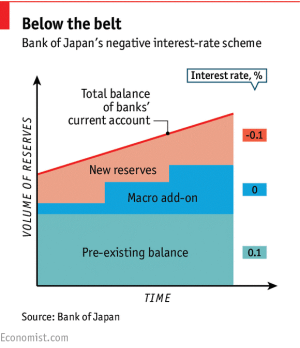
below tha belt

The Bank of Japan (BoJ), which pushed its main policy rate negative last week, did it by introducing a complicated three tier interest rate structure. The headline negative rate will only apply to new balances created by the Bank’s continuing quantitative easing—what the BoJ terms “policy-rate balances”. Old balances—called the “basic balance”—will continue to earn interest. As the stock of reserves in the system grows the Bank plans to increase its “Macro add-on balance”—which receives 0% interest—so that only banks’ marginal reserves attract the negative rate. The negative rate on policy-rate balances should be passed on to borrowers. As the policy rate balances are only a small fraction of total reserves, bank profitability shouldn’t get hit too badly.

This mimics how Switzerland and Denmark have implemented negative interest rates. Each Swiss bank is allocated a “threshold” by the Swiss National Bank—usually 20 times its reserve requirement. Only reserve balances in excess of that threshold attract the negative interest charge.

Cleverly, the threshold gets reduced if banks withdraw their reserves and hold cash—so as to prevent them from avoiding the charge by hoarding banknotes. Denmark’s central bank does something similar. It imposes a limit on reserve balances—which do not attract negative interest.

Any excess is converted into “certificates of deposit”, which attract a charge of -0.75%.
These schemes should allow banks to remain profitable even in a negative interest rate environment. It is worth asking who pays, though. Central banks earn a profit—known as seigniorage—by earning a higher interest rate on their assets (usually loans to the banking system and government bonds) than they pay on their liabilities (cash and bank reserves). That profit flows to the government. The tiered system Japan has introduced should—if it works—lower market interest rates without a concomitant reduction in the interest rate paid on reserves. That in effect transfers some seigniorage (profit made by a government by issuing currency) revenue to the banking system.
yen stands strong

Asia dips amid banking sector concerns, yen stands tall

Shinichi Saoshiro
TOKYO — Reuters
Published Tuesday, Feb. 09, 2016 7:55PM EST

Asian stocks dipped early on Wednesday amid smouldering banking sector concerns, particularly banks in Europe, while the safe-haven yen stood atop large gains made overnight.

MSCI’s broadest index of Asia-Pacific shares outside Japan edged down 0.2 per cent. The decline was limited after Wall Street shares cut most of their losses overnight and gave battered risk assets some relief.

Australian stocks fell 1 per cent. Japan’s Nikkei lost 0.2 per cent after sinking 5.4 per cent on Tuesday.

Equity markets remained wobbly after being hit hard early in the week by worries about the health of the euro zone banking sector, with a very easy monetary policy seen crimping bank profits and consequently their ability to repay debt.

Trouble for equities has meant a boon for government bonds, with the Japanese government bond 10-year yield dropping into the negative for the first time on Tuesday and the U.S. Treasury benchmark yield declining to a one-year trough.

The yen, often sought in times of financial market turmoil, has also received a strong boost this week. The dollar traded at 114.96 yen after sinking to a 15-month low of 114.205 overnight. The euro was flat at $1.1288 after scaling a four-month high of $1.1338 overnight on the dollar’s broader weakness.

After a tumultuous start to the week, markets looked to Federal Reserve Chair Janet Yellen, who will address the U.S. Congress later in the session, for fresh cues and possible relief.
While Yellen is expected to defend the Fed’s first rate hike in a decade and likely insist that further rises remain on track, any signs of a departure from such a stance could provide risk assets with a breather.

“The narrative that she faces is that the U.S. economy and asset markets are being sucked into the downdraft caused by oil, China, emerging markets, reserve manager and sovereign wealth fund asset selling, commodities, currency war, the strong dollar, weak European banks, weak Japanese banks, weak US banks and policy ineffectiveness…to name a few,” wrote Steven Englander, global head of FX strategy at Citi.

In commodities, crude oil prices trimmed some of their sharp losses suffered overnight. U.S. crude was up 1.6 per cent at $28.39 a barrel. Crude sank nearly 6 per cent on Tuesday after weak demand forecasts from the U.S. government and a rout in equities pressured prices.

Spot gold fetched $1,189.36 an ounce, staying near a 7-1/2-month peak of $1,200.60 stuck on Monday on the back of the risk aversion in the wider markets.

BoJ negative rates what you need to know

 10000 yen notes

©Bloomberg
Japan crossed a “financial rubicon” on Tuesday as the country sold new 10-year bonds with a yield below zero for the first time at a government auction.

The sale is the latest sign of a worldwide collapse in borrowing costs which has upended assumptions about the workings of financial markets, as policymakers take ever more drastic steps to stimulate economic growth.

It also highlights the challenge of retaining support for unconventional central bank measures, with Prime minister Shinzo Abe struggling to maintain momentum behind his “Abenomics” growth policies.

Disruption and uncertainty created by the Bank of Japan’s announcement of negative interest rates has left 50 per cent of voters dissatisfied with the government’s economic policy, according to a Nikkei poll published earlier this week.

The world’s third-largest economy last month followed Switzerland, Sweden, Denmark and the European Central Bank by cutting short-term interest rates below zero to prevent stagnation and deflation.

“I don’t think it would be surprising if one day this happened in Germany,” said Peter Goves, European interest rate strategist for Citi.

The European Central Bank is expected to announce further monetary easing next week, and 10-year Bunds yield only 13 basis points.

Japan is the second country to sell 10-year bonds at a negative yield, after Switzerland became the first to do so in April last year

The auction, of Y2.2tn ($19.4bn) in 10-year paper, at an average yield of minus 0.024 per cent, means investors have paid a fee to lend money for a decade to the government, the most indebted G7 nation.

The buying appears to have been almost entirely dealers and speculators looking to hold the paper for a brief time or covering short sales accumulated in expectation of the yield dropping into negative territory. Traders expect much of it to be flipped directly back to Japan’s central bank in a few weeks as part of a bond-buying programme, also designed to stimulate the economy.
Big investors, which include Japan’s largest pension funds and banks, are understood to have stayed away from the auction as the fund management industry readjusts its strategies for the distortions of a financial environment where negative rates become the norm.
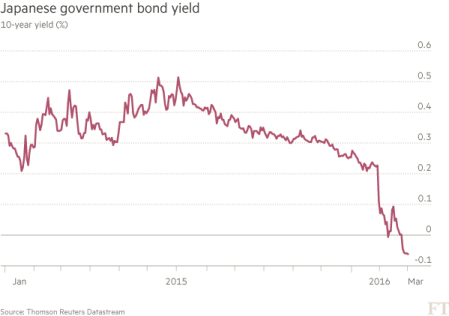
Japanese 10 year bond

As well as forcing wholesale adjustments to the structure of many investment products, analysts at Nomura have warned that the JGB market could now be prone to regular phases “where fair prices are no longer obvious”.

Analysts described Tuesday’s JGB sale as the latest in a string of “inevitable distortions” that have descended on Japan, which has a gross debt/gross domestic product ratio of 250 per cent, since the BoJ revealed its negative rates policy (NIRP) on January 29.

Koichi Sugisaki, fixed-income strategist at Morgan Stanley MUFG Securities, said: “Going into the auction, most dealers believed that it wouldn’t make sense to investors to buy [the 10-year JGB] at negative rates so they took out short positions and today’s auction would have seen them buying to short-cover.”

Sub-zero rates are a sign that policymakers are running out of options to invigorate the economy, say critics

Another motive behind the dealers’ buying appears to be a straightforward play on the BoJ’s upcoming “rinban” bond purchases and the opportunity to sell to the central bank at a profit.
The 10-year notes sold at Tuesday’s auction will not be eligible for the buying operations scheduled for Wednesday this week but can be sold into the rinban operations scheduled for March 18.

The potential for Japan’s first negative-yield auction of the 10-year JGB had already convinced large pension funds to stay away.

In a note to clients published on Monday, fixed-income analysts at Barclays said: “We see no need to be particularly aggressive at tomorrow’s auction, either outright or on a relative value basis.”
The difficulty facing the big pension funds, however, is that they cannot stay away from the auctions forever if their mandates include following particular bond indices. The current response, say analysts, has been to dip further into the super-long end of the JGB market.

Other market side-effects of NIRP include the unsecured overnight call rate — ground zero for interbank lending — hitting zero last month on thin volumes as the Japanese financial system scrambles to update its computer systems to accommodate the mathematics of negative rates.

Barclays analysts said long-term yields had probably fallen too far and that because G20 central bank governors and finance ministers had made a public pledge to use all available policy tools to stabilise markets, the global risk-off trend may now take a breather.

japanese yield curve


South Korea impasse delays labour market shake-up

February 25, 2016 3:46 amSimon Mundy in Seoul

Korean welder

©Bloomberg
Sparks fly: tensions between unions and Seoul have mounted over law changes the IMF says are vital to make hiring easier
When South Korean trade unionists launched a campaign against labour law reforms, they did so by a statue of Jeon Tae-il.
The 22-year-old labour activist’s 1970 self-immolation, in protest over miserable working conditions in Seoul sweatshop factories, is seen as a pivotal event that helped galvanise the workers’ rights movement in military-ruled South Korea, and the broader movement towards democracy.
korean labor sit in
Labour unions are portraying their current fight against the reforms as a continuation of Jeon’s battle for justice — but critics accuse them of seeking to derail measures that would create jobs for the swelling ranks of unemployed youth to protect relatively privileged older workers.

With growth slowing, the official under-30 jobless rate reached 9.2 per cent last year: the highest in the current data series starting in 1999. That is widely seen as understating the problem, with many young graduates caught in precarious low-paid work while hunting for career opportunities.
Economists at the International Monetary Fund and elsewhere have long argued that the government must reduce protections and entitlements for workers to encourage more hiring, with companies deterred by the cost and risk of expanding their labour force.

“In the medium term, more flexibility in the labour market would help to boost labour productivity, which has slowed markedly since 2012,” says Kwon Young-sun, an economist at Nomura. “But in the short term people will feel concern about job security.”

In the first such pact since the late-1990s Asian financial crisis, the government of Park Geun-hye in September agreed with business and labour representatives on a joint process to overhaul the country’s labour laws.

But union leaders last month declared that deal void, arguing that the government had broken its accompanying pledge not to introduce reforms without further consultation. In December the labour ministry issued guidelines to employers saying they could now dismiss workers for poor performance, not only in cases of grave misconduct or corporate financial distress.
“President Park Geun-hye is very friendly with the chaebol conglomerates,” says Lee Jeong-sik, deputy general secretary of the Federation of Korean Trade Unions, the country’s biggest labour group. “I see her government trying to give favours to Samsung and Hyundai.”

Tear gas and water cannon used in largest anti-government protest for 7 years
Strong union resistance has prompted the government to withdraw a proposed bill that would have extended the maximum employment period for temporary workers. Four other pieces of legislation, including one that would expand the range of industries allowed to use temporary staff, have been stalled in parliament amid resistance from liberal lawmakers.

The drive to expand temporary work is misguided, argues Kim Yoo-sun of the Korea Labour & Society Institute. He notes that sweeping reforms in the 1990s have led to a much higher proportion of such workers than in most developed economies: a third of the workforce according to official data, and nearly half according to the unions. “I don’t agree that South Korea’s labour rules are rigid — it’s the other way around,” he says. “Jobs that used to be stable have now been converted to irregular ones.”

Tensions between unions and the state spilled into violence in November at Seoul’s biggest protest for years: demonstrators attacked police barricades with metal bars, while police used water cannon, knocking over an elderly farmer who has since been in a coma.
Following a visit to South Korea last month, UN special rapporteur Maina Kiai accused the government of “palpable . . . indifference towards the ability of workers to associate”, criticising its recent forcible dissolution of the teachers union. “I sense a trend of gradual regression on the rights to freedom of peaceful assembly and of association,” he wrote.

South Korea doesn’t have appropriate laws to protect temporary workers, and the government does not make employers comply even with the rules that are in place
– Kim Yoo-sun, Korea Labour & Society Institute

With time running out in the current parliamentary session, Ms Park has resorted to promoting a public petition campaign to urge lawmakers to pass the reforms. The Federation of Korean Industries, which represents large companies, has joined the drive, warning that its members would find it “impossible to create jobs for young people as long as the unfair labour law is kept as it is”. It added that the new laws would enable companies to scrap the traditional seniority-based pay system in favour of one based on performance, giving a fairer deal to young workers.
But critics dismiss such talk as cover for a move to perpetuate the “mass production” of irregular workers. “South Korea doesn’t have appropriate laws to protect temporary workers, and the government does not make employers comply even with the rules that are in place,” says Mr Kim, arguing that many employees remain on temporary contracts well beyond the legal time limit. “The government has closed its eyes to these people.”

Taiwan’s political landslide

Not trying to cause a big sensation

As much as anything, victory for Tsai Ing-wen and her party represents a generational change

Tsai Ing-wen, Taiwan's president-elect, center left, delivers her victory speech to supporters in Taipei, Taiwan, on Saturday, Jan. 16, 2016. Taiwan opposition leader Ing-wen rode a tide of discontent over everything from China ties to economic growth to become the island's first female president and secure a historic legislative majority for her Democratic Progressive Party. Photographer: Maurice Tsai/Bloomberg *** Local Caption *** Tsai Ing-wen

Jan 23rd 2016 | TAIPEI | From the print edition

SHE had led in the opinion polls for Taiwan’s presidential election for months. Yet the margin of Tsai Ing-wen’s victory surprised many. She won 56% of the votes in a three-way race, with her chief contender, Eric Chu of the Nationalist Party or Kuomintang (KMT), trailing badly (see chart). Ms Tsai will become the island’s first female leader, while Mr Chu has already resigned as party chairman.

The outcome of the election to Taiwan’s parliament, the Legislative Yuan, was more striking still. Ms Tsai’s Democratic Progressive Party (DPP) won 68 of the 113 seats up for grabs, compared with only 35 for the KMT, which has lost its hold on the legislature for the first time since Chiang Kai-shek set up on the island in 1949. The KMT is now in the wilderness even if Ma Ying-jeou, president since 2008, limps on until Ms Tsai’s inauguration in faraway May.

Already, change is under way. An old guard of national and local figures who have dominated politics for years is shuffling off the stage. Such is the bad blood in the KMT that the prime minister, Mao Chi-kuo, rebuffed Mr Ma’s efforts to persuade him to stay on as caretaker—even leaving the president standing in the cold outside his home while refusing to meet him. Ms Tsai (pictured above with colleagues) says that her transition team will work closely with the KMT and others in the coming months. She is open to non-DPP politicians getting cabinet posts in areas where her party lacks expertise, like defence. But whether the political shock on January 16th can accommodate her promise of a consensual approach is unclear.

Across the country, the enthusiastic participation of younger and more liberal voters in the election has emphasised a sense of generational change. Activists from the Sunflower Movement of 2014 that opposed Mr Ma’s policy of strengthening economic ties with China are now fresh-minted politicians, accounting for the Legislative Yuan’s third-biggest grouping, the New Power Party. One of them is a front man of a heavy-metal rock group. It would have made old lawmakers’ black-dyed hair stand on end—had the election not pushed so many of them aside.

But at the crest of the wave is Ms Tsai. At 59, she is of an older generation than many of those who voted for her, and is not a natural guitarist, but she embodies a progressive spirit—supporting gay marriage, for instance. A former legal academic and trade expert, her somewhat mousy, low-key air seems to engender trust—and, no one doubts, conceals an iron will.

Above all she appealed by wanting to improve livelihoods. Her refrain was a message of generational equity: promising a fairer life for younger Taiwanese who struggle to afford housing, worry about job prospects and think that they will have to pick up the tab for a looming pensions crisis. Her call to boost energy from renewables while promising to make Taiwan nuclear-free within a decade appeals to those worried about the environment being at the mercy of the big energy firms. Yet Ms Tsai, who once helped negotiate Taiwan’s entry into the WTO, is not anti-business. In the face of diplomatic pressure from China, she wants Taiwan, with its huge export machine, to strike more trade deals. She has already announced that she will negotiate a free-trade pact with Japan. Membership of the American-led Trans-Pacific Partnership is also in her sights. Elsewhere, she says that Taiwan must find better ways to encourage innovation, including by removing the barriers to new businesses, and cut its reliance on contract manufacturing, amid cheaper competition elsewhere. A measure of Taiwan’s malaise is that the economy hardly grew last year.
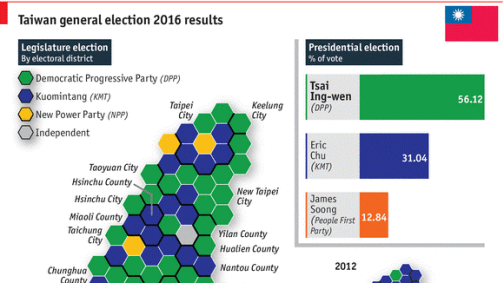
taiwan election results

Be careful what you wish for

It will be hard to turn things around quickly. Ms. Tsai’s plans for incentives to landlords to help provide 200,000 units of social housing are imaginative, and could boost growth. Restructuring industry to place more emphasis on design, marketing, logistics and services will prove much harder. Meanwhile, some of Ms. Tsai’s ideas appear questionable. Promising to go after assets that the KMT purloined following the defeat in 1945 of Taiwan’s Japanese overlords may make sense from the point of view of “transitional justice”. But it will hardly help engender the cross-party collaboration she says she seeks. As for scrapping nuclear power without thinking adequately about its replacement, it seems to promise a grave electricity shortage in the future—the kind of crisis that could scupper anyone’s presidency.

That kind of crisis aside, the hardest part of Ms. Tsai’s time in office is likely to be managing relations with China across the Taiwan Strait. Under Mr. Ma relations only improved, with 23 cross-strait economic agreements and, in November, an unexpected meeting between him and President Xi Jinping in Singapore. Yet stronger economic ties seemed to many Taiwanese not to benefit them, while the perceived secrecy of the negotiations engendered the Sunflower Movement.

Ms Tsai will be cooler on China—though not chilly. Mr Xi insists that China continue to endorse the so-called “1992 consensus”, in which China’s Communists and the KMT agreed there was but one China while differing on what that meant. Ms. Tsai has resisted endorsing the consensus. But she has rowed her party a long way back from its desire to declare formal independence—an act that would invite a military response against the island of 23m people. In her victory speech, she appealed to China’s leaders, emphasising that both countries should search for an acceptable way to interact “based on dignity and reciprocity”. She says she wants to “set aside differences” and build on the cross-strait dialogue to date. Probably, most Taiwanese approve, as does America, Taiwan’s protector. Now Ms Tsai’s unfiery manner must persuade China, too.

 China’s P2P lending boom

Taking flight

The allure and the peril of Chinese fintech companies

Jan 23rd 2016 | SHANGHAI | From the print edition

 

chinese realty

ONE of the supposed virtues of peer-to-peer lenders—websites that connect borrowers to people with money to lend—is transparency. They often publish a range of information about those seeking loans (credit history, employment status, income), so that the investors stumping up the money know what they are getting into. So it is fitting that Imperial Investment, a Chinese P2P firm, is impressively transparent about its own circumstances. Earlier this month it published four separate notices from police, employees and family pleading for its runaway founder to return. “Our faces are bathed in tears,” the employees wrote.

Chinese media were far more phlegmatic about the woes of Imperial Investment, which has facilitated 935m yuan ($142m) in loans since its launch in 2013. “Runaway P2P bosses are no longer newsworthy,” declared the Jinling Evening News. At the end of 2015, nearly a third of all Chinese P2P lenders (1,263 out of 3,858) had run into difficulties, according to Online Lending House, an industry website. It classifies them according to the nature of their troubles: halted operations, disputes, frozen withdrawals or, as in the case of Imperial, bosses who have absconded. Running away may sound rather extreme but it turns out to be popular: 266 P2P bosses have fled over the past six months, by Online Lending House’s count. Although most of the firms in trouble are small, a few bigger ones have also come unstuck: Ezubao, China’s biggest P2P lender, which has arranged $11 billion-worth of loans, is one of the firms with frozen accounts.

Chinese P2P lenders’ many and varied problems might be expected to deter investors. Yet some of the bigger, better-run firms are still attracting serious money. In December Yirendai, the consumer arm of P2P lender CreditEase, became the first Chinese “fintech” firm to go public abroad, listing on the New York Stock Exchange with a valuation of around $585m. Earlier this month Lufax, a platform for a range of products including P2P loans, completed a fundraising round that valued it at $18.5 billion, setting it up for a keenly anticipated IPO. Both companies pride themselves on their risk controls.

china volatile

Daily dispatches: China’s market mess

The optimistic scenario is that well-managed fintech firms will bring much-needed competition and efficiency to China’s sclerotic banking system, and profit handsomely while at it. The biggest lenders in China are mammoth state-owned banks, which tend to favor lending to state-owned enterprises over lending to private firms. That cedes plenty of space to P2P firms to build up their customer base and deliver credit to previously overlooked segments of the economy.

The worry, though, is that the sudden rush of money into P2P could push even good firms into bad lending decisions. Outstanding P2P credit rose more than tenfold over the past two years, from 31 billion yuan at the start of 2014 to 439 billion yuan at the end of last year. Average lending rates, meanwhile, fell from nearly 20% to 12.5%. Should inflows to P2P firms slow, lending rates will not be the only thing to spike higher: so too will the incidence of runaway bosses.

China to abstain from veto power at Asian Infrastructure Investment Bank

Bank president Jin Liqun said the practice would be a departure from policies at other institutions.

By Elizabeth Shim   |   Jan. 26, 2016 at 11:14 PM
china's flags

China’s ceremonial flags fly in a stiff wind over Tiananmen Square in Beijing on March 8, 2015. China has been trying to build financial credibility as an economic powerhouse. Photo by Stephen Shaver/UPI

BEIJING, Jan. 26 (UPI) — China doesn’t plan to exercise veto power at the Beijing-led Asian Infrastructure Investment Bank, a departure from practices at institutions like the World Bank, where the United States has presiding influence on major policy decisions.

AIIB president Jin Liqun said the power of the vote would be shared among the 57-member countries, state-owned China Daily reported Wednesday, local time.

“There are still many countries on the waiting list, and when the new members join, China’s voting power will be reduced. Such de facto veto power will be lost gradually,” Jin said at the World Economic Forum in Davos last week.

The bank would instead retain a “fixed” special majority that are two-thirds of the number of members and equal to 75 percent of the voting power.

China currently holds less than 30 percent of voting or veto power.

Beijing has been trying to build financial credibility as an economic powerhouse, but the AIIB, which was signed into agreement last June, has been met with skepticism from rivals United States and Japan.

The two economies have declined to join the bank that plans to focus on building infrastructure that could bridge Europe and Asia, and provide financial support for projects in developing countries.

CNBC reported AIIB expects to lend $10-15 billion annually.

Russia, a bank member, is expected to lend $1 billion for various projects.


Why China poses the next great risk for a deflationary world

Ambrose Evans-Pritchard, The Telegraph | February 10, 2015 | Last Updated: Feb 10 1:20 PM ET

shadow banking

Getty Images A year of tight money from the People’s Bank and a $250-billion crackdown on shadow banking have together pushed the Chinese economy close to a debt-deflation crisis.

A year of tight money from the People’s Bank and a $250-billion crackdown on shadow banking have together pushed the Chinese economy close to a debt-deflation crisis.Haibin Zhu from JP Morgan says the 50 point cut in the RRR cut from 20% to 19.5% injects roughly $100-billion into the system.Yet the cut marks an inflexion point. There will undoubtedly be a long series of cuts before China sweats out its hangover from a $26 trillion credit boom. Debt has risen from 100% to 250% of GDP in eight years. By comparison, Japan’s credit growth in the cycle preceding its Lost Decade was 50% of GDP.Related

The People’s Bank may have to cut all the way to zero in the end — a $4 trillion reserve of emergency oxygen — but to do that is to play the last card.This will not itself change anything. The average one-year borrowing cost for Chinese companies has risen from zero to 5% in real terms over the last three years as a result of falling inflation. UBS said the debt-servicing burden for these firms has doubled from 7.5% to 15% of GDP.

The surprise cut in the Reserve Requirement Ratio — the main policy tool — comes in the nick of time. Factory gate deflation has reached 3.3%. The official gauge of manufacturing fell below the “boom-bust” line to 49.8 in January.China has edged out the West as the investment kingpin for the world — expect political influence to follow. China is trapped. The Communist authorities have discovered, like the Japanese in the early 1990s and the US in the inter-war years, that they cannot deflate a credit bubble safely.

china investment

china import plummet

The trigger was an amber warning sign in the jobs market. The employment component of the manufacturing survey contracted for the 15th month. Premier Li Keqiang targets jobs — not growth — and the labour market is looking faintly ominous for the first time.

Unemployment is supposed to be 4.1%, a make-believe figure. A joint study by the International Monetary Fund and the International Labour Federation said it is really 6.3%, high enough to cause sleepless nights for a one-party regime dependent on ever-rising prosperity to replace the lost elan of revolutionary Maoism.

Whether or not you call it a hard-landing, China is struggling. Home prices fell 4.3% in December. New floor space started has slumped 30% on a three-month basis. This packs a macro-economic punch.

A study by Jun Nie and Guangye Cao for the U.S. Federal Reserve said that since 1998 property investment in China has risen from 4% to 15% of GDP, the same level as in Spain at the peak of the “burbuja” — the country’s house price bubble. The inventory overhang has risen to 18 months compared to 5.8 in the US.

The property slump is turning into a fiscal squeeze since land sales make up 25% of local government money. Zhiwei Zhang from Deutsche Bank says land revenues crashed 21% in the fourth quarter of last year. “The decline of fiscal revenue is the top risk in China and will lead to a sharp slowdown,” he said.

The IMF says China’s fiscal deficit is nearly 10% of GDP once land sales are stripped out and all spending included, far higher than generally supposed. It warned two years ago that Beijing was running out of room and could ultimately face “a severe credit crunch.”

The gears are shifting across the Chinese policy spectrum. Shanghai Securities News reports that 14 Chinese provinces are preparing a $2.4 trillion blitz on infrastructure to combat the downturn.

How much of this is new money remains to be seen but there is no doubt that Beijing is blinking. It may be right to do so — given the choice of poisons — yet such a course stores up even greater problems for the future. The China Development Research Council, Li Keqiang’s brain-trust, has been shouting from the rooftops that the country must take its post-debt punishment “as soon possible”.

China is not alone in facing this dilemma as deflation spreads and beggar-thy-neighbour currency wars become the norm. Fifteen central banks have eased monetary policy so far this year.

Denmark’s National Bank has cut rates three times in two weeks to minus of 0.5% to defend its euro-peg, the latest casualty of the European Central Bank’s euros 1.1 trillion quantitative easing. The Swiss central bank has been blown away.

Asia is already in a currency cauldron, eerily like the onset of the 1998 crisis. The Japanese yen has fallen by half against the Chinese yuan since Abenomics burst upon the Pacific Rim. Japanese exporters pocketed the windfall gains of devaluation at first to boost margins. Now they are cutting prices to gain export share, exporting deflation.

China’s yuan is loosely pegged to a rocketing US dollar. Its trade-weighted exchange rate has jumped by 10% since July. This is eroding the wafer-thin profit margins of Chinese companies and tightening monetary conditions into the downturn.

David Woo from Bank of America says Beijing may be forced to join the currency wars to defend itself, even though this variant of the “Prisoner’s Dilemma” leaves everybody worse off. “We view a meaningful yuan devaluation as a major tail-risk for the global economy,” he said.

If this were to happen, it would send a deflationary impulse worldwide. China spent $5 trillion on fixed investment last year, more than Europe and America combined, increasing its overcapacity in everything from shipping, to steels, chemicals, and solar panels, to even more unmanageable levels. A yuan devaluation would dump this on everybody else. It would come at a moment when Europe is already in deflation at minus 0.6%, and when Britain and the U.S. are fast exhausting their inflation buffers as well.

Such a shock would be extremely hard to combat. Interest rates are already zero across the developed world. Five-year bond yields are negative in six European countries. These are no longer just 14th Century lows. They are unprecedented.

My own guess that we would have to tear up the script and start printing money to build roads, pay salaries, and fund a vast New Deal. This form of helicopter money or “fiscal dominance” may be dangerous, as dangerous as the alternative.

China faces a Morton’s Fork. Li Keqiang has made it his life’s mission to stop his country drifting into the middle income trap. He says himself that the investment-led model of last 30 years is obsolete. The low-hanging fruit of catch-up growth has been picked. China passed the point of no return five years ago.

Januaryfacing Vietnam as party meets

Michael Peel in Hanoi Financial Times  @AFP

vietnam economy

Vietnam’s ruling Communist party is preparing to select its next leaders at its five-yearly congress, amid tensions over China, the economy and the pace of political reform. The weeklong event in Hanoi offers a rare glimpse of the power struggles inside one of Southeast Asia’s largest countries and fastest-growing economies. Here are the big themes facing the country.

Not many people think the country is set for radical change. While internal battles are taking place, none of the likely new leaders is expected to push hard for greater freedom of speech, accelerated economic change or a love-in with China. Much of the smart money is on Nguyen Phu Trong, the party general secretary and one of a triumvirate of senior leaders, having his term extended by a year or two. An effort by one party faction to install Nguyen Tan Dung, prime minister for 10 years, as general secretary appears to be foundering — although the picture remains unclear. The third key figure is President Truong Tan Sang. However it plays out, there is little sign of a large injection of the youth that might better mirror the country’s populace.

Change needed

While the prime minister’s supporters say he is a reformist, pointing to greater freedom of speech, privatization, economic deregulation and better international ties, critics say he is given too much credit. Such public debate as exists is via social media rather than the government, which still detains dissidents often enough to remind people of the dangers of straying too far out of line. There is cronyism in business and privatization has been slow — the flagship Vietnam Airlines part-sale last year amounted in the end to just 5 per cent of the company and attracted little international interest (although Japan’s All Nippon Airways announced this month it was taking an 8.8 per cent stake).

International relations

Anti-China sentiment has grown so strong that it is hard for any politician to take a more accommodating line with Beijing, even if some would probably tone down the rhetoric of Mr Dung. The foreign ministry said this week it had raised concerns with China over its movement of an oil rig in a disputed area of the South China Sea — exactly the sort of clash that sparked anti-Chinese riots in some of Vietnam’s vast industrial zones in 2014. But Vietnam cannot afford to be too aggressive — it has a complex cultural and political relationship with China, by far its biggest trading partner. While Hanoi has been making some overtures to Washington, including high-level official visits each way, realpolitik and history mean it will never be in the western camp. Rather, Vietnam will probably try to use US links to persuade China to moderate its behavior.

Investment climate

With gross domestic product growth back above 6 per cent, Vietnam is benefiting from manufacturers relocating in a bid to cut costs after wage rises in countries such as Thailand and, particularly, China. But while the headline numbers and trends might look attractive to international investors, there is also a strong sense of unfinished business in Vietnam’s economy. These include bad loans at banks and enduring problems at big state companies. There are also fears the property bubble that led to a crash in the late “noughties” could be re-inflating again. The government has made a huge and still unproved bet on using generous perks to attract multinational companies such as Korea’s Samsung and Intel of the US to make Vietnam an export hub.

January 27, 2016 9:42 am

China’s economic leaders struggle to explain thinking to world

Tom Mitchell in Beijing and Gabriel Wildau in Shanghai Financial Times

fang Xinghai

Chinese regulator Fang Xinghai in Davos with Christine Lagarde, where he conceded Beijing has a messaging problem

Henry Kissinger’s famous question about the EU — “who do I call if I want to call Europe?” – now has a Chinese variant: who do investors turn to for guidance on Beijing’s monetary and currency policies?

Until recently, calls for clarity were met only by resounding silence, even as turmoil on China’s equity and currency markets reverberated around the world at the start of this month. While the government and central bank have since woken up to the fact they face a communications crisis, officials and analysts say the opacity of the Communist party makes it a difficult challenge to overcome.

Senior figures finally came out of their shells last week at the World Economic Forum in Davos to address their peers’ concerns about China’s management of its economy, markets and currency. Leading the charge was a good cop, bad cop team featuring Fang Xinghai, one of three vice-chairmen at China’s securities regulator, and Li Yuanchao, the country’s vice-president.

Both hold government positions that belie their real influence in China’s power structure. In addition to his post at the China Securities and Regulatory Commission, Mr. Fang is also affiliated with the party’s powerful Central Leading Group on Economic and Financial Affairs, where he is believed to have the ear of President Xi Jinping. Mr. Li, meanwhile, though ostensibly Mr. Xi’s number two, does not sit in the party’s inner sanctum — the seven-member Politburo Standing Committee.

Mr Fang is a Stanford-educated former World Bank official. Speaking on a panel with the likes of Christine Lagarde, head of the International Monetary Fund, he admitted that Chinese leaders needed to communicate better with global markets.

Mr. Li, meanwhile, attributed the renminbi recent volatility to market forces, which he said were reacting in part to the US Federal Reserve’s December interest rate rise. He also repeated the Chinese leadership’s longstanding assertion that it has “no intention to devalue its currency”.

Beijing’s critics say the belated appearance of two relatively unknown Chinese officials on a Swiss stage — while Premier Li Keqiang and central bank governor Zhou Xiaochuan maintained a steely silence back in the Chinese capital — is illustrative of the larger problem.

Messaging stumbles belie policy strides

China’s central bank has moved to jettison command-economy style mechanisms, write Tom Mitchell and Gabriel Wildau

“A lot of my clients thought they understood China,” says one Asian currency strategist. “They thought they knew what the [policy] framework was. But now they don’t understand who is making the decisions and why communication isn’t provided.

“They are increasingly becoming more disappointed with China,” the strategist added. “When the markets have no guidance they expect the worst.”

The People’s Bank of China’s defenders argue that the central bank does in fact provide good policy guidance — investors just have to comb through its publications or the state press to find it.

The communications problem stems in part from the fact that China’s central bank is technically an advisory body answerable to Premier Li’s State Council and does not enjoy the independence and power of the Fed or European Central Bank.

As a result, China lacks a Ben Bernanke or Mario Draghi type figure who can reassure markets in times of turmoil by pledging to do “whatever it takes”. Nor are other senior Chinese financial officials inclined to use the threat of a bazooka in their pocket, as Hank Paulson, former US Treasury secretary, did during the depths of the global financial crisis.

“Zhou Xiaochuan used to be quite active speaking but was heavily criticized for it,” says one Chinese financial policy expert, who asked not to be named. “Now poor Fang Xinghai is out there but in the wrong [government] position. The system doesn’t allow for an active PR posture.

“The PBoC has done a great job with its various reports but if you expect someone to go public, forget it,” he adds. “The premier likewise is in no position [to do so]. That’s not how the Chinese bureaucracy works.”

The central bank has, for example, published a detailed breakdown of the currency basket it now advises investors to benchmark the renminbi against, rather than the dollar. Confusion over this policy switch, announced in December, was blamed by many for this month’s market and currency turmoil.

One person who advises Chinese policymakers says the basket is an important tool as the renminbi transitions from a loose dollar peg system to a freely tradable currency, but he admits execution has not been perfect. “There is a strategy,” the adviser says. “It may not have been communicated very well but it is not stupid. They just need to be a lot clearer and make sure [the renminbi] is damn stable against the basket.”

Others argue that in terms of communication, the Chinese government and central bank are on the right path, albeit a long one. “Markets will always cry out for more and better information,” says Richard Yetsenga, head of ANZ Research in Sydney. “They will particularly cry for guidance when in a new regime and renminbi depreciation is new.”

“Some of the recent adjustments were not ideal,” adds Mr. Yetsenga, who believes investors have been “excessively bearish” on China. “But China is feeling its way and a bit of patience is called for.”

Moves to establish channels for dialogue

As part of the Chinese government’s efforts to improve communication with its global peers, Beijing officials conduct an annual Strategic and Economic Dialogue with their Washington counterparts.

On Wednesday, Nikkei reported that the Chinese and Japanese governments are also considering the launch of a “cabinet-level economic summit” in the coming months, which would provide a welcome change of focus from the two countries’ long-running disputes over historical issues and territory.

Beijing has established its most ambitious government-to-government exchange with Berlin — the two governments alternately host cabinet-wide meetings encompassing a full range of economic, financial and political matters.

More recently, former New York mayor Michael Bloomberg and US Treasury secretaries Timothy Geithner and Henry Paulson have established the Working Group on US Renminbi Trading and Clearing to promote financial links between the world’s two largest economies.

New York has trailed international rivals Hong Kong and London as a test bed for the internationalization of the renminbi.

Troubled manufacturing slows to weakest since 2012

Nathan VanderKlippe

1451908363193006-asian-markets-tank-on-weak-data-as-china-halts-trading

BEIJING — The Globe and Mail

Published Monday, Feb. 01, 2016 5:14AM EST

Last updated Monday, Feb. 01, 2016 9:25AM EST

Trouble in China’s manufacturing industry continues, as new data show slowing output and rising layoffs, a further sign of the economic malaise affecting the world’s second-largest economy.

In China’s once-thriving factory regions, the New Year has brought more bad news, with plants shutting down, bankruptcy courts struggling to sell assets and confidence faltering.

The Caixin China General Manufacturing Purchasing Managers’ Index in January marked its 11th consecutive month in contraction territory, with a reading of 48.4. Anything below 50 is a signal for negative growth in the index, which offers a snapshot of manufacturing health.

The official Chinese PMI, at 49.4 in January, also indicated ongoing shrinkage in the sector that has been a key pillar of the country’s economy. Released Sunday, that figure was the weakest since 2012.

China’s economic signals are conflicting, with some bellwethers, like car sales, once again rising.

But the PMI data are among the first important Chinese economic indicators in 2016, and they offer little reason for hope after a rocky start to the new year. By midafternoon Monday in Asia, oil prices had fallen nearly 2 per cent, while Chinese markets also slipped more than 1 per cent and the yuan nudged downward. The Shenzhen and Shanghai composite indexes have both lost roughly a quarter of their value so far this year.

“The economy is still in the process of bottoming out and efforts to trim excess capacity are just starting to show results,” He Fan, chief economist at Caixin Insight Group, said in a statement. “The pressure on economic growth remains intense in light of continued global volatility.”

The Caixin data show stocks of finished goods continuing to rise and employment falling at the strongest pace in four months. Chinese manufacturers have now been in layoff mode for 27 months. The sector is nearing the year-long PMI contraction it saw in 2011 and 2012, its worst since the index was launched in 2004.

China went on “a debt binge” after the 2008 financial crisis, and “the process of working out debt problems and de-levering is unlikely to be resolved any time soon,” said Li Wei, director of the China Economy and Sustainable Development Center at the Cheung Kong Graduate School of Business.

He oversees the CKGSB Business Conditions Index, a different measure of corporate sentiment that in January came in at 51.2, a mark of only slight optimism (anything below 50 is pessimistic), that is down dramatically from 61.3 in May 2015.

Prof. Li also sits on several corporate boards in the midst of bankruptcy proceedings, “and for some of the assets that they are trying to unload in auction houses there has been no bidder. So all of this takes time,” he said. “We expect probably 2016 and well into parts of 2017 there won’t be much change in the way that China numbers are going to look.”

Chinese stock-market turmoil, in particular, is exacting a heavy toll on companies. Although much of the daily trading is conducted by at-home investors, they hold only about 40 per cent of shares. The remainder resides with governments and companies with large corporate cross-holding positions, some used as loan collateral.

Many firms in that situation now “have hit the point where there is a margin call on them,” Prof. Li said.

At the same time, the manufacturing sector “is struggling to transition away from overcapacity,” particularly in smokestack industries like cement, steel and coal, said Simon Gleave, a partner in the financial services practice at KPMG in Beijing.

But, he said, China is also “beginning to see some really positive signs in the economy.”

Take car sales which, after falling mid-year, rebounded strongly at year-end, rising 20 per cent in November. A significant tax cut helped move smaller-engined cars off lots, but in 2015 it was SUV sales that did best in China, up 52.4 per cent. The number of Chinese with driver’s licences is still rising at 12 per cent a year.

And while housing starts have now fallen for two years, housing prices were up 7.7 per cent in December, and China reached a record 7.3-trillion yuan ($1.55-billion Canadian) in nationwide home sales in 2015. Just over half of China’s major housing markets are now seeing rises in home prices, after 13 months of declines ended in October.

Here, too, there are underlying problems, including a staggering 13 million vacant homes – and recent buying has been propelled in part by government incentives.

But the price gains make it harder to predict the worst for China, Mr. Gleave said.

“I don’t see how you can have a hard landing if housing is picking up and car sales are picking up,” he said.

That’s not to say 2016 will bring much in the way of good times.

China is still “struggling very much” with poor-quality economic gains, Mr. Gleave said. Rather than chase long-term sustainable growth, “the government is trying to get eye-catching headlines that they’ve hit targets – but that gives you a very low return on capital investment.”

For now, China’s economy is “just bumping up and down a bit and we might get a few more knocks on the way.”

Follow Nathan VanderKlippe on Twitter: @nvanderklippe


February 29, 2016 3:04 pm

China injects cash to boost growth and counter capital outflows

Gabriel Wildau in Shanghai

shanghai bank

©Bloomberg

China has moved to inject cash into its banking system in the latest effort by the government in Beijing to boost economic growth by ensuring the flow of low-cost credit from banks to corporate and household borrowers.

China recorded its weakest growth in a quarter of a century last year at 6.9 per cent and a further slowdown is expected this year. The G20 warned at the weekend of slowing growth and urged countries to strengthen policy support.

But economists said the decision by the People’s Bank of China to cut the required reserve ratio — or the share of customer deposits that banks must hold on reserve — by 0.5 percentage points risked putting downward pressure on the renminbi. The cut to the RRR will inject about Rmb690bn ($106bn) into the banking system, according to Financial Times estimates based on central bank data, and brings the ratio for big banks to 17 per cent.

“The aim [of the RRR cut] clearly is to support the economy at a time that downward pressures on growth remain strong and uncertainty is elevated,” Louis Kuijs, head of Asia economics at Oxford Economics, wrote on Monday.

“This move suggests that for China’s policymakers growth remains key.”

The latest cut brings the reduction of the RRR to two percentage points since last February. Monday’s cut was the first since October and marks a return by the PBoC to the policy tool which had been shelved in recent months in favour of open market operations, an alternative tool for managing the money supply.

The latest cut is also aimed at countering the impact on the money supply of large capital outflows in recent months and may also be intended to boost confidence in China’s stock market, which has renewed its falls, according to analysts.

china tremors

China tremors

China roiled global markets last summer as its authoritarian leaders tried to stop a huge stock bubble from bursting and its slowing economy from stalling

In February the PBoC expanded its use of alternate tools to manage the money supply by increasing the frequency of open market operations. Open market operations, which inject cash into the banking system and have a similar impact to RRR adjustments, are considered more flexible because the size and duration of cash injections can be more finely calibrated.

A PBoC official had previously indicated that the central bank preferred to avoid further RRR cuts, a blunter instrument, due to concerns that they exacerbate renminbi weakness and capital outflows.

“It may be that the PBoC senses that speculative pressure has diminished or that closer monitoring of capital flows has helped slow the [outflow[s],” Mark Williams, China economist at Capital Economics, said in a note.

“Either way, today’s decision suggests the PBoC is more relaxed about outflows than a few weeks ago.”

The cuts are effective from March 1.

HSBC’s domicile dilemma

Asian dissuasion

Despite Britain’s bank-bashing mood, HSBC should stay in London

Feb 6th 2016 | From the print edition

HSBC

LIKE many firms with roots in Hong Kong, HSBC has traditionally consulted a feng shui master on the design of its headquarters’ buildings. The bank’s dilemma today is more serious: in which country should its headquarters be? For the past year HSBC has debated moving its domicile, which in turn determines its tax base, lead regulator and lender of last resort.

One option is to stay in Britain, with its bank-bashers, latent hostility towards the City of London and ambivalence about Europe. The alternative is to move back to vibrant-but-riskier Hong Kong, where HSBC was founded 151 years ago and was based until the 1990s. It is not an easy choice, but in the end pub grub and stability trump dim sum and political uncertainty.

HSBC matters. Regulators judge it to be the world’s most important bank, alongside JPMorgan Chase. A tenth of global trade passes through its systems and it has deep links with Asia. (Simon Robertson, a director of the bank, is also on the board of The Economist Group.) Its record has blemishes—most notably, weak money-laundering controls in Mexico. But it has never been bailed out; indeed, it supplied liquidity to the financial system in 2008-09. It is organized in self-reliant silos, a structure regulators now say is best practice.

For Britain, the departure of its best bank would be perverse (if only it could deport Royal Bank of Scotland instead). But HSBC is fed up with Blighty. A levy charged on its global balance-sheet cost 10% of last year’s profits; rules on ring-fencing its retail arm will cost $2 billion. Both are meant to protect Britain from global banks blowing up, but they duplicate other measures aimed at the same problem—silos, capital surcharges, “bail-in” bonds and liquidity buffers. Britain says it will lower the levy. But over time Asia, which accounts for 60% of the bank’s profits, will grow faster than Britain, and so HSBC will too. The tension between HSBC’s ambitions and Britain’s suspicion of giant banks is not going away.

Hong Kong is keen for the bank’s return, which would boost confidence after a torrid time for Chinese markets. HSBC’s biggest subsidiary is already based in the territory and supervised by the Hong Kong Monetary Authority (HKMA), its impressive regulator. By moving, HSBC would not ease its tax bill or capital levels by much. But it would avoid the levy, butt heads with Western regulators less and be closer to its biggest markets.

From a dirty old river to a fragrant harbour

Time to pack the bags? One objection is that HSBC is already thriving in greater China: it does not need to be domiciled there to succeed. Nor would moving to Hong Kong insulate HSBC from a British exit from the European Union. But the biggest worry is that Hong Kong is small and a territory, not a country. The HKMA has $360 billion of foreign reserves but it lacks the crisis toolkit of a central bank. It cannot print an infinite amount of money without undermining its currency peg and it lacks a credit line from America’s Federal Reserve to supply it with dollars, HSBC’s operating currency.

With a balance-sheet nine times bigger than Hong Kong’s GDP, HSBC’s ultimate backstop would be mainland China’s government, whose approach to finance is as transparent as Victoria Harbour. That might deter some customers. It would also annoy America, which might not be keen on HSBC playing a big role in the dollar-clearing system, a privilege that is vital for HSBC’s business. For an Asia-centric bank to be based in London is an anomaly. But, for now, one worth keeping.

Outflows from China top $110bn in January

Shawn Donnan in Washington
chinese rnb

©Bloomberg

Chinese companies and residents sent more than $110bn out of the country in January alone, according to new estimates, as they continued to evade tightening capital controls amid another round of market turmoil.

Surging capital outflows from China have become a source of growing concern around the world and left Beijing scrambling to support its currency. Recently-released data showed the country’s foreign exchange reserves falling to their lowest level in almost four years in January.

Be briefed before breakfast in Asia – our new early-morning round-up of the global stories you need to know

In the first significant attempt to digest the capital flight amid January’s market turmoil in China, the Institute for International Finance estimated that $113bn had been sent out of the country in the month.

That was more than in any month bar two in 2015, when it estimated a total of $637bn left China, down slightly from the estimate of $676bn it released last month. It also marked the 22nd month in a row of net outflows.

The IIF is a Washington-based industry group that represents banks and insurers around the world. Its estimates are based on extrapolations from official Chinese data and it cautioned that its January figures amounted to only “an approximation of the magnitude of capital flows”.

But the IIF’s figures shine a light on the extent of capital flight as they endeavour to capture funds leaving the country through unofficial channels, such as over-invoicing for exports and other methods used to circumvent official capital controls.

“If anything, it looks too low,” said Mansoor Mohi-uddin, senior market strategist at RBS in Singapore, referring to the IIF’s estimate for January. “With FX reserves falling at $100bn a month it appears increasingly likely the central bank will allow the [renminbi] to slide lower again towards 7.00 against the dollar.”

The IIF’s economists said that, based on recently-released official reserve data, they estimated that the Chinese government had spent $90bn intervening to prop up its currency in January.

Those interventions by the People’s Bank of China represented more than a quarter of the $342bn it spent in all of last year in response to outflows, the IIF said.

However, Beijing remains reluctant to appear to crack down too much on capital outflows, said Zhou Hao, senior economist for Asia at Commerzbank AG in Singapore. Tightening “could have a negative impact on people’s mindset. It could encourage more capital outflows because people would think something is wrong.”

Video After the sudden closure of a shoe factory, a migrant worker on China’s eastern seaboard heads back to his home in the countryside. China’s shoe industry has been hit hard by the slowing economy.

By NEIL GOUGH

January 19, 2016

closed donnguan market

DONGGUAN, China — Walking around an abandoned furniture factory, Fang Minghua pointed out the workshops where several hundred employees once toiled, transforming sheets of raw wood into TV stands or wardrobes for the aspiring middle class in China and other emerging economies.

The factory is relocating to a new facility two hours away, priced out by rising costs and falling orders. Mr. Fang estimated that as many as a third of the furniture factories around town had gone out of business, while many others were struggling.

“The economic slowdown is real,” said Mr. Fang, 46, who over the last 22 years had worked his way up from $50-a-month laborer to production supervisor.

The downturn in Dongguan, a once-thriving manufacturing hub, is part of the Chinese economic puzzle that global investors are trying to solve.

China Rattling the world

Graphic | Why China Is Rattling the World China’s economy is faltering, prompting concerns that are now shaking global stock markets.

While China has been moving away from the type of low-end manufacturing that has been Dongguan’s specialty, the protracted slump in the country’s vast industrial sector is a major threat to the nation’s already slowing economy. As the government tries to manage the situation, the risk is that the Chinese economy is worse off than expected — a concern that has put markets around the world on edge.

The latest signals from China don’t offer much reassurance, as the economic weakness shows little sign of abating. On Tuesday, China reported growth of just 6.8 percent for the fourth quarter, its slowest expansion since the depths of the financial crisis in 2009.

For the full year, China expanded at 6.9 percent, just below the government’s target of 7 percent and the weakest performance since 1990 when foreign investment shriveled in the year after the deadly crackdown in Tiananmen Square.

When it comes to the economy, Mr. Fang said, politicians and business leaders talk about industrial innovation and upgrading, “but I think that is just a slogan. It’s really hard to carry out.”

Lam Yik Fei for The New York Times

Dongguan is at the heart of south China’s Pearl River Delta. For decades, the region drove the country’s global ascent in exports, producing furniture, garments, shoes and other goods.

But the world’s workshop has been stumbling as cheaper production bases in Asia have gained ground. Last year, Chinese exports fell for the first time since the financial crisis — and for only the second time since the country’s economy began reopening to the outside world in the late 1970s.

That position is likely to be further eroded by the Trans-Pacific Partnership. The United States-led trade agreement deepens American ties with Asian countries like Vietnam and Malaysia, but it excludes China.

The slump has created a tricky situation for the government.

shoe vendors banner.jpg

A shoe vendor’s banner says “Financial Crisis, Want money instead of goods.” Many workshops in Dougguan, China, have closed; others have moved in search of cheaper rent and labor.

Lam Yik Fei for The New York Times

Officials have encouraged phasing out low-end exports in favor of promoting the service sector and high-tech manufacturing. While newer and more dynamic companies are on the rise in China, the risk is that they won’t develop fast enough to offset the hollowing out of light manufacturing, which remains a shrinking but significant employer across the country.

Some traditional manufacturers have responded to the downturn by relocating farther inland or overseas, where costs are generally lower. Others are trying to reduce their reliance on export orders by establishing their own branded products for domestic sale.

“This is an unfortunate pain being felt in traditional, older sectors,” said Louis Kuijs, the head of Asia economics at Oxford Economics. However, he added, the shift away from low-end, labor-intensive manufacturing “is an unavoidable part of the structural change that the economy is undergoing.”

Zhang Lin, 43, is trying to adapt to the shifting terrain.

workers walking

Workers walk past notices listing factory space for rent in Dongguan, a once thriving manufacturing hub.

Lam Yik Fei for The New York Times

As a supervisor, Mr. Zhang, who left his home in western Sichuan Province 25 years ago to work in Dongguan shoe factories, once oversaw about 7,000 production-line workers at a Taiwanese-owned factory here. At their peak, before the financial crisis, factories in the city accounted for about one in every four pairs of athletic shoes sold globally, according to estimates from the Dongguan Shoe Industry Commerce Association.

But rising costs have weighed heavily on the shoemaking business. The Taiwanese factory where Mr. Zhang worked closed in 2012. He and several partners went out on their own, setting up a plant making shoes and leather boots for brands like K-Swiss and Durango. Today, Mr. Zhang’s factory employs about 700 people.

While costs are rising, demand from overseas customers has also been declining. The company’s orders slipped to about 1.2 million pairs of shoes last year, down about 15 percent from 2014.

“It’s hard to say whether we can keep going for another five years — the outlook isn’t very good,” Mr. Zhang said.

In response, the company has been reducing hours for its workers. It also considered moving.

While the company plans to keep the existing factory here, it is making a future bet by expanding to a less-developed province, Guizhou. Labor costs there are as much as 40 percent less than those in Dongguan. Mr. Zhang also went on a scouting trip in August to Bangladesh, where some other large Dongguan shoe companies have shifted production.

The factory has also started making its own line of leather casual shoes. It sells them online in China, for as much as $75 a pair, on Taobao, Alibaba’s main online shopping platform.

“In a situation where overseas orders are falling, you need to have a backup plan,” Mr. Zhang said.

Other sectors have similarly been struggling, including some electronics manufacturers. In October, Fu Chang Electronic Technology, a supplier to the telecommunications equipment makers Huawei and ZTE, shut its doors unexpectedly. The closing prompted a protest by thousands of workers in front of a government building in Shenzhen.

Chinese officials, wary of further labor unrest, have sought to ease pressures on the sector. Earlier this month, one of China’s main tech regulators said it would team up with a big local bank to set up a $30 billion fund to support troubled small and medium-size electronics suppliers.

While there are still many active factories in Dongguan, the main ones succeeding are increasingly high-tech and less reliant on large staffs.

After working 15 years at an automotive plant in Alabama, Michael Recha moved to Dongguan in 2012 to set up a specialized factory for car parts, one of the first of its kind in China. Owned by Gestamp, a Spanish automotive component maker, the factory uses a technology called hot stamping to form metal sheets into precision parts like car bumpers and body panels for both local and foreign carmakers.

But robots do an increasing share of the work. The factory employs just 400 workers working two shifts a day.

“China is no longer a low-cost country, so we have the same robots and equipment here” as in Europe, Mr. Recha said.

Mr. Fang, of the furniture factory, estimates that by moving inland and consolidating three factories, the company saves about $150,000 a month in operating costs — including lower electricity and water bills, and also taxes. The biggest saving is on rent, because the owner of the company was able to buy low-cost land to build the new compound.

The move, though, has extracted a different toll.The new factory is relatively remote, so there isn’t much to do after work. Mr. Fang’s wife, who stayed behind in Dongguan, “doesn’t feel very happy about being apart,” he said. Their current plan is for her to join him sometime after next month’s Lunar New Year holiday.“She will get a new job, probably in the same factory with me,” he said.

Sarah Li contributed research.

China’s excess industrial capacity harms its economy and riles its trading partners

Feb 27th 2016 | SHANGHAI |
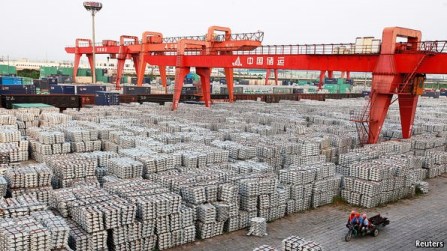
chinese exports

“OVERSUPPLY is a global problem and a global problem requires collaborative efforts by all countries.” Those defiant words were uttered by Gao Hucheng, China’s minister of commerce, at a press conference held on February 23rd in Beijing. Mr. Gao was responding to the worldwide backlash against the rising tide of Chinese industrial exports, by suggesting that everyone is to blame.

Oversupply is indeed a global problem, but not quite in the way Mr. Gao implies. China’s huge exports of industrial goods are flooding markets everywhere, contributing to deflationary pressures and threatening producers worldwide. If this oversupply were broadly the result of capacity gluts in many countries, then Mr. Gao would be right that China should not be singled out. But this is not the case.

China’s surplus capacity in steelmaking, for example, is bigger than the entire steel production of Japan, America and Germany combined. Rhodium Group, a consulting firm, calculates that global steel production rose by 57% in the decade to 2014, with Chinese mills making up 91% of this increase. In industry after industry, from paper to ships to glass, the picture is the same: China now has far too much supply in the face of shrinking internal demand. Yet still the expansion continues: China’s aluminum-smelting capacity is set to rise by another tenth this year. According to Ying Wang of Fitch, a credit-rating agency, around two billion tonnes of gross new capacity in coal mining will open in China in the next two years.
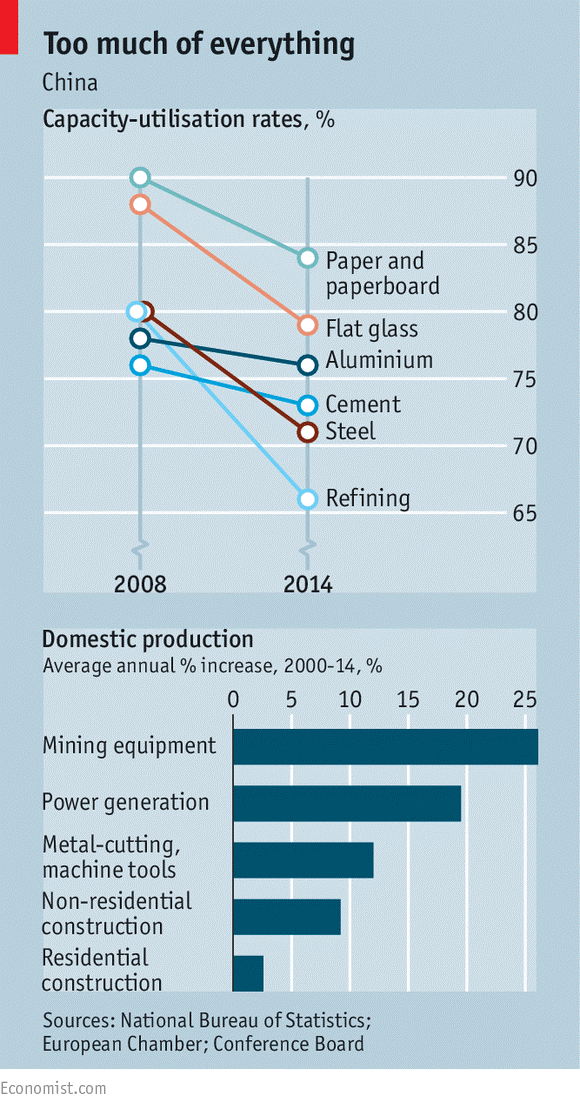
too much of everything

A detailed report released this week by the European Union Chamber of Commerce in China reveals that industrial overcapacity has surged since 2008 (see charts). China’s central bank recently surveyed 696 industrial firms in Jiangsu, a coastal province full of factories, and found that capacity utilisation had “decreased remarkably”. Louis Kuijs of Oxford Economics, a research outfit, calculates that the “output gap”—between production and capacity—for Chinese industry as a whole was zero in 2007; by 2015, it was 13.1% for industry overall, and much higher for heavy industry.

Scarier than ghosts

china zombies

Much has been made of China’s property bubble in recent years, with shrill exposés of “ghost cities”. There has been excessive investment in property in places, but many of the supposedly empty cities do eventually fill up. China’s grotesque overinvestment in industrial goods is a far bigger problem. Analysis by Janet Hao of the Conference Board, a research group, shows that investment growth in the manufacture of mining equipment and other industrial kit far outpaced that in property from 2000 to 2014. This binge has left many state-owned firms vulnerable to slowdown, turning them into profitless zombies.

Chinese industrial firms last year posted their first annual decline in aggregate profits since 2000. Deutsche Bank estimates that a third of the companies that are taking on more debt to cover existing loan repayments are in industries with overcapacity. Returns on assets of state firms, which dominate heavy industry, are a third those seen at private firms, and half those of foreign-owned firms in China.

The roots of this mess lie in China’s response to the financial crisis in 2008. Officials shovelled money indiscriminately at state firms in infrastructure and heavy industry. The resulting overcapacity creates even bigger headaches for China than for the rest of the world. The overhang is helping to push producer prices remorselessly downward: January saw their 47th consecutive month of declines. Falling output prices add to the pressure on debt-laden state firms.

The good news is that the Chinese have publicly recognized there is a problem. The ruling State Council recently declared dealing with overcapacity to be a national priority. On February 25th the State-Owned Assets Supervision and Administration Commission, which oversees big firms owned by the central government, and several other official bodies said they would soon push ahead with various trial reforms of state enterprises. The bad news is that three of the tacks they are trying only make things worse.

One option is for China’s zombies to export their overcapacity. But even if the Chinese keep their promises not to devalue the yuan further, the flood of cheap goods onto foreign markets has already exacerbated trade frictions. The American government has imposed countervailing duties and tariffs on a variety of Chinese imports. India is alarmed at its rising trade gap with China. Protesters against Chinese imports clogged the streets of Brussels in February. There is also pressure for the European Union to deny China the status of “market economy”, which its government says it is entitled to after 15 years as a World Trade Organisation member, and which would make it harder to pursue claims of Chinese dumping.

Another approach is to keep stimulating domestic demand with credit. In January the government’s broadest measure of credit grew at its fastest rate in nearly a year: Chinese banks extended $385 billion of new loans, a record. But borrowing more as profits dive will only worsen the eventual reckoning for zombie firms.

A third policy is to encourage consolidation among state firms. Some mergers have happened—in areas such as shipping and rail equipment. But there is little evidence of capacity being taken out as a result. Chinese leaders are dancing around the obvious solutions—stopping the flow of cheap credit and subsidized water and energy to state firms; making them pay proper dividends rather than using any spare cash to expand further; and, above all, closing down unviable firms.

That outcome is opposed by provincial officials, who control most of the country’s 150,000 or so publicly owned firms. Local governments are funded in part by company taxes, so party officials are reluctant to shut down local firms no matter how inefficient or unprofitable. They are also afraid of the risk of social unrest arising from mass sackings.

China’s 33 province-level administrations are at least as fractious as the European Union’s 28 member states, jokes Jörg Wuttke, head of the EU Chamber: “On this issue, increasingly Beijing feels like it’s Brussels.” So Mr. Gao’s claim that the problem is not entirely his government’s fault may be true in a sense. But in the 1990s China’s leaders did manage bold state-enterprise reforms involving bankruptcies and capacity cuts,  that overcame such vested interests. To meet today’s concerns, the central government could provide more generous funding to local governments to offset the loss of tax revenues arising from bankruptcies, and also strengthen unemployment benefits for affected workers.

If China’s current leaders have the courage to implement such policies, there may even be a silver lining. Stephen Shih of Bain, another consulting firm, argues that much quiet modernization “has been masked in many industries by overcapacity”. For example, little of the fertilizer industry’s capacity used advanced technologies in 2011; most of the new capacity added since then has been the modern sort that is 40% cheaper to operate.

Baosteel Group, a giant state-owned firm, has been forced by Shanghai’s local authorities to shut down dirty old mills in the gleaming city. So its bosses have built a gargantuan new complex in Guangdong province with nearly 9m tonnes of capacity. This highly efficient facility has cutting-edge green technologies that greatly reduce emissions of Sulphur dioxide and nitrogen oxides, recycle waste gas from blast furnaces and reuse almost all wastewater. “When the older capacity in China is shut down, we’ll have a much more modern industrial sector,” Mr. Shih says. “The question is, how long will this take?”

TPP deal signed, but years of negotiations still to come

Rebecca Howard

WELLINGTON — Reuters

Published Wednesday, Feb. 03, 2016 10:48PM EST

Last updated Wednesday, Feb. 03, 2016 10:48PM EST
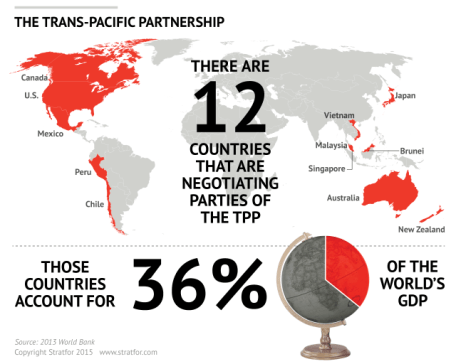
Trans-Pacific-Partnership

The Trans-Pacific Partnership, one of the world’s biggest multinational trade deals, was signed by 12 member nations on Thursday in New Zealand, but the massive trade pact will still require years of tough negotiations before it becomes a reality.

The TPP, a deal which will cover 40 per cent of the world economy, has already taken five years of negotiations to reach Thursday’s signing stage.

The signing is “an important step” but the agreement “is still just a piece of paper, or rather over 16,000 pieces of paper until it actually comes into force,” said New Zealand Prime Minister John Key at the ceremony in Auckland.

The TPP will now undergo a two-year ratification period in which at least six countries – that account for 85 per cent of the combined gross domestic production of the 12 TPP nations – must approve the final text for the deal to be implemented.

The 12 nations include Australia, Brunei, Canada, Chile, Japan, Malaysia, Mexico, New Zealand, Peru, Singapore, the United States and Vietnam.

Given their size, both the United States and Japan would need to ratify the deal, which will set common standards on issues ranging from workers’ rights to intellectual property protection in 12 Pacific nations.

Opposition from many U.S. Democrats and some Republicans could mean a vote on the TPP is unlikely before President Barack Obama, a supporter of the TPP, leaves office early in 2017.

U.S. Trade Representative Michael Froman has said the current administration is doing everything in its power to move the deal and on Thursday told reporters he was confident the deal would get the necessary support in Congress.

In Japan, the resignation of Economics Minister Akira Amari – Japan’s main TPP negotiator – may make it more difficult to sell the deal in Japan.

There is wide spread grassroots opposition to the TPP in many countries. Opponents have criticized the secrecy surrounding TPP talks, raised concerns about reduced access to things like affordable medicines, and a clause which allows foreign investors the right to sue if they feel their profits have been impacted by a law or policy in the host country.

In New Zealand on Thursday more than 1,000 protesters caused traffic disruptions in and around Auckland and police said a large number of police have been deployed.

Chile’s Foreign Minister Heraldo Munoz predicted “robust democratic discussion” in his South American nation.

Australian Trade Minister Andrew Robb said the agreement would be tabled next week in parliament. Opposition to the deal in Australia has been building, but Robb was confident it would be approved, despite the government not control the Senate.

Canada’s new government signed the deal on Thursday, but Trade Minister Chrystia Freeland has said “signing does not equal ratifying.”

She emphasized that the government committed itself to a wide-ranging consultation on the TPP during its election campaign and that process was currently underway.

Secretary of the Economy for Mexico, Illdefonso Guajardo, said the TPP would be voted on before the end of 2016, while Malaysia said the deal had already been approved, although some legislative changes were still needed.

Russian softwood lumber prices decreased by 22% in 2015

February 08, 2016

Whatwood/Fordaq

russian6

In 2015, sales of softwood lumber from Russia to foreign markets increased by 5% to 22.4 million m3. However, sales volume in value terms fell by $753 million to $2.7 billion, says WhatWood in its report.

Thus, the price decline amounted to 22% in dollar terms. China, the major market for Russian softwood lumber, increased deliveries by 18% to 9.8 million m3, while the import value fell by 8% to $973 million.

Russia’s share in the Chinese imported lumber market was about 50%. Deliveries to Uzbekistan, the second largest market, fell by 14% to 2.4 million m3, while the total import value plummetted, down to $210 million (-49%).

In the summer of 2015, imports to Egypt – the third largest consumer of Russian lumber – reached a record-high level (over 200,000 m3 monthly), but during the period from September to December 2015, the volumes were steadily declining: by 12% every month. As a result, the total annual volume increased by 33% to 1.9 million m3, while the import value fell by 3.6% to $310 million.

“The drop in the price of Russian softwood lumber on export markets is in line with the global trend of price reduction for all basic commodities. The decline in export prices was influenced by the strengthening of the US dollar against the currencies of importing countries and rising supply along with shrinking global demand,” commented WhatWood timber industry analytic agency in a press release.


Despite benign economic conditions, India faces tricky budget decisions

Feb 27th 2016 | MUMBAI |

indian taxis

A plus for finance ministers: the extra day bolsters annual output by a sliver and so flatters their record. Arun Jaitley, India’s finance minister, should be especially grateful for any boost to GDP on “leap day”, when he unveils his third budget. Although the Indian economy continues to outpace both richer and poorer rivals, the government’s fiscal options are narrowing.

Given jittery markets and total public debt of around 65% of GDP, a high figure for an emerging market, the question isn’t whether the government should cut its budget deficit but by how much. It is projected to be 3.9% in the fiscal year that ends on March 31st. The government has pledged to reduce the shortfall to 3.5% in the coming year and 3% the following one. But these targets are already less ambitious than ones Mr. Jaitley had set previously, and ministers seem to be preparing the ground to push them back further—to bond markets’ consternation.

As always, politicians can craft a compelling case for another “one-off” delay in budget-trimming. Civil servants are expecting a mammoth pay bump as a result of a once-a-decade wage negotiation; there is also a boost to military pensions that will cost around 1.1 trillion rupees ($16 billion), or 0.8% of GDP. Fresh funds will have to be found to recapitalize 29 state-owned banks, most of which have books infested with dud loans and so are making heavy losses. State governments, which add a further 2.3% of GDP to the central government’s deficit, are being leant on to bail out bankrupt power-distribution companies.

There is an economic case for deferring cuts, too, given febrile global conditions. Private investment is at a nadir, due to firms’ heavy debt and weak earnings. Two disappointing rainy seasons in a row have depressed incomes in rural regions, where most Indians live. And though India’s growth, at 7.5% last year, looks buoyant by global standards, it is below the 9-10% the government aspires to. (Many, including some government officials, in any case question the accuracy of the data.)

There is some debate among economists about whether further public spending is warranted in such circumstances. Unfortunately for Mr. Jaitley, one of the most vocal critics is Raghuram Rajan, the central-bank governor. He has compared India’s economy to Brazil’s, which is similarly indebted and shrinking fast—a humiliating rebuke to the government.

Mr. Rajan has argued that there are few investments the government can make that are likely to deliver high enough returns to compensate for adding to India’s debt pile. More public spending risks crowding out the private sort, he thinks. The implicit threat from Mr. Rajan is that he will not reduce interest rates from their current 6.75% if the deficit does not shrink.

After all, India has already received a hearty stimulus, albeit not one of Mr. Jaitley’s doing. No other country has benefited quite so much from the tumbling price of commodities, particularly oil, of which it is a huge net importer. When Narendra Modi came to power in May 2014, with crude at nearly $110 a barrel, whatever tax the government levied on petrol and other oil products was largely spent on fuel subsidies for the poor. The subsidy bill has since atrophied, while the government has pocketed much of the benefit of falling prices by raising the tax on petrol. It has received unexpected revenue of 1.5% of GDP, even as consumers’ spending power has risen.

For a country whose tax receipts total around 11% of GDP, that is a sizeable boon. Economists point out that the oil price, currently hovering near $30, cannot tumble another $80 next year. Worse, it might go up, which could prompt a reversal of the tax increases. If so, a $10 increase in the oil price would cost the government 0.35% of GDP, according to Morgan Stanley, a bank, more or less doubling the cuts needed to meet its current fiscal targets.

spot the pattern

Modest rises in other taxes have been mooted, and may be necessary if Mr Jaitley sees public investment or rural handouts as a political necessity. But there is another obvious way of raising money: selling down the government’s stakes in hundreds of Indian companies. Targets for privatisation have been missed in nine of the past ten years (see chart).

Although many of the government’s holdings have little strategic value—it owns stakes in cigarette-makers, engineering firms and hotels, for instance—it has resisted a sell-off. The reticence should end, argues Sajjid Chinoy of JPMorgan Chase, a bank, who advises government to think of divestments not as asset sales but as asset swaps, trading stakes in companies for the money to build new roads and railways.

February 26, 2016 7:36 am

India economic growth likely to level off next year, says survey

Victor Mallet in New Delhi

indian markets

India’s robust growth rate is likely to level off in the coming year and could drop to as low as 7 per cent in an “increasingly grim” world economy, according to Arvind Subramanian, the government’s chief economic adviser.

Releasing the annual economic survey on Friday ahead of next week’s budget, Mr Subramanian said India had the potential in the medium term to grow at 8-10 per cent a year — matching the rates of east Asia’s “tigers” in previous decades.

That, however, would require India to abandon its reflexive hostility to markets, invest heavily in health and education and focus more on agriculture, the survey said.

Opinion

In the fiscal year to the end of March 2017, gross domestic product growth was likely to be in the range of 7 to 7.75 per cent, compared with a forecast 7.6 per cent in the current year and 7.2 per cent in the previous year.

Official data show that India has overtaken China to become the world’s fastest-growing large economy — although economists have cast doubt on the reliability of statistics in both countries — and the survey said India now stood out “as a haven of stability and an outpost of opportunity”.

But it added that India’s growth was now twice as closely correlated to the world’s as it was in the 1990s and would be seriously affected by a lurch into global economic crisis — an extreme event that Mr Subramanian said could not be ruled out.

Jaitley

Arun Jaitley, finance minister, is due to present his annual budget on Monday, amid disagreements among policymakers over whether to abandon deficit reduction targets to give the economy a boost.

Mr. Subramanian, who favors loosening the reins to boost the economy, said India’s problem was no longer “twin deficits” — the budget and current account deficits now seen as under control — but a “twin balance sheet challenge”: banks are burdened with increasing amounts of bad and doubtful loans, while many large companies cannot or will not service their debts.

The survey described the balance sheet problem as “unsustainable” and a “major impediment to private investment, and thereby to a full-fledged economic recovery”, and mentioned the possibility of “bad banks” to relieve commercial banks of their burden of stressed assets.

In the survey, Mr. Subramanian outlined some achievements of the Narendra Modi government since it was elected nearly two years ago, including a campaign against corruption and easing some limits on foreign direct investment.

But he also lamented the agenda of unfinished plans, including a nationwide goods and services tax blocked by the opposition Congress party in the upper house of parliament and the slow pace of divestment from state companies.

The Indian economic “sweet spot” created by Mr. Modi’s strong political mandate was still “beckoningly there”, Mr. Subramanian said, but would not last indefinitely.

Yet if anything, he is expected to trim projected revenue from privatization. The disappointment of bond markets will be blunted by a rule that obliges banks to keep 21.5% of their assets in government bonds. But the price of profligacy is mounting: of the 13.7 trillion rupees the government expects in revenue in the coming year, over a third of it, or 5.1 trillion rupees, will go on interest payments.


Ports and policy in Indonesia Spend a little, build a lot

jokowi indonesia ports

Indonesia’s president Jokowi has ambitious plans to overhaul the country’s backward infrastructure. He had better work fast.

Feb 27th 2016 | JAKARTA

http://www.economist.com/news/asia/21693716-indonesias-president-jokowi-has-ambitious-plans-overhaul-countrys-backward-infrastructure-he