Second Quarter 2018 Economic and Wood Product News -Demographic Challenges, Update China’s Belt and Road Initiative, North Korean and Stratfor’s Outlook

Gone in their prime Many countries suffer from shrinking working-age populations

There are things they can do to mitigate the dangers

 Print edition | International

May 5th 2018| VILNIUS

workin age populations

MANY developed countries have anti-immigration political parties, which terrify the incumbents and sometimes break into government. Lithuania is unusual in having an anti-emigration party. The small Baltic country, with a population of 2.8m (and falling), voted heavily in 2016 for the Lithuanian Farmer and Greens’ Union, which pledged to do something to stem the outward tide. As with some promises made elsewhere to cut immigration, not much has happened as a result.

“Lithuanians are gypsies, like the Dutch,” says Andrius Francas of the Alliance for Recruitment, a jobs agency in Vilnius, the capital. Workers began to drift away almost as soon as Lithuania declared independence from the Soviet Union in 1990. The exodus picked up in the new century, when Lithuanians became eligible to work normally in the EU. For many, Britain is the promised land. In the Pegasas bookshop just north of the Neris river in Vilnius, four shelves are devoted to English-language tuition. No other language—not even German or Russian—gets more than one.

Mostly because of emigration, the number of Lithuanians aged between 15 and 64 fell from 2.5m in 1990 to 2m in 2015. The country is now being pinched in another way. Because its birth rate crashed in the early 1990s, few are entering the workforce. The number of 18-year-olds has dropped by 33% since 2011. In 2030, if United Nations projections are correct, Lithuania will have just 1.6m people of working age—back to where it was in 1950.

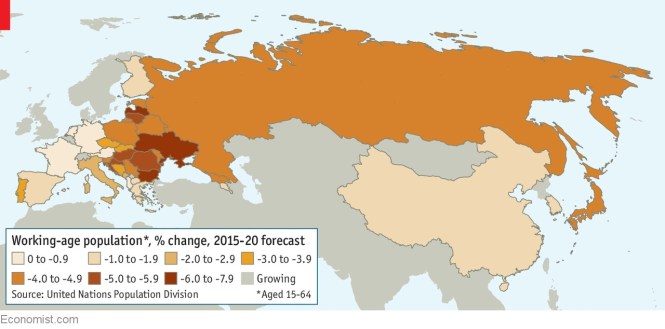
Lithuania was an early member of a growing club. Forty countries now have shrinking working-age populations, defined as 15- to 64-year-olds, up from nine in the late 1980s. China, Russia and Spain joined recently; Thailand and Sri Lanka soon will. You can now drive from Vilnius to Lisbon (or eastward to Beijing, border guards permitting) across only countries with falling working-age populations.

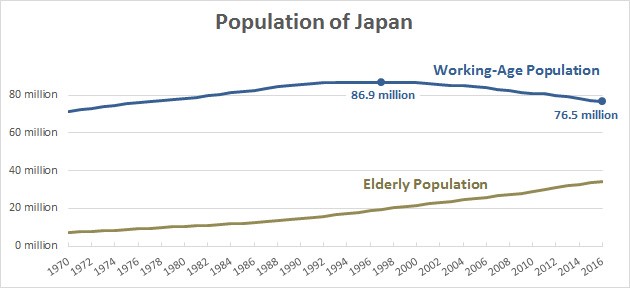
It need not always be disastrous for a country to lose people in their most productive years. But it is a problem. A place with fewer workers must raise productivity even more to keep growing economically. It will struggle to sustain spending on public goods such as defence. The national debt will be borne on fewer shoulders. Fewer people will be around to come up with the sort of brilliant ideas that can enrich a nation. Businesses might be loth to invest. In fast-shrinking Japan, even domestic firms focus on foreign markets.

The old will weigh more heavily on society, too. The balance between people over 65 and those of working age, known as the old-age dependency ratio, can tip even in countries where the working-age population is growing: just look at Australia or Britain. But it is likely to deteriorate faster if the ranks of the employable are thinning. In Japan, where young people are few and lives are long, demographers expect there to be 48 people over the age of 65 for every 100 people of working age in 2020. In 1990 there were just 17.

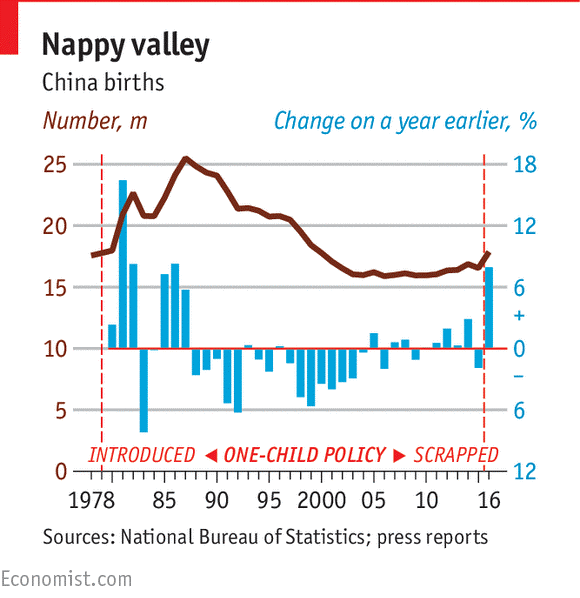
Some countries face gentle downward slopes; others are on cliff-edges. Both China and France are gradually losing working-age people. But, whereas numbers in France are expected to fall slowly over the next few decades, China’s will soon plunge—a consequence, in part, of its one-child policy. The number of Chinese 15- to 64-year-olds, which peaked at just over 1bn in 2014, is expected to fall by 19m between 2015 and 2025, by another 68m in the following decade, and by 76m in the one after that (see chart 1).
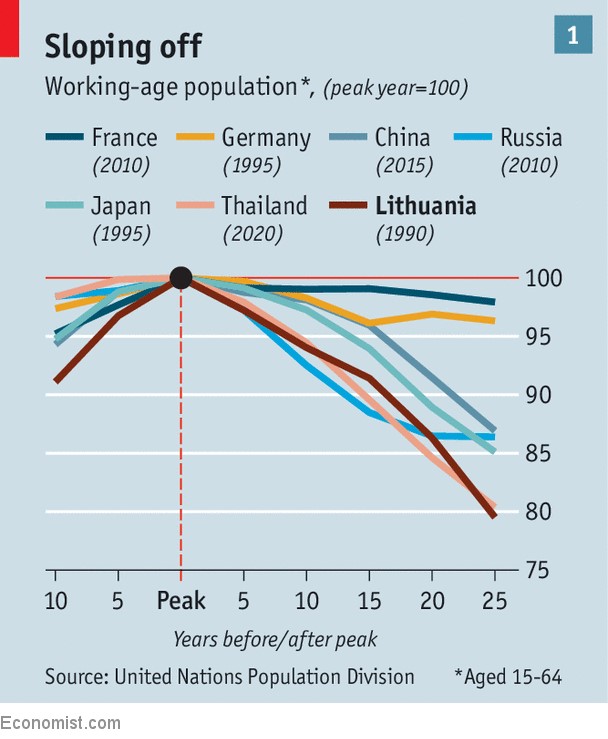
sloping off

Jörg Peschner, an economist at the European Commission, says that many countries face demographic constraints that they either cannot or will not see. He hears much debate about how to divide the economic cake—should pensions be made more or less generous?—and little about how to prevent the cake from shrinking. Yet countries are hardly powerless. Even ignoring the mysterious business of raising existing workers’ productivity, three policies can greatly alleviate the effects of a shrinking working-age population.

Never done

The first is to encourage more women to do paid work. University-educated women of working age outnumber men in all but three EU countries, as well as America and (among the young) South Korea. Yet female participation in the labour market lags behind men’s in all but three countries worldwide. Among rich countries, the gap is especially wide in Greece, Italy, Japan—and South Korea, where 59% of working-age women work compared with 79% of men.

Governments can help by mandating generous parental leave—with a portion fenced off for fathers—to ensure that women do not drop out after the birth of a child. And state elderly care helps keep women working in their 50s, when parents often become needier. But a recent IMF report argues the greatest boost to recruiting and keeping women in paid jobs comes from public spending on early-years education and child care.

Employers can do more too, most obviously by providing flexible working conditions, such as the ability to work remotely or at unconventional hours, and to take career breaks. Fathers need to be able to enjoy the same flexible working options as mothers. Some women are kept out of the workforce by discrimination. This can be overt. According to the World Bank, 104 countries still ban women from some professions. Russian women, for example, cannot be ship’s helmsmen (in order, apparently, to protect their reproductive health). More often discrimination is covert or the unintended consequence of unconscious biases.

Countries can also tap older workers. Ben Franklin, of ILC UK, a think-tank, argues that 65, a common retirement age, is an arbitrary point at which to cut off a working life. And in many countries even getting workers to stick around until then is proving difficult. Today Chinese workers typically retire between 50 and 60; but by 2050 about 35% of the population are expected to be over 60. Thanks to generous early-retirement policies, only 41% of Europeans aged between 60 and 64 are in paid work. Among 65- to 74-year-olds the proportion is lower than 10%. In Croatia, Hungary and Slovakia it is below one in 20.

The levers for governments to pull are well known: they can remove financial incentives (tax or benefits) to retire early and increase those to keep working. Raising the state retirement age is a prerequisite almost everywhere; if the average retirement age were increased by 2-2.5 years per decade between 2010 and 2050, this would be enough to offset demographic changes faced by “old” countries such as Germany and Japan, found Andrew Mason of the University of Hawaii and Ronald Lee of the University of California, Berkeley.

Employers, too, will have to change their attitudes to older workers. Especially in Japan and Korea, where they are most needed, workers are typically pushed out when they hit 60 (life expectancy is 84 and 82 respectively). Extending working lives will require investment in continued training, flexible working arrangements, such as phased retirement, and improved working conditions, particularly for physically tough jobs. In 2007 BMW, a German carmaker, facing an imminent outflow of experienced workers, set up an experimental older-workers’ assembly line. Ergonomic tweaks, such as lining floors with wood, better footwear and rotating workers between jobs, boosted productivity by 7%, equalling that of younger workers. Absenteeism fell below the factory’s average. Several of these adjustments turned out to benefit all employees and are now applied throughout the company.

A final option is to lure more migrants in their prime years. Working-age populations are expected to keep growing for decades in countries such as Australia, Canada and New Zealand, which openly court qualified migrants. Others can try to entice foreign students and hope they stick around. Arturas Zukauskas, the rector of Vilnius University, thinks that he could improve greatly on the current tally of foreign students—just 700 out of 19,200. In particular, he looks to Israel, which has the highest birth rate in the rich world. Lithuania had a large Jewish population before the second world war, and many prominent Israelis have roots in the country. Partly to signal the academy’s openness, Vilnius University has started awarding “memory diplomas”, mostly posthumously, to some Jewish students evicted on Nazi orders.

The trouble is that the countries with the biggest demographic shortfalls are often the most opposed to immigration. For example, the inhabitants of the Czech Republic and Hungary view immigrants more negatively than any other Europeans do, according to the European Social Survey. Those countries’ working-age populations are expected to shrink by 4% and 5% respectively between 2015 and 2020. Countries that lack a recent history of mass immigration may have few supporters for opening the doors wider. Even if they wanted new settlers, they might have to look for them far afield. Countries with shrinking working-age populations are often surrounded by others that face the same problem.

“China has never been a country of immigrants,” explains Fei Wang of Renmin University in Beijing. It is unlikely to become one, but is trying to lure back emigrants and to attract members of the ethnic-Chinese diaspora. In February the government relaxed visa laws for “foreigners of Chinese origin”. In Shanghai, and perhaps soon in other cities, foreign-passport holders are allowed to import maids from countries such as the Philippines. That is a small step in the right direction.

italian jobs

Just as countries’ demographic challenges vary in scale, so the remedies will help more in some countries than in others. Take Italy and Germany. Both have shrinking working-age populations that are likely to go on shrinking roughly in parallel. But Italy could do far more to help itself. Because the women’s employment rate in Italy lags so far behind the men’s rate, its active population would jump if that gap closed quickly—and if everybody worked longer and became more educated (see chart 2). Germany could do less to help itself, and Lithuania less still.

In theory, every rich country can prise open the demographic trap. Governments could begin by lowering barriers to immigrants and raising the retirement age. They could entice more women into the workforce. They could raise the birth rate by providing subsidised child care, which would create a wave of new workers in a couple of decades, just when the other reforms are petering out. But, when a country is shrinking, many things come to seem more difficult. Earlier this year, Poland built up a large backlog of immigration applications, many of them from Ukrainians. It turned out that the employment offices were badly understaffed, and could not process the paperwork in time. They had tried to take on workers, but failed.

This article appeared in the International section of the print edition under the headline “Small isn’t beautiful”


Why people are working longer

Labour-force participation rates are rising for older people in advanced economies

carpenter

The Economist explains

Jun 11th 2018

THE golden years of retirement, when decades of toil are traded for some downtime, are starting later. In the mid-1980s, 25% of American men aged 65-69 worked; today, nearly 40% do. The situation is the same for younger men. In 1994, 53% of 60- to 64-year-olds worked; now 63% do. American women are working longer too, and similar upticks have been witnessed in Japan and other parts of western Europe. Since unhealthy workers tend to retire earlier, many attribute the ageing workforce of today to improvements in health. Mortality rates for American men in their 60s have declined by 40% since 1980; for women, they have fallen by 30%. Education and occupation are also relevant. In countries of the OECD, the share of 55- to 64-year-olds with a college education has increased in the past three decades, and better-educated people tend to work longer, doing white-collar jobs. In a similar vein, the fact that modern jobs in general are less physically taxing than those of yore allows all people to work for longer or look for jobs suitable to their advancing years.

But these are not the primary drivers of the greying workforce, suggests Courtney Coile, an economist at Wellesley College. Social-security reforms and other institutional changes play a central role. In recent decades, many countries and companies have altered the way they fund pensions. About half of Americans working in the private sector participate in employer-sponsored plans. In the 1980s a third of these were “defined benefit” (DB) schemes, under which a company pays its retired employee a predetermined lump sum depending on tenure, age and past earnings. Now, though, “defined contribution” (DC) plans, for which employees contribute a percentage of their paycheques to their retirement fund, have largely supplanted DB plans. These are generally lower than DB pensions (hence their popularity with employers), so their recipients cannot afford to retire so early. By working longer, they increase the size of the pot. Researchers reckon the growth in DC plans has led to a five-month increase in the median retirement age.

Reductions in the generosity of social security and disability insurance have also had an impact. Since the 1990s, Italy, Germany, Japan and others have raised the minimum age at which citizens can accept retirement benefits. The labour-force participation rates for older workers there have risen in lock-step, with a one- to two-year lag. A final factor is the increased number of women in the workforce: about 44% more hold a job now, across 12 developed countries, than in 1995. And, like men, they are working longer. Given that married couples often retire at the same time, this “co-ordination”, which sees men working longer to keep up with Stakhanovite wives, can have profound effects. In Canada, for example, it could explain around half the change in the labour-force participation rates of married men aged 55-64.

This is good news. The “lump of labour” fallacy holds that older workers threaten economic prosperity by crowding out younger workers. (The same argument had been used to exclude women from the workforce.) In fact the economies of many countries with ageing workforces are growing quite quickly. Older workers use their wages to buy goods and services made by other workers. And as Lisa Laun of Sweden’s Institute for Evaluation of Labour Market and Education Policy points out, with more workers, of whatever age, tax revenues and pension contributions rise. That means a larger pie for everyone.

Not much leeway Singaporeans are in the dark about their next prime minister

Not that their views count for much

lee hsien loong

Print edition | Asia

Apr 25th 2018 | SINGAPORE

A PILLAR of stability, Lee Hsien Loong, son of Singapore’s independence leader, Lee Kuan Yew, has run the country since 2004. Despite a decline in his party’s popularity, the manicured electoral system has returned him to office time and again, most recently in 2015. The country is now more than halfway to the next election, which must be held in 2021 at the latest. As it nears, a tricky subject looms: who will replace Mr. Lee? He plans to step down as prime minister ahead of his 70th birthday in 2022. The question has the government on edge.

Mr. Lee will almost certainly win the next election. The ruling People’s Action Party has held power since before independence in 1965. It holds 83 of the 89 elected seats in Singapore’s parliament. Predicting the identity of the next prime minister is trickier. But a cabinet reshuffle this week provided clues. Three older ministers, all in their 60s, stepped down. Younger ones won more responsibility.

Mr. Lee’s possible successors include Heng Swee Keat, the finance minister, Ong Ye Kung, the education minister and Chan Chun Sing, newly promoted from the prime minister’s office to the Ministry of Trade and Industry. Mr. Heng, who has led the education ministry and the Monetary Authority of Singapore, as well as serving as an aide to Mr. Lee’s father, is regarded as the frontrunner. One former official praises him for his growing ease in the public eye, despite not being “a natural politician”. Wonkiness does not tend to hold Singaporean politicians back. His health, however, might: he suffered a stroke in 2016.

Public opinion is unlikely to play much part in the decision. In fact, the government is further crimping freedom of speech in a country not exactly known for it. In March parliament passed a law that allows police to ban the dissemination of videos or pictures of certain events. The sorts of incidents that qualify range from terrorist attacks to demonstrations that block pavements or disrupt business. Plans to put cameras linked to facial-recognition software on more than 100,000 lampposts will further discourage even the most respectable protests. Social media are also being scrutinized by a parliamentary committee which wants to fight “deliberate online falsehoods”. Whoever ends up in charge, the government will be well defended against unruly critics.

This article appeared in the Asia section of the print edition under the headline “Not much leeway

Haiyan Zhang

By Haiyan Zhang

Technical Director, Canada Wood Shanghai

May 30, 2018

 speakers Shanghai.jpg

Fire safety symposiums held in Shanghai and Beijing

Guest speakers at the event venue in Shanghai on April 27th.

Canada Wood China joined European Wood to hold symposiums on fire safety in timber structures. The first was in Shanghai on April 27th while the second was in Beijing on April 28th.

The seminars attracted more than 400 industry professionals including researchers, designers and developers. Five guest speakers from Canada, Europe and China gave presentations on fire safety attributes in modern timber structures. They also shared insight into the history and evolution of fire safety code requirements for timber structures in Canada and Europe. The latest in fire research, alternative solutions in fire safety design, and fire safety codes for timber structures in China were also discussed.

delegates shanghai.png

Audience members listen to a presentation at the event venue in Beijing on April 28th.

Officials from the Canadian Embassy, Canadian Consulate in Shanghai and MOHURD attended the seminars and made opening remarks.


Japan Housing Starts Summary for February & March 2018

By Shawn Lawlor

shawn lawlorDirector, Canada Wood Japan

May 30, 2018

Total February housing starts edged down 2.6% to 69,071 units. Wooden starts fell 3.2% to 38,340 units. Pre-fab housing fell 8% to 10,063 units. Post and beam housing declined 3.2% to 29,070. Platform frame starts fell 3.0% to 8,255 units. The decline in 2×4 starts was primarily attributable to a 5.9% decrease in multi-family rentals. Platform frame custom ordered and built for sale spec housing gained 0.8% and 4.4% respectively.

March housing activity decelerated significantly with an 8.3% drop in total starts. Rental housing fell 12.3% compared to owner occupied single family starts which dropped 4.2%. Total wooden housing retreated 4.3% to 39,736 units. Post and beam starts fell 4.3% to 30,106 units. Wooden pre-fab fell 4% to 911 units. Platform frame starts fell 4.4% to 8,719 units. As with the previous month, results for platform frame were dragged down by weakness in rentals; single family starts showed gains. Platform frame rentals fell 9.1% to 5,385 units, custom ordered single family homes increased 3.0% to 2,226 units and built for sale spec homes increased 7.4% to 1,086 units.

Japan Economic Update

By Shawn Lawlor

Director, Canada Wood Japan

May 30, 2018

According to Cabinet Office date, Japan’s first quarter GDP slipped by 0.2%, thereby ending two consecutive years of continuous growth. The decline was attributable to flat consumer spending and a slight decrease in capital investment. The majority of analysts contend that this decline is a temporary blip and that economic fundamentals remain strong. A tightening labour market resulted in a 1.3% year increase in average wages and inflationary pressures are picking up. Improved capital spending and exports are expected to Japan’s GDP is expected to return into positive territory for the balance of the year.


Leading Architectural Firm and Prefabricator in Korea Join Forces for the Creation of Industrialized Wood Frame House

By Tae Hwang

HwangProgram Manager / Market Development & Market Access, Canada Wood Korea

May 30, 2018

Gansam Architects & Partners, one of the top 10 architectural firms in Korea and Refresh House, the leading prefabricator-builder-developer of energy efficient wood frame houses, have joined their efforts together for the creation of small ready-to-order wood frame structure called “Off-site Domicile Module” or ODM. The ODM, with slogan of “Small but Enough,” has footprint of 7.25-meter x 3 meter rectangular shape with 20 m2 of floor area.

Several types of the module designed by Gansam will be built completely and entirely under the roof of Refresh House’s factory and can be transported to sites. The Nest, pictures shown in this article, is designed as small home consists of sleeping and living area, kitchen and bathroom. And other types for different uses include canteen, pop-up store, exhibition, café,etc. Also, you can order single module or two modules which can be joined at the site for more space.

Industrialized construction, off-site construction or prefabrication is gaining momentum in Korea as the weather dependent traditional site building is getting less and less productive due to harsher weather arising from climate change and the shortage of skilled labours combined with rising wages.

Korean Architecture Fair demos

Japanese-style housing projects planned

Update: June, 25/2018 – 14:56

TWGroup Corporation and Japan’s Hinokiya Group Co. on June 22 sign an agreement to develop housing and other projects in Việt Nam. — VNS Photo

Viet Nam News

Valora-Kikyo-Villa-overview-1-1170x0-c-center.jpg

HCM CITY — TWGroup Corporation and Japan’s Hinokiya Group Co. have signed an agreement to develop housing and other projects in Việt Nam, starting off with a Japanese-style housing project in HCM City next year.

The low-rise residential project will have intelligent solutions enabling residents to live close to nature.

TW said in a press release that the outstanding elements of the project would include a relaxing onsen area – a Japanese hot spring for dipping in the buff — and a Japanese-style park with fresh greenery.

Lê Cao Minh, general director of TWGroup, said: “Hinokiya is a leading corporation of Japan, a pioneer in bringing solutions to improve the quality of life.

“After contacting Hinokiya leaders and visiting their projects in Japan, we are really convinced by their convenience, intelligence, safety, and, especially, the humanity.

“Hinokiya builds not only housing but also pre-schools and nursing homes for old people.”

Hinokiya said it fully believed that the experience of both parties would create projects bearing their own marks, meeting the needs of customers for ideal living spaces.

The company, established in 1988, designs, builds, and sells houses; undertakes renovation, expansion, and reconstruction works; offers real estate brokerage services; leases houses; provides real estate investment and lease management consultancy, and produces and sells thermal insulation materials.

It also operates nursing and childcare facilities.

TWG has interests in property, construction, construction consultancy, education, and healthcare. — VNS

Chinas belt and Road

China’s ambitious Belt and Road Initiative, formally announced in 2013, has revived the country’s ancient concept of the Silk Road.

Highlights

◾Despite its success in the developing world, Beijing’s approach to the Belt and Road Initiative has raised concerns over corrupt practices and financial sustainability in several recipient countries.

◾Beijing’s ambitious outreach, and its hidden agenda for strategic expansion riding on the initiative, will continue to fuel skepticism, suspicions and resistance among core powers.

◾Ultimately, given the sheer scale of the Belt and Road Initiative, snags, delays and cancellations are to be expected.

Since it began in 2013, the Belt and Road Initiative has become the centerpiece of China’s domestic and foreign policy, jump-starting diplomatic, financial and commercial cooperation between China and more than 70 neighboring countries across the Eurasian landmass. When complete, the massive infrastructure project will increase China’s overland and maritime connectivity to other regions, extending its trade and technology to new markets. The initiative also gives Beijing the opportunity to offload some of its excessive industrial capability, facilitating the necessary domestic industrial reforms it needs to establish a more stable economy.

In the past five years, China has spent at least $34 billion on the Belt and Road Initiative, focusing primarily on connectivity projects such as railways, ports, energy pipelines and grids. And though China has made major progress toward its long-term goals, it has also experienced several delays and setbacks. Given the sheer scale of the Belt and Road Initiative and how many large projects it encompasses, hold-ups, cancellations and failures are to be expected. But the causes of delays, in some cases a result of increased skepticism and resistance to China’s strategic aims, will continue to shape the future development of the Belt and Road Initiative.


The Big Picture

China’s ambitious Belt and Road Initiative, formally announced in 2013, has revived the country’s ancient concept of the Silk Road. Stratfor has closely tracked the development of this continent-spanning project, and in 2017 they published a four-part series discussing the underlying motivations behind this grand initiative — and the challenges it faces. Now that the Belt and Road Initiative has entered its fifth year, Stratfor is taking the time to examine the current state of the project and how its challenges will impact the way we analyze the initiative in the coming year

See China in Transition

Strategic Partnerships

Though one of Beijing’s stated goals is to foster inclusive Eurasian integration with the Belt and Road Initiative, its scheme so far has focused on the developing world, particularly countries in Central and Eastern Europe, South and Southeast Asia and Central Asia. It has achieved only limited success drawing developed states, such as Japan, and core European powers into the Belt and Road project. After all, though they may share business interests with China, they also maintain a strong and growing skepticism about Beijing’s means of increasing its competitiveness and its agenda for strategic expansion on the global stage.

According to a survey covering primarily emerging and transitional economies, Chinese financing — such as the Silk Road Funds and the Asian Infrastructure Investment Bank — provides a more significant boost to the majority of Belt and Road countries than their own domestic financing or even, in many cases, the International Monetary Fund, the World Bank and other international financing institutions.

China has many reasons for focusing on developing nations with strategic positions. And the developing countries themselves, which in many cases have weak economic foundations and governance, have been extremely welcoming to the Belt and Road Initiative. Many of these countries — 11 of which have been identified by the United Nations as the world’s least developed, such as Laos, Tanzania and Djibouti — have major infrastructure deficits but are eager to avoid the kind of restrictive, strings-attached financing offered by Western institutions. Since China’s approach to funding emphasizes non-interference and is generally unconditional and indiscriminate of regime, Beijing has achieved more access and goodwill than is usually given to its Western competitors. China’s methods to draw these smaller countries into its Belt and Road framework also offer them a way to leverage their strategic positions and balance regional powers such as Russia, the European Union and India.

Domestic Complications

China’s aspirations with the Belt and Road Initiative have increasingly been constrained by its own approaches and strategic objectives. Though the Belt and Road gained great success in the developing world, challenges over financing capabilities and political instability in the recipient states have repeatedly caused delays and even cancellations. This has been the case with several transportation and energy projects in countries such as Kazakhstan, Bangladesh, Myanmar and Pakistan. Beijing also had the unlikely hope that it could link several war-torn states, such as Afghanistan and Yemen, but that will certainly not happen in the foreseeable future.

Moreover, China’s partnership and perceived support for partner countries’ ruling regimes have led to domestic political polarization, opposition and international criticism. In some cases, leaders of these states have used the Belt and Road Initiative in service of their domestic political agendas, leveraging Beijing’s international clout to further their own international interests. And more significantly, corrupt governments have used Chinese funds for their own personal and political benefit.

Problem Countries

Problem Countries

problem Countries 2

Political corruption and instability have not only invited judgment but have also put Belt and Road projects at risk of delay. In Malaysia, for example, a game-changing May election turned several China-backed infrastructure projects into centerpieces of the political discourse. The new ruling power in Kuala Lumpur aims to investigate investments to not only delve into the corruption of the former government but to reduce its debt burden. Although Beijing’s policies are mostly to blame for such complications, China has also been frustrated by the liabilities caused by corrupt regimes. For instance, despite early investment, China has had to hold back some of its projects in politically risky countries such as Djibouti and Venezuela.

Finally, China’s eagerness to draw in partner countries provides these governments with leverage as they attempt to win investment from China’s rivals. Countries such as Thailand, Indonesia and some South Asian states, in particular, have been able to encourage Japan and India to compete with China over railways and hydropower projects at home, dampening Beijing’s objective of becoming the most influential regional power.

Debt Concern, or Debt Strategy?

China’s approach to debt financing in key strategic projects has also led to pushback, mainly over Beijing’s level of influence. For example, the East Coast Rail Link in Malaysia and the deep-water Kyaukpyu port in southern Myanmar are currently under review by the recipient governments, which are already critical of Beijing’s goal of securing supply routes other than the Strait of Malacca. Like Malaysia, Myanmar is concerned about the possibility of ending up in a “debt trap,” where China holds disproportionate control over the nation’s economy. After all, the $9 billion Kyaukpyu project is equivalent to 14 percent of Myanmar’s gross domestic product. As a result, the country is fearful that China could ultimately exert its influence to gain ownership of the strategically important Kyaukpyu port.

Myanmar’s concern is not unfounded. Both Sri Lanka and Pakistan — governments struggling with debt repayment and financing negotiations — have entered into “debt-for-assets” land-lease agreements with Chinese companies. In Sri Lanka, the Hambantota Port is now leased for 99 years, while areas around the Gwadar Port in Pakistan are leased for 43 years. In other states that already have high external debt or rely excessively on direct Chinese investment — such as Djibouti, Laos, Tajikistan, Kyrgyzstan and Montenegro — Beijing has used different forms of debt relief or forgiveness measures, in some cases resorting to acquiring the recipient country’s natural resources or long-term oil contracts to offset the loans. And speculation is rising over whether China will leverage its financing of strategic deep-water ports in countries like Myanmar and Djibouti to gain an advantage in the Indian Ocean supply routes. Just recently, China established its first overseas naval base in Djibouti.
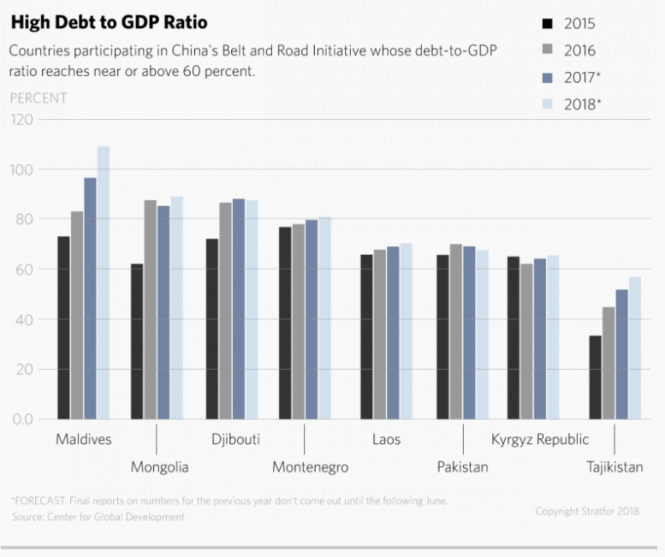
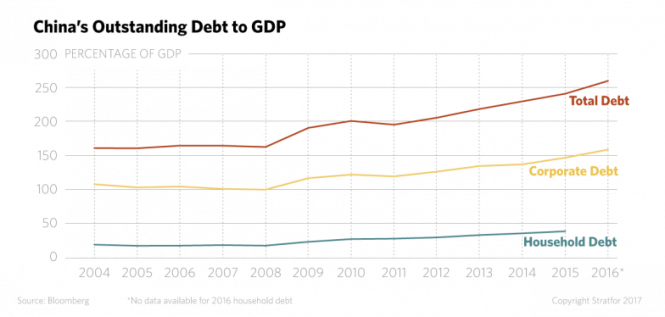
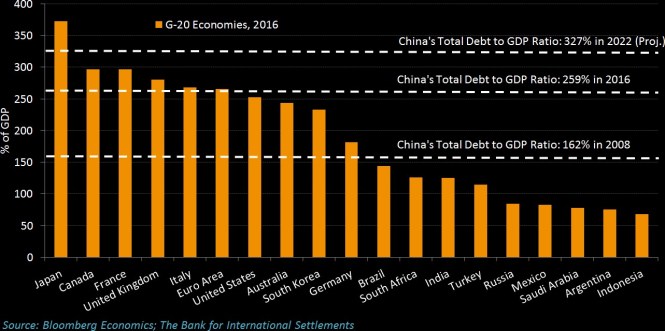
High debt to GDP Ratio

Confronting the Core Powers

There is a growing wariness of China’s strategic intent and expanding influence with the Belt and Road Initiative. Beyond the concerns of developing states, China’s strategic rivals and powers throughout the developed world maintain a strong, if not growing, resistance to the project. Though core regional powers such as India, Russia and some European countries share business interests with China, they also maintain a strong and growing skepticism about Beijing’s means of increasing its competitiveness. And beyond that, China’s hidden agenda for strategic expansion on the global stage.

Despite India’s tactical recalibration to ease its tense relationship with China, New Delhi remains vehemently opposed to the China-Pakistan Economic Corridor. This is seen by India as part of Beijing’s strategy to encroach on the subcontinent and could potentially undermine New Delhi’s claims to the contested Kashmir region. Indeed, India’s opposition has factored significantly in some South Asian states’ strenuous geopolitical balance. For instance, last year Nepal scrapped a $2.5 billion Budhi Gandaki hydropower project, because of Indian concerns.

In Europe, core EU members such as Germany and France have found Beijing’s outreach in Central and Eastern Europe to be more competitive than cooperative, viewing the project as an attempt to dilute the bloc’s rule and agenda. This led to ongoing criticism and increased scrutiny over Chinese investment and projects in Eastern and Central Europe. The proposed railway between Budapest and Belgrade — a key piece of Beijing’s strategy to link to the Mediterranean port of Piraeus — is under review.

Where China’s outreach has received some success in the developed world is in Russia and, to some extent, Japan. Initially suspicious of the Belt and Road Initiative, Russia has grown more amiable as it recognizes how Chinese investment can benefit its own economy and foster development in Central Asian countries over which it exerts significant control. Moscow has begun supporting and even participating in some Belt and Road projects. Most recently, it entered into a co-financing agreement with China for close to 70 projects under its own Eurasian Economic Union, a move that will greatly ease the barriers to Beijing’s investment in some Eastern European and Central Asian countries as well as the Arctic.

Japan, for its part, continues to refrain from openly endorsing the Belt and Road Initiative. But in more tacit ways, the Japanese government is working to encourage its companies to participate in some of China’s projects. This is especially true in areas such as Central Asia and Africa, where Tokyo hopes to boost Japanese corporations’ waning overseas presence.

Looking Forward

Despite these successes, Beijing’s ambitious outreach will continue to fuel skepticism, suspicion and resistance among the core powers and complicate its agenda, especially as it works to hedge against increased pressure from the United States. And China has even inadvertently encouraged loose regional blocs to counter it. Japan and India, for instance, have begun working on an alternative to the Belt and Road Initiative on the African continent, participating in a U.S.-led proposal to establish a quadrilateral framework for infrastructure investment. Elsewhere, Australia is pledging an extensive campaign of aid, trade and diplomacy in the South Pacific, hoping to regain the position it has lost to China in its traditional backyard.

The reality is that none of these countries’ proposals can outdo China’s enormous and well-funded infrastructure plan. They lack China’s capital, human resources and moral flexibility. For participating countries, the long-term benefits of Chinese investment and infrastructure construction in many ways outweigh the risks. So, while investors should be aware that China will continue to experience setbacks in its Belt and Road projects, the initiative is still moving along relatively successfully, as are Beijing’s expansionary aspirations.


Economic scramble for North Korea picks up pace

Pyongyang appears to favour state-guided Chinese model over unfettered capitalismNorth Korea

Bryan Harris in Seoul, Lucy Hornby in Beijing and Demetri Sevastopulo in Washington JUNE 19, 2018

When Donald Trump outlined his vision for the economic development of North Korea, he played on western ideals of luxurious apartments with sea views.

But just days after a landmark summit with the US president, North Korean leader Kim Jong Un has made clear he has a different model in mind: China.

The 34-old-year dictator was set to depart Beijing on Wednesday after a two-day tour aimed at winning China’s financial backing for what Pyongyang says will be a new era of reduced international tensions and domestic economic development.

Scepticism persists about North Korea’s true ambitions, but the renewed optimism has investors salivating over the country’s untapped markets, including its substantial mineral deposits and inordinately cheap workforce.

As the scramble for North Korea picks up pace, however, it is becoming clear that Pyongyang is veering not towards unfettered capitalism but rather a state-guided model along the lines of its huge neighbour.

Beijing — with its long history of friendship and political affinity with Pyongyang as well as its geographical proximity — appears poised to reap its dividend.
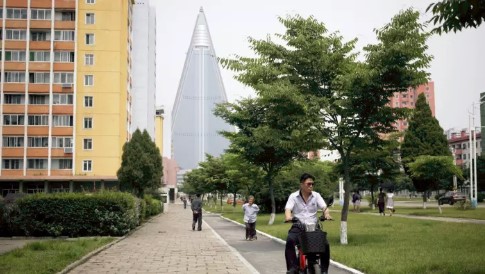
North Korea 2.jpg© AP

“China is eager to encourage the North Koreans to take up the Chinese model because it will bind Pyongyang closer to Beijing and therefore lower the chances of Pyongyang either falling into the US orbit or experiencing a democratic uprising against the Kim regime,” said Dennis Wilder, a former top China analyst at the CIA.

China is holding out the promise of economic development to Mr. Kim if he lowers tensions with the US, Mr. Wilder added.

Long viewed as the last bastion of Stalinist economics, North Korea has undergone a period of quiet but transformative change since Mr. Kim took power in 2011.

The regime introduced agricultural reforms in 2012, legal revisions in 2014 and an overhaul of enterprise laws in 2015 — all of which loosened state control over the market and have contributed to an uptick in wages and the quality of life.

But most of the changes have been spearheaded by ordinary North Koreans, who have found themselves free to eke out a living through private enterprise within the shadows of the state’s hulking institutions.

North Korea 3

Unlike his father and predecessor Kim Jong Il, Mr. Kim has allowed marketisation to flourish and has vowed to pursue economic development. These changes, however, have not been accompanied by political liberalisation.

“He is copying China without admitting it. These are reforms without openness,” said Andrei Lankov, a North Korea expert at Kookmin University in Seoul.

“North Korea wants foreign direct investment. The problem for them now is they don’t know how to get it,” added Prof Lankov, who regularly travels to the reclusive nation.

In this regard, Beijing appears to be willing to offer assistance. Last month, the Chinese Communist party escorted a group of North Korean officials around Beijing to study “reform, opening up and economic development”, according to the Global Times, a Chinese newspaper.

Their trip followed a visit by the Chinese ambassador to Sinuiju, North Korea’s special economic zone near the Chinese border, as part of a broader push by Beijing to promote its model of controlled economic opening.

wage growth North korea.gif

Mr. Kim’s interest in the Chinese model was further highlighted by his inclusion of Pak Pong Ju, a key official spearheading North Korea’s economic reform, in this week’s delegation to Beijing.

“This visit to China was primarily aimed at winning economic support,” said Lee Seong-hyon, researcher at Sejong Institute in Seoul. “China’s economic model is the most viable, realistic option for North Korea and [Chinese President Xi Jinping] must have assured Kim about how North Korea can achieve economic development without risking political stability.”

One part of the model that North Korea has already sought to replicate are the special economic zones (SEZs), which China used effectively in southern cities Shenzhen and Zhuhai.

North Korea operates more than 20 SEZs, mostly in its border regions, although few have attracted foreign investment.

Even before the implementation of international sanctions, the attractiveness of the zones was undercut by entrenched North Korean bureaucracy, a lack of infrastructure — including electricity and roads — and the fear that assets could be expropriated.

av ratio offical_unofficial jobs to total income

“Sometimes they even put these SEZs in the middle of nowhere, so they could not cause a political disturbance,” said Prof Lankov.

“North Korea always wanted investment but on its own conditions. China used to be annoyed by these conditions. But now that Beijing is in a trade war with the US, it may accept.”

Lee Sung-yoon, a Korea expert at Tufts University, cast doubt on the scope of economic reform in North Korea, saying that Mr. Kim only sought “controlled SEZs which are more like enclaves for generating foreign currency”.

“Genuine reform and opening would entail liberalising banking and the private sector [and increasing] transparency in finance and trade — all anathema to long-term regime preservation,” he added.

South Korea is also anticipating economic liberalisation and the lifting of sanctions.

Recommended

North Korea nuclear tensions

mr_kim_mr_Xi

Kim Jong Un visits Beijing after Trump summit

The Moon Jae-in administration has already outlined to Mr. Kim its plans to develop rail routes along North Korea’s east and west coasts, which could integrate the reclusive nation into the wider region.

The country’s dominant conglomerates, meanwhile, have established task forces to probe opportunities in the North amid concerns about the longer-term economic outlook in South Korea.

According to a survey of 167 businesses earlier this month, almost 75 per cent would be prepared to invest in the North if sanctions were lifted. Companies that stand to benefit, such as steel and cement groups, have seen their stock prices soar in recent weeks.

Shares in Hyundai Cement rose more than 500 per cent between March and June as detente unfolded on the Korean peninsula. US-North Korea summit: a win for Kim Jong Un

“There is a lot of enthusiasm. Maybe too much,” said Chung Yeon-wook, a private banker with NH Investment and Securities.

https://next-media-api.ft.com/renditions/15288169683760/1920×1080.mp4

However, many in Seoul feel that South Korea’s historically adversarial relationship with the North may undermine its prospects.

“The rivalry between China and South Korea [for access to North Korea] has already been there for 10 years. China is now taking advantage of the situation because the North Koreans feel more comfortable dealing with them,” Mr. Chung added. Additional reporting by Song Jung-a

Q3_18 Stratfor forecast

Stratfor Worldview June 7 2018

Overview

China Remains in the U.S. Cross-hairs. The United States will impose tariffs, sanctions and blocks on investment and research in a bid to frustrate China’s development of strategic technologies. China not only has the tools to manage the economic blow, but will also accelerate efforts to lessen its reliance on Foreign-sourced technological components.

Trade Battles Fall Short of a Full-Fledged War. Trade frictions will remain high this quarter as the White House continues on an economic warpath in the name of national security. U.S. tariffs will invite countermeasures from trading partners targeting U.S. agricultural and industrial goods. As Congress attempts to reclaim trade authority, the White House will refrain from escalating these trade battles into an all-out trade war.

Taking the First Big Step with North Korea. Drama will inevitably surround the negotiation, but the United States and North Korea have a decent shot at making progress toward a political agreement this quarter, something that will set the stage for much thornier and lengthier technical discussions on denuclearization. Even if talks appear to break down in the coming months, Pyongyang will avoid more aggressive measures in the near term while working to maintain diplomatic and economic momentum with China and South Korea.

Tremors in Europe. The new Eurosceptic government in Rome will hold off on threats to leave the Eurozone for now, but will be seeking allies in southern Europe to battle Brussels on fiscal deficit and debt rules. Divisions within the British government will meanwhile raise the potential for Parliament to take more control of the Brexit process to keep the UK in the customs union.

All Eyes on Riyadh. As Iran’s major European and Asian clients negotiate waivers with the U.S. in return for reducing oil exports from Iran, the United States will be looking to Saudi Arabia to coordinate with major oil producers to make up the supply gap. Riyadh will nonetheless be cautious in planning a market intervention as it aims for a higher price band in anticipation of the Saudi Aramco IPO.

Moscow Tries to Break a Stalemate with Washington. Poland and other borderland states will make appeals for stronger security guarantees from Washington while they still have the United States’ attention. Moscow will try to break a negotiating stalemate with the U.S. to talk sanctions, military build-ups and arms control by promoting its mediation in the Syrian conflict and its potential utility in North Korean denuclearization. Don’t hold your breath for a breakthrough, though.

Polarizing Allies. In harnessing the power of tariffs and extraterritoriality in sanctions, the United States will polarize many of its security allies in Europe and Asia — strategic partners that Washington needs to counterbalance the emerging threat from China and Russia. Attempts to target Russia’s strategic relationships will call into question the long-term reliability of the U.S. as a defense partner and invite heavy push back from Turkey, Vietnam, Germany and India, in particular.

Iran’s Return to the ‘Resistance Economy.’ As the limits of EU economic safeguards are exposed, Tehran will cautiously walk back its commitments to the JCPOA while seeking out willing partners to circumvent sanctions. Russia will take advantage of Iran’s rising vulnerability to deepen its military ties with Tehran while mediating between Iran and Israel in Syria.

The Big Turkish Gamble. Turkey will be a big feature of the third quarter following a precarious electoral gamble by Turkish President Recep Tayyip Erdogan. Erdogan has the tools to eke out a win and whip up a nationalist reaction to any outside questioning of the vote, but the highly polarized country will remain on shaky economic ground amid worsening relations with the West.

Votes against the Status Quo. Mexico’s populist candidate stands a chance of winning big in July elections, which could pose a threat energy and education reforms while further complicating NAFTA talks. A strong anti-establishment current will also be on display in Colombia, where the FARC peace deal is under threat, and in Brazil and Argentina, where the appetite for economic reform will plummet.

Key Trends

The Constant Battle Against Unpredictability

As the United States enters the long summer stretch before midterm congressional elections in the fall, the midpoint of Donald Trump’s presidency will also come into sight this quarter. And after a particularly suspenseful spring of sanctions, tariffs, Cabinet changes and summit surprises, the U.S. president has only reaffirmed to the world his reputation for bending constraints toward a particular policy end — even if the means to that end cause considerable collateral damage at home and abroad.

And so, with several negotiations still pending — including discussions over the fate of the Korean Peninsula and high-stakes trade talks — a world weary from grappling with the fitful superpower is bracing itself for another quarter of whiplash from White House maneuvers.

The world is muddling through a blurry transition from the post-Cold War world to an emerging era of great power competition.

 But while Trump thrives on unpredictability as his chief negotiating tactic, many of his moves fit quite neatly— Even predictably — in the context of the United States’ great power rivalry with China and Russia. The United States’ intensifying economic pressure on China, its harder-hitting sanctions on Russia and its growing support for critical borderland states, such as Taiwan, Ukraine and Poland, are all a part of this budding competition. Even the U.S. search for a way to reunify and denuclearize the Korean Peninsula is a piece of a broader long-term strategy to balance against China.

Yet the United States is creating bigger distractions for itself in the Middle East with Iran while putting stress on the very alliances it needs in its global competition with China and Russia. Although the contradictions in U.S. policy are taxing much of the world, this prolonged state of confusion is par for the course as the world muddles through a blurry transition from the post-Cold War world to an emerging era of great power competition.

U.S.-China Competition Builds

Narratives casting China as an economic imitator, as opposed to an innovator, are out of date. As the country grows more economically advanced, focusing its attention on game-changing technologies, the United States will heighten its economic scrutiny on China — and squeeze numerous companies along U.S.-Asian supply chains in the process. This dynamic will endure well beyond the quarter and the Trump presidency. In the name of national security, the executive and legislative branches of the U.S. government will continue to target China’s Made in China 2025 strategic development program through various means, including tariffs, sanctions and restrictions on investment and research. U.S. companies, particularly those involved in sensitive technology sectors, will face growing risk and uncertainty over the potential for export controls and for closer monitoring of foreign investments.

Specific measures to watch for in the third quarter include a special investment regime for Chinese companies designed to block investment into sensitive areas like robotics, telecommunications, semiconductors, artificial intelligence (AI), virtual and augmented reality, and new energy. The White House already has announced its intention to impose tariffs on up to $50 billion worth of Chinese industrial technology goods under a Section 301 investigation into Chinese intellectual property and technology theft. (More details are expected June 15.) The United States will apply tight scrutiny to outbound investment to or informal collaboration with Chinese companies, especially in high-tech sectors. Telecommunications firms Huawei and ZTE are already feeling the pressure; the U.S. Commerce Department has slapped hefty penalties on ZTE, while Huawei is under investigation by the Justice Department. In addition to those companies, the United States could expand its net to ensnare tech giants like Baidu, Alibaba and Tencent, launching investigations into web services they provide. Washington is also likely to impose visa restrictions on Chinese researchers and students in the United States.

U.S. pressure will only make China more determined to accelerate its drive to forge its own supply chains for sensitive technologies.

 Deepening U.S.-China economic competition, however, does not guarantee a trade war, in which tit-for-tat trade measures escalate with no clear end in sight. China, along with the European Union,

Japan and other major U.S. trade partners, is trying to avoid destabilizing the global economy more severely. The United States, meanwhile, despite an apparent penchant for picking trade spats, will run into political constraints that will avert a worst-case scenario. Washington and Beijing alike will eventually make concessions to justify dialing back their more extreme tariff threats. Still, the negotiations will be bumpy.

There are hard limits to what each side can concede, and Chinese compliance is not assured, leaving the door open for some tariffs, and retaliatory measures, to shake out this quarter.

Internal White House dynamics will also be key to watch in tracking the progress (or lack thereof) in trade negotiations. Treasury Secretary Steven Munchkin and White House economic adviser Larry Kudlow will push for a compromise that minimizes collateral damage, while economic adviser Peter Navarro and U.S. Trade Representative Robert Lighthizer drive a much harder, and perhaps impossible, bargain with China. In the lead-up to U.S. midterm elections, the White House will probably be more sensitive to retaliatory tariffs targeting the U.S. farm belt, where support for Trump was strong during the 2016 presidential race. Tariffs on smaller crops such as cranberries and ginseng, for example, could hit a political nerve in Wisconsin, a state in which the farming vote could make a big difference.

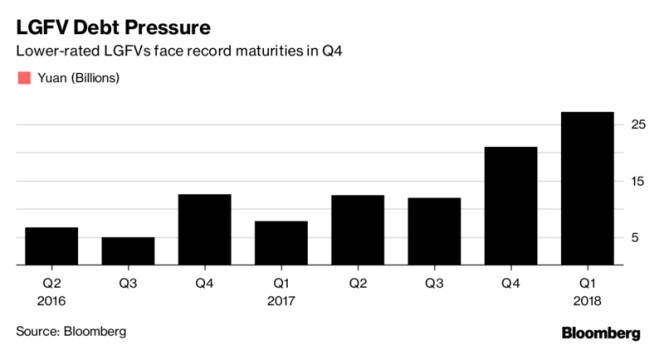
Even as the negotiation inches ahead, the United States won’t prevent China from providing heavy, focused support to Made in China 2025 sectors. The U.S. pressure will only make China more determined to accelerate its drive to forge its own supply chains for sensitive technologies. China will, however, be willing to negotiate ways to increase U.S. imports, including of energy, semiconductors, vehicles and agricultural products; to partially liberalize certain sectors, such as the financial sector; to reduce some trade barriers for imported vehicles; to enhance intellectual property protection rights; and to restructure state-owned enterprises as part of its reform drive. Even if the United States hits it with tariffs this quarter, China has the political and economic means to withstand the blow at home [10]. A growing number of maturing corporate bonds will add to the financial strain on local state-owned and private enterprises, but Beijing will inject liquidity selectively to ease the pain, particularly in central and northeastern China, and to manage any fallout.

A Framework for North Korean Denuclearization

Trump and North Korean leader Kim Jong UN will meet face-to-face June 12 for a much-anticipated summit in Singapore]. While there will be moments throughout the process where it appears as if the whole     dialogue is collapsing, there is reason to believe that the negotiation will still have legs by the end of the quarter. Our focus will not be so much on the drama to come — the typical walk-outs,

Name-calling and muscle-flexing — as Trump and Kim battle to prove who can play the unpredictability card most effectively in the talks. Setting aside the theater of the negotiation, the fundamental question for the quarter is whether both sides will muster enough political will to develop a framework for denuclearization. If a dialogue advances, it will likely start with freezing nuclear development, leaving room to tighten the screws on denuclearization over time. Just as the United States is unwilling to offer North Korea instant regime security, North Korea will negotiate denuclearization only over a long period of time.

Compared with previous efforts at negotiation, the stakes are much higher this time around. North Korea is closer than ever to its nuclear deterrent, and if the talks fail, the United States will have invalidated the diplomatic route. The United States would find it difficult to build international consensus to reinstate crippling sanctions on North Korea, much less a consensus to pursue a military option.

If the United States can manage to avoid a military conflict with North Korea, it will be able to apply more resources and attention to reinforcing countries in China’s borderlands.

 But a breakdown in talks with the United States would not necessarily lead North Korea to resume its nuclear testing immediately. Even if the United States walks away, China and South Korea would keep up the diplomatic momentum with North Korea, giving Pyongyang an opportunity to press its neighbors to ease up on their own economic sanctions.

Japan will remain largely on the sidelines of the negotiation], given its frosty ties with South Korea and even frostier ties with North Korea. As trade tensions mount between the United States and Japan over the threat of auto tariffs, Tokyo will do its best to keep them separate from its security partnership with the United States. Japan’s biggest concerns lie in North Korea’s short- and medium-range ballistic missile threats and any short-term shifts to the U.S. force presence on the Korean Peninsula that could also lead to a draw down in Okinawa before it is politically and militarily ready to compete with China. Japanese Prime Minister Shinzo Abe will try to keep a high diplomatic profile this quarter both to try to insert Japan’s security interests into the U.S.-North Korea dialogue and to distract his own constituency from a scandal that threatens his six-year tenure. Should Abe lose the critical contest for the ruling party’s leadership in September, Japan could enter another period in which prime ministers come and go more frequently, creating more uncertainty as the great power competition in the Pacific heats up.

If the United States can manage to avoid a military conflict with North Korea, it will be able to apply more resources and attention to reinforcing countries in China’s borderlands [19]. Though China has managed to ease tensions with the states in its periphery, its continued militarization in the South China Sea will draw the United States into a more active military role in the region to balance it. The United States will increase naval deployments and patrols in the South and East China seas this quarter while working to expand military exercises with members of the Association of Southeast Asian Nations (ASEAN). An increase in U.S. deployments will lead to a period of heightened tension between Chinese and U.S. forces in these waters, and instances of harassment could become more frequent as the rate of close encounters and interceptions increases.

Friction Points in the U.S.-Russia Relationship

Russia’s influence over North Korea will remain limited so long as Washington sustains its diplomatic engagement with Pyongyang through the quarter. If the talks make progress, Russia will try to secure a role in the denuclearization process to make sure it has a seat at the table. And should the talks collapse, Russia will align itself closely with China to resist the United States in the U.N. Security Council on sanctions and military action.

The push and pull between the U.S. Congress and the president on Russia policy [20] can be messy and contradictory at times, but the result tends to be a harder U.S. line on the country. Congress will lean on the Treasury Department to sharpen its aim in targeting Russian elites with an eye toward sowing divisions in the Kremlin without creating the kind of significant global economic blowback that sanctions against Russian aluminum producer Rusal caused in the second quarter [21]. At the same time, U.S. lawmakers will be working to implement the Russia-related provisions of the Countering America’s Adversaries through Sanctions Act [22] (CAATSA) to coerce other countries to reduce their defense, intelligence and energy ties with Russia.

Though the White House has been more reluctant in the past to confront Moscow, secondary sanctions targeting Russia’s defense and energy sales appeal to its business sense by creating more export opportunities for U.S. liquefied natural gas producers. They will also appeal to the United States’ business sense by potentially creating more export opportunities for U.S. defense firms and for U.S. liquefied natural gas producers. Commercial interests, along with a growing U.S. strategic focus on Central and Eastern Europe in its competition with Russia and China, will give Poland, Ukraine and the Baltic states an opportunity to appeal to the White House for stronger security commitments. Warsaw, in particular, will try to advance talks with Washington over a permanent U.S. military presence in Poland, which will in turn cause Russia to up the pressure on Belarus to host a Russian airbase in its borders.

A potential military buildup in Russia’s periphery is one of several factors that could prompt a high-level dialogue, or at least preparations for one, between Washington and Moscow this quarter. Russian President Vladimir Putin has a long list of items ready for when he sits down with Trump, including sanctions, military buildups and stymied arms control talks. Russia will try to use its mediation in the Syrian conflict and offers to help with North Korea’s prospective denuclearization to present itself as a more constructive force. But the White House will engage with Moscow at a high level only if it feels that it has made enough progress on North Korea that it can deflect negative attention from the Russia-related investigations underway. Even if Trump and Putin manage to set up a meeting, the geopolitical environment will not be conducive to a grand bargain.

It will be important to watch how Putin handles the various challenges facing him this coming quarter.

 Having made it to a fourth term in office in elections in March, Putin will have to maneuver carefully among the government, his inner circle and Russia’s powerful oligarchs as the United States dangles the threat of heavy sanctions over them. Efforts to consolidate the assets of Russia’s elite will continue in the third quarter, as the Kremlin works to maintain economic stability and political loyalty. Higher oil prices will help ease some of the strain that honoring social pledges made during the campaign season, increasing security spending and hosting the World Cup have put on the Kremlin’s finances. Competition among the security services remains a key area to watch as Putin balances among rival factions. We’ll also be watching carefully for further signs that the longtime president is elevating younger members of the elite in search of a successor.

The more immediate priority in the quarter will be for Putin to try to take more steam out of opposition protests. In the second quarter, a wave of opposition protests in Armenia that swept longtime leader Serzh Sargsyan from power was another wake-up call for the Russian government and the heads of other former Soviet states: Once a protest movement has gathered enough momentum, not even brute force tactics can quell it. Determined to avoid a similar fate, the Kremlin will work on co-opting opposition leaders into government positions. Opposition leaders like Alexei Navalny are unlikely to fall for this strategy. But figures from other prominent dissident parties — especially those that stand to do well in September’s regional elections, including Yabloko and the Communist Party — may yield to the Kremlin.

Doubling Down on Iran

A big element of the U.S.-Russia competition will also play out in the Middle East. In walking away from the Iran nuclear deal and reinstating hard-hitting sanctions, the White House is hoping against all odds to foment enough economic frustration in Iran to set regime change in motion. Israel, meanwhile, is seizing a rare opportunity to escalate its military campaign against Iranian and Hezbollah assets in Syria, knowing that it has firmer security guarantees from the United States to manage the fallout of a cycle of attacks and retaliatory attacks that risks drawing in Russia. Moscow will plan its next steps carefully with the aim of avoiding a direct collision with the United States while exploiting U.S. and Israeli needs to disengage on the Syrian battlefield. Despite its attempts to mediate between Israel and Iran — in hopes of bargaining on a more strategic level with the United States — Russia’s limited influence on the Syrian battlefield will prevent a lasting truce. Russia also will try to take advantage of Iran’s vulnerability with the United States to deepen its own military footprint in the region. Watch for discussions between Iran and Russia over boosting Iranian air defenses and appeals from Moscow for access to Iranian bases.

Tehran’s focus for the third quarter will be to buy itself as much room to maneuver as possible with those trading partners willing to risk U.S. secondary sanctions. In the immediate term, Iran will take care to avoid aggressive actions that could push the European position closer to that of the United States. But as the limits of the European Union’s economic guarantees become more evident in the coming months, Iran’s internal debate over how to proceed will intensify. Iran will probably still confine retaliatory attacks against Israeli strikes in Syria to the Golan and potentially the Palestinian territories as it tries to avoid a bigger conflagration. It will also test the limits of the nuclear deal and its cooperation with Europe, for instance by threatening to increase enrichment, to limit access to International Atomic Energy Agency inspectors or to withdraw from the Nuclear Non-Proliferation Treaty.

Philippines-Infrastructure-Workers-November-15-2010-630x378

Philippine infrastructure push is unlikely to boost wages as lack of high-paying jobs hinders government’s poverty reduction plan FT Confidential Research JUNE 18, 2018

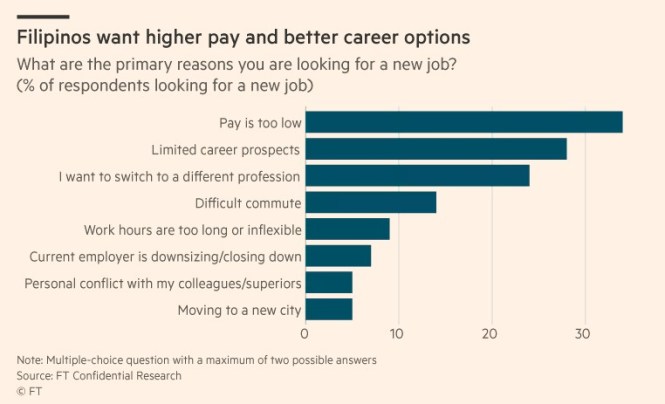
As living costs in the Philippines rise, neither the government nor the private sector can provide Filipinos with higher-paying jobs. Dissatisfied workers demanding more work, more money and better career options threaten President Rodrigo Duterte’s poverty reduction agenda. In our first-quarter survey of 1,000 urban Filipinos, 55 per cent of respondents said they had a “secure” or “very secure” job. The figure is in line with the average for the other ASEAN-5 economies included in the Economist survey. Although the majority enjoy job security, people looking for a new job are having a hard time. Forty per cent of our respondents said they found it difficult to get hired, while only 11 per cent said it was easy. Among job seekers, 34 per cent said they wanted a higher salary, while 28 per cent wanted career growth.
filipnos want hiher wages.jpg

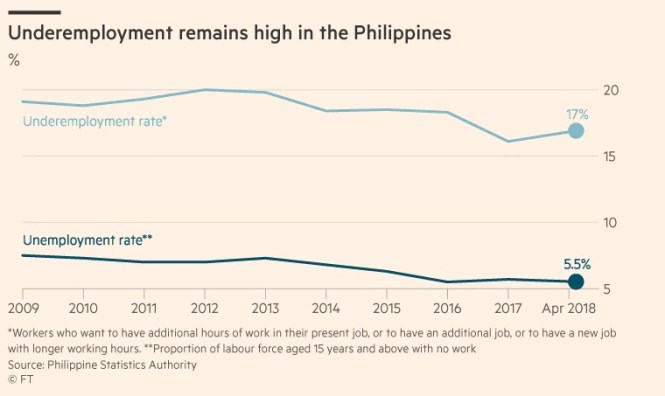
The survey corroborates government data showing that while unemployment is down, underemployment is high. The underemployment rate — defined as those wanting to work longer hours or get an additional job to earn more — rose to 17 per cent in April, from 16.1 per cent the year before.
underemployment remains high.jpg

The Economist sees underemployment as a more formidable challenge than unemployment. In the public sector, Mr. Duterte’s promise to spend up to 8.44tn pesos ($158bn) to fix the country’s dilapidated infrastructure is producing low-paid, temporary construction jobs, incapable of sustaining a typical Filipino family. Private companies, meanwhile, are bracing for wage rises this year that could increase labour costs. This, in turn, is making the Philippines unattractive to private investors, who are critical to the creation of competitive jobs.

Low pay, temporary work

The government’s ambitious “Build, Build, Build” programme aims to generate 6.4m jobs by 2022, mostly by employing low-skilled workers in construction. We think the programme is a good way to absorb poor rural agricultural workers into higher-paying jobs, especially since some of the projects are in regions outside Metro Manila.

jobs

This is all part of Mr. Duterte’s plan to spread wealth beyond Manila. But while the infrastructure push will indeed reduce unemployment, it is unlikely to offer the competitive salaries and permanent positions available in the private sector, or overseas. In fact, government data show that 96 per cent of current vacancies would pay only a minimum wage, below the amount needed for a decent living. In Manila, the minimum wage amounts to 15,360 pesos a month, but wages in poorer areas tend to be lower and fall near the 2015 poverty line of 9,064 pesos.  Although there is no official definition, Ernesto Pernia, the socio-economic planning secretary, recently said that a “decent income” for a family of five would be at least 42,000 pesos a month. This is achievable if two family members are earning 21,000 pesos each, near the average entry-level salary in the booming business process outsourcing industry. Construction jobs are also temporary. Since none of the 75 big-ticket infrastructure projects are under way yet, government contractors concentrate on smaller projects that require fewer workers and are completed in a shorter time. Some bigger projects funded by China are also likely to employ Chinese workers, leaving fewer opportunities for Filipinos. The lack of job security and decent pay make local construction jobs unattractive compared with employment overseas. There is no incentive for skilled Filipino engineers and architects currently working abroad to heed Mr. Duterte’s call to come home and contribute to his nation-building project. This could partly explain why construction jobs remain open, and state projects delayed.

Tough times all round

Poverty also affects households with permanent jobs. The World Bank, in a recent report on the Philippines, found that 54 per cent of poor households are headed by wage earners (as opposed to those who are self-employed). These include university graduates who work for private companies that typically pay more than the government.

Businesses are also operating in a more difficult environment. Accelerating consumer prices and a weaker peso, which hit a 12-year-low against the dollar this month, are increasing operational costs. Central bank data show fewer companies are planning to hire workers in the next quarter and we believe this will only get worse in succeeding months, especially as the government is pushing for a higher minimum wage. The minimum wage level in the Philippines in certain regions is already higher than in more developed Malaysia.

The private sector picture is not encouraging. Infrastructure projects have been delayed and the government plans to reduce tax incentives for investors under its proposed tax reform. As a result, foreign investment in the economic zones where these incentives are offered has fallen to its lowest level since 2010. Never mind tackling underemployment; even sustaining the recent drop in unemployment could be challenging. — Prinz Magtulis, Philippines Researcher,

philippines_copy_1

Economic Snapshot for ASEAN

June 21, 2018

Economic momentum remains solid in Q2 after a positive Q1

The latest indicators suggest that ASEAN’s economy continues to perform well in the second quarter despite swirling global trade tensions, with growth forecast to come in at 5.2% year-on-year. With the exception of Malaysia, manufacturing PMIs for April and May were firmly in expansionary territory across the region, supported by strong domestic demand. In May, Indonesia’s PMI reached a near two-year high, while readings also improved in the Philippines and Vietnam. In Singapore, the indicator has moderated slightly so far in Q2 despite remaining firm, while in April Myanmar’s PMI reached its highest level in the survey’s history before a correction in May.

Other signs corroborate the ongoing momentum, with internal dynamics buttressed by strong labor markets and wage gains. In April, Indonesia saw healthy retail sales growth, while industrial production grew at a robust pace throughout the region. In contrast, the external sector appears to be softening. Import growth is outpacing export growth in many countries, on strong private consumption, higher international oil prices and tough prior-year comparisons for export growth.

The latest GDP readings for the first quarter confirmed regional growth at 5.4%. Comprehensive data for Singapore saw GDP growth revised up, on the back of an expansion in the services sector that was stronger than previously estimated. In addition, the figures point to a broadening of economic momentum towards more domestic-oriented sectors, as well as an incipient recovery in the construction sector. In Thailand, growth was clocked at 4.8% year-on-year in Q1, marking a five-year high and in line with FocusEconomics panelists’ forecasts. The reading was underpinned by higher farming and non-farming incomes, and a recovery in public investment.

On the political front, Malaysia reduced the Goods and Services Tax (GST)—an important source of revenue for the government—to 0% effective 1 June. This should give private consumption a shot in the arm in the short term, at least until a substitute Sales and Services Tax (SST) takes effect from September. However, the move creates fiscal uncertainty. Until the SST is introduced there will likely be a fiscal shortfall, despite the breathing space provided by higher oil prices. In addition, it is unclear whether, once introduced, the SST will raise as much revenue as the GST. To convince investors that it is serious about fiscal discipline, the new administration has moved to reduce infrastructure spending—including scrapping a planned high-speed rail link to Singapore—and trim ministries’ spending and the public sector wage bill.

Thailand is also trying to present a fiscally responsible image; the Junta recently presented a draft budget for FY 2019 aimed at reigning in the budget deficit. Proposed spending is slightly below the FY 2018 budget, although defense spending will receive a notable boost. In contrast, several areas important for future economic development will see spending cuts, including education, agriculture and social development.

 See the full FocusEconomics Consensus Forecast ASEAN report

Economic outlook looks rosy, but trade concerns are rising

Economic growth should remain solid going forward, as the region continues to benefit from resilient domestic demand. Public infrastructure investment in key economies such as Indonesia and Philippines will support growth, while strong labor markets bode well for private consumption. On the downside, external sectors will likely continue to weaken, as export growth eases after a stellar performance in 2017 and higher crude prices raise the import bill. In addition, tighter financial conditions could weigh on activity, while a further escalation of trade tensions between the U.S. and China would hit the generally open economies of ASEAN hard, particularly given the importance of both countries as key export markets. GDP growth for the region is expected to come in at 5.2% this year, which is up 0.1 percentage points from last month’s estimate and matches last year’s expansion.

This month’s upgrade comes on the back of higher 2018 growth projections for Thailand—following a strong Q1 outturn—and the Philippines. In contrast, growth forecasts for the rest of the economies surveyed in the ASEAN region—including heavyweights Indonesia, Malaysia and Singapore—were unchanged from the prior month. For 2019, our panel sees growth at 5.1%.

Our panel projects that Myanmar will be the fastest-growing economy in the region, with a 7.1% increase expected in 2018. Conversely, Brunei is foreseen logging the weakest expansion this year, at 1.4%. Among the major economies in the region, the Philippines will record the fastest increase, followed by Indonesia and Malaysia.

INDONESIA | Economic growth appears firm in the second quarter

The most recent indicators from Q2 suggest that economic activity is picking up from Q1’s muted performance. Retail sales growth accelerated to a ten-month high in April and should remain elevated, as consumer confidence in May improved markedly. The manufacturing PMI increased in May to the best print in almost two years, underscoring the improving health of the sector. Against this positive backdrop in the domestic economy, S&P Global Ratings affirmed the country’s BBB- rating and stable outlook on 31 May. The ratings agency applauded the government’s prudent handling of fiscal accounts and the recent reform that has increased tax collection. Nevertheless, it warned that increasing external financing costs because of faster-than-expected monetary tightening in the United States and modest increases in the prices of Indonesian key exports could cause external buffers to deteriorate and expose the country to economic shocks.

The economy is expected to accelerate slightly compared to last year on faster growth in government consumption and fixed investment. Higher crude oil prices and a modest price outlook for Indonesian commodities, however, are weighing down growth prospects. FocusEconomics panelists see GDP growth of 5.3% in 2018, which is unchanged from last month’s forecast. In 2019, the economy is seen growing 5.4%. 

THAILAND | Growth hits a multi-year high in Q1, data for Q2 suggests continuing momentum

National accounts data showed the economy continued to enjoy a strong run in the first quarter, growing at the quickest pace in five years. This was largely due to strong activity in the domestic economy as private consumption benefitted from an increase in non-farming income. In addition, the external sector remained solid despite a moderation in export growth and a pick-up in import growth on the back of a strong domestic economy. Data for Q2 continues to suggest that the domestic economy is gaining traction, while the external sector is softening slightly. In April, manufacturing growth accelerated, while the country recorded its second trade deficit of the year, owing to strong import growth outpacing double-digit export growth.

Although growth is expected to moderate in the coming quarters, economic growth should remain robust this year due to healthy domestic demand. Export growth is, however, likely to ease due to a large base effect. Looking to 2019, a tight fiscal stance as outlined in the recent draft budget could drag on growth. Risks to the outlook stem from rising trade tensions, mostly coming out of the United States. Furthermore, high household indebtedness and political uncertainty in the lead up to elections to be held no later than February 2019 could drag on economic prospects. FocusEconomics panelists expect the economy to grow 4.2% in 2018, which is up 0.3 percentage points from last month’s forecast. The panel projects growth of 3.8% in 2019.

See the full FocusEconomics Consensus Forecast ASEAN report

MALAYSIA | Economic signs are positive, although fiscal concerns emerge following tax change

Following a robust Q1, the economy appears to have gotten off to a solid start to Q2: Exports jumped and industrial production growth accelerated in April. On the downside, the manufacturing PMI moved further south of the neutral 50-point threshold in May due to weakening domestic demand. The new government reduced the Goods and Services Tax (GST) to 0% effective 1 June. This should provide a boost to private consumption in the short term until the Sales and Services Tax (SST) is introduced on 1 September. However, slashing the GST creates a sizable gap in the budget, raising questions about the government’s finances and whether it will be able to stick to the 2.8% deficit target for 2018. To rein in spending, Prime Minister Mahathir Bin Mohamad has cancelled big infrastructure projects and told ministers to implement austerity measures.

GDP should remain resilient this year on the back of strong private consumption growth, although government consumption is likely to suffer in the near term from the cancellation of previously approved projects and expenditure cuts. Risks are, however, titled to the downside: High household debt servicing costs could drag on private consumption, while uncertainty over government policy and the fiscal situation could dent private sector activity and investment. FocusEconomics Consensus Forecast panelists expect the economy to grow 5.3% this year, unchanged from last month’s forecast, and 5.0% in 2019.

MONETARY SECTOR | Inflation picks up marginally in May

A preliminary estimate by FocusEconomics shows regional inflation accelerated to 2.6% in May from 2.5% in April, on the back of stronger inflation in Laos, the Philippines, Thailand and Vietnam. Price pressures dipped in Indonesia and are still outstanding for the remaining countries in the region. In an unscheduled meeting on 30 May, Indonesia’s Central Bank raised its policy rate from 4.50% to 4.75%, mere weeks after a similar rate hike to 4.50%. The move was designed to support the depreciating currency, particularly given the prospect of the Federal Reserve raising interest rates in mid-June.

Inflation will be supported this year by higher global oil prices and solid domestic activity, although price pressures will remain relatively muted. Our panelists expect inflation to average 2.9% this year, which is unchanged from last month’s estimate and marginally above the 2.8% inflation figure recorded for 2017. Our panel foresees inflation ticking up and averaging 3.1% in 2019.

For more information -please visit this website https://www.focus-economics.com/regions/asean .  Reports available for purchase…

Oliver Reynolds

Economist

Fourth Quarter 2017 Economic and Wood Product News

The year of the fire rooster was a humdinger. Lots of social, political and economic anxiety and uncertainty. The rise of populism working against globalization. 2018 will be very interesting. Happy New Year!

Banyan For Asia, the path to prosperity starts with land reform

Countries that did it properly have grown fastest

land reform

 Print edition | Asia

Oct 12th 2017

NEARLY as striking as Asia’s dynamism is how unevenly prosperity is spread—in contrast to Africa, Latin America or Europe. First-world Japan (with a GDP per person of $38,900) is in effect part of the same island chain as the Philippines ($2,950). Rich Singapore ($53,000) is little more than an hour’s flight from Myanmar ($1,275). On the Korean peninsula, the division is even starker. Two economies that started out in identical circumstances have diverged so wildly that South Koreans are between 3cm and 8cm taller than their North Korean counterparts on average, depending on their age, thanks to better nutrition.

A voluminous literature ponders the causes of the East Asian miracle, in which first Japan, then the four original “Asian tigers”—Hong Kong, Singapore, South Korea and Taiwan—and then China sustained bounding growth for decades. Most studies point to market-friendly policies that encouraged exports of manufactures and the rapid accumulation of capital, including the human sort. Others emphasise the importance of institutions. Yet one crucial factor has been relatively underplayed: restructuring agriculture.

“Land reform” sounds innocuous but involves great upheaval: seizing land from those who have it and giving it to those who do not. Yet radical action may be necessary in countries with big, impoverished, rural populations. As Joe Studwell points out in “How Asia Works”, farm yields often stagnate in such places. As populations grow, making land scarce, landlords jack up rents and lend at extortionate rates. That leaves poor tenant farmers mired in debt, with no means to invest.

China provides a stark example. By the 1920s, a tenth of the population owned over seven-tenths of the arable land. Three-quarters of farming families had less than a hectare. Mao Zedong’s Communists reallocated land in every new territory they seized. After the defeat of the Kuomintang (KMT) in 1949, they rolled out land reform nationwide. Landlords, some with scarcely more land than most, were blamed for everything. In the decade after 1945, millions of them were beaten to death or shot, or left to starve. Revolution, Mao said, was not a dinner party.

The effect was immediate. Grain output leapt by perhaps 70% in the decade after the war. When farmers can capture most of the value of their land, they have a powerful incentive to produce. And while smallholder agriculture is hugely labour-intensive that makes sense when labour is abundant. (Only a few years later the Communists embarked on the madness of collectivisation. China emerged from that disaster in 1978, after Mao died. North Korea is starting to do so only now.)

China’s early success challenged Japan, South Korea and Taiwan. These countries, pressed by America to carry out land reform, showed that it does not require mass murder. By the war, half of Japan’s arable land was worked by tenant farmers, and rent was never less than half the crop. After the war, farm size was limited to three hectares. Land committees on which tenants outnumbered landlords oversaw a reapportionment that took land from 2m households and gave it to 4m others. Compensation fell short (and was gobbled up by inflation), but there was little violence among farmers. Perhaps it helped to be able to blame the occupiers when politely taking over someone’s paddy field. At any rate, agriculture boomed.

South Korea had the most unequal land ownership in the region, and resistance by the elites was strongest. Some landlords lost as much as 90% of their land. But Taiwan under the KMT shows the clearest benefits from land reform, which started with rent controls and reforms to tenancy. Sales of formerly Japanese-owned land followed. Then, in 1953, came appropriation. The share of land tilled by the owner rose from just over 30% in 1945 to 64% in 1960. Yields on sugar and rice leapt. New markets sprang up for exotic fruits and vegetables. Household farmers dominated early exports. Crucially, income inequality shrank thanks to the new farmer-capitalists. Less spent on imports of food, more money in Taiwanese pockets, a new entrepreneurialism: farming was the start of Taiwan’s economic miracle.

Cheap at half the price

Indonesia, Malaysia and Thailand could have followed Taiwan’s example, but didn’t. Their economies have done far worse. With between 25% (Malaysia) and 48% (Thailand) of their populations still living in the countryside, land distribution matters. The state favours agribusiness and plantations over small farmers. There is a yawning gap in income between countryside and city.

The situation is worse in the Philippines, which had a similar income per person to Taiwan’s just after the war. Before independence in 1946, America auctioned off the Catholic church’s huge estates. Only the local elites could afford them. These became the hacienda class that thrives today, forming the basis of many political dynasties. Admittedly, after the People Power revolution (led by Cory Aquino, from one landed family, who married into another), political pressure for land redistribution culminated in a reform law passed in 1988. Nearly 30 years on the law, replete with loopholes, is still being implemented. The operations of many big estates have hardly been affected, while household farmers still lack technical and financial support. Many of those given plots have had to lease them back cheaply to the big planters, becoming wage labourers on their own land.

There are political consequences too. In South Korea and Taiwan inclusive agricultural growth prefigured the inclusive politics of today’s thriving democracies. In South-East Asia, by contrast, cronyism and inertia are consequences of an economy that is unfair to those at the bottom. The Philippines and Thailand have most clearly paid a price, in the form of insurgencies and rural unrest, for keeping poor people down. When weighed against the costs, land reform, done well, starts to look cheap.

This article appeared in the Asia section of the print edition under the headline “Land to the tiller”

Sep 2, 2017 | 15:44 GMT

Will the U.S. Free Itself From a South Korean Trade Deal?

South Korean Trade Minister Kim Hyan-chong

(NICHOLAS KAMM/AFP/Getty Images)

The White House is considering beginning the official withdrawal process from the U.S.-Korea Free Trade Agreement (KORUS) next week, several sources have told Inside U.S. Trade. The online publication noted in a Sept. 1 report that U.S. President Donald Trump has not made a final decision on whether to make the move, but the news source also reported that the draft notice has been written and that several members of Congress have been told it will be announced Sept. 5.

The U.S. trade pressure on South Korea comes as Washington is trying to maintain Seoul’s cooperation in reining in North Korea. The two negotiations have run on parallel tracks, and South Korea is aware that the United States will pursue its trade agenda regardless of Seoul’s cooperation against Pyongyang. However, trade has the potential to drive a wedge between the two allies, particularly as South Korea mulls the pursuit of a softer stance toward the North to avert a military conflict.

Issuing a Threat to Force a Move

While the Trump administration is almost certainly considering a clean break from KORUS, the media leaks and the threat of withdrawal are as much a negotiating tactic as anything else. In July, the United States called for a special meeting of the agreement’s joint committee to discuss modifying the deal after arguing that KORUS has unfairly hurt the United States. Since the agreement came into force in March 2012, the U.S. trade deficit with South Korea has increased from $15.1 billion in 2011 to $29.7 billion in 2016. When the joint committee finally met on Aug. 22, talks went nowhere. The United States demanded the two countries renegotiate the deal, but South Korea said it would reject any changes to the agreement that did not come with a recommendation from an objective joint study. This difference in views echoes the disagreement between the two sides during South Korean President Moon Jae In’s visit to Washington in June, when Trump said the United States and South Korea were negotiating a new trade agreement but Seoul remained conspicuously silent about such an arrangement.

By threatening to withdraw from the trade deal, the United States is hoping to force South Korea back to the negotiating table. This is the second time that the United States reportedly has been close to withdrawing from an existing trade deal. In April, there were leaks that the United States was about to pull out of the North American Free Trade Agreement (NAFTA), forcing Mexican President Enrique Pena Nieto and Canadian Prime Minister Justin Trudeau to hurriedly phone Washington to object. While the more recent threat may be a negotiating tactic, it is far more realistic than the threat to leave NAFTA.

After all, KORUS is a 5-year-old trade deal between two countries an ocean apart, whereas NAFTA is a 25-year-old trade deal between three countries on a deeply integrated continent. Over the last quarter-century, the United States, Canada and Mexico have developed closer links and sophisticated supply chains where goods crisscross national borders multiple times before finally being sold to end consumers. These deeply interwoven supply chains are difficult to unravel, and the outright breakdown of NAFTA would cause immediate economic pain to a considerable portion of the U.S. electorate — and key Republican Party constituencies. States, communities and a number of powerful industries provide a significant counterweight that constrains Trump’s ability to completely rip apart NAFTA.

The same level of supply chain integration with South Korea does not exist. The vast majority of U.S. imports from South Korea are finished products that go to end consumers. The products include $16.4 billion worth of automobiles in 2016 and $7 billion in phones, representing about a third of U.S. imports from South Korea alone. As a result, there would be less of a lobbying push from U.S. industry and fewer immediate consequences to communities and regions dependent on U.S.-South Korean trade.

A Perception of Caution Abandoned

Should the United States actually issue a withdrawal notice — even if its ultimate intention is to make South Korea decide between negotiating or losing the free trade agreement — it would change how the world sees the country’s trade negotiation strategy. So far under Trump, the United States has taken a cautious approach toward trade policy. The key professional free trade camp within the White House — led by Treasury Secretary Steven Mnuchin, chief economic adviser Gary Cohn and, to a lesser extent, Secretary of State Rex Tillerson — has been able to prevent Trump from going to the extreme or taking drastic measures. A withdrawal from KORUS would shatter confidence that they would be able to continue to do so.

This newfound doubt would have important implications for Washington’s other ongoing trade negotiations. The most critical of these talks concern NAFTA, with a second round of negotiations taking place Sept. 1 to Sept. 5. Trump already has threatened to pull out of the deal once. Last month as the talks began, Trump complained on Twitter that Canada and Mexico were being “very difficult” in negotiations. There has long been speculation that Trump might try to weaken Mexico’s and Canada’s hands by issuing a formal withdrawal notice — which takes six months to complete — and then negotiating during the countdown as a way to reduce their leverage.

By pulling out of KORUS, Trump would be announcing to the world that he is willing to put his money where his mouth is and sever trade ties with countries. Until now, his policy has focused more on orderly negotiations and higher levels of trade agreement enforcement, but if the president pulls the trigger on KORUS next week, that policy will change.
Oct 2, 2017 | 07:58 GMT

Korean Economy, Construction & Lumber Shipments

By Tai Jeong

Tai Jeong

Technical Director, Canada Wood Korea

October 30, 2017

Posted in: Korea

Economy

South Korea’s economic growth hit a seven-year record high in the third quarter of 2017 mainly due to increased construction investment and exports.

South Korea’s gross domestic product in the third quarter increased 1.4% from the previous quarter, faster than the previous quarter’s 0.6% on-quarter gain and improved 3.6% from a year earlier.

Government spending increased by 2.3% in the third quarter, the highest since the first quarter of 2012, when it came to 2.8% and construction investment grew 1.5%, faster than the previous quarter’s 0.3% on-quarter gain.

On the back of rising global demand, exports, South Korea’s key economic driver, grew a solid 6.1%, the highest since the first quarter of 2011.

However, South Korea’s private consumption has remained in the doldrums for months as consumer sentiment dropped for two straight months to a five-month low of 107.7 in September. Consumer prices continued their sharp growth in September to 2.1% from a year earlier due to high-flying food prices.

South Korea’s jobless rate stood at 3.4% in September, down 0.2 percentage point from a year ago.

The exchange rate for Canadian Dollar averaged at 903.08 won in the third quarter of 2017, up by 4.95% from 860.47 in the second quarter of 2016 and also down by 7.40% from 840.88 in the previous quarter.

Construction

In early September, the South Korean government announced a fresh set of regulations to cool down the overheated housing market, a month after in October adopting strong measures for Seoul and other cities.  Household loans in South Korea accounted for 95% of all household debt, which stood at 1,388 trillion won (US$1.23 trillion) as of the first half of 2017. Mortgage loans took up 54% of all household loans.

Amid ongoing government intervention to limit the supply of new homes, especially new apartment in Seoul, South Korea’s housing starts in number of buildings in the first eight months of 2017 decreased 14.3% to 67,077 buildings from a year earlier 78,264 buildings while that in number of units significantly decreased 22.4% to 311,098 units from a year earlier 400,898 units. Housing permits in number of buildings and units for the same period of 2017 also decreased 9.7% and 15.9% respectively to 79,999 buildings and 396,469 units from a year earlier 88,614 buildings and 471,528 units. This downward trend in both housing starts and permits is set to be precipitated by the government’s measures aimed at curbing rising house prices and a planned cut in public infrastructure spending.

While the overall residential construction sector struggles, the number of wood building permits in the eight months of 2017 increased 3.0% to 11,588 buildings from a year earlier. However, the number of wood building starts for the same period decreased 6.3% to 9,317 buildings.

Total floor areas of wood building permits for the same period in 2017 increased 6.6% to 1,060,196 m2but that of wood building starts slightly decreased 3.6% to 866,930 m2 from a year earlier.

Korean wood building

Lumber Shipments


Owing to the increased percentage use of Canadian lumber in wood building sector and price competitiveness of Canadian lumber resulted by 0% tariff as a benefit of the CAN-KOR FTA, BC softwood lumber export volume to South Korea for the first eight months of 2017 increased 5.7% to 196,631 cubic meters as compared to 186,005 cubic meters for the same period of 2016.

Export value for the same period also increased 17.3% to CAD$56.954 million as compared to CAD$48.559 million for the same period in 2016.

BC Lumberexports to Korea

Safe against Fire, ‘Age of Tall Wood Mass Timber’ Begins

By Sunny Kim

sunny kim

Program Manager / Market Development & Market Access, Canada Wood Korea

October 30, 2017

Posted in: Korea

CLT floor test

CLT floor test

The two-hour fire resistive performance of a wood frame construction (WFC) was proven for the first time in South Korea. The National Institute of Forest Science (NIFoS), formerly known as KFRI, tested five different main structural members of tall wood mass timber such as glued laminated timber columns and beams and Cross Laminated Timber (CLT) floor and wall materials in the fire certificate testing performed at the Korea Institute of Civil Engineering and Building Technology (KICT). The test materials satisfied the two-hour fire resistive performance.

According to the Building Act of Korea, 5 to 12-storey buildings must satisfy at least two-hour fire resistive performance for its major structural components, such as bearing walls and floors. The test proved that the materials successfully secured the two-hour fire resistive performance, which is the precondition for tall wood mass timber, for the first time in South Korea.  As the wood framed structural components developed in this fire certificate test stably secured the fire resistive performance, it is expected to encourage the acquisition of the two-hour fire rated certificates for WFC (Weighted Fractional Count) and promote tall wood mass timber.

CLT floor test2

Test passed with flying colors

CLT wall test

CLT wall fire test

Green Building Seminar Held in Conjunction with CWK’s Participation in 2017 Busan Kyunghyang Housing Fair

By Sunny Kim

Program Manager / Market Development & Market Access, Canada Wood Korea

November 30, 2017

Posted in: Korea

Hyeon Wook Lee

Presentation by Mr. Hyeon Wook Lee

Canada Wood Korea (CWK) participated in the 2017 Busan Kyunghyang Housing Fair from September 14 to September 17, 2017. In conjunction with the participation in the Housing Fair, CWK held a “Green Building Seminar”, a wood-frame construction technical seminar to promote wood as a sustainable building material.

Two passionate speakers spoke at the seminar: Mr. Wook Lee, the principal of Kwangjang Architects, famous for the “Peanut House” spoke on wood infill walls and Mr. Ki Cheol Bae, the principal of IDS, famous for designing large scale wood institutional buildings using mass timber spoke on “tall buildings”.

Ki Cheol Bae

Presentation by Mr. Ki Cheol Bae

Tai Jeong, Country Director of CWK, also spoke on tall wood and mass timber products with emphasis on nail laminated timber (NLT), and reviewed technical aspects relating to installation, connections, and fire protection focused on design and construction of the 18 storey Brock Commons in Canada.

Busan Metropolitan City, with 3.5 million population, is the second most-populous and the largest port city in Korea located in the southeastern corner of the peninsula.

FacebookTwitterGoogle+Share

Canada Wood Korea Provides Seismic Design Solutions for Architects, Engineers and Builders

By Tai Jeong

Technical Director, Canada Wood Korea

November 30, 2017

Posted in: Korea

Caterina Armstrong

Catriona Armstrong, Manager, Market Development, Trade and International Division, Natural Resources Canada providing welcoming remarks.

Korea used to be considered as safe from earthquakes, however, an earthquake with the magnitude of 5.8 in Richter scale, the strongest one since the measurements of seismic activities began in 1978 in Korea, occurred in September 2016 and the Ministry of Land, Infrastructure and Transport (MLIT) has recently strengthened the seismic design requirements and soon the requirements will be extended to 2 storey buildings and houses.

workshop

Workshop received keen interest from more than 170 local professionals

In response to growing needs for seismic design solutions, CWK organized the Seismic Design Workshop with local and overseas lecturers: David Joo (PE, President of King Engineering, Canada), Sang-sik Jang (Professor of Chungnam National University, Korea) and Damon Ho (PE, Engineering Supervisor with Simpson Strong-Tie, U.S.).

The three speakers have introduced Mid-rise Wood Construction in Canada focused on seismic design, Simplified Seismic Design Method for using OSB sheathed shearwalls and North American Lateral Force Provisions and Seismic Design Method respectively, providing seismic design solutions for various types of wood frame buildings.

The workshop was attended by more than 170 architects and designers, engineers and builders showing growing interest in seismic design and wood construction. And two special guests, Catriona Armstrong, Manager, Market Development, Trade and International Division, NRCan and Joyce Wagenaar, Director, Market Outreach, FII also came from Canada and provided welcoming remarks.

FacebookTwitterGoogle+Share

2017 Fourth-Quarter Forecast

fourth Q forecast

(HUYANGSHU/WIN MCNAMEE/CHUNG SUNG-JUN/ED JONES/YOUNG84/iStock/Getty Images)

Overview

Homing in on North Korea: An emerging nuclear crisis on the Korean Peninsula will rise to the top of the United States’ agenda this quarter, reducing the priority of less pressing issues as Washington works furiously to avoid — and prepare for — the worst. Thoroughly distracted, the United States will have little time and few resources to spend on other foreign policy matters, including its nuclear deal with Iran. Though Washington will try to counter Tehran’s regional power grabs where it can, it will not risk triggering another diplomatic meltdown by abandoning the agreement. The White House will similarly shelve the most aggressive moves in its protectionist trade agenda until next year.

The Debate Over Europe’s Future Begins: Europe, for its part, will turn its attention inward to wrestle with weighty questions about its future. But discussions of reform will be fraught with thorny issues that lay bare the fundamental differences among European Union members. As France lobbies to more closely knit together the Continent’s core, Central and Eastern European countries will be torn between their desire for the security and financial perks that deeper integration could bring and their determination to keep institutions in Brussels at arm’s length. All the while, the bloc’s leader, Germany, will be preoccupied with the task of cobbling together a ruling coalition after September elections produced a divided parliament, forcing parties to enter into complex negotiations in hopes of forming a government.

Pragmatic Cooperation Masks Deeper Competition in the Middle East: As U.S. pressure gradually builds against Iran, the government in Tehran will try to relieve it somewhat by easing tension with its regional rivals, Turkey and Saudi Arabia. At least, that is, on the surface. Though Iran will find common ground with each country in places such as Iraq and Syria, its pragmatic cooperation will remain just that — pragmatism — as its long-standing feuds persist beneath the surface in proxy battles scattered across the Middle East. But Iran is not the only external power involved in these conflicts, and as common enemies like the Islamic State are beaten back, the risk of clashes breaking out between the partners of the United States and Russia will only increase, potentially pulling their larger patrons deeper into the fray.

In a Volatile Region, Japan and China Seek Stability at Home: Though North Korea will pose the greatest security threat to the Asia-Pacific this quarter, leaders in China and Japan will have other problems on their minds. The Chinese Communist Party is gearing up for a crucial congress in October, where President Xi Jinping will take the opportunity to further concentrate power among a circle of trusted allies. In much the same way, Japanese Prime Minister Shinzo Abe will work to shore up his support base during snap elections in October with an eye toward his party’s leadership contest next year.

India Finds the Enemies of Its Enemy: The tense standoff between India and China on the Doklam Plateau has ended, but it exposed the neighbors’ age-old dispute over much of the mountainous border separating them. As India races to expand its infrastructure in the region in case tensions flare again, it will also reach out to Japan and the United States to deepen its defense relationships in hopes of countering the rising power looming on its doorstep.

Global Trends

In today’s world, nations are becoming increasingly interconnected by air, land, sea and cyberspace. As globalization has knitted countries and continents closer together, the borders of the map and the barriers of geography have been rendered, in some ways, obsolete. Now events in one region can more easily have consequences in another, at times even rippling across the globe. We explore those with the greatest impact on international decision-making during the forecast period below.Read Synopsis

NASA

(NASA/Newsmakers)

Table of Contents

OVERVIEW

Section Highlights

  • North Korea’s nuclear ambitions will occupy most of the United States’ attention as Washington searches for ways to halt the progress of Pyongyang’s weapons program, even as China and Russia continue to subtly prop up their belligerent neighbor.
  • Distracted by North Korea, the United States will not be willing to create another headache for itself by withdrawing from its nuclear deal with Iran. Russia, meanwhile, will deepen its involvement in several conflicts around the world to strengthen its own bargaining position in talks with the United States.
  • The White House will keep putting its trade policies into practice in the fourth quarter, but despite its tough talk in the opening phase of NAFTA negotiations, the United States will have a hard time persuading Mexico and Canada to meet its steep demands.
  • Across the Atlantic, Europe will turn to the difficult task of reforming institutions within the European Union and eurozone now that national elections in France and Germany have wrapped up.
  • Though the world’s oil inventories have declined, they haven’t fallen quickly enough to suit the organizers of a pact among oil producers to slash output, signaling the group’s likely intent to extend the quota beyond March 2018.

The Start of a Dangerous Race

The United States will head into the last quarter of the year facing one of the greatest direct nuclear threats to the American mainland since the Cuban missile crisis. Over the past three months, North Korea has stepped up its nuclear and ballistic missile tests, leading U.S. intelligence officials to conclude that Pyongyang will obtain a reliable intercontinental ballistic missile (ICBM) capable of carrying a nuclear warhead before next year is out.

Washington will race against the clock to find ways to stall North Korea’s progress and bring it back to the negotiating table. The United States will likely try to court the support of Russia and China in this endeavor as it doubles down on employing diplomatic and financial pressure to dissuade further weapons tests by Pyongyang. But getting their help will not be easy. Even if the United States casts a wider sanctions net to include Russian and Chinese firms that trade with or provide financial services to North Korea, it will not weaken either country’s determination to protect the stability of the government in Pyongyang while advocating a policy of engagement rather than isolation.

But therein lies the problem.

Dialogue between North Korea and the United States presents somewhat of a Gordian knot. Pyongyang will agree to talk with Washington only as an equal, and it will not curb its weapons development to do so. Pyongyang is also willing to accept the risk of further sanctions, confident that its troop presence on the Korean Peninsula and its burgeoning nuclear capabilities would preclude any military action against it. Washington, on the other hand, has demanded that Pyongyang freeze its nuclear weapons tests before talks can begin. Washington also views coercion as the most effective method of blocking Pyongyang’s continued weapons development. Because the two adversaries’ positions are incompatible, their dispute will doubtless escalate in the coming quarter.

north korea

A picture taken on Sept. 23 shows an anti-U.S. rally in Pyongyang’s Kim Il Sung Square.

(STR/AFP/Getty Images)

As North Korea continues to conduct weapons tests, the risk of U.S. military action against it will rise. Though the United States could launch a limited strike against North Korea with the assets it currently has near the peninsula, Washington is far more likely to gradually build up its military presence in the region throughout the quarter, giving diplomatic overtures and sanctions a chance to take effect. And though an accident or close call during a North Korean missile launch may force the United States or its allies to shoot down the device, they will not make the decision to initiate a more serious military intervention before the end of the year.

The Side Effects of U.S. Tunnel Vision

More Information

syrian loyalists

Syrian loyalists stand on the side of a road on the outskirts of Deir el-Zour on Sept. 24.

(STRINGER/AFP/Getty Images)

A continent away, Russia is gaining ground in yet another regional conflict: the Syrian civil war. Loyalist forces, backed by Russia and Iran, broke the Islamic State’s grueling siege against Deir el-Zour in September. Now those troops will be free to push toward the Iraqi border even faster. As they do, the United States will have to maintain contact with Russia to prevent the outbreak of clashes between their battlefield proxies.

Closer to home, Washington will have to come to grips with Moscow’s presence in a third unstable environment. Venezuela is inching closer and closer to a financial default, and Russia (along with China) is one of the last allies the foundering country has left. Caracas has even asked Moscow to restructure Venezuelan debt as U.S. sanctions weigh heavily on its finances.

As Western Protectionism Surges, the World Adjusts

The return of protectionism will continue to manifest in trade, investment and technology relationships across the globe through the end of the year. As has been true for most of 2017, the United States will lead the charge, particularly with the renegotiation of NAFTA underway. In fact, Washington has already put forth plans outlining the ways in which bilateral trade deals should be implemented instead. It has also called for the introduction of a U.S. content requirement in certain sectors, stipulating that foreign goods must contain a given share of parts produced in the United States in order to qualify for reduced tariffs. Washington has even gone so far as to suggest an automatic sunset clause that would terminate NAFTA under certain circumstances.

Both proposals have drawn criticism from Canada and Mexico, but they also have signaled Trump’s determination to significantly revise the North American pact. Despite adopting an aggressive opening stance in the talks, however, the United States will not abandon NAFTA. Instead, the three partners will eventually reach an agreement, albeit beyond the fourth quarter’s end.

Over the past few months, the United States has shifted more attention toward its trade complaints with China and South Korea. As a result, disputes between Washington and both Asian nations will become more heated in the months ahead. U.S. investigations into China’s technology transfer requirements and other practices related to intellectual property could lay the groundwork for sweeping action against China, including broad tariffs. However, such moves likely won’t come until next year.

The United States may not wait that long to clarify its intention to pursue a case against China through the World Trade Organization (WTO). If U.S. investigators discover that Chinese tactics are inconsistent with the bloc’s rules, Washington will be compelled by both its WTO obligations and U.S. law to bring the disagreement to the organization before unilaterally imposing other punitive trade measures. On the other hand, if China’s activities are found to hurt American companies in ways that are not addressed by WTO regulation, the United States will be able to more swiftly respond as it sees fit.

The United States is not the only party concerned about Beijing’s strategy for acquiring Western technology, either. In September, the European Commission called for the Continent to establish more mechanisms for scrutinizing investment into strategic sectors from companies backed by states outside the European Union — a move clearly aimed at Chinese money. Italy, France and Germany have each supported this sentiment as well, fearing that the Chinese government may be using the resources of the state to encourage takeovers of European companies to “buy” the core technologies and know-how that underpin the world’s modern economies. As usual, France will lead the protectionist charge within the European Union in the months ahead. But Paris’ proposals will create controversy among market-oriented countries, such as Denmark, and Eastern European states, which will view with suspicion any undertaking that could rob them of Chinese investment opportunities or increase Brussels’ control over their economies.

These differences of opinion, along with many others, will be on full display this quarter as Europe tackles the task of reforming the union. Now that critical elections in France and Germany have concluded, the bloc will weigh proposals to create a European Monetary Fund, boost public investment across the Continent and introduce risk-sharing measures in the eurozone. Though Berlin is willing to find common ground with Paris, Germany will spend the remainder of the year building a governing coalition at home. Even so, the debate over Europe’s future that will become a defining feature of 2018 will kick off within the next three months.

Amid the resurgence of economic nationalism in the United States and parts of Europe, the rest of the world will scramble to adjust its expectations and strategies. The 11 members left standing in the Trans-Pacific Partnership will continue to hash out a pact without the United States, but there is no guarantee that they will find compromise. The group’s large, developed members — Japan, Australia and Canada — are certainly eager to sign a deal, but their less-developed counterparts may demand enough concessions to precipitate the negotiations’ collapse. The incipient bloc’s best chance for success, then, lies in its speed, suggesting that talks could progress quickly before the year’s end.

With the WTO’s biennial ministerial meeting set to take place in December, countries will likely spend the months leading up to it lobbying for their pet projects. The bloc will also hold an unprecedented “mini-ministerial” meeting in October to try to firm up an agenda for the full summit in Buenos Aires. But this year’s convention may not be as fruitful as some states had hoped. In light of dissent from the United States, India and South Africa earlier this year, China and Germany’s hopes of reaching a comprehensive agreement on the facilitation of investment have been dashed, as has any chance of a deal to restrict agricultural subsidies. Even so, some progress on issues such as e-commerce, public stock holdings and fisheries subsidies cannot be ruled out.

A Crude Awakening

Meanwhile, the world’s oil stockpiles are declining, but not quickly enough for global producers’ liking. In the United States, one of the most closely watched markets in the industry, crude oil inventories totaled 471 million barrels (about 24 percent higher than the five-year average) as of Sept. 22. Such gluts will spur the strongest advocates of production cuts — Saudi Arabia, Russia and Venezuela — to redouble their efforts to extend the quotas among OPEC members and non-OPEC states beyond March 2018. At the same time, they will ratchet up pressure on exempted OPEC members Libya and Nigeria, which have increased their collective output by 622,000 barrels per day since the fourth quarter of 2016, to join the pact. However, these states are unlikely to sign on. And if the cuts are extended, it won’t be long before compliance among existing signatories starts to weaken.

oil production

The United States, for its part, continues to see its output climb. But by the end of June, U.S. crude production reached a little under 9.1 million bpd — just 27,000 bpd higher than its February total. This suggests that the recent growth in U.S. output is not as resilient as industry experts initially expected. And though the country’s production will keep rising slowly throughout the quarter, it will not be cause for debate and contention among the global producers trying to counter the persistent oversupply in the oil market.

US Crude

Asia-Pacific

The Asia-Pacific is home to more people than any other region. Centered on the western rim of the Pacific Ocean, this region includes the easternmost countries of continental Asia as well as the archipelagos that punctuate the coast. Several of these countries, most notably China, experienced rapid economic growth in the second half of the 20th century, giving the region a new sense of global economic relevance that continues today. That relevance, however, depends largely on China, a power in transition whose rise is testing the network of U.S. alliances that have long dominated the region. How effectively Beijing manages its transition will shape the regional balance of power in the decades to come.Read Synopsis

rice fields

(Thoyod Pisanu/Shutterstock.com)

Table of Contents

OVERVIEW


PRINT

SAVE AS PDF

Section Highlights

  • Heedless of the sanctions mounting against it, North Korea will continue to steadily conduct weapons tests while the United States pursues every economic and diplomatic tool available to stop it.
  • Next door, China will work to pre-empt the crisis in Pyongyang while fortifying its own administration in Beijing, completing a leadership transition within the Communist Party that will likely result in a strong show of support for President Xi Jinping.
  • Though China will focus on preserving its economic and social stability once the crucial party congress is over, the conclusion of its leadership transition will give Beijing greater flexibility in its foreign policy, making room for it to grow more assertive in South Asia and the South China Sea.NE and SE asiaSee more on this RegionWar Looms Over the Korean Peninsula

    North Korea will remain at the center of the region’s — and the world’s — attention as the year comes to a close. Over the third quarter, Pyongyang made steady strides in its intercontinental ballistic missile (ICBM) and nuclear weapons  programs, even going so far as to conduct launches over Japanese territory. And as Pyongyang inched closer to fielding a nuclear device capable of striking the U.S. mainland, China’s temporary detente with the United States on North Korea crumbled. Hoping to sever Pyongyang’s economic lifelines for good, Washington stepped up pressure on Beijing and, at times, Moscow by slapping their citizens and companies with new sanctions, both unilaterally and with the support of the United Nations.

    North Korea’s weapons tests will proceed apace in the coming quarter as the country closes in on a credible nuclear deterrent. The United States will exhaust every economic and diplomatic tool at its disposal to arrest Pyongyang’s progress and to persuade China to step in on its behalf. Though Washington will also hedge its bets by continuing to build up strategic and tactical assets on the Korean Peninsula and in the Asia-Pacific, it will opt for an incremental expansion of its military footprint in the region to give its other sticks and carrots time to take effect. At the same time, the United States will strike deals with Japan and South Korea aimed at bolstering their defenses — especially their missile defense systems — over the long run.

    N Korea arms pushDetermined to counter the U.S. military buildup on its doorstep, China will work to amass its own forces along the North Korean border. Pyongyang will also keep shoring up its defenses as it continues to test devices in accordance with its technical needs and in response to U.S. actions. Such tests may include firing ICBMs (perhaps even several at a time) to prove North Korea’s ability to overwhelm nearby missile defense systems.

    During the fourth quarter, the likelihood that these tests will trigger a conflict on the Korean Peninsula is greater than the possibility of a preventive military strike by the United States. Should a North Korean missile come perilously close to or break up over Japanese or South Korean territory, the United States and its allies would have to decide whether to try to shoot it down. The attempt would be costly, no matter the outcome: Success would risk retaliation from North Korea, while failure would undermine the credibility of the region’s missile defenses. Pyongyang, moreover, may feel the need to counter the movements of U.S. air and naval assets in the region. Its responses could inadvertently lead to a rapid military escalation, as could a decision by Pyongyang to test a missile near the U.S. mainland. Another North Korean nuclear test cannot be ruled out either, and if that was an atmospheric test, Washington may feel the need to halt it by downing the missile carrying the test warhead.

    It is possible (albeit unlikely) that the United States will use the forces it already has stationed in the region to launch a punitive or preventive strike against North Korea’s nuclear and missile programs. Washington might resort to such drastic measures in response to an unforeseen crisis or to unexpected progress in Pyongyang’s weapons development. However, the United States would be far more likely to preface an attack by deploying more military assets to the Asia-Pacific to better respond to any retaliation by North Korea.

    Of course, the United States has many avenues it can pursue before turning to a military solution. To that end, Washington will continue to isolate Pyongyang economically and diplomatically, leaning on North Korea’s dwindling trade partners to fall in line with the initiative. China may consider squeezing some flows of aid to North Korea in the interest of averting a U.S. intervention — a prospect it fears even more than the collapse of the government in Pyongyang. Russia, however, will work to undercut any endeavor that threatens to undermine the North Korean administration.

    As China comes under mounting pressure from the United States to cut economic ties to North Korea, Russia will move to soften the resulting blow to Pyongyang’s finances. In hopes of discouraging such behavior, Washington may pursue secondary sanctions against China and Russia in the months ahead. But as both countries distance their most important firms from North Korea, these measures will likely affect companies and individuals with relatively minor roles in the Chinese and Russian economies.

    Meanwhile, Beijing and Moscow will continue to emphasize the importance of easing tension and diplomatically engaging with Pyongyang. The two will try to dissuade Washington from taking military action against North Korea, advocating dialogue between the North and South instead. The installation of the Terminal High-Altitude Area Defense (THAAD) system in South Korea, however, will feed tension between Seoul, on one hand, and Moscow and Beijing on the other. Eager to fortify its alliance with the United States, South Korea will remain broadly aligned with the White House’s stance, temporarily shelving its own attempts to pursue a dialogue with North Korea for a more opportune time while reinforcing its indigenous defenses.

    China’s President Tightens His Grip

    China, for its part, will have bigger concerns to grapple with at home this quarter. The Chinese Communist Party’s careful preparations for a change in leadership will be realized in mid-October at its quinquennial congress. The event will bring reshuffles at the highest ranks of the party and serve as an important test of President Xi Jinping’s attempts to consolidate power.

    So far, all signs point to the president’s success in tightening his grip over the country’s top decision-making bodies. Xi has already secured the honored status of “core leader,” not just of the Communist Party but also of the Chinese state and military. He has also managed to rapidly promote many of his associates to prestigious positions in recent months. Looking ahead, as many as 11 Politburo and five Politburo Standing Committee members are nearing retirement — vacancies that would give Xi the opportunity to fill the majority of seats in both bodies with political allies. Perhaps even more important, party members are likely to endorse the inclusion of Xi’s guiding philosophy in the Communist Party Constitution at the approaching congress, allowing him to join the venerated ranks of Deng Xiaoping and Mao Zedong.


    But the summit will also signal the lengths to which Xi must go to secure the political compromises he seeks. It remains to be seen whether the president will be able to break the ruling party’s customary age limit to keep longtime ally and anti-corruption czar Wang Qishan on the Politburo Standing Committee. It is similarly unclear whether Xi intends to try to extend his presidency beyond the two-term ceiling specified in the Chinese Constitution.

    Even so, Xi will likely emerge from the party congress with the political capital needed to see many of his grand visions through. But in the wake of widespread turnover among the Party’s upper ranks, the president will focus his immediate attention on stabilizing the country. Xi will look to contain any socio-economic issues at home or diplomatic disputes abroad that could threaten the image of the Party or the president’s status within it. This effort will include steadying China’s precarious financial system and highly leveraged companies while mitigating the risk of external volatility. To that end, China has attempted to blunt the effect of U.S. trade measures, insisted on negotiation with North Korea while discouraging U.S. military action and struck a temporary deal with India to end their tense border standoff.

    China’s sensitive political environment will not cause its leaders to completely ignore economic reform, though. The party’s newly instated officials, after all, will need to boost the public’s confidence in the government as the economy remains stable but weak. Over the past few months, Beijing has combined broad-based structural reforms such as the consolidation of industries, production cuts and the enforcement of environmental regulations with renewed efforts to chip away at the mountain of debt crippling the country’s state-owned enterprises, financial sector and local governments. These reforms will only accelerate in the coming quarter.

    growin mountain of debtBeijing, however, will have to hedge against the significant risks associated with the reforms. They include threats to corporate solvency and a slowdown in the all-important real estate market on which China’s heavy industries and construction sector depend. Underpinning these problems are the long-term risks that the country’s considerable debt presents to the Chinese economy, which will only become more fragile over time if it is not paid off. And though Beijing has the resources and fiscal tools with which to contain the danger of widespread default, relying on them will only exacerbate the government’s debt problems in 2018 and beyond.

    The global resurgence of protectionism, moreover, will run counter to China’s desire to avoid upheaval outside its borders. Over the past few months, the United States has opened several investigations into China’s technology transfer requirements as well as other matters related to the protection of intellectual property. In the months ahead, discord between the two countries will only worsen in the trade realm. Even if the United States chooses not to take action against Chinese practices, Washington will probably expand its investigations into critical Chinese industries, such as semiconductors. As it does, it will doubtless use the same justification — safeguarding U.S. national security — that it has used to target China’s steel and aluminum sectors before. China, which is eager to dissuade the United States from targeting its economy, will ramp up its efforts to increase the protection of intellectual property at home while leveraging market access and investment in its negotiations with Washington. But the United States is not alone in its scrutiny of China: A recent decision by the European Union to deepen investigations into Chinese takeovers of high-tech companies on the Continent underscores the growing backlash against the country’s overseas investment into crucial industries.

    Despite the economic nationalism sweeping across the developed world, Beijing will continue its effort to upgrade its domestic manufacturing base and to invest in infrastructure in countries participating in the Belt and Road Initiative. It will, however, maintain close control over the outflow of capital into foreign industries it deems risky, including property, entertainment and sports. Countries whose property markets have been buoyed by China’s previous spending sprees will feel Beijing’s tightening grip most acutely.

    Asia’s Biggest Powers Square Off

    China will try to ease mounting U.S. pressure on trade issues and North Korean threats where it can. But Beijing will be particularly wary of any attempts by Washington to raise the touchy subject of Taiwan’s status before or during the Communist Party Congress. Once the summit is over, however, China will have more flexibility in its foreign policy.

    As the United States disengages from Southeast Asia, China will continue its amicable outreach to the members of the Association of Southeast Asian Nations (ASEAN), offering to negotiate a code of conduct in the South China Sea and to formalize discussions with the Philippines on joint energy development in the disputed waters.But Beijing will also keep its coercive options open in dealing with states that prove uncooperative, increasing the likelihood of new spats emerging between China and Vietnam.

    The Philippines, for its part, will try to strike a balance between its relationships with China and the United States. Manila hopes to secure its maritime boundaries by maintaining its detente with Beijing, but it also relies on the assistance of the U.S. military to combat militants linked to the Islamic State in the restive region of Mindanao. Once the few insurgent pockets left in Marawi City fall, the Philippine military will have the opportunity to clear the region of any remaining fighters. But Manila will also face the challenge of reconciling with the mainstream militant Moro Islamic Liberation Front, which has assisted military operations in Marawi City and will expect political concessions in exchange for its help.

    Meanwhile, China’s foray into South Asia through the Belt and Road Initiative will continue to inspire similar projects among Beijing’s regional rivals, including India. New Delhi already has entered the proposal stages of the India-Japan Freedom Corridor and of the joint construction of ports by India, Japan and the United States. None of these undertakings, however, will notably progress during the fourth quarter.

    As China builds up its infrastructure and troop presence along its contested border with India, New Delhi will follow suit, blazing its own roads while seeking out new defense relationships with Asian partners such as Vietnam, Mongolia and Australia. Chief among them, however, will be Japan. The common ground that New Delhi and Tokyo find in maritime security and in their mutual aspirations in Africa and Southeast Asia could drive Beijing to expand its own outreach in India’s backyard. If it does, states like Nepal, Bhutan and Sri Lanka will have to find a way to juggle their relationships with India and China. In much the same way, China will work to solidify its security and economic ties with Pakistan amid the United States’ calls for India to play a larger role next door in the stabilization of Afghanistan.

    The Tale of Two Trade Deals

    Scrambling to account for the recent swell of global protectionism, countries in the Asia-Pacific will feverishly negotiate deals to increase their connectivity with international markets. The 11 members left in the Trans-Pacific Partnership will try to pick up the pieces of the crumbling pact as tension rises between its more- and less-developed signatories. Pressure to reach an agreement will only grow as the rival Asia-Pacific Economic Cooperation bloc prepares to meet in November. Nevertheless, states will have a tough time finding a compromise on thorny issues such as data exclusivity, investment regulations and copyright protections.

    The outlook of another major Asian trade pact under negotiation — the Regional Comprehensive Economic Partnership — is even less promising. Its members are largely split into three camps. Developing nations, many of which belong to ASEAN, are interested in discussing little beyond tariffs on goods. By contrast, developed countries such as Japan and Australia aim to hash out a more comprehensive pact. Caught in the middle, India is reluctant to discuss measures to ease the trade of goods but is keen to liberalize the trade of services. These stark differences are guaranteed to lead to dysfunction in talks regarding the deal.

    proposed trade agreementsAll the while, the United States will continue to hassle Asian exporters — particularly South Korea and China — to change their trade policies. Though Washington will not take any concrete steps to revamp the United States-Korea Free Trade Agreement in the coming quarter, Seoul suspects that it will eventually, regardless of how much South Korea cooperates with U.S. attempts to rein in North Korea. Seoul will likely try to preempt any punitive measures against the South Korean electronics and automotive industries by agreeing to some concessions in its trade arrangement with Washington.
    Japan’s Ruling Party Makes a Bid to Preserve Power

    Like China, Japan will concentrate on the political changes underway within its borders this quarter. Over the past few months, few challenges have arisen at the national level to the rule of the Liberal Democratic Party (LDP) as its opponents have remained in disarray. But Prime Minister Shinzo Abe’s approval ratings have dipped repeatedly amid a series of scandals and his use of the LDP’s majority to ram unpopular bills through the legislature. The public made its growing dissatisfaction clear in Tokyo elections on July 1, dealing the LDP a humiliating blow with the victory of a right-wing contender backed by the capital city’s governor, Yuriko Koike.

    On the heels of a Cabinet reshuffle and a rebound at the polls, Abe recently decided to take advantage of lingering disunity among his opponents by calling for snap elections in late October. The vote will bring Koike’s new political party to the national stage for the first time. It will also test the popularity of Abe’s ambitious proposal to revise the Japanese Constitution to pave the way for the normalization of the country’s military and for a massive economic reform package. North Korea’s persistent weapons tests, particularly those that involve launching missiles over Japanese territory, will certainly drum up support for the prime minister and his party.

    If the LDP sweeps the elections on the promise of constitutional revision, the win would give Abe a broad mandate to pursue his reform agenda. On the other hand, a loss of seats would jeopardize the ruling party’s plans, particularly if coalition ally Komeito or the opposition party led by Koike — both of which are ambivalent to the prime minister’s proposals — carve out a bigger share of seats. And though the opposition has long been disunited, there is a risk that it will start to coalesce into a more coherent force. More important for Abe, however, the snap elections will serve as a bellwether of the prime minister’s political future as his party nears a leadership transition scheduled for late next year.


    Abe Win May Boost Chances of Second Term for Kuroda, Takenaka Says

    By

    Toru Fujioka

    and

    Masahiro Hidaka

    October 16, 2017, 2:00 PM MDT

    • Takenaka says Kuroda should remain Bank of Japan governor
    • The ex-economy minister says Kuroda has done ‘excellent’ jobKarudaHaruhiko KurodaPhotographer: Kiyoshi Ota/Bloomberg

      If Shinzo Abe wins the election next week, it will boost the chances that Bank of Japan Governor Haruhiko Kuroda will serve a second term, according to a former Japanese economy minister.

      “Kuroda has done a excellent job. He should continue,” Heizo Takenaka said in an interview on Monday. After Kuroda pushed through massive stimulus, prices have stopped falling and the economy is in better shape, Takenaka said.

      TakenakaHeizo Takenaka

      Photographer: Akio Kon/Bloomberg

      Abe has expressed his trust and confidence in Kuroda numerous times, and reappointing him was seen as the most likely scenario in a recent survey of economists. Even though inflation is nowhere near the BOJ’s 2 percent target, the Nikkei 225 Stock Average closed at a 21-year high on Monday and the economy is on track for the longest expansion since 2001.

      Recent polls show Abe’s ruling Liberal Democratic Party could win a majority in the lower house by itself in the Oct. 22 election. An Abe victory “will of course push the tide” toward a second term for Kuroda, said Takenaka, a professor at Toyo University in Tokyo. “I think there is a sufficient amount of trust between the government and the BOJ for that to happen.”

      Takenaka and Abe served together in the cabinet of former Prime Minister Junichiro Koizumi in the early 2000s. He also served with current Tokyo Governor Yuriko Koike, who was environment minister at the time and is now an opposition leader. He is a member of an advisory panel for special economic zones chaired by Abe.

      More: Kuroda Is on Top in Guessing Game for Who Will Run the BOJ

      Unlike the 2012 election that returned Abe to power, the BOJ isn’t the center of debate this time, with none of the parties proposing alternative policies for the central bank. Still, if Kuroda were reappointed, the decision could draw criticism. Abe advisers Nobuyuki Nakahara and Etsuro Honda have both suggested Kuroda should step down because the central bank needs a new face.

      Takenaka said that even though there is no need for further easing at this point, an exit won’t happen soon, so the BOJ needs to continue stimulus with “considerable patience.” Kuroda, speaking in Washington over the weekend, pledged to continue monetary easing as inflation remains a long way from his target. Japan’s core inflation rose 0.7 percent in August.

      Takenaka became widely known after he led the write-off of bad loans at Japan’s debt-ridden banks, when he served as financial services minister under Koizumi. He also held the economic and fiscal policy portfolio and oversaw plans to privatize the post office.

      Appointing Kuroda for another term will raise expectations for appropriate policies, Takenaka said. “A shift in personnel can change expectations at once.”

      B.C.’s largest forestry trade mission to China

      Japanese 2×4 Building Code to Specify High Performance Shear Walls

      By Hidehiko Fumoto


      hidehiko fumoto

    • Deputy Director and Manager Technical Services, Canada Wood Japan

      November 6, 2017

      Posted in: Japan


      shear walls

    • When designers take the prescriptive design approach for wooden buildings, shear wall multipliers are the indicator that are popularly used to determine the seismic load resistance.  In the PFC building code, a shear wall multiplier 3.5 has been the highest value given to a shear wall with 9-mm thick Class 1 JAS plywood sheathing fastened with the CN50 nails at 100 mm spacing.  In the past 3 years, MLIT has been reviewing the shear wall ministerial approvals with the multiplier higher than 3.5 and has been seeking the possibility to include those specifications in the code.  The reviewed approvals include those obtained by the APA the Engineered Wood Association.  As a result, it has been decided to specify in the PFC code the shear walls with the multiplier as high as 4.8.  The code revision draft defines 4.8 for the walls with 12mm-thick Class 3 OSB and Class 1/Class 2 plywood sheathing fastened with CN65 nails at 50mm spacing.  Using these high shear wall factors would enable the architects to design PFC houses with remarkably higher seismic resistance than currently achievable in the code.  It is important to note that shear wall factors approved in the past remain effective even after the new code becomes enacted.  The revised code is scheduled to be released in December 2017.


      The Seven Men Who Will Rule China for the Next Five Years

      Bloomberg News

      October 24, 2017, 10:12 PM MDT October 25, 2017, 3:39 AM MDT

      • New Politburo Standing Committee surrounds Xi with loyalists
      • Communist panel manages affairs for one-fifth of humanity


      China’s Xi Unveils New Leaders But No Clear Successor

      Trump, Corker Get Into Feud That Could Hurt Tax Reform

      Why Capital Economics Is Bearish on China After Congress

      China’s Top Political Body Shows No Clear Successor

      President Xi Jinping walked onto the red carpet of China’s Great Hall of the People on Wednesday having amassed more power than any leader in a generation.

      new politburoPhotographer: Qilai Shen/Bloomberg

      Behind him followed — in order of rank — the other six members of the Politburo Standing Committee, the panel that meets weekly to manage the affairs of almost one-fifth of the world’s population. The new line-up chosen after the Communist Party’s twice-a-decade congress surrounds Xi with loyalists to advance his ambitious plans to cement one-party rule and complete China’s reemergence as a great power.

      Here’s a look at the officials who will run China for the next five years, in the order they appeared:

      Xi Jinping, 64

      Xi JinpingPhotographer: Qilai Shen/Bloomberg

      For Xi, the party congress was a crowning moment. The enshrinement of his name in the party’s charter capped a decades-long journey from being forced to live in the countryside under Mao Zedong to becoming a leader on par with him. In his first five years in power, Xi has demonstrated vast ambitions to restore China’s place among the great powers, laying out a three-decade plan to finish the job. His changes to the party’s governing documents — and the lack of a clear heir — position him to rule China for years to come.

      Li Keqiang, 62

      Li KeiqaingPhotographer: Qilai Shen/Bloomberg

      Once seen as a contender for the presidency, Li Keqiang watched Xi win the top job and instead became premier. The job appeared a natural fit for Li, who holds a Ph.D in economics and served as top lieutenant to former Premier Wen Jiabao. He once likened unleashing market forces to “cutting one’s wrist.” His image took a hit during the 2015 stock market rout and Xi has quickly assumed economic roles held by past premiers. Still, if there’s any gap between Xi and Li, outsiders haven’t been allowed to see it.

      Li Zhanshu, 67

      Li ZhanshuSource: Imaginechina

      Not only is Li Zhanshu among an exclusive group of top officials who accompany Xi on diplomatic visits, he’s also become the leader’s personal liaison to Russian President Vladimir Putin. Before becoming Xi’s chief of staff in 2012, Li toiled for decades in rural obscurity. He wrote poetry and held jobs in places like China’s ancient heartland of Shaanxi and the rust belt province of Heilongjiang. His ties with Xi stretch back to the 1980s, when they served in adjacent counties in the central province of Hebei.

      Wang Yang, 62

      Wang YangPhotographer: Andrew Harrer/Bloomberg

      Wang Yang missed the cut for the Standing Committee in 2012, the year his effort to bring the pro-democracy protests in the fishing village of Wukan to a peaceful resolution helped earn him a spot on Time Magazine’s most-influential list. He had risen to prominence in an unusually public debate about China’s economy. Wang backed a relatively liberal package of policies called the “Guangdong model” that allowed a greater role for non-profits and trade unions. That approach contrasted with Bo Xilai’s “Chongqing model,” which emphasized social cohesion and the role of the state.

      Wang Huning, 62wang huningPhotographer: Andrew Harrer/Bloomberg

      Wang Yang missed the cut for the Standing Committee in 2012, the year his effort to bring the pro-democracy protests in the fishing village of Wukan to a peaceful resolution helped earn him a spot on Time Magazine’s most-influential list. He had risen to prominence in an unusually public debate about China’s economy. Wang backed a relatively liberal package of policies called the “Guangdong model” that allowed a greater role for non-profits and trade unions. That approach contrasted with Bo Xilai’s “Chongqing model,” which emphasized social cohesion and the role of the state.

      Zhao Leji, 60

      Zhao LejiPhotographer: Wang Zhao/AFP via Getty Images

      Zhao Leji has played an instrumental role in Xi’s efforts to position allies ahead of the current reshuffle. For the past five years, he has led the powerful Organization Department, which holds sway over appointments to senior jobs across the country, from provinces to central party agencies. Before that, he spent almost three decades climbing the ranks in Qinghai, a northwestern province bigger than Texas at the crossroads of some of the country’s largest ethnic groups. He eventually became the country’s youngest provincial leader, overseeing the doubling of Qinghai’s economy.

    • Han Zheng, 63Han ZhengPhotographer: Qilai Shen/BloombergHan Zheng’s ascension from Shanghai to the Standing Committee is all the more remarkable after the shocking 2006 downfall of his then-boss Chen Liangyu amid bribery charges. During more than three decades in Shanghai, Han has overseen the once-gray former colony’s transformation into a shimmering monument to modernity. As mayor, he led a $44 billion infrastructure makeover for the 2010 Shanghai Expo. He has faced challenges since taking over as Shanghai party chief in 2012, from runawayproperty prices to a New Year’s stampede that killed 36.

      — With assistance by Keith Zhai, Peter Martin, and Ting Shi

      XI’S CHINA

      China’s Xi gains Mao status, adding to power with name in constitution

      CPC delegates

A general view shows delegates attending the closing of the 19th Communist Party Congress at the Great Hall of the People in Beijing on October 24, 2017

NICOLAS ASFOURI/AFP/GETTY IMAGES

NATHAN VANDERKLIPPE

OCTOBER 24, 2017

Xi Jinping sat before the thousands of delegates gathered for his latest coronation in Beijing, and asked for a show of hands. Did anyone oppose adding his name to the party’s constitution?

The shouts rang out across the enormous Great Hall of the People:

“Meiyou” – “none.”

With that, “Xi Jinping Thought on Socialism with Chinese Characteristics for a New Era” formally entered ruling party doctrine, a stroke vaulting Mr. Xi into the ranks of Communist royalty, alongside Mao Zedong and Deng Xiaoping.

Read also: China’s Xi Jinping: Inside his rise from an enigmatic nobody to a strongman who’s just getting started

China Communist Party enshrines ‘Xi Jinping Thought’ in constitution(REUTERS)

China’s Xi sells his vision of new socialism to the world

Far from a theoretical nicety, the change both reflects and strengthens the firm grasp Mr. Xi has attained over the direction of the world’s second-largest economy.

“Xi’s ability to dominate the policy-making process has just increased by a factor of 10,” said Jude Blanchette, an expert in the Communist Party at the Conference Board’s China Center for Economics and Business in Beijing.

Mr. Xi has sought to unify the Chinese people, military and economy toward a vision of national rejuvenation – one that promises new greatness by rejecting Western principles in favour of an authoritarian, neo-Marxist ideology under Communist rule.

“The Chinese people and the nation will, of course, embrace a bright future. And in this great era, we are full of confidence and pride,” Mr. Xi said moments after the unanimous show of his support for his leadership. Delegates to the Communist Party’s 19th National Congress also added Mr. Xi’s “Belt and Road Initiative” to the constitution, enshrining his vision of extending China’s political and development models far beyond its borders. The plan would place Beijing at the centre of new networks of trade and investment that extend as far as Europe. The concept of “supply-side reform,” a description of Mr. Xi’s vision for fixing domestic economic problems, is also included.

“The inclusion of Xi Jinping thought in the constitution along with the requirement to pay obeisance to him as the party core is no small feat,” said Bonnie Glaser, director of the China Power Project at the Center for Strategic and International Studies “The new era is where Xi will take China in the years to come – history that has yet to be written.”

But Mr. Xi has offered a clear preview, both in his first five years of rule and in his remarks, in which he called on the party to be “brave and passionate … to create achievements and make great strides to a promising future.”

The Chinese president has pledged to eradicate poverty, restore environmental health and wage war on corruption at home, while elevating China’s global influence abroad.

Mr. Xi called it “the historical mission of the Communist Party of China in a new era.” As he spoke, former presidents Jiang Zemin and Hu Jintao looked on at the man who has now eclipsed them. Neither of the two predecessors had their names added to the constitution.

“There is enormous meaning in changing the party’s constitution, since the constitution is the leading guidebook for Chinese development,” Xie Chuntao, member of administrative committee at the Party School of the CPC Central Committee, told China Youth Daily.

“China is currently going through the most comprehensive revolution in its history,” Wang Xinsheng, who is with the School of Marxism at Nankai University, told China National Radio.

“As a country at a critical stage of development, we can’t help asking what we should do to push forward our cause of socialism with Chinese characteristics. And President Xi, the core of the Communist party, is the one who can answer this question.”

In his dramatic ascension, however, Mr. Xi has taken onto himself a degree of personal authority rejected by party elders in favour of consensus rule following the vicious turbulence of the Mao era.

The extent of Mr. Xi’s influence will come into sharper view on Wednesday, when the party unveils the roster of the Politburo Standing Committee, the elite inner trust that holds great power. A relatively youthful new face in the Standing Committee would signal that Mr. Xi has selected someone as his likely successor.

A Standing Committee stacked with older leaders, or perhaps one winnowed from its current seven members to five, would confirm suspicions that Mr. Xi expects to stay in power beyond the two five-year terms allowed for presidents.

Mr. Xi’s more powerful positions as general secretary of the party, and chairman of the Central Military Commission, which he also now holds in addition to his leadership of a number of influential “small leading groups,” carry no such restrictions.

But for at least the next five years, Mr. Xi’s new pre-eminence gives him potent new authority to shape a country of 1.3 billion people after his own vision.

“Non-compliance with his signature policies – the Belt and Road Initiative and Supply Side Structural Reform – is now tantamount to betrayal after their inclusion in the Party Constitution,” said Mr. Blanchette.

His success, however, will be measured in his skill in putting his new power to use.

“The moves over the past week are primarily about increasing Xi’s power within the party-state bureaucracy, so we really won’t know the extent of his power until we see how effectively he can initiate and oversee policy,” Mr. Blanchette said.

FOLLOW NATHAN VANDERKLIPPE ON TWITTER @NVANDERKLIPPE

Oct 18, 2017 | 09:00 GMT

China’s Economic Reforms Get Another Chance

Shanghai

(STR/AFP/Getty Images)

Editor’s Note

The 19th Chinese Communist Party Congress runs Oct. 18-24. The convention marks the start of a transition as delegates name new members to lead China’s most powerful political institutions. But the change in personnel is only part of a larger transformation underway in the Party and in the country — a process that began long before the party congress kicked off and will continue long after it ends. This is the third installment in a four-part series examining how far China has come in its transition, and how far it has yet to go.

The global financial crisis in 2008 was the last straw for the Chinese economy. After years of rapid growth, China had finally reached the limits of its economic model, centered on exports of low-end manufactured goods. The ensuing slump revealed the glaring inequality that still divided the country’s coastal regions from its inland, its wealthiest citizens from its poorest. To get back on track, Beijing would have to break with the socio-economic paradigm that it had maintained for the preceding three decades and introduce a new one.

Today, the transformation is far from complete. The balanced and homogenous society the central government had imagined — and the sustainable, consumption-based economy that would support it — are still little more than a decades long dream. China’s socio-economic disparities are as stark as ever, and the legacy of past growth models continues to haunt the country’s economy. What’s more, Beijing’s attempts at change have unleashed numerous social pressures that China’s growing material wealth had previously kept at bay. For Chinese leaders, the transition poses a dilemma. On the one hand, they understand that reform is necessary to sustain the country in the coming decades. But on the other, they know the difficulties inherent to the transformation could jeopardize their positions, and that of the Communist Party. President Xi Jinping spent his first term in office struggling to reconcile these conflicting concerns, and he’ll spend his second term in much the same way.

china province GDP

Hu’s Legacy Is This

When Xi took office in 2012, he inherited a socio-economic situation in China far different from the one that had greeted his predecessor, Hu Jintao. Hu came to office in 2002, just as China was emerging from the Asian financial crisis and as the dust was settling from reforms to the state sector that had caused massive unemployment. Having survived the crucible, China was ready to resume double-digit economic growth with help from a capital stimulus initiative, a booming private sector and its recent accession to the World Trade Organization. Social and regional inequality, along with rampant bureaucratic corruption, were beginning to take their toll on the country, giving rise to unrest. Still, the government could manage the brewing discontent so long as the economy was strong enough to uphold the Communist Party’s legitimacy.

To that end, Hu focused on growth. But because China’s economic model had already reached its limit, and its workforce was nearing its peak, Beijing had to find new ways to stimulate the economy. Hu and his administration launched a host of measures to try to retool the economy, including efforts to develop China’s inland regions, fiscal incentives to encourage manufacturers to relocate their operations from the coast and reforms aimed at cultivating a domestic consumer base. As it worked to promote these endeavors, however, the government had to contend with resistance from bureaucratic patronage networks and extensive business interests concentrated on the coast, not to mention the global financial crisis that hit in 2008. To keep the economy afloat, the government radically expanded access to credit while also funneling state money into infrastructure projects, particularly in the property sector, through state-owned enterprises and banks.

outstanding debt to GDP

Thanks to these policies, Xi arrived in office to find a precariously swelling real estate bubble, massive overcapacity in China’s industries, severe environmental degradation and a staggering level of debt awaiting him. The government is still dealing with the fallout five years later. Xi’s administration has accepted comparatively sluggish growth as the new normal for China and has adapted its policies and rhetoric to temper expectations for a more robust recovery. Structural reforms to reinvigorate the economy, for instance by phasing out inefficient heavy industrial and low-end manufacturers, and initiatives to curb pollution have made little headway, constrained by Beijing’s core imperative to maintain employment levels. China’s debts, meanwhile, have continued to pile up, reaching an equivalent of 250 percent of the country’s gross domestic product. (Corporate debt alone accounts for 165 percent of GDP, of which state-owned enterprises — mainly in the sectors that most benefited from the credit expansion, such as real estate and steel — hold more than half.) To make matters worse, China’s real estate market is starting to correct itself. The decline in property sales, coupled with the efforts to consolidate China’s unwieldy steel and coal sectors, could bring the simmering debt crisis to its boiling point.

China SOE Problem

Under the circumstances, Xi has no choice but to try to push forward with structural economic reforms. His attempts to do so have put him on a different course from those followed by predecessors Deng Xiaoping, Jiang Zemin and even Hu. To overcome the many obstacles standing in the way of change, Xi dispensed with the devolved power structure that for some 30 years had given localities, bureaucracies and industries considerable political sway as a way to drive growth. In its place, a more cohesive central government emerged and with it, a more unified Communist Party.

Xi and the Party undertook a sweeping campaign to streamline China’s key economic sectors and bring them and the country’s provinces more firmly under their control. Since taking office, the president has largely consolidated his power over economic decisions while cracking down on Beijing’s disparate political factions, including the array of powerful state-owned industries and the regional cliques of Chongqing, Sichuan and Shanxi. Under the guise of an anti-corruption drive, Xi’s administration has overhauled the Chinese bureaucracy. Not even the country’s entrenched financial and banking sectors have escaped the shake-up. At the same time, Beijing has refrained from stepping in to weaken the state economy, despite its promises of reform in the public sector, preferring mergers and consolidations to rehabilitate ailing state-owned enterprises. It has also apparently reinforced its role in the private sector. By adopting more stringent regulations on outbound investment, for example, the central government aims to increase its oversight of private companies at home — and over itsBelt and Road Initiative projects abroad.

Compared with Western economies, China’s has always been subject to greater state control. However, the Xi administration’s recent moves don’t necessarily signal a return to a command economy in China, nor do they suggest that the Party even aspires to gain total control of economic affairs. Instead, the president is trying to move away from the devolved system that, from his perspective, empowered competing factions whose interests conflicted with, and thereby threatened, those of the central government. With a more unified Communist Party at the helm of China’s economic policy, Xi hopes to bring his vision for the country to fruition.

Falling Into a Familiar Pattern

Of course, whether he can achieve that goal is hardly certain. Beijing can’t prevent provincial and local governments from bucking its orders, given China’s sheer size and complexity. Nor can it keep strategically important sectors from challenging its policies, as many of the country’s high-tech companies have demonstrated. This predicament isn’t unique to Xi’s administration, either; Chinese rulers throughout history have struggled against the forces pulling the country apart to form a coherent political entity. Campaigns to consolidate power inevitably follow stretches of decentralization as new leaders take over, or as tenured rulers encounter new problems.

And so, Xi will likely continue his quest to concentrate control under his office, though the aim of his endeavors will be increasingly unclear. The president outlined an ambitious reform agenda in 2013 in which he called for the market to “play a decisive role” in charting the course of China’s economy. Yet his administration’s apparent return to economic statism, its push for political conformity among the economy’s various sectors and its efforts to give the Party enhanced authority over the state have all undermined or contradicted that goal. Beyond small steps toward liberalizing China’s currency and stock market, Beijing has kept its reforms to the financial system limited to regulatory and bureaucratic changes. Its bids to restructure state-owned enterprises, likewise, have focused on staving off their collapse by bringing them more closely under the Party’s control. Furthermore, the central government’s policies to expand key strategic sectors abroad have only invited pushback from foreign powers, including the United States and the European Union. Xi’s efforts to reform China’s heavy industries have produced uneven results at best — to say nothing of his initiatives to kick-start the country’s languid services sector or to improve conditions for private businesses.

Even so, he could turn things around in the coming years. The steps Xi took during his first term in office to consolidate power could ease the way for deeper and more politically challenging structural reforms in his next term. Otherwise, the president and the Communist leadership may find themselves in a tricky position when the next party congress rolls around in 2022.

Please use the sharing tools found via the email icon at the top of articles. Copying articles to share with others is a breach of FT.com T&Cs and Copyright Policy. Email licensing@ft.com to buy additional rights. Subscribers may share up to 10 or 20 articles per month using the gift article service. More information can be found here.
https://www.ft.com/content/7ed7fe86-b8b4-11e7-8c12-5661783e5589

China consumer sentiment improves as party extols economic record Premium FTCR Consumer Index just short of record high in October despite slower income growth EM Squared Read next EM Squared Chinese operators bullish as freight rates rise Premium Share on Twitter (opens new window) Share on Facebook (opens new window) Share on LinkedIn (opens new window) EmailSave to myFT YESTERDAY by FT Confidential Research The FTCR China Consumer Index rose 0.7 points in October to 74.8, the second-highest reading since our survey launched in July 2011. The improvement in the headline reading was largely the result of household views on the economy, which were at their best on record. This in part reflects the economic and financial market stability engineered as the Communist party leadership met in Beijing for its twice-a-decade congress. Blanket domestic coverage of the congress, including the party’s emphasis on its achievements in developing the Chinese economy and raising living standards, was not lost on Chinese households. In contrast, our measure of household incomes and of their financial situations softened again in October. Although both remained near recent record highs, their relative weakness follows signs that wage inflation is cooling and the housing market is responding to government tightening measures. The wealth effect generated by rising house prices was evident from a pick-up in the reported growth of discretionary spending in October, while indices measuring sentiment towards the purchase of cars and clothing, as well as housing, all improved. Share this graphic Consumers said their discretionary spending improved in October compared with both last month and October 2016. The FTCR China Discretionary Spending Index rose 0.6 points month on month and 2.9 points year on year to 78.1. Our Discretionary Spending Outlook Index also increased, rising 0.4 points month on month and 3.2 points year on year to 75.8. Share this graphic Consumers reported that their household incomes grew at a slower pace for a second straight month but remained well above historical averages. Our Household Income Index fell 0.1 points to 78.2. However, it was 7.6 points higher than last year and 3.7 points above the series average. Our Household Income Outlook Index rose 0.2 points month on month and 5.8 points year on year to 78.4, while our measure of financial situations dropped 0.5 points to 62.8. Share this graphic Household views on the economy were at their best on record in October. Our Economic Sentiment Index rose 3.1 points month on month and 16.6 points year on year to 77. Our Economic Outlook Index also hit a fresh high, rising 4.3 points month on month and 16 points year on year to 85. Share this graphic Consumers reported that their cost of living rose at a quicker pace in October but remained well below the historical average. Respondents estimated their average cost of living rose 7.8 per cent year on year in October, up from 6.7 per cent the previous month and close to the series average of 8 per cent. They expected their cost-of-living growth to increase 7.1 per cent over the next six months, up from 6.5 per cent previously. Share this graphic Our House Buying Sentiment Index rose 0.9 points to 56.3, the second highest reading on record. Our Property Investment Index rose 2 points, taking it 9.9 points higher than last year at 51.1 — only the fourth reading above 50 since our survey launched in July 2011. Indices measuring sentiment towards purchases of cars and clothing both rose but remained below August’s record high readings. Our measure of sentiment towards buying watches and luxury jewellery weakened. Share this graphic Our A-share Buying Sentiment Index, measuring whether consumers perceive now to be a good time to invest in A-shares, fell in October despite another improvement in the stock market. The index dropped 2.5 points to 50.1, but was 6.2 points higher year on year. Actual stock-buying intentions weakened, with 35.2 per cent of retail investors saying they plan to buy stocks in the next three months. Buying sentiment towards funds was also weaker but consumer sentiment towards purchases of wealth management products and insurance products strengthened. The FTCR China Consumer survey is based on interviews with 1,000 consumers nationwide. For further details click here. This report contains the headline figures from the latest Consumer survey; the full results are available from our Database.

China’s Government Bond Woes Prove Infectious

The slow-burn rout in China’s government bonds started to cause some turmoil elsewhere this week. The nation’s $3.4 trillion corporate debt market was showing the strain, as were key policy banks. And stocks took a tumble that may last for a while. The disturbances highlight the difficult course China has chosen, stepping up a deleveraging campaign to make long-term growth more sustainable, at the risk of curbing short-term growth if the consequences prove  disruptive. On the other side of the equation, some are concerned the reform moves won’t do enough to get rid of  moral hazard. It all adds to the challenges that will greet China’s next central bank chief. And it explains why China is seen in some quarters as one of the top two major risks for the global outlook now.

G20 china economies

By Lisa Dou

dora xue

FII General Manager

November 30, 2017

Posted in: China

B.C. Forests, Lands, Natural Resource Operations and Rural Development Minister Doug Donaldson led a B.C.’s largest-ever forest sector mission to China from November 12th to 15th. There were over 40 delegates from more than 20 B.C. forest companies and associations, and representatives from Embassy of Canada to China, the Consulate General of Canada in Shanghai, B.C. Trade Office and Canadian Trade Office joining in the mission. John Kozij, Director General, Trade, Economic and Industry Branch of Natural Resources Canada was one of the delegates.

Although it was an only four-day mission in China, the mission covered comprehensive elements to provide Minister Donaldson and delegates to:

  • Gain new insights into China’s economic and political trends;
  • Reinforce the commitment of B.C. government to Chinese stakeholders;
  • Understand the range of opportunities for B.C. wood products in China;
  • And enhance government-to-government relations with key partners.

Minister and the full delegation participated in 3rd Sino-Canada Wood Conference on the first day. It is worth mentioning that there were more than 200 participants attending the conference consisting of Shanghai local MOHURD officials, real estate developers, wood traders, builders and academics. It provides an important platform to promote Canadian forest products, particularly in industrialized construction sector. At the beginning of the conference, Minister Donaldson, Weldon Epp, Canadian Consul General in Shanghai and Mr. Pei Xiao, Deputy Director-General of Shanghai MOHURD provided opening remarks respectively. Furthermore, it also provides opportunities for Canadian sellers and Chinese buyers to strengthen business-to-business relationships.

minister donaldson

Minister Donaldson and delegates participating in 3rd Sino-Canada Wood Conference in Shanghai

The panel discussion was another important segment in the conference. Executives from West Fraser, Canfor, Interfor, Tolko and Interex had a discussion moderated by Susan Yurkovich, President and CEO of COFI. The industry executives highlighted that China is one of most important market for Canadian wood business. Nowadays China has been the second-largest export market for Canadian softwood lumber. The Canadian wood industry is committed to China, values China as a business partner and expects to further strengthen this partnership.

panel discussion

Panel discussion by Canadian Forestry Executivies

Following the wood conference in Shanghai, it was an official meeting with Jiangsu Ministry of Housing and Urban-Rural Development (MOHURD) in Nanjing, Jiangsu Province on the second day. Minister Donaldson and other delegates had a deep discussion with Mr. Liu Dawei, Vice Minister of the Jiangsu MOHURD, and other Chinese government and industry stakeholders on the latest developments of wood construction in Jiangsu and potential innovative applications in Jiangsu such as prefabricated wood infill wall, re-roofing and cross-laminated timber. Minister Donaldson expressed gratitude to Jiangsu MOHURD for their efforts and contribution on developing wood technology in Jiangsu province and making Jiangsu Province as a leader in wood construction in China.

meeting with MOHURD

Meeting with Jiangsu MOHURD

Also in Jiangsu, CW China signed an MOU with Yadong Group which is a large, specialized real-estate and industrial investment enterprise with witness of Minister Donaldson, John Kozij, Liu Dawei and other governmental officials and industry executives from Canada and China. Signing MOU with Yadong Group will help CW China step further into tourism sector as the group is using wood to build resort home and tourism projects in China including wood-frame villas, hotels and commercial facilities.

MOU signing

MOU signing with Yadong Group; seats from left to right: Michael Loseth, CEO, Forestry Innovation Investment; Liu Chenggang, President of Yadong Group; Rick Jeffery, Chairman of Canada Wood Group

The mission ended with a tour of the Jiangsu Urban and Rural Construction College in which the delegation was introduce the development of wood frame course in the school and its workshop with various wood application models.

The trade mission plays an important role for Canada Wood China carrying out our strategies in Chinese market. Canada is a long-term, reliable partner to China for wood products.

FacebookTwitterGoogle+Share

China Economy, Construction & Lumber Shipments

By Eric Wong

eric wong

Managing Director, Canada Wood China

November 6, 2017

Posted in: China

2017Q3 highlights[i]:

  • GDP growth in Q3 is 6.8% (YOY), maintaining strong growth between 6.7% to 6.9% consecutively for 9 months.
  • Consumption is 64.5% of GDP, increased by 2.8% compared to 2016.
  • Fixed-asset investment in Q1-3 is 45,847.8 billion RMB, grew 7.5% (YOY).
  • Investment in real estate development in Q1-3 is 8,064.4 billion RMB, grew 8.1%. New construction started over Q1-3 is 1,310 million m2 (floor space), grew 6.8%.

PMI (Caixin) indexes dropped to 51.0 in September 2017 from 51.6 (August) which was the weakest expansion since this June due to the slow growth of output, new orders and export sales in the past three months[ii].

china exports and manufacturing

China Consumer Price Index (CPI) has increased 1.6% year-on-year in September compared to the 1.8% rise in August and both under 3% which is Beijing’s 2017 target.[iii] USD/CNY decreased continuously from 6.78(July 1st) to 6.72 (August 1st) to 6.56 (September 1st) and slightly came back to 6.65 (October 1st[iv]CAD/CNY fluctuated from 5.23 (July 1st) to 5.35 (August 1st) to 5.29 (September 1st) to 5.34 (October 1st)[v].

Building material prices

Cement price moved from RMB 308.33 to RMB 320.00 per metric ton (up 3.78%%) over September [vi]; Rebar steel price dropped by 3.89% from RMB 4,049.33 per metric ton on September 1st to RMB 3,892.00 per metric ton on September 30th [vii].The log price index in September was 1,106.30 which increased 1.81% more than this August and grew 5.54% YoY; the lumber price index in September was 1,102.98 with 0.85% growth MOM and 1.89% growth YoY[viii].

Wood import of China[ix]

From January to August 2017 the forestry fixed asset investment was worth RMB 144.89 billion which increased 7.1% year-on-year. During the same period around 7.76 million m3 of Russian wood were imported through Manchurian Port with 8.1% growth year-on-year. In the second quarter of 2017 the Swedish softwood lumber inventory was predicted to be 2.1 million mwith a 21% decreasing year-on-year. Canadian lumber output was 5.2 million min July 2017 which showed -1.9% year-on-year and -9.1% month-on-month; its lumber shipment quantity was 5.5 million m3, down 0.8% year-on-year and down 5.2% month-on-month.

china deman for wood

 [i] Yawen Chen and Ryan Woo (October 4th, 2017). China September data to show steady growth ahead of key Communist Party congress

[ii] Trading Economics (September, 2017). China Caixin Manufacturing PMI

[iii] Trading Economics (September,2017). China Consumer Price Index (CPI)

[iv] XE Currency Charts: USD to CNY

[v] XE Currency Charts: CAD to CNY

[vi] Sunsirs (September 2017). Spot Price for Cement

[vii] Sunsirs (September 2017). Spot Price for Rebar Steel

[viii] BOABC (September 2017). China Wood and Its Products Market Monthly Report

[ix] BOABC (July to September 2017). China Wood and Its Products Market Monthly Report

Kiwi politics New Zealand’s Labour Party turns defeat into triumph

Another youthful leader takes the helm, even though her party won second place

Jacinda Ardern

Oct 20th 2017

FOR the first time since the 1920s, a losing party will form a government in New Zealand. Labour came second in last month’s election, claiming 46 seats with a shade under 37% of the vote. But after the horse-trading had finished, it emerged with political power. It has entered a coalition with New Zealand First, a populist party that won nine seats and held the balance of power. By relying as well on the votes of the Green Party’s eight MPs (who remain outside the coalition), Labour secured a narrow majority in the one-house, 120-seat parliament. The party was polling terribly before the campaign, but recovered under a charismatic new leader, Jacinda Ardern, who has been the boss for less than three months. Her coalition ousts the soft-right National government, which has been in power for nearly a decade. At just 37 years old, Ms. Ardern joins a growing club of youthful leaders promising to shake up politics.

The result will incense the conservatives, led by the outgoing Prime Minister, Bill English, who steered the economy out of the financial crisis and returned it to enviable growth. After three terms in charge, his National Party won 44% of the vote—and ten more seats than Labour. Under New Zealand’s German-style system of proportional representation, the winning party does not have the first opportunity to form a government, however. Any leader who can command the confidence of parliament may do so. Expect dissatisfaction from conservative voters who are “not used to the biggest party not being in government”, says Bryce Edwards, a political analyst.

Ms Ardern, who almost single-handedly breathed new life into her party after its decade on the sidelines, is liked for her warmth and approachability. She makes an unusual mate for Winston Peters, the belligerent 72-year-old leader of New Zealand First. Yet the two have found common ground on issues relating to the economy. Labour will not announce policy agreements until next week, but will almost certainly push forward with promises to cut net immigration by almost half, to stop foreign non-residents from buying houses, and to renegotiate existing and prospective trade deals. Mr Peters will be rewarded with four cabinet positions for his party and another, less senior ministerial spot. For the second time in his career, he has also been offered the role of deputy prime minister. After feigning a lack of interest in the spoils, he will probably accept.

He said that he had chosen to side with “change” over a “modified status quo” because “far too many New Zealanders have come to view today’s capitalism not as their friend but as their foe”. It is time, he argued, “for capitalism to regain a human face”. Strategically, identifying with a new government makes sense for New Zealand First, which has been stung by coalitions with incumbents in the past. But Mr Peters’s comments alarmed some observers, who fear that the new government will now veer leftwards, ending more than 30 years of liberal reform. The New Zealand dollar fell immediately.

Labour’s positive campaign resonated with some locals whose personal wealth has not grown alongside the economy. Many are frustrated by high house prices and increasingly gridlocked roads. Yet New Zealanders are not ideologically divided, nor itching for the revolution to which Mr Peters points. The campaigns of the two main parties were generally mild-mannered and at times painfully polite. After three terms of conservative leadership, the mood for change was as much a product of boredom as of anti-establishment zeal. The main local news channel switched off its coverage before Mr English made a magnanimous speech conceding defeat on October 19th. It did something similar before the final count came in on election night. Interested New Zealanders had to turn to Australian networks instead.

Promising the Moon South Korea tries to boost the economy by hiking the minimum wage

But at 70% of the median wage, is it going too far?

seoul

Oct 12th 2017| Seoul

A LOT has changed since Jeon Tae-il killed himself. In 1970, when the 22-year-old South Korean set himself alight to protest about poor working conditions, his country received millions of dollars of foreign aid. Now it is the world’s 11th-biggest economy. The statue that commemorates him in the capital, Seoul, is dwarfed by skyscrapers. Passers-by play games on their smartphones. Yet his memory is often invoked by activists and politicians who argue that ordinary workers do not get their fair share of the national pot of kimchi. “He was a great man,” says a market trader, having a cigarette break next to the memorial. “Things have improved a lot but our wages are still poor.”

Moon Jae-in, the left-leaning president who took office in May, was elected in part on the promise of changing that. The centrepiece of his economic policy is a bold experiment in raising the minimum wage. The first step is a 16.4% increase set for next year, the biggest rise since 2000. The difference is that in 2000 the economy was growing three times as fast as it is now. Even more ambitious is the sequence of increases planned for coming years, intended to produce a total rise of 55% by 2020.

South Korea’s is far from the only government ratcheting up the minimum wage, but the others that have opted for such big increases have typically been those of wealthy cities or regions in rich countries, such as Seattle and Alberta. It is rare for an entire country to move so aggressively, especially one that relies on exports. If South Korea follows through as intended, its minimum wage will be roughly 70% of its median wage by 2020, well above the level in all other big economies (see chart).

pushing it

On the face of things, the South Korean economy is doing well. Growth has averaged 3% annually over the past six years, a decent outcome for a period when global trade was sluggish. Income per person is about two-thirds of America’s, up from a third 25 years ago. The unemployment rate is just 3.6%. South Korea spends more as a share of GDP on research and development than almost any other country.

But it may not be the best time for such a radical economic reform. There are immediate concerns: Donald Trump’s threat to tear up a bilateral free-trade pact, foreign investors’ jitters over the nuclear stand-off with North Korea and Chinese economic retaliation in response to South Korea’s deployment of an American missile-defence system. There are also more lasting worries: high household debt, a rapidly ageing population and stiffer competition from China in a range of industries.

Nonetheless, poorer Koreans resent rising inequality. The chaebol—sprawling family-run conglomerates such as Samsung and Hyundai—dominate business, as they have for decades. A study by the International Monetary Fund last year found that the top 10% of South Koreans receive 45% of total income—a greater concentration than in other big economies in Asia. The proportion has risen sharply over the past two decades as the wages of the rich have grown faster than those of the poor. A spike in youth unemployment earlier this year highlighted a mismatch between the needs of business and an education system that is geared towards producing stellar test scores. Adjusted for inflation, household incomes fell last year, something that in recent decades had happened only in the wake of financial crises.

In his campaign Mr. Moon pledged to take on vested interests and rev up the economy. Nearly six months into his presidency, he has taken several symbolic steps in that direction. He has appointed Kim Sang-jo, known as the “chaebol sniper”, to head the Fair Trade Commission, raising expectations that he will try to reduce the big conglomerates’ clout. His government is nudging up taxes on companies and high-earners. It has also increased spending, albeit modestly. But most striking of all in its immediate impact is the hefty increase in the minimum wage, the heart of what Mr. Moon calls his “income-led growth” strategy.

The bet is that the jump in wages will feed through to stronger consumption, particularly as low-earners tend to spend more of their pay than the rich do. In addition to propping up growth, stronger consumption would make South Korea less reliant on exports and so less beholden to the whims of China and America, Mr. Moon predicts. It should also help reduce inequality.

Politically, the push for higher wages is popular. All the main candidates in the presidential election matched Mr. Moon’s pledge to increase the minimum wage to 10,000 won ($8.80) per hour. They differed only about how quickly to do so. Two said they would reach the goal by the end of their five-year term; three, including Mr. Moon, said they would do it by 2020.

Whether the increase will actually work as planned is, however, in doubt. Nearly 14% of companies ignore the current minimum, according to a government-run employment agency; it reckons the share could go up to 20% next year. The vast majority of people on the minimum wage work at smaller businesses, not chaebol. Nearly all respondents to a survey by the Korean Federation of Micro Enterprise said they would consider laying off workers to cope with higher wage bills.

Park Kyung-ja, 59, who runs two convenience stores with her son, says the rise will hit them hard. They plan to close their less profitable branch to cut costs and will probably cut two of six part-time staff, who are paid the minimum wage. “What could we sell here to make up that cost?” she says, gesturing to the packs of chewing gum and cigarettes.

Evidence from elsewhere suggests that increases in the minimum wage generally lead to only slight declines in employment as well as to solid rises in income for those on lower salaries. But at a certain point—economists use 50% of the median wage as a rule of thumb—employers will begin to cut back on hiring. Misgivings are widespread enough that the government has promised to review the policy next year.

Another concern is that the reform does nothing to diminish the sharp split between permanent employees and those on part-time or temporary contracts. Other economies have similar divisions, but they are particularly pronounced in South Korea, with permanent employees accounting for less than 50% of the workforce. As Sung Taeyoon of Yonsei University puts it, half of workers end up overpaid and overprotected, and the other half underpaid and insecure.

No remedy is straightforward. The government could make it easier for companies to fire permanent workers or expand social spending to provide more of a backstop for those with temporary jobs. However, the former would anger Mr Moon’s base and the latter would require a big increase in taxation.

Raising the minimum wage, by contrast, is popular and cheap for the government. But it risks exacerbating the divide in the workforce and further discouraging companies from creating permanent jobs. An executive at a big company says that it will lead to greater polarisation between profitable conglomerates and struggling small businesses—just the opposite of what the government set out to do. Mr Moon’s big experiment could soon turn into a big liability.

This article appeared in the Asia section of the print edition under the headline “Promising the Moon”

Please use the sharing tools found via the email icon at the top of articles. Copying articles to share with others is a breach of FT.com T&Cs and Copyright Policy. Email licensing@ft.com to buy additional rights. Subscribers may share up to 10 or 20 articles per month using the gift article service. More information can be found here.
https://www.ft.com/content/fe003926-b8dc-11e7-9bfb-4a9c83ffa852

India agrees $32bn plan to recapitalise state banks Balance sheets strained by soaring corporate defaults Read next Opposition says Kenya constitution being subverted 2 HOURS AGO The Reserve Bank of India. State banks have been hit by soaring corporate defaults © Bloomberg Share on Twitter (opens new window) Share on Facebook (opens new window) Share on LinkedIn (opens new window) Email11 Save to myFT YESTERDAY by Simon Mundy in Mumbai India’s government has announced a $32bn recapitalisation plan for the country’s ailing state-controlled banks in a bid to tackle a festering economic problem. The finance ministry promised on Tuesday to take a “massive step . . . to support credit growth and job creation” by shoring up bank balance sheets strained by soaring corporate defaults over the past three years. Of the Rs2.11tn ($32.4bn) to be raised over the next two years, Rs1.35tn would come through recapitalisation bonds, the ministry said, promising further details in due course. Karthik Srinivasan, financial sector head for rating agency ICRA., said the government was likely to issue the bonds to the banks themselves and use the proceeds to inject capital in them — an approach previously used by New Delhi in the 1990s. The state banks have been faced with weak credit demand this year and have lost market share to private sector rivals. A further Rs580bn will be raised from private investors, diluting the government’s holdings in the banks, while direct budgetary support will account for a further Rs181bn. Analysts at Nomura called the intervention “growth positive”, while noting that it would push up the stock of government debt, even if the recapitalisation bonds are not formally included in the fiscal deficit estimate. India is aiming to bring its deficit down to 3.2 per cent of gross domestic product in the fiscal year ending next March, from 3.5 per cent in the last year. Concerns about the condition of the state-owned banks, which account for more than two-thirds of sector assets, have been mounting along with estimates of their bad loans. Recommended Serious economic reform is key to unlocking India’s potential Modi’s pursuit of black money proves drag on India’s economy Why Thomas Piketty is wrong about inequality in India This is because of a spurt in loans to companies in sectors such as steel and infrastructure over much of the past decade, many of which subsequently turned sour. Gross non-performing loans at the state-controlled banks rose to 13.7 per cent of their assets at the end of June, up from 5.4 per cent in March 2015. The finance ministry’s announcement implicitly acknowledged the limitations of the government’s previous recapitalisation plan, announced two years ago. That allowed for government capital injections of Rs519bn and a further Rs213bn from the market. Beyond the recapitalisation, the government promised to push the banks to step up their lending to small and medium-sized enterprises, including by partnering with financial technology companies. This sector was badly hit by India’s demonetisation last year, which triggered a shortage of bank notes that rocked companies long used to dealing entirely in cash. Further problems were caused for many smaller companies by the introduction in July of a new goods and services tax. The government acknowledged the hit to growth from the tax on Tuesday, while calling it “a historic economic and political achievement”. The government also gave new details of its plans for infrastructure investment, with Rs6.9tn to be spent on a 83,677km road-building programme over the next five years.

zero no more

Investors Told to Brace for Steepest Rate Hikes Since 2006

By

David Goodman

Aviva’s Nicola Sees Three Hikes for Fed Into 2018

China Credit Growth Tops Estimates

Stiglitz Says U.S. Tax Bill Is the Worst He’s Ever Seen

Aviva investment strategist Mary Nicola discusses Fed policy, inflation and her out for markets in 2018.

Wall Street economists are telling investors to brace for the biggest tightening of monetary policy in more than a decade.

With the world economy heading into its strongest period since 2011, Citigroup Inc. and JPMorgan Chase & Co. predict average interest rates across advanced economies will climb to at least 1 percent next year in what would be the largest increase since 2006.

As for the quantitative easing that marks its 10th anniversary in the U.S. next year, Bloomberg Economics predicts net asset purchases by the main central banks will fall to a monthly $18 billion at the end of 2018, from $126 billion in September, and turn negative during the first half of 2019.

That reflects an increasingly synchronized global expansion finally strong enough to spur inflation, albeit modestly. The test for policy makers, including incoming Federal Reserve Chair Jerome Powell, will be whether they can continue pulling back without derailing demand or rocking asset markets.

“2018 is the year when we have true tightening,” said Ebrahim Rahbari, director of global economics at Citigroup in New York. “We will continue on the current path where financial markets can deal quite well with monetary policy but perhaps later in the year, or in 2019, monetary policy will become one of the complicating factors.”

years of tightening

A clearer picture should form this week when the Norges Bank, Fed, Bank of EnglandEuropean Central Bank and Swiss National Bank announce their final policy decisions of 2017. They collectively set borrowing costs for more than a third of the world economy. At least 10 other central banks also deliver decisions this week.

The Fed will dominate the headlines on Wednesday amid predictions it will raise its benchmark by a quarter of a percentage point. Outgoing chair Janet Yellen is set to signal more increases to come in 2018. On Thursday, the SNB, BOE and ECB will make decisions in quick succession although each is forecast to keep rates on hold.

There will likely be more activity next year as Citigroup estimates the advanced world’s average rate will reach its highest since 2008, climbing 0.4 percentage point to 1 percent. JPMorgan projects its gauge to rise to 1.2 percent, a jump of more than half a percentage point from 0.68 percent at the end of this year.

Citigroup expects the Fed and its Canadian peer to move three times and the U.K., Australia, New Zealand, Sweden and Norway once. JPMorgan is forecasting the U.S. will shift four times. The latest Bloomberg survey also showed three Fed hikes in 2018, but moved forward one of them to March from June.

Behind the shift are expectations that the world economy will expand around 4 percent next year, the best since a post-recession bounce in 2011. Among the accelerators: falling unemployment, stronger trade and business spending, as well as a likely tax cut in the U.S.

The International Monetary Fund predicts consumer prices in advanced economies will climb 1.7 percent next year, the most since 2012, although it remains below the 2 percent most central banks view as price stability.

The global tightening will still leave rates low by historical standards and central banks may ultimately hold fire if inflation stays weak. Neither the ECB nor the BOJ are currently expected to lift their benchmarks next year.

Past and ongoing bond buying will cushion the withdrawal of stimulus elsewhere, as will easing by some emerging market central banks. Russia and Colombia may this week follow Brazil in cutting their benchmarks.

busy central bankers

While BOE Governor Mark Carney and ECB President Mario Draghi pivoted away from easy money without roiling financial markets, the calm may not last. The Bank for International Settlements warned this month that policy makers risk lulling investors into a false sense of security that elevates the risk of a correction in bond yields.

What Our Economists Say…

“Many developed market central banks, led by the Fed, are entering 2018 taking a leap of faith that inflation will return as they move toward normalizing monetary policy. Continued asset purchases by the BOJ and ECB will buy sometime for policy makers to discover the unattended consequences of quantitative tightening without risking a severe market disruption. Nevertheless, too much normalization too fast, risks reversing a relatively upbeat global economic outlook in 2018, especially if central bankers’ assumptions on the Phillips Curve prove to be false.”

–Michael McDonough, Bloomberg Economics

Investors are already less bullish than most economists. In the U.S., where inflation has shown some signs of slowing, the market sees about two quarter-point hikes next year, according to federal funds futures contracts. There is also speculation the bond yield curve may even invert as long-term borrowing costs fall below short-term ones, a trade which sometimes foreshadows a recession.

Torsten Slok, chief international economist at Deutsche Bank AG in New York, is betting that “quantitative tightening” will hit markets in the second quarter. That’s when he assumes U.S. inflation takes off and the ECB signals an end to bond buying.

“We see 2018 as a pretty key year for normalization,” said Victoria Clarke, an economist at Investec in London. “It’s going to be quite challenging for central banks to get the balance right on how much to do.”

— With assistance by Jeff Black, Anooja Debnath, Zoe Schneeweiss, Brett Miller, and Andre Tartar

Fourth Quarter North American Housing and Economic News

Paper house under a magnifying lens

CANADA

Metropolitan Resale Snapshot: November 2017

Another Month of Varied Results in October

by Robin Wiebe

Short-Term Year-Over-Year MLS Price Change Expectations

Resale Indicators

About the Metro Resale Snapshot

Sales remained mixed in October, with transactions falling in 13 of our 28 areas (Sudbury data remain unavailable). Most declines were small; only three markets posted a loss of 5 per cent or more. Southern Ontario markets are still well off their 2016 levels, thanks to the province’s Fair Housing Plan, but sales in Toronto and Hamilton edged up on the month. Volumes in Vancouver and the Fraser Valley are rebounding from B.C.’s foreign buyers tax. Saskatoon’s sales jumped, but sales in other Prairie cities were soft. Volumes rose in four of six Quebec areas.

Listings fell between September and October in 17 markets and hovered below year-earlier levels in 14 areas. London saw last month’s largest decline. Listings either declined or were flat in the Golden Horseshoe last month and were down in Vancouver, the Fraser Valley, Calgary, and Edmonton. Listings generally fell in Quebec and Atlantic cities.

The sales-to-listings ratio was on the rise in October, rising in 17 areas and exceeding year-earlier levels in 15 markets. Balance prevails in 20 markets, including Toronto, Vancouver, and Montréal. Oshawa is a buyers’ market (as are Regina and Saskatoon), but the rest of the Golden Horseshoe is balanced. All markets east of Ottawa are also balanced. The Fraser Valley, London, Windsor, and Kingston are enjoying sellers’ markets.

Monthly price changes were evenly divided between advancers and decliners in October. Saguenay and Thunder Bay saw healthy jumps, while Regina saw a significant loss. Values advanced in Montréal, Toronto, and Vancouver. Calgary’s price appears to have stabilized, but pricing in the Golden Horseshoe continues to be uneven. Saint John and Newfoundland and Labrador saw prices ease.


Short-Term Year-Over-Year Price Change Expectations

+7% Vancouver, Fraser Valley, St. Catharines, Kitchener, London, Windsor
5–6.9% Victoria, Thunder Bay, Kingston, Ottawa, Montréal
3–4.9% Edmonton, Winnipeg, Toronto, Oshawa, Hamilton, Gatineau
0–2.9% Calgary, Regina, Sudbury, Québec City, Trois-Rivières, Sherbrooke, Saguenay, Saint John, Halifax, Newfoundland and Labrador
Falling Saskatoon

resale1

resale2

resale3

resale4

resale5
1 For real estate board area (except Newfoundland, which is province-wide).
2 Italics indicate per cent change. The second row shows the percentage change from the previous month; the third row from the year earlier.
3 Within one standard deviation of long-term average sales-to-new-listings ratio.
4 Includes Abbotsford.
Note: All data are seasonally adjusted.
Sources: The Conference Board of Canada; Canadian Real Estate Association; Quebec Federation of Real Estate Boards.

About the Metro Resale Snapshot

The monthly Metro Resale Snapshot provides an overview of the existing home market for 28 areas and expectations for existing home price growth over the short term.

Disclaimer: Forecasts and research often involve numerous assumptions and data sources, and are subject to inherent risks and uncertainties. This information is not intended as specific investment, accounting, legal, or tax advice.

During boom times, when there is plenty of business to go around, misconduct by real estate agents tends to be less serious, a RECO spokesman says.

MARK BLINCH/REUTERS

Janet McFarland

REAL ESTATE REPORTER

Tougher mortgage stress-testing rules could make it impossible for 40,000 to 50,000 Canadians to buy a home each year, driving down real estate sales and reducing the anticipated pace of new mortgage-lending growth, according to a new analysis.

A report by Mortgage Professionals Canada, a national mortgage-broker industry association, forecasts about 18 per cent of home buyers – or about 100,000 people a year – would not qualify for their preferred home purchase option under new rules announced in October by Canada’s banking regulator, the Office of the Superintendent of Financial Institutions.

Websites publishing Toronto home sales data quick to spring up after federal court ruling

Mortgage Professionals Canada chief economist Will Dunning, who wrote the report released Tuesday, estimates 50 per cent to 60 per cent of those not qualifying will be able to adjust their expectations and buy a cheaper home, but he anticipates the other 40 per cent to 50 per cent will likely not buy anything because the adjustments they have to make would price them out of the market.

It will leave about 40,000 to 50,000 potential buyers a year shut out of the market, which means a 6-per-cent to 7.5-per-cent drop next year in home sales, including sales of both new and resale homes, he said.

He added that rising interest rates are expected to have a similar level of impact on home buyers next year, on top of the stress-test rule impact.

“Between the two – the policy effect and the interest-rate effect – we’re looking at somewhere between 12-per-cent and 15-per-cent less sales next year than we saw in 2016,” Mr. Dunning said in an interview.

The stress-testing rules, which will take effect Jan. 1, will require borrowers who are making a down payment of more than 20 per cent of a home’s value to prove they could still afford their mortgage payments if interest rates were significantly higher. The OSFI rule change will require borrowers to qualify for mortgages at the greater of the Bank of Canada’s five-year benchmark rate or an interest rate two percentage points higher than they negotiated.

Mr. Dunning said federal regulators have introduced six prior policy changes since 2010 impacting mortgage eligibility in Canada, but until now, only the package of changes in 2012 – which reduced maximum amortizations to 25 years from 30 years – had a substantial impact on home sales.

“It appears that this new policy change is also likely to have substantive and prolonged consequences,” the study concludes.

While home sales are expected to fall, the report forecasts 5.5-per-cent growth in the amount of outstanding mortgage credit in 2018, which is a reduction from 5.9-per-cent growth in 2017 and the prior 12-year average growth rate of 7.3 per cent.

Mr. Dunning said mortgage borrowing is expected to grow despite his forecast of falling sales, largely because there are so many new homes under construction that have already been started and have buyers scheduled to take possession next year.

“There have been a lot of housing starts lately and those are going to be completed next year, so that’s going to require a lot of new mortgages on those newly completed dwellings,” he said. “That’s what’s holding it up. If you look further out, there’s going to be a further drop off in credit growth in 2019 and 2020.”

Many analysts have predicted buyers will have to reduce their target prices by 20 per cent under the new stress-testing rules, but the report said those estimates ignore the fact that most people borrow much less than the amount their banks qualify them to borrow, so have leeway to adjust.

Based on data from a survey the mortgage association conducted in the spring – asking potential home buyers their target purchase prices, their down payments and their borrowing rates – Mr. Dunning predicts average home buyers would need to reduce their target prices by just 6.8 per cent or by $31,000 under the new rules.

Follow Janet McFarland on Twitter @JMcFarlandGlobe

As Alberta rebounds, massive inventory of unsold condos raises concerns

new condos

New condos under construction in Calgary on Nov. 30, 2017.

Todd Korol/The Globe and Mail

KELLY CRYDERMAN CALGARY

Published December 1, 2017 Updated December 4, 2017

Alberta’s economy is slowly emerging out of a deep hole, but there are lingering worries about a massive inventory of condominiums available for sale.

While it could be a buying opportunity for someone who wants to get into the market as the province’s fortunes improve, the sizable inventory could just as easily drive down prices. New condo projects and purpose-built rental apartments planned when oil was riding high are now hitting the market, even as the vacancy rates in both Edmonton and Calgary remain high, and employment and migration remain weak.

The number of new housing units sitting unsold in Alberta this year is striking. The figure soared above 4,000 in early 2017, and peaked at a record 4,447 in July. In October, it still sat at 4,161, according to Canada Mortgage and Housing Corp. That is about double the unsold units in British Columbia (2,105) and much higher than Ontario (2,580) – both provinces with much higher populations, but where there are more robust economies and hot housing markets.

Story continues below advertisement

Related: Critics paint ‘bleaker picture’ amid Alberta’s jobs optimism

Looking at it another way, nearly 30 per cent of Canada’s 14,204 built-but-unsold housing units are in Alberta.

“In a cyclical market like Alberta, if you are building that much inventory and you go through an economic cycle, you will end up with unsold inventory,” said Matthew Boukall, a senior director at Altus Group Ltd. real estate data group.

“That’s kind of where we’re at today.”

More than 45 per cent of the empty housing units in the province are apartment-style condos, mostly in Edmonton and Calgary. In Calgary, the province’s largest city, the new condo units for sale are being added to an increasingly large inventory of resale apartment condos – a number now sitting at more than 1,600.

Lurking in the background are the debt obligations carried by developers who could be pressured to sell for lower prices in the months ahead, and the possibility of more units coming on the market from individual condo owners who bought when prices were high and want to sell their properties as soon as there is a slight improvement in the market. Shamon Kureshi, chief executive of Hope Street Management Corp. – one of Calgary’s largest property management firms – describes the condo owners who are now renting when they would rather get their money out “accidental landlords.”

Economists and market watchers have been surprised at how resilient the overall housing market has stayed through the province’s economic downturn that began three years ago. The Teranet-National Bank National Composite House Price Index shows Calgary’s overall prices are down 2.85 per cent from a peak in October, 2014 – significant but not calamitous.

But the city’s condo prices have been harder hit. According to Ann-Marie Lurie, chief economist for the Calgary Real Estate Board (CREB), its benchmark apartment-style condo price is still well below the September, 2007, high of $297,600 – a time that saw the oil price trending upwards – and the October, 2014, high of $300,000 – when oil prices had started a multi-month decline. The benchmark Calgary condo price in October was $261,600, and CREB expects that figure will drop another 3 per cent by the end of 2017.

Alberta, like other provinces, is seeing a major shift from single-family to multi-family housing construction as land prices surge. While it takes two years or more to build a high-rise, economic fundamentals can shift drastically in that period. That time lag between deciding on a multi-family project, and completion, doesn’t always work with the cyclical nature of Alberta’s oil and gas-focused economy. Condo projects planned and started when oil was $100 (U.S.) per barrel have many units sitting empty today, as crude prices nudge up from the lows of 2015 and 2016 toward $60 per barrel.

Alberta’s economy is improving, with ATB Financial forecasting GDP growth of 3.9 per cent in 2017, to be followed by growth of about 2.7 per cent in 2018. However, employment remains a major issue. In the same way that many of Calgary’s downtown offices are sitting empty, many of the residential condos in the inner city are also unoccupied. “Continued high vacancy rates in the downtown core is an indication that near-term recovery of higher-paid energy sector jobs is not expected,” said a recent CREB report.

Mr. Boukall said many of the jobs that are coming back are not coming to downtown Calgary – and instead are service or industrial jobs further out from the core. For condos in Calgary, he expects flat pricing in the suburban market in 2018 and, in the inner city, a price decline of less than 5 per cent.

He notes two key risks to the condo market recovery: The tightening of mortgage stress-test rules to take effect across Canada on Jan. 1, and the high levels of inventory and slow sales making it difficult for developers to keep their businesses afloat or to service debt.

Already, well-known Alberta builder and property developer ReidBuilt Homes, which had been in business for more than 35 years, collapsed into insolvency this year. Receiver Alvarez & Marsal Canada Inc. this month pointed to sluggish sales, downward pressure on prices and “an unsustainable debt load and leverage” as reasons for the private firm’s downfall.

Some developers have taken to renting out completed but unsold units – Lamb Development Corp. is offering realtors a 50 per cent cut of a month’s rent if they find a tenant for its newly built 230-unit 6th and Tenth building in Calgary’s Belt line.

Lai Sing Louie, a regional economist for CMHC, said multi-family construction is going to slow down next year so some of the inventory can be absorbed. However, he believes “one shadow component of supply” in Calgary are the people who bought a condo during a boom period, at one of the price highs, and are still trying to recoup their investment.

“People who bought in that sort of frenzied period are still likely under water,” Mr. Louie said.

Mr. Louie’s assessment squares with the experience of Farhan Qureshi. A decade ago, when Calgary’s economy was booming, the engineer took possession of his two-bedroom, two-bathroom unit with a wrap-around balcony high above the Stampede grounds.

Mr. Qureshi believed the $350,000 preconstruction price – an amount paid in 2005, “when people were basically bidding against each other” – would be a solid investment, and eventually the condo would be good place for him and his wife to live when their children moved out.

Now, forced into a retirement earlier than he would have liked by Alberta’s economic slump, the condo doesn’t work as a home for Mr. Qureshi, 65, and his wife. The unit has occasionally sat empty for a couple of months, but he now has a tenant with a six-month lease. He still can’t charge a rent that covers all his monthly costs, and the $600 per month in condo fees feels like a weight. “I have chewed up all my savings.”

Mr. Qureshi listed the condo for sale about 18 months ago at $480,000, but he couldn’t get an offer he liked and took it off the market. This month, he listed the condo again, at just less than $400,000.

“I just want to get it over with so I can pay off the mortgage,” Mr. Qureshi said. “I don’t want to be a landlord.”

CHMC

Highlights taken from https://www.cmhc-schl.gc.ca/odpub/esub/61500

After the boost in residential construction for 2017, housing starts are projected to decline by 2019. „ Sales of existing homes are expected to decline relative to the record level of above 535,000 MLS® sales registered in 2016. The average MLS® price should increase over the forecast horizon, but at a slower rate than in the past four years. The average price should lie between $493,900 and $511,300 in 2017 and between $499,400 and $524,500 by 2019. Trends Impacting the Housing Sector  Before turning to the detailed forecast, this section reviews key assumptions of the housing market at the national level. These drivers are the central building blocks for CMHC’s framework to produce the Housing Market Outlook.

canada starts

Canada MLS Price

Growth in GDP to slow by 2019 after stronger-than-expected growth in 2017 Based on the average of private sector forecasts, our baseline forecast scenario assumes that Canada’s real GDP growth will range between 2.4% and 3.2% in 2017 and between 1.2% and 2.5% in 2018. The strong growth in 2017 was due to accommodative fiscal and monetary policies, households’ wealth and income gains. It is expected that growth in Canada’s economy will slow by 2019 due to an increase in interest rates, reduced contribution from households’ consumption and weaker boost from fiscal policy. However, the expected acceleration in business investment and foreign demand will mitigate some of these negative pressures on real GDP growth. In 2019, GDP growth is forecast to lie between 1.0% and 2.4% for Canada.

Trends in the labour market improving over the forecast horizon. In the past year and up to this summer, growth in employment has been positive for both full-time and part-time employment, but part-time employment growth was stronger than full-time employment growth. Part-time work is usually said to provide less support to housing markets. Even as the number of jobs increased, the number of actual hours worked declined, contributing to less support for housing markets. In terms of wages, the average real weekly earnings declined in 2017 compared to 2016 on a national level. For the forecast horizon however, labour market conditions are expected to improve. According to the private-sector forecasts, the overall Canadian unemployment rate is expected to decline to 6.5% in 2017 and 6.4% in 2018 (compared to 7.0% in 2016). In addition, hourly earnings are forecast to grow faster (at 2.7% and 3.5% year-over-year) than consumer prices (at 1.9% and 2.2% year-over-year) in 2017 and in 2018 respectively, increasing households’ purchasing power. Our projections for average weekly earnings are growth rates of 1.0% this year and 1.9% in 2018 and in 2019, providing more support for housing demand.

Strong net migration from 2016 will continue to support demand for new dwellings in 2017. The historically high growth in net migration in 2016 continues to support demand for new homes for all housing types. Net migration increased by roughly 60% from 2015 to 2016, setting a close-to record number of new immigrants to the country. This number will likely be closer to the average of the last ten years by the end of the forecast horizon.

Mortgage rates are expected to rise gradually over the forecast horizon Mortgage rates are expected to rise modestly over the period 2017-2019. This increase is consistent with the expected improvement in domestic economic conditions and the predicted increase in world interest rates. In our baseline scenario, the posted 5-year mortgage rate is expected to lie within the 4.9%-5.7% range in 2018 and within the 5.2%-6.2% range in 2019. Hence, the expected increase in this rate over 2017-2019 should be at most 160 basis points. Over our forecast horizon, mortgage rates are expected to stay below levels observed prior to the Great Recession.

Detailed National Housing Outlook Strong housing starts to level off by 2019 National housing starts will register more than 200,000 starts for 2017 – a boost compared to last year. The inner range for 2017 is estimated to be 206,300 – 214,900 units for the year. However, by the end of 2019, the total number of starts should decline compared to 2017. The inventory of completed and unsold units in Canada has been driven by the multi-unit segment since the early 2000s, and still represents about 60% of all the inventories of completed and unsold units. The inventory of total completed and unsold dwellings per 10,000 population was 4.2 units in the second quarter of 2017, its lowest level in 6 years. This trend suggests that inventory management is adjusting to market conditions, hence putting upward pressure on starts for the short-term.

The growth in population and near-record growth in immigration will continue to have a positive effect on housing starts over the forecast horizon. Employment growth should stay positive and provide support to new housing market activity, but this effect should even out by the end of 2019. We project starts to decline in 2018 and 2019 compared to 2017 as there will be less simulative economic conditions and gradually increasing mortgage rates. As a result, residential construction is projected to level off by the end of 2019, but still represents an upward revision compared to our previous forecast. Housing starts are to range from 192,200 to 203,000 units in 2018 and from 192,300 to 203,800 units in 2019. Single-detached starts are forecast to contract by 2019

Single-detached starts are forecast to contract by 2019 Single starts have been increasing since the first quarter of 2016. This was partly explained by stronger demand for those types of units, as there were continued low inventories of new and unsold single detached homes, especially in some of the major housing markets in Canada, encouraging single-detached starts in the short-term. Single starts are forecast to range between 75,900 units and 77,100 units, compared to 74,100 units in 2016.

As more supply becomes available from this year’s strong construction, and households continue to opt for lower-priced alternatives in the multi-unit sector, we expect this recent boost to be short-lived and single-detached starts to range between 66,200 units and 68,400 units in 2018 and between 66,100 and 68,900 units for 2019.

Multi-unit starts to remain strong over the forecast horizon Multi-unit starts are expected to increase this year and level off by 2019, but remain above the historical average over the forecast horizon. The pool of potential first-time home buyers, people aged 25-34 years old, is expected to slow, negatively impacting the demand for multi-unit homes, but the demand due to increasing aging population will partly offset that areas are experiencing historically low apartment vacancy rates and low inventories of new and unsold multiple units. Combined with relatively low ownership cost compared to single-detached homes, this will create upward pressure on multi-unit starts. Accordingly, multi-unit starts are expected to increase in 2017, ranging between 128,800 and 139,400 before leveling off to 124,400-136,200 units and 123,200-137,800 units in 2018 and 2019 respectively. These represent increases compared to the level of 123,800 registered in 2016.

MLS® sales are forecast to decline this year and stabilize by the end of 2019 MLS® sales were at a record high in 2016 and are projected to lose momentum in 2017, before settling in 2018 and 2019 at levels that are more in line with the projected economic conditions. While there is evidence of overheating in the resale markets of many major CMAs, this has subsided in recent months as the supply of resale homes (listings) has increased relative to the demand (sales). The strong boost in international migration has provided support to sales in 2017, but this factor is expected to dissipate by 2019. Moreover, the projected gradual rise in mortgage rates by the end of the forecast horizon could restrain sales for existing homes. Therefore, MLS® sales are expected to be between 493,900 units and 511,400 units in 2017, between 485,600 units and 504,400 units in 2018, and between 484,700 and 509,900 in 2019.

Canada MLS sales

Resale prices are expected to keep increasing, but at a slower pace than in previous years. In 2016, most of the strong growth in average prices came from a compositional effect: proportionately more sales of expensive single detached homes were pushing up the average price. As the sales of apartments in 2017 are increasing in share of total sales, there is downward pressure on the MLS® average price since apartment condominiums are usually a less expensive option than single detached homes. However, as the demand grows for apartment condominiums, this in turn pushes apartment prices upwards. Figure 4 shows the rising Apartment MLS® HPI (Home Price Index)while the single-detached MLS® HPI declined relative to the recent peak. The average MLS® price declined from the recent monthly peak of $536,000, but the average price for the year is still expected to increase compared to 2016 and to range between $493,900 and $511,300. For 2018 and 2019, the MLS® price is expected to range between $491,900 and $512,100 and between $499,400 and $524,500, respectively.

Apartments HPI

Risks to the Outlook and Scenarios

While the outlook for the Canadian housing sector is one of general stability, there are global and domestic risks to consider. The evolution of risks since our last forecast has been stable.

Global effects -from an international perspective

·         Sluggish business investment in Canada may mean that Canadian firms do not have the productive capacity to respond to demand for exports. This would mostly impact export-dependent provinces.

·         There could be a positive risk for housing market variables if real GDP growth in the USA, triggered by higher business confidence, leads to stronger U.S. economic growth, increasing Canada’s net exports, employment and real GDP.

Household Debt

·         Recent levels of strong consumer confidence point to robust consumption. Higher consumption would mean a higher boost to GDP and to housing markets, but it would also increase vulnerability related to already high levels of debt in Canada. High household debt remains a risk for the Canadian economy, making households more vulnerable to an economic or interest rate shock.

·         If interest rates or unemployment were to increase sharply and significantly, more heavily indebted households may need to liquidate some assets. This could include their homes, which would put downward pressure on housing market activity.

Overvaluation in property markets

·         Fundamentals such as income and population growth are not catching up to the strong growth in house prices observed in most major markets such as Vancouver, Toronto and surrounding markets. This adds considerable uncertainty over how the housing market will adjust to these imbalances.

·         A sharper and quicker-than-expected unwinding of imbalances between observed house prices and those that would be supported by underlying fundamentals could impact forecasts negatively, and result in outcomes in the lower part of the forecast range presented in figures 1, 2 and 3 above.

·         To reflect these upside and downside risks to the economy and housing markets,

o   The outer range for housing starts on a national level is from 190,100 to 231,100 in 2017, compared to 176,000 to 219,200 in 2018, and 175,600 to 220,400 in 2019.

o   MLS® sales could range from 465,500 to 539,700 in 2017 before moving to a range of 455,000- 535,000 in 2018, and 452,500- 542,000 in 2019.

o   The average MLS® price could range from $478,900 to $526,300 in 2017, from $477,000 to $527,000 in 2018 and from $482,300 to $541,600 in 2019.

Canada – Economic Forecasts – 2018-2020 Outlook USDOC Economic Trading

These pages have economic forecasts for Canada including a long-term outlook for the next decades, plus medium-term expectations for the next four quarters and short-term market predictions for the next release affecting the Canada economy.  https://tradingeconomics.com/

canada econ stats1

canada econ stats2

canada econ stats3

canada econ stats4

canada econ stats5

canada econ stats6

canada econ stats7

canada econ stats8

canada econ stats9

canada econ stats10

canada econ stats11

canada econ stats12

UNITED STATES

2018 housing predictions

ERA Forest Products Research

December 6, 2017

RESEARCH NOTE

Caution On Housing, Negative For Building Products ERA FOREST PRODUCTS RESEARCH December 6, 2017

info@ERA-research.com – 2 – Tel: (604) 886-5741

non farm employment

As the chart above shows, the growth rate in non-farm employment has been declining steadily for the past two years. Previous large declines in non-farm employment have typically coincided with sizeable reductions in housing starts (see 1973–75, 2005–09). There have been some exceptions, however (e.g., in 2000–02, the change in non-farm employment fell from roughly 280,000 to a loss of 160,000, but housing-start growth was largely uninterrupted and eventually eclipsed the 2MM mark — although this ended in tears). We have seen non-farm employment dip slightly and then reverse course without severely impacting starts (e.g.,1998–1999), but with little by way of positive policy changes currently in the pipeline, weakness in employment trends is increasingly worrying for the economy as a whole, and for housing as well.

This trend should temper some of the optimism running rife in the market presently. The Trump administration’s recently proposed tax cuts have been well received by Wall Street (although there are concerns that a cut to the home mortgage interest deduction could end up weakening house prices), offering further support to a year-end rally that will no doubt raise many observers’ expectations for 2018. However, economic growth in the U.S. is typically reliant on the quality and quantity of its workforce, and today there is a growing shortage of both skilled and unskilled labour. Some companies in our coverage universe have cited housing as their biggest concern heading into 2018, stressing that the lack of available labour (rather than demand for new housing) is the root cause of their concern. Government initiatives, like first-time home buyer grants and mortgage tax credits, are ineffective if there are no homes available for would-be buyers to buy! For housing starts to continue on the same slow-and-steady trajectory we have seen over the past six years (we forecast an increase of 5% to 1.27MM in 2018 and a further 6% to 1.35MM in 2019), more needs to be done to address the current labour shortage. NAFTA battles and wall-building won’t help.

This problem is not unique to the construction industry. Agriculture, manufacturing and transportation are all facing an urgent shortage of workers. October’s unemployment rate edged down ten basis points to 4.1% and most economists agree that the U.S. is beyond “full employment”. In many industries, wage increases have been unsuccessful in attracting and retaining quality labour — U.S. workers are largely unwilling or unable to do the grueling, “low paid” work required to transport produce and fill refrigerators across the country. In the case of recent rebuilds after the hurricanes in Houston and South Florida, sizeable wage increases haven’t been enough to attract the required number of residential construction workers, and efforts to get displaced residents back in their homes have been delayed. Given President Trump’s hardline stance on immigration (the Department of Homeland Security this week announced that non-criminal arrests of illegal immigrants were up 42% ytd) this problem is likely to get a whole lot worse before it gets any better.

Solid wood names would be first impacted by a slowdown in housing start

A slowdown in housing would primarily slow demand growth for lumber and panels, and thus would have more immediate negative consequences for TSX:OSB and NYSE:LPX as well as TSX:WFT, CFP, and IFP. Longer-term, timberland names NYSE:WY, RYN and Nasdaq:PCH would feel the effects of lower lumber production and the resultant reduction in timber demand. Many of our names are looking more than full-value right now, and once this Christmas rally has run its course and the realities of seasonal slowdowns in consumption and current housing and labour trends return to focus, we expect to see downward corrections. Lumber names have already started to come off this quarter, and we expect they still have some downside runway. Panel names have been a mixed bag of late, but again we see more downside than upside as 2017 draws to a close. The OSB industry, in particular, is more at risk than others given the 11% growth in capacity coming to the market next year. There will be a time to buy again, but not now.

– John Cooney

Fed Raises Rates, Eyes Three 2018 Hikes as Yellen Era Nears End

By

Christopher Condon

@chrisjcondonMore stories by Christopher Condon

and

Craig Torres

@ctorresreporterMore stories by Craig Torres

‎December‎ ‎13‎, ‎2017‎ ‎12‎:‎00‎ ‎PM Updated on ‎December‎ ‎13‎, ‎2017‎ ‎1‎:‎57‎ ‎PM

Central bank expects labor market to ‘remain strong’
Kashkari, Evans dissent, preferring to leave rates unchanged

fed report

Bloomberg’s Mike McKee reports on the Fed’s rate hike.

Federal Reserve officials followed through on an expected interest-rate increase and raised their forecast for economic growth in 2018, even as they stuck with a projection for three hikes in the coming year.

“This change highlights that the committee expects the labor market to remain strong, with sustained job creation, ample opportunities for workers and rising wages,” Chair Janet Yellen told reporters Wednesday in Washington following the decision. In her final scheduled press conference, Yellen noted that her nominated successor, Jerome Powell, has been part of the consensus shaping the Fed’s gradual rate-hike strategy.

In a key change to its statement announcing the decision, the Federal Open Market Committee omitted prior language saying it expected the labor market would strengthen further. Instead, Wednesday’s missive said monetary policy would help the labor market “remain strong.” That suggests Fed officials expect improvement in the job market to slow.

The yield on 10-year U.S. Treasury notes fell after the Fed announcement, as did the Bloomberg Dollar Spot Index. Trading at record highs recently, stocks jumped after the Fed’s announcement before paring gains. Asked during a press conference about rising asset prices, Yellen said the high valuations don’t necessarily mean that they’re overvalued and that she’s not seeing a worrisome buildup of leverage or credit.

The 7-2 vote for the rate move, the Fed’s third this year, raises the benchmark lending rate by a quarter percentage point to a target range of 1.25 percent to 1.5 percent. In another move that could tighten monetary conditions, the Fed confirmed that it would step up the monthly pace of shrinking its balance sheet, as scheduled, to $20 billion beginning in January from $10 billion.

Through the policy adjustments and the statement, the Fed continued to seek a delicate balance between responding to positive news on growth and unemployment that encouraged gradual tightening, while signaling caution due to persistently weak inflation readings that have befuddled policy makers.

That puzzle continued earlier Wednesday when Labor Department data showed consumer inflation, excluding food and energy, was lower than expected at 1.7 percent in the 12 months through November.

Inflation Developments

“Hurricane-related disruptions and rebuilding have affected economic activity, employment and inflation in recent months but have not materially altered the outlook for the national economy,” the Fed said. Repeating language used since June, the FOMC said that “near-term risks to the economic outlook appear roughly balanced, but the committee is monitoring inflation developments closely.”

In the latest set of quarterly forecasts released Wednesday, the median estimate for economic growth next year jumped to 2.5 percent from 2.1 percent. It wasn’t immediately clear how much of the change reflected confidence that the tax-cut legislation moving through Congress will boost growth, or other factors such as pickups in business spending and global growth.

feds new dot plot

At the same time, the committee’s median forecast for long-run expansion was unchanged at 1.8 percent, suggesting officials aren’t yet convinced the tax package will significantly affect the economy’s capacity for growth.

Minneapolis Fed President Neel Kashkari and the Chicago Fed’s Charles Evans both dissented against the interest-rate decision, preferring to leave them unchanged. It was the first meeting with more than one dissent since November 2016; Kashkari’s dissent was his third this year. Evans dissented for the first time since 2011.

What FED Economists Say:
“The most important takeaway from the December FOMC meeting is that even though policy makers are becoming more bullish on economic prospects, they are not shifting to a more hawkish policy stance. An extended inflation soft patch is giving the Powell-Fed a free pass to continue along Janet Yellen’s gradualist path toward policy normalization.”

— Carl Riccadonna and Yelena Shulyatyeva, Bloomberg Economics.
That follows a solid rebound for the expansion since a disappointing start to 2017. Gross domestic product grew at more than a 3 percent annualized pace in both the second and third quarters, and is on track to expand in the fourth quarter by 2.9 percent, according to the Atlanta Fed’s GDPNow tracking estimate.

Rate Path

Despite the upgrade in near-term growth expectations, policy makers left the number of hikes projected for 2018 effectively unchanged. The median forecast pegged the federal funds rate at 2.1 percent at the end of next year.

That could, in part, reflect lingering concerns over sluggish wage and price gains. The Fed’s preferred gauge of inflation, based on consumer spending, gained just 1.6 percent in the year through October.

Weighed against unemployment, which has dropped to a 16-year low at 4.1 percent, that weakness has puzzled economists and made some policy makers declare the Fed should hold off on additional rate increases until prices respond more briskly.

The committee lowered its median estimate for the unemployment rate, expecting it to hit 3.9 percent by the end of 2018, compared with a September projection of 4.1 percent.

The committee left its median estimate for the lowest sustainable level of long-run unemployment at 4.6 percent, suggesting that officials still expect the drop in joblessness to eventually boost inflation. Forecasts showed little change in the inflation outlook over the next three years.

Yellen is expected to chair the committee’s next meeting on Jan. 30-31 for what will be her last FOMC gathering of her time on the committee spanning three decades as chair, vice chair, San Francisco Fed president and governor.

Other Details of Projections

Median estimate for 2019 federal funds rate held at 2.7 percent; 2020 projection rose to 3.1 percent from 2.9 percent, while long-run rate remained at 2.8 percent
Median inflation forecasts all unchanged except for 2017 headline PCE forecast, which rose to 1.7 percent from 1.6 percent
2019 median economic-growth forecast rose to 2.1 percent from 2 percent; 2020 projection moved to 2 percent from 1.8 percent
Median 2019 unemployment-rate projection fell to 3.9 percent from 4.1 percent; 2020 estimate declined to 4 percent from 4.2 percent

— With assistance by Matthew Boesler, Jeanna Smialek, and Steve Matthews

US Housing starts

US Full time employment

US family earnings

United States – Economic Forecasts – 2017-2020 Outlook USDOC Trade Economics

After growing the most since 2015 in the second quarter of 2017, we expect the US economy to slow down in Q3 due to effects of Hurricanes Harvey, Irma and Maria. The expansion is likely to gain speed in Q4, as rebuilding activity takes place, and continue throughout 2018. Consumer spending will continue to benefit from employment gains, stronger wage growth and expected personal tax cuts. Also, corporate income taxes are likely to bring further improvement in investment activity and growing external demand and abetting effects of dollar appreciation should boost exports. Lastly, as inflation remains close to its 2 percent target and labour situation continues to improve, the Fed funds rate is projected to rise gradually. This page has economic forecasts for the United States including a long-term outlook for the next decades, plus medium-term expectations for the next four quarters and short-term market predictions for the next release affecting the United States economy.

US econ stats1

US econ stats2

US econ stats3

US econ stats4

US econ stats5

US econ stats6

US econ stats7

canada econ stats8

US econ stats9

US econ stats10

US econ stats11

US econ stats12

US econ stats13

US econ stats14

US econ stats15

Third Quarter 2017 North American Housing News

Canada

CENSUS 2016

Census 2016: Income grows in resource-rich provinces, Ontario and Quebec lag behind

Over the past decade, Canadian median income rose 13 per cent for individuals, with much variation between regions, according to the latest data. Here are the highlights

Median household total income in 2015,

median household income

Median household total income in 2015, by 2016 census division

Income

Tavia Grant , Rachelle Younglai and MURAT YUKSELIR

Most Canadians saw their incomes climb over the past decade as the resource sector boomed, though new census numbers underscore the dramatic variation between regions.

The median incomes of individuals in Canada rose 12.7 per cent between 2005 and 2015, to $34,204, adjusting for inflation, Statistics Canada said Wednesday. For Canadians in all household types, median income rose 10.8 per cent between 2005 and 2015, to $70,336. That is an acceleration from the prior decade’s 9.2-per-cent growth and the decline of 1.8 per cent between 1985 and 1995.

The income data is the fourth tranche of information from the 2016 census following releases this year on population, age, language and living arrangements. It’s the first time the agency has linked income data from the Canada Revenue Agency to all census respondents.

The findings paint a picture of growth for most households, though the gains were uneven. Households in the Prairies registered rapid increases in median incomes, led by Saskatchewan where median individual incomes jumped 36 per cent in the decade. Median incomes in Ontario and Quebec, which have the highest populations and suffered steep factory job losses, saw the weakest gains. More seniors are living in low income, while the share of young children living in poverty declined.

As a result of these shifts, Ontario’s low-income rate is now close to the national average. The Atlantic Provinces still have the highest low-income rates in Canada.

“The biggest thing that jumps out, when you look at median household income, is the clustering of growth in provinces and cities,” said Brian Murphy, chief of analysis for census income at Statscan. “The strong growth has been in the West, the North and Newfoundland, so areas related to high resource development, so a lot of construction follows … in the flip side of that, Ontario shows up as having below-normal growth.”

Canadians experienced sweeping economic changes in the 10-year period, with a 2008-2009 recession followed by a recovery and rapid price increases in the housing market, especially in urban areas such as Vancouver and Toronto, where average house prices nearly doubled in the decade. Because it’s based on 2015 incomes, the data does not fully capture the impact of the 2015-2016 oil price collapse that slammed resource-dependent provinces such as Alberta and Newfoundland.


Median income: The big picture

The median income for individual Canadians rose 12.7 per cent to $34,204 over the past decade, with the heftiest gains in the oil-producing provinces.

The median individual income in Newfoundland and Labrador rose 37 per cent to $31,754. In Saskatchewan, it increased 36 per cent to $38,299 and in Alberta it grew 25 per cent to $42,717.

The multiyear boom in commodities prices was responsible for driving up wages in the three resource-dependent provinces. The fastest growth for individuals was in the oil sands region of Wood Buffalo, Alta., where the median income rose 49 per cent. Other areas that experienced rapid wage increases included Yorkton and Estevan in Saskatchewan.

Meanwhile, the loss of factory positions in the country’s manufacturing heartland of Ontario weighed heavily on the province. The median individual income increased 3.8 per cent to $33,359 – the slowest growth in the country.

change in median income by region

In areas where manufacturing was a major employer in Ontario, the median income dropped over the decade. Windsor saw the median income fall 1.5 per cent. When looking at households, the median income in Windsor declined 6.4 per cent, Tillsonburg dropped 5.7 per cent and Leamington fell 2.8 per cent.

The release is notable for what it doesn’t contain: the agency compared income trends in 2015 with the 2005 census, skipping over any comparison with the 2011 National Household Survey. That last release on 2011 incomes was controversial as a government-mandated switch to a voluntary survey resulted in lower response rates. Many researchers didn’t use the data, citing it as unreliable.

The release also didn’t contain details on demographics, such as how incomes by ethnicities fared in the 10-year period, how education levels affected income trends or which occupations saw the strongest gains. Nor did it detail how income inequality changed in the past decade, or changes in income distribution.


Which Canadians earned more?

Cities within the oil-producing provinces experienced the steepest increase in the number of people earning more than $100,000, which is considered in the top 10 per cent of all income earners.

In Saskatchewan, the number of these high-income earners more than tripled in North Battleford and Yorkton. In Bay Roberts, Nfld., and Okotoks, Alta., the number of individuals earning at least $100,000 nearly tripled.

Toronto and Montreal continued to be the top two locations for individuals earning a minimum of $100,000 in 2015. But over the 10-year period, Calgary edged Vancouver out of the third spot. Calgary, which is home to major oil companies headquarters, nearly doubled the number of high-income earners while Vancouver increased its ranks by 55 per cent.

In contrast, Toronto’s high-income earners grew by 40 per cent and Montreal rose by 35 per cent.


Which Canadians earned less?

Canada’s low-income rate – as measured by the after-tax low income measure – was 14.2 per cent in 2015 from 14 per cent a decade earlier. The measure counts a household as low income if it earns less than half of the median of households. As of 2015, the low-income threshold for someone living alone was $22,133.

All told, 4.8 million people in Canada were considered as living in low income in 2015, compared with 4.3 million in 2005.

Though the rate was little changed, the poverty shifted among regions and age groups. More seniors are living in low income, while the proportion of children under the age of five in low-income households declined. “While the increase was particularly strong for senior men, overall, senior women were still more likely to be in low income in 2015,” Statscan said.

By province, low income shares fell “sharply” in Newfoundland (to 15.4 per cent from 20 per cent) as well as in Saskatchewan, the agency said; in Ontario, it rose to 14.4 per cent from 12.9 per cent.

More details on low-income trends by demographic groups will come in Statscan’s November release.


Children and low income

Children represent nearly a quarter of people in low-income in Canada, with almost 1.2 million kids under the age of 18 living in poorer households in 2015.

Their share in the low-income population has been falling, helped partly by the introduction of new policies. The average child benefit that families received “has nearly doubled since the 1990s,” the agency noted. Among cities, Windsor, Ont. (hit hard by a manufacturing downturn) has the highest rate in Canada of children living in low-income households. Nearly one in four kids in the city lived in low income.

By province, Alberta has the lowest rate of kids living in poverty, while Nova Scotia and New Brunswick have the highest rates. Quebec – which has lower daycare costs and higher child benefits – is the only province where kids are less likely than adults to live in low-income households.

By household type, single-mother families have the highest incidence of children in low-income, at 42 per cent. Two-parent families have a lower rate, at 11.2 per cent. And households with three or more children tend to have higher child poverty rates.


income in Canada

A tale of two Canadas: Where you grew up affects your income in adulthood A study of millions of Canadians’ income data reveals a country of opportunity, with most children out-earning their parents – but also a country pocked with mobility traps, Doug Saunders and Tom Cardoso explain.

pop growth by prov

Population: Western provinces are the fastest-growing in Canada As of 2016’s census day, there were 35,151,728 people in Canada, and nearly one in three lived in the West.

age projection

Age and gender: The growing generational gap and other key takeaways Statscan’s May release painted a clearer picture of Canada’s aging population and how they live.

Families: More Canadians than ever living alone For the first time in the country’s history, the number of one-person households surpassed all other types of living situations in 2016, Gloria Galloway explains.

percentage one person house

Where RBC sees the Canadian dollar heading next

loonie

The loonie is pictured in this illustration picture taken in Toronto January 23, 2015.

MARK BLINCH/REUTERS

David Berman

23 hours agoSeptember 12, 2017

For Subscribers

The strong Canadian dollar has been weighing heavily on U.S. dollar assets held by Canadian investors, but is the pain nearly over?

Here’s one way to look at the issue: The S&P 500 is at a record high in U.S. dollar terms, but if you hold an S&P 500 index fund priced in U.S. dollars, then your holding in Canadian dollar terms is down more than 6 per cent since June. Your U.S. bonds are probably smarting even more.

Add in the lacklustre performance of Canadian stocks – the S&P/TSX composite index is down nearly 5 per cent since February – and your investment portfolio just might be sputtering as we approach the final quarter of 2017.

Currency trends are notoriously difficult to predict, but it helps to arm yourself with an understanding of what’s driving the moves.

The loonie has recently surged above 82 cents (U.S.), up from about 75 cents since the start of the summer. The remarkably sharp increase follows surprisingly strong Canadian economic growth that has pushed the Bank of Canada to raise its key interest rate twice in the past three months – with more hikes likely on the way.

In a report on global currencies by Royal Bank of Canada, analysts now expect Canadian gross domestic product will rise 3.1 per cent in 2017, up from an earlier forecast of 2.6 per cent. Needless to say, they also expect the Bank of Canada will raise its key interest rate again in October.

This might suggest that the Canadian dollar is going to continue to move up, but RBC analysts believe that the biggest moves are behind us and that the loonie should settle back.

That’s because the U.S. dollar, which has been weak against a basket of global currencies, is by no means down for the count: Stronger global currencies are merely adjusting to the fact that the U.S. Federal Reserve is not the only central bank now raising interest rates from ultra-low levels.

“The standard explanation for U.S.-dollar underperformance is that it reflects a reversal of the policy divergence theme that drove previous U.S.-dollar outperformance when the Fed was the only major central bank hiking rates. Now, the Bank of Canada has followed (twice) and markets are priced for varying degrees of policy normalization elsewhere, including the Bank of England, European Central Bank and smaller European countries,” RBC said in its note.

Some observers believe that the U.S. Federal Reserve might even have to delay additional rate hikes given U.S. economic uncertainty, which is also undercutting the greenback. And confusion over the direction of the Trump administration isn’t helping matters.


However, RBC expects that the U.S. economy will continue to power ahead (GDP in the second quarter was revised up to 3 per cent from 2.7 per cent), pushing interest rates higher.

“With just one hike priced between now and mid-2018, it should not be hard for the Fed to over-deliver,” the RBC analysts said in their note.

Changes to U.S. tax laws, which could encourage U.S. companies to repatriate foreign earnings, could provide another bump to the U.S. dollar.

Yes, there are a lot of moving parts here, which underscores the difficulty in making currency predictions. Nonetheless, RBC expects the Canadian dollar will slip below 81 cents against the U.S. dollar in the fourth quarter of this year, and retreat below 79 cents in the first quarter of 2018.

Your U.S. dollar assets, which have struggled this year, might soon provide a tailwind to your results

United States

Hurricanes Harvey & Irma: What They Could Mean for Housing

Zillow

We cover homes and the real estate marketplace.  Opinions expressed by Forbes Contributors are their own.

svenja Svenja Gudell , Contributor

In the immediate aftermath of Hurricane Harvey, and ahead of the huge potential for danger and destruction still to come from Hurricane Irma, there remains much uncertainty and fear about estimated and actual damage to housing markets in Texas and the Southeast. But based on past and present research, there are several things we can state with confidence about both situations, and more about which we can make educated assumptions.

As more data comes in and official reports are finalized, we will update these facts and figures wherever possible. But here’s what we know now:

Hurricanes, Housing and Our Love of the Ocean

Over the past roughly two decades, a number of destructive hurricanes have had a costly immediate impact on a huge number of U.S. coastal communities – from Hurricane Andrew, through Katrina, Sandy and most recently Harvey. While the immediate impact on housing is immense and often runs in the billions of dollars’ worth of damage, the lasting impact of these kinds of storms on local housing markets is surprisingly minimal.

Our research shows that properties near the coast – those most likely to get battered by the wind, rain and storm surges wrought by large hurricanes – exhibit a consistent pattern:

  • They command a significant premium over properties located farther inland;
  • They retain that premium even after the danger posed by these storms has become obvious.

The bottom line: Homebuyers love coastal areas. The attraction of living near the sea is too strong to dampen interest simply because of a few hurricanes here and there. Evidently, people either quickly forget the potential dangers, or they place more weight on the upsides of coastal living. Whether or not this holds true in the wake of Harvey and Irma remains to be seen.

Read our research on the premium placed on coastal properties – both before and after large storms.

Hurricane Irma: What Can Miami Expect From a Six-Foot Storm Surge?

Hurricanes pose an immediate danger, through rising seas caused by storm surges and wind-whipped high tides. But a more gradual threat is no less real and potentially much more destructive than localized, hurricane-driven flooding: The threat of rising sea levels caused by climate change.

Given growing evidence of the relationship between climate change and the strength of major hurricanes like Irma and Harvey, this threat becomes doubly important.

Some estimates suggest sea levels will rise six feet or more by the year 2100 if climate change continues unchecked. Using maps from the National Oceanic and Atmospheric Administration (NOAA), in conjunction with our database of information on more than 100 million homes nationwide, we determined which properties were at risk of being submerged (at least their ground floors) in the next century or so, and roughly what they’re currently worth.

Our research found:

  • Nationwide, almost 1.9 million homes (or roughly 2 percent of all U.S. homes) – worth a combined $882 billion – are at risk of being underwater by 2100.
  • If sea levels rise as much as climate scientists predict by the year 2100, almost 300 U.S. cities would lose at least half their homes, and 36 U.S. cities would be completely lost.
  • One in eight Florida homes would be under water, accounting for nearly half of the lost housing value nationwide.

Miami sits squarely in the projected path of Hurricane Irma, which is expected to bring a significant storm surge that could easily exceed six feet or more. For reference, in Miami, a sea level rise of six feet could flood almost 33,000 homes, worth a combined total of $16 billion (as of summer 2016).

miami

Zillow Research

Underwater Homes in Miami

Hurricane Harvey & Houston-Area Housing: What We Know

Based on very preliminary flood data coming out of Hurricane Harvey’s immediate impact zone in Southeast Texas, combined with home value information from our database, we can make some initial estimates about the amount of housing damage sustained in the region.

Hurricanes Highlight Failure to Enforce Flood Insurance Rules

Government-backed mortgage holders in high-risk areas are required to maintain a policy. But federal agencies are playing “not it” over who has to hold them accountable.

By Christopher Flavelle

 September 13, 2017, 9:15 AM MDT

resident

A resident of Bonita Springs, Fla., removes her belongings from her home on Sept. 12, 2017, after it was flooded by Hurricane Irma.

 PHOTOGRAPHER: MARK WILSON/GETTY IMAGES

As the floodwaters of Hurricanes Harvey and Irma recede, they may reveal more than moldy drywall and fetid trash. They could lay bare the federal government’s failure to police a basic tenet of its own disaster policy: that properties with government-backed mortgages in risky areas carry flood insurance.

The government has known for decades that homeowners in flood zones often don’t have the insurance they should. Just two years ago, the Federal Emergency Management Agency estimated that as few as half of the 1.5 million residential structures required to carry flood insurance actually do. It can’t be sure, though: FEMA isn’t responsible for tracking that kind of data—nor is any other agency.

“This is a huge blind spot,” says Samantha Medlock, a senior adviser to President Obama on flood insurance policy. Homeowners with lapsed insurance could “mistakenly believe that if their luck runs out, the federal government will come in and take care of them,” she says.

The magnitude of the risk is revealed partly by the numbers of uninsured homes in the paths of the recent storms. More than 80 percent of homeowners in the Texas counties hit by Harvey lack flood insurance, according to a Washington Post analysis. In Florida, FEMA estimated in 2015 that as many as 43 percent of those required to have coverage didn’t. And as climate change and coastal development increase the number of homes at risk, it’s becoming harder for the federal government to keep ignoring the problem.

texas

When a mortgage is issued, the lender is supposed to check whether the home is in a flood plain, and if so, it should require the owner to acquire insurance. When that mortgage is sold to investors, the company that services it must make sure the premiums are paid or pay them through escrow. If the coverage lapses, the servicer is supposed to buy coverage on the homeowner’s behalf, then add the premiums to the mortgage payments.

Fannie Mae, Freddie Mac, and government entities own or guarantee 60 percent of U.S. mortgages. Lisa Tibbitts, a spokeswoman for Freddie Mac, says the insurer conducts yearly reviews of its loan portfolio, including rates of flood insurance coverage. “These reviews reveal a very low percentage of noncompliance,” she says.

And yet, since 2012, the Office of the Comptroller of the Currency, which regulates federal banks, has fined at least 27 institutions for failing to meet their obligations on flood insurance. Experts in flood insurance policy say the process appears to break down after the mortgage is made. Homeowners required to carry insurance typically keep paying their premiums for just two to four years, said University of Pennsylvania researchers in a 2012 study.

central florida

“There are plenty of areas to pass the buck in the chain of mortgage finance,” says Nela Richardson, chief economist for Redfin Corp. “That’s what makes it ultimately hard to track.” The National Mortgage Servicing Association, a trade group that represents servicers, didn’t respond to a request for comment. Four of the five largest servicers as identified by Inside Mortgage Finance declined to provide information about how many of their mortgages even require flood insurance, let alone how many comply. About 4 percent of mortgages at Wells Fargo & Co., the country’s largest servicer, require the insurance, according to spokesman Tom Goyda. He declined to say how many of those homeowners had stopped paying their premiums or how much time typically goes by between a policy lapsing and Wells Fargo finding out about it.

Mortgage lenders and servicers that are lax about flood insurance tend to be penalized lightly. In March 2013 the OCC, which regulates federal banks, determined that Amarillo National Bank had been making or renewing loans without requiring the necessary flood insurance. The fine? All of $7,250. In July 2015, Sumner National Bank of Sheldon in Illinois was fined just $3,000 for allegedly engaging in a pattern of “making, modifying, or renewing loans” without requiring coverage. First Federal Community Bank in Dover, Ohio, got dinged for $1,800. The banks neither admitted nor denied liability.

Ignoring flood insurance could soon become more costly for the mortgage industry, says Carolyn Kousky, a flood insurance expert at the Wharton School at the University of Pennsylvania. “So far there hasn’t been enough of a default risk to motivate lenders to do more on their own, voluntarily, but we’re seeing worse and worse events,” she says. “After Harvey, we might see a different kind of response.”

That’s because uninsured homeowners with severe damage may decide their only option is to abandon the property and stop making mortgage payments. “If you’ve lost your home and you don’t have insurance, that’s a good time to walk away from your property,” said R.J. Lehmann, an insurance expert at the R Street Institute, a libertarian research organization in Washington.

Fannie Mae and Freddie Mac can force servicers to buy mortgages they’ve sold or had guaranteed if they don’t have the required flood insurance, according to the Federal Housing Finance Agency. Susan Wachter, a professor of finance at Wharton, says that’s true—but it only works if the servicer has the money. And as flood events increase, so does the risk that individual servicers, which increasingly aren’t banks, will run out of funds.

“Servicers may be contractually on the line, but if they don’t have the capital, then they can’t pay up,” Wachter says, adding that taxpayers could be further exposed if clusters of homes default at the same time, reducing the value of houses around them.

Some experts have suggested that the federal government should require all homes to have flood insurance. Another possibility is to have policies last as long as 10 years.

Whatever the fix, Harvey and Irma have given the federal government a brief window to change its policy. “We can capitalize on this,” says Howard Kunreuther, a director of the Risk Management and Decision Processes Center at Wharton. “If you don’t take advantage after a disaster, you’re missing a critical opportunity.” —With Heather Perlberg, Joe Light, and Jeanna Smialek

BOTTOM LINE – The federal government has struggled for decades to enforce flood insurance requirements. Climate change is increasing the cost of that failure.

How a Disaster’s Economic Impacts Are Calculated

Providing an early estimate of a storm’s costs is generally a pretty rough science, and Harvey is a particularly tough case.

floodwaters

Floodwaters surround a home in Spring, Texas, after Harvey.David J. Phillip / AP

ALANA SEMUELS

  AUG 29, 2017


 HURRICANE HARVEY


Tropical Storm Harvey had not stopped raining on Texas before the first estimates emerged as to how many billions of dollars in damages would result from the storm. Initial estimates from insurance companies like Hannover Re put the number at $3 billion. In a note to clients, JP Morgan estimated that the insurance industry could lose $10 to 20 billion from Harvey, making it one of the top 10 costliest hurricanes to hit the U.S. Enki Holdings, a consultancy that calculates the risks and costs of various natural disasters, said Monday afternoon that its estimates for Harvey damages had reached $30 billion. It’s likely, though, that none of these estimates will end up being accurate. “It’s a pretty tough business—you don’t really know what’s on the ground,” Tobias Geiger, a researcher from the Potsdam Institute for Climate Impact Research, told me, about forecasting the impact of disasters. “A good ballpark would be if you’re off by a factor of two.”

There are two different types of damages tallied from natural disasters: direct damages, which are caused by harm to physical structures like buildings and the belongings inside of them, and indirect damages, which are caused by people losing their incomes and jobs. Both direct and indirect damages are best tallied months or years after a storm has taken place because people have made insurance claims, and if they’re not insured, they know how much money they spent rebuilding. But dozens of companies try to predict damages earlier than that, both because it is useful for insurers to know what their potential costs may be, and because government officials may need to offer economic aid for residents.

Every company that predicts damages from disasters has a different method for doing so. Enki, for example, has a computer simulation that uses the laws of physics to estimate what the forces of nature such as wind, waves, and flood waters would do to the properties it is predicted to hit. The company comes up with the values of the properties in a storm’s path using data it has tabulated on what sits on parcels of land across the country. Risk Management Solutions (RMS), a catastrophic-risk-modeling company based in California, has constructed a hurricane model that simulates tens of thousands of potential hurricanes to advise the insurance industry on the likely impacts of Harvey. RMS can use wind speeds to calculate what percentage of the home may be damaged by the storm, said Tom Sabbatelli, a senior product manager with the company. Once it gets information from insurers on the how much particular properties are worth, RMS can estimate the cost of the damages based on those percentages.

These models are pretty accurate when accounting for the damage caused by wind speed and storm surges, which are typically the two factors that cause the most damage from a hurricane. But Harvey was not a typical hurricane. Rather than just hitting the coast and moving on, it crept inland and lingered, causing huge amounts of flooding in Houston and surrounding areas. Watson estimates that 30,000 square miles have seen over 10 inches of rain. Experimental flood models he’s run show that impacts from Harvey are four to five times higher than those of a typical hurricane. “If Harvey had been a normal Category 3 or 4 hurricane, we’d be talking about a $4 billion storm—from a national perspective, it would not have been a huge event,” he said. “The problem is that Harvey moved inland and turned into a big, wet, tropical storm.”

Economists are now trying to calculate how to factor in the flooding damage that Harvey is causing. But damage from flooding is much more difficult to model than damage from wind. While the general wind structure of a hurricane is well understood by scientists, flooding is more circumstantial. Small factors can easily aggravate flooding—a trash can could block a drainage ditch, for example, and flood a block of homes, while the drainage ditch in the next block worked as planned, Watson said. Wind damage also usually harms the outside of a structure, while flood damage is heavily dependent on what’s inside the structure too, which can vary from house to house, Sabatelli said. And while instruments on the ground can accurately measure how fast the wind is blowing during a storm, there are not enough instruments to determine a flood’s extent with great granularity, block to block or home to home. “There will always be uncertainty in flood estimates,” he said.

Still, there are two past storms that can be compared to Harvey when it comes to calculating the amount of damages—Hurricane Ike and Tropical Storm Allison. Ike in 2008 had lower wind speeds than Harvey, but had a high storm surge and a great deal of coastal flooding. It cost $30 billion, which is about $38.4 billion in today’s dollars, according to the National Oceanic and Atmospheric Administration (NOAA). Tropical Storm Allison, which dumped 30 to 40 inches of rainfall in Texas and Louisiana in 2001 and produced severe flooding in Houston, cost about $8.5 billion, which is about $11.9 billion in today’s dollars, according to NOAA. The amount of rain Allison dumped on Houston was catastrophic, but Harvey released as much rain in two and a half days as Allison did in five, Watson said. “It’s probably too early to tell, but my guess is there is going to be parts of Houston that will be uninhabitable for at least months,” said Tatyana Deryugina, a professor of finance at the University of Illinois who studies the economic impact of disasters.

The fact that Houston is the nation’s fourth-largest city will also push the damages up, simply because there were more people and properties in the storm’s path. It is a bigger city today than it was when Allison hit. The city of Houston had 2.3 million residents last year, an 18 percent jump from the population in the year 2000, according to Census data. As more people move to coastal regions, scientists predict that the costs of storms could continue to rise because more people and properties will lie in the path of big weather events.

In addition, economic forecasters have also discovered that each new storm can generate costs that had not been problematic in the past. Hurricane Sandy, for instance, caused tens of millions of dollars in additional damage because of the valuable equipment like servers and financial documents stored in basements of some of the buildings that were affected. The costs of things like road signs and guardrails often add up more quickly than most forecasters anticipate—Watson estimates the costs of replacing street signs and repairing road damage after Katrina reached $800 million.

Still, one bright spot might be that indirect damages from Harvey might not be particularly bad. In a 2014 study, Deryugina used tax-return data to track the long-term economic impact of Hurricane Katrina on its victims. She found that though Katrina uprooted many people from their homes, the storm did not harm their long-term economic prospects. Though incomes of the average Katrina victim were lower than that of counterparts in other cities the year after the storm, by 2008, the average hurricane victims had incomes that were higher than comparable people in other cities. “What we found is that people bounce back pretty quickly,” she told me. On the other hand, New Orleans was a city with declining economic opportunities when Katrina hit, which meant that people forced to relocate often found better opportunities when they moved, she said. Houston was booming economically before Harvey, and if people lose jobs in Houston because of the storm, they might have trouble finding better opportunities elsewhere.

Photographer: Craig Warga/Bloomberg

Homes Are Getting Snapped Up at the Fastest Pace in 30 Years

The typical U.S. home lasted just three weeks on the market, according to a new report.

By

Patrick Clark

October 30, 2017, 8:06 AM MDT


Here’s more evidence that the defining characteristic of the U.S. housing market is a shortage of inventory for sale: Homes are sitting on the market for the shortest time in 30 years, according to an annual report on homebuyers and sellers published today by the National Association of Realtors.

fast money

The typical home spent just three weeks on the market, according to the report, which focused on about 8,000 homebuyers who purchased their home in the year ending in June. That was down from four weeks in the year ending June 2016 and 11 weeks in 2012, when the U.S. housing market was still reeling from the foreclosure crisis. It was the shortest time since the NAR report began including data on how long homes spend on the market, in 1987.

Buyers are snapping up homes quickly at a time when for-sale listings are in short supply, forcing them to compete. The number of available properties declined in September, according to NAR’s monthly report on existing home sales, marking the 28th consecutive month of year-on-year decline in inventory.

In addition to moving fast, buyers also had to pony up to close the deal. Forty-two percent of buyers paid at least the listing price, the highest share since the NAR survey started keeping track in 2007.

paying up

“With the lower end of the market seeing the worst of the supply crunch, house hunters faced mounting odds in finding their first home,” said Lawrence Yun, NAR chief economist, in a statement. “Multiple offers were a common occurrence, investors paying in cash had the upper hand, and prices kept climbing, which yanked homeownership out of reach for countless would-be buyers.”

Third Quarter 2017 Wood Product and Economic News

BRICSSep 2, 2017 | 12:57 GMT

For China, BRICS Is a Means to an End

(JIM BARBER/Shutterstock)


It can be difficult to separate the important from unimportant on any given day. Reflections mean to do exactly that — by thinking about what happened today, we can consider what might happen tomorrow.


Over the years, the group of countries known as BRICS has seen its members’ relationships develop and mutate with the shifting geopolitical climate. When a Goldman Sachs analyst came up with the premise of BRICS in 2001, he saw the group — made up of Brazil, Russia, India, China and later South Africa — as a gang of the world’s up-and-comers. These were countries, he reckoned, that it would be smart to invest in. After receiving the BRICS title, representatives from these nations went to town, organizing annual meetings and developing their own institutions. From the perspective of BRICS members, the best way to force themselves into the global governance conversation was by presenting a united front.

But today, the BRICS group is being driven increasingly by China, now the world’s second largest economy. When the country’s thriving east coast city of Xiamen hosts the annual BRICS summit on Sept. 3, the event will not only be of personal significance to Chinese president Xi Jinping, who was once Xiamen’s mayor, but also an opportunity for China to expand its global influence. And while Beijing’s economic heft will give it plenty of power to direct the course of this year’s meeting, there is another major BRICS player that is not so keen to let China have its way entirely.

Looking Out For Number One

The economic links between the BRICS members are not of equal strength: Brazil, Russia, India and South Africa are all much more closely tied to China than they are to one another. And the way that each member will engage with this year’s annual meeting can be traced to what it hopes to get out of China.

In this regard, Brazil and South Africa share similar ambitions. Both are struggling with economic slowdowns and see the meeting as an opportunity to garner investment from China as well as from the BRICS’ New Development Bank (NDB), which was designed as a counterpart to the World Bank. Indeed, Brazilian President Michel Temer arrived in China several days before this year’s summit in order to grease some wheels ahead of negotiations. He brought a new privatization plan to present to prospective Chinese investors, as well as a desire to strengthen the NDB to get more money flowing from it. Meanwhile, South Africa has also maintained strong support for the BRICS bank, as part of its larger goal of diversifying so it can rely less on Western-backed organizations.

For its part, Russia has become an increasingly enthusiastic partner to China across multiple fronts, as relations with Western nations sour and as Moscow’s global economic growth potential increasingly shifts toward Asia. Russia is currently building infrastructure to divert energy exports east. Meanwhile, trade with China is up 30 percent so far this year. Beijing and Moscow are further cooperating in areas such as security, intelligence and cyber-security, and in October they are expected to sign a joint space exploration agreement. Finally, the two are conveniently in lock-step on many foreign policy fronts, including dealings with North Korea and the United States. Ultimately, Russia sees China, and BRICS as a whole, as a way to show the developed world that it is not isolated.

Clashing Powers

If BRICS was a four-member group consisting of China, Brazil, South Africa and Russia, it would likely have little in the way of disagreement. But India, which has also seen major economic growth in recent years, is increasingly disrupting the party, at least as China sees it. After last year’s meeting, India emerged frustrated with Russia and China’s refusal to endorse its anti-terrorist message, largely aimed at Indian rival Pakistan.

And during the past year these tensions have grown, particularly with China, which has further strengthened its ties to Pakistan.

In May, India skipped the summit for China’s Belt and Road Initiative, which plans to build economic infrastructure in Pakistan. Then, India and Japan began working on a competing project, known as the Asia-Africa Growth Corridor. Issues between Beijing and New Delhi came to a head in June, when Indian and Chinese troops began a military standoff on a remote Himalayan plateau. After almost three months, the conflict came to an end on Aug. 28. But the last twelve months have certainly been the rockiest for Sino-Indian relations in at least five decades.

China’s Big Plans

When considering China’s wider global strategy, tension with India presents a complication. No longer just an up-and-comer, Beijing is now trying to establish itself on the world stage as a worthy rival to Washington and as a potential leader of a new global order. With this goal in its sights, China has launched several major initiatives, including its flagship Belt and Road project. For President Xi, China’s own international development bank, known as the Asian Infrastructure and Investment Bank, is a much higher priority than the NDB; it boasts a whopping 56 members, including global heavyweights such as the United Kingdom, Germany and France.

Meanwhile, China is also trying to present itself as a supporter of free trade following the United States’ withdrawal from the Trans-Pacific Partnership, a multilateral trade deal it crafted in part to contain Chinese influence. Beijing views the U.S. departure as an opportunity to expedite the launch of its own mega-bloc, the Regional Comprehensive Economic Partnership (RCEP), which it aims to finalize by end of the year. But the RCEP in its current form also includes India, and while there are other reasons for delayed trade negotiations — such as different priorities among the ASEAN countries and Japan, Australia and South Korea — India’s stubbornness has played a major role in the group’s dysfunction.

As it strives to enact its ambitious plans for BRICS, China faces additional headwinds from India. In March, Chinese Foreign Minister Wang Yi proposed a “BRICS Plus” model, which would open up membership to other interested developing countries. But India, sensing a Chinese plot to dilute its influence, demurred. And though China has invited Tajikistan, Egypt, Thailand, Mexico and Guinea to attend this year’s summit, it is on the understanding that it will be for one year only.

Fifteen years ago, both India and China were small enough that their differences could be overlooked. But now, the two have both reached sizes that cause them to clash, and as China looks to increase its global influence, India is in the way. But any Chinese attempt to remove India from BRICS would be difficult: The country is firmly enmeshed in the group’s institutions — the NDB’s president is, for example, Indian. And then Russia, which still has warm ties with India, would likely resist any efforts to remove New Delhi.

The BRICS countries were originally brought together by their potential for growth, but now the reality of that growth is causing problems among its members. As China strives to make BRICS a cog in its larger global strategy, the time is quickly arriving when the Beijing will have to assess how to manage India’s continued (and increasingly disruptive) presence in so many of its multilateral groups.

korean young mother and baby

 South Korea’s fertility rate plunges to 7-year low

Wednesday, August 30, 2017 – 15:02

[SEOUL] South Korea’s fertility rate plunged to a seven-year low in 2016, official statistics showed Wednesday, with more women delaying marriage in the highly competitive, workaholic country.

The average number of babies a South Korean woman is expected to have in her lifetime dropped to 1.17 last year, down 5.4 per cent from 2015 and the lowest in the OECD group of advanced countries, Statistics Korea said.

The figures come as Asia’s fourth largest economy faces a worrying demographic shift with young, working-age South Koreans decreasing in numbers and the elderly population burgeoning.

Around 6.5 million out of the country’s 50 million population were 65 years or older in 2015, and in the next 10 years, one out of five South Koreans will be retired, according to a Statistics Korea report last year.

But soaring property prices and narrowing job prospects have caused many young South Korean women to put off marriage and having babies.

china party shuffle

China Announces Start Date for Twice-a-Decade Party Reshuffle

Bloomberg News

‎August‎ ‎31‎, ‎2017‎ ‎4‎:‎17‎ ‎AM

  • Ruling Communist Party expected to kick off congress Oct. 18
  • Much of top leadership are slated for replacement at event

The Chinese Communist Party will likely begin its much-anticipated congress on Oct. 18, state media said, officially starting the clock on the country’s biggest political reshuffle since 2012.

The 19th Party Congress’s proposed start date was announced Thursday after a meeting of the party’s Politburo, according to the official Xinhua News Agency. While the schedule is technically a recommendation and requires approval from the broader Central Committee, that’s usually a formality.

The gathering of some 2,300 party delegates — held every five years in Beijing — will provide President Xi Jinping his biggest opportunity to reshuffle scores of top positions across the government and write his policies into the party’s guiding documents. As many as five of the seven officials on the Politburo’s elite Standing Committee — and roughly half of the broader Central Committee — could be replaced.

The Politburo said the congress came during a “critical period of the development of socialism with Chinese characteristics,” according to Xinhua.

The week-long event will determine Xi’s ability to implement policies such as overhauling the world’s largest military or reducing China’s $33 trillion debt pile. The pageantry begins with a speech by Xi detailing the party’s policies for the next five years and ends with curtain call by the new Standing Committee line-up.

Read more: What to Watch in China’s Big, Secret Party Powwow: QuickTake Q&A

The brief announcement suggested dates for the meeting, as well as dates for an earlier conclave of China’s outgoing leadership. It noted that preparations for the event were going smoothly. The congress date is expected to be confirmed at a plenary session of the Central Committee on Oct. 11.

While the congress is in theory a decision-making body, the event is heavily stage managed. Still, surprises are common in the run-up to the party congress as behind-the-scene fights spill into public view.

In July, the party chief for the southwestern city of Chongqing, Sun Zhengcai, was unexpectedly removed from his post over alleged disciplinary violations. The one-time presidential contender was replaced with a long-time Xi associate, Chen Miner.

— With assistance by Peter Martin

China used research mission to test trade route through Canada’s Northwest Passage

china research vessel

In this photo provided by China’s Xinhua News Agency, Chinese icebreaker Xuelong, or Snow Dragon, is harbored in Shanghai, after an 85-day scientific quest across the Arctic ocean, Thursday, Sept. 27, 2012. Xinhua News Agency says the Snow Dragon “accumulated a wealth of experience for Chinese ships going through the Northwest Passage in the future.”

PEI XIN/AP

ROBERT FIFE AND STEVEN CHASE

OTTAWA

China’s official government news agency says Beijing used a scientific icebreaker voyage through Canada’s Northwest Passage to test the viability of sailing Chinese cargo ships through the environmentally fragile route that links the Atlantic and Pacific oceans.

Xinhua News Agency, often used to deliver messages on behalf of the Chinese state, lauded the Sept. 6 completion of the first-ever Chinese voyage through the Arctic waterway, saying the Snow Dragon icebreaker “accumulated a wealth of experience for Chinese ships going through the Northwest Passage in the future.”

Beijing’s state news agency said the Arctic route through Canadian waters can reduce the delivery time for Chinese cargo ships by 20 per cent.

Related: Chinese ship making first voyage through Canada’s Northwest Passage

“It opened up a new sea lane for China,” the news agency said. “From Shanghai to New York, the traditional route that passes through the Panama Canal is 10,500 nautical miles, while the route that passes through the Northwest Passage is 8,600 nautical miles, which saves 7 days of time.”

Xinhua also reported that China sent six merchant ships through Russia’s Northeast Passage this summer as the world’s second-largest economy hopes to take advantage of melting Arctic sea ice to speed the delivery of goods to North America and European markets.

Canada demands that foreign vessels ask permission before sailing through the Northwest Passage. Foreign Affairs Minister Chrystia Freeland’s office said last week that Canada granted its approval on the basis that China was conducting scientific research. A team of Canadian scientists were also on board as well as a Canadian navigator.

A senior government official, who was not authorized to speak on the record, told The Globe and Mail that “China may say whatever it wants to a domestic audience [but] that does not mean it reflects the reality of what happened here.”

Adam Austen, the press secretary to Ms. Freeland, echoed the senior official’s viewpoint, saying the Snow Dragon mission was solely a “scientific expedition” and China’s desire to use the Northwest Passage for shipping is not a done deal.

“All commercial voyages through Canada’s territorial waters, including the Northwest Passage require an application,” Mr. Austen said. “While we permit commercial traffic through our domestic waters, we expect that ships comply with our strict laws on safety, security and the protection of the environment. All cases are evaluated on an individual basis.”

Arctic expert and professor Rob Huebert, who tracked the Snow Dragon’s voyage using satellite imagery, said he was surprised the Chinese were so blunt in revealing their clear intentions for the Northwest Passage.

“They are preparing for a very substantial increase in the amount of shipping. It is obvious this is going into the planning to a degree that we don’t see in Western shipping companies,” Prof. Huebert said. “They have given us clear notice this is going to happen.”

Prof. Huebert, who teaches at the University of Calgary’s Centre for Military and Strategic Studies, said he is not convinced the Canadian government is prepared to handle large-scale Chinese shipping through this waterway and to ensure China respects the Arctic Waters Pollution Prevention Act.

Environmentalists have expressed concern over the risks of increased ship traffic in the pristine Arctic, such as oil spills and sooty emissions.

“We need to get the Arctic patrol vessels built. We need to get the Coast Guard better funded and we need the facilities for better surveillance and enforcement capability,” Prof Huebert said.

For some years, state-owned Cosco – which is China’s largest shipping group – has been exploring the potential of the Arctic as a new and reliable global trade route.

Using the Arctic would allow Chinese cargo ships to provide faster delivery without having to worry about monsoons in the Indian Ocean, armed pirates on other routes or paying fees to pass through the Suez or Panama canals. In early July, Chinese President Xi Jinping and Russian Prime Minister Dmitry Medvedev agreed to explore co-operation on the northern sea route to build a “Silk Road on Ice.”

Chinese state media have called the Northwest Passage a “golden waterway” for future trade; 90 per cent of China’s exports are by ship. China has no Arctic territory, but has been attempting to play a larger role in the region and gained observer status at the Arctic Council in 2013.

Despite concerns about the effect of increased shipping traffic on the fragile Arctic environment, there is little that Canada can do to prevent countries from using the Northwest Passage as a trade route, according to University of British Columbia Professor Michael Byers.

However, Prof. Byers said the fact that Beijing sought Canada’s approval to enter the Arctic waters strengthens Ottawa’s sovereignty claims to the Northwest Passage.

“If anything, Canada’s legal position has been bolstered by the fact that the Chinese were so willing to work with us. They waited a whole week before they got the letter [of Canadian government approval] before entering Canadian waters,” Mr. Byers said. “Every time another country works with us, they are at least implicitly recognizing that we are the state in control, that we have rights in the Northwest Passage. So this voyage is actually a good thing from the perspective of Canadian sovereignty.”

Prof. Byers acknowledged though that it is in China’s interest to seek Canadian approval because it strengthens Beijing’s claims to the Hainan Strait, which, as with the Northwest Passage, the United States considers international waters.

“That is actually the reason why China is respecting us in terms of not challenging our position [on the Northwest Passage]. They are not challenging our position because if they challenged our position, they would be weakening their position in the high Hainan Strait,” he said.

The Hainan Strait is an important shipping route connecting the South China Sea to the Gulf of Tonkin and one that China claims as internal waters.

Canada claims sovereignty over the Northwest Passage based on historic title – a status conveyed by the Canadian Inuit’s usage of those waters. This claim has long been challenged by the United States, which considers the passage an international strait through which Americans are entitled transit rights.

Nonetheless, the United States does notify Canada when its vessels are passing through the channel.

Prof. Huebert said it will be important for Canada to ensure that Chinese shipping companies request Canadian authorization before they venture into the Northwest Passage.

“If [China] bring containers in, the first one will be important in that they follow our procedures for requesting permission,” he said. “If they start coming in and get sloppy and they start not asking for consent, then the Americans will quite rightly say you are not enforcing it and therefore it is an international straight. And that is the real danger.”

China’s Arctic plans fit with a broader effort to create new trade shortcuts. Last year, Beijing send the first container train from eastern China to Iran – a land journey 30 days shorter than by water.

surging funding costs

China Cities Face Surging Funding Costs on Default Concerns

Bloomberg News

September 6, 2017, 3:00 PM MDTSeptember 7, 2017, 3:19 AM MDT

  • Hanrui sold 270-day bond at 6.8%, matching record-high yield
  • Investors’ faith in implicit guarantee is weakening: Yaozhi

A Look at China’s Looming Debt and Credit Problems

A Look at China’s Looming Debt and Credit Problems

China’s cities, towns and counties are facing surging borrowing costs as investors anticipate landmark defaults.

A local government financing vehicle in the country’s east was recently forced to pay a coupon on a bond that matched a record. Average financing costs in credit markets for the units that finance roads, bridges and sewers have jumped, with yields for some borrowers surging the most in six years.

Chinese investors are gradually accepting a new reality: the government is reducing support for the local funding units as it tries to curb their massive borrowings. In August, a builder of social welfare housing in the southern province of Hunan said it will change from a government financing arm to a regular state-owned company, fueling concern it will lose financial support from regional authorities. At least 40 other LGFVs across China announced similar plans from 2015.

“Investors’ faith in the government’s implicit guarantee for LGFVs is weakening,” said Wang Ming, chief operating officer in Shanghai at Shanghai Yaozhi Asset Management Co. “The pricing of LGFV bonds is more and more reflecting their own credit fundamentals, which aren’t good. Default risks of weaker LGFV bonds are rising.”

The Chinese government has stepped up efforts to curb local government debt. In an April-dated statement, the finance ministry said local governments must not provide any guarantees to back corporate or individual borrowings, and urged them to push forward the conversion of LGFVs into regular state-owned enterprises.

Those broader concerns spelled higher debt costs recently for Jiangsu Hanrui Investment Holding Co., based in Zhenjiang in the Yangtze River delta. The builder of an economic development zone in the city in the eastern province of Jiangsu sold 1 billion yuan ($153 million) of 270-day bills last week to yield 6.8 percent. That matched the highest coupon on record for similar-maturity LGFV notes.

LGFV Debt Pressure

In secondary trading, notes from the nation’s local funding units are also losing luster. The average yield on seven-year AA- rated LGFV bonds has risen 108 basis points this year, set for the sharpest increase since 2011. At 6.45 percent, it’s near a two-year high marked in June.

China has allowed no LGFV bond to default, while state-owned enterprises have missed payments on at least 23 bonds, according to data compiled by Bloomberg.

Despite the shift in the market, there are still some investors who believe the government won’t allow defaults among the financing vehicles that support construction throughout the nation.

“If any LGFV runs into repayment trouble, local government won’t stand aside,” said Qiu Xinhong, a Shenzhen-based money manager at First State Cinda Fund Management Co. “Otherwise, it would cause systemic risk.”

Read more: Chinese regulators are wary about LGFV’s offshore debt sales

But there are warning signs. Just as the market reassesses local credit risks, lower-rated LGFVs face rising bond repayments next quarter. Financing arms must repay a record 21 billion yuan of notes rated AA or lower in the period, the highest amount on record, according to Bloomberg-compiled data.

Hanrui illustrates the bigger trend of the local units piling on borrowing. It has sold 8.5 billion yuan this year in the onshore market, almost double all of 2016, the data show. All of the securities sold mature in a year or less.

China’s Golden Credit Rating International Co. rated Hanrui investment grade at AA+, while Fitch Ratings gave the issuer a junk score of BB+. An operator at Hanrui declined to transfer Bloomberg’s call seeking a comment on the coupon rate.

“It’s hard to define LGFVs’ risk profile under current circumstances,” said Chen Qi, chief strategist at private fund management company Shanghai Silver Leaf Investment Co. “The government is trying to let LGFVs operate as regular enterprises but LGFVs still have connections with the government in many aspects so it can’t totally withdraw the support.”

— With assistance by Judy Chen

September 20 2017 Random Lengths International

main_gp04im0_meitu_2

China’s environmental reforms reaching wood products

The Chinese government’s multi-year environmental reform program aimed at curbing air and water pollution that have reached “crisis” levels has engulfed the country’s softwood lumber industry in early 2017, impacting hundreds of smaller sawmills, remanufacturing plants, and end-users.

China’s 13th five-year plan, unveiled in early 2016, included legislation that tightens China’s air pollution emission restrictions significantly. Observers call the plan the “most ambitious” environmental control effort in the country’s history. Some studies indicate air pollution kills 1.1 million people in China each year.

Initially, the Chinese Ministry of Environmental Protection focused its Industrial Environmental Clean-Up Policy heavily on the country’s steel and coal industries.

Earlier this year, the government announced the closure or cancellation of 103 coal-fi red power plants, according to nationalgeographic.com. The government also announced plans to trim China’s steel production capacity to reduce that industry’s impact on air quality.

Car emission standards set to take effect in 2020 will be comparable to Europe and the U.S. The government’s wide range of environmental control programs extends to cities offering incentives for residents to give up coal stoves and furnaces at home.

The government’s efforts to reduce air pollution emissions grew more visible in the softwood lumber industry earlier this year. In recent months, government officials have temporarily or permanently closed numerous wood processing facilities in various regions within China.

In many cases, the government required those companies to install modern equipment designed to reduce the plant’s sawdust emissions into the air. A large percentage of those businesses have remained idle, largely because they are unable to afford the required emissions control equipment.

Some North American-based Western S-P-F exporters estimated that the shutdowns have affected hundreds of factories in China. An accurate count, however, has proven elusive.

Traders say some furniture makers and remanufacturing plants that have been closed recently have resumed operations at new locations in cities or provinces where emissions regulations are less strict.

Further, leaders often order temporary factory closures in wood products and other industries before high-profile events such as international conferences to improve air quality for visitors. Officials also frequently close factories for weeks in November and December to ensure the cities they represent won’t exceed annual pollution limits.

Some softwood lumber traders expect China’s environmental reforms to encompass a growing number of wood processing plants in the near term. A few exporters say a number of remanufacturing plants they sell to have received notices from government inspectors that they need to upgrade emissions control equipment or face potential shutdowns.

A few exporters estimated that roughly 70% of sawmills and remanufacturing plants in the city of Taicang, which is near Shanghai in the Jiangsu province, have received notification from the Ministry of Environmental Protection that upgrades to their emissions control equipment will be necessary.

Abrupt plant closures associated with the environmental reform program have occasionally caused cancelled orders or shipping disruptions, but have had minimal impact on the overall fl ow of lumber from North America to China.

However, traders note that prices for finished wood products may climb within China, as mills and remanufacturers pass along rising costs associated with the stricter emissions control standards.

Shuffle

Markets Are About to Find Out What China’s Leadership Reshuffle Means

Bloomberg News

August 31, 2017, 4:25 AM MDT August 31, 2017, 3:45 PM MDT

For most of the year, there’s been an oft-repeated refrain among China-watchers. Whispered in private meetings with clients or loudly spoken by confident brokers, it goes something like this: “Don’t worry about the economy or markets in 2017 — Beijing won’t let anything bad happen ahead of the Communist Party Congress.”

Much less clear is what happens after the gathering, a once-in-five years conclave now scheduled to convene on Oct. 18 in Beijing. Now that the dates — a secret until late Thursday — are known, the narrative will need to evolve, with what takes place at the meeting of some 2,300 delegates key to determining China’s course over the next five years.

“There are two big concerns among overseas investors who are interested in China — the yuan and the uncertainties around the party congress,” said Han Tongli, chief investment officer at DeepBlue Global Investment Ltd. in Hong Kong, which oversees $200 million. “Once the dust has settled and the uncertainties have gone post-congress, investors will re-evaluate market pricing.”

China’s policy makers have stressed the need for stability and order in financial markets in the lead-up to what will be the 19th congress, even as they persist with a campaign against leverage endorsed by the country’s top leaders. Investors have taken comfort in the strengthened yuan and buoyant stocks, betting officials will act swiftly to quash any signs of speculation or upheaval that could distract from the party’s message of prosperity and control.

Swings Afterward

But the ‘Congress Put’ keeping markets calm won’t last, with the gathering a vehicle to dispense key messages about the party’s vision for China’s future. That could unleash a flurry of policy and regulatory activity once the agenda has been set and the delegates have returned home. Markets typically see volatility in the wake of party congresses, according to Goldman Sachs Group Inc.

President Xi Jinping, who also serves as general secretary of the party, has been continuously solidifying his power base since his ascension at the 2012 congress, and a key metric for China watchers will be how successful he is in influencing key personnel appointments.

bond balloon

The second critical aspect of the meeting will be the work report delivered on the first day, which sets the priorities for government policy in China for the next half decade. The importance of this document “can’t be stressed enough,” say analysts at Trivium, a research group co-founded by former Conference Board economist Andrew Polk.

“We are genuinely curious to see what happens here,” they wrote in a preview of the gathering. “Xi has changed tack several times and the debate over economic policy is still raging with no obvious conclusion — stay tuned.”

While the Communist Party pledged early in Xi’s term to give markets a “decisive” role in shaping the economy, his leadership has seen the party’s control deepened in a broad range of areas, from state-owned enterprises to social media and the military.

Yuan Shock

Xi’s first term has seen periods of tumult in the markets, with individual investors encouraged to buy into stocks that went from boom to bust in a matter of weeks in mid-2015. Then came the shock devaluation of the yuan, which rattled global markets and exacerbated depreciation pressures on the currency just as China was trying to internationalize it.

Since then, policy makers have been trying to insulate the yuan, first using reserves, then stricter capital controls and monetary tightening to stem its drop. Donald Trump’s election, and his threat to label China a currency manipulator, brought with it a fresh imperative to stem weakness, and the yuan has chartered a steady, strengthening course through 2017.

rocky reign

This means the work report will be keenly watched for the tone it adopts on market reforms.

“The guidance won’t come in the form of specific policies, but represent the party consensus on longer-term strategies going forward,” said Aidan Yao, a senior economist at AXA Investment Asia Ltd. in Hong Kong.

Another key point is language surrounding China’s growth objectives. For market watchers, it’s key that the party strike the right balance. Abandoning an explicit target for the economy without some new pledge to sustain a steady pace of expansion could cast doubt over the outlook for a continuation of the 6-percent-plus pace of gross domestic product gains. Still, too aggressive a target may fuel worries about excessive debt.

Similarly, observers will be watching for language on reining in financial risks, where again a balance between pledging to avoid a buildup in leverage while averting a contraction in credit that damages growth may be needed.

On personnel, the reshuffled membership of the Communist Party’s top body, the standing committee of the Politburo, will be all-important. Among the key markers to watch:

  • Whether Xi ally Wang Qishan, who has led the anti-corruption drive, stays for another five-year term, despite being beyond the informal retirement age of 68. That could indicate whether Xi stays in power beyond 2022, breaking a recent precedent for party leaders to step down after a decade.
  • How many allies Xi gets on the seven-member panel, and whether the group shrinks — giving Xi greater influence.
  • Whether a clear potential successor is appointed to the panel. In recent history, the mid-term party congress typically sees the leader-in-waiting established, as Xi himself was in 2007. One man to watch is Chen Miner, a Xi protégé recently elevated to party boss of megapolis Chongqing.

Also key is whether People’s Bank of China Governor Zhou Xiaochuan stays on, along with Premier Li Keqiang. Li is considered a proponent of market reforms, but has been marginalized by Xi as the president set up competing bodies overseeing economic and financial policy.

The extent to which the looming party congress has influenced the economy and markets was on display Thursday, when China’s monthly purchasing manager index gauge of manufacturing advanced for August. With activity among larger enterprises outpacing that for smaller ones, it might have signaled “the outsized role played by government-affiliated enterprises in sustaining economic conditions during the crucial period” before the gathering, Morgan Stanley analysts wrote in a note.

Economic conditions will probably remain solid until the congress is done, keeping Morgan Stanley “optimistic” on the direction of the offshore yuan and the prospects for higher bond yields.

But time is running out on that narrative.

“The past five years has seen growth largely driven by spending and an increase in leverage,” said DeepBlue Global’s Han. “It’s understandable that Xi spent the first five years focusing on creating an environment that discouraged corruption, but now the market is looking for more.”

— With assistance by Chris Anstey, and Helen Sun

surging yuan

What the Surging Yuan Means for China’s Economy

Bloomberg News

September 17, 2017, 10:00 AM MDT September 18, 2017, 5:07 AM MDT

  • Currency gains give officials room to ease curbs: StanChart
  • PBOC may take incremental steps toward freer yuan: Goldman

The yuan’s surge this year is proving a double-edged sword, risking hurting the nation’s exports even while boosting the chances of currency and capital control reforms.

The exchange rate’s 5.7 percent advance this year has crushed depreciation pressures, allowing policy makers the freedom to loosen capital outflow controls that may impact the currency. The People’s Bank of China took a step in that direction on Sept. 11, scrapping a reserve requirement on the trading of foreign-exchange forwards that had made it expensive to short the yuan. Some of the potential lifting of curbs may help companies by making their overseas investment efforts easier.

Here’s a look at the implications of the yuan’s strength:

big turnaround

Export Risk

Overseas shipments are typically first in the firing line when a currency appreciates strongly, with official data showing a slowdown in China’s exports in the last two months as the yuan climbed 2.9 percent.

Profit margins may shrink unless the companies get payments in yuan, especially if they haven’t hedged enough, said Iris Pang, an economist at ING Groep NV in Hong Kong. She recommends increased hedging, adding that the yuan will become more volatile.

Any protracted yuan gains will make the authorities uncomfortable because exports are an important economic growth driver, according to MK Tang, senior China economist at Goldman Sachs Group Inc. in Hong Kong. Export growth has contributed to a 1 percentage point improvement in China’s gross domestic product this year, he added.

Capital Controls

The yuan’s strength gives the authorities an opportunity to ease capital curbs, some of which hurt China’s economy, said Ding Shuang, chief China economist at Standard Chartered Plc in Hong Kong. The potential steps include making it easier for companies to move money overseas and easing restrictions on foreign acquisitions by domestic firms. The nation toughened capital outflow controls last year in an effort to arrest depreciation pressures on the yuan, which plummeted 6.5 percent against the dollar in its biggest drop since 1994.

Wider Impact

The yuan’s strength has spread cheer to the nation’s equities market, with the benchmark Shanghai Composite Index extending a three-month advance to rise to the highest level since January 2016. Bonds have steadied as well after a three-quarter selloff as foreigners tripled their holdings of banks’ short-term debt and increased their ownership of sovereign bonds in August.

confidence boost

Reforms, Deleveraging

Chinese policy makers will likely take incremental steps to move the yuan closer to a free float, such as by allowing more two-way volatility and reducing intervention, said Goldman’s Tang.

A freer yuan will serve the nation’s economy well because resources will be allocated in a more efficient way without government controls, said Tommy Xie, an economist at Oversea-Chinese Banking Corp. in Singapore. A steady currency market will also allow China more room to focus on its drive to reduce excessive borrowing, which will benefit the economy in the long term, he said.

Click here to read more about China’s deleveraging drive.

— With assistance by Tian Chen, and Miao Han

Canadian lumber steps into furniture market

On August 25th 2017, Canada Wood China (CW China) signed a strategic cooperation MOU with Sichuan Guodong Construction Holding Co., Ltd (Sichuan Guodong) on “jointly promote the applications of Canadian qualified lumber on furniture markets in China” in Chengdu. Eric Wong, managing director of CW China and Mr. Xie Suming, general manager of Sichuan Guodong signed the MOU on behalf of each side.

This MOU signing indicates that Sichuan Guodong will participate in CW China’s promotion on Canadian wood in furniture application with its over 20-year rich experience in furniture and door-sets. Read more

Market: China

Five furniture industrial bases in China, account for 90% of China’s furniture production capacity

There are five furniture industry bases generated in China, after years of development in furniture industry. They are:

1. Pearl River Delta Furniture Industrial Base
2. Yangtze River Delta Furniture Industrial Base
3. Bohai Sea Rim Furniture Industrial Base
4. Northeast China Furniture Industrial Base
5. Southwest China Furniture Industrial Base
The first four bases are mainly consisting of furniture importing and manufacturing companies, which supply domestic and overseas markets. Whereas the fifth one – the West China Furniture Industrial Base targets domestic market. Read more

Market: China

Pilot CLT Plant in China

We visited a CLT plant in Ningbo, Zhejiang Province on August 31st. This plant is the company’s first pilot plant – Ningbo Sino-Canada Low-Carbon Technology Research Institute Co., Ltd. whose CTO used to be a senior scientist at FPInnovations – Dr. Brad J. Wang.

As a professor who has been studying the CLT technology for several years, Dr. Wang has abundant knowledge of it. He was involved in writing CLT Manufacturing Chapter II of CLT Handbook (both Canadian and USA versions) in June 2012 and 2013. Two years later, Dr. Wang led a group back to China

Glue application
and built this first pilot CLT plant and made the first batch of Canadian hemlock CLT. The plant covers an area of 13,500 m2 in Ningbo and was put into use in November 2015. Read more

Market: China

Tapping the fast-growing middle-class consumers, Canada Wood exhibited at China’s largest furniture show to showcase BC softwood in furniture application

Canada Wood China participated in 23rd China International Furniture Expo, the most leading furniture tradeshow in China, from September 12th to 15th. The 4-day tradeshow was held in Shanghai New International Expo Centre, covering furniture industry chains ranging from materials, design to manufacturing.

This is an annual gala show that attracts furniture wholesalers, manufacturers, raw-material trading companies as well as consumers. You can find almost all the established local furniture brands with just one-stop visit.

Children’s bunk bed made from BC Hemlock.
Interior environment has become one of the top concern among Chinese consumers, especially for new renovated homes. To address that, the Chinese government for example is going to put in effect from May 1, 2018 a new regulation on formaldehyde standards toward wood-based panel which is much stringent than previous version. Read more

ding dongin

Ding-dongIn Hong Kong, a row over land rights reflects a bitter divide

Why the Communist Party sides with the landlords

 Print edition | China

Aug 10th 2017| HONG KONG

HONG KONG’S serried ranks of high-rises, stuffed with small flats, are the epitome of modern city living. Yet more than half of the 1,100-square-km territory is green: outside the dense urban centres lie countryside and mountainous jungle dotted with ancient villages. Many are still inhabited by the clans who founded them hundreds of years ago. Families gather in ancestral halls bearing the names of their forefathers, who are buried in traditional horseshoe-shaped graves nearby, nestled at the spots on the hillsides with the most auspicious feng shui. By dint of this historical connection, some villagers receive a valuable and controversial privilege: the right to buy land at a discount from the government and to build a house on it, of a size most Hong Kongers would envy. The system has become a topic of fierce debate in the territory—a proxy war, in effect, between pro-democracy activists and the most powerful defender of the privileges: China’s ruling Communist Party.

The party seized power in China 68 years ago on the back of a rural rebellion fuelled by hatred of landlords. In Hong Kong, however, the twists and turns of history have left it on the other side; the territory’s rural landowners are a pillar of the party’s support. They have a seat reserved for them in Hong Kong’s quasi-parliament, the Legislative Council (or Legco). They also have 26 guaranteed seats in the 1,200-member committee that elects Hong Kong’s leader. In a territory bitterly divided between democrats and the party’s backers, the party needs any friends it can get.

In recent months pro-democracy politicians have been mounting a vocal campaign against the rural landowners, whose privileges they consider deeply unfair. At issue is what is known, ironically enough, as the “small-house policy”. This was introduced in 1972, a quarter-century before Britain handed Hong Kong back to China. It grants male villagers the right to build a house of up to three storeys on a plot of land in their ancestral village. If they have no land themselves, they can buy it from the government at a discount.

The lucky few

It is a policy wrapped in layers of unfairness. First, there is the obvious discrimination between men and women: the policy is exempt from Hong Kong’s sex-discrimination laws. Then there is a further refinement: it applies only to “indigenous” men who can trace their ancestry through the male line to occupants of their village at the time when Britain took control (Hong Kongers often refer to these privileges as “ding rights”; ding means an adult male). Therein lies a third layer of inequity: the policy applies only to inhabitants of villages in the New Territories, a largely rural district of Hong Kong, much of which borders on Guangdong province. Britain acquired this area on lease from China in 1898, 56 years after it had seized the island of Hong Kong and nearly 40 years after it had expanded its control into Kowloon. Villagers in the rest of Hong Kong (there are very few of them) do not get the same deal.

By Hong Kong’s standards, the “small houses” are palatial. They typically have a floor area of 2,100 square feet (195 square metres). The most common type of apartment built by developers in recent years, in contrast, is the “micro-home”, of 215 square feet or less. To many urban Hong Kongers, who struggle to buy even such minuscule dwellings in what is one of the most unaffordable cities in the world, the small-house policy seems grossly unjust. Worse, it is often abused by villagers who make fortunes by illegally selling their ding rights to developers or by selling their houses, which can go for millions of dollars.

It is not clear how many people have unexercised ding rights. One recent study put the number at 90,000; an earlier one at 240,000. Recipients argue that the scheme is less generous than most Hong Kongers suppose. As homes can only be built in areas designated by the government, many villagers own land they are not allowed to build on. Some villages are running out of land for construction. It is not clear if the government will expand the amount available. What is more, most villages are not connected to the sewage system; some have no water or roads. Applications to build a small house can take years to be approved, and if their owners want to sell within five years they must pay a penalty to the government.

Few outside the villages are sympathetic. The New Territories are now home to half of Hong Kong’s 7m people. Most live in small apartments in new towns; many live in illegally subdivided flats or wait years for public housing. One of the leaders of the campaign against the villagers’ economic and political privileges is Eddie Chu, a pro-democracy legislator and founder of a group called the Land Justice League. Mr Chu accuses rural landowners of hiring thugs to intimidate unfriendly politicians and adversaries in land disputes. Last year he received death threats after exposing hitherto unpublicised meetings between officials and landowners that had apparently resulted in a public-housing development being scaled back to avoid encroaching on villagers’ land.

But Mr Chu is up against a powerful force: the Heung Yee Kuk, an advisory body to the government that holds considerable sway in rural politics. It is this body, usually known as the Kuk (meaning “council”), that represents the landowners in Legco and the election committee. The Kuk’s leader, Kenneth Lau, inherited the position from his father in 2015. Lau Wong-fat, known to all as “Uncle Fat”, was a rural patriarch who ran the Kuk for 35 years; he died in July. Mr Lau speaks proudly of how his ancestors resisted the British in 1898. But he has a lot to thank them for. Fifty years ago Hong Kong was shaken by violent pro-Communist protests against British rule. The colonial authorities created ding rights to reward the Kuk for its support and to win backing from villagers for plans to build new towns in rural areas.

To ensure the Kuk’s loyalty to the post-colonial government, China all but endorsed ding rights when it drew up a mini-constitution for the territory, known as the Basic Law. Article 40 calls for the protection of “the lawful traditional rights and interests of the indigenous inhabitants” of the New Territories. Loyal the Kuk certainly is. During a recent visit by China’s president, Xi Jinping, the Kuk flew 100,000 Chinese and Hong Kong flags in his honour in villages across the New Territories—even as supporters of greater democracy took to the streets in protest.

Mr Chu, the campaigner, says the government is unwilling to do battle with the rural landowners. Carrie Lam, who was sworn in by Mr Xi as Hong Kong’s leader on July 1st, has experience of the risks of fighting them. In 2011, when Mrs Lam was head of the civil service, rural groups burned effigies of her after she suggested cracking down on illegal extensions that villagers had been adding to their houses. The Kuk seems determined to fight for ding rights too. Junius Ho, a legislator and member of the Kuk, can trace his family back 32 generations. He agrees that the small-house policy is contentious, but only because “people have sour grapes”. Mr Ho accuses other politicians of “stirring up conflict” over the issue. His advice to the government is to process villagers’ applications for ding-rights land more quickly.

Market: Japan

Reconstruction Projects Facility Growth of Non-Residential Construction in Tohoku

On September 22nd Canada Wood visited the new Selco Home non-residential demonstration office project in Sendai with Catriona Armstrong of NRCan and Joyce Wagenaar of FII. Selco Home opened The “City Forest” 3 storey demonstration office in August to show prospective clients the beauty and performance of wood in commercial, non-residential uses.

Traditionally a 2×4 single family home builder, Selco’s first non-residential project was the Canada Wood Yuriage Public Market Reconstruction Project in Natori City. The public market project was a catalyst for Selco to establish a new team targeting business development in the non-housing sector. Since then, Selco Home has completed a number of non-residential projects including offices, restaurants, retail outlets, multi-use public facilities, community centres, clinics, kindergartens and elderly care facilities. Read more

Market: Japan

Esprit Kagoshima Arai

Elder care service provider Esprit, continues to expand with 2×4. They are now constructing their fourth 2×4 senior’s facility in Kyushu region of Japan, this time in Arai City in Kagoshima Prefecture, slated for completion later in the year. When finished, the new private nursing home will house 64 seniors as well as one large room, which will be used to provide day-service care for local seniors living nearby. As with its three previous senior’s homes, Esprit chose again to build this one with platform frame construction for several reasons; lower initial building cost, quicker construction time, superior thermal insulation – allowing building to use less heating and cooling energy to achieve and maintain a comfortable temperature for occupants, as well as a better depreciation rate for the building (compared to non-wood construction methods). The facility, a combined one and two-storey quasi-fireproof 2×4 building will have a total floor area of 2,425 m² and just about all the structural wood products used for its construction, Douglas Fir dimension lumber and OSB panels, were supplied by Canadian companies. Read more

National Institute of Forest Science Performs Seismic Test on Midply Shearwall System

The National Institute of Forest Science performed a seismic test on the Midply Shearwall System on July 28. For the test, a Midply Shearwall bearing wall was constructed and vibration was applied at a vertical load of 3.7 tons in order to examine and study the seismic performance of the structure. The outcomes of the studies on this test may help the revision of the seismic design criteria for wood frame construction in the future.

The Midply Shearwall System is a new type of shear wall that was first co-developed by FPInnovations and the University of British Columbia in Canada in the 1990’s. This structure was included in the CSA O86 standards of Canada in 2014, and Canada Wood Japan has already developed the Midply Wall System Manual and commercialized and used the structure. Read more

Market: Korea

Meeting the Ever-Increasing Requirements for Energy Efficiency: Forward-Looking 21 Korean Builders, Designers and Distributors Participate 11 Day Super-E® Training in Canada

The Advanced Technology Construction Training in Canada in its 13rd year was planned and delivered successfully from July 4 and July 14, 2017 in collaboration with the Super-E® Office/Energy Efficient Exporters Alliance (EEEA), the University of the Fraser Valley (UFV) and Canada Wood Korea at the UFV’s Chilliwack Campus.

The extensive training program, totally revamped 2 years ago to focus on transfer of technology and expertise needed for design and construction of above code high performance Super-E® House (known as R-2000 home in Canada), consists of lectures and special lectures by guest speakers, hands-on practical training, site visits and testing and demonstrations, which were made possible by combination of best Canadian experts, training facility and construction sites not available in Korea. Read more

Market: Korea

Bukhangang Dongyeonjae, the Largest Wood Frame Housing Complex in Korea, Wins Grand Prize for Small and Low-story Housing

A joint public-private project is bringing in a new wind in the low-story housing market. While it is normal in the rural housing market to only develop the land and sell the land first, where the contractor would then construct the house as they wish after signing a contract for the land, this project made an exception and constructed single family houses first and sold them afterwards. Also, some houses are constructed as energy independent houses based on so-called “semi-passive” technology.

Bukhangang Dongyeonjae’, a country house complex in the Daljeon District of Gapyeong, jointly developed by the public corporation, Gyeonggi Urban Innovation Corporation(GICO), and private corporation, Dreamsite Korea, won the grand prize (Minister of Land, Infrastructure and Transport Award) for small and low-story housing at the 21st Good Apartment Design Contest. Read more

Market: Korea

Super-E® Program Gaining Momentum in Korea: MOU for Technical Supports for Construction of 13 Super-E® and Net-Zero Energy Houses Signed between GICO and EEEA

On July 12, 2017, the Energy Efficient Exporters Alliance (EEEA) and Gyeonggi Urban Innovation Corporation (GICO) and Dreamsite Korea (DSK) signed an MOU for technical, training and marketing supports for construction of 13 Super-E® and Net-Zero Energy houses to be built as part of on-going 154 unit wood frame housing complex development in Korea, Bukhangang Dongyeonjae, the Canada Village project.

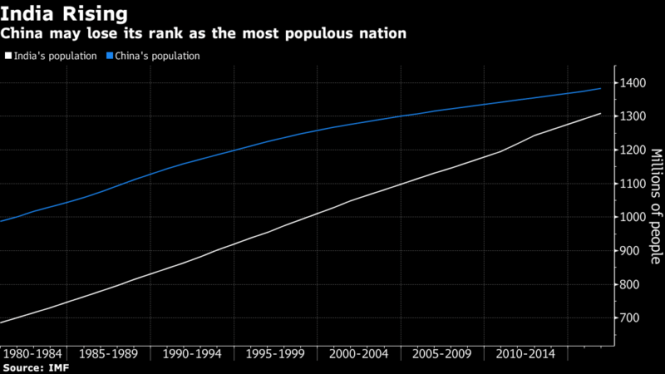
The MOU, which marks a major step forward in establishing Super-E® program in Korea, was signed by Geuk-Han Yun, Manager of Housing Business, representing GICO, Kwang Hoon Lee, CEO of Dreamsite Korea, and Ken Klassen, representing EEEA. Read more


Superpower India to Replace China as Growth Engine

India super engine

India’s economy has youth on its side.  https://www.youtube.com/watch?v=JeV2bPU6-Ag

By

Michael Heath

September 17, 2017, 4:29 PM MDT

India is poised to emerge as an economic superpower, driven in part by its young population, while China and the Asian Tigers age rapidly, according to Deloitte LLP.

The number of people aged 65 and over in Asia will climb from 365 million today to more than half a billion in 2027, accounting for 60 percent of that age group globally by 2030, Deloitte said in a report Monday. In contrast, India will drive the third great wave of Asia’s growth – following Japan and China — with a potential workforce set to climb from 885 million to 1.08 billion people in the next 20 years and hold above that for half a century.

India will account for more than half of the increase in Asia’s workforce in the coming decade, but this isn’t just a story of more workers: these new workers will be much better trained and educated than the existing Indian workforce,’’  said Anis Chakravarty, economist at Deloitte India. “There will be rising economic potential coming alongside that, thanks to an increased share of women in the workforce, as well as an increased ability and interest in working for longer. The consequences for businesses are huge.’’

While the looming ‘Indian summer’ will last decades, it isn’t the only Asian economy set to surge. Indonesia and the Philippines also have relatively young populations, suggesting they’ll experience similar growth, says Deloitte. But the rise of India isn’t set in stone: if the right frameworks are not in place to sustain and promote growth, the burgeoning population could be faced with unemployment and become ripe for social unrest.

india rising

Deloitte names the countries that face the biggest challenges from the impact of ageing on growth as China, Hong Kong, Taiwan, Korea, Singapore, Thailand and New Zealand. For Australia, the report says the impact will likely outstrip that of Japan, which has already been through decades of the challenges of getting older. But there are some advantages Down Under.

Rare among rich nations, Australia has a track record of welcoming migrants to our shores,” said Ian Thatcher, deputy managing partner at Deloitte Asia Pacific.  “That leaves us less at risk of an ageing-related slowdown in the decades ahead.’’

Japan’s experience shows there are opportunities from ageing, too. Demand has risen in sectors such as nursing, consumer goods for the elderly, age-appropriate housing and social infrastructure, as well as asset management and insurance.

But Asia will need to adjust to cope with a forecast 1 billion people aged 65 and over by 2050. This will require:

  • Raising retirement ages: Encouraging this could help growth in nations at the forefront of ageing impacts.
  • More women in the workforce: A direct lever that ageing nations can pull to boost their growth potential.
  • Taking in migrants: Accepting young, high-skilled migrants can help ward off ageing impacts on growth.
  • Boosting productivity: Education and re-training to bolster growth opportunities offered by new technologies.

— With assistance by Garfield Clinton Reynolds


australia

Australia: TPP Trade Talks Sail on Without the United States

Stratfor 2017)


The 11 remaining countries of the Trans-Pacific Partnership (TPP) are moving forward after the departure of the United States early this year. They recently concluded three-day negotiations in Sydney, meant to map a way forward and broadly address certain issues that will be discussed more thoroughly at the group’s September meeting in Japan. And while the Sydney meeting was seen as a success, there is still some uncertainty over how the group will progress without the United States.

Japan, Australia and New Zealand — all enthusiastic to see progress made — served facilitating roles in the talks, while Mexico and Canada arrived with their own amendments, which they hoped to see made quickly. The TPP could have the power to set standards in other trade deals, and the two North American countries were aiming to reshape the agreement in a way that will benefit them in current NAFTA renegotiations.

In spite of their differences, all TPP members — Japan, Australia, Brunei, New Zealand, Peru, Mexico, Canada, Chile, Malaysia, Singapore and Vietnam — unanimously agreed to suspend a clause on pharmaceutical data exclusivity, which prevents new versions of a drug from entering the market until a certain amount of time has passed. The now-absent United States pushed hard for the inclusion of the clause, and resounding agreement to ditch it may be further echoed in a planned patent-requirement freeze.

With access to huge U.S. markets no longer an incentive, it’s not surprising that the remaining countries have become a little less ambitious in their commitments. Meanwhile, this type of watering down of trade terms could also have domestic repercussions for individual countries. For example, Vietnam’s reform progress was partly driven by TPP requirements, and if they are made less stringent, the country’s reform momentum could also suffer.

Most of the TPP members remain on board with the tariffs and import caps negotiated in the original deal, but they have yet to reach conclusions about investment rules, copyright protection and other topics. The countries will decide which specific terms to suspend at their next meeting, and are aiming to reach an agreement at the Asia-Pacific Economic Cooperation in Hanoi in November.

Overall, negotiations seem to be progressing well (unlike ongoing Regional Comprehensive Economic Partnership talks, which have seen China struggling to get its Asian neighbors to align). But ultimately, if this new TPP agreement is finalized, it will likely be a shallower deal than originally envisioned, composed of smaller economies and making less of a global impact.

And there are still sizable hurdles on the way to a final deal. For example, if the TPP-skeptic New Zealand First Party comes into power in New Zealand’s Sep. 23 election, the country could withdraw from negotiations. And a recent public consultation process in Canada revealed strong negative sentiment toward TPP among some Canadians. Any additional departures from the group could slow down or even derail progress. But if they are avoided, the accomplishments of this recent summit indicate that a final deal on a smaller, shallower TPP appears to be coming together.

After TPP, Vietnam’s Quest for Trade

(Stratfor)

vietnam quest for trade

vietnam's changing economy

Vietnam has embarked on one of the most active quests for free trade in the Pacific Rim. From Hanoi’s perspective, deals like the Trans-Pacific Partnership (TPP) are perfect for attracting foreign investment and buyers for its exports, both of which are crucial to ensuring its success amid heightened regional competition and its gradual reform of the Vietnamese economy. (Currently, inefficient state-run enterprises are responsible for much of the country’s economic output.) Despite the deal’s impending failure, Hanoi has pursued a fairly liberal trade agenda that has left it with a cushion of other free trade agreements to fall back on, including with the Eurasian Economic Union and European Union.

Nevertheless, the two blocs set lofty standards that would require Hanoi to undertake extensive regulatory overhauls and politically sensitive labor union reforms that could directly threaten the operations of its bloated state-owned enterprises. That the Vietnamese government is willing to do so in spite of the risks to its own position in power is a testament to its desire to seek out trade partners other than China and, by extension, limit Beijing’s influence over Vietnam. But putting its plan into practice has been no easy feat. The TPP or a free trade agreement with the European Union would expand Vietnam’s access to other markets and foreign partners, eventually reducing its dependence on Chinese products. However, in the short term, these deals will offer little relief.

Vietnam’s deepening integration with the rest of the world has made it vulnerable to volatility in global markets while squeezing its domestic manufacturers as well. After years of generous foreign investment, investor pledges have tapered off in recent months, a sign of the challenges to come for Vietnamese exports in the wake of the TPP’s demise. Meanwhile, growing protectionism in the United States and European Union — Vietnam’s largest export markets — bode ill for its economic prospects. The timing of those developments could not be worse for Hanoi, which is in the midst of a painful effort to restructure its economy that could put pressure on some of Vietnam’s most important industries, including agriculture, steel and electronic components.

The country’s manufacturing supply chains, moreover, are far from complete. Vietnam must import many of the raw materials it uses to generate its exports. Without a long-term strategy to develop these industries and boost its productivity, Vietnam is vulnerable to external disruptions to its supplies. All of these issues have been aggravated by Vietnam’s persistent macroeconomic problems, including its fragile banking system, an excessive number of non-performing loans, underdeveloped regulations and lagging public enterprise reforms, as well as continued volatility in global commodity prices and financial markets. Facing such difficulties, Hanoi will continue its subtle pursuits to keep its options in the region open.

PRINT

SAVE AS PDF

Section Highlights

  • India likely will manage to implement only part of the critical Goods and Services Tax in the third quarter because of disagreements between the federal and state governments as well as onboarding challenges for businesses across the country.
  • Social and economic disruptions caused by Prime Minister Narendra Modi’s nationwide ban on cattle sales will give the opposition a pretext to keep the government from passing labor reform legislation during the Parliament’s monsoon session.
  • Modi will continue pursuing a diverse foreign policy this quarter, visiting Israel, hosting Japanese Prime Minister Shinzo Abe and dispatching forces to participate in the Malabar naval exercises.
  • Fighting in Afghanistan will intensify as the United States sends more troops to bolster the Afghan National Security Forces in their war against the Taliban.
  • Pakistan will try to subvert Zakir Musa’s Hizbul Mujahideen breakaway faction to prevent an anti-Pakistani transnational jihadist movement from taking root in the disputed territory of Kashmir.

See more on this Region

Realizing India’s Tax Reforms

After three years in office, Indian Prime Minister Narendra Modi has centralized power enough to give his Bharatiya Janata Party (BJP) the leeway to pursue long-awaited reforms. Modi’s administration achieved a victory on that front in the first quarter, when Parliament passed the Goods and Services Tax bill. But the task of introducing the changes prescribed in the law still lies ahead of the prime minister and ruling party. While India will likely manage to implement, at least in part, the sweeping tax reform by the government’s July 1 deadline, lingering disagreements between state leaders and their national counterparts in New Delhi over tax classification will frustrate progress. In fact, the states of West Bengal and Tamil Nadu, two of the strongest objectors to the tax scheme, resisted adopting local versions of the legislation until recently. Their success putting the laws into practice will serve as a test case for the overall efficacy of the measures in India. In addition, complications bringing the businesses in India’s vast informal economy into compliance with the laws, as well as obstacles to getting the plan’s information technology infrastructure system up and running, will hold up the implementation process.

In part because of the fitful progress of the tax reform, India’s business climate is unlikely to improve in the third quarter as the central government hoped it would. India’s $2 trillion economy will keep struggling to attract foreign investment into its manufacturing sector, the focus of Modi’s “Make in India” initiative. Of course, in a democracy of nearly 1.3 billion people, change is a gradual process, and the tax reform package, even if only partially implemented, marks a landmark achievement for India. The measures’ implementation marks the first of many steps toward unifying the country’s fragmented economy, boosting interstate trade, streamlining supply chains and increasing gross domestic product growth.

Housing Affordability Fires Up New Zealand’s Voters


By

Tracy Withers

August 29, 2017, 11:00 AM MDT August 29, 2017, 10:17 PM MDT

  • Nation’s home ownership has fallen to lowest level since 1951
  • Ardern’s resurgent opposition party makes housing key issue

When Olivia Hollywood began hunting for her first house in Wellington early last year, she was optimistic that half a million New Zealand dollars ($362,000) would get her on the property ladder.

After eight months attending packed viewings and watching homes auctioned at vastly inflated prices, Hollywood and her partner abandoned their search. Since then, average prices in the Wellington area have gained another 13 percent to exceed NZ$607,000. The couple is among thousands of Kiwis for whom home ownership is looking increasingly distant.

“It was frustrating for us because we did expect it was going to be quite easy,” said Hollywood, 24. “We decided it was just too crazy for us and we’d rather sit tight for a couple of years and save up a bit more.”

Jacinda Ardern

Photographer: Mark Coote/Bloomberg

As ownership falls to the lowest since 1951, housing affordability is firing up voters ahead of New Zealand’s general election on Sept. 23. The government is under attack for failing to respond to price surges that have forced many to ditch their property dreams. New Labour leader Jacinda Ardern has made housing a key issue, helping restore the main opposition party in opinion polls and leaving the election too close to call.

“The government’s response has been too slow and inadequate for many because they’ve seen house prices rising very fast,” said Raymond Miller, professor of politics at Auckland University. “Some voters might well have a feeling of being let down by what they see as indifference to their plight. It’s the government’s Achilles’ heel.”

Prices across New Zealand have risen 34 percent the past three years, fanned by record immigration, historically low interest rates and a supply shortage. That’s seen the portion of owner-occupied properties slump to 63 percent of the nation’s 1.8 million homes in the second quarter, down from a peak of 74 percent in the early 1990s.

In response, the ruling National Party has made more land available for development and increased deposit grants to first-home buyers. But it’s done little to curb immigration that’s added 201,000 to the population the past three years, while a policy of taxing profits on investment properties sold within two years of purchase has been criticized as too mild.

More Aggressive

Labour is pledging a more aggressive solution. It’s promising to ban property sales to non-resident foreigners who it says have fanned price pressures, and will extend the period in which investors will be subject to tax to five years. It wants to curb immigration, and plans to build 100,000 homes over 10 years and sell them at affordable prices.

“We’re going to get the government back into the business of building large numbers of affordable homes for first-home buyers like governments used to in this country,” Labour’s housing spokesman Phil Twyford said in a Television New Zealand interview. “The government has had nine years and they’ve just tinkered around the edges.”

Read about the resurgence of Labour under Jacinda Ardern

Many New Zealanders are motivated to save for a home where they can bring up a family just as their parents and grandparents did. National will be wary that disillusioned home-buyers may turn their back on the party, thwarting its efforts to win a rare fourth term.

No party has won an outright majority since the South Pacific nation introduced proportional representation in 1996. National had 44 percent support in a poll published Aug. 17. Labour had 37 percent but could get across the line with the additional support of ally the Green Party, which had 4 percent, and New Zealand First, which got 10 percent.

Prime Minister Bill English is optimistic that housing affordability issues are on the wane. Home-loan interest rates are near 50-year lows and rising household incomes make mortgage payments more manageable. House-price inflation is slowing and a report this month predicted 196,500 homes will be built in the six years through 2022.

Bill English

Photographer: Brendon O’Hagan/Bloomberg

“We have a flat to falling market, with all those houses coming into the market, and rising incomes,” English told the New Zealand Herald last week. “Housing affordability is going to get better.”

His outlook isn’t guaranteed. Both National and Labour’s ambitions to build more homes may be derailed by skill shortages and capacity constraints in the construction industry. Building consents fell for a second straight month in July, data released Wednesday showed.

The Treasury Department last week cut its forecasts for residential investment, and now projects a contraction in 2018, citing a lack of workers and bankers’ reluctance to lend to developers. It also expects the Reserve Bank to raise interest rates from mid-2018.

House prices rose just 1.6 percent in the three months through July as central bank-imposed lending curbs, particularly on investors, started to bite. In the Auckland area, home to a third of New Zealand’s 4.7 million people, prices have fallen slightly since last year, but still average more than NZ$1 million.

“There’s still a fundamental supply-demand mismatch,” said Zoe Wallis, chief economist at Wellington-based Kiwibank. “People are viewing the price drop as a great opportunity to get into the market. We’re not expecting to see a large outright fall in Auckland prices because of that.”

That’s cold comfort for Olivia Hollywood in Wellington, who is waiting for the local market to allow her another shot. Prices in the capital have risen 5.7 percent so far this year after surging 21 percent in 2016.

“I think the market is coming back,” she said. “We are hoping it will drop a little bit more.”

Second Quarter 2017 Economic and Wood Product News

This quarter focuses on key globalization issues including worker replacement with robotics, economic hurdles in China and India, container shipping meltdown. Thankfully no news on “The Donald”

Bloomburg Report on JOBS -ASEAN Factory workers displacement with Robots

 Manfg succession

Illustration: Traditional Manufacturing Succession in Asia. Progression of wealth building for Factory workers leading to the growth of middle class workers -DBW


Kevin Hamlin and Dexter Roberts ‎June‎ ‎21‎, ‎2017‎ ‎2‎:‎00‎ ‎PM

Thirty minutes by car into the scrubby desert outside Korla, in China’s remote Xinjiang region, a textile manufacturer owned by Jinsheng Group is building its latest factory complex. Inside the 16 billion-yuan ($2.4 billion) facility—a collection of stark white warehouses surrounded by an enormous expanse of pristine artificial grass—are rows of huge cotton spools, more than a million bright red and blue spindles, and almost no people. A few German engineers wander around, making sure the equipment runs at peak efficiency. This is the depopulated future of an industry that’s lifted millions of Asians out of poverty.

Jinsheng’s factory covers almost 15 million square feet, more than five times the floor area of the Empire State Building, but it needs only a few hundred production workers for each shift. “Textiles used to be a labor-intensive industry,” said Pan Xueping, the chairman and chief executive officer, in a September speech in Urumqi, Xinjiang’s capital. “We are at a turning point.” Instead of moving production to whatever nearby country has the lowest wages, he added in an interview a day after the speech, “the industry can achieve a human-free factory.”

Pan’s company is at the vanguard of a trend that could have devastating consequences for Asia’s poorest nations. Low-cost manufacturing of clothes, shoes, and the like was the first rung on the economic ladder that Japan, South Korea, China, and other countries used to climb out of poverty after World War II. For decades that process followed a familiar pattern: As the economies of the early movers shifted into more sophisticated industries such as electronics, poorer countries took their place in textiles, offering the cheap labor that low-tech factories traditionally required. Manufacturers got inexpensive goods to ship to Walmarts and Tescos around the world, and poor countries were able to provide mass industrial employment for the first time, giving citizens an alternative to toiling on farms.

“The window is closing on emerging nations. They will not have the opportunity that China had in the past”

Today, Bangladesh, Cambodia, and Myanmar are in the early stages of climbing that ladder—but automation threatens to block their ascent. Instead of opening well-staffed factories in these countries, Chinese companies that need to expand are building robot-heavy facilities at home. “The window is closing on emerging nations,” says Cai Fang, a demographer in Beijing who advises the Chinese government on labor policy. “They will not have the opportunity that China had in the past.”

The transformation looks like it will happen fast. The International Labor Organization (ILO) estimates that mass replacement of less-skilled workers by robots could be only two years away. Overall, more than 80 percent of garment industry workers in Southeast Asia face a high risk of losing their jobs to automation, according to Chang Jaehee, an ILO researcher who studies advanced manufacturing. Chang recalls presenting her findings to a government official in a country in the region that she declines to name. The official’s response? If she’s right, the result could be civil unrest.

Until recently, even as robots took over much of the manufacturing of larger goods such as cars and jet engines, the prospect of applying automation to towel-weaving or dress-stitching looked like a long shot. Sewing clothes is a delicate undertaking. Making a seemingly simple dress shirt with a breast pocket can require 78 separate steps, and machines that can match the dexterity of human fingers are still a costly rarity. What’s more, tech entrepreneurs had little incentive to design automated systems for a low-margin industry with ample access to cheap labor and little cash to spend on sophisticated gear.


These factors have led to complacency in parts of the textile industry. “Today, there is no equipment that can make these handmade products,” says Sahil Dhamija, whose Sahil International produces bathmats and bed linens for export at a factory in Panipat, India, that employs about 500 people. He spoke at the Canton Fair, a trade conference in Guangzhou, China, in May.

Dhamija might want to visit Atlanta. A group of Georgia Tech engineering and robotics professors founded a startup called SoftWear Automation there in 2007, with the goal of overcoming the difficulties machines have in picking up flexible fabric and pinpointing where to stitch and cut. SoftWear’s first prototype took seven years to develop, sustained in part by a $1.75 million grant from the Defense Advanced Research Projects Agency, a Pentagon group that pushes bleeding-edge development. In 2015 the company made the first sales of its invention, the Sewbot, to customers in the U.S. Revenue last year rose 1,000 percent, and it’s on track to do the same in 2017, according to CEO Palaniswamy “Raj” Rajan.

The breakthrough was as much about vision as touch; before SoftWear’s robots could make clothes accurately, they needed to learn to see garments as a collection of fine folds and details, rather than undifferentiated blobs of fabric. For now, the Sewbot can handle products including towels, mattress covers, and pillows, which require 10 steps or fewer to produce. But the company is at work on upgraded machines that can create T-shirts and eventually more complicated garments such as jeans and dress shirts. The ultimate goal, Rajan says, is “full automation, from a roll of material to finished product.” He says he has preliminary interest from clients in China, South Korea, Japan, and other countries across Asia.

viet robot sew machine

SoftWear Automation’s sewing-machine robot prototypes at the startup’s offices in Atlanta.

Photographer: Melissa Golden/Redux

As automation accelerates, it’s not just Asia that could see its industrial trajectory affected. If the cost of labor is no longer a major factor, there’s no reason manufacturers can’t relocate production to where the bulk of their customers are: North America and Europe, where wages for decades have been too high to support textile production. Remove most of the workers from the equation, along with the costs and delays of round-the-world shipping, and making clothes or shoes in Dallas or Düsseldorf instead of Dhaka starts to look like a compelling idea.

German sportswear giant Adidas AG moved some shoe production to a highly automated “speedfactory” in its hometown of Ansbach that’s scheduled to begin large-scale operations this year. The company plans to open a similar plant in the U.S. In May, China’s Shandong Ruyi Technology Group Co., the owner of luxury brands such as Sandro and Maje, announced that it would invest $410 million in a textile plant in Forrest City, Ark. “Automation essentially levels the playing field,” says Frederic Neumann, co-head of Asian economics research at HSBC Holdings Plc in Hong Kong. “What emerges is a giant strategic game, in which individual governments will seek to attract industries to set up shop locally.”

The losers are likely to be poor countries that were counting on large-scale manufacturing employment to build prosperity. As wages rose in China, Transit Luggage Co., a suitcase maker based in the southern city of Dongguan, explored two options: moving production to low-wage Vietnam or investing in automation at home. Executives chose the latter. One robot now matches the output of about 30 workers making soft luggage, says sales manager Yang Yuanping. As a result, she says, the company employs fewer workers than it did a decade ago, while producing three times as many items.

Even that pace of production is no guarantee of survival in a fast-innovating industry. Yang has begun to worry about competition from Poland and the Czech Republic, as automation allows European countries to compete on price for the first time. “We have to think about how we can beat them,” she says. “We know they will get the machines.” —With Jason Clenfield and Bloomberg News

chandan india

(Chandan Khanna/AFP/Getty Images)

Series Introduction:

As each country tries to find the best way to thrive in the global economy, it must consider its comparative advantages. Take Brazil, for example. Like many other countries in North and South America, Brazil has an abundance of land that it exploits efficiently through large, modern farms. Japan, on the other hand, is light on land but has a wealth of capital at its disposal. And India’s biggest strength is its massive — and growing — labor pool. These disparate assets help determine not only a country’s economic development but also its stance on trade.

Every international trade negotiation starts out with a goal and a price. The goal is typically to open up an area of another country or bloc’s economy that could benefit the nation driving the negotiations. In return, the negotiator must pay a price, often by opening a sensitive part of its economy to the other party’s products. But even while pursuing its offensive interests in trade talks, a state must also consider its defensive interests — less competitive areas in its domestic economy that it must shield against foreign competitors, lest they overwhelm the sector. Defensive interests are sometimes more strategic; Japan, for example, has long protected its agricultural sector as a way to ensure its self-sufficiency in the event of a trade disruption. Either way, the industries that fall under a country’s defensive interests often have outsize political influence and powerful lobby groups on their side to resist liberalization.

Global trade, meanwhile, is changing. The kinds of multilateral agreements that characterized the postwar years have stalled out over the past two decades, prompting countries and economic blocs to try to negotiate smaller deals with fewer partners. Nations and blocs have more leeway under this new model to negotiate the trade agreements that best suit their interests and to avoid those that don’t. Now, more than ever, the future of international trade depends on a country or bloc’s defensive interests, offensive interests and underlying factors of production. Our fortnightly Trade Profiles aim to break down these factors to facilitate an understanding of where global trade stands today and where it’s headed.

In this first installment, we focus on India.

snapshot

offensive interests

Economic Background

India has traditionally taken a defensive stance on trade. Its first leaders adopted a closed economic model when the country gained its independence in 1947. Wary of external influence following centuries of imperial domination, the newly minted government instated rules to prevent majority foreign ownership of Indian companies and erected formidable trade barriers. These, along with high taxes and extensive domestic regulations, restrained the market. Protected from external competition and undermined by chronic government corruption and poor infrastructure, Indian industry became deeply noncompetitive. One notable exception was the pharmaceuticals sector, in which the government’s disregard for foreign patents created a nimble and innovative industry based on reverse engineering and reproducing Western goods.

Agriculture was also of high political importance, given India’s closed and poor economy and its largely rural population. Domestic farmers, however, struggled to feed the country, which for a time relied on agricultural donations from the United States to avoid famine. The Green Revolution of the 1960s transformed agricultural productivity, banishing the specter of famine — but also creating a need for government subsidies to sustain the burgeoning farming industry. The farm lobby steadily amassed influence in India; Charan Singh, in fact, rose out of the camp to rule the country for a brief stint as prime minister in 1979, and huge farmers’ marches characterized the 1980s.

Then in 1991, an economic crisis in India, along with the fall of the Soviet Union, signaled an abrupt change. The government toppled tariff barriers, eased regulations, cut taxes and opened up much of the country’s economy to international competition during a three-year liberalization campaign. Companies around the world entered the market in force, sending India’s share of global foreign direct investment from 0.5 percent in 1992 to 2.2 percent in 1997. (The movement stopped short of a full revolution, though; extensive regulations and widespread corruption still hampered the economy, while rules limiting foreign direct investment — and investment in India’s capital market — remained in place.) India has signed 84 bilateral investment treaties since 1994, a number consistent with the overall global trend.

The reforms of the 1990s cost Indian farmers some of their clout. The sectors that thrived under the country’s economic liberalization were the newer industries, such as information and communication technology, that the old regulations least affected. India’s relatively low labor costs and large number of English speakers made it a natural hub for business process outsourcing, and today, the country ranks fifth among the world’s top services exporters (discounting trade within the European Union). Agriculture, meanwhile, lost ground in the Indian economy — it accounted for just 18 percent of the country’s gross domestic product in 2014 compared with 52 percent in 1950. As agriculture declined, debt levels climbed among India’s farmers. The mounting financial pressures led to high suicide rates in the sector; more than 270,000 farmers have killed themselves since the mid-1990s, causing widespread consternation. The industry, after all, is still politically relevant, since more than two-thirds of India’s population lives in rural areas. To try to address the problem, Uttar Pradesh’s new chief minister decided to forgive all farming loans in his state, which stand at $5.6 billion total, or 2.5 percent of India’s GDP.

The liberalization did little to boost India’s manufacturing industry, either. Poor infrastructure and uncompetitive labor costs relative to countries such as China, Vietnam and Bangladesh have held the sector back. Today, India’s merchandise exports account for just 1.6 percent of the total trade, while its exports of information and communication technology, for instance, make up 17 percent of the total worldwide. The pharmaceuticals sector, by contrast, has continued to boom in the wake of the reforms, even if they curbed its freedom. On joining the World Trade Organization in 1995, India had to sign the Agreement on Trade-Related Aspects of Intellectual Property Rights, or TRIPS, which protected foreign patents in the industry. But since the agreement took effect in 2005, Indian pharmaceutical companies have drawn on the skills they learned in their days of replicating drugs at a lower cost to make their country the world’s leading exporter of generic medications.

And remittances have also grown substantially since India liberalized its economy. The country’s sizable diaspora — now the world’s largest — dates back to colonial times. But as new opportunities have arisen for Indian software engineers in countries such as the United States, and capital controls have relaxed, personal remittances to India skyrocketed from $2.4 billion in 1990 to $70.4 billion in 2014. Half of the money comes from Indians working in Arab states, including the United Arab Emirates, Saudi Arabia and Kuwait.

Trade Implications

Defensive Interests

Notwithstanding the reforms that India undertook in the early 1990s, its trade policy has long centered on resisting liberalization. Antipathy toward free market competition extends to a societal level in India, and in the decades after its period of liberalization, the country largely reverted to its defensive ways. In 2001, for instance, India’s staunch opposition to the lower trade barriers proposed in the WTO’s Doha Development Round contributed to the negotiations’ failure.

The agricultural sector is the primary focus of India’s protectionism. With a mean farm size of only 1.33 hectares (about 3.3 acres), India can’t compete in the global market against countries in South America, where farms average 50.7 hectares, or North America, whose farms cover 186 hectares on average. India paid out an estimated $51 billion in agricultural subsidies in 2011-12, putting it on par with Japan, though its economy is only half as large. India’s applied agricultural tariffs of 32.7 percent dwarf those of its fellow BRICS — Brazil, Russia, China and South Africa, countries recognized for their rapid economic growth and potential. If New Delhi continues down this path, its refusal to reduce agricultural tariffs could keep new trade partners away. Proposed regional trade agreements such as the Regional Comprehensive Economic Partnership (RCEP), after all, emphasize tariff reduction, particularly on commodities.

Investment is also emerging as another target of India’s protectionist policies. Over the past 14 years, the country has brought 21 dispute cases against investors — a sharp increase, albeit one that conforms to global trends. (State-investor disputes tripled between 2005 and 2015, though countries, and particularly developing nations, are usually the defendants in these suits.) India has lost 80 percent of its cases, prompting New Delhi to express its dissatisfaction with the process. The country went so far as to scrap 57 existing bilateral investment treaties in 2016 in hopes of renegotiating them under the new contract model it introduced the previous year. Then this year, it blocked discussion of multilateral investment facilitation at the WTO on the grounds that the measure would limit its policy options.

New Delhi is even more eager to protect its pharmaceuticals sector, something else that could cause strife with its trade partners abroad. Many developed countries are pushing to extend the patent terms for pharmaceutical products through so-called TRIPS+ trade agreements. But because longer patent terms would cut into India’s booming generics business, New Delhi will resist the initiative. The country’s labor standards, too, could create problems. Recent multilateral trade agreements, such as the Trans-Pacific Partnership, have included prescribed labor standards. India, which ranks 105th on the Human Capital Index, may struggle to meet the new requirements.

Offensive Interests

indias population

Nevertheless, demographics could force India to resist its protectionist impulses. Compared with countries such as China, whose population will peak in 2028, India has a much younger demographic profile. A projected 280 million people will flood the workforce by 2050. Already, roughly 1 million people are entering India’s workforce each month, a rate that far exceeds the country’s job creation. In 2015, for example, India created just 135,000 new jobs. And though that year was particularly slow, even in 2009 — the best year for job growth in recent history — the country managed to add just 1.2 million positions. The situation could lead to massive unrest if India’s leaders don’t find a way to address it.

Other developing countries have traditionally relied on manufacturing to employ growing populations. Japan, South Korea, Taiwan and China all achieved solid export-led growth by rising gradually through the value chain from textiles to cars to advanced engineering. India, however, is in no position to follow their example. In addition to its relatively high wages and deficient infrastructure, the country has a dearth of available land, making it ill-suited to industries such as manufacturing. And the problem will only get worse as the population keeps growing. India’s shortcomings aside, though, the age of manufacturing-driven economic development also seems to be reaching its end. More and more, the world is spending its disposable income on services rather than goods, while the manufacturing sector itself is yielding increasingly to automation.

Yet New Delhi has not given up on manufacturing. Prime Minister Narendra Modi’s administration, in fact, has made boosting India’s manufacturing industry one of its main priorities through the “Make in India” campaign. Under the initiative, the government has eased restrictions on foreign investment in the defense, railway, civil aviation, broadcasting and pharmaceuticals sectors. It has even taken some tentative steps toward liberalizing India’s capital markets (although foreign financial services still face significant barriers). New Delhi has revived ambitious infrastructure projects, as well, and the Goods and Services Tax bill, introduced this year, stands to facilitate the transport of goods across state borders, once India’s state legislatures approve it. The legislation could inspire the country’s trade negotiators to prioritize reducing barriers to exports of manufactured goods in future talks.

The country’s services sector, meanwhile, is probably India’s best bet for coping with its demographic problem. The industry is hardly a silver bullet, considering that large swaths of the population are still illiterate and don’t speak English. Still, strong competitiveness has created a $33 billion trade surplus in services — compared with a $126 billion trade deficit in goods — and external demand promises to increase in the future, given the global market’s development. An added benefit is that services can often be performed by an Indian worker living abroad, an arrangement that would not only cut down on the number of jobs to be created domestically but could also further increase remittances.

With these factors in mind, India has recently shifted to a more offensive stance to further open the services sector. The country has been working to make it easier for Indians to move across borders for work through its free trade agreement negotiations. Last year, it proposed a multilateral trade facilitation in services deal at the WTO (following the signing of an equivalent agreement over goods in 2013) that would, among other things, encourage relaxed visa restrictions. But in a global climate in which immigration has become a highly charged subject, particularly in the developed world, India’s focus on sending its workers abroad is likely to meet some resistance from potential trading partners.

india trade facts

Home Bloomberg Businessweek

forest city

A model of the Forest City development at the Country Garden showroom in Johor, Malaysia.

Photographer: Ore Huiying/Bloomberg

The $100 Billion City Next to Singapore Has a Big China Problem

Beijing’s capital controls are spooking some property buyers

Bloomberg News ‎June‎ ‎22‎, ‎2017‎ ‎3‎:‎00‎ ‎PM

The $100 billion city rising from the sea next to Singapore has hit a roadblock: China’s capital controls.

The dream of a Malaysian version of Shenzhen — largely funded by Chinese developers and buyers — with hotels, offices, golf courses, tech parks and thousands of ritzy new apartments, is having to adapt after China’s government clamped down on an exodus of money for investment in overseas property.

Developers’ sales offices in China that once brought in buyers by the hundreds are now pushing developments in Chinese cities. Subsidized junkets that flew in prospective buyers to development sites in the southern Malaysian state of Johor have dwindled. And some buyers who paid deposits for yet-to-be-built homes are considering canceling their purchases.

“I feel I’m on the horns of a dilemma,” said Michelle Gao, who paid about 600,000 yuan ($87,825) toward the 1.2 million yuan cost of a two-bedroom apartment at Country Garden Holdings Co.’s vast Forest City development. “If the project relies so much on Chinese buyers like me, how on earth are they able to sell in future? Will the construction ever finish?”

forest city2

Country Garden’s “Forest City” development project in the Iskandar region of Johor, Malaysia.

Photographer: Ore Huiying

The crackdown on outflows of money from China has spooked some buyers. While Chinese citizens are allowed an annual foreign exchange quota of $50,000, the government said in December that all buyers of foreign exchange must sign a pledge that they won’t use their quotas for offshore property investment. Violators would be added to a watch list, denied access to foreign currency for three years and be subject to a money-laundering investigation.

The restriction threatens to take the wind out of residential property sales in cities around the world where prices have been driven in the past few years by buyers from China. Few projects are likely to be affected as much as the Chinese-financed developments in Johor, some of which had relied on mainland customers for as much as 90 percent of sales.

Six Chinese buyers interviewed for this story said they paid a 10 percent down-payment to Country Garden in showrooms in China by swiping debit or credit cards or using payment services like Alipay. They said the property agents are now telling them they need to go to Hong Kong, Singapore, Malaysia or Macau to swipe their cards to pay the balance of installments, or wire funds to Country Garden’s overseas accounts.

buyers walking

Top: Potential buyers walk around a model of the Forest City showroom development as lines of buses ferrying would-be buyers sit parked outside in November 2016. Bottom: The same showroom during an event in June this year.

Photographer: Ore Huiying/Bloomberg

Many are worried that would still make them liable under China’s foreign exchange rules. This month, the Chinese government said domestic banks will have to provide daily reports of clients’ overseas transactions of more than 1,000 yuan.

“I was told it can still be done from Hong Kong, but I’m just scared now,” said buyer Elaine Xiao. “I don’t know what punishment I may get.”

Country Garden said the controls have not had a material effect on sales and construction at Forest City is continuing. It has completed a luxury hotel and handed over the first batch of 132 apartments on May 1.

The Johor developments stem from Iskandar Malaysia, a government effort to leverage Singapore’s success by building a new metropolis near the causeway that connects the island state to the Malaysian city of Johor Bahru. When the 20-year project was announced in 2006, it envisaged a total investment of 383 billion ringgit ($87 billion) and much of the early investment came from Singapore.

But then Chinese developers like Country Garden and Greenland Holdings Group Co. moved in with projects that dwarfed those of their Malaysian and Singaporean rivals. Country Garden’s “Forest City” alone called for a $100 billion high-rise town to be built on artificial islands within a few hundred yards of Singapore.

The projects were marketed in China, and thousands paid deposits for apartments that cost as much as double the rate per square meter of homes for Malaysian buyers in Johor Bahru.

A buyer whose family name is Yu said she doesn’t intend to pay the next installment on her apartment when it comes due this month. She said her agent advised her to swipe her credit card in Hong Kong to get around the rules. “I asked the sales agent will you take responsibility when I’m blacklisted in China?”

Yu, from Guangzhou, put down a deposit on a 1.2 million yuan, 59-square-meter apartment in Phase III of the project while visiting the vast landscaped sales gallery at the construction site in December. She’s among those now considering walking away from the agreement because of concern about breaking the rules.

forest city construction

Ongoing construction at Country Garden’s “Forest City” development.

Photographer: Ore Huiying/Bloomberg

Country Garden announced on June 20 it would proceed with stage 2 of the Forest City development, a $280 million plan that includes golf courses, an international school and another hotel. The developer said in April it was in discussion with fewer than 60 Chinese buyers who indicated their intention to cancel bookings. The company said it sold 16,000 residential units in Forest City last year.

Country Garden said earlier it had stopped marketing Forest City in its sales galleries in China and ceased organizing tours to its Johor projects for would-be buyers. Its agents in China are pushing domestic projects in the country’s tropical southern resort of Sanya and the seaside city of Beihai.

The developer said it has opened Forest City showrooms in Singapore, Kuala Lumpur and Jakarta, and plans to open more this year in Vietnam, Myanmar, Taiwan, Thailand, Japan, Dubai, the Philippines and Laos.

Construction at Greenland’s Jade Palace development was suspended in November while the company considered revising the project density to build more, but smaller apartments, according to a sales agent with knowledge of the project. No construction work was going on during a weekday visit to the site in May.

show apartment

A show apartment at the Tropicana Danga Bay property showroom.

Photographer: Ore Huiying/Bloomberg

In a response to written questions, Greenland said on June 3 that construction had not stopped and that the design of the apartments will be optimized pending feedback from previous buyers. It declined to give sales figures, but said it is looking for more buyers outside China.

Samuel Tan, executive director at KGV International Property Consultants, said approvals for all new serviced apartments in Johor have been frozen since 2014 and existing projects were introducing more affordable properties at around 600,000 ringgit instead of 800,000 to 1 million ringgit.

“Given the oversupply, we don’t foresee any recovery until 2019 for high-rise projects,” Tan said. He said China’s capital controls were only significant to the Chinese-owned projects.

The glut of properties being built in Johor has also affected local developers, Petaling Jaya-based Tropicana Corp. is giving a 25 percent rebate on the list price of homes they are marketing an interest-free, 36-month deferred payment plan. Resale asking prices of properties in Johor have dropped 2 percent in the past two years, according to real estate listings website PropertyGuru.com.

Yu, the buyer from Guangzhou, worries that the thousands of apartments still to be built at Forest City will be hard to sell without Chinese buyers.

“My home is still in the ocean,” Yu said. “Locals will not buy homes with prices double the local rate. Without enough residents from China, everything will change.”

reclaimed land

Construction continues on reclaimed land at Country Garden’s “Forest City”, with Singapore in the background.

Photographer: Ore Huiying/Bloomberg

India’s prime minister is not as much of a reformer as he seems

But he is more of a nationalist firebrand


Japan Economy & Housing Starts

shawn-lawlor

By Shawn Lawlor

Director, Canada Wood Japan

May 29, 2017

Posted in: Japan

Japan Q1 GDP grew at an annualized 1.2% rate. February industrial production posted a solid growth of 4.7%. February unemployment held at 2.8%, its lowest level since the early 1990s. The consumer price index edged up 0.2% in February. Japan posted a large current account surplus of US $187 billion in February. Japan’s GDP growth forecast for 2017 is at 1.2%.

Japan Housing Starts Summary

Japanese Monthly Housing Starts Summary for January 2017

japan walkups

January total housing starts increased 12.8% to 76,491 units thanks primarily to a jump in rental housing. Rental housing saw growth of 12% compared to a decline of 0.2% in owner occupied housing. January results were boosted by a 38% surge in non-wood housing. Wooden housing gained 4.2% to 39,079 units. Of wooden housing, post and beam starts increased 4.9% to 29,714 units; wooden pre-fab declined 12.8% to 1,057 units, and 2×4 starts gained 4.0% to 8,308 units. Two by four owner occupied custom homes advanced 6.6% to 2,260 units, multi-family apartments increased 2.0% to 4,901 units and built for sale spec homes grew 6.6% to 1,129 units.

Japanese Monthly Housing Starts Summary for February 2017

February housing starts trailed 2.6% to finish at 70,912 units. Total wooden starts edged up 2.5% to 39,587 units, however the non-wood “mansion” condominium market fell 35.7% after experiencing a surge the month prior. Post and beam starts improved 3.4% to 30,023 units. Wooden pre-fab starts were flat at 1,057 units. Two by four starts declined 0.3% and broke down as follows: custom owner occupied declined 4.2% to 2,220 units, built for sale spec homes dropped 10.4% to 970 units and rentals improved 4.3% to 5,303 units.

Japanese Monthly Housing Starts Summary for March 2017

March total housing starts registered a faint increase of 0.2%, finishing at 75,887 units. Although owner occupied housing starts fell 3.6%, rentals posted an 11% gain. Rental housing recorded a 17thconsecutive monthly gain. Total wood starts posted a small 0.9% gain thanks to strength in the post and beam segment. Post and beam starts increased 2.9% to 31,471 units. Wooden pre-fab starts slid 7.4% to 949 units. Two by four starts declined 4.6% to 9,116 units broken down as follows: custom built owner occupied fell 8.0% to 2,161 units; rentals gained 0.5% to 5,921 units and built for sale spec homes declined 5.0% to 1,011 units.

South Korean Economy, Housing & Lumber Shipments

By Tai Jeong

tai-jeong

Technical Director, Canada Wood Korea

May 29, 2017

Posted in: Korea

Economy Update

Owing to increased construction investment and exports, South Korea’s economy grew at a fast pace in the first quarter of 2017 showing a 0.9% GDP increase from the previous quarter. Both construction and facility investments grew 5.3% and 4.3% respectively in the first quarter from the previous quarter.Gross domestic income rose 2.3% in the first quarter of 2017 from the previous quarter, compared with a 0.8% expansion three months earlier.

On a steady recovery in exports, South Korea posted a trade surplus for 63 straight months in April since February 2012 showing a surplus of US$13 billion with 24.1% on-year increase in exports to US$51 billion and 17.3% on-year increase in imports to US$38 billion.South Korea’s consumer prices increase 1.9% in April, slowing down from the previous month’s 2.2% rise amid high-flying oil prices. Unemployment rate hit a 17-year high at 4.2% in April, up 0.3 percentage point from the same month last year.

The exchange rate for Canadian Dollar averaged at 844.08 won in April, 2017, down by 5.52% from 893.35 in April, 2016 and also slightly down by 0.44 % from 847.85 in one month earlier.

Housing Construction

korea housing

South Korea’s housing starts in number of buildings for the first three months of 2017 decreased 2.7% to 23,574 buildings from a year earlier 24,224 buildings while that in number of units significantly decreased 15% to 100,124 units from a year earlier 117,742 units.

Housing permits in number of buildings for the same period of 2017 also decreased 0.6% to 27,825 buildings from a year earlier 28,005 buildings while that in number of units significantly decreased 13.4% to 141,100 units from a year earlier 163,009 units amid ongoing government intervention to limit the supply of new homes, especially new apartments in Seoul, as a way of limiting the rise in household debts.

Though the overall residential construction sector struggles, the number of wood building permits for the first three months of 2017 increased 4.7% to 3,808 buildings from a year earlier. However, the number of wood building starts for the same period slightly decreased 1.1% to 3,172 buildings.

korean wood building stats

Both total floor areas of wood building permits and starts for the same period in 2017 increased 12.5% and 5.8% to 368,703 m2 and 303,770 m2 respectively from a year earlier.

Lumber Shipments

BC softwood lumber export volume to South Korea for the first three months of 2017 decreased 14.2% to 68,876 cubic meters as compared to 80,311 cubic meters for the same period of 2016.

Export value for the same period also decreased 9.9% to CAD$18.264 million as compared to CAD$20.285 million for the same period in 2016.

BC Softwood Lumber Exports to South Korea

2014/2016 Cumulative

Korea accum vol

Korea monthly vol

According to the data from Korea Forest Service, Chile continued to be ranked as the number one lumber export country for the first three months of 2017 with a 44.1% increase to 162,680 m3 followed by Russia with a 16.4% decrease to 91,480 m3 and Canada with a 26.4% decrease to 39,850 m3.

Germany ranked as the 4th largest lumber export country with a remarkable 104.5% increase to 37,850 m3 followed by New Zealand with a 24.9 decrease to 25,870 m3 and Finland with a 64.9% increase to 21,540 m3.

Amid historically low levels of lumber prices in European countries, European mills continue to gain lumber market share in South Korea, especially as they increase their volume of kiln-dried and higher-grade lumber. These factors pose a growing threat to Canadian lumber export to South Korea.

China Makes Historic Strategic Move

By Edward Zheng

edward Zheng

Research Manager, Canada Wood China

May 25, 2017

Posted in: China

Xi Jinping announces Xiongan New Area of Hebei Province as part of a measure to advance the development of the Beijing-Tianjin-Hebei region.

In April, China announced it will establish the Xiongan New Area in Hebei Province, as part of measures to advance the coordinated development of the Beijing-Tianjin-Hebei region.

What is Xiongan New Area (XNA)?

beijing urban ills

On April 1st 2017, the Central Committee of the Communist Party of China (CCCPC) and State Council announced to establish a new satellite metropolitan district in Xiong’an., the Xiongan new area is comparable to the Shenzhen Special Economic Zone and the Shanghai Pudong New Area. According to the official circular, the new area will initially cover around 100 km2 and will be expanded to 200 km2 in the mid-term with plans for further expansion of 2,000 km2 in the long term.

The move is a “major historic and strategic choice made by the Central Committee of China’s Communist Party State Council with Comrade Xi Jinping as the core,” said the circular, which described the decision as “a strategy crucial for a millennium to come.” [1]

What are the main functions of Xiongan New Area?

  • Help phase out functions from Beijing that are not related to the capital
  • Explore a new model of optimized development in densely-populated areas
  • Restructure the urban layout in the Beijing-Tianjin-Hebei region
  • Build Xiongan into “a demonstration area for innovative development
  • The area feature geological advantages, convenient transportation, an excellent ecological environment, ample resources and lots of room for development

Xiongan

Xiongan is located approximately 100 kilometers southwest of downtown Beijing, the Xiongan New Area covers the counties of Xiongan, Rongcheng and Anxin, and is home to Baiyangdian, one of the largest freshwater wetlands in North China.

Significance? One of the reasons for developing the Xiongan district is that the region would serve as a high-technology hub for the Beijing-Tianjin-Hebei (Jing-Jin-Ji) metropolitan region. In fact, the government is looking to use the most advanced world-class standards and technologies to build the city; Xiong’an will serve as a so-called “iconic project” for the township initiative. The interest in showcasing cutting-edge green technologies may open opportunities for CW China to introduce wood technologies to this massive development.

Xiongan District

Xiongan District

[1] From China Daily: http://www.chinadaily.com.cn/china/2017-04/01/content_28774796.htm

China Economy, Construction & Lumber Shipments

eric-wong

By Eric Wong

Managing Director, Canada Wood China

May 3, 2017

Posted in: China

March highlights:

china townhouses

China plans to build a “first-class international city” called “Xiong’an New Area” from scratch which will cover 2,000 square kilometers, making it almost 300% larger than New York City or Singapore

China plans to build a “first-class international city” called “Xiong’an New Area” from scratch which will cover 2,000 square kilometers, making it almost 300% larger than New York City or Singapore; President Xi intends this new city to have “a beautiful environment” with high-tech industries and efficient transportation system. The first phase (time will be determined) will cover 100 square kilometers[i].

  • Wood inventory in Taicang (along with Wanfang and Meijing) port increased dramatically (67%) from 736,000 m3 (January 2017) to 1,230,000 m3 (February 2017) (see the last chart below). Volume in March dropped slightly but is still 1,153,000 m3 which shows an unexpected trend that is very different compared to the previous year[ii]. Canada Wood will follow-up to uncover the reason behind the trend.
  • GDP growth and PMI in 2017Q1 were 6.9% and 51.8% respectively which are better than forecast of most economists.

Caixin PMI decreased from 51.7% in February to 51.2% in March which is the second highest figure during the past 6 months (highest is 51.9% in December 2016)[iii]. After experiencing a dramatic downward turn from USD 182.8 billion in January 2017 to USD 120.1 billion in February, exports value was back to USB 180.6 billion in March 2017 which is higher than the average value during the past 6 months (USD 177.4 billion)[iv].

china exports and manf


China Consumer Price Index (CPI) increased from 100.8(February) to 100.9 (March) Index Points which marks the second lowest rate since October 2016 (lowest rate is 100.8 in February 2017 during the past 6 months)[v]. USD/CNY dropped from 6.88 (February 1st) to 6.87 (February 28th) and then increased slightly from 6.88 (March 1st) to 6.89 (March 31st)[vi]; CAD/CNY fluctuated from 5.27 (February 1st) to 5.16 (February 28th) to 5.16(March 1st) to 5.18(March 31st)[vii].

Building material prices

The price for cement in China increased 2.69% from RMB 291.50 per metric ton on March 1st to RMB 299.33 per metric ton on March 31st [viii]; rebar steel was worth RMB 3,688.00 per metric ton on March 1st and then declined 15.50% to RMB 3,584.38 per metric ton on March 31st [ix].

Wood Export to China[x]

China demand for wood


[i] Economist (April 6th, 2017). A plan to build a city from scratch that will dwarf New York

[ii] China Bulletin (April, 2017).

[iii] Trading Economics (April, 2017). China Caixin Manufacturing PMI

[iv] Trading Economics (April, 2017). China Exports

[v] Trading Economics (April, 2017). China Consumer Price Index (CPI)

[vi] XE Currency Charts: USD to CNY

[vii] XE Currency Charts: CAD to CNY

[viii] Sunsirs (March 2017). Spot Price for Cement

[ix] Sunsirs (March 2017). Spot Price for Rebar Steel

[x] BOABC (March 2017). China Wood and Its Products Market Monthly Report

May 09, 2017 

Source: Fordaq

china forestry

According to the 2016 China Forestry Development Report, total timber supply (domestic resources and imports) in 2015 rose 2.3% to 552 million cubic meters (RWE).

Of the domestic timber supply, 13% was for commercial processing, 7% farm use and fuel wood, and 27% for fiberboard and particleboard. Timber imports accounted for a further 53% of the total timber supply which include logs, sawn wood, veneer, wood-based panel, wooden furniture, wood pulp, wood chips, paper and paper products, waste paper, as well as other wood products. The Forestry Development Report also says China’s timber consumption rose.

Domestic timber resources are mainly consumed in construction 30%, 1.7% in the coal industry, 29% in paper making, 12% in wooden furniture, 3.5% in the transport sector and 5.5% timber consumption for farmer use and fuel wood with the balance being for other purposes.

Timber exports account for around 18% of timber supply and comprised mainly wooden furniture, wood-based panels, wooden doors, window and flooring, paper and paper products.

China warning Moody’s Investors Service cut its rating on China’s debt to A1 from Aa3, its first reduction for the country since 1989. The agency warned of a “material rise” in economy-wide debt which will place a burden on the state’s finances. MSCI Inc (Modern Index Strategy). Chief Executive Officer Henry Fernandez earlier warned that China still has a lot of issues to resolve before its onshore stocks can get into the company’s emerging markets indexes. The Shanghai Composite Index, which fell as much as 1.3 percent following the downgrade, closed 0.1 percent higher after a late-session rally. Iron ore led a slump in industrial commodities following the announcement.

May 24 17

Beyond the Headlines: Five Things to Watch in China GDP Data

Bloomberg News

July 15, 2017, 8:00 PM MDT July 16, 2017, 10:01 AM MDT

  • Support from state-owned enterprises may have subsided
  • Slower credit expansion may be drag on economic output growth


With China’s expansion poised to hold steady, a closer look at the data reveals a more nuanced portrait of the world’s second-largest economy.

Gross domestic product expanded 6.8 percent from a year earlier in the second quarter, according to a Bloomberg survey of economists before the report due at 10 a.m. Monday in Beijing (10 p.m. Sunday in New York). Other data are forecast to show industrial production and fixed-asset investment held up while retail sales growth edged down.

With deleveraging being the dominant economic theme this year, the reports will show if and to what extent the curbs are starting to bite. With producer-price reflation slowingand property markets cooling, strong exports and resilient consumption will be key pillars of growth this year.

To better gauge China’s economy, here’s what to watch in the reports:

Borrowing Curbs

deleveraging at work

Broad money supply as a percentage of total economic output, tracked via a Bloomberg Intelligence index, probably pulled back from a near record high in the second quarter.

The ratio of broad money to GDP also shows whether authorities are making progress in efforts to rein in excessive borrowing. Broad money supply growth was the slowest on record in June, signaling policy makers may be seeing some success.

Slower credit expansion may be a drag on growth though, and a gauge of new lending as a share of GDP, which tends to lead the growth cycle, has gone from sharply rising to gently falling in the past two years, according to Fielding Chen, an economist at Bloomberg Intelligence in Hong Kong. “That casts a shadow on the growth outlook despite recent signs that suggest momentum may have picked up slightly in June,” Chen wrote in a recent note.

Chinese President Xi Jinping said at a two-day National Financial Work Conference ended Saturday the central bank will play a stronger role in defending against risks, calling for more work on safeguarding the financial system and modernizing its regulatory framework. Xi said the financial sector should better serve the real economy, according to state media.

Who’s Investing

Fixed investment is projected to hold up, rising 8.5 percent from a year earlier in the first six months. The breakdown of that growth gives an indication of demand later this year.

state support wanes

The boost from state-owned enterprises may have waned as private spending recovered from a record low last year. Less state dependence signals stronger business confidence.

Property development investment eased in May as sales cooled amid local curbs on buying. That weakness weighs on the expansion by sapping demand for materials like steel, concrete, glass and consumer goods such as home appliances. A sub-gauge of infrastructure spending also has been declining since a peak in the first two months of this year.

Growth Drivers

A supplemental report from the National Bureau of Statistics due for release Tuesday will break down contributions to output by industry. Information technology services, commercial leasing services and transportation were the biggest sources of growth in the first quarter.

china tech surge

The output of services, also known as the tertiary sector, has accounted for more than half of the economy since 2015 and likely remained a key support for the second quarter. Real estate brokerage services probably slowed further on purchasing curbs, while financial intermediation may have remained sluggish.

Consumer Pulse

Consumer spending has supported the economy’s transition away from smokestack sectors. Retail sales probably expanded 10.6 percent in June, according to economist projections.

The sub-gauge of online retail sales may signal more strength in digital commerce, and show consumer demand for specific products such as cars or clothes.

Labor Market

Slower wage gains may weigh on consumption. Disposable income levels included in Monday’s data dump will give a fresh read on the wages of about 280 million migrant workers from rural areas, a low-income group that’s still a big part of the economy.

The NBS may also comment on the labor market, including an update to the survey-based jobless rate, a better barometer than the official registered rate, although it’s not published on a regular schedule. The Ministry of Human Resources and Social Security will release its labor demand and supply ratio on Monday, which signals the overall tightness of the job market.

— With assistance by Xiaoqing Pi

Still on borrowed time Two decades after taking over Hong Kong, China is getting tougher

Will the territory’s new leader, Carrie Lam, stand up to its meddling?

hong kong 2020

Print edition | China

Jun 22nd 2017 | HONG KONG

TWO decades ago a media circus descended on Hong Kong to witness its transfer, after a century and a half as a British colony, to Chinese rule. The handover on July 1st 1997 was an extraordinary, and for many, a poignant moment—not least for the people of Hong Kong, who had created a phenomenal economic success and who were now being placed in the care of a Leninist one-party state.

Britain’s acquisition of the “barren rock” of Hong Kong in 1842 after a brief, unequal war marked the rise not just of a small, aggressive, mercantile, maritime power but the ascent, in general, of the West. Equally, it marked the decline of a once-great civilisation. Hong Kong’s return brought the narrative full circle. For all the pomp, it was clear that Britain was just another so-so power, and China a fast-rising one that might one day eclipse the West. For the government in Beijing it was a moment of triumph: China was back.

On July 1st, in the same convention centre in which the handover ceremony was held, the country’s president, Xi Jinping, will join celebrations to mark the 20th anniversary of the handover—his first visit to the territory as China’s leader. He will preside over the swearing-in of Carrie Lam (pictured) as Hong Kong’s chief executive in place of “C.Y.” Leung Chun-ying. Mrs Lam, who previously served as head of the civil service, will be the first woman to lead the territory.

Mr Xi is certain to praise the success of “one country, two systems”, the formula China prescribed for Hong Kong. But he will be uneasy. Many people in Hong Kong are bitterly frustrated by their lack of say in how they are governed. And the growth of a “localist” movement in Hong Kong over the past five years, demanding self-determination or even independence, has greatly angered a Communist Party for which absolute sovereignty—ie, the regime’s security—is the bottom line.

carrie lim

Carrie Lam faces tough times ahead

Two systems, converging

China’s formula was intended to reassure Hong Kong that it could keep its capitalist economy, its independent courts and its politically liberal (if undemocratic) culture. Yet it will be lost on no one that Mrs. Lam, like her predecessors, was chosen not by ordinary Hong Kong people but by 777 votes in a nominating process tightly controlled by the party. A striking feature of Mr Leung’s five years in office has been the growing sway and visibility of the central government’s organ in Hong Kong. Known as the Liaison Office, it was once low-key. Some now divine a parallel government operating in the territory.

Just as they will be on July 1st, the people of Hong Kong were mere extras 20 years ago. They had not been consulted about the terms of the handover, including the drafting of the territory’s new mini-constitution, the Basic Law, which promised a “high degree of autonomy” and a way of life that would remain unchanged for 50 years. A lack of confidence in Hong Kong’s future had prompted a rush to obtain full British or other Western passports and to find bolt holes abroad.

Yet as the handover date approached, a generally positive mood prevailed among ordinary citizens. Opinion polling by Hong Kong University showed twice as many people satisfied with their lives as not. After all, China’s economy was beginning to take off. Indeed the whole region was booming. Hong Kong seemed extraordinarily well-placed to benefit. Early impressions of Chinese rule reinforced optimism. When the People’s Liberation Army crossed the border into Hong Kong, they disappeared into barracks. The goose stepping was confined largely to the convention centre (most people have yet to see a Chinese soldier on the streets).

Hong Kong remains distinct—not only the most prosperous part of China but also the freest. Hong Kong’s courts are still respected globally for their professionalism and unbiased rulings. The press still airs vigorous criticism of the local government and of China’s leaders. Political debate is vibrant and protest is permitted, including by organizations such as Falun Gong that are banned on the mainland. Hong Kong’s way of doing business has not noticeably eroded, despite an influx of Chinese “red-chip” companies raising capital in Hong Kong (its stock exchange is vying to attract them, see article).

But since the handover, and especially in the past five years, anxieties have grown. They have been fueled by subtle changes in Hong Kong’s political culture (“mainlandisation”, as some describe it) and intrusions by the Chinese state. In 2015 Chinese secret police abducted a bookseller to the mainland; earlier this year they did the same to a Chinese tycoon.

Democrats complain about ever-more-blatant attempts by China to manipulate elections, journalists about self-censorship in the media and university staff about politically driven appointments. Lawyers fear an erosion of judicial independence caused by China’s efforts to make sure that the Basic Law is interpreted to suit the party’s political needs. Its latest constitutional pronouncement, in November, aimed to prevent two localist legislators from taking up their posts on the ground that they had deliberately garbled their oaths when they were sworn in. A court in Hong Kong was already considering the legality of their oaths; China wanted to stop it reaching the wrong decision.

Dashed hopes

At the time of the handover, The Economist expressed hope that Hong Kong would serve as a laboratory for political change on the mainland. “What if”, we asked, “Hong Kong takes over China?” Instead, over the past two decades, and especially under Mr Xi, the party has shut down dissent on the mainland. Politics there has grown only more illiberal. Protecting Hong Kong from this trend will require considerably greater vigilance by its government and people. The greatest risk, as one former senior official says, is that political and business elites in Hong Kong, rather than strongly making the case for Hong Kong’s autonomy, fawningly cede it to the Liaison Office, or to the party in Beijing.

In the past it was easier to argue that China risked damaging itself by interfering in Hong Kong. At the time of the handover, the colony, with a population of 6.5m (now 7.3m), had an economy equivalent to a fifth of that of the mainland, with its population of over 1bn. This may partly explain why, for the first few years after the handover, China let Hong Kong’s government rule much as it wished, as long as it did not challenge the mainland politically. Anson Chan, who represented continuity as civil-service chief under both the last British governor, Chris Patten, and the first chief executive, Tung Chee-hwa, says that not once in four years did she have contact with the Liaison Office as part of her work.

But China no longer feels so beholden to Hong Kong for its economic welfare. The territory’s GDP is now less than 3% of the faster-growing mainland. And as China’s economy rapidly becomes more integrated with the rest of the world, Hong Kong’s no longer looks so special to officials in Beijing. In his book, “A System Apart”, Simon Cartledge (formerly of the Economist Intelligence Unit, a sister firm of this newspaper) argues that Hong Kong’s economy is “stuck, with remarkably little change to show for the last two decades”. Trade and logistics, which are exemplified by Hong Kong’s container port, make up nearly a quarter of GDP, little different from the mid-2000s. Finance accounts for 17%—little changed either.

China, however, has changed a lot. In many ways it is now a rival. Ports in the city of Shenzhen just across the border now do more business than Hong Kong. And Hong Kong’s role as a financial hub is no longer as important to China as it once was. The bourses in Shanghai and Shenzhen do far more trade and are strengthening their links with global markets (see article).

The rise of an economically powerful China—one less bashful about asserting its authority in Hong Kong—has coincided with growing gloom in the territory about its own economy. When measured by GDP per head, Hong Kong’s performance over the past two decades has been respectable. It is worse than other Asian tigers (and Ireland, the Celtic tiger), but better than almost everyone else. Yet its boom days are over. In the 1970s Hong Kong’s annual GDP growth averaged 9%; in the 1980s, 7.4%. But from 1998 to 2016 it averaged just 3.3%. And during Mr. Leung’s tenure, the figure was 2.3% (for annual rates, see chart). Even the one notable growth area, tourism, contributes mainly low-paying jobs and a huge influx of mainlanders whom many Hong Kongers resent. They call them “locusts” for the frenetic way they shop.

HKOK

A slowdown is inevitable as any fast-growing economy matures. Yet many people are disgruntled. Inequality is rising, soaring property prices make it hard to afford a flat (nearly half of Hong Kongers live in public housing), and general satisfaction is sharply lower than it was a decade ago.

The economy has long been dominated by the same conglomerates and increasingly elderly tycoons. Property development is the most conspicuous example. A few giants are allowed a lock on a lucrative market because property is the government’s chief source of taxation. But other industries, often related to the developers, also operate as monopolies, duopolies or cartels. They include supermarkets, power, ports and aviation. From nothing, Shenzhen has given birth to such tech giants as Tencent, Huawei and ZTE; entrepreneurs in Silicon Valley salivate over the Chinese city’s prospects. Hong Kong has no such energy. Preserving wealth trumps creating it. A seventh of Hong Kongers are poor. On the streets at night old women collect cardboard to make ends meet.

With pinched prospects and inequality on the rise, it is hardly surprising that many feel the government is out of touch. There was an underappreciated economic dimension to the dissatisfaction expressed in the “Umbrella” protests in favour of free elections that blocked several major roads for more than 11 weeks in 2014. Similar sentiment was evident in elections for the Legislative Council (Legco) in September, in which localists secured a fifth of the popular vote, as well as in the underwhelming public reception of Mrs Lam’s elevation.

In Beijing, Hong Kong’s political mood is interpreted as rank ingratitude at best, treason at worst. Both the central government and Hong Kong’s pro-Beijing elites long to turn Hong Kong back to what they like to call an “economic” city, putting politics back in the bottle. That is wholly to miss the point. China’s efforts to keep Hong Kong’s economy running as it did in colonial days have compounded the local government’s political problems today.

Under the British, the government was pro-business but not of business. Since 1997 business interests have been baked into the political system (Mr Tung, the first chief executive, was a shipping magnate). Conflicts of interest have multiplied. Cronyism has grown. To date, the tenures of all chief executives have ended in ignominy or failure. The government has been reluctant to foster change. It could have tried to broaden the tax base so as to reduce its dependence on property. To broaden its appeal, it could have sought to let political parties be represented in government. It has done neither.

In office, Mrs Lam will struggle to break with this legacy. Though a hard-working bureaucrat, her cosy relations with the central government undermine her credibility locally. She is prone to curious gaffes, such as admitting she did not know where to buy lavatory paper. Above all, she is struggling to bring together a competent administration. As a gulf of legitimacy grows between the government and the governed, able people from outside the bureaucracy are less willing to take cabinet positions. Mrs Lam can always recruit members of the civil service into political posts, but that drains a respected service of competent and experienced administrators.

Shadowy government

One unwelcome consequence of the mess is that the baneful presence of the Liaison Office is even more likely to grow. As it is, the central government’s outpost has abandoned any pretense at remaining low key. It provides loans to businesses. It has bought up Hong Kong’s largest publishing house and book-chain owner. (Titles critical of the party have, of course, been removed.) It openly lobbied for Mrs Lam to be endorsed by Hong Kong’s tame election committee. Some analysts believe it influenced her decision to choose Hong Kong’s immigration chief—whose relations in that capacity with mainland authorities had been central to his work—as her future chief secretary, despite his lack of administrative experience.

Dinner DAB

One of these characters wields great power

The office’s representatives get pride of place at civic functions. And it backs candidates sympathetic to the Communist Party in elections to district councils and LegCo. Last year the office’s chief, Zhang Xiaoming, allowed his calligraphy extolling moral strength to be auctioned to raise funds for the main pro-Beijing party, the DAB (he is pictured above at the event, wearing a blue tie). A businessman with mainland interests bid HK$18.8m ($2.4m) for the art. “And it was really bad calligraphy,” says a former official. Many in the democratic camp see the creeping arm of the Liaison Office, Hong Kong’s “second team”, as a breach of China’s promises to Hong Kong—and a possible conduit for mainland-style corruption.

infrastructure march

For those Hong Kongers with the territory’s interests at heart, the past 20 years offer some lessons. One is that for all the Communist Party’s might, and a want of democratic representation, popular opinion—strongly expressed—counts for something. Mr Tung’s attempt to pass an anti-subversion law demanded by the central government led to huge protests in 2003, the bill’s shelving, and Mr Tung’s eventual resignation. Protests in 2012 stopped a move to foist on schools a programme of Communist-inspired patriotic education. And even though Mr Leung patiently wore down the Umbrella protests by refusing to make concessions, his actions fostered a younger generation of political activists, many of them teenagers. That generation identifies far less with the mainland than do those who witnessed the handover.

Localism may help to preserve some of what makes Hong Kong distinct, but its rise is creating fractures in the pro-democracy camp. Under pressure from localist radicals, moderates are finding it more difficult to compromise with the government. Hence their rejection of a political-reform package in 2014 that would have allowed universal suffrage in choosing the chief executive, but with only vetted candidates running. Localism has also encouraged hardliners in Beijing to treat the territory as a potential political threat. Mrs Lam will take over an administration that feels overwhelmed by such conflicting pressures. Once a gung-ho place, Hong Kong these days struggles even to put in place sensible rubbish-recycling policies or push forward oft-stalled plans for a world-class cultural district. The quotidian falls victim to broader ideological struggles.

For all the current protest-fatigue, those struggles are bound to continue. Under British rule, Hong Kong was often referred to as a borrowed place on borrowed time (a description inspired by the title of a classic book about the territory by Richard Hughes). Time still haunts it. Nathan Law, an advocate of self-determination who at 23 is LegCo’s youngest member, points out that 20 years since the handover is also just 30 years until July 1st 2047, when all formal promises about Hong Kong’s autonomy are void. In May last year, protesters displayed a countdown in seconds to that date on Hong Kong’s tallest skyscraper; see picture. To Mr Law’s generation, he says, 2047 is not far away; he will still be in his prime. It is why, he argues, there is all to play for now.

HK business

Counting down to the next big date

The Communist Party and its Hong Kong backers are clear about how to play the game: restrain democracy and try to exclude from elections any candidate they deem to be sympathetic to independence. Chinese officials have been making it clear to Mrs Lam that they want the shelved anti-subversion bill to be revived; as they see it, such a law would be a useful weapon against separatists.

A better approach

So Hong Kong needs a new form of politics that involves playing a long game cannily. Mrs Lam does not seem the kind of person to argue doggedly in defence of Hong Kong’s rule of law, its way of life or its right to have free elections. But both she and her critics must find the confidence to seek new ways of co-operating with China economically. That will stick in the craw of people keen to safeguard Hong Kong’s distinctiveness. Yet dogged opposition to everything China does will make the party all the more inclined to tighten control. Let the game begin.

This article appeared in the China section of the print edition under the headline “Still on borrowed

Banyan Will China fill the vacuum left by America?

Not as long as Chinese officials remain shy of the world stage

Horse

Print edition | China

Jun 8th 2017

EVEN analysts who make a living predicting a great shift of wealth, power and global leadership from the United States to China never anticipated the speed with which Donald Trump appears to be marginalizing his homeland. Last week Mr. Trump announced he would pull America out of the Paris accord on climate change. At an annual China-EU summit under way at the time, the president of the European Council, Donald Tusk, declared that China and Europe together would demonstrate “solidarity with future generations and responsibility for the whole planet”. Others have gone further: it will be to China that the world will now turn for leadership on the issues that matter.

China appears to have advanced on other fronts. The Shangri-La Dialogue in Singapore, an annual talkfest on security, exists in part to showcase America’s commitment to keeping the peace in Asia. Mr. Trump’s defense secretary, James Mattis, did his best at this year’s event over the weekend to reassure Asian friends. Their chief concern is over the South China Sea, which China appears bent on turning into its own lake.

But though Mr. Mattis’s promises to expand American engagement in Asia were welcome, they did not dispel the perception that America is taken up with North Korea’s nuclear threat (see Lexington), at the expense of the rest of the region. And America is run not by Mr. Mattis but by an erratic man for whom “America First” may imply wrecking the world order that America itself built out of the ruins of the second world war. Amid doubts about America’s commitment to the region, South-East Asian officials proposed that their countries’ navies join China’s to patrol the South China Sea, in which China has greatly expanded its presence through the construction and military reinforcement of artificial islands. It smacked, to some, of rolling over in the face of Chinese power.

Elsewhere, Chinese leadership seems to move from strength to strength. As The Economist went to press, China’s own security grouping, the Shanghai Co-operation Organization (SCO), which includes Russia and four Central Asian states, was preparing to welcome India and Pakistan as new members. Pakistan, an old ally of China’s, is a natural inclusion. But India is a rival, so its nod to Chinese might is notable. The SCO’s expansion reinforces China’s ambitions for its “belt and road” initiative of infrastructure spending that is intended to tie Asia to Europe, the Middle East and even Africa. Those who worry about Chinese power see the initiative as a gilded instrument of a new Chinese order.

This seeming tilt towards China owes little to its powers of attraction. It is more of a knee-jerk response to events in Washington: if that’s what you do, Mr. Trump, say those who have prospered under an American-led order, it leaves us with no choice but to turn elsewhere. But admire China’s sense of timing. In January, even before Mr. Trump’s inauguration, China’s president, Xi Jinping, speaking before the world’s elites in Davos, presented his country as a champion of globalism and open markets.

And yet: where China appears to be filling a leadership vacuum, there is often less than meets the eye. Climate change is one example. The world’s largest emitter has done much to cut back on its discharge of greenhouse gases, installing more renewable capacity than any other country. Yet its own transparency and accountability over pollution and emissions still falls far short of the openness a world leader on climate change would need to adopt. Meanwhile, common cause between Europe and China has severe limits. As James Kynge of the Financial Times says, China’s push to cut emissions is motivated by an environmental crisis at home, combined with hopes of conquering world markets for renewable energy. Europe wants to save the planet.

As for economic leadership, the EU-China relationship again reveals the limits. Mr. Xi prizes open markets, but many of China’s own remain closed—and where foreigners may operate, the fear is of technology being stolen. That has led to European frustrations. Anger is growing over China’s divide-and-rule tactics in separately wooing 16 poorer central and eastern European countries, using belt-and-road enticements.

With the addition of India and Pakistan, the share of the world’s population who are citizens of SCO members will balloon to nearly half: Chinese officials proudly point out that the group will embrace three-fifths of the Eurasian land mass. But managing the newcomers’ bickering could absorb China’s energies, reducing the forum to little more than a talking shop about terrorism and trade. As for the South China Sea, China has been strangely quiescent since an international tribunal a year ago lambasted its territorial claims in the sea. It has been at pains to get on with neighbors it has disputes with, especially the Philippines and Vietnam.

No such thing as a small matter

Since at least the days of Napoleon, the world has been gasping at the scale of China’s potential. China certainly knows how to play to that imagining. And the propaganda directed at its own people emphasizes a return to historical importance every second of the day. Yet China is reluctant to push really hard on the outer boundaries of what it might hope to do. Just as it is browbeating neighbors over the South China Sea less than some had predicted, so, for all that it relishes being referred to as a leader in climate change, it is far from keen to take on a leader’s responsibilities. And at Shangri-La, China didn’t even send any senior leaders, merely what Washington wonks call “barbarian handlers”: lower-level functionaries whose job is merely to parrot their government’s line. Being a world leader involves being able to handle criticism on an international stage. China remains very unwilling to risk that. And the reason is simple: fear of how any slip-up might play at home. Waishi wu xiaoshi, goes the saying: there is no such thing as a small matter in external affairs.

This article appeared in the China section of the print edition under the headline “Still shy of the world stage”

Herding mentalityInner Mongolia has become China’s model of assimilation

But Chinese Mongolians are still asserting their identity

Mongolia

Print edition | China

Jun 1st 2017 | HOHHOT AND WEST UJIMQIN

BAYIN was three when he moved from the eastern grasslands of Inner Mongolia to Chifeng, a city of some 1 million people. Like hundreds of thousands of ethnic Mongolian pastoralists forced to settle by the government, his family has gone from rural yurt to urban block of flats within a generation. Bayin, who is 32, moves seamlessly between staccato Mongolian and tonal Mandarin. In many ways he exemplifies the successful assimilation of China’s 6 million ethnic Mongolians, most of them in Inner Mongolia in China’s north.

Yet Bayin lives largely within a Mongolian world. He designs Mongolian robes for a living and wore them to get married in 2012; of his 300 or so wedding guests only a handful were Han, the ethnic group that makes up more than 90% of China’s population. His daughter attends a Mongolian-language kindergarten. He likes to watch videos of Mongolian life in the 1950s.

The Chinese government has long struggled to bring the country’s borderlands under control. It took a decade for the Communist Party to subdue Yunnan in the southwest and Tibet after it came to power in 1949. In Tibet and in the far western province of Xinjiang ethnic tensions still sometimes flare into violence; both have separatist movements that have been brutally suppressed. Ethnic relations have not always been easy in Inner Mongolia either: Mongolians frequently clashed with the authorities until the early 1990s.

In recent decades, however, the province has been largely quiescent. It does not have a separatist movement—a surprise given that Mongolia, an independent, democratic country populated by 3m people of the same ethnicity, lies just to the north. Local gripes are more often expressed in economic terms than in ethnic ones. It helps that many ethnic Mongolians are visually indistinguishable from Han Chinese, says Enze Han of the School of Oriental and African Studies in London. They are far more likely to marry a Han than minorities in western China. Many more youths leave the province to find work elsewhere too. Small wonder that the Communist Party is trying to replicate at high speed in Tibet and Xinjiang policies that have helped it subdue Inner Mongolia over many decades.

Damned if you Xanadu

Inner Mongolia’s integration is partly historical. Kublai Khan, grandson of Genghis Khan, founded a dynasty in 1271 that bound it to China. Geographical proximity to Beijing meant exchanges were frequent. Tribal divisions and the dispersal of the population hampered resistance to Chinese authority. Inner Mongolia constitutes 12% of China’s territory, but hosts less than 2% of its population.

Government policies suppressed Mongol identity. Han migration started in the 19th century. The native population was already in the minority by 1949; now only 20% of people in the province are Mongolian. The region suffered especially severe violence in the Cultural Revolution—up to 100,000 people died, by some reckonings. Buddhism, which was strongly rooted in Inner Mongolia, was crushed, and most temples destroyed. At the sprawling monastery of Da Zhao in the provincial capital of Hohhot, tourists now outnumber devotees (nevertheless, in case of problems, a SWAT team waits around the corner).

Teaching local children in Mandarin, a policy which the party is now pursuing with gusto in Tibet and Xinjiang, started early in Inner Mongolia too. All young Mongolians speak Mandarin—far fewer understand Mongolian. So comfortable is the party with the dominance of Mandarin that it has allowed Mongolian-language education to grow: the share of primary and middle-school pupils taught in Mongolian actually increased from 10% in 2005 to 13% in 2015.

Money has helped ethnic Mongolians come to terms with the Chinese Communist Party: GDP per person is $10,000 a year in Inner Mongolia, compared with $4,000 in Mongolia the country. Such riches are the result of a deliberate government strategy to exploit minerals, particularly coal, and build infrastructure (another measure repeated recently in western China).

The question is whether the model of assimilation and appeasement is sustainable. Economic pressures are growing. Many Mongolians feel excluded from the province’s overall prosperity. City folk, who are disproportionately Han, earn twice as much as herders. Even in rural areas, the energy-intensive and heavily polluting industries that fuelled the region’s boom largely benefit Han companies; few miners are Mongolian.

Mining companies show scant regard for grass or goats and consume lots of water. The water table has dropped by 100 metres in some places, according to Greenpeace, an NGO. New mines were curtailed in 2011, when a Han driver deliberately ran over and killed a Mongolian herder, sparking protests. The provincial government also soothed pastoralists with subsidies.

But Tsetseg, a 36-year-old herder near West Ujimqin, close to the scene of the killing, says most subsidies now exist in name only. Desertification and climate change mean there is less grass for her goats to graze on, so she increasingly has to buy corn as well. With rising feed costs and falling meat prices, her family has little hope of ever repaying the 100,000 yuan ($15,000) they owe. Tsetseg’s economic woes sometimes assume ethnic overtones. The area was awash with Han police after the protests in 2011, she says. She “would not agree” to her son marrying a Han: “There aren’t many Mongols now. When they marry a Han we lose them: we have to keep our bloodline.”

Bodi, who is 65, lives in a community of settled herders in Bailingmiao, an hour’s drive from Hohhot. His flat is comfortable, he says, but he hates the noise of cars, the fried (Chinese) food and eating meat raised by someone else. His neighbours, who are in their thirties, say they miss the grasslands, but their 12-year-old daughter is happy “anywhere where there is Wi-Fi”.

The government is emboldened by the area’s tranquillity. This year it is marking Inner Mongolia’s 70th anniversary as an “autonomous region” with months of “traditional” sports, music and other events. Beyond government-sponsored festivities, however, there are signs of a quiet resurgence of Mongolian identity. A 20-something in West Ujimqin whose upbringing was so Chinese that he goes by his Chinese name recently started a line of clothing adorned with local Mongolian monuments and Mongolian script that he himself cannot read. Social media have helped Mongolians from different parts of the province get in touch; Mongolian-language apps, some aimed at adults wishing to learn, are helping revive the language.

Ties with the country of Mongolia have grown too. Restaurants in Hohhot advertise chefs and singers from Mongolia. Like many Chinese-Mongolians, Bayin talks of his visit to Mongolia with awe: “Everyone there is Mongolian—even the leaders.”

This article appeared in the China section of the print edition under the headline “Herding mentality”

Tsai’s brighter side Taiwan’s economy has defied the pessimists

The hard part will be making the upturn last

president Tsai

Print edition | Finance and economics

Jun 1st 2017 | TAIPEI

TAIWAN’S president, Tsai Ing-wen, has had a tough first year in office. Her popularity has plummeted as she has struggled to find a path through thorny policy debates. Hope that she might have a staunch ally in Donald Trump has receded. China has ratcheted up pressure, leaving Taiwan more isolated internationally. Less noticed is that Ms. Tsai has, for now, won over one important group: investors. Cash inflows from abroad have made Taiwan’s stock market and currency among Asia’s best performers. Foreign direct investment in the electronics industry has also surged.

The government, to be sure, cannot take too much credit. A revival in global trade is the main reason for Taiwan’s improved fortunes. Exports rose 15% in the first quarter, the fastest rate in six years. The big gains for Taiwan’s stock market—up 40% in dollar terms since Ms. Tsai’s inauguration—are about the same as those in South Korea, another economy whose growth is fueled by the global electronics sector.

Nevertheless, without a deft touch from Ms. Tsai, things could have been worse. It is easy to forget that, a year ago, the odds seemed stacked against Taiwan’s economy. Falling exports had tipped it into a recession. Slowing smartphone sales pointed to little relief ahead. Most worrying was the political backdrop, with Ms. Tsai caught between her supporters, many of whom crave independence, and China, which demands that she acknowledge Taiwan to be part of “one China”.

Ms. Tsai has, so far at least, steered a middle course, neither ceding ground to China nor taking actions that might provoke a harsh response. Investors, judging that cross-strait relations are frosty but generally stable, have felt confident enough to scoop up Taiwanese assets. The $8.3bn in foreign direct investment in Taiwan last year was more than triple the 2015 amount and the highest on record. If exports remain strong, the economy has a good chance of beating the government’s forecast of 2% growth this year.

A focus on commercial ties with Asian countries other than China has helped tourism. Ms. Tsai’s election prompted China to push its travel agencies to send tour groups elsewhere in the region. In the first three months of this year Chinese arrivals in Taiwan were down by some 42% from the same period in 2016. Taiwan, however, has made up for much, if not all, of the loss by attracting visitors from Japan, South Korea and South-East Asia.

tsai trade

The real test for Ms. Tsai’s stewardship of the economy will be whether she can make progress on a series of deeper problems over the remaining three years of her first term. Taiwan’s electronics businesses are under threat as China moves up the value chain. Productivity growth has slowed and wages have stagnated. Many of the most talented young Taiwanese are moving abroad, including to China, to work. And the rapid ageing of the population is taking a toll: there is a heated debate about how to prevent pension liabilities from crushing the state budget.

Ms. Tsai’s economic strategy has three main prongs. First is an NT$882.4bn ($29.3bn) infrastructure stimulus, covering projects from the railways to renewable energy. Second, she wants to lessen Taiwan’s reliance on China with a “New Southbound Policy”, of closer ties with countries in South-East and South Asia. Finally, Ms. Tsai is crafting an industrial policy to promote innovation, talking, for instance, about creating an “Asian Silicon Valley”.

All sensible enough, but each prong, on closer inspection, looks flimsy. The stimulus will be spread over eight years, providing a smaller boost than advertised. Variations of the southbound policy have been tried for decades: the smaller economies of South-East Asia are no substitute for the Chinese giant next door. And just about every country aspires to foster innovation; few succeed.

Gordon Sun, director of the Taiwan Institute of Economic Research, says the main conclusion from Ms. Tsai’s first year is that “our government is very good at making many noises.” Investors like the story they have been told. But if Ms. Tsai’s plan to revitalize the Taiwanese economy falls flat, it will soon start to ring hollow.

This article appeared in the Finance and economics section of the print edition under the headline “Tsai’s brighter side”

HCMC to focus on four key industries

Update: July, 18/2017 – 09:00

viet TV Factory

Television assembly in a HCM City Samsung factory. — Photo thanhnien.vn

Viet Nam News

HCM City — HCM City’s Department of Industry and Trade (DoIT) will focus on improving the strength and efficiency of four key industries under the city’s stimulus package until the end of this year, said Nguyễn Phương Đông, DoIT’s deputy director last week.

The four key industrial sectors are food processing, chemical rubber, mechanics and information technology.

Under the plan, the city’s DoIT will support industry development by building databases in order to create information connection among production enterprises or between manufacturers and distributors.

In addition, the department will help connect supply and demand, stabilise the market, promote local consumption, develop business points and enhance traditional market brands.

At the same time, DoIT will intensify the promotion of domestic trade in order to connect the consumption of industrial products among the enterprises in provinces and cities nationwide, while enhancing the activities to promote enterprises’ exports.

In the first six months of 2017, the total retail revenue of goods and services in HCM City reached VNĐ449.91 trillion (US$19.8 billion), up 10.2 per cent over the same period last year. Of which, retail sales of goods reached VNĐ291 trillion, a year-on-year increase of 12.2 per cent.

Total import-export turnover of the city reached approximately $2.76 million, up 27.24 per cent against last year’s period. However, this number only accounted for 45.93 per cent of the year plan because, most of the orders came in the second half of the year.

Evaluating the attractiveness of HCM City’s investment environment, representative of the DoIT said that the city had some limitations such as high renting rate due to infrastructure investment costs and difficulties in land clearance. These obstacles make it unaffordable for many enterprises to rent land.

The bank-enterprise link-up programme in HCM City has enabled over 4,600 businesses to borrow VNĐ139 trillion up to now. The conference on connecting banking and businesses, which was held in June, also resulted in 21 branches of commercial banks supporting 612 borrowers with a total capital of VNĐ49.04 trillion. — VNS
Read more at http://vietnamnews.vn/economy/380256/hcmc-to-focus-on-four-key-industries.html#qmggggc8qhdwrD9L.99


Mar 27, 2017 | 09:30 GMT

Why the Global Shipping Industry Will Be Tough to Salvage

why global shipping hard to salvage

(SPENCER PLATT/Getty Images)

Connections

Forecast Highlights

  • The next two years will be difficult for the global shipping industry as it struggles to address problems of excess capacity.
  • The uncertainty and adjustments to global trade caused by the United States’ growing isolationism will only add to the pressure building on the sector.
  • Meanwhile, German banks and Chinese officials will take steps to protect their national interests from contagion, to the possible detriment of the global shipping industry.

The political order that defines the world is changing, and with it, the global shipping industry. The advent of container shipping in the mid-1950s propelled the age of globalization forward as the world’s biggest economies forged new and closer trade links with one another. International trade is now undergoing another massive overhaul as the rise of Western isolationism, the restructuring of China’s economy, the weakening of European growth and the Fourth Industrial Revolution alter how goods and services flow between countries in the coming decades.

But these fundamental shifts won’t change the fact that the cheapest way to move things in large quantities is over water. As a result, the shipping industry will continue to putter along, struggling to stay afloat as countries with competing imperatives — whether shipping, shipbuilding, shipbreaking or banking — pull it in different directions over the next few years.

A Glut in Global Supply

Since 2007, the world’s available shipping capacity has grown faster than global trade. Amid the explosion of trade that accompanied globalization, international shipping companies ordered the construction of new vessels — orders that were placed before the financial crisis of 2008-09 but weren’t completed until after the downturn hit. Around the same time, the container industry began to advocate the use of bigger and bigger ships, arguing that they would boost efficiency and lower operating costs. (This logic holds only if the ships are fully utilized.) Thanks to the extra space the gigantic vessels provided, shipping costs and shipyard fees declined, encouraging companies to capitalize on low prices by buying even more boats.

Their purchases exacerbated the world’s ballooning overcapacity problem. By 2016, about 10 percent of the global shipping fleet was out of service, whether scrapped or laying idle, a record high in the industry. And despite the International Monetary Fund’s expectations that the volume of global exports will rise by 3.5 percent this year (compared with only 2.2 percent last year), the shipping sector’s excess capacity is unlikely to disappear by the end of 2017 as container space growth outpaces the uptick in shipping traffic once again.

container-ship-expansion

Carriers have had to ride out boom and bust cycles before. But the severity of the current downturn has spurred an unprecedented amount of consolidation in the industry as companies work to make better use of the larger, more efficient ships they ordered nearly a decade ago. Even so, these efforts were too little, too late for many firms, and in August 2016, Hanjin — one of the shipping industry’s biggest carriers — filed for bankruptcy.

Hanjin was not the only company in dire financial straits, though its high-profile collapse helped to shed light on just how long the industry’s road to recovery would be. In fact, 18 major container carriers have seen their fortunes reversed over the course of the industry’s downturn. Even Maersk Line, considered one of the healthiest operators in the global fleet, posted a $376 million loss last year. Hoping to plug the leak, Maersk cut back its capacity and acquired Hamburg Sud Group to address the underlying causes of its financial problems.

This type of consolidation is expected to become even more common this year, something industry experts say will be necessary to restoring balance to the shipping sector. If all of the mergers and acquisitions planned for 2017 are completed, only 13 major carriers will be left. Those firms may then choose to join forces with one another as a new set of cooperative deals comes into force on April 1. The alliances will doubtless make room for the more efficient use of the world’s half-empty container ships, and perhaps even cut down on the purchase of extra capacity by requiring firms to seek approval first.

Building, Breaking and Banking

Shipbuilders and shipbreakers will also play an important role in correcting the imbalance in the industry. Orders for the construction of new container, bulk and tanker ships fell sharply in 2016, a dip that will help to address the shipping industry’s problems but will damage the shipbuilding sector in the process. Though there is usually a two-year delay between the order of a new ship and its actual delivery, some shipyards have already finished filling the orders on their books. And with no new purchases on the horizon, many have had to shut their doors for good. Desperate to protect the industry vital to their economies, countries like Japan, South Korea and China will continue trying to attract buyers and bolster national shipbuilders, regardless of the fact that doing so would widen the shipping industry’s supply and demand gap even more.

global-shipbuilding-delivery

For the shipbreaking sector, on the other hand, 2016 was a banner year. More than 500,000 twenty-foot equivalent units’ (TEUs’) worth of cargo capacity was demolished in container shipping alone, much of which came from relatively new ships. Between the expansion of the Panama Canal, which led to an overabundance of Panamax-sized vessels, and the glut of ships on the market as a whole, companies that couldn’t afford to maintain unused vessels were forced to scrap ships as young as 7 years old — a historical record. Countries with sizable scrapping industries, such as India and Bangladesh, welcomed the additional business, even if it was a product of international shipping companies’ misfortune. But the boom of 2016 probably won’t last for much longer, since companies can afford to get rid of only so many ships.

Dwindling purchases and heightened scrapping have yet to fully right the shipping industry. At the same time, they have put shipbuilders — which are crucial producers for many countries — in a difficult position. Without new vessels to build, shipyards have had a hard time staying up and running, even with the help of government subsidies. China Ocean Shipping Co., China’s third-largest shipbuilder, will be closing three of its yards by 2020, while Mitsubishi Heavy Industries is weighing the possibility of restructuring its company. Hyundai Heavy and Daewoo Shipbuilding, moreover, may lower their prices to bring in more buyers. If they succeed, the addition of new ships to the global fleet may help keep shipping rates low — at the industry’s expense.

Nevertheless, companies in search of new ships must be able to find the capital with which to buy them. Firms also have to meet their payments on existing loans, a reality that inextricably links them to the world’s banks. Because German banks own roughly a quarter of the container shipping industry’s outstanding loans, they are particularly vulnerable to the sector’s financial troubles. And with the country’s crucial elections set for later this year, German banks will no doubt take steps to protect themselves from default, choosing policies that best suit their interests rather than the shipping industry’s.

Staying the Course

As the world’s oversupply of shipping capacity gradually shrinks, carriers will find some measure of financial relief as prices — and profits — begin to rebound. But the industry will still have to adapt to its new international environment. The growing need for corporate partnerships will prompt the globe’s shipping giants to invest in technology that will increase transparency and efficiency. (Maersk has already worked with IBM to incorporate blockchain applications into its business practices.) Moreover,


Second Quarter 2017 North American Housing News

Canadian News

canada-housing-prices-chart

turning point

Globe and Mail July 15 2017

Barrie McKenna and David Parkinson

Barrie McKenna an David Parkinson

From Ottawa to Frankfurt, central bankers are starting the complex process of unwinding a series of emergency measures put in place to deal with the Great Recession. The shift in policy could take years to play out, and will have a profound impact on lenders, savers, borrowers and investors. There will be winners — and losers, write Barrie McKenna and David Parkinson

Nearly a decade after the easy money era began, the great unwinding is finally under way. How the world’s central bankers are preparing for a delicate balancing act as years of interest-rate hikes loom – and why lenders, borrowers, investors and savers are on the edge of their seats. Barrie McKenna and David Parkinson report

From Ottawa and Washington to London and Frankfurt, central bankers are gingerly dismantling the emergency measures they put in place to deal with the aftermath of the 2008 financial crisis and the Great Recession

It’s not often the world’s financial markets pay rapt attention to the deliberations of Canada’s central bank.

This week marked one of those rare moments as the Bank of Canada announced a modest quarter percentage-point rise in its key interest rate – its first rate hike in seven years.

It’s not that traders in London and Hong Kong care what the future holds for Canadians on fixed incomes or those stuck with big variable-rate mortgages and crushing debt loads. Nonetheless, they were watching events in Ottawa this week with unusual interest, seized by a sense that the world has reached a tipping point, where the costs of low rates are starting to outweigh the benefits.

In the rear-view mirror lies an unprecedented era of easy money. Ahead looms a future of steadily rising interest rates, not just in Canada, but globally.

And so it was big news that a G-7 central bank would suddenly flip the switch from loose monetary policy to tightening, without a whiff of inflation in the summer air. Tired of waiting for a spike in consumer prices, inflation-fighting central banks everywhere are suddenly looking at how to get out of the rut they’ve been in for nearly a decade – flooding the global economy with liquidity through ultralow interest rates and relentless bond buying.

“This is a really important turning point, not just for the Canada story, but for the global rate story,” explains Frances Donald, senior economist at Manulife Asset Management in Toronto. “Central banks seem to be saying, collectively, that they don’t expect inflation to get back to target. But they realize they can’t keep rates at emergency levels forever. It’s a tacit admission that low rates can’t solve all of the world’s problems. In fact, they may be exacerbating them.”

From Ottawa and Washington to London and Frankfurt, central bankers are starting the complex process of unwinding a series of emergency measures they put in place to deal with the aftermath of the 2008 financial crisis and the Great Recession. They realize these policies have hung around, increasingly uncomfortably, for much longer than anyone had anticipated.

The way forward creates a delicate balancing act for the world’s central banks. Higher interest rates will inevitably cause stress, particularly in pockets of the global economy where cheap money has created bubbles. Canada is just one of several countries that have witnessed sharp runups in real estate prices. There are also concerns that too much borrowed cash has flooded into bonds, emerging markets and even some infrastructure projects – investments that could now crumble in a rising rate environment.

One of the legacies of low-forlong interest rates is the potential for a dangerous debt hangover. Global debt as a share of GDP reached a record high of $217-trillion (U.S.) in early 2017, reaching 327 per cent of the world’s GDP, according to the Institute for International Finance. That’s higher than it was before the financial crisis, driven by a combination of consumers, businesses and governments feasting on low rates. The shift in policy could take years to fully play out and will have a profound impact on lenders, savers, borrowers and investors.

The past decade has been a remarkable learning experience for central bankers. They exposed us all to the exotic world of negative interest rates, quantitative easing and financial engineering. The consensus of experts is that these extraordinary measures were necessary, saving the global economy from financial ruin. But all that easy money, including lowfor-long interest rates, was not without cost. And the unwinding process will not be without pain.

Canadians who live in Toronto, Vancouver and other hot housing markets know all too well what low interest rates have done to the cost of homes and to urban skylines. Million-dollar fixeruppers, mushrooming condo towers and home buying bidding wars are all part of the legacy of easy money.

On the flip side of the low-interest-rate problem, savers are also feeling the unpleasant side effects of near-zero interest rates. There are people on fixed incomes struggling to get by and pensionfund managers scrambling to generate adequate returns to meet generous promises made to retirees.

Investors have poured cash into stocks, corporate bonds, real estate and emerging markets – all in the pursuit of higher yields in a low-rate world.

Perhaps most troubling for Bank of Canada Governor Stephen Poloz and other central bankers is that easy money has not magically produced the robust economic recovery everyone hoped for. Instead, Canada and other countries have experienced a frustrating series of false economic starts since the last recession. Key economic drivers, such as business investment and exports, remain weak and inflation continues to fall in many countries.

“There has been a general belief that central banks can save the day, and the past few years are a great example that there are limitations to monetary policy,” explains McGill University economist Christopher Ragan, a former special adviser at the Bank of Canada.

One of the lessons learned in Canada is that interest rates are a blunt instrument to deal with events such as the commodities shock in 2014 and 2015, when the price of crude plunged 50 per cent. The Bank of Canada responded with two quarter-point “insurance” rate cuts in a bid to ease the hit to the broader economy.

The rate cuts accelerated the decline of the already falling Canadian dollar. While that was good for exporters, it has inflated the cost of imported goods for consumers and businesses. Low rates also encouraged consumers to load up on debt – to buy cars, furniture, electronics and the largest personal expenditure of all: homes.

“The aftermath [of low rates] was to take an already hot housing market and throw kerosene on it,” Bank of Nova Scotia economist Derek Holt complains. “One of the reasons we’ve had supercharged growth for several quarters now is because we have applied excess stimulus – both

This is a really important turning point, not just for the Canada story, but for the global rate story. Central banks seem to be saying, collectively, that they don’t expect inflation to get back to target. But they realize they can’t keep rates at emergency levels forever. It’s a tacit admission that low rates can’t solve all of the world’s problems. In fact, they may be exacerbating them. Frances Donald Senior economist at Manulife Asset Management monetary and fiscal.”

The Bank of Canada would have been wiser to let the dollar drift lower on its own, easing the pain of lower revenues from oil exports, according to Mr. Holt.

Mr. Poloz would dearly love to get back to a normal world, McGill’s Mr. Ragan says. In that world, inflation would be on target at two per cent, growth would be steady and workers would be seeing their wages rising. And most importantly, interest rates would be firmly neutral, neither stoking excessive borrowing nor deflationary pressures.

“He wants to get back to normal,” Mr. Ragan says.

There is now a growing consensus among central bankers – Mr. Poloz among them – that the time has come to start scaling what was clearly intended as emergency stimulus. The U.S. Federal Reserve has led the way with a few modest rate hikes and a promise this week from Fed chair Janet Yellen to shrink the central bank’s $4-trillion (U.S.) balance sheet in a “slow, gradual, predictable way,” likely starting later this year.

In Britain, Bank of England Governor Mark Carney has hinted at a possible rate hike. Even European Central Bank head Mario Draghi, the most enthusiastic user of unconventional monetary policy, endorsed the shifting mood when he mused recently that “deflationary forces have been replaced by reflationary ones.” Even China is in tightening mode.

“The unwinding of monetary stimulus is significant, especially if central banks are jumping the gun,” economist David Andolfatto, vice-president of research at the Federal Reserve Bank of St. Louis, said in an interview this week. “If central banks guide their decisions through the lens of conventional theory, then raising interest rates is contractionary and disinflationary. Given the present [weak] measures of real economic activity and inflation, it’s not entirely clear why central banks are suddenly so keen to embark on a tightening cycle.”

Former Bank of Canada Governor David Dodge sees it differently. He says the world put too much faith in monetary policy to carry the global economy in recent years, without the help of government spending. Rates have stayed too low for too long, creating dangerous distortions in asset prices.

“It’s not a question of should we be going up [with rates], but how late are we in doing that,” Mr. Dodge argues.

The unwinding won’t be easy. Interest rates remain ultralow – negative even – after you factor in the rate of inflation.

Global central banks have swollen their balance sheets, scooping up mortgage bonds and other assets in an effort to create liquidity in financial markets artificially. Those assets have swelled to $19-trillion – roughly the size of the U.S. economy – from $3-trillion in 2000. And every month, the ECB and the Bank of Japan add tens of billions of dollars more in assets to their balance sheets.

A sudden move to sell those assets by Ms. Yellen or Mr. Draghi would send long-term interest higher and shock waves through financial markets. No one wants a repeat of the 2013 “Taper Tantrum,” when the Fed first mused about scaling back its bond purchases.

“You have to watch the pace in which you unwind [central bank balance sheets],” says Steven Ambler, professor of economics at the Université du Québec à Montréal. “If you dump all this stuff on the market at once, it will be hard for the private sector to absorb.”

As this unwinding progresses, central bankers in Canada and elsewhere will have to figure what to do about inflation – or rather, its mysterious absence. Inflation has become the most persistent and frustrating riddle of the low for-long rate era. Over the past quarter-century, the use of a clearly identified inflation objective as a critical guide for setting interest rates has become a widely accepted practice among the world’s leading central banks. (A 2-per-cent target, which the Bank of Canada has relied on for more than 20 years, is pretty much the accepted standard today.)

But in many economies now talking about unwinding their substantial monetary stimulus, the inflation target remains stubbornly elusive – despite years of low rates that were pretty much designed to reinflate the economy. Indeed, that’s the whole point of inflation targeting – to apply interest rates to steer the inflation rate toward the target. By extension, a near-target inflation rate is supposed to imply an economy generating relatively healthy and stable growth. (This relationship between inflation and the broader economy is known in economics circles as “the divine coincidence”; it is the very backbone of inflation-targeting monetary policy.)

Economists generally agree that extreme low rates successfully staved off a deflationary spiral during the depths of the 2008-09 financial crisis – and in doing so, averted a full-blown depression. But after the better part of a decade on the job, they have failed to revive inflation. Indeed, when central banks cut their rates to the bone, and even introduced quantitative easing in the wake of the crisis, many critics feared that, in their zeal, they would unleash an inflation storm; we’ve seen nothing of the sort.

Even as economies accelerate, inflation has continued its persistent lag. And most disturbingly, there are virtually no wage pressures, even in areas where there are skills shortages. Canada’s inflation rate is a tepid 1.3 per cent, as is the euro zone’s. In the United States, where the Fed has raised its key interest rate three times in the past eight months, the core inflation rate was a modest 1.6 per cent in June. Japan’s inflation rate is a puny 0.4 per cent.

The reasons for why inflation is so weak are myriad and complex. The most obvious recent factor is the collapse in the price of oil and other commodities, whose effects filter throughout the global economy. Global trade, the emergence of new markets and technological change have also made it easier and cheaper to make things. Finally, populations in the developing world are greying, slowing the growth of the labour market. All this creates what economists call “slack,” or an excess of labour and factory capacity.

“I don’t think [ultralow rates] did what they were supposed to do. If they were supposed to get inflation back up to more or less target rates around the world, it has not been successful,” UQAM’s Prof. Ambler says.

“Part of the job of monetary policy was to prevent booms and recessions in the real economy, and inflation targeting was supposed to be a means in part to achieving that end. It didn’t work,” adds Nicholas Rowe, economics professor at Carleton University in Ottawa.

In the short run, central bankers face the kind of decision the Bank of Canada did this week: whether to forge ahead with monetary tightening, despite the lack of an imminent inflation signal.

Mr. Dodge thinks central banks should set aside inflation targeting temporarily and commit to gradually lifting interest rates from their current extreme lows to something approaching “normal” levels.

“There’s an argument to say, ‘We’re going to move those rates up to, say, 2 per cent, and we’re going to move them up in a slow and deliberate fashion, and we’re going to tell you ahead of time.’ So that there need be no panic and no uncertainty as to what is going to happen. Without having some understanding of how fast and how far you’re going to move, there’s a danger that markets become unsettled,” Mr. Dodge says.

In the longer term, central bankers will have to confront a much bigger question: Whether they’ve put too much faith in inflation as an anchor for monetary policy.

“I think the inflation target itself has taken a hit,” Prof. Rowe says. “The 2-per-cent inflation target needs to be looked at. It didn’t turn out to be as good a thing to target as some of us thought it would be.”

There is no shortage of ideas out there to replace the 2-per-cent target. Some economists believe central banks need a higher target, say 3 per cent, to reset inflation expectations and create more breathing room from the bottom for both inflation and, by extension, interest rates. Others think central banks would be better off targeting a price level rather than an inflation rate, so slowdowns in inflation would be offset by policy aimed at temporarily higher inflation to return prices to their original growth path. Still others think that targeting growth in nominal gross domestic product – an indicator that essentially combines real economic growth and inflation in one package – is the solution.

“There are more questions being raised as to whether targeting domestic inflation is as appropriate as it was 20 years ago,” Mr. Dodge says. “I don’t think any central bank really has a definitive answer to that. We’re all a little bit puzzled, quite frankly.”

And Mr. Dodge feels for Mr. Poloz, Ms. Yellen, Mr. Draghi and the others. “This is a challenging time for central banks everywhere,” he says.

As interest rates rise, beware the Great Doldrums ahead

economic doldrums


Ian McGuggan

IAN MCGUGAN

The Globe and Mail

Published Friday, Jul. 14, 2017 5:20PM EDT

Last updated Friday, Jul. 14, 2017 7:33PM EDT

Thanks in large part to seven years of rock-bottom interest rates, many investments around the world are shockingly expensive. From Canadian homes to U.S. stocks to European bonds, asset prices teeter at historic highs.

So what comes next? Most of the world’s major central bankers – including the Bank of Canada – have delivered unusually uniform messages in recent weeks, pointing to higher rates ahead.

world banks

Everything else being equal, a global move to higher rates is likely to start pressing down on asset prices over the coming year, in much the same way as lower rates after the financial crisis provided a powerful push upward.

It’s easy to sketch a nightmare scenario in which central bankers jerk on the rate lever too fast, toppling housing markets and stock prices into the ditch and bringing about a new crisis.

More likely, though, is for rates to inch higher in a slow, cautious crawl. Our monetary overlords know the risks of being too aggressive.

They will want to avoid setting off a new emergency even as they attempt to bring rates back to more normal levels nearly a decade after first slashing them.

Exactly how this move to higher rates will work out is open to conjecture. Never before have the world’s central banks had to normalize their economies after an extended period of what Andy Haldane, chief economist at the Bank of England, reckons to be the lowest interest rates in 5,000 years.

For now, one scenario that many people appear to be willfully ignoring is the prospect of a Great Doldrums – a situation where rates rise but asset prices do little or nothing for several years to come.

For workers, this could be pleasant. Homes would gradually become more affordable; stocks, too. Savings accounts might even start to provide a reasonable return, while higher rates on GICs and bonds would benefit retirees with large fixed-income portfolios.

For other investors, though, the new era could come as an unwelcome jolt. A typical Canadian family, which has seen both its stock portfolio and home value soar in recent years, might have to buckle up for an extended period of much lower returns. That could be painful to people who are counting on big investment gains to finance their golden years.

Still, a long lull would be much easier for an economy to handle than a market crash. In fact, an extended pause would be the most painless way to reverse the effects of years of ultralow rates and bring asset prices back into line.

Consider real estate. Based upon the historical relationship between property values and personal incomes, Canadian home prices are overvalued by 30.5 per cent, according to the Organization for Economic Co-operation and Development.

So a decade in which real estate prices flat-lined while incomes grew at 3 per cent a year wouldn’t take the market into unfamiliar territory, but simply restore the traditional relationship between home prices and family paycheques.

Similar math holds true for the U.S. stock market, where many valuation measures point to frothiness. The Shiller price-to-earnings ratio, which compares current stock prices to corporate earnings over the preceding 10 years, hovers around 29, far above its historical average of 16.6. A flat decade for stock prices, coupled with steady growth in corporate profits, would go a long way to bringing that distorted ratio back into kilter.

To be sure, a long period of flat asset prices would be an historical anomaly, but if the past decade has taught us anything, it’s to be prepared for the unusual.

Nobody in 2007 foresaw an extended period of zero, or even negative, interest rates across many of the world’s developed economies.

Right now, a long period of flat asset prices would be the logical result of a standoff between tighter monetary policy and more ebullient growth.

Think of it this way: Central banks’ new willingness to raise rates amounts to a vote of confidence in the global economy. For the first time since the financial crisis, all major regions appear to be expanding at a decent clip.

As a result, central banks are eager to dial back the easy-money policies with which they’ve nursed sick economies back to health. This doesn’t have to be disruptive.

If investors conclude that the strengthening global economy is just enough to balance off the drag of tighter monetary policy, then there’s no need for asset prices to move much, if at all.

The danger is if central banks miscalculate and raise rates too fast or too slow. Some observers worry that years of low rates following the financial crisis have created financial imbalances across the global economy that can’t be easily reversed.

Among other things, near-zero rates have encouraged borrowers around the world to take out mammoth amounts of loans. According to the Institute of International Finance, global debt hit a record $217-trillion (U.S.) in the first quarter of this year, equivalent to 327 per cent of global gross domestic product.

“Financial markets will need to adjust after an exceptionally long period of dependence on ultra-easy monetary conditions,” the Bank for International Settlements warned in its annual report this past month. Among the most prominent dangers is that “the global economy is threatened by a global debt overhang.”

Another risk is a stock market collapse. GMO, a widely followed money manager in Boston, predicts that large U.S. stocks are set to lose roughly a quarter of their inflation-adjusted value between now and 2024 if markets revert to their historical valuations over the next seven years.

Losses of that magnitude would gut many pension fund assumptions, not to mention many personal portfolios.

Central banks know all of this, and will move cautiously to normalize their economies. “Expect a gradual reversal in yields that will play out glacially over many years,” says Tyler Mordy, of Forstrong Global Asset Management.

Expect, too, that this will not be an entirely smooth operation. Capital Economics notes that seven of the 11 central banks it covers have raised interest rates since 2008, only to subsequently lower them again when growth has disappointed.

The global economy appears to be on a more solid footing this time.

Still, “we suspect that the Bank of Canada will reverse [this week’s] rate hike next year, because we anticipate that the bubble in the country’s property market will burst,” Andrew Kenningham, chief global economist at Capital Economics, writes.

Brace for some bumps ahead.

 Report Typo/Error

Follow Ian McGugan on Twitter: @IanMcGugan

MORE RELATED TO THIS STORY

MortgageUmbrella

Average payments on new mortgages rising faster than inflation: CMHC

TORONTO — The Canadian Press

Published Tuesday, Jun. 13, 2017 9:08AM EDT

Last updated Tuesday, Jun. 13, 2017 9:23AM EDT

Canada’s federal housing agency says the average scheduled monthly mortgage payment for new loans climbed to $1,328 in the fourth quarter of 2016, up 4.6 per cent from $1,269 a year ago.

The increase came as house prices continued to rise, particularly in the cities of Toronto and Vancouver and their surrounding areas.

Canada Mortgage and Housing Corp. says the fact that the average scheduled monthly payment is growing faster than inflation is concerning because it suggests that homeowners could struggle to make their payments going forward.

In Toronto, the average payment was $1,826 during the fourth quarter of last year, up 11.5 per cent from $1,638 a year prior.

In Vancouver, it rose by 4.5 per cent to $1,936 from $1,853 in the fourth quarter of 2015.

CMHC, which obtained the data from credit monitoring agency Equifax, says mortgage delinquency rates during the fourth quarter of 2016 were 0.34 per cent nationwide compared with 0.35 per cent a year earlier.

EXPLORE MORE TRENDS IN OUR HOUSE PRICE DATA CENTRE

UPDATED WEDNESDAY, JUN. 14, 2017 3:55PM EDT

House prices see record gains in May

House prices rose by a record 2.2 per cent across Canada in last month compared to April, led by a 3.6 per cent price increase in Toronto even as total sales fell during the month, Teranet reported Wednesday.

The index recorded the largest May gain in its 19-year-history, reaching another record high for the 16th consecutive month. Prices were up in May over April in all 11 major markets included in the index.

National prices were up 13.9 per cent over May last year, coming close the record annual price gain of 14.1 per cent recorded in September, 2006.

National Bank economist Marc Pinsonneault said the data suggests new housing measures introduced by the Ontario government in April may have dampened sales and boosted new listings, but the impact on home prices “remains to be seen.”

The strength of the Canadian market is clearly driven by Victoria, the GTA, Hamilton, and other regions in Ontario in the “golden horseshoe” area surrounding the GTA, he said, which all have double-digit year-over-year price gains.

— Janet McFarland

year over year


house prices

Below you’ll find house price data for the most recent month, including any recent change in prices, the current average house price, and the long-term trend for Canada’s biggest cities. Select a city next to the graph to see how it compares to the others.

National house prices for May 2017

national house prices


MORE RELATED TO THIS STORY

THE NEXT MOVE

Is it a blip, or is the GTA housing market on the verge of severe correction?

CAROLYN IRELAND

The Globe and Mail

Published Thursday, Jul. 13, 2017 8:02AM EDT

Last updated Thursday, Jul. 13, 2017 1:55PM EDT

a blip

Is the recent downturn in the Greater Toronto Area’s real estate market a blip or the start of a severe correction?

John Andrew, a professor at Queen’s University and executive director of the Queen’s Real Estate Roundtable, is calling it a blip. He expects strength to return to the market after prospective buyers get their heads around the Ontario government’s recent policy changes. But the business professor cautions there are risks to his prediction.


One is the spectre of rising interest rates. This week, the Bank of Canada hiked interest rates for the first time in seven years when it lifted its benchmark rate by 25 basis points to 0.75 per cent. The move was widely expected by financial markets.

This week, the Bank of Canada hiked interest rates for the first time in seven years when it lifted its benchmark rate by 25 basis points to 0.75 per cent. The move was widely expected by financial markets.

Related: Cooling Toronto forecast to lead national house-price growth

Explainer: How the rate hike affects homeowners and buyers

Prof. Andrew warns that a series of rate hikes in Canada would put pressure on a lot of households – especially in Toronto and Vancouver, where many people hold massive mortgages. Another factor is the level of trepidation buyers already appear to be feeling after Ontario’s introduction on April 20 of a tax aimed at foreign buyers.

“What a quick transition we’ve seen from a very strong sellers’ market to a very strong buyers’ market,” Prof. Andrew says of the abrupt decline in sales.

Data from the Toronto Real Estate Board show sales plunged 37.3 per cent in the GTA in June compared with the same month last year. New listings last month jumped 15.9 per cent from June, 2016. That tally follows a topsy-turvy May, when sales dropped 20.3 per cent compared with a year earlier and new listings skyrocketed 48.9 per cent for the same period.

The swell of new listings subsided in June after May’s surge, but that’s partly because June traditionally marks the end of the spring season, when the number of people putting their properties on the market tends to dwindle.

But the GTA market has been in a skid since the Ontario government introduced a slate of new measures aimed at taming runaway price growth. After a blistering first quarter, the province launched a 15-per-cent tax on non-resident speculators who purchase property in a part of Ontario known as the Greater Golden Horseshoe.

The measures appear to have spooked buyers, but even in the weeks leading up to the announcement, some buyers were becoming hesitant about venturing into such a zany market.

Prof. Andrew believes the foreign-buyers tax is the most significant factor in pushing buyers to the sidelines.

Last week, the Ontario government reported that 4.7 per cent of homes purchased in the Greater Golden Horseshoe between April 24 and May 26 were by foreign buyers.

“It’s not a very significant number that are being bought by foreign investors,” Prof. Andrew says. “But it has changed buyer psychology and that’s all it takes.”

He says there is not a lot of objectivity or rationale for the market responding as it has, which bolsters his belief that people were just looking for an excuse for the market to cool off.

He believes the percentage reported by the province is a flimsy reason for the market to tank because the tally is not all that reliable. The data were collected over only a few weeks. There’s also a relatively high degree of error in such reports, he adds, and they tend to skew on the low side.

A more thorough breakdown of the numbers obtained by The Globe and Mail this week confirms that certain pockets in the Toronto area have much higher rates of foreign investment.

Prof. Andrew adds that it’s difficult for the government and industry to know who the actual buyer of a property is. There are various loopholes and exemptions that allow overseas investors to get around the tax, he adds.

People exempt from paying the tax include immigrants who either have or are seeking permanent-resident status, and foreign students studying in Canada.

“That’s a no-brainer. That’s quite an exemption,” Prof. Andrew says of the international-student status. “These are sophisticated investors, and who doesn’t want to get a Canadian university or college education anyway?”

John Pasalis, president of Realosophy Realty Inc., thinks the province’s numbers need some context. He notes the data were based on deals that closed – that is, ownership was transferred – between those dates. Mr. Pasalis points out that closing the deal typically happens 60 days after a home is sold. He reckons the majority of these sales took place before the province introduced the non-resident speculation tax.

Also, while the data cover the Greater Golden Horseshoe, most foreign buyers are zeroing in on the GTA. The numbers obtained by The Globe this week back up Mr. Pasalis’s view that the 416 area code and parts of York Region, such as Richmond Hill and Newmarket, have pockets that attract large numbers of deep-pocketed overseas investors.

Mr. Pasalis adds that even 4.7 per cent is meaningful in a market where prices were rising by as much as 33 per cent on an annual basis in the first quarter. Homes purchased in the first quarter required 72 per cent of the average local household’s income to cover the carrying costs.

Looking ahead to the fall, Prof. Andrew will be interested to see what the central bank does at its next policy meeting.

“Certainly, the Bank of Canada is very disciplined in not responding to the real estate market,” he says, noting that the bank remains focused on keeping inflation in check. He adds there are real estate markets in Canada that don’t need cooling off.

But he figures if the central bank were to raise rates two or three times, housing markets across the country would slump.

“By about the second increase, the response will be ‘the gravy train has stopped.’ I think we would see a decline in house prices right across the board.”

In that scenario, Prof. Andrew’s biggest concern is what happens when homeowners’ mortgages come up for renewal.

Those with a five-year fixed-rate mortgage, for example, may be facing significantly higher rates when the five years are up. If consumers were stretched with rates below 3 per cent, they will be reeling if they have to renew a mortgage at 5.3 per cent, for example.

The problem is that employees’ income levels, on average, are not climbing. Those who took out a mortgage in 2016 or 2017 could feel a lot of pressure in 2020 or beyond.

“In a market like this, they borrow every dollar they can possibly borrow.”

Homeowners will find all kinds of ways to cut costs so they can stay in their principal residence, he says.

“They will go to Herculean efforts to not lose their home.”

His fear centres on the investors who own downtown Toronto condo units. In the current low-rate environment, those owners may be able to rent out the unit for $3,000 a month, which covers their mortgage payments and costs. But in a rising rate environment, carrying costs may shoot up to $4,000 a month. Even if the rent has risen to about the $3,300 level during the same period, the owner is no longer recovering expenses.

“Those are realistic numbers,” Prof. Andrew stresses. He worries about investors in that situation because their commitment quickly vanishes. Rather than be out of pocket every month while hoping the unit rises in value, the investor is more likely to sell and take any gains from the appreciation above the purchase price.

“A lot of investors will do the math at the same time and they’ll dump them.”

The panic would be compounded by the fact that so many buildings are reaching completion within a relatively short time of one another. That means those unit owners would also be renewing their mortgages at about the same time.

Prof. Andrew says those owners will drop the asking price quickly and repeatedly until the unit sells.

“They want out,” he says. “Investors like that tend not to be patient.”

 Housing-Market-Uptrend-up-green-arrow-keyimage

United States News

Photographer: Zuraimi/RooM RF

These Are the U.S. Cities Where It Costs Too Much to Build

These-Are-the-U.S.-Cities-Where-It-Costs-Too-Much-to-Build-•

Regulations and sky-high land prices are scaring off apartment developers.

By

Patrick Clark

@pat_clarkMore stories by Patrick Clark

‎June‎ ‎26‎, ‎2017‎ ‎2‎:‎00‎ ‎AM

The U.S. needs more new housing.

Existing homes are in short supply for both buyers and renters, from bustling coastal metropolises to smaller inland cities. Home seekers are bidding up prices and historically low ownership rates mean more people are renting, triggering fierce competition for leases. There are signs that rent growth is slowing—it’s just not slowing quickly enough.

A new report published by the National Multifamily Housing Council and the National Apartment Association—two trade groups for landlords—seeks to quantify just how much rental housing is really needed in cities across the U.S.—as well as how difficult it is for real estate developers to actually deliver.

in demand

The first chart seeks to quantify the demand part of the equation. It looks across metropolitan areas, estimating future homeownership rates, household formation, demand for second homes, and attrition of older units—among other factors.

Here’s some past and prologue: Between 2000 and 2015, New York has added 212,000 rental units in buildings that have at least five units, according to the report. While less than what the city needs between now and 2030, it’s at least in the ballpark. Dallas, however, has built 144,000 such units over the same period. This means, given the above chart, the metro will have to almost double the pace of construction to meet estimated demand.

hard to build

The good news, such as it is, is that there’s not a lot of overlap between the cities with the most overall demand and the ones shown in the second chart, which combines measures of zoning regulation and availability of buildable land. In this way, it ranks where regulation and land costs are the most challenging to developers.

The bad news for cities on this chart is that rent is expensive all over. In seven out of 10 cities where it’s hardest to build, more than two-fifths of renters spend at least 35 percent of their income on rent. The worst on that count is Miami, where 54 percent of renter households spend more than one-third of their income to pay for housing.

Big apartment buildings aren’t the only type of housing stock that’s in high demand. The U.S. needs more small apartments, and more single-family houses, too, especially in West Coast cities that have seen rapid job growth but only a modest supply of new homes for sale.

DDFOJ3zUIAAU8fn

Central Bankers Tell the World Borrowing Costs Are Headed Higher

By

James Hertling

@JamesHertlingMore stories by James Hertling

and

Alessandro Speciale

@aspecialeMore stories by Alessandro Speciale

‎June‎ ‎28‎, ‎2017‎ ‎10‎:‎52‎ ‎AM ‎June‎ ‎28‎, ‎2017‎ ‎5‎:‎01‎ ‎PM

  • Markets fluctuate on hawkish notes from Europe to Americas
  • Weak prices still a challenge but policy direction seems set

Global central bankers are coalescing around the message that the cost of money is headed higher — and markets had better get used to it.

Just a week after signaling near-zero interest rates were appropriate, Bank of England Governor Mark Carney suggested on Wednesday that the time is nearing for an increase. His U.S. counterpart, Janet Yellen, said her policy tightening is on track and Canada’s Stephen Poloz reiterated he may be considering a rate hike.

The challenge of following though after a decade of easy money was highlighted by European Central Bank President Mario Draghi’s attempt to thread the needle. Financial markets whipsawed as Eurosystem officials walked back comments Draghi made Tuesday that investors had interpreted as signaling an imminent change in monetary policy “The market is very sensitive to the idea that a number of central banks are appropriately and belatedly reassessing the need for emergency policy accommodation,” said Alan Ruskin, co-head of foreign exchange research at Deutsche Bank AG.

The Federal Reserve has been setting the tone in the trend toward a re-normalization of monetary policy and Yellen gave no sign that her plans for tightening were changing, even as she acknowledged that some asset prices could be rising more than warranted by fundamentals.

Fed Expectations

“We’ve made very clear that we think it will be appropriate to the attainment of our goals to raise interest rates very gradually,” she said on Tuesday, amid asset valuations that are “somewhat rich if you use some traditional metrics like price-earnings ratios.”

Yellen was the only major central banker from developed economies who didn’t attend the ECB’s yearly conference in Sintra, Portugal, where her counterparts from the U.K. and Canada signaled they could soon be following the U.S. on the path of rate hikes.

Carney said on Wednesday that the BOE may need to begin raising interest rates and will debate a move in the next few months. His comments mark a shift in emphasis after he signaled last week that it wasn’t yet the time to start that process, a statement he clarified was his position as of when the officials last met on June 15. The pound jumped the most since April.

Bank of Canada Governor Poloz reaffirmed his tightening bias, pushing the Canadian dollar higher and almost doubling the market-implied chance of a hike at the central bank’s next decision on July 12.

Job Done

“It does look as though those cuts have done their job,” Poloz said, according to the transcript of an interview with CNBC. “But we’re just approaching a new interest-rate decision so I don’t want to prejudge. But certainly we need to be at least considering that whole situation now that the excess capacity is being used up steadily.”

Bottom of Form

And while rate increases are off the table for the ECB until well after it eventually ends bond purchases, Draghi got a taste of just how difficult it will be to steer a course out of extraordinary stimulus without unsettling markets. His speech sparked a rally in the euro and bond yields on Tuesday, leading officials familiar with the central bank’s strategy to try to contain what they saw as an excessive market reaction.

Underpinning Draghi’s caution in signaling an exit is the fact that, while the euro-area recovery continues to strengthen, inflation is still weak and wages and investment increases remain subdued. That’s a factor also highlighted by Bank of Japan governor Haruhiko Kuroda, who unlike his counterparts is set to keep the foot on the pedal of monetary stimulus.

The BOJ has pushed central-bank activism further than its peers. After more than four years of massive bond buying and with inflation still far from its 2 percent target, the central bank has embraced an active control of the yield curve. Still, Kuroda admitted the liquidity glut hasn’t been enough to spur companies to spend more.

“Since the introduction of qualitative and quantitative easing, economic conditions have improved and firms have experienced record high profits,” Kuroda said. “However, firms are still cautious about increasing spending, including investment.”

new res const

FOR RELEASE AT 8:30 AM EDT, FRIDAY, JUNE 16, 2017 MONTHLY NEW RESIDENTIAL CONSTRUCTION, MAY 2017 Release Number: CB17-98 June 16, 2017 – The U.S. Census Bureau and the U.S. Department of Housing and Urban Development jointly announced the following new residential construction statistics for May 2017:

Building Permits

Privately-owned housing units authorized by building permits in May were at a seasonally adjusted annual rate of 1,168,000. This is 4.9 percent (±0.9 percent) below the revised April rate of 1,228,000 and is 0.8 percent (±1.1 percent)* below the May 2016 rate of 1,178,000. Single-family authorizations in May were at a rate of 779,000; this is 1.9 percent (±1.0 percent) below the revised April figure of 794,000. Authorizations of units in buildings with five units or more were at a rate of 358,000 in May.

Housing Starts

Privately-owned housing starts in May were at a seasonally adjusted annual rate of 1,092,000. This is 5.5 percent (±11.9 percent)* below the revised April estimate of 1,156,000 and is 2.4 percent (±11.4 percent)* below the May 2016 rate of 1,119,000. Single-family housing starts in May were at a rate of 794,000; this is 3.9 percent (±10.4 percent)* below the revised April figure of 826,000. The May rate for units in buildings with five units or more was 284,000.

Housing Completions

Privately-owned housing completions in May were at a seasonally adjusted annual rate of 1,164,000. This is 5.6 percent (±9.2 percent)* above the revised April estimate of 1,102,000 and is 14.6 percent (±10.9 percent) above the May 2016 rate of 1,016,000. Single-family housing completions in May were at a rate of 817,000; this is 4.9 percent (±11.6 percent)* above the revised April rate of 779,000. The May rate for units in buildings with five units or more was 335,000. 0 300 600 900 1,200 1,500 May-12 May-13 May-14 May-15 May-16 May-17 Thousands of Units


Builder Confidence Slips Two Points in July, Remains Solid

BY ROSE QUINT on JULY 18, 2017 • (0)

Builder confidence in the market for newly-built single-family homes slipped two points to 64 in July from a downwardly revised June reading on the National Association of Home Builders/Wells Fargo Housing Market Index (HMI). It is the lowest reading since November 2016.

Members are expressing significant concerns over rising material prices, particularly lumber. This issue, along with other significant supply-side constraints (i.e. cost and availability of labor and land), continue to limit builders’ ability to increase production at a faster pace.

Derived from a monthly survey that NAHB has been conducting for 30 years, the NAHB/Wells Fargo Housing Market Index gauges builder perceptions of current single-family home sales and sales expectations for the next six months as “good,” “fair” or “poor.” The survey also asks builders to rate traffic of prospective buyers as “high to very high,” “average” or “low to very low.” Scores for each component are then used to calculate a seasonally adjusted index where any number over 50 indicates that more builders view conditions as good than poor.

All three HMI components registered losses in July but are still in solid territory. The components gauging current sales conditions fell two points to 70 while the index charting sales expectations in the next six months dropped two points to 73. Meanwhile, the component measuring buyer traffic slipped one point to 48.

Looking at the three-month moving averages for regional HMI scores, the Northeast rose one point to 47. The West and Midwest each edged one point lower to 75 and 66, respectively. The South dropped three points to 67.

HMI tables can be found at nahb.org/hmi. More information on housing statistics is also available at housingeconomics.com.

Residential Construction Loan Growth at Smaller Banks Has Slowed

BY MICHAEL NEAL on JULY 17, 2017 • (0)

Residential construction loans held by banks have grown over the past 4 years. However, in recent quarters, growth in the stock of residential construction loans has slowed. The recent slowdown in residential construction loan volume largely reflects a deceleration in growth across smaller banks, those with assets below $10 billion. These banks hold the majority of the bank-held residential construction loan stock. After a slowdown in positive growth for four consecutive quarters, the volume of residential construction loans held by smaller banks shrank in the first quarter of 2017.

bank held res.jpg

Previous analysis from NAHB found that residential construction loans held by banks have grown for 16 consecutive quarters. As of the first quarter of 2017, the volume of residential construction loans held at banks totaled $70.7 billion, up 74 percent from its low, $40.7 billion, reached in the first quarter of 2013, but 65 percent below its recorded high of $203.8 billion reached in first quarter of 2008*.

However, in recent quarters, growth in the stock of residential construction loans has slowed from its steadier growth rates between 2014 and the first 3 quarters of 2016.  As shown in the figure above, quarter-over-quarter growth in the residential construction loan stock returned in the second quarter of 2013. Between the first quarter of 2014 and the third quarter of 2016, quarterly growth averaged 4.1 percent. However, in the fourth quarter of 2016 growth slowed to 1.5 percent and in the first quarter of 2017 growth in the volume of residential construction loans was 1.6 percent.

The recent slowdown in residential construction loans largely reflected a deceleration in the rate of growth across smaller banks, those with assets at or below $10 billion, while growth at larger banks, those with assets at or exceeding $10 billion, has been more sporadic. NAHB analysis has found that smaller banks, those with assets totaling less than $10 billion , hold the majority of the residential construction loans stock. In the first quarter of 2017, these banks, in aggregate, accounted for 62 percent of the residential construction loans on the balance sheets of FDIC-insured banks.

Over the first two quarters of 2016, growth in the residential construction stock at smaller banks slowed in each successive quarter while growth at larger banks first accelerated over the first quarter than slowed in the second. In the third quarter of 2016, residential construction loan growth at smaller banks continued to slow, but growth at larger banks accelerated again. Despite strong growth across larger banks over the first quarter of 2017 as well, residential construction loan growth overall remained low as the volume of residential construction loans held by smaller banks shrank.

* The residential construction loan data only go back to the first quarter of 2007.

Builders Starting to Report Shortages of Framing Lumber

BY PAUL EMRATH on JULY 10, 2017 • (7)

For several years now, the recovery in single-family home building has been hampered by shortages of labor and lots.  Availability of building materials, meanwhile, has not been much of an issue.  But that may be starting to change.

In answer to questions on the May 2017 survey for the NAHB/Wells Fargo Housing Market Index, 21% of single-family builders reported a shortage of framing lumber.  Although still well below the share currently reporting shortages of lots and labor, this nevertheless marks a clear movement on the building materials front since 2014, when no product or material was cited as being in short supply by more than 15% of builders.

builder shortages

That was still true for most building materials in the May 2017 survey.  Next to framing lumber, the most widespread shortages reported in 2017 are for ready-mix concrete and trusses, with 14% of builders currently reporting shortages of each.  The graph below shows all 23 materials and products listed in the 2017 survey, sorted in descending order of the reported shortages.

For nearly all of these materials and products, the recent history has been relatively stable, with the share of builders reporting shortages moving only a couple of percentage points between 2014 and 2017.  Framing lumber is the single, notable exception.  In 2013, it looked as though a problem with the supply of framing lumber was starting to emerge, but the situation subsequently eased.  Only 8% of builders reported a shortage of framing lumber in July of 2014 and 7% in July of 2015.  But then, the share more than doubled in May of 2017, to 21%—a post-housing recession high.  The last time framing lumber shortages were as widespread as they are now was in October of 2004, at a time when the annual rate of housing starts was hovering around 2.0 million (compared to the current rate of about 1.1 million).

housing starts

The rising share of builders reporting shortages of framing lumber is consistent with recent increases in prices for softwood lumber.  It is virtually certain that an underlying factor contributing to the shortages and price increases is the ongoing softwood lumber trade dispute between the U.S. and Canada, including the duties on lumber imported from Canada levied by the Department of Commerce in 2017.  NAHB analyzed the economic impact of these duties, the latest of which was announced on June 26, in a previous post.

Open Construction Jobs Fall in May

BY ROBERT DIETZ on JULY 11, 2017 • (0)

The count of unfilled jobs in the construction sector declined in May, falling to level below that recorded a year ago.

According to the BLS Job Openings and Labor Turnover Survey (JOLTS) and NAHB analysis, the number of open construction sector jobs (on a seasonally adjusted basis) stood at 154,000 in May. The cycle high was 238,000, set in July of last year.

The open position rate (job openings as a percent of total employment) for May came in at 2.2%. On a smoothed twelve-month moving average basis, the open position rate for the construction sector declined to a still elevated level of 2.6%.

The overall trend for open construction jobs has been increasing since the end of the Great Recession. This is consistent with survey data indicating that access to labor remains a top business challenge for builders. However, recent data indicate a slowing in the count of unfilled construction jobs, albeit at levels higher prior to 2016.

const labor mkt

The construction sector hiring rate, as measured on a twelve-month moving average basis, increased slightly to 5.2% in May. The twelve-month moving average for layoffs was steady (2.7%), remaining in a range set in 2014. The recent increase in the quits rate, an indicator of labor market churn, slowed in May to a 2% rate.

Overall, the labor market for construction workers remains tight as it continues to expand. Home builders and remodelers added 115,600 job over the last 12 months, and industry employment has increased by almost 713,000 since the low point after the Great Recession. As housing starts continue to increase, more workers will be needed in the residential construction sector.

First Quarter 2017 Wood and Economic News – The Year of the Fire Rooster


fire rooster

I thought these were amusing predictions from the Toronto Sun for 2017. Somewhat relevant with the current cast of leaders. Let us hope that the red rooster’s impulsive and hasty nature does not “trump” strategic and measured responses. Another fun and exciting year in our global neighborhood!

The Chinese New Year is coming up January 28, and this year is the Year of the Rooster. Every year, world-renown astrology Eugenia Last presents a special horoscope celebrating this auspicious occasion.

United States Outlook

The United States will need to practice control, striving to obtain the perfect balance between diplomacy and strong-arming any opponents that might want to challenge or take privileges without asking. It will be of utmost importance that strategy supersedes the temptation to act in haste and without the general consensus of superpowers around the world.

Showing excellence and integrity along with compassion and logic will be required during many muddled moments that could result in hasty reactions based on assumptions instead of facts.

A steady hand and willingness to work in unison with the majority will mark the outcome of a year riddled with posturing. It will take strong, savvy leadership to navigate through the challenges that face the world physically and financially.


Canada Outlook

Canada will strengthen its relationships within the global network of countries fighting for freedom and peace on earth. The contributions made by this nation will set an example on the world platform that will inspire others to follow suit.

The 2017 Fire Rooster year will radiate authority and precision in order to bring about control, however not without plenty of drama to assure his presence is felt on a world level. This is a year where pressure and persuasion will be applied to vie for power, making it necessary to join forces with those who share the same values and environment concerns.

United Kingdom Outlook

The United Kingdom will face its own challenges, but a steady pace to strengthen and bring about positive change is apparent. However, it could still be subjected to homeland security issues, leaving room to be threatened by outside sources trying to undermine this great nation’s intelligence and courage to stand tall and remain united with its allies.

It will be time for the British to use past experience and intelligence to contribute to and bring about a worldwide plea for universal solidarity.

Schumpeter

banks

The three Rs behind global banks’ recovery

Soaring share prices suggest the end of the tunnel for big banks

Jan 7th 2017

IN THE Bible, seven years of feast were followed by seven years of famine. For banks there have been ten lean years. Subprime-loan defaults started to rise in February 2007, causing a near-collapse of the industry in America and Europe. Next came bail-outs from governments, then years of groveling before regulators, mass firings of staff and quarter after quarter of poor results that left banks’ shareholders disappointed. Now, a decade later, the moneylenders are quietly wondering if 2017 is the year in which their industry turns a corner.

Over the past six months the FTSE index of global bank shares has leapt by 24%. American banks have led the way, with the value of Bank of America rising by 67%, and that of JPMorgan Chase by 39%. In Europe BNP Paribas’ market value has risen by 52%. In Japan shares in the lumbering Mitsubishi UFJ Financial Group—the rich world’s biggest bank by assets—have behaved like those of a frisky internet startup; they are up by 57%. Predictions about global banks’ future returns on equity have stopped falling, note analysts at UBS, a Swiss bank. Some of the biggest casualties of the financial crisis are even expanding. On December 20th Lloyds, bailed out by British taxpayers in 2009 at a cost of $33bn, said it would buy MBNA, a credit-card firm, for $2bn.

The excitement can be explained by three Rs: rates, regulation and returns. Consider interest rates first. The slump in rates has been terrible for banks. Between 2010 and 2015, the net interest income of the rich world’s 100 biggest banks fell by $100bn, or about half of 2010 profits. When rates across the economy rise, by contrast, banks can expand margins by charging borrowers more, while passing on only some of the benefit of higher rates to depositors. So bankers have been watching the bond market with barely concealed joy. Ten-year government yields have risen by one percentage point in America, and by 0.30-0.64 points in the big euro-zone economies and Japan over the last six months. Investors are talking about a Trump-inspired “reflation”: the president-elect promises to embark on a public-spending boom. In Germany inflation is at a three-year high of 1.7%.

3

Banks’ CEOs are also chipper because they think that regulation has peaked. In America the new administration is likely either to repeal the Dodd-Frank act, an 848-page law from 2010, or to prod regulators to enforce it less zealously. Bank-bashing fatigue seems to have set in among the public. True, when firms misbehave, there is still a firestorm of outrage. John Stumpf, the boss of Wells Fargo, quit in October after his bank admitted creating fake accounts. But many people can see that power has migrated from banking to the technology elite in California. The brew of high pay, monopolistic tendencies and huge profits that attracts populist resentment is now more to be found in Silicon Valley than in Wall Street or the City of London.

Global supervisors are still cooking up new rules, known as “Basel 4” (see article), but are unlikely to demand a big rise in the safety buffer the industry holds in the form of capital. The strongest banks are signaling that they will lay out more in dividends and buy-backs, rather than hoard even more capital (today, the top 100 rich-world banks pay out about 40% of their profits).

A third reason for optimism in bank boardrooms is returns. Global banking’s return on equity (ROE) has crept back towards a respectable 10%. The worst of the fines imposed by American regulators are over. So far, “fintech” startups that use technology to compete with rich-world banks have not won much market share; banks have used technology to boost efficiency. They have also got better at working out which of their activities create value after adjusting for risk and the capital they tie up. Barclays, once known for cutting corners, says it can calculate the ROE generated by each of its trading clients. It is ditching 7,000 of them.

Given the giddy mood, the big danger starts with a C, for complacency. Regulators believe that banks now pose less of a threat to taxpayers. American lenders have $1.2trn of core capital, more than twice what they held in 2007. Citigroup, the most systemically important bank to be bailed out, now has three times more capital than its cumulative losses in 2008-10. European banks’ capital buffers have risen by 50% since 2007, to $1.5trn.

Yet there are still plenty of weak firms that could cause mayhem. Deutsche Bank, several Italian lenders and America’s two state-run mortgage monsters, Fannie Mae and Freddie Mac, are examples. Mega-banks may simply be too big for any mortal to control. For every dollar of assets that General Electric’s Jeff Immelt manages, Jamie Dimon at JPMorgan Chase looks after $5.

Once bitten

And banks still lack a post-crisis plan beyond cost-cutting. Despite their surging shares, most are valued at around the level they would fetch if their assets were liquidated, which hardly indicates optimism about their prospects. Before the crisis, they inflated their profits by expanding in unhealthy ways. They captured rents from state guarantees, created ever more layers of debt relative to GDP, and grew their balance-sheets by means of heavy over-borrowing. They have reversed much of this expansion over the past decade but that strategy cannot go on forever.

In 2017 banks will need to articulate a new growth mission and show that they can expand profits without prompting public outrage or a regulatory backlash. One area of promise is the drive to raise rich-world productivity. That would boost economies broadly, and their own profits. There is plenty that banks could do: get more credit to young firms, improve payments systems so that a higher proportion of midsized firms can engage in cross-border e-commerce, and harness technology to make banking as cheap and easy to use as a smartphone app. Forward-thinking bank bosses are already emphasizing such goals. If they could achieve them over the next decade, they might even realize a fourth R—redemption.

Global corruption in forestry sector worth USD 29 billion a year, says Interpol

A recently released Interpol report underlines the scale of criminal activity tied to the forestry sector and the importance of coordinating anti-corruption efforts to protect forests.

Among its key findings, the report entitled Uncovering the Risks of Corruption in the Forestry Sector estimates that the annual global cost of corruption in the forestry sector is worth some USD 29 billion.

It also found that bribery is reported as the most common form of corruption in the forestry sector. Other forms of corruption include fraud, abuse of office, extortion, cronyism and nepotism.

The report says that criminal networks use corruption and bribe officials to establish ‘safe passage’ for the illegal movement of timber. Criminal groups also exploit these routes to transport other illicit goods such as drugs and firearms.

It includes an example from Peru where the mayor of an important timber trading city was arrested for his involvement in drug trafficking through plywood shipments. The mayor controlled a timber business that had been used to strategically build a logistical network for bribing officials to move illegally harvested timber out of the country.

Using this network, the mayor and other drug traffickers were able to move cocaine hidden in plywood shipments. Upon arrest, police seized assets worth USD 71 million which could not be accounted for.

“By raising awareness and documenting current corruption practices as well as potential solutions, we empower law enforcement officers in the field. This increases the chances of criminals getting caught and is one of the greatest deterrents to corruption,” said Interpol Secretary General Jürgen Stock.

“An international, coordinated response is an essential part of the solution to combat the organized transnational criminal groups involved in forestry crime. Our collective goal must be to turn corruption into a high risk, low profit activity,” added the Head of Interpol.

To this end the key measures that the report recommends include capacity building across the entire law enforcement chain, enhanced financial investigation techniques, and adoption of Interpol’s I-24/7 global secure communications network for anti-corruption investigators.

In 2012, Interpol launched Project Leaf to counter various aspects of forestry crime, including illegal logging and timber trafficking, and related crimes such as corruption.

Under the Project, Interpol can issue international notices and alerts on behalf of member countries to request information on, and warn of, the movements and activities of people, vehicles and vessels.

It can also organize national and regional training sessions relevant to forestry crime, including evidence collection, chain-of-custody and operational planning.

Funded by the Norwegian Agency for Development, Project Leaf works in collaboration with UN Environment to help shape a global response to forestry crime.

FORDAQ january

David Keohane

China’s coming property oligopoly, charted

The thesis is simple. More market share based on the need for more market share: “Leaders’ near-term priority for market share will force out small players, raising entry barriers (given difficulties to replenish land) and sowing the seeds for an oligopoly market (巨头垄断) – securing mid-long term earnings visibility. By 20E, the top-10 players’ shares should rise to 35% (top-20: 45%), and they can start diversification with distinctive edges (e.g., huge clientele).”

And do note that we are apparently through the high-paced but coarse growth stage for this market, as per the following charts, the second of which includes actual names for those feeling brave:

Not pictured: Continuously perilous bubble-like conditions and the related overriding presence of the state in the market. Over the past half year that presence has been aimed at cooling the overheating market, particularly in Tier1 and Tier2 cities, and it’s important to remember that the government can very easily increase the supply of land if it wants to:

To be fair to China property bulls though, China’s developers are not new to the cycles of the property market and the assumption is always that the government is keen to defend land and property value since so much of the highly-leveraged economic edifice is built upon it. Land (and construction) has an outsized role in GDP growth and is used as collateral in local government, individual and corporate borrowing — the local government bit being extremely important during the fiscal expansion of the past few years.

As Citi say, with our emphasis:

According to the China National Audit Office (NAO), China’s local governments are estimated to have total debts of RMB17.4 trillion, of which RMB11.3 trillion (c. 65%) are bank borrowings that have land pledged as collateral. Besides, according to MLR’s report (2015 中国国土资源 公报), for the 84 key cities, the land areas that have been collateralized have been continuously increasing. By the end of 2015, a total 490,800 hectares had been pledged for total loans of RMB11.30 trillion, up 8.8% and 19.1% yoy, respectively…

Fiscal revenues (mainly tax-related revenues such as business taxes, propertyrelated taxes, etc) and government fund income (dominated by revenues from land sales) are the key sources of direct income for local governments. They also enjoy tax returns/transfers from the central government to subsidize investments and expenditures. According to our analysis, property-related tax revenues and land sales proceeds jointly account for 42% of local governments’ direct income (fiscal revenues + local government funds). The property market, in short, has become the critical income source for local governments. This is the key reason why we believe a property market collapse could be ill afforded by central/local governments, though they do hope for a cooling of the property market.

Also:

.. 2017 is a “politically” important year for China given the 19th National Congress of the Communist Party of China (中国共产党第十九次全国代表大会) will be hosted in 2H (around Nov). Before this meeting, “stability” will be the watchword, in our view, making it unlikely that there will be significant reform of the land system.

We look forward to it all continuing in a linear, forecast able manner.

Renewable Energy

Top of Form

Add to myFT

Bottom of Form

Wave of spending tightens China’s grip on renewable energy

Beijing’s global role in green power contrasts with Trump rhetoric on retrenchment

© Reuters

Bottom of Form

January 5, 2017

by: Andrew Ward, Energy Editor

China is strengthening its dominance of the global renewable energy industry after increasing investments in green technology overseas to more than $32bn — far in excess of the amounts deployed by any other country.

The 60 per cent surge in Chinese capital last year highlights the country’s increasing economic commitment to low-carbon forms of energy even as Donald Trump, the US president-elect, threatens to weaken Washington’s backing for the shift away from fossil fuels.

China is already investing more than $100bn a year in domestic renewable energy projects — more than double the US figure — and the latest data show that Chinese money also dwarfs US green finance globally.

“As the US owned the advent of the oil age, so China is shaping up to be unrivaled in clean power leadership today,” said Tim Buckley, director of energy finance studies for the Institute for Energy Economics and Financial Analysis, a US-based think-tank.

Chinese companies made 11 outbound investments in excess of $1bn in 2016, adding up to a combined $32bn, compared with eight deals for a combined $20bn in 2015, according to research by IEEFA.

These ranged from an offshore wind farm in Germany and a solar power project in Egypt, to an Indonesian hydropower plant and lithium production for electric vehicle batteries in Chile.

Four of the five biggest renewable energy deals worldwide in 2016 were made by Chinese companies, according to Mr Buckley, and he predicted this trend would continue irrespective of any change in approach by the US.

“Whether it’s for energy security, or the need to improve air quality, or the need to create jobs and find outlets for capital; by any of these logics China is totally committed to renewable energy,” said Mr Buckley. “Until recently it was a domestic story but in the past year or two China has started to invest globally.”

By far the biggest of the deals struck in 2016 was the acquisition of a controlling stake in CPFL Energia, one of Brazil’s biggest generators and distributors of renewable power, by State Grid Corporation of China as part of a proposed takeover expected to total $13bn once completed.

Mr Trump, who once tweeted that climate change was a Chinese hoax to undermine US competitiveness, promised before his election to withdraw the US from the Paris climate accord and sweep aside many of the commitments to cut fossil fuel emissions that the US had pledged as part of the agreement. However, he has since said he has an “open mind” on the issue.

Sam Geall, a specialist on low-carbon technology in China at the University of Sussex, said Chinese capital had become a more important driving force behind the expansion in renewable energy capacity around the world than US policy.

The 2015 UN climate agreement in Paris was only possible, he said, because of the rapidly declining cost of replacing fossil fuels with renewable energy — a trend he attributed in large part to Chinese investment. Five of the world’s top six solar panel manufacturers are Chinese, as are five of the top 10 wind turbine manufacturers.

“That was the result of smart long-term industrial policy in China and the Trump presidency will not change that,” said Mr Geall. “What it may mean is that, if the US does not support its own renewable industry, it will lose out to China.”

China invested $103bn in domestic renewable energy in 2015, according to Bloomberg New Energy Finance, compared with $44bn by the US. China’s National Energy Administration this week committed to further increases in years ahead with a plan for Rmb2.5tn ($363bn) of domestic investment in clean energy by 2020.

China eyes biomass energy as to replace coal

China plans to expand the upgrade of biomass energy in the next 5 years as to reduce coal consumption and improve the air quality.

The National Energy Administration announced on the 5th of December that the country aims to achieve the target of using biomass energy equivalent of 580 million of tons of coal yearly by 2020, as reported by China Daily.

As the administration’s 2016-2020 biomass energy development plan shows, the biomass energy use will be more commercialized and industrialized by 2020.  At the moment, China produces biomass energy that is similar to approximately 460 million tons of coal annually. The energy is used mostly for biogas, biomass power generation and biomass heating, but the great amount of biomass is not yet used because the proper technology isn’t ready for it.

Biomass is a forestry by-product which can be used as to produce heat via combustion directly or indirectly after being converted to different biofuels.

As reported by China Daily, the country is promoting non-fossil energy, including biomass energy, to power its economy in a cleaner, more sustainable fashion. The government aims to lift the proportion of non-fossil energy in the energy mix to 20 percent by 2030 from the current level of around 11 percent.

At the moment, China’s energy mix is dominated by coal.

FORDAQ  January 18, 2014

FSC to publish revised Chain of Custody standards

The FSC Board of Directors has approved revised FSC chain-of-custody standards FSC-STD-40-004 V3-0 and FSC-STD-20-011 V4-0. The revised standards will become effective on 1 April 2017.

The two revised standards are:

The main purposes of this revision process were to simplify and streamline the chain-of-custody certification. Requirements have been simplified, including the addition of illustrative examples, tables, and graphics to clarify key concepts.

Content changes
The main content changes are the following.

  • New transaction verification requirements: A new clause has been added requiring businesses to support transaction verification conducted by its certification body and Accreditation Services International (ASI), by providing samples of FSC transaction data as requested by the certification body. Further information on this will be communicated in the first quarter of 2017.
  • Permitted application of percentage and credit systems at multiple site level, under certain conditions (also called “cross-site methods”): FSC will monitor the implementation of these requirements and re-evaluate them after two years.
  • Refined credit system and product group requirements, including clarifying credit accounting for assembled wood products, and an extension of the credit accounting period from 12 to 24 months.
  • Reduce the threshold for FSC-labelled recycled wood products from 85 per cent to 70 per cent (same threshold as required for FSC Mix products).
  • A merger of advice notes and standard interpretations is incorporated into the standard.


China and the Fed: how different this time?

USRNB

Renminbi mystery has a Beijing suspect

by: Gavyn Davies

Exactly a year ago this week, the mood in the financial markets started to darken markedly. As 2015 had drawn to a close, financial markets had seemed to have weathered the first increase in US interest rates since 2006 in reasonable shape. The Federal Open Market Committee had telegraphed its step to tighten policy in December 2015 with unparalleled clarity. Forewarned, it seemed, was forearmed for the markets.

Meanwhile, China had just issued some new guidance on its foreign exchange strategy, claiming that it would eschew devaluation and seek a period of stability in the RMB’s effective exchange rate index. This had calmed nerves, which had been elevated since the sudden RMB devaluation against the dollar in August 2015.

A few weeks later, however, this phoney period of calm had been completely shattered. By mid February, global equity markets were down 13 per cent year-to-date, and fears of a sudden devaluation of the RMB were rampant. It seemed that the Fed had tightened monetary policy in the face of a global oil shock that was sucking Europe and China into the same deflationary trap that had plagued Japan for decades. Secular stagnation was on everyone’s lips.

We now know that the state of the global economy was not as bad as it seemed in February, 2016. Nor was the Fed as determined as it seemed to tighten US monetary conditions in the face of global deflation. And China was not set upon a course of disruptive devaluation of the RMB. Following the combination of global monetary policy changes of February/March last year, recovery in the markets and the global economy was surprisingly swift.

A year later, the key question for global markets is whether the Fed and the Chinese currency will once again conspire to cause a collapse in investors’ confidence. There are certainly some similarities with the situation in January 2016. The Fed has, once again, tightened policy, and China is battling a depreciating currency. But there are also some major differences that should protect us this time.

First, consider the attitude of the Federal Reserve. The main problem, a year ago, was that the FOMC seemed hell-bent on a pre-set course to “normalize” US monetary policy, almost regardless of events in the US economy and, especially, in the rest of the world. Of course, there were many caveats in the Fed’s communication of its intentions at the time, but the basic message was that the US economy had returned close to “normal”, while the setting of monetary policy was still highly abnormal.

The Fed believed that the headwinds that had slowed US growth for so long were waning, and was reluctant to believe that the equilibrium real interest rate (r*) had permanently dropped. There was scant belief in secular stagnation within the corridors of the Board’s headquarters on Constitution Avenue.

The markets, however, did not agree. The large gap between the FOMC’s predictions for US short rates, and the markets’ far lower expectations, proved that investor confidence was fragile. The collapse in markets in early 2016 was driven largely by widespread fears that US monetary tightening would persist in the face of an economy that was already slowing and vulnerable.

In short, the Fed seemed determined to administer an adverse monetary shock – an inappropriate tightening – on the slowing US economy, and this was spreading to the rest of the world via a possible devaluation of the RMB.

This year, the FOMC once again seems fairly hawkish, to judge from the FOMC minutes published last week. However, there is much less concern that the rise in US interest rates is inappropriate this time (see Tim Duy). In particular, according to the Fulcrum nowcasts, the US and Chinese economies are considerably more robust than they were a year ago, and even the Eurozone is doing quite well:

est underlying growth

Instead of the adverse monetary shock that was happening a year ago, there has been a positive shock in global economic activity. Markets have reacted accordingly.

In both the monetary shock of 2015 and the activity shock of 2016, real bond yields and the dollar increased. But elsewhere the differences in market behaviour have been stark: inflation expectations have risen this time, instead of falling; and equities have surged, instead of collapsing. These are clear signs of a positive activity shock, not an adverse monetary shock.

Using the “economic shocks” model developed by Juan Antolin Diaz and colleagues at Fulcrum, the difference between last year and this year in the shocks that have been driving US equities is clear. Last year, Fed tightening, weak foreign demand and weak domestic supply pushed stocks down. This year, a positive domestic demand shock, and reduced risk premia, have triggered a bull market:

macroeconomic shocks

According to the model, the markets have not perceived the Fed tightening to be an adverse monetary shock this time. The FOMC is raising rates, but it appears much more concerned about foreign risks and the dollar than was true a year ago, and is less convinced about the need to return to a historic level for r*. Policy is genuinely “data determined” this year, which I think makes a hawkish monetary mistake far less likely.

What about China? Here, too, the strength of economic activity is clearly helping, and the Chinese authorities have shown a readiness to protect the RMB and stimulate the domestic economy when necessary. This makes the China factor less poisonous than it was last year.

effective and dollar exh rates

However, the behaviour of the exchange rate continues to cause nervousness in markets. Before last week, the RMB’s effective index had been broadly stable for some months, but the currency had depreciated against the rising dollar. The capital outflow from China has continued at an alarming rate, caused mainly by domestic entities fleeing the currency, not by sales of the RMB by foreign investors.

The authorities have been forced to prop up the RMB by running down China’s foreign exchange reserves, and by tightening loopholes in outward capital controls. But this has not been sufficient, so last Wednesday the authorities intervened forcibly to buy RMB, and to squeeze liquidity in the offshore market for the currency. The result was the sharpest two-day rise in the Chinese currency in history as short term speculators were crushed.

This action was similar to that taken in January 2016, when the currency crisis last appeared to be getting out of hand. But it might also have been influenced by the possibility that incoming President Trump has threatened to label China as a currency manipulator as soon as he arrives in the White House on 20 January. Strong intervention to reverse the decline in the RBM would make this less likely – in a rational world.

So will the events of early 2016 repeat themselves in the near future? Global economic activity and the changed attitude of the Fed argue not. And the gradual RMB depreciation of 2016 leaves China inherently less vulnerable than it was a year ago.

But the Trump/China nexus is the risk that investors should be watching. If President Trump defies economic logic by labelling China as a currency manipulator, global market confidence could swiftly suffer a major setback.

economic reform

China should fulfill global obligations by promoting structural reforms

7:49 pm, January 30, 2017

The Yomiuri Shimbun China must propel structural reforms aimed at realizing consumption-led economic growth while preventing its economy from plummeting, thus contributing to the stability of the world economy.

China’s gross domestic product posted annual growth of 6.7 percent last year, the country’s lowest growth in 26 years. Annual GDP growth has slackened for six consecutive years, with the underlying tone of an economic slowdown further intensifying.

Exports, the driving force of China’s economy, fell markedly. The decline is believed to stem from its weakened international competitiveness, centering on the manufacturing sector, due to rising labor costs that accompany economic growth.

China’s economy is the world’s second largest after the U.S. economy and is more than twice as large as Japan’s. Since the country joined the World Trade Organization in 2001, the exports of China as “the world’s factory” have soared, boosting its GDP.

Chinese President Xi Jinping has held up a policy of shifting China’s economic growth pace to a “new normal,” from rapid growth to stable domestic demand-led growth. The question is how deep-rooted the structural problems impeding the transition are.

China’s 4 trillion yuan stimulus measures, implemented in the wake of the financial crisis triggered by the collapse of Lehman Brothers, propped up the world economy. Now, however, the stimulus has become a negative legacy for the country, weighing on its economy.

The country’s steel industry is burdened with excessive production facilities, whose capacity is as much as four times that of Japan. Already more than half of its steelmakers are said to be so-called zombie companies, which have effectively collapsed.

Prevent capital outflow

The liquidation of unprofitable enterprises is a very difficult problem to deal with. This is because provincial governments, which dislike increases in unemployment, oppose this. As nonperforming loans held by financial institutions have piled up, a sense of unease has spread, which stems from the real state of affairs being kept in the dark.

What the new U.S. administration under President Donald Trump will do is likely to add to such worries, with Trump increasing his criticism of China, the U.S. trading partner with which it has the largest trade deficit.

If trade friction between the United States and China becomes a reality, it would embroil many other countries that have deep economic ties with the two countries, and thus likely depress the world economy.

China needs to expedite its efforts to correct its overproduction so as not to foster U.S. protectionism.

At the World Economic Forum held recently in Switzerland, Xi said, “We must … promote trade and investment liberalization … and say no to protectionism.” He was probably trying to hold in check Washington’s hardline stance against China. But we cannot help but feel a sense of discomfort.

In China there remain many restrictions on foreign capital and opaque administrative guidance and the like. Its domestic market is by no means open to foreign countries.

Against the backdrop of the uncertain economic situation, capital outflows from China are continuing. The Chinese authorities have been driven to take yuan-buying and dollar-selling interventions with its foreign currency reserves, which once reached close to $4 trillion, dropping to $3 trillion late last year.

China should make efforts to carry out structural reforms, such as improving the investment environment for foreign capital, rather than merely criticize protectionism.

(From The Yomiuri Shimbun, Jan. 30, 2017)Speech

Understanding the spike in China’s birth rate

Will it end the country’s fertility woes?

two child

Jan 25th 2017 | BEIJING | China

WHEN China’s government scrapped its one-child policy in 2015, allowing all couples to have a second child, officials pooh-poohed Western demographers’ fears that the relaxation was too little, too late. Rather, the government claimed, the new approach would start to reverse the country’s dramatic ageing. On January 22nd the National Health and Family Planning Commission revealed data that seemed to justify optimism: it said 18.5m babies had been born in Chinese hospitals in 2016. This was the highest number since 2000—an 11.5% increase over 2015. Of the new babies, 45% were second children, up from around 30% before 2013, suggesting the policy change had made a difference.

nappy valley

Confusingly, the National Bureau of Statistics announced its own figures at the same time: it said the number of births had risen by 8% to 17.9m (see chart). These numbers were based on a sample survey of the population, not hospital records, hence the difference. But both sets of figures used valid methods of calculating a birth rate and both showed a significant rise. Yang Wenzhuang of the health and family-planning agency said the increase showed the introduction of a two-child policy had come “in time and worked effectively”.

It always seemed likely that the one-child policy was a little like a dam, with couples wanting a second child banked up behind it. As soon as the flow of the dam was changed, they would have their desired babies quickly. That seems to have happened. It might also have made a difference that 2016 was the year of the monkey in the Chinese zodiacal calendar. This is considered a propitious year. Chinese couples have sometimes chosen to have a child under such a sign, rather than (say) in the less lucky year of the chicken, which begins on January 28th. So there were one-off reasons for the number of births to rise.Alas, it is far too early to claim victory. There are several reasons for thinking the rise in births is a spike, and very few causes to believe the underlying fertility rate (the number of children a Chinese woman can expect to have during her lifetime) has risen much, if at all.

Even so, the increase was smaller than expected. When they introduced the two-child policy, family-planning officials forecast that between 17m and 20m babies would be born every year between 2015 and 2020—an increase of about 3m a year. In the event the increase in 2016 was only 1.3m. Moreover, if pent-up demand explains much of the increase, that influence will fade. After a brief spate, the flow of water through the dam will go back to what it was before—unless there is a change in China’s underlying fertility rate, meaning unless the average woman of child-bearing age decides she wants more children.

So far, that does not seem to be happening. It is true that the short-term rise in births may be hiding long-term changes but, anecdotally, there is little sign yet of a shift towards wanting larger families. More than 30 years of relentless propaganda have persuaded most Chinese that “one is enough”. In a government survey in 2015 three-quarters of couples said they did not want a second child, citing the cost of child care and education. People’s Daily, the Communist Party’s main mouthpiece, recently lamented that China’s fertility rate, at 1.05, was the lowest in the world (others put the rate a little higher). It has fallen consistently since 1950.

Even if the fertility rate were to rise, it might not be enough to offset the continuing influences of the one-child policy and the destruction of female fetuses that accompanied it. Because of these, the number of women of child-bearing age (15-49 years) is due to fall by about 5m each year in the next four years. So if the fertility rate stays the same, the number of births will start falling, because there will be fewer mothers to bear children.

And that in turn would mean the remorseless greying of China would continue. At the moment, one in seven of the population is over 60. By 2050, the share will rise to more than one-third. China will need more than a change in the one-child policy or a spike in the birth rate to reverse that.

china-sets-2017-gdp-growth-target-at-around-6-5

China Sets Growth Target of About 6.5% Amid Pledges to Ease Risk

Bloomberg News

March 4, 2017, 5:33 PM MST March 4, 2017, 11:38 PM MST

  • M2 money supply growth objective lowered to about 12%
  • CPI target increase about 3%, retail sales growth of about 10%


Takeaways From China’s National People’s Congress

takeaways

China set a 2017 growth target of “around 6.5 percent, or higher if possible” as focus shifts to easing risk and ensuring stability before a twice-a-decade leadership transition this year.

The objective outlined Sunday in Premier Li Keqiang’s work report to the National People’s Congress in Beijing compares with last year’s target rangeof 6.5 percent to 7 percent. Economists surveyed by Bloomberg project 6.5 percent expansion this year.

Read More: China dials back defense spending increases

Other objectives included:

  • M2 money supply growth target was cut to about 12 percent from 13 percent last year
  • Consumer price index target of about 3 percent increase was unchanged from last year
  • Fiscal budget deficit ratio goal at 3 percent of gross domestic product, also unchanged
  • Yuan exchange rate will be further liberalized, Li says in report

Top leaders working to steady economic growth also are shifting to a more neutral policy to reduce financial risks from excessive borrowing. Economic and social stability are key priorities before President Xi Jinping and his cadres gather later for a reshuffling of top officials, which is planned for the fourth quarter.

“China has lowered the economic development targets across the board,” said Zhou Hao, an economist at Commerzbank AG in Singapore. “China’s policy stance has turned to risk control and bubble deflating. This means that the monetary policy will gradually tighten.”

RMB liberalized

The report said “the RMB exchange rate will be further liberalized, and the currency’s stable position in the global monetary system will be maintained.” That’s a change from last year’s language saying the market-based mechanism for setting the exchange rate will be improved “to ensure it remains generally stable at an appropriate and balanced level.”

china's changing economy

The work report reiterated that China will pursue a prudent and neutral monetary policy this year. The People’s Bank of China has left the benchmark interest rate at a record low while starting to tighten money market rates, and analysts expect further measures to cool lending without choking the wider economy ahead of the 19th Communist Party Congress.

Li’s report sounded a hopeful note with the addition of language calling for growth above the target if possible, while also emphasizing the need to reduce threats to that expansion. China is confident it can keep systemic financial risk in check, and is “highly cautious” of the dangers from bad loans, bond defaults, shadow banking and online finance.

Despite pledges to keep an eye on emerging risks, the credit taps are still flowing freely. Aggregate financing, the broadest measure of new credit, climbed to a record 3.74 trillion yuan ($545 billion) in January. The credit-to-GDP ratio rose nearly 100 percentage points in eight years to 260 percent by the end of 2016, according to Bloomberg Intelligence estimates.

Top leaders also face external uncertainty. Potential threats include a sharp drop in exports due to slowing demand or rising trade barriers — U.S. President Donald Trump has promised tariffs on Chinese goods — and faster-than-expected rate hikes by the Federal Reserve.

Here’s What to Expect at China’s NPC

national congress

Read More: What to Watch at China National People’s Congress

The work report also outlined objectives for attacking excess capacity by cutting 150 million metric tons of coal capacity this year and reducing steel capacity by 50 million metric tons. Urban home buying by both local and new residents will be supported, while another 6 million housing units will be renovated in urban areas, according to Li’s report.

Financial regulation will be “proactively and prudently reformed” and the industry’s ability to serve the real economy will be strengthened, the report said. Officials also vowed to accelerate reforms of state-owned enterprises and said “more will be done to energize the non-public sector.” They also plan more support for technological innovation and the development of emerging industries.

Bottom of Form

The annual gatherings of the NPC and the Chinese People’s Political Consultative Conference, are known as the “two sessions.” They include release of Li’s government work report and accompanying reports from the Ministry of Finance and top economic planning body, the National Development and Reform Commission, outlining plans for everything from ammonia nitrogen emissions to mobile phone roaming charges

‘Very High’

Michael Tien, a delegate from Hong Kong and chairman of clothing retailer G2000 Group, said he was “surprised” by the GDP target and thought it was “very high.” “I don’t think China can sustain such growth if they only look at the domestic market,” he said in an interview on the sidelines of the gathering. “They really need to open up, get foreign investment in.”

Over the longer term, policy makers aim for a 6.5 percent average growth pace in the five years through 2020 to achieve the party’s promise of building a “moderately prosperous society” with GDP and income levels double those of 2010. Xi isn’t wedded to the 6.5 percent goal due to concerns about rising debt, a person familiar with the situation told Bloomberg News in December.

The upcoming Party Congress marks a critical juncture in Xi’s leadership and will show the extent to which he has consolidated support since taking power in 2012. If retirement conventions hold, 11 of 25 Politburo members — including five of seven members on its supreme Standing Committee — would be expected to step down, leaving positions open.

Party leaders have repeatedly emphasized the need to maintain control before the conclave. Xi told a meeting of his National Security Commission — its first known meeting since 2014 — that safeguarding “political security” was the top priority.

“A slightly lowered and somewhat more flexible growth target is about as good as we could have asked for,” said Andrew Polk, Beijing-based head of China research at Medley Global Advisors, which advises institutional investors. “We’d still like to see an abandonment of the growth target altogether, but that is just not in the DNA of China’s government.”


China Economy, Construction & Lumber Shipments | Canada Wood Group
http://canadawood.org/wp-content/themes/canadawood/js/html5.js

China Economy, Construction & Lumber Shipments

Eric Wong

By Eric WongManaging Director, Canada Wood China

February 17, 2017

January economic highlights (China): 

  • China’s economy situation was generally positive in 2016 thanks to a growth in consumers spending and a property market rebound.
  • GDP grew 6.8% year-on-year during Q42016, which is slightly more than the grow forecast of 6.7% as indicated in a Reuters poll of 42 economists.
  • China’s economy managed to expand the fastest rate in Q4 in 2016 despite that the property market was tightened with less decisive policy support. Experts believe that increasing retail sales and manufacturing activities are the main source of growth.[i]
  • China’s wood import in 2016 has reached 80.24 million m3 – setting a new record -and increased 13.2% compared to last year.

China’s GDP growth rate in Q42016 reached 6.8% with 6.7% growth in the full year, which fit the estimation from head of China’s state planning agency; consumption constitutes for 64.6% GDP in 2016 while annual per capital consumption was up 8.9% year-on-year to RMB 17,111 (USD 2,490).[ii]

Caixin PMI decreased to 51.0 in January 2017 from 51.9 in December 2016. December had marked the seventh back-to-back month growth period.[iii] Exports from China dropped 6.1% year-on-year to USD 209.42 billion in December 2016 with a revised 1.6% drop in November against an expected drop of 3.5%; Sales decreased 7.7% in the full year of 2016 which is the second year of decline and the lowest since the global financial crisis of 2009.[iv]

China Consumer Price Index (CPI) dropped to 102.10 Index Points in December (102.30 in November 2016).[v] USD/CNY fluctuated from 6.89 (December 1st) to 6.94 (December 31st) and 6.94 (January 1st) to 6.88 (January 30th)[vi]; CAD/CNY stayed level at 5.17 on both December 1st and 31st but increased from 5.17 (January 1st) to 5.28 (January 30th)[vii].

Real Estate Construction Market

 In 2016 the total investment in national real estate reached RMB 10258.1 billion, growing 6.9% year-on-year;[viii] in the same year construction floor area started increased to 1.67 billion m2 with 8.1% growth year-on-year; residential floor area started was up to 1.16 billion m2 with 8.1% growth year-on-year.[ix]

Construction: floor area started

Taiwan GDP Q4 2016

taipei

Taiwan: Economy shows solid growth in fourth quarter of 2016

February 13, 2017

Taiwan’s GDP increased 2.6% year-on-year in Q4 2016, accelerating from the 2.0% increase in Q3, marking the fastest pace of growth since Q2 2015. The result nevertheless missed the 2.9% increase the markets had expected. Sequentially, economic growth moderated. GDP—adjusted for seasonal factors—expanded 0.5% from the previous quarter in Q4, which was down from the 1.0% rise in Q3.

The headline figure continued to suggest positive economic dynamics and looking at the details, exports of goods and services accelerated substantially in the final quarter of 2016 (Q4: +8.2% year-on-year; Q3: +3.6% yoy). Imports also jumped (Q4: +9.4% yoy; Q3: +5.3% yoy), bringing the contribution from net exports to overall economic growth to 0.4 percentage points in Q4, swinging from a 0.4 percentage-point drag in Q3. In terms of domestic demand, private consumption slowed from a 2.5% increase in Q3 to a 1.3% expansion in Q4. Growth in gross investment picked up from a 3.1% increase in Q3 to a massive 8.2% expansion in Q4, supported by a strong rebuilding of inventories. On a negative note, government consumption decreased 1.1% in Q4, which was the first fall since Q1 2015.

In the full year 2016, Taiwan’s economic growth was 1.4%, strengthening from the 0.7% expansion in 2015. Taiwan’s economy is one of the most exposed to China’s and Q4’s acceleration is consistent with a modest upturn in GDP growth in China in the final quarter of the year.

The government expects GDP to expand 1.9% in 2017. FocusEconomics Consensus Forecast panelists project GDP to grow 1.8% in 2017, which is unchanged from last month’s forecast. For 2018, the panel estimates that economic activity will increase 2.0%.


Author: Ricardo Aceves, Senior Economist

SAMPLE REPORT

Looking for forecasts related to GDP in Taiwan? Download a sample report now.

DOWNLOAD

Taiwan GDP Chart

Note: Year-on-year changes of GDP in %.
Source: Directorate General of Budget, Accounting and Statistics (DGBAS) and FocusEconomics Consensus Forecasts.

Taiwan GDP


Technology | Mon Jan 9, 2017 | 5:50am EST

UPDATE 2-Taiwan’s Dec export spurt may mean factories keep firing into Q1

* Exports +14.0 pct y/y, beats forecasts

* Shipments to China +21.4 pct y/y; to U.S. +2.0 pct

* Exports to Japan +10.2 pct y/y; to Europe +0.1 pct

* 2016 exports contract for 2nd year, -1.7 pct (Releads, adds more comment from official and analysts)

By Jeanny Kao and J.R. Wu Rueters

TAIPEI, Jan 9 Taiwan’s exports bounced to a four-year high in December, fuelling hopes that global demand for technology goods and commodities will keep the island’s exports strong through the first quarter.

The third monthly rise in exports, however, was not enough to help full-year shipments stay out of the red or subdue worries about rising global trade protectionism.

The island’s tech-dominated manufacturers are nervous about the policies of incoming U.S. President Donald Trump, who has threatened to raise tariffs on imports from some countries when he takes office on Jan. 20.

“We cannot assess the exact impact. It is only after he takes office that we will know exactly how he will implement (his policies),” Beatrice Tsai, an official with Taiwan’s finance ministry, told a news conference on Monday.

ADVERTISING

Tsai said improved momentum reflects the global recovery and also stronger orders ahead of the long Lunar New Year holiday at the end of January, when factories in China and Taiwan grind to a halt.

ADVERTISING

inRead invented by Teads

“We expect double-digit growth extending into the first quarter of this year. However, it would be a difficult job to maintain the same level of growth beyond the first quarter,” said Tony Phoo, Northeast Asia senior economist at Standard Chartered Bank.

Taiwan’s recent export-related data could signal a stronger first quarter, which tends to be a cyclically weaker period and is coming from a low base. A measure of manufacturing activity in December showed operating conditions at their best in nearly six years and pointed to new business ahead at home and abroad.

Annual exports in December rose 14 percent, beating a 10.4 percent forecast in a Reuters poll and the fastest pace since January 2013’s 21.9 percent gain.

Exports to China – where many Taiwan factories are located – leapt 21.4 percent, finance ministry data showed.

Shipments of electronic components, and the sub-category of integrated circuits, showed solid gains of more than 20 percent in December, while those related to smartphones rose just over 9 percent, data showed.

Exports of base metals, chemicals and transportation equipment posted double-digit growth.

But full-year exports fell for a second year in a row by 1.7 percent, while imports dropped 2.6 percent.

Goldman Sachs cautioned that rising trade barriers could limit export growth prospects in Asia this year, and it expects little monetary tightening in the region even if the Federal Reserve keeps raising interest rates.

“Downside risks to exports from increased trade protectionism look substantial,” the investment house said in a research note on Monday.

Taiwan’s trade surplus with the United States, its second-largest trading partner last year, fell to $4.92 billion, compared with $5.35 billion in 2015 and is down from highs of as much as $8.8 billion five years ago, ministry data showed.

Officials have said that Taiwan’s trade surplus with the United States is within acceptable levels that shouldn’t trigger protectionist attention from the incoming Trump government. (Editing by Jacqueline Wong)

taipei 101

Taiwan Ratings upbeat on Taiwan’s GDP growth in 2017, 2018

2017/01/18 19:37:23

Taipei, Jan. 18 (CNA) The Taiwan Ratings Corp. (TRC) has predicted that Taiwan will see growth of 2 percent in its gross domestic product (GDP) this year and a 2.5 percent rise in 2018, surpassing the levels of both Hong Kong and Singapore.

Taiwan’s economic growth will jump from 0.9 percent in 2016 to the levels forecast by the rating agency’s mother company, Standard & Poor’s International, the TRC said in its 2017 Taiwan Credit Outlook report, published on Wednesday.

The 2 percent GDP growth for this year will be higher than the 1.7 percent predicted for Hong Kong, and the 1.3 percent for Singapore, the report said.

In the report, South Korea is forecast to achieve GDP growth of 2.7 percent in 2017, the highest among the so-called “Four Asian Tigers” — Taiwan, Hong Kong, Singapore and South Korea.

GDP in 2018 will see growth of 2.9 percent in South Korea, 2.5 percent in Taiwan, 2.0 percent in Hong Kong and 2.0 percent in Singapore, according to S&P’s rating.

TRC credit analyst Lan Yu-han said Taiwan’s economic development will benefit from a gradual recovery of the U.S. economy in the coming two years, as well as economic stability in the emerging countries.

These two factors are expected to help boost Taiwan’s exports in the near future, Lan said.

However, the growth momentum might be slow in the first few months of this year due to a slow recovery in mainland China and Europe and increasing competition from other exporters, Lan said.

(By Tsai Yi-chu and Elizabeth Hsu)
ENDITEM/J

metaphysics

Monetary metaphysics: China

If interest rates rise in an economic forest and no one hears a central-bank statement, do they still make a tightening sound? This is the metaphysical question of Chinese monetary policy these days. Last week the People’s Bank of China nudged up rates on a series of short-term liquidity tools that lenders can tap if short on cash. But it left benchmark rates untouched and also offered no explanation for its moves. Still, its intentions seem plain enough: worried about a property bubble and excessive credit growth, the central bank wants to tighten monetary conditions. At the same time, it hopes to avoid panicking financial markets or weighing too heavily on growth. So far, investors remain content, pricing in mild downward pressure on stocks and bonds, and not overreacting. But the Chinese central bank is walking a tightrope. It has only taken the first step; keeping balance will get harder.

cautious steps

liquidity squeeze

Squeezed to life

China’s currency upsets forecasts by beginning the New Year stronger

A liquidity squeeze thwarts investors hoping to profit from a falling yuan

 From the print edition | Finance and economics

Jan 14th 2017

THE omens for the Chinese yuan seemed bad heading into 2017. The capital account looked as porous as ever, making a mockery of the government’s attempts to fix the leaks. The new year, when residents received fresh allowances for buying foreign currency, was due to bring even more pressure. Analysts braced for a stampede for the exits from China. The yuan had fallen sharply at the beginning of 2016, catching them by surprise. This time, they were ready.

Instead, the yuan began the year as one of the world’s star performers. This was particularly so in the offshore market, where foreigners trade it most freely. It gained 2.5% against the dollar over two days in the first week of 2017, its biggest two-day increase since 2010, when trading began in Hong Kong, its main offshore hub. Within China itself, price increases were more subdued, but the yuan still climbed to a one-month high.

Currency markets are notoriously fickle, so it is dangerous to read too much into a few days of price swings. But in China the government has always had a tight grip on the yuan. So the currency’s strength raised the question of whether it was simply being propped up—or whether the yuan’s prospects were in fact improving.

The Hong Kong rally has the Chinese central bank’s fingerprints all over it. The proximate cause was a shortage of yuan in Hong Kong. As its residents have turned away from the Chinese currency, deposits there have fallen to just over 600bn yuan ($86.7bn), their lowest level since early 2013. That has led to periodic liquidity squeezes, making the cost of borrowing yuan in Hong Kong prohibitive: the overnight rate soared to 61% at the start of 2017.

In normal circumstances, central banks would be expected to inject money to ease such shortages. But the Chinese authorities did little to stem the cash crunch, pleased to see it hurt those betting against the yuan. To make money by “shorting” a currency, investors borrow it, sell it and then hope to buy it back after its value has fallen. With borrowing rates so high, this becomes all but untenable. As the liquidity squeeze has abated in recent days, the offshore yuan has pared its earlier gains.

China’s success in defending the yuan suggests that, as the government tightens capital controls, they are having more effect. In the past two months it has started reviewing all transfers abroad by companies worth $5m or more. Transfers by individuals will also soon face more scrutiny. The controls should slow the erosion of China’s foreign-exchange reserves, which are down to $3trn from $4trn in 2014.

Most important, the Chinese economy is sounder than it was two years ago, when the yuan’s gradual descent began. A property boom has breathed life into heavy industry. Producer-price inflation is running at its fastest in more than half a decade. The central bank is tightening monetary conditions, however gingerly. As China’s economic and policy cycles more closely track those in America, there is less scope for runaway strength in the dollar, which in turn takes pressure off the yuan.

Even so, many of the factors remain that led the yuan to drop by 7% last year, its steepest fall on record. The broad money supply is still growing at a double-digit rate. Chinese companies and households still have a ravenous appetite for foreign assets. Most analysts expect the yuan soon to start falling again, though that consensus is no longer rock-solid. China’s central bank has long said that it wants to make the yuan more volatile and less predictable. On that score, it has surely succeeded.

This article appeared in the Finance and economics section of the print edition under the headline “Squeezed to life”

pop up currency

China’s New Banking Regulator Chief Faces Daunting Challenges


Bloomberg News

February 23, 2017, 11:20 PM MST

  • Rise in shadow banking and bad loans are among risks
  • Guo Shuqing said to head China Banking Regulatory Commission

Guo Shuqing

Guo Shuqing.

Photographer: Sim Chi Yin/Bloomberg

China has appointed Guo Shuqing as the new head of the banking regulator, according to people familiar with the matter. Having spent much of his life working on transforming the nation’s financial system, Guo, 60, faces daunting tasks ahead as he takes on oversight of the world’s largest banking industry by assets. Below are five charts highlighting some of the biggest issues.

  1. Shadow Banking

Bottom of Form

Shadow banking is now in every segment of China’s financial system, prompting authorities to work together to address growing risks. The central bank and the securities, banking and insurance regulators are drafting new rules for asset-management products that have swollen to almost $9 trillion as of June 30. So-called wealth-management products issued by banks surged 30 percent last year, making them the largest component of the banking system that exists largely outside of lenders’ balance sheets.

follow the money

  1. Liquidity Risks

Banks have increased reliance on funding their operations by borrowing from each other with short-term instruments such as negotiable certificates of deposit, raising risks of a liquidity shock. Difficulty selling the securities is fueling concerns that smaller lenders could face cash crunches and even miss payments.

surging interbank borrowing

  1. Profit Slowdown

China’s largest lenders are expected to post their first decline in annual profit in more than a decade. Earnings growth has slowed in recent years because of swelling bad loans and pressure on lending margins.

faltering growth

  1. Funding Costs

Policy makers’ recent drive to reduce financial-system risks is squeezing banks. Caught between the central bank’s intensifying efforts to raise short-term borrowing costs, and benchmark interest rates that haven’t moved since 2015, Chinese lenders have few options but to absorb much of the higher costs.

  1. Bad Loans

China’s economy is growing at the slowest pace in a quarter century, adding urgency to the banks to clean up bad loans. Official figures on soured debts are widely believed to understate the true scale of the problem, with CLSA Ltd. estimating the non-performing loan ratio at 15 percent to 19 percent for 2015 — about 10 times higher than the official 1.67 percent.

bail out mongolia

Getty Images

This might yurt!

The IMF bails Mongolia out—again

Every commodity bust brings a balance-of-payments crisis

 From the print edition | Asia

Feb 25th 2017

WHEN Jim Anderson first lived in Mongolia in 1993, there was one local word foreigners could not help but learn: baikhgui, which translates as “absent” or “unavailable”. Bread? Rice? Electricity? Often as not, they were baikhgui, he recounts in a blog post for the World Bank, for which he has returned to Mongolia as country director. Even those lucky enough to have American currency to spend in “dollar shops” received sticks of chewing gum as change.

Mongolia thought it had left those days far behind. A mining boom (copper, coal, gold) has transformed the country, filling the shops with goods and the cities with cranes. From 2009 to 2014, the economy grew by 70%. In 2012 alone, it attracted foreign-capital inflows equivalent to some 54% of its GDP. But since 2014 commodity prices have fallen, foreign-direct investment has reversed and a number of daunting debt payments have crept closer. Mongolia’s foreign reserves have dwindled from over $4bn in 2012 to little more than $1bn at the end of September, equivalent to about four months of imports. Foreign creditors were about to learn the word baikhgui.

Enter the IMF. This month it agreed to lend Mongolia about $440m over three years to help it avoid default and rebuild its reserves. Assuming the agreement is approved by the fund’s board, it should unlock another $3bn or so from the Asian Development Bank, the World Bank, Japan, South Korea and others.

China should also help. Irked by the Dalai Lama’s visit in November, it imposed new duties on Mongolian goods and delayed lorries at the border. A little over 50% of Mongolians identify as Buddhist. But almost all the country’s exports (84%) are sold to China, making it the most China-dependent exporter in the world (see chart). Mongolia’s government has apologised for the “misunderstanding” caused by the visit and said it will not permit a repeat. It now hopes China will extend a 15bn yuan ($2.2bn) swap line.

The strings attached to the IMF’s loan are more conventional. They include keeping the central bank out of “quasi-fiscal” activities: it had bought cheap-rate mortgages worth 1.95trn togrog ($787m), helping to support a housing bubble in a country known for nomadism. At the IMF’s urging, the government is also distancing itself from the management of the Development Bank of Mongolia, a state lender that accounts for over a fifth of credit in the country.

Mongolia’s prospects should improve. Copper and coal prices have recovered somewhat. The economy will also benefit from heavy investment in Oyu Tolgoi, a copper mine operated by Rio Tinto. But Mongolia has turned to the IMF twice in eight years. If it does not manage the next commodity cycle better, it might find that its benefactors’ patience is baikhgui.

 the great thrall

Mongolia to spend India’s one billion USD loan on infrastructure

mr. Khaliun

By Ch.KHALIUN

During his state visit to Mongolia last year, Prime Minister of India Narendra Modi promised to provide one billion USD in loans. Mongolian Mining Journal interviewed Minister of Foreign Affairs L.Purevsuren about details on the loan agreement and plans for spending. 

Last May, India said that it would provide a one billion USD loan to Mongolia. What will it be used for?

In May 2015, Prime Minister Narendra Modi paid an official visit to Mongolia. During the visit, the prime ministers of Mongolia and India held official negotiations and exchanged views on expanding cooperation and relations between the two countries. Prime Minister Modi reported that the Government of India had decided to open a one billion USD credit line for ensuring Mongolia’s economic growth, based on the importance of Mongolia’s infrastructure sector development.

This is a long-term concessional loan. Does the Indian side have any requirements for the loan’s conditions and spending? 

Since 1990, Mongolia has taken out 27.5 million USD in concessional loans from India, which makes up one percent of the nation’s total concessional loans. Prime Minister Modi underlined that the loan will be issued for the nation’s infrastructure sector. The Indian side proposed a concessional loan with a 1.5 percent annual interest rate and an eight-year repayment period. At the beginning of April, government representatives from the Cabinet Secretariat, Finance Ministry, Foreign Affairs Ministry, and Roads and Transportation Ministry visited Delhi to negotiate with the Indian side on softening the loan conditions. As a result, the concessional loan will issued for a 25-year period with a 1.75 percent annual interest rate, and Mongolia will be exempt from repaying the principal payment of the loan for the first seven years after receiving funds. We are now working toward establishing the general loan agreement. We are planning to spend the money on infrastructure, especially in the railroad sector.

Are there any other loans or financial assistance that will be provided to Mongolia in 2016? 

In addition to the concessional loan from India, we are negotiating on a one billion USD loan from China’s Exim Bank. The issue of taking out loans from Asian Development Bank, World Bank, and other international banks and financial organizations remains open. These issues will be regulated in accordance with the Law on Debt Management.

Short URL: http://ubpost.mongolnews.mn/?p=19359


Viet Nam News Economy

VN can meet 6.8% growth target in 2017: Forbes

Update: January, 09/2017 – 16:30

vietnam worker
HÀ NỘI – Việt Nam will keep attracting investment, expanding export production and watching domestic consumption spread in 2017, according to Forbes’ forecast.Viet Nam News

The country can also meet its economic growth target of 6.8 per cent set by the Government thanks to these advantages, Forbes said.

According to Forbes, US President-elect Donald Trump is expected to scrap Trans-Pacific Partnership (TPP), the 12-nation trade agreement that would particularly help member Việt Nam as an exporter. However, there are some who suspect Trump will somehow salvage it.

If not, according to Forbes, Việt Nam already takes part in 16 free trade agreements (FTAs), including with economic powerhouses China and Japan. It can pursue bilateral agreements with other TPP members if the US Congress declines to ratify the deal signed in 2016.

Việt Nam is also on the list to join a Chinese-championed Regional Comprehensive Economic Partnership trading group that would encompass 30 per cent of the world’s GDP.

Besides this, Việt Nam will also keep giving foreign companies reasons to invest, Forbes said, adding that foreign investors already benefit from lower tariffs under the trade deals. Some also get lavish tax breaks.

In 2015, the country made its rules on foreign investment clearer and sped up permit processing.

Last year was a “transition year” for those changes, and in 2017, Việt Nam will start to “collect the fruits of having a more structured and competitive business legislation, which has had an impact on attracting more FDI and also helped Việt Nam become one of the major manufacturing hubs in the world,” Forbes quoted Oscar Mussons, international business advisory associate with Dezan Shira & Associates consultancy in HCM City, as saying.

In addition, Vietnamese people are getting richer and spending more. The country’s middle class will double by 2020 to 33 million people and that means more consumption, the Boston Consulting Group estimated last year. People in that group earn at least US$714 per month, enough for phones, motorcycles, travel and health products, items that usually make the short list of local consumer preferences.

The middle class has got where it is because wages are rising along with a boom in jobs linked to growth in export manufacturing.

According to Forbes, factory work in Việt Nam is moving up in value from traditional industriesHigh-tech’s share of total exports from the country reached 25 per cent in 2015 from five per cent in 2010 and kept going last year, with no signs of abating currently.

Investments by electronics giants Hon Hai Precision, Intel and Samsung – worth billions of dollars – have led the shift. Samsung Display is considering a new $2.5 billion investment in a project already worth about $4 billion, according to a stock market research firm in Hà Nội.

Electronics are replacing traditional industries, such as garments and shoes, production of which is slowly moving to other Asian countries.

Policymakers in Việt Nam aim to increase annual export value by 8-10 per cent this year, Louie Nguyen, editor and founder of the news website Vietnam Advisors, said. The trend will bring new skills, higher wages and more revenue for those companies making high-value products.

Private business is, meanwhile, expanding and doing more kinds of work in Việt Nam. – VNS

 bending adversity

The Enduring Mystery of Japan’s Economy

KEVIN DRUMFEB. 27, 2017 9:50 AM

 The Wall Street Journal writes today about Japan’s stagnant economy and persistent deflation:

During Japan’s go-go 1980s, Hiromi Shibata once blew a month’s salary on a cashmere coat, wore it a few times, then retired it. Today, her daughter’s idea of a shopping spree is scrounging through her mom’s closet in Shizuoka, a provincial capital.

….The U.S. appears to be leading other parts of the globe out of an extended era where central banks relied heavily on low and negative interest rates and stimulus to jump-start growth and keep prices from falling….Japan remains definitively stuck, despite a long and aggressive experiment with ultra-low rates. A quarter-century after its property bubble burst, a penny-pinching generation has come of age knowing only economic malaise, stagnant wages and deflation—a condition where prices fall instead of rise.

….Since then, annual growth has averaged less than 1% amid periodic recessions. Prices began falling in the late 1990s….Many economists believed the Bank of Japan’s 2013 stimulus would be enough to jolt the nation out of its downward spiral of weak growth and falling prices….Some economists contend the government should try even more fiscal stimulus and monetary easing. Others argue the stimulus has already saddled Japan with so much debt—now 230% of gross domestic product—that it could end in an economic collapse.

It’s true that Japan has suffered through two decades of low growth:

real GDP Growth

But there’s way more to this story. Obviously, the bigger your population, the bigger your GDP. The fact that the Russia has a bigger GDP than Switzerland doesn’t mean it has a better economy. It just means it’s bigger. The key metric to judge whether an economy is in good shape is GDP per working-age adult, since that tells you how productive your workers are. So let’s look at that:


Despite its persistently low inflation, Japan’s economy is doing fine. Their GDP per working-age adult is actually higher than ours. So why are they growing so much more slowly than us? It’s just simple demographics:

population of Japan

Japan is aging fast. Its working-age population peaked in 1997 and has been declining ever since. Fewer workers means a lower GDP even if those workers are as productive as anyone in the world. Now put all this together, and here’s what you get:

real GDP per Capita

This is GDP per capita. That is, the amount of stuff that Japan produces for each person in the country. Over the past two decades it’s grown 20 percent. And aside from the Great Recession, that growth has been pretty steady. It’s not declining. It’s not stagnating.

Under the circumstances, Japan is doing fine. Each of their workers is as productive as ours, and their productivity has actually grown a little faster than ours. But there’s only so much you can do when your population is declining. Given the demographic realities, Japan is probably doing about as well as they could.

There are two things I take away from this. First, there’s not much the Bank of Japan can do to stimulate their economy. It’s already running pretty well. Second, despite this, Japan is suffering from persistent deflation. Why? If their economy is productive and growing, deflation shouldn’t be any more of a problem for them than it is for us. Somehow, though, the very fact of a declining working-age population—and, since 2011, a declining overall population—seems to be driving deflation. This is very mysterious, especially since Japan’s deflation has persisted even in the face of massive BOJ efforts that, according to conventional economics, should have restored normal levels of inflation.

So why didn’t it? Is it really a consequence of demographic decline? Or is it something else?

 December Japan Housing Starts Summary

shawn lawlor


December housing starts increased 3.9% to 78,406 units. For the first time in several months owner occupied single family housing led the gains with a 6.5% increase compared a 2.2% rise in rental units. The mansion condominium market gained 10.7%.

December total wooden starts improved 6.6% to 45,974 units. Post and beam housing increased 4.9% to 34,572 units. Pre-fab wooden starts fell 4.5% to 1,109 units and total pre-fab fell 4.1% to 12,179 units. Platform frame construction gained 13.9% to 10,293 units. Two by four starts broke down as follows: custom ordered single family units rose 11.9% to 2,716 units; rentals gained 16.8% to 6,422 units and built for sale speculative housing increased 1.6% to 1,122 units.

2 Japan Economy, Housing Starts & Lumber Shipments | Canada Wood Group
http://canadawood.org/wp-content/themes/canadawood/js/html5.js

Japan Economy & Housing Starts

Shawn Lawlor

By Shawn Lawlor

Director, Canada Wood Japan

May 29, 2017

Japan Q1 GDP grew at an annualized 1.2% rate. February industrial production posted a solid growth of 4.7%. February unemployment held at 2.8%, its lowest level since the early 1990s. The consumer price index edged up 0.2% in February. Japan posted a large current account surplus of US $187 billion in February. Japan’s GDP growth forecast for 2017 is at 1.2%. 

Japan Housing Starts Summary

Japanese Monthly Housing Starts Summary for January 2017


January total housing starts increased 12.8% to 76,491 units thanks primarily to a jump in rental housing. Rental housing saw growth of 12% compared to a decline of 0.2% in owner occupied housing. January results were boosted by a 38% surge in non-wood housing. Wooden housing gained 4.2% to 39,079 units. Of wooden housing, post and beam starts increased 4.9% to 29,714 units; wooden pre-fab declined 12.8% to 1,057 units, and 2×4 starts gained 4.0% to 8,308 units. Two by four owner occupied custom homes advanced 6.6% to 2,260 units, multi-family apartments increased 2.0% to 4,901 units and built for sale spec homes grew 6.6% to 1,129 units.

Japanese Monthly Housing Starts Summary for February 2017

February housing starts trailed 2.6% to finish at 70,912 units. Total wooden starts edged up 2.5% to 39,587 units, however the non-wood “mansion” condominium market fell 35.7% after experiencing a surge the month prior. Post and beam starts improved 3.4% to 30,023 units. Wooden pre-fab starts were flat at 1,057 units. Two by four starts declined 0.3% and broke down as follows: custom owner occupied declined 4.2% to 2,220 units, built for sale spec homes dropped 10.4% to 970 units and rentals improved 4.3% to 5,303 units.

Japanese Monthly Housing Starts Summary for March 2017

March total housing starts registered a faint increase of 0.2%, finishing at 75,887 units. Although owner occupied housing starts fell 3.6%, rentals posted an 11% gain. Rental housing recorded a 17th consecutive monthly gain. Total wood starts posted a small 0.9% gain thanks to strength in the post and beam segment. Post and beam starts increased 2.9% to 31,471 units. Wooden pre-fab starts slid 7.4% to 949 units. Two by four starts declined 4.6% to 9,116 units broken down as follows: custom built owner occupied fell 8.0% to 2,161 units; rentals gained 0.5% to 5,921 units and built for sale spec homes declined 5.0% to 1,011 units.


 vietnam challenges

Vietnam’s economic challenges in 2017

VietNamNet Bridge – Vietnam economy will encounter more difficulties in 2017 than in 2016 amid global geopolitical changes and financial uncertainties, experts say.

Many economists have said that the 6.7 percent GDP growth rate target set by the government for 2017 was too ambitious as Vietnam only obtained 6.21 percent growth in 2016.

In the context of the increased budget deficit, fiscal policy would not help support growth. Therefore, it is highly possible that monetary policy loosening will be maintained.

However, some forecasts say it would be difficult to maintain the current stable interest rates. Some commercial banks have raised interest rates again, while bad debt, the exchange rate and higher requirements on capital adequacy ratio will affect the interest rate.

If interest rates go up, this will affect businesses’ demand for lending. This means the credit growth plan may be unattainable and loose monetary policy will not bring desired effects, affecting the GDP growth plan.

Some forecasts say it would be difficult to maintain the current stable interest rates. Some commercial banks have raised interest rates again, while bad debt, the exchange rate and higher requirements on capital adequacy ratio will affect the interest rate.

In the last three years, credit has been growing, nearly reaching 20 percent. Some international institutions have warned that rapid monetary policy loosening would bring high risks to the economy.

Regarding the dong/dollar exchange, Governor of the State Bank Le Minh Hung said the dong lost only 1.2 percent of its value in 2016. However, analysts do not believe that modest depreciation will continue in 2017.

If US President Donald Trump expands fiscal policy, the US dollar would continue appreciating in the world market and capital flow would head for the US, thus putting pressure on new emerging economies like Vietnam.

Meanwhile, the zero percent ceiling interest rate on dollar deposits has made it less attractive to bring dollars to Vietnam.

The overseas remittances (kieu hoi) to Vietnam decreased sharply in 2016, but the foreign currency supply was still plentiful thanks to increased disbursement in Foreign Direct Investment (FDI), the trade surplus and foreign portfolio investment.

In 2017, the capital flow to Vietnam may change direction as a result of the US FED decision on raising the prime interest rate, the US policy on attracting enterprises to invest in the US and the failure of the TPP trade agreement.

Vietnam gained the trade surplus of $2.7 billion in 2016 thanks to the increase in exports and the decrease in imports caused by the domestic weak demand. Meanwhile, in 2017, Vietnam’s export would bear the impacts from the devaluation of many currencies in the world against the dollar. The stronger Vietnam dong would encourage imports, which means that the trade deficit may return.

From July 2017, Vietnam may have to borrow ODA capital at market interest rates, while higher interest rates and shorter-term loans would affect Vietnam’s foreign currency supply source

Lack of timber threatens wood industry

Update: January, 28/2017 – 10:20

vietnam log yard
This was stated by Bùi Chính Nghĩa, deputy head of the Ministry of Agriculture and Rural Development’s (MARD) Forestry Department.
HÀ NỘI — The wood processing industry faces a lot of difficulties in the future following the government’s order close natural forest gates from January 1.

Nghĩa said this would result in a cut of some 40,000 cu.m. of raw material this year.

Ensuring timber supply for domestic manufacturing is a problem in Việt Nam as a large amount of raw timber is exported despite many domestic producers lacking raw material.

To have enough material for processing and exports, many businesses have proposed that the government prohibit the export of raw material to other countries.

If the quantity of exported wood is retained in the country, it would help local businesses take the initiative in signing orders with their partners in Europe and the United States.

Sharing his opinion on this proposal, Huỳnh Kim Báu, assistant to the director of Saigon Furniture Co. Ltd, said the government should levy a tariff of 30-35 per cent on raw timber exports, the same level as applied by some regional countries, such as Cambodia and Thailand, to lower exports. In addition, enterprises need to plant high-quality tree species that grow in a short period of time to meet the industry’s increasing demand.
Huỳnh Văn Hạnh, deputy chairman of the Handicraft and Wood Industry Association of Hồ Chí Minh (HCM) City, said small- and medium-sized enterprises (SMEs) needed to co-operate with each other if they wanted to compete with foreign firms globally.

The association should make decisions based on three criteria — they are in real need of co-operation with other, they should trust their partners, and their rights and interests should be based on fairness as the work will be divided equally based on production and supply for each participant.

As for those enterprises which are capable of expanding their business, they should invest in advanced technology to raise capacity and quality to overcome difficulties and access large orders.

Hạnh said Việt Nam had more than 4,000 timber processing and export businesses but only seven per cent of them were large and could easily access huge orders from clients from the United States, Japan and the European Union. The remainder, which was small and medium enterprises, had weak competition capacity and small investment capital, hence they faced more difficulties while seeking orders.

Meanwhile, the number of foreign investment businesses in the country was few, but they retained more than 50 per cent of the market share. Vietnamese SMEs mostly did outsourcing work of foreign investment businesses.

Dương Phương Thảo, deputy director of the Import-Export Department under the Ministry of Industry and Trade, said Việt Nam exported processed wood worth US$7 billion in 2016, while global demand stood at $400 billion for wood products. Việt Nam’s wood industry, he said, must grow further to capitalise on the huge global demand.
In 2017, MARD will switch the use of 200,000ha under small tree forests to growing large trees and issue sustainable forest certificate to those land areas. The total area under large trees granted sustainable forest certificates is expected to reach 500,000ha by 2020, promising a high-quality and certified source of timber for processing and exporting.

Thảo added that the Vietnamese Government planned to negotiate with its Lao and Cambodian counterparts to create better conditions for Vietnamese firms to source timber from forests in these countries to increase the supply of raw material.
The local wood industry uses 30 million cu.m. of raw timber for manufacturing every year and has shipped products to more than 100 countries and territories. Only two-thirds of the timber is sourced domestically while the rest has to be imported. — VNS
Read more at http://vietnamnews.vn/economy/350348/lack-of-timber-threatens-wood-industry.html#dKZ6rrjiRp3sfccI.99

laos wharehouse

116 warehouses for Laos, Cambodia gates

Update: February, 14/2017 – 10:15

HÀ NỘI – Việt Nam will have some 116 warehouses at the border gates with Laos and Cambodia by 2035, according to the Ministry of Industry and Trade.

Under Decision 229/QĐ-BCT issued on January 23, the ministry said it would develop professional and modern warehouses with enough logistics services to keep import and export goods at these border gates.

The warehousing system will promote sustainable development of import and export activities along the border lines, especially exports at border gates along border lines between Việt Nam and the two countries.

According to specific targets of the plan, by 2025, the warehousing system will meet all demand of the area and have enough capacity to store import and export goods at the border gate regions.

Eighty per cent of the warehouses will be required to provide important and necessary logistics services, such as storage, handling, inspection and implementation of customs procedures for import and export goods.

The plan includes the upgrade or building of at least one warehouse at an international border gate region or a major border gate to meet the demand of import and export goods. All goods under the warehousing system will be inspected for quality, food hygiene, safety and other related standards.

The ministry expected the plan to ensure stability and step-by-step promote growth of imports and exports at border gates along border lines between Việt Nam and the two countries.

By 2035, all border gates along those border lines will have a completed warehousing system, including 116 existing and newly-built warehouses, to meet all warehousing demand for import and export goods and provide synchronous logistics services for promoting rapid and sustainable development of import and export activities, the ministry said. — VNS

Russia-Japan railway corridor to require 75% budgetary funding of project costs

Business & Economy

January 14, 1:45 UTC+3 MOSCOW
Russian Transport Minister Maxim Sokolov said, the corridor was “a project for next decade”

russia asian

MOSCOW, January 14. /TASS/. Project of a direct railway corridor between Russia and Japan will require budgetary funding of no less than 75% of the total costs, Russian Transport Minister Maxim Sokolov told reporters on Friday.

Along with it, he admitted the corridor was “a project for next decade”.

“As for bringing in the off-budget investment, a preview modeling of the project has shown it won’t be workable if budgetary funding covers less than 75% of the costs and even then the investments will pay back with much difficulty and there’ll be a need for support all the same,” Sokolov said.

He added that it was too early yet to specify the cost of the project but private investment might cover one-fourth of it at the very best.

“First it’s important to make certain on technological solutions,” Sokolov said. “A number of proposals have already been made and construction of a bridge or tunnel with a length of over 40 km is possible but first we must ensure a reliable transport link between (the Isle of) Sakhalin and mainland Russia and this will require an overhaul of several hundred kilometers of railway lines.”

He recalled along with it that the regions of the Russian Far East were located in a zone of high seismic risks and Russian safety standards prohibited construction of tunnels there.

To get down to the implementation of the momentous project, it was also important to assess the prospective size of the transit cargo flows between Europe and Japan via Russia, Sokolov said.

Dr. Pavel Ivankin, the Director General of the Institute for Research on Railway Transport, a direct railway corridor between Russia and Japan might cost around 1 trillion rubles (around $ 16.13 billion). He believes that construction of links between Sakhalin and mainland Russia, as well as Sakhalin and Hokkaido should begin simultaneously and is likely to take from three to five years with account of exploration and engineering works.

Dr.  Ivankin pointed out the high potential of the hypothetical transit route in terms of passenger service, saying along with it that the prospects for cargo haulage through it required more detailed assessments.

Vice-President of Russia’s state railway corporation RZD Vyacheslav Pavlovsky told TASS earlier construction of a permanent overpass between Sakhalin and the mainland might cost an estimated 400 billion rubles (around $ 6.5 billion).

As for the second stage of the project, or the construction of the corridor between Sakhalin and Hokkaido, Pavlovsky pointed out a need for comprehensive and complicated studies “for detailing the feasibility research”. He admitted a possibility of a sizable synergic effect the direct railway corridor between Russia and Japan could bring

More:
http://tass.com/economy/925043
Five bleak numbers that show demonetization’s impact on India’s economy

  • Rimin Dutt
  • Published at 06:41 PM January 09, 2017
  • Last updated at 06:49 PM January 09, 2017

indian currency collection

Tackling demonetization was a daunting logistical challenge/REUTERS

With demonetization, India’s economy suffered

The following numbers don’t paint a pretty picture.

  1. New investments fall sharply

India has seen a steep decline in new investment proposals since demonetization was announced on November 9, according to data by the Centre for Monitoring Indian Economy, Mint reported.

The October-December quarter saw Rs1.25 trillion in new investment proposals, nearly half of what each quarter had seen in new investments in the last nine quarters.

  1. Factory output plunges

India’s factory activity plunged into contraction last month as the cash crunch severely hurt output and demand, according to a survey by the Nikkei/Markit Manufacturing Purchasing Managers’ Index, which fell to 49.6 in December from November’s 52.3, its first reading below the 50 mark separates growth from contraction since December 2015.

It was also the biggest month-on-month decline since November 2008, just after the collapse of Lehman Brothers triggered a financial crisis and brought on a global recession.

The cash-driven economy saw financial services, hotels, restaurants, renting, and business activities suffer the most as consumers curbed discretionary spending

According to Pollyanna De Lima, economist at survey compiler IHS Markit: “Shortages of money in the economy steered output and new orders in the wrong direction, thereby interrupting a continuous sequence of growth that had been seen throughout 2016.”

  1. Core sector growth declines, which could weaken industrial output

The impact of note ban seems to be weighing on industrial output with core sector growth decelerating to 4.9% in November 2016 as against 6.6% in the previous month, according to data released by the commerce and industry ministry.

Rating agency ICRA has said that while healthy production in the core and other organised sectors may support the growth of IIP in November: “The early evidence of the impact of the note ban on several unorganised sectors appears to be negative.”

According to the Nikkei/Markit survey, output prices rose at a subdued pace last month, while input prices climbed sharply, suggesting manufacturers had little power to pass on rising costs.

  1. Monthly services activity worst since 2008

For the month of November, India’s monthly services activity fell to its lowest level since the 2008 financial crisis. The Nikkei/Markit Services Purchasing Managers’ Index sank to 46.7 in November from October’s 54.5, the first time since June 2015.

According to data provider, MHS Markit: The cash-driven economy saw financial services, hotels, restaurants, renting, and business activities suffer the most as consumers curbed discretionary spending.

  1. Cash-intensive sectors hit

In addition to the services sector, cement production expanded by only 0.5% in November, against 6.2% in the previous month while steel output rose 5.6% against 16.9%.

According to Aditi Nayar, principal economist, Icra, while the slowdown in core sector growth in November 2016 has been somewhat modest, the growth of cement and steel output slowed sharply in November 2016 compared to previous month, a clear indication of the short-term impact of the note ban on domestic demand in cash-intensive sectors such as construction and real estate.

Rimin Dutt is Business Editor, HuffPost India. This article first appeared on Huffington post India.

January 7, 2017 1:00 pm JST

More people to be jobless in India: ILO

Special Correspondent

NEW DELHI: January 13, 2017 22:34 IST

Updated: January 14, 2017 01:06 IST

jobless

Special Correspondent

NEW DELHI: January 13, 2017 22:34 IST

Updated: January 14, 2017 01:06 IST

Number of people without jobs will rise to 18 million by 2018

The number of unemployed people in India is expected to rise by 1 lakh in 2017 and another 2 lakh in 2018, according to the International Labour Organisation (ILO).

The ILO  predicted that the number of jobless will increase from 17.7 million in 2016 to 18 million by 2018 even though the country’s unemployment rate is expected to go down from 3.5 per cent to 3.4 per cent in 2017.

Globally, the ILO  reckons that the number of jobless people will increase by 3.4 million in 2017, in its report on World Employment and Social Outlook for 2017 released late Thursday, with projections based on econometric modelling carried out in November 2016. The global unemployment rate is expected to rise modestly from 5.7 to 5.8 per cent in 2017 as the pace of labour force growth outstrips job creation.

“Economic growth continues to disappoint and under perform – both in terms of levels and the degree of inclusion. This paints a worrisome picture for the global economy and its ability to generate enough jobs, let alone quality jobs,”

“In fact, almost one in two workers in emerging countries are in vulnerable forms of employment, rising to more than four in five workers in developing countries,” said Steven Tobin, ILO senior economist and lead author of the report. The report has clubbed India in the category of emerging nations.

Less than $3 per day

The number of workers earning less than $3.10 per day is even expected to increase by more than 5 million over the next two years in developing countries. Global uncertainty and the lack of decent jobs are, among other factors, underpinning social unrest and migration in many parts of the world.

“A coordinated effort to provide fiscal stimulus and an increase in public investment that takes into account each country’s fiscal space, would provide an immediate jump-start to the global economy and reduce global unemployment in 2018 by close to 2 million compared to our baseline forecasts,” the ILO said.

Asia-Pacific region

Asia Pacific region, with nearly 60 per cent of the global workforce, saw net employment rise by over 20 million (or 1.1 per cent) in 2016, and a similar expansion is anticipated in 2017. “Southern Asia has created most of the new employment, with employment expanding by 13.4 million in 2016, underpinned by population-driven labour force growth. The majority of this new employment was created in India.”

“Manufacturing growth has underpinned India’s recent economic performance, which may help buffer demand for the region’s commodity exporters,” the report said.

“Entering 2017, working poverty is projected to continue to decline in Asia-Pacific, in both rate and absolute numbers, while vulnerable employment numbers look set to rise, despite decreases in the vulnerable employment rate, largely as a result of population growth.”


Digital economy: India badly needs access to high-speed internet

Disruption and pain caused by demonetization has spun off the greatest market opportunity in India’s history.

digital india

Rajeev Sunu and Prof Sridhar Samu


Disruption to a long established socio-economic system, and its accompanying comfort of symmetry, was one universally agreed outcome of demonetization in India, regardless of which side of the debate you stood. The pessimistic expectation of a rancorous miasma of dysfunction faded away giving rise to ingenuity and innovation to “get things done” — good or bad.

In an interconnected wireless world, a world without boundaries, market disruption is the norm, and it has been the quickest path to bring innovative products and services to customers, leading to rapid economic growth.

Yes, the disruption and pain caused by demonetisation has spun off the greatest market opportunity in the history of India — to fast-track high-speed internet access to every single citizen of this country — that too by disrupting the conventional business models of mobile telecom operators who continue to focus only on high net worth individual (HNI) and enterprise markets at the expense of the less privileged in the society.

India with a land mass of 2.9 million square kilometre, excluding area under inland water bodies, and a population of 1.3 billion requires high-speed internet access. We have one of the lowest internet access speeds in the world ranked at a low of 105, with average speeds around 4 Mbps against global average of 6.3 Mbps, China’s 5.7 Mbps and Singapore’s 18 Mbps.

Although our mobile use penetration is close to 48 per cent with around 600 million mobile users, active internet users are only 33 per cent of the population or around 462 million. While demonetization disruption precipitated this opportunity when it was realized that high-speed internet access is required across the country for cashless transaction and transformation to digital economy, this opportunity was always there.

PM India

While India has around 600 million mobile users, active internet users are only around 462 million. (Credit: PTI photo)

But as they say, market desperately requires a jolt to realize rivers of golden opportunities.

How can India quickly secure high-speed internet access without relying on highly capital intensive and technically complex 4G and 5G mobile telecom network rollout?

The strategic business opportunity for connecting India is through internet protocol, rather than solely depending on 4G and 5G mobile network expansion. How can we quickly increase internet access through Wi-Fi access? Primarily through the cable and dish TV service operators who have penetrated close to 90 per cent of the households in India.

These TV operators are beginning to realise the power and possibilities of their fiber optic cable covering almost the entire Indian landscape and have slowly started transforming themselves into internet service providers (ISPs) and started offering Wi-Fi internet access as part of their service portfolio.

The reason for their slow pace of transformation, especially in rural India, is mainly because the bulk of these operators are unorganised and a typical owner-operated cable TV service provider may own only 10 to 15 km of cable and cover 100 to 200 households. But their combined cable TV service penetration in India is around 90 per cent against active internet users of 33 per cent.

Mobile phone operators are aiming to take the maximum share of internet access through mobile phone service and package the internet access offer with value added services such as music, videos, and other bells and whistles.

Of course, these are of no use if primary high-speed internet access is not available. Hence, the case for broadband access to internet using a smartphone and secured quickly through the fiber optic cables delivering TV channels to households.

When we consider that cable TV service providers can cooperate and through Wi-Fi boosters and routers provide a seamless internet access service to those on the move also, and can quickly cover a typical densely populated panchayat or block-level area, the stage is all set for an innovative disruption in the internet access market using a smartphone device.

The theatre will become even more appealing given the poor infrastructure for mobile voice service, especially when the quality of applications such as Skype through internet protocol has become better than the often dropped out voice calls service provided by mobile telecom operators.

To succeed in the innovation and secure high-speed internet access across India, disruption of the cozy markets of mobile operators and their brand power is required.

This can be done by the yesteryears’ brand leaders such as Nokia, Ericsson and Blackberry (NEB). Apple and Samsung disrupted the mobile phone market dominated by NEB since the advent of mobile phone technology with touch screen smart phones that also included a camera, dictaphone, music and video storage.

These phones were largely beneficiaries of telecommunication technology’s evolution from plain second-generation (2G) voice service to 4G and 5G now. The new age handsets like Apple and Samsung built their brand through their enabling power to use new generation technology to transit and transact data at high speed — information and entertainment or infotainment, and data transaction or e-commerce functions.

Yes, like our good old Ambassador cars that stood watching Indian market swept away by the Japanese and European manufacturers, NEB were too shocked to act when their market share fell precipitously and remained as onlookers at the four corners of fast technological changes that gripped the interconnected wireless world.

The brands failed to move with time and embrace possibilities afforded to the customers through the evolution of mobile telecom technology.

But let us not yet write the epitaph of the fallen mobile phone brand leaders of 90s, as they are trying to come back with a thunder led by Nokia 6. The return of Nokia, and the possible return of Ericsson and Blackberry from the ruins of its early mobile handset empire could mark an important mile stone in the history of wireless communication market in India.

How can this happen in a crowded market of smartphones and, especially when China is pumping out newer models at such alarming speed?

NEB needs to do two things to make a big comeback. Firstly, disrupt the existing market where voice and SMS are fast becoming obsolete and then leverage its nostalgic brand value.

Nokia 6 for example, needs to disrupt this market by forming partnerships with companies that offer broadband services to customers. Companies like Tikona or Kerala Vision which are in the process of wiring customers to high-speed Internet could be the ideal partners for Nokia for their return.

How would such partnerships help Nokia?

Partnerships with players other than the mobile telecom operators will fast-track its market penetration and disrupt voice service selling mobile operators, but most importantly become the catalyst to bring together India’s rich diversity on an internet access-based communication platform.

And how can Nokia leverage its nostalgic brand value to disrupt the market held by other major brands and take on telecom operators? Consumers may say, I already have my Samsung, Apple, Micromax and all the Chinese brands. Why do I need a Nokia? Can Nokia really do better than all the current brands? Can they overtake the Samsung, Apple and the Chinese brands common in the market today? Can Ericsson and Blackberry really make a comeback?

Yes, it is possible. NEB can change the whole smartphone market like they did for the mobile market in the 1990s. How can they do this? If NEB can unearth its brand power and use it to re-connect India, then it would be possible.

For most of us, Nokia was the first phone that we owned. Do you remember the first mobile phone you used to call your husband, then your college sweetheart? Or the first time when you called from Manhattan subway to your mother in Kumbhakonam or Varanasi?  Chances are it would have been a Nokia phone. Most people still fell nostalgic when they think of the days when they owned the Nokia 3310 or the Nokia 3210 and had so much fun connecting with people.

Strangely enough, that was Nokia’s tagline — connecting people. And they were really good at that.

Research in consumer behaviour shows that nostalgia is a critically important ingredient for brand loyalty. Nostalgia takes us back to those days which give us sweet or dystopian memories of life many of which were defining moments in our personal life. And we look back and think to ourselves — if only we could live those moments one more time, or if only we could have avoided those low moments. Just like Maggi leveraged nostalgia for the brand in their comeback, mobile handsets can also use their residual brand equity to return to the market.

In his last interview with The New York Times, US President Barack Obama said in part “much of our politics is trying to manage this clash of cultures brought about by globalisation and technology and migration, the role of stories to unify — as opposed to divide, to engage rather than to marginalise — is more important than ever”.

This fits in so well with the Nokia’s tagline of connecting people across India that Obama could well have been speaking of what NEB can do in India.

The single biggest requirement of India post-demonetisation is high-speed internet access across the country. To secure the goal of digital India, we need to develop that strange sense of defamiliarisation with the symmetry and rhythm we are lectured to by the developed nations, where umpteen number of fiber optic cables don’t run through slums and tied to rubber and banyan trees.

Fast-tracking seamless high-speed internet access of around 20 Kbps can only be through innovation in India. That will also be a disruption to those mobile operators who continue to play the market by developed nations’ rule book.

So Nokia, Ericsson and Blackberry, would you please DE familiarise with the old India you were connecting, get away from the comfortable symmetry you were used to and rediscover the new India for re-connecting it through high-speed internet access?

Also read: India’s digital infrastructure isn’t ready to handle a cashless society

Writer

Rajeev Sunu and Prof Sridhar Samu

Rajeev Sunu was previously employed with Vodafone Australia, France Telecom and Tata Teleservices. Dr. Sridhar Samu is Associate Professor of Marketing at Great Lakes Institute of Management. We

India likely to be less affected by global economic shocks: International Monetary Fund

india markets

“India has an inward domestically demand-oriented economy, which is good when global growth factors are not exactly healthy,” IMF’s India chief said.

By: PTI | Washington | Published: February 24, 2017 3:53 pm

“India has an inward domestically demand-oriented economy, which is good when global growth factors are not exactly healthy,” IMF’s India chief said.

India’s economy is in a “fairly good shape” and it is likely to be less affected than other emerging economies if there is a further shock to the global economy, according to a senior official of the IMF. “We’ve seen pretty tepid global growth rates in the recent past. If there’s any adverse shock to the global growth and thereby global demand, we think India will not be unaffected but will be less affected than other countries which rely on exports and trade far more than India does,” Paul A Cashin, Assistant Director in IMF’s Asia & Pacific Department, and mission chief of India, told PTI.

Ahead Of 2017 Union Budget, Former PM Manmohan Singh Says Indian Economy Not In Good Shape

“Until demonetisation there was very healthy consumption spending in India, which was basically propelling economic growth. India has an inward domestically demand-oriented economy, which is good when global growth factors are not exactly healthy,” he said.

“That’s why we think India will be, I’m not going to say immune, but less affected than other emerging economies if there’s a further shock to the global economy, including a general global slowdown,” Cashin said.

The International Monetary Fund this week in its annual report on India, projected the growth to slow to 6.6 per cent in 2016-17 fiscal due to “temporary disruptions” caused by the demonetisation of high-value currency notes in November.

It, however, said demonetisation would have only short term impact on the economy and it would bounce back to its expected growth of more than 8 per cent in the next few years.

The near-term adverse economic impact of accompanying cash shortages remains difficult to gauge, while it may have a positive economic impact in the medium term, it added.

Cashin said the IMF is “fairly pleased” with what India has done, certainly over the last couple of years. “They’re in a much better fiscal position than they were, much better in terms of their monetary framework and monetary policy.”

“The external sector seems to be quite under control these days. Just on the inflation side, because of these eruptions in food prices which happen from time to time, now that they have formal inflation targeting, they need to properly implement a monetary stance to achieve their inflation targets,” he said.

“Once the short-term dislocation to consumption from demonetisation passes, there’ll be a little bit of a growth downturn this fiscal year, including the first quarter of the upcoming fiscal year. But after that, India should resume its previous above eight percent growth path in the medium term,” Cashin said.

In its annual report, the IMF said in the absence of disruptive global financial volatility, slower growth in China, Europe and the United States would have only modest adverse spillovers to India, given weak trade linkages.

“On the external side, despite the reduced imbalances and strengthened reserve buffers, the impact from global financial market volatility could be disruptive, including from US monetary policy normalization or weaker-than-expected global growth,” it said.

Economist Expresso

indian woodlot.JPG

500 new wood-based licences to be issued in India

To establish the wood-based industry in India, the state forest department will issue about 500 new licenses. These licences would be issued online, the through an e-citizen service — grant of license to establish wood-based industries — which is being developed by the forest department.

“Setting up such industries would encourage planting of more trees under farm forestry, and help achieve the goals of Haryana Forest Policy. Licences to already-established wood-based industries would also be renewed online,” said the state forestry minister Rao Narbir Singh.

“The department had already launched two e-citizen services — permission for felling of trees and NOCs in respect of Punjab Land Preservation Act, 1900, forest and restricted lands — last February. These two services have been integrated with Right to Service Act,” he said.

But city-based environmentalists are welcoming the government’s decision, with caution. “Wood prices have declined significantly in the last few years. Issuance of new licences should hopefully lead to increased processing, demand and better prices for Haryana’s farmers in the future. At the same time, care should be taken in locating the units at a distance from existing forests,” said environmental analyst Chetan Agarwal.

“Growing trees for timber requires a long gestation period, say about 5-7 years. In this period, if demand falls, farmers will lose out. We need a balance between demand and supply of timber, in order for the farmer to benefit from this move,” he added.

Others said this will bring more transparency in the department. “Now that the government has decided to issue new licences to wood-based industries, this will bring more transparency as earlier, people used to sell their licences for a price. Also, since the already existing licenses will be renewed online, it will bring transparency and efficiency in the system, as the file can be tracked online by anyone,” said another environmentalist.

Currently, digitisation of block forest areas in 14 districts have been carried out by the forest department during 2016-17, through the Haryana Space Applications Centre (HARSAC). The digitisation work is also in progress for the districts of Mahendergarh, Ambala, Kurukshetra, Mewat, Gurgaon, Faridabad and Rewari.

The department had planted 141.01 lakh saplings over 18,842 hectares during the same period while 31.56 lakh plants have also been sold or distributed. Under the ‘Har Ghar Hariyali’ programme, aimed at increasing green cover, over 12.58 lakh saplings have been planted in various households.

Rao Narbir said nature education and awareness programmes have also been launched from Kalesar, to sensitise people about preserving and protecting natural resources. Nature Education and Awareness Centres have been established at Hisar, Jind and Bhindawas for this purpose.

Digital growth

smartphone growth india

India, South East Asian nations improving connectivity: Nirmala Sitharaman

By PTI | Updated: Feb 27, 2017, 04.09 PM IST

She said huge potential exists in the Cambodia, Laos, Myanmar and Vietnam (CLMV) nations for Indian manufacturers.

JAIPUR: India and the South East Asian nations, including Myanmar and Cambodia, are enhancing land and sea connectivity to boost trade and are working on various projects such as Kaladan Multi-Modal Transit Transport, Union Minister Nirmala Sitharaman said today.

She said huge potential exists in the Cambodia, Laos, Myanmar and Vietnam (CLMV) nations for Indian manufacturers.

The Commerce and Industry Minister said India and CLMV countries are working on accelerating projects to improve port, road and air connectivity.

India and Myanmar are cooperating to connect the Bay of Bengal ports (Visakhapatnam-Krishnapatnam) and the Sittwe port (in Myanmar), Sitharaman told reporters here.

She was speaking here for the 4th India-CLMV Business Conclave, organised by industry body CII.

“Sittwe is a major port in Myanmar. If Sittwe is connected with our Bay of Bengal ports, Visakhapatnam, Krishnapatnam and also south Chennai or even further up to Haldia, Paradaip or Dhamra, a lot of trade which goes from India to these SEA countries can go and land in Sittwe and from there go to Myanmar or CLMV countries,” she said.

As regards the land connectivity, she informed that the work is being expedited for the Kaladan Multi-Modal Transit Transport project (KMTTP).

It aims to improve connectivity between Indian ports on the eastern seaboard and Sittwe port in Myanmar.

The Myanmar government has stated that it will expedite the work from its side, she said, adding that the Indian side of the work is progressing.

This project, she said, would technically connect Kolkata through the north eastern states of India to the entire South East Asian nations.

On improving the air connectivity, she said that a lot is happening between SEA and India in this area and from Gaya airport, there is a need to give more connections.

“We want more aircraft to go from there. Also, from Assam and Guwahati airports as from other parts of India. We want to connect with the Southeast Asian countries…lot of discussions are going on. These are international negotiations, so they do take time,” Sitharaman added.

On a project in Bangladesh, she said that through Petrapole, the undersea linkage for Internet facility “is something on which India and Bangladesh are working”. It will improve the Internet connectivity of the north east states.

South Korea Economy, Housing Construction & Lumber Shipments

Tai Jeong

By Tai Jeong

Technical Director, Canada Wood Korea

Korea Economy Update

The South Korean economy has started 2017 with discouraging figures showing sluggish exports, pessimistic consumer sentiment, heavier debt and a high unemployment rate.Political uncertainties stemming from the impeachment of President Park in late 2016 on top of external global uncertainties will further pressure South Korean economy for some time.Mainly affected by increased political uncertainties and corporate restructuring, South Korea’s 2017 growth outlook was lowered to 2.5% by the Central Bank of Korea.

South Korea’s exports fell 5.9% on-year to US$495.5 billion in 2016 from a year earlier due largely to a drop in global demand and weak oil prices, while its imports dropped 7.1% on-year to US$405.7 billion. Trade surplus stood at US89.8 billion in 2016, down slightly from US$90.3 billion a year earlier.

Despite the prolonged economic slowdown, South Korea’s consumer prices grew 1% in 2016 from a year earlier, sparking concerns over whether South Korea could face stagflation and the South Korean government expects the country’s inflation would go up 1.6% in 2017 on the back of rising oil prices. Local consumer spending has also remained weak throughout 2016 amid a steady increase in household debt.

South Korea’s unemployment rate in 2016 was 3.7%, the highest since 2010, inching up 0.1% point from 2015.The exchange rate for Canadian Dollar averaged at 885.30 won in December, 2016, up by 3.34% from 856.66 in December, 2015 and also up by 2.42 % from 864.34 in one month earlier.

Housing Construction

South Korea’s housing starts in year-to-date November of 2016 increased 2.3% to 106,029 buildings from a year earlier 103,632 buildings. Housing permits in the same period also increased 5.7% to 119,494 buildings from a year earlier 113,027 buildings.

The boom in the construction industry in recent years is expected to slow in 2017 due to possible fall in home prices caused by the tightened government policy on real estate and increased interest rate.

The number of wood building permits and wood building starts in year-to-date November of 2016 also increased 10.2% to 15,582 buildings and 10.4% to 13,855 buildings respectively compared with those in 2015. Both total floor areas of wood building permits and starts in the same period of 2016 remarkably increased to 13.5% and 14.9% to 1,371,153 m2 and 1,246,114 m2 respectively from a year earlier.

Lumber Shipments

BC softwood lumber export volume to South Korea for the first eleven months of 2016 increased 3.4% to 252,651 cubic meters as compared to 235,005 cubic meters for the same period of 2015.

However, export value for the same period of 2016 slightly decreased 0.4% to CAD$66.821 million as compared to CAD$67.086 million in 2015.

For the year-to-date to November of 2016, BC’s SPF shipment to South Korea increased 4.1% to 238,871 cubic meters while shipments of Hemlock, Western Red Cedar and Douglas-Fir plunged 30%, 59% and 64% to 6,659m3, 906m3 and 931m3 respectively.

south korean homes

January 25, 2017

South Korean home prices level off

Housing market casts gloom on country’s future economic growth

Condos like these in Seoul are now harder to flip under new rules.

The South Korean housing market is rapidly cooling thanks to new rules that make it difficult for homeowners to flip properties. With the sole growth engine now losing steam, the country’s economic future looks increasingly murky.

According to KB Kookmin Bank, one of the country’s major banks, the pace of increases in home prices slowed sharply to 0.07% in December from a month before. The growth rate had been above 0.2% in October and November. Greater Seoul was especially notable for how fast price increases decelerated in December, to 0.1% from close to 0.4%.

“[The market] is cooling faster than expected,” a property analyst at the bank said on TV on Tuesday. “Unless there is some new market-moving news to restore investor confidence, it will take a while to emerge from winter.”

The government in November decided to rein in the housing market. Buyers of new condos in Seoul’s Gangnam and three other districts where home prices had been soaring now have to move in before they can sell their units.

Also, homebuyers in Seoul and some parts of its urban footprint are now banned from flipping their properties in the first 18 months of signing sales contracts. As a result, sales for the purpose of immediate resale have apparently dwindled.

Since 2014, the government has introduced a series of measures designed to buoy the economy. It has raised the cap on housing loans relative to the value of the property and allowed borrowers to take on more debt.

A series of interest rate cuts by the Bank of Korea, the central bank, also helped pull money into the housing market. The number of newly built homes doubled from 200,000 units in 2010 to 400,000-500,000 units got built in 2015 and 2016.

As a consequence, household debt at the end of September had more than doubled from 10 years earlier to 1.295 quadrillion won ($1.08 trillion). This eye-opener was what prompted the government to curb borrowing two months later.

The Bank of Korea, meanwhile, is unlikely to further cut interest rates for fear of chasing capital out of the country and into the U.S., where rates have been rising lately. The housing oversupply, therefore, is likely to persist.

There are other economic hangovers. Exports, long a major driver of South Korea’s economy, have been queasy, mostly due to China’s economic slowdown.


Was 2016 The Worst For South Korea’s Startups? Survey Says Nope

Elaine Ramirez ,  

Contributor

I write about tech and startups in South Korea. 

Coupang

If we exclude Coupang’s investment in 2015, last year was Korea’s best yet. Credit: Lezhin Comics

2016 was a wild ride in so many ways, and that was no less true for South Korea’s nascent startup scene. Slowing economic conditions, a cut in government funding for local venture capital firms and wave of Silicon Valley down rounds loomed like dark clouds at the beginning of the year to send jitters through local investors’ spines.

Then, local unicorns, or startups with over $1 billion valuation, came under scrutiny: Ecommerce giant Coupang, which had raised a record $1 billion from Softbank the year before, was criticized for its massive operating losses while building out its rapid-delivery infrastructure. Yello Mobile, a startup holding company that earned a $4 billion valuation in 2015, took four loan investments last year but its valuation never budged, leading to increased suspicion as it reportedly streamlines ahead of an IPO.

And Korea saw the first casualty of its most promising startups, as the $18 million-funded Beatpacking Company closed its 3-year-old music streaming service Beat in November owing to mounting royalty expenses without a clear profit model.

Yet when the clouds parted, things weren’t so bad at all. Thanks in part to a last-minute frenzy of activity in December, we found a sprawling garden of newly funded startups, with some leaders strengthening their roots with fresh investments. If we exclude Coupang’s record investment in 2015, last year was the best yet for funding Korea’s modern generation of startups, and investors are eager about thriving new industries like fintech, cybersecurity and health tech.

startup funding

Excluding Coupang’s investment in 2015, last year was the best yet for Korea. Data: TheVC. Graphs: Ryu Ji-min.

10 biggest funding rounds 2016

Strong get stronger

“For us, the amount of capital we invested [in Korea] was larger in 2016 than 2015. We expect 2017 to be similar,” said Han Kim, Seoul-based partner of Silicon Valley’s Altos Ventures. “Additionally, we doubled down on several companies in growth rounds.”

His venture capital firm, backed by foreign investors, is a barometer for increasing global investments in Korea’s startup scene. They make up for the gap created by nascent local VCs with low spending power. His portfolio companies, including Woowa Brothers (the creator of food delivery app Baedal Minjok), fintech startup Viva Republica and cosmetics subscription startup Memebox, were all some of the hottest startups of 2014-2015 that continued to shine:

Rising startups like Memebox and Woowa Brothers (creators of Baedal Minjok) continued to power through 2016 with fresh investments. Data: TheVC. Graphs: Ryu Ji-min.

10 biggest investors

The biggest funding rounds are usually backed by global investors, who bridge the gap created by local venture capital firms with low spending power. Data: TheVC. Graphs: Ryu Ji-min.

South Korea Remains The World’s Most Innovative Economy

Jayson Derrick , Benzinga Staff Writer   Follow

January 17, 2017 1:23pm   Comments

Share:

seoul

Related EWY

South Korea is still the world’s most innovative economy, according to the 2017 Bloomberg Innovation Index.

Bloomberg’s proprietary index ranks countries according to research and development spending, value-added manufacturing, patent activity, high-tech density, higher education, productivity, research concentration and other factors.

After ranking No. 1 in 2016, South Korea held on to the top spot with a
score of 89.00. What’s remarkable in South Korea’s case is the fact that it ranked a dismal 32nd in productivity among all innovative economies.

South Korea did, however, rank top in the world in R&D intensity, manufacturing value-added and patent activity. It ranked in the top five in high-tech density, tertiary efficiency and research concentration.

Significant Moves

Sweden moved up one spot from 2016 to second place despite the current government’s less business-friendly policies including potentially crippling labor taxes. However, the Swedish people, unlike many of its European neighbors, promote an atmosphere of personal ambition as opposed to emphasizing the collective.

Russia was the most notable loser in the index and fell 14 spots from last year to No. 26. The country suffered from economic sanctions and low energy prices.

Israel was the lone country to move into a top 10 spot this year, while France was the lone country to lose its position as one of the top 10 most innovative economies.

Top 10? Depends who you ask

innovative-countries-by-region-610x863 - Copy

Here is one of the top 10 most innovative countries and their respective score:

  • 1. South Korea: 89.00.
  • 2. Sweden: 83.98.
  • 3. Germany: 83.92.
  • 4. Switzerland: 83.64.
  • 5. Finland: 83.26.
  • 6. Singapore: 83.22.
  • 7. Japan: 82.64.
  • 8. Denmark: 81.93.
  • 9. United States: 81.44.
  • 10. Israel: 81.23.

South Koreans Cut Spending as Household Income Growth Slows

Jiyeun Lee

BloombergFebruary 23, 2017

_76482696_76482695

  • South Korean household income grew at the slowest pace on record last year and spending fell for the first time, underscoring the challenge facing policy makers as they try to ignite a sluggish economy.
  • Households’ average monthly income increased 0.6 percent in 2016 from the previous year to 4.4 million won ($3,884), the smallest gain since the statistics office began compiling the data in 2003. Consumption expenditure dropped 0.5 percent, with larger drops seen in transportation and clothing expenses, data from the statistics office showed on Friday.
  • The weakness in household income reflects slowing growth amid a political scandal that has led to theimpeachment of President Park Geun-hye. The situation worsened in the fourth quarter, when the scandal erupted, with income growth slipping to 0.2 percent from a year earlier and spending falling 3.2 percent. Korea’s economy expanded 0.4 percent in the fourth quarter from the previous quarter, the slowest pace in more than a year.
  • While exports are faring better than expected as the global economy strengthens, consumption is falling short of forecasts and sentiment remains poor, the Bank of Korea said on Thursday. The central bank sees the economy growing 2.5 percent this year, the slowest pace since 2012.
  • The tepid income growth last year was due to “job growth slowing on a delay in the economic recovery and corporate restructuring,” the finance ministry said in a separate statement on Friday.
  • Household spending as a percentage of disposable income, excluding items like taxes and pensions, fell to 71.1 percent, also the lowest on record going back to 2003.
  • “Spending is typically large for households with children, and the low birth rate and aging are factors we see as decreasing consumption,” Kim Bo-kyoung, an official at the statistics office, said in a briefing in Sejong.

How powerful are Malaysia’s sultans?

A look at what is probably the world’s oddest monarchy

malaysias sultans

The Economist explains

Feb 3rd 2017

by M.J.

IT HAS been two years since the scandal surrounding 1MDB, a Malaysian state investment firm from which billions of dollars have been looted, began to attract attention around the world. During that time Malaysia’s prime minister, Najib Razak, has hung on to his job despite claims that nearly $700m of the firm’s money passed through his bank accounts. The opposition fears that heavily gerrymandered elections, due in 2018 but generally expected to take place this year, will hand Mr Najib’s party (which has led Malaysia for 60 years) yet another term in power. All this has prompted some Malaysians to wonder whether the country’s several sultans could be persuaded to intervene. But how much power do they really have?

Although more than 40 countries retain a monarch of some sort, Malaysia’s system is probably the world’s oddest. The country has nine sultans, who as well as reigning ceremonially in their own states take it in turns to serve five-year terms as Yang di-Pertuan Agong, the head of state of the entire country. The sultans meet three times a year and are considered guardians of the culture and religion of the ethnic-Malay majority, though they have little formal authority. In the early 1990s Mahathir Mohamad, a long-serving and combative prime minister, managed to push through constitutional amendments withdrawing the sultans’ power to veto state and federal legislation, and curbing their legal immunity. His reforms were helped along by public outrage at royal misdeeds—particularly those of the late Sultan Iskandar of Johor, who was convicted of assault and manslaughter for the fatal beating of a golf caddy and only escaped prosecution thanks to his immunity as head of state.

Despite Mr Mahathir’s efforts, the sultans’ role and the precise limits of their authority remain subject to wide interpretation. In recent years the royals are seen to have grown more active, both in politics and in business. In 2014 the Sultan of Selangor, a wealthy central state, chose not to endorse the chief minister nominated by the local government; he ended up picking from a list of alternative candidates which state legislators were persuaded to supply. In Johor, a southern state just across the causeway from Singapore, the prerogatives of palace and parliament have sometimes blurred—notably in 2015, when the outspoken local sultan (the eldest son of Sultan Iskandar) appeared to order state lawmakers to forbid the sale of e-cigarettes. Full and frank debate about these kinds of interventions is made fraught by an archaic law on “sedition”, which occasionally sees jail sentences handed to Malaysians accused of insulting royalty.

For the moment Malaysia’s scandal-hit government looks unlikely to face any meaningful opposition from its royals. Although their influence is ticking up, the sultans are hardly popular or powerful enough to tie the hands of Mr Najib’s administration; they would probably emerge diminished from the constitutional crisis any such efforts would engender. And it is also not clear that the sultans would benefit were the country’s multi-cultural opposition to take office. A weak and pliable central government is probably an asset for any royals aspiring to restore their palaces’ wealth and power.

headlineImage.adapt.1460.high.Thailand_Headline_20150904.1448477380068

Royal flush: Thailand’s constitution

Asia’s only military dictatorship will begin a face-saving operation after the new king on Tuesday refused to endorse a new constitution. The 20th since 1932, it is the country’s most illiberal yet; critics say it was designed by the junta that has ruled since a coup in 2014 to hold back democracy. Maha Vajiralongkorn is thought to disapprove of its curtailment of royal powers. His highly unusual intervention could delay a general election that had been scheduled for this year; he will have to endorse a new version first. Polls had already been delayed by the prolonged period of mourning that will precede the cremation of his father, Bhumibol Adulyadej, in October, and by his own coronation, for which the palace has not yet set a date. The conditions for democracy in Thailand—a demilitarisation of politics and a DE sacralisation of the monarchy—remain absent.


Waiting to make their move

Asia’s looming labour shortage

There is an obvious solution

labor crisi

 From the print edition | Asia

Feb 11th 2017

THE agencies are anonymous and unobtrusive amid the glamorous hustle of Shanghai, the better to stay in the shadows. They deal in an illegal but highly desirable product: people, specifically Filipina domestic workers to serve China’s growing middle class. Filipina helpers, says one agent, will follow your exact instructions, whereas locals are choosy and tend to handle only one task: if they clean, for instance, they will not look after children. Filipinas’ diligence makes them popular. The Philippine consulate in Hong Kong estimates that more than 200,000 undocumented Filipinas work as domestic helpers in China, earning 5,000 yuan ($728) per month, far more than they could make back home. As for legal troubles, the agents are reassuring. Fines can be hefty but are rarely imposed. One agent admitted that a client was caught employing an illegal worker; the worker was sent home, but the client was not fined.

Another Filipina no doubt took her place. The Philippines abounds with labour, and China needs domestic workers. This exemplifies two demographic trends in Asia. Poor, young South and South-East Asian countries suffer low wages and underemployment, while richer, ageing countries in the north need more people to bolster their workforces. Theoretically, this problem contains its own solution: millions of young workers should go north and east. Receiving countries would benefit from their labour, while their home countries would benefit from their remittances and eventually from the transfer of skills when the workers return, as many migrant labourers do.

Practice, however, is less accommodating than theory. The Asian “model” of migration tends to be highly restrictive, dedicated to stemming immigration, rather than managing it. Entry is often severely curtailed, permanent settlement strongly discouraged and citizenship kept out of reach.

Rich in people, poor in migrants

Asia is home to about half of the world’s people, but is the source of only 34% of its emigrants and host to only 17% of its immigrants. About a third of Asians who have left their country have laid their hats somewhere else in Asia. But despite wide income and age gaps between one end of Asia and the other, two-thirds of intra-Asian migrants remain in their own part of the region. South Asians migrate elsewhere in South Asia, East Asians stick to East Asia, and so on.

Much of this labour is irregular. Thailand, for instance, may have as many as 5m migrant workers, mainly from neighbouring Myanmar, Cambodia and Laos. Many of them lack visas—particularly those in construction and services. Three years ago, a rumoured crackdown on illegal labour sent around 200,000 Cambodians fleeing for the border. The resulting paralysis of the construction industry, among others, prompted Thailand to reverse course quickly and implement a brief amnesty during which workers could apply for temporary documents. Some workers do not bother with those, complaining that the process of getting them is too time-consuming and expensive. Still, millions remain willing to take the risk of working illegally or semi-legally in Thailand because wages back home are so low.

China has long been able to satisfy its demand for labour by moving rural citizens to cities. Over the past 30 years around 150m Chinese have left the countryside to staff factories, cook in restaurants and clean homes. But with China’s population ageing, foreign workers have begun filling the gap: as many as 50,000 Vietnamese illegally cross the border into the southern province of Guangxi each spring to help harvest sugar cane. In 2015 the provincial government started a programme to bring Vietnamese workers into local factories in one city. Off to a good start, it is being introduced in other parts of Guangxi.

China remains a net exporter of labour, but the balance is shifting quickly. Over the next 30 years its working-age population will shrink by 180m. How China handles this fall will play a large role in shaping Asian migration patterns. Manufacturers can move factories to labour-rich countries, or invest in automation. Other industries lack that option. The ILO forecasts that China will need 20m more domestic workers as it ages.

The impending collapse of the workforce is not an exclusively Chinese problem. To keep the share of its population at working age steady, East Asia would have to import 275m people between the ages of 15 and 64 by 2030. South-East Asia would have to attract 6m, though that number masks wide gaps: Singapore, Malaysia, Vietnam and especially Thailand need workers, while Myanmar, Indonesia and the Philippines have too many. South Asia, meanwhile, could afford to lose 134m workers—India alone could send more than 80m abroad—without worsening its dependency ratio. China’s projected shortfall in 2030 is equivalent to 24% of its current working-age population; in Bangladesh the likely surplus is 18% (see map).

Some countries have become more flexible. Foreign workers are around 40% of Singapore’s workforce, with slightly less than half of those on restrictive domestic-work and construction visas. To prevent foreigners from undercutting domestic wages, employers must pay levies for each foreign worker they hire.

Paid leave

Such financial incentives can help regulate inflows of foreign workers. They can also help encourage outflows, ensuring that temporary migration does not become permanent. In 2003 South Korea introduced a quota scheme allowing small firms, mostly in labour-intensive manufacturing, to employ foreigners from poor countries for limited periods—“sojourns”, as the authorities put it, of up to four years and ten months. To make sure that the sojourners do not overstay their welcome, they are charged in advance for the cost of returning home. Their employers also deduct a percentage of their salary, which is given back to them only as they leave the country. (It can be paid to them in person after they pass the immigration desk.) These temporary workers account for about a quarter of the 962,000 foreigners (3.5% of the labour force) now working in South Korea.

Japan has long preferred exporting capital to importing labour. Its multinationals have set up plants across South-East Asia to make Japanese goods, bringing factories to foreign workforces, not the other way around. But this approach has its limits. For the sort of non-tradable services especially in demand in ageing countries, such as domestic care and nursing, it is useless. Japanese companies can build their cars in Vietnam, but their executives cannot (or at least ought not to) send their mothers to Danang when they start to get frail.

Hong Kong has opened its borders to foreign nurses, nannies and maids. It introduced a scheme to import domestic workers in 1974: the same year, coincidentally, that the Philippines adopted its policy of encouraging people to find jobs overseas. By the end of 2015 Hong Kong had over 340,000 foreign domestic “helpers”—one for every 7.3 households. Over half still come from the Philippines, with another 44% from Indonesia. Their employers must provide food, board, travel to Hong Kong and wages of at least HK$4,310 ($556) a month. Including those costs, as well as the implicit cost of their rent, they earn a little less than a Hong Konger working 60 hours a week at the minimum wage—but much more than they would at home.

By the mid-2000s, over half of married mothers with a college degree in Hong Kong employed foreign domestic help. By taking on duties traditionally shouldered by wives and mothers, these foreigners have made it easier for many local women to pursue careers outside the home.

Governments often worry that immigrants will be a substitute for native employment, rather than a complement to it. Hong Kong’s foreign maids were both. They “displaced” local women from unpaid employment in the home. But in so doing, they provided a powerful complement to their paid employment outside it.

Foreign domestic workers may have other beneficial side-effects. A study of the United States showed that immigrant inflows lower the cost of child care and modestly increase fertility rates among native women with college degrees. Immigration may therefore have a triple benefit for Asia’s ageing societies. Foreign workers add to the labour force themselves, they help native women take fuller part in it, and they help them bear the workers of tomorrow. What a pity Asia does not make more use of them.

G20 Performance

G20-2

G20

Fourth Quarter 2016 North American Housing market News-Canada on a Cliff, Trumpflation, FED Boogeyman

 trumpflation

Canada Housing Market


How ‘Trumpflation’ could ripple through Canada’s housing market

Michael Babad

The Globe and Mail

Published Monday, Nov. 14, 2016 5:01AM EST

‘Trumpflation’

As if there isn’t enough going on with Canada’s housing market already, now comes “Trumpflation.”

The impact on Canadian housing could happen in a roundabout way, and there are different scenarios for how it could play out. But we’re already seeing the ripple effect in bond markets.

President-elect Donald Trump’s stimulus proposals are fuelling expectations of stronger inflation, pressing up Treasury yields and, in turn, those of Government of Canada bonds.

ten-yr-bond

“Bond markets have interpreted a Trump win as one that will make inflation if not great again then at least rise again,” said Toronto-Dominion Bank senior economist Leslie Preston.

“Market-based measures of inflation expectations have reached their highest level since the middle of last year, driven by the prospects for fiscal expansion, as well as the risk of higher inflation due to an increase in trade protectionism,” she added.

“Higher import tariffs, of the sort discussed by Trump during the election campaign, typically raise prices for imported goods for consumers.”

She wondered, though, about just how this will play out; for example, the extent of “fiscal discipline” other Republicans will demand.

“Markets may be getting a bit ahead of themselves, as it very much remains to be seen whether this ‘Trumpflation’ will pan out,” Ms. Preston said.

goc-5-yr-bond

Yields rose in Canada last week, though not to the same extent as in the U.S.

“We did indeed see some upward pressure on GoC yields … but to a somewhat lesser degree than what we saw in Treasury yields post-election,” said BMO Nesbitt Burns chief economist Douglas Porter.

“And I would expect that underlying trend to be the case for many more months – an underlying upward trend in U.S. yields, with Canada pulled along in tow, but to a lesser extent,” he added.

“The ’lesser extent’ is due to the fact that the Bank of Canada is highly unlikely to hike rates in the foreseeable future.”

There are different scenarios for how this could ripple into Canada, with mortgage rates tied to the bond market.

“For mortgage rates and the housing market, the upswing is unlikely to be significant enough to take a serious bite,” Mr. Porter said.

“However, the point may well be that finally – finally! – the tide may be turning on borrowing costs, and that rates will become a small headwind for housing, rather than the gale-force tailwind they have been for years.”

Of course, Mr. Trump’s policies could also juice the U.S. economy, which is his goal and was behind the surge in stock markets, after some initial fear, in the wake of his victory. Which brings us to a different scenario.

“If ‘Trumpflation’ also leads to much stronger U.S. growth (and thus somewhat stronger Canadian growth), it could actually fuel the housing market further, at least initially,” Mr. Porter said.

David Madani, senior Canadian economist at Capital Economics, fears a more severe outcome, one that would press already vulnerable borrowers.

“Given record high household debt levels in Canada, any material increase in bond yields and, in turn, household borrowing costs would be unsettling,” said Mr. Madani, who has been down on Canada’s housing market for years.

“As we have highlighted several times before, Canadian household debt obligations as a share of disposable income are fairly high, despite the current low level of household borrowing rates … So, any increase in mortgage rates, for example, would cause these debt obligations to grow, clouding the outlook for consumption and investment in the severely overvalued housing market.”

Canadian home price and debt charts that will raise the hair on your neck

Michael Babad

The Globe and Mail

Briefing highlights

  • Of household debt and home prices
  • Major stock indexes mixed
  • Oil prices climb on weekend agreement
  • Canadian dollar tops 76 cents

Raising hairs

Here are some charts that should raise the hair on the back of your neck.

Or, given how often Canadians have been warned about high levels of household debt and home prices, some eyebrows, at least.

They’re from a quarterly report released over the weekend by the Bank for International Settlements, a global body made up of central banks, which in a previous review already had singled out Canadian consumers for naughty borrowing habits.

They also come during a key week for debt and housing numbers, with reports on tap from Statistics Canada, the Bank of Canada and groups that measure home prices.

Household debt has been a huge issue in Canada, tied to the run-up in home prices, which have cooled in some cities of late.

This first chart speaks for itself. Canadian household debt, as a percentage of gross domestic product, certainly isn’t the highest among major developed countries, but it’s way up there.

We’ll get a fresh look on Wednesday, when Statistics Canada releases its quarterly report on debt and wealth.

While we’ve been getting richer as home prices and stock values rise, our debts have been getting that much fatter.

The Wednesday report is the one that includes the key measure of household debt to disposable income. Whether the latest reading is up a bit or down a bit almost doesn’t matter, given the exceptionally high level at which it now stands.

But for the record, Bank of Montreal chief economist Douglas Porter expects to see a fresh record of almost 170 per cent.

“Household debt growth continues to chug along at a 5.2-per-cent year-over-year clip, while disposable income growth labours along at about a percentage point slower,” he said.

Which tells you why what’s happening is happening.

Royal Bank of Canada economists, on the other hand, expect to see a wee dip to 166.9 per cent in the third quarter from the 167.6 per cent of the previous three-month period, because the federal government’s child benefit cheques, which were sent in July, are helping us out.

“Growth in assets and net worth should also have outpaced the increase in debt outstanding in the quarter,” they added.

In a previous report, the BIS red-flagged Canada, warning of likely stress on the banking system because of the credit surge.

It noted an elevated credit-to-GDP “gap,” the difference between credit-to-GDP and its long-term trend. That takes in all credit to the non-financial sector, including loans and other instruments such as debt securities.

Here’s where that stands now:

Many economists believe that Canadian families are generally in okay shape, despite the debt burden and absent a shock such as a spike in unemployment or a sudden rapid rise in borrowing costs.

Remember, too, that Ottawa recently brought in new mortgage and tax measures aimed at cooling our credit appetite and heading off a popped housing bubble.

“We have consistently been in the ‘sky-is-not-falling’ camp on this issue, and would point out that the household savings rate has quietly hit its highest level since 2000 (5.8 per cent in Q3),” Mr. Porter said.

Looking ahead, economists believe the housing market will cool further. Sales are already slumping in Vancouver, in the wake of a separate provincial tax on foreign buyers of Vancouver area properties, and the pace of growth in Toronto is expected to ease as people are increasingly priced out of the market.

“The housing market started to slow in Q3, but debt burdens continued to build faster than income gains,” said Mr. Porter’s colleague, BMO senior economist Benjamin Reitzes.

“The new mortgage restrictions should restrain housing activity (and in turn borrowing) in 2017, suggesting the debt ratio could start to flatten out somewhat next year.”

This week also brings the Bank of Canada’s financial system review, which no doubt will again highlight the debt surge and high home prices as points of vulnerability.

“The BoC has been supportive of recent macro-prudential measures … but remains likely to see elevated household debt as a key vulnerability to the system,” said the RBC economists.

“Indeed, while Vancouver has shown signs of moderation, Toronto-area home prices have continued to rise,” they added.

“As well, the recent jump in long-term interest rates, which received a mention in the [Bank of Canada’s] short December rate statement, should get some attention from a financial-conditions perspective.”

Note how the blue line pokes its head just above the others in this chart, below.

Two housing reports this week may also show markets cooling, but for Toronto. We’ll see both the Teranet-National Bank home price index and the Canadian Real Estate Association’s monthly look at sales and prices.

The latter, said BMO’s Mr. Reitzes, is likely to show sales flat compared to a year ago.

“The new mortgage rules took effect in the second half of October, weighing on activity mostly in higher-priced markets,” he said.

“Vancouver continues to be hid hard by the foreign buyers tax and now the mortgage rules, driving sales down nearly 40 per cent year over year,” he added.

“Contrast that with Toronto, where sales remained red hot, surging over 15 per cent year over year.”

Expect to see average price increases stay “relatively healthy” at about 6 per cent, compared to a year earlier, and the MLS home price index, which is deemed a better measure, up by about 14.5 per cent.

More on this topic

Updated Tuesday, Nov. 15, 2016 6:04PM EST

imagesp7wewp1i


Canada’s home prices rose 0.3 per cent in October compared with September, according to new data from the Teranet-National Bank House Price Index.

Six of the 11 metropolitan markets surveyed experienced month-over-month price gains. There were monthly increases of 1.4 per cent in Hamilton, 1.2 per cent in Toronto, 1.1 per cent in Quebec City, 0.5 per cent in Calgary, 0.4 per cent in Winnipeg and 0.3 per cent in Victoria.

Montreal, Vancouver, Ottawa, Halifax and Edmonton had declines in October from September.

The composite index saw a year-over-year improvement of 11.8 per cent to a record high of 198.35, meaning prices went up by 98.35 per cent since June, 2005. It is the sharpest 12-month increase since June, 2010. The average sales price in the national survey was $576,656 for the 11 markets last month.

— Brent Jang

The economic dangers of cooling Canada’s housing market Subscribers Only

David Parkinson and Brent Jang

TORONTO and VANCOUVER — The Globe and Mail

Published Friday, Dec. 09, 2016 7:09PM EST

Last updated Friday, Dec. 09, 2016 7:09PM EST

You don’t have to tell Neil Chrystal about how a booming housing sector can put strains on an economy. He lives it every day, as the Vancouver developer scrambles to keep up with demand and compete for scarce contractors.

“New construction here has been very busy,” said Mr. Chrystal, chief executive officer of Polygon Homes Ltd., which builds condos and townhouses throughout British Columbia’s Lower Mainland – the epicentre of Canada’s housing boom. “On any given day, there are about 1,000 workers at our sites. Those are trades who come to do drywall, painting, concrete work or landscaping. It is getting more challenging to find trades.”

An influx of skilled tradespeople from Alberta, migrating to the Lower Mainland to escape the oil slump gripping that province, is helping ease some of his pressures to keep up with his building schedule. But more people moving in from Alberta also means more people looking for homes – adding even more housing demand.

“The local construction industry provides a lot of jobs in our marketplace. It’s a huge economic driver,” Mr. Chrystal said.

Indeed, the ongoing strength of the housing market in post-recession Canada – now seven years and running – has made the sector a critical engine of growth throughout the economy’s often-trying recovery, not just in hot markets such as Vancouver but throughout the broader Canadian economy. The country’s dependence on the sector for growth has become even more acute in the past two years, as the collapse in resource prices kicked away one of the strongest legs that the post-recession economy had been standing on.

Now, policy makers are looking to tap the brakes on the housing booms in massive markets such as Vancouver and Toronto, in response to deep concerns about dangerously high mortgage debt loads and fast-evaporating affordability. But experts warn they will have to tread carefully to avoid upending Canadians’ broader economic prospects in the process.

“Yes, affordability is important. But we can’t lose sight of the fact that this market has a huge impact on our general economic and personal well-being,” said Frank Magliocco, partner and national real estate leader at business consultant PricewaterhouseCoopers Canada. “If we shut that market down, I think it could have a precipitous effect.”

While it’s hard to get a full measure of the real estate market’s footprint on the economy, as a wide range of goods and services businesses have ties to housing-related activities, the most commonly-used gauge is to look at the two economic segments that relate directly to housing: residential construction (the building of homes) and real-estate services (the buying, selling, renting, leasing, appraising and managing of properties). These two segments today account for 15 per cent of Canada’s gross domestic product, up from 13 per cent a decade ago. But more significantly, they have been responsible for an oversized 26 per cent of Canada’s real GDP growth over the past five years – and a whopping 41 per cent of growth in the past two years.

This impact is most acute in British Columbia, whose economy is dominated by Vancouver – whose economy is, in turn, dominated by residential real estate. In 2015, residential construction and real estate services accounted for 21 per cent of the province’s GDP, far above the national average. Since 2011, these two segments have produced 35 per cent of B.C.’s real GDP growth.

“You see the spinoffs in other industries as well,” said David Bell, a business team leader at Vancouver-based PGL Environmental Consultants, which garners roughly half its revenue from real-estate-related work. “Developers hire consultants, mechanical and electrical engineers, all kinds of technical trades and the whole construction side. The side benefits even spill into the food and hospitality side, because workers have to buy their lunches and some people who travel use hotels.”

The big gains in home prices over the past several years have also made Canadian homeowners much wealthier. Household net worth has surged 40 per cent in the past five years, thanks primarily to the rising values of homeowners’ properties. This has delivered another economic lift, what economists call the “wealth effect” – in short, rising wealth fuels rising consumer spending. Benjamin Tal, deputy chief economist at Canadian Imperial Bank of Commerce, estimates that about 10 to 15 per cent of the growth in Canada’s retail sales in the past year can be attributed to the wealth effect from rising house values.

Of course, the bulk of Canada’s housing boom is now centred in the Vancouver and Toronto regions; in most of the rest of the country, the sector has already moderated. But these two metropolitan areas – which, between them, represent about one-quarter of Canada’s population and its gross domestic product – have delivered most of the growth in Canada’s struggling economy of the past two years, propelled in no small part by their hot housing sectors.

The Conference Board of Canada recently estimated that metropolitan Vancouver’s real GDP expanded by 4 per cent this year while metro Toronto’s grew 3.4 per cent; by comparison, the Conference Board expects Canada’s economy as a whole to achieve growth of just 1.3 per cent this year. If you deduct Vancouver and Toronto from the national figures, the rest of the country is on track to grow a paltry 0.5 per cent. In 2015, when Canada’s economy scratched out 1.1-per-cent real growth, Toronto and Vancouver accounted for all but 0.2 percentage points of that.

Now, with Vancouver’s housing sector recently showing signs of easing, the national economy soon faces a smaller growth contribution from that city. The Conference Board predicts that Vancouver’s growth will moderate to 2.8 per cent in 2017, mainly on the back of a forecast 20-per-cent drop in housing starts, as new federal and provincial regulations take more wind out of the housing sector’s sails.

Governments are also on the hook should the housing market fizzle. In a recent report, National Bank of Canada economists Warren Lovely and Marc Pinsonneault estimated that housing-related activity generates about $120-billion a year in federal, provincial and municipal taxes, covering about 17 per cent of their total revenues. Governments trying to cool their housing markets could put a hole in their own budgets.

“With so much economic activity and government revenue being spun off from today’s housing market, policy makers (be it the Bank of Canada, financial regulators and/or federal, provincial, municipal governments) need to proceed cautiously and with a full understanding of what’s at stake,” Mr. Lovely and Mr. Pinsonneault wrote. “It’s not so obvious that meaningful alternative revenue streams are waiting in the wings should today’s housing-related revenue gusher dry up.”

Jeremy Kronick, senior policy analyst at the C.D. Howe Institute, an economic think tank, argues that if governments want to cool overheated housing markets without chilling economic growth in the process, they’ve been going about it the wrong way.

“If you think about the measures that have been put in place to slow down the housing market, they’re all on the demand side – they’re all with the idea of slowing down demand,” he said. “When you do that, maybe you get the result you want, but those actually slow down [housing activity],” he said.

“The supply side might be the better way to go. If you increase the supply of detached and semi-detached homes, you can get the lowering of price that help with affordability and risk-taking. But you get the added bonus of continuing to contribute to a section of GDP that is a big part of growth.

“Maybe it’s time for a different approach that maybe produces more optimal results.”

Globe & Mail EXPLAINER

Real-estate reform: What you need to know about Ottawa’s overhaul

realestate-reform

BEN NELMS FOR THE GLOBE AND MAIL

The Globe and Mail Last updated: Thursday, Nov. 17, 2016 2:38PM EST

TABLE OF CONTENTS

What’s changing?

Why are they doing this?

What have provinces been doing?

What else has Ottawa already done?

What happens next?

Will this actually work?

The federal government is throwing some cold water on Canada’s overheated housing market, hoping to keep Canadians out of unaffordable debt and slow down foreign investment in Toronto and Vancouver’s real-estate markets. Here’s a guide on what has happened so far, what it means and what’s next.

What’s changing?

Earlier this month, Finance Minister Bill Morneau announced a major shakeup of Canada’s mortgage and foreign-ownership rules for real estate. Some of those rules begin to take effect today. There are four big changes involved, The Globe’s Bill Curry explains:

1 Expanding stress tests to all insured mortgages, not just mortgages in which the buyer has put down less than 20 per cent of the purchase price. This may make it harder for some buyers to get insured mortgages, even if they make a larger down payment, because it ends a two-tier system where some mortgages were weighed differently against the buyer’s income to see whether the mortgage is affordable. (To illustrate the difference in dollar terms, here are three scenarios and the maximum purchase prices that would be insured in each under the old and new rules.) Some buyers may be exempt from the new rules, though; here’s Rachelle Younglai’s explanation (for subscribers) of who’s exempt and who’s not.

2 Closing a tax loophole that some foreign buyers have used to claim exemptions in capital-gains tax for selling properties that they falsely claim as their primary residences. Now, home buyers must file taxes in Canada, as a resident, the same year they buy a home, before they can later claim the principal residence exemption on any gains for that year.

3 Launching consultations to see if banks can take on added lending risks, which would lighten Ottawa’s obligations to pay for insured mortgages in the event of a housing crash – but could also lead to higher mortgage rates. (Here’s an explanation of the three scenarios Ottawa is proposing and how lending institutions can give their feedback on them.)

4 Changing the restrictions on portfolio insurance, a type of bulk insurance for mortgages with down payments of 20 per cent or more.

Ottawa targets foreign real-estate investment with new housing measures

The measures got the thumbs-up from Bank of Canada officials who said on the week of the announcement that the changes would help ease risks on the nation’s financial system.

Rachelle Younglai spoke with first-time home buyers ( story for subscribers) to see how they saw the changes affecting them. Here’s how 35-year-old Michael Mikhail of Toronto felt:

This is a big blow. I will get approved [for a mortgage] because I have decent savings and a good job, but they will give me a lot less.

How Ottawa’s new mortgage rules could impact Toronto’s rental market

(Return to top)

Why are they doing this?

To crack down on foreign real-estate speculation: Investigations by The Globe and Mail over the past year have also shed light on how local and foreign buyers have been flipping Vancouver-area homes for profit, buying and selling properties in the names of relatives or corporations and collecting tax windfalls in the process. In B.C., fears of wealthy foreign buyers inflating Vancouver’s sky-high housing prices have led to tougher restrictions on how the market is regulated and taxed provincially (more on this below); now Ottawa is hoping to close the federal tax loopholes too, a move met with cautious optimism by the B.C. government.

To keep Canadians out of debt: Mr. Morneau hopes that applying the same stress test to all high-ratio mortgages will make prospective home buyers think twice about taking on more debt than they can pay for. “We want to ensure that we have measures in place to help them to take on risks that they can afford, especially in the situation where mortgage rates go up or their family income goes down,” Mr. Morneau said in an interview with The Globe. Analysts are worried that Canada’s housing markets, especially Toronto and Vancouver’s, are unsustainable: On Oct. 26, the CMHC is set to issue its first-ever “red” warning for the housing market, with CEO Evan Siddall warning that, when home prices and debt levels are high, economic contractions usually follow.

To keep Ottawa off the hook: The federal government currently assumes the full cost of insured mortgages in the event of defaults. Mr. Morneau’s changes would mean Ottawa would pay less, and banks might pay more – as much as 15 per cent, according to the Finance Department’s proposal. Those are costs that the banks might pass on to homeowners by raising rates. The changes to low-ratio mortgage insurance would put the government in less risk in markets with lots of residential mortgages worth $1-million or more, such as Vancouver and Toronto.

(Return to top)

What have provinces been doing?

premier-clarke

B.C. Premier Christy Clark speaks in Vancouver on June 29, 2016.

JOHN LEHMANN/THE GLOBE AND MAIL

The federal government is part of a task force along with the B.C. and Ontario governments that is looking at housing prices in the Toronto and Vancouver areas. Here’s what those provinces have been up to in their own jurisdictions:

British Columbia: This summer, Premier Christy Clark’s government began more rigorous tracking of home buyers’ nationalities and instituted a 15-per-cent tax on home purchases in Metro Vancouver that involve foreigners. The number of foreign-involved transactions plummeted once the tax took effect on Aug. 2; more Vancouver housing numbers released on Tuesday showed a further drop in property sales in September. But Canada Mortgage and Housing Corp. cautioned in an October report that foreign investment is only one facet of Vancouver’s ultra-hot housing market, and it’s too early to tell if the B.C. tax has made a difference.

sutton

B.C. real estate reform: What you need to knowHere are other ways the province is shaking up the rules of real estate.

web-nw-na-wynnehousing-0925

Ontario: Premier Kathleen Wynne says the province needs more information about the factors behind Toronto’s red-hot real estate market before adopting a foreign-buyer tax like B.C.’s.

(Return to top)

What else has Ottawa already done?

The federal government’s most recent measures come after years of fine-tuning Canada’s housing laws in the aftermath of the 2008-09 financial crisis. Here’s what Justin Trudeau’s Liberal government and the Harper Conservatives before it have already done so far:

Feb. 15, 2016: The minimum down payment for new government-backed insured mortgages increases from 5 per cent to 10 per cent for the portion of a house price over $500,000.

July 9, 2012: The maximum amortization period for new government-backed insured mortgages drops to 25 years from 30 years. Ottawa lowers the maximum amount Canadians can borrow when refinancing to 80 per cent from 85 per cent and stops offering insurance on mortgages for homes worth more than $1-million, instead requiring borrowers for such homes to make a minimum down payment of 20 per cent.

April 18, 2011: Ottawa withdraws government insurance backing on lines of credit secured by homes, such as home equity lines of credit.

March 18, 2011: The maximum amortization period for government-backed insured mortgages is cut to 30 years from 35 years and the maximum amount Canadians can borrow in refinancing their mortgages is reduced to 85 per cent from 90 per cent of the value of their homes.

April 19, 2010: Ottawa introduces a requirement that all borrowers meet the standards for a five-year fixed rate mortgage even if they choose a mortgage with a lower interest rate and shorter term. The government also lowers the maximum amount Canadians can withdraw in refinancing their mortgages to 90 per cent from 95 per cent of the value of their homes and requires a minimum down payment of 20 per cent for government-backed mortgage insurance on non-owner-occupied properties bought for speculation.

Oct. 15, 2008: The maximum amortization period for new government-backed mortgages is fixed at 35 years and a requirement for a minimum down payment of 5 per cent is introduced. Ottawa also establishes a consistent minimum credit-score requirement and introduces new loan documentation standards.

(Return to top)


What happens next?

The new stress-test rules came into effect for borrowers on Oct. 17. While several economists don’t fear a housing meltdown as a result of the new rules, some effects may be felt immediately. Royal Bank of Canada’s Robert Hogue predicts it will “harden” the landing as the markets shift, Michael Babad reports.

Here are some other important dates to watch out for as the changes come into effect:

  • Nov. 30: The new rules for low-ratio mortgages come into effect.
  • Feb. 28: This is Ottawa’s deadline for feedback from lending institutions on possible risk-sharing in the mortgage industry.
  • April 30: For most Canadians, this is the deadline day for filing taxes. The new housing rules affect when you have to declare the sale of your home to the government.

Ottawa doesn’t have any other plans to intervene in the housing market beyond the changes already announced, Mr. Morneau said on Oct. 13.
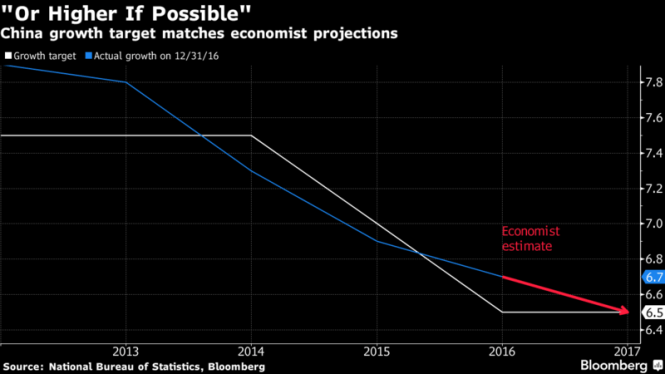
(Return to top)

sutton

Will this actually work?

RAFAL GERSZAK FOR THE GLOBE AND MAIL

When it comes to housing prices and sales, we won’t know for a while what effect Ottawa’s latest measures will have, or whether they’re working as the Trudeau government intends.

Not all the factors behind Toronto and Vancouver’s high prices – like the shortage of single family houses in those cities, or global trends that drive foreign investment in real estate – are within the federal government’s control, The Globe’s Barrie McKenna explains, and mortgage stress tests may not be a sufficient fix.

Here’s Kathy Tomlinson and Mike Hager’s report on what some real-estate experts predict will happen after the federal changes take effect. Over time, monthly housing reports will also paint a clearer picture of how they’re affecting home buyers’ bottom line across the country. To see how the market is shifting in your city or neighbourhood, get the latest numbers and analysis from The Globe’s house-price data centre.

(Return to top)

Canada’s housing bubble makes America’s look tiny

Comparing Canada’s infatuation with real estate against the peak of the U.S. housing bubble yields some disturbing insights

Andrew Hepburn

October 31, 2016

housing-subdivision

It’s been just over a decade since the U.S. housing market peaked, and rarely a day goes by without stories exploring the hot real estate market in Canada. Whether it’s warnings about elevated levels of household debt, government regulations to cool prices or the influx of foreign money, residential real estate generates sustained discussion and debate. After witnessing the housing crash south of the border, and the carnage it wrought, this is to be expected.

For all the attention, it’s notable that most analysts don’t see Canada facing a U.S.-style housing crash. For instance, Moody’s Analytics argued this month that even though price growth will decelerate, there is not likely to be a hard landing. Some observers are a bit more pessimistic, such as TD Bank, which predicts a 10 per cent fall in Vancouver house prices. Still, if there is a consensus view among professional forecasters about the Canadian housing market, it’s that prices will plateau or suffer only a minor dip. For a variety of reasons, most people do not see a U.S.-style crash on the horizon for Canada.

Yet when it comes to our respective housing bubbles, comparing Canada’s current infatuation with real estate with the peak of property mania in the U.S. yields some disturbing insights. We may not be as different as we like to think.

MORE: Hands off my housing bubble!

When looking at housing markets, the most obvious comparison is price. How does the level and trajectory of Canadian house prices stack up against the U.S.?

The following chart is drawn from the Federal Reserve Bank of Dallas’s International House Price Database. It’s an index (100 = prices in 2005) of real, or inflation-adjusted house prices, and it drives home just how much more inflated Canadian house prices are than at the U.S. bubble’s peak. The chart also includes Japan and its mammoth housing bubble of the 1980s—which is more akin to what’s gone on in Canada.

Here’s another way to look at the astonishing price gap between Canada now and when the U.S. bubble peaked. BMO economist Sal Guatieri put together the following chart in May, showing average house prices for Canada and the U.S. since the year 2000 but with both housing markets denominated in U.S. dollars in order to show relative valuations. It reveals just how expensive our housing market has become relative to the U.S. bubble’s peak.

avg-sale-price

As has been pointed out many times, two cities in particular are driving Canada’s real estate boom: Vancouver and Toronto. Here are how those two cities compare against four American cities that saw rapid house inflation during the U.S. boom. Vancouver’s market quite clearly leads the pack, with prices going parabolic. Toronto comes in second, with its price appreciation since 1998 eclipsing the mid-2000 bubbles in all four American cities on the graph—even the hyper-charged markets of Miami and Las Vegas. Of course, prices are not the only way to look at the evolution of a housing market. Another important consideration is the level and change in household debt. As with the U.S. bubble, a surge in household indebtedness (principally via mortgages) has provided the fuel to send prices soaring. If we examine U.S. and Canadian household debt-to-GDP ratios, we see that Canada recently exceeded the level reached by American households in the first quarter of 2008. Perhaps a more telling comparison, however, is household debt to disposable income for the two countries. Indeed, that’s the ratio more often cited by economists, because it measures the debt burden of households against the income they have available to repay it. When Canada’s debt and income data is adjusted to reflect how the U.S. measures them, Canada’s debt-to-income ratio now sits just shy of the U.S. peak reached in the wake of the housing crash. (It should be noted, though, that among industrialized countries, Canada is not the most indebted using this ratio. Norway and the Netherlands have household debt to disposable income ratios well in excess of 200 per cent, while Denmark’s households owe just over 300 per cent.)

Some critics have in the past argued that household debt to disposable income is a misleading metric, when what really matters is not the debt burned itself but the ability of households to manage it. And for a long time, Statistics Canada’s debt-service ratio—the amount of disposable income required to cover debt payments—showed Canadian households in a far better position than American households were at the time of the housing crash, with Canada’s ratio hitting record lows thanks to near-zero interest rates. But those claims were made when StatsCan only published the interest part of debt servicing. Now that StatsCan includes principal repayment in the calculation, bringing the measure in line with the U.S. methodology, the situation in Canada looks much grimmer and skeptics have stopped using it.

Another way to assess a housing market is to consider it relative to the size of the national economy. Again, both in the case of the U.S. at the time of the bubble and in Canada now, residential construction represents a sizable share of GDP. Further, the following graph from investment bank Macquarie suggests that Canada is following the path of the U.S. when it comes to this sector. And crucially, using the U.S. bubble as a guide, Canadian residential investment may have recently peaked.

res-invstment

Comparing the underlying data and trends in the two North American housing manias is interesting. But it’s in some of the softer, less quantifiable aspects of the Canadian bubble that we see echoes of the U.S. boom.

One obvious similarity between the Canadian and U.S. bubbles is the wall-to-wall coverage of all things real estate. Turn on Canadian radio and television these days, or browse the Internet and social media, and you’ll encounter a near-constant barrage of pitches for condos, mortgages (as well as second mortgages) and real estate seminars, promising the secrets of easy real estate riches as taught by self-professed experts. Also ubiquitous: ads for debt management and credit counselling.

As with the U.S., too, there are seemingly compelling arguments put forth as to why bubble fears are overblown. For example, in 2004, then-Federal Reserve chairman Alan Greenspan argued that U.S. households were actually in reasonably good shape, despite rising consumer debts. In painting a healthy picture, Greenspan pointed to rising household net worth, which of course was principally the result of the soaring real estate market. The problem was, when the market crashed, so too did the net worth of U.S. households. Similar arguments have been repeatedly made in Canada.

Given all these similarities, both statistical and anecdotal, why then do more people not believe Canada could suffer the sort of housing crash that the U.S. suffered?

In part, it may be related to how the respective bubbles formed. The U.S. bubble involved widespread use of complex products such as collateralized debt obligations and credit default swaps. That sort of financial engineering is not nearly as prevalent in Canada, and while there are signs of fraud in the mortgage industry, the causes of the Canadian bubble seem more straightforward: low interest rates and lots of bank lending (much of it insured by the taxpayer), with foreign investors also playing a role in certain areas (namely Vancouver). Oh, and old-fashioned greed, fuelled by ridiculously unrealistic expectations.

Another explanation for the lack of housing fear lies in Canada’s sense of its own economic uniqueness. When the U.S. housing market collapsed, it kneecapped the global economy, and yet Canada emerged largely unscathed, with observers praising the health of Canada’s banks. Then when the European debt crisis and U.S. debt ceiling debates raged, observers again pointed to Canada for its sound government finances. Now as global growth slows, yet more observers are singing Canada’s praise for its embrace of fiscal stimulus, trade and newcomers, a stark contrast to the presidential candidacy of Donald Trump. It’s enough to make anyone smug.

Canada better hope all this housing confidence is justified. If there’s one thing the U.S. crash reminded us, it’s that housing bubbles can have very serious and long-lasting consequences—property values crater, mortgages become millstones, consumer spending plummets, and unemployment soars.

After all, with so many indicators suggesting Canada’s housing market has inflated well beyond what the U.S. experienced in the early 2000s, the chart shown above simulates what a 33 % house price decline would mean for the Canadian market. This is sobering.

But surely that can’t happen here. Right?

 homesweethome


Watch this indicator for signs of an impending plunge in housing prices

Scott Barlow

The Globe and Mail

Published Friday, Dec. 23, 2016 10:08AM EST

The following is an excerpt from Scott Barlow’s collection of 10 charts that will define the markets in 2017. To view the entire series, click here.

The Teranet-National Bank composite index of the country’s 11 largest housing markets shows a healthy 11.8 per cent year-over-year increase in residential real estate prices. This is deceiving. Once booming everywhere, national housing prices are now dependent to a great extent on the red-hot Greater Toronto Area and the now-flagging British Columbia markets.

The first chart below shows the year-over-year change for the Teranet-National Bank composite 11 index of home prices and all of its components (using October data). Vancouver homes saw the greatest increase at 22.5 per cent but recent measures to slow foreign investment flows saw prices fall in the September to October period. The Toronto real estate market remained strong and the 15-per-cent increase in Hamilton home prices indicates how far outside the city GTA homebuyers had to go to find affordable prices.

realestate-prices

Five markets saw flat or declining housing values – Halifax, Montreal, Quebec, Edmonton and Calgary.

The second chart compares national home prices and retail spending in an attempt to predict the future course of the real estate market. The thesis here is that the infamously indebted Canadian consumer will pull back on discretionary spending when monthly mortgage payments start to bite. Mortgage payments aren’t optional and if high household debt levels are about to slow the housing market and the economy at large, the trend should be visible first at the shopping mall.

From November, 2011, to July, 2013, the growth in Canadian real estate values trended lower, following declining sales growth with a lag of about six months.

retail-prices

This year has seen a much different pattern. Retail sales growth has slowed sharply, falling below the five-year average. At the same time, the Teranet-National Bank composite 11 index has continued to rocket higher, creating a major divergence on the chart.

The relationship between home prices and retail spending growth is far from ironclad – it is not guaranteed that housing prices will follow consumption levels lower. But it stands to reason that further weakness in Canadian spending levels is a negative sign for real estate and an indication that high household debt levels are beginning to limit domestic economic growth.

The Bank of Canada and the U.S. Federal Reserve are moving in different directions and this is likely to result in a lower Canadian dollar for 2017.

The price of oil has a significant impact on the loonie but interest rates have been the better predictor of the domestic currency’s value in the past five years. Specifically, the yield on the Canadian two-year government bond minus the yield on the two-year U.S. Treasury bond has been almost foolproof as a fair value indicator for the Canadian dollar, as the chart below shows.

Cross border investment flows are behind the trend. Domestic and foreign investors will shift assets to higher-yielding bond markets. In April, 2012, for instance, the two-year Canada bond yielded 1.42 per cent compared with 0.25 per cent for the U.S. equivalent bond. U.S. bond investors moved assets to the Canadian market to receive higher yields. As part of this transaction, these foreign funds were converted to Canadian dollars in foreign exchange markets, pushing the loonie’s value above par on the greenback.

Current trends in Canadian bond yields are very negative for the loonie. Fed chairwoman Janet Yellen’s recent decision to increase U.S interest rates pushed the orange-coloured line on the chart lower. Fed policy caused U.S. bond yields to rise relative to Canadian bond yields. The Bank of Canada is not expected to change policy in 2017, but if it does, the most likely action is an interest rate cut. This would also make domestic bond yields less attractive relative to U.S. bonds and weaken the loonie. In other words, central bank policy on both sides of the border is leaning towards a weaker Canadian dollar.

central-bank

The extent to which Canadian bond yields follow U.S. yields higher will be an important theme for 2017. Historically, domestic yields have followed U.S. yields even during periods when the Canadian economy did not justify any change. In bond trader parlance, Canada is a ‘yield taker’ country. Any change in Canadian yields relative to U.S. bonds will likely have a significant effect on the value of the domestic currency.


With reports from Bill Curry, Tamsin McMahon, Rachelle Younglai, Kathy Tomlinson,


US Housing Market

Housing Market Forecast: Experts Weigh In On 2017 Real Estate

Low Mortgage Rates, High Demand Fueled 2016 Housing Market

The year 2016 proved to be a hot one for real estate.

Home values, prices and sales showed some of their strongest numbers since before the economic downturn a few years ago.

And mortgage rates were downright cheap.

But there’s no guarantee favorable conditions for buying and borrowing will continue in the months ahead.

Consequently, it’s fair to ask the question: Will housing prices keep climbing into 2017?

Industry experts weigh in. Though no one can tell the future, their housing market forecast can help first-time home buyers make better decisions this year and next.

Should you buy now, or wait? Here is advice from leading experts.

Home Prices Near Pre-Recession Peak

First, a closer look at the current climate on housing prices nationally.

Home prices continue to post steady year-over-year gains and are nearly back to pre-recession highs, based on 90.6 million U.S. single-family homes and condos tracked by real estate data firm ATTOM Data Solutions.

In July, for example, the national median home price for single-family homes and condos collectively was $226,500 – an increase of 7% from a year earlier and the 53rd consecutive month with a year-over-year increase.

This is within a half percent of the pre-recession peak price observed in July 2005, says Daren Blomquist, senior vice president for ATTOM Data Solutions.

But looking closer at market indicators reveals further truths.

“The strong national sales price numbers mask a shift in the market where we are seeing home price appreciation weaken in some previously high-flying and high-priced markets while continuing to strengthen in some of the secondary markets,” says Blomquist.

Case in point: In July, home price appreciation in San Jose and San Francisco was each 5%, the former down from 16% a year earlier. San Francisco was down from a high of a 32% rate of appreciation in July 2013.

Secondary markets like Portland, Denver and Seattle, meanwhile, all experienced appreciation increases in 2016 versus one year ago.

Nela Richardson, chief economist for Redfin, agrees that bullish real estate sales prices are decelerating.

“After several years of steady and steep price growth, we are seeing indications that price growth is slowing and the market is normalizing,” says Richardson. “Redfin housing market data indicate that home prices in August rose just 4.4% compared to 2015 — the slowest pace of the year.”

Prediction: Housing Market To Normalize

Based on these indicators, Richardson expects 2017 will bring a more normalized housing market — one that still boasts a healthy number of sales but a moderate rate of price growth.

“According to a recent survey of Redfin agents, 54% predict prices will rise somewhat next year and 36% predict prices will level off,” says Richardson.

Ask Rick Sharga, executive vice president of Ten-X (previously Auction.com), and he’ll tell you that home price appreciation is likely to slow down next year, “although we’re still likely to see at least a 3 to 4% year-over-year increase,” he says.

“In 2017, we’re also projecting another modest increase in total home sales,” Sharga continues. “However, three headwinds continue to challenge the housing market’s recovery — tight credit, limited inventory, and rising prices, which are beginning to create some affordability problems in certain markets.”

Home Appreciation Might Slow, But Not Stop

Blomquist anticipates home appreciation to slow nationally to approximately 5% in six months and to 3.5% in 12 months.

“Based on bellwether markets across the country, where sales volume has been decreasing often for several months, I would expect sales volume nationally also to slow down in 2017,” says Blomquist.

“That slowdown could be accelerated by rising mortgage rates,” he says, “but even without rising interest rates I think enough markets are now hitting affordability and inventory constraints that demand will slow down. And as demand slows, inventory will gradually increase in 2017.”

Many parts of the country could see a small dip in property values over the next six to 12 months, predicts Brian Guth, regional vice president/branch manager for Cross-country Mortgage, Inc.

“But real estate, for most people, should still be thought of as a long-term hold with a great tax write-off, forced savings plan, and long-term appreciation,” Guth says. “My home has doubled in value since I purchased it in 2002, even though it was hit very hard in 2009.”

Colby Sambrotto, president of USRealty.com, expects home sale prices to gradually increase in 2017 as more moderately priced homes ease into the market.

“There’s a lot of demand right now for moderately priced houses that appeal to both first-time buyers and baby boomers who want to be in a right-sized house for aging in place. Across the country, most markets don’t have enough houses at or just below the median price in that market,” says Sambrotto.

Click to see today’s rates (Nov 24th, 2016)

Rising Rent Could Be Your Deciding Factor in 2017

Considering these housing market forecasts, many professionals say it’s wise for prospective home buyers to think about purchasing relatively soon.

Mortgage interest rates remain low and housing price are rising.

“I think it’s still a great idea for first-time buyers to purchase now, because most are paying high rents and need the tax write-offs that come with owning a home,” says Guth.

Richardson agrees that rental affordability is one of the biggest factors driving first-timers into the market.

“With rates at historic lows, buyers may be able to find a home with a monthly mortgage payment that is less than or equal to rent,” she says.

Richardson adds, “The conditions that challenged first-time and millennial homebuyers this spring are starting to ease. There are fewer bidding wars and less of a need to escalate significantly above the list price to get an offer accepted. And the pace of the market is also slowing, which helps buyers since they can now afford to be more patient.”

Should Buyers Put Off Their Purchase?

Blomquist says purchasing sooner versus later can be smart — so long as you view the home as a long-term investment.

“It’s probably not the best time if you are counting on your home value going up by another 20 or 30% in the next three years,” says Blomquist.

He also offers a mortgage rate forecast: “The rock-bottom interest rates make it a good time to be a borrower, but I don’t expect interest rates to rise dramatically in 2017.”

Sharga warns that trying to time the housing market can be as frustrating as trying to time the stock market.

“For first-time buyers seeking a place to live and possibly raise a family, it’s smart to have a long-term view on a home purchase,” says Sharga. “In many markets, prices are still below peak pricing from the boom years, so there are many markets across the country with excellent affordability.”

In addition, waiting for the next real estate crash and prices to go lower really isn’t a good strategy — “it’s much more likely that home prices will continue to go up over time and that interest rates will ultimately rise,” Sharga adds.

creacrea-2

Quarterly Forecasts- The Canadian Real Estate Association (CREA)

Ottawa, ON, December 15, 2016


The Canadian Real Estate Association (CREA) has updated its forecast for home sales activity via the Multiple Listing Service® (MLS®) Systems of Canadian real estate Boards and Associations in 2016 and 2017.

Canadian housing market trends have evolved largely as expected since CREA last published its forecast in September. Sales activity in British Columbia is showing signs of returning to, and stabilizing at, more normal levels, while Ontario sales continue to set new records despite an unprecedented supply shortage in the Greater Toronto Area (GTA) and throughout the surrounding region (Greater Golden Horseshoe).

Mortgage regulations were further tightened following CREA’s previous forecast. In the near term, tightened regulations are expected to reduce the number of first-time buyers who qualify for mortgage financing, particularly in pricier markets where there is a severe shortage of lower-priced listings. Tightened mortgage regulations and lending guidelines are also expected to increase capital costs for lenders, resulting in modest increases in mortgage interest rates in the New Year. These regulatory headwinds were not a factor at the time of CREA’s previous forecast, and have resulted in downward revisions to the forecast for sales and average price in 2017.

Nationally, sales activity is projected to rise by 6.2% to 536,700 units in 2016. This represents a slight upward revision from CREA’s previously forecast increase of 6.0%. However, the forecast for sales activity was revised upward for Ontario and downward for British Columbia.

Projected annual sales for 2016 would represent a new annual record for national activity, up 3.3% from the previous record set in 2007. That said, after adjusting for population growth, sales are nonetheless expected to remain below the 2007 peak.

Among Canada’s most populous provinces, British Columbia is still forecast to post the largest annual increase in activity (+10.0%) due to unprecedented strength in sales there early this year. Ontario’s annual increase in sales (9%) is anticipated to be nearly as large.

Prince Edward Island should post the largest annual percentage increase in sales this year (+22.4 percent), making it one of only four provinces to set a new annual sales record in 2016 (along with British Columbia, Manitoba and Ontario).

Among provinces where housing market prospects are closely tied to the outlook for natural resource prices, Alberta is still expected to record the largest annual decline in activity in 2016 (-8.1 percent), followed by Saskatchewan (‑4.6%). Meanwhile, annual activity in Newfoundland and Labrador is now anticipated to register almost no change in 2016 as compared to 2015.

Elsewhere, sales are forecast to rise in Manitoba (+4.0%), Quebec (+5.8%), New Brunswick (+6.1%) and Nova Scotia (+4.9%). In the latter three provinces, activity has been slowly but steadily gaining momentum, and 2016 is expected to mark a multi-year high for annual sales.

Year-over-year average price gains have continued to accelerate in Ontario amid strong demand in the face of an unprecedented supply shortage. Meanwhile, average prices in British Columbia have receded due to a sharp decline in multi-million-dollar single detached home sales in the Lower Mainland.

As a result, the projected annual average price for Ontario in 2016 has again been upwardly revised compared to CREA’s previous forecast, while the projected annual average price for British Columbia has again been downwardly revised. As with the revisions to forecast sales, revisions to average price forecasts for these provinces mostly offset each other at the national level.

In provinces where economic and housing market prospects are closely tied to the outlook for the oil patch and other natural resource industries, average prices appear to be stabilizing in Alberta and Saskatchewan but remain down from year-ago levels in Newfoundland and Labrador. Average prices in other provinces are either rising modestly or holding steady, reflecting well balanced supply and demand for housing stock.

The national average price is now projected to rise by 10.5% to $489,500 in 2016, with a slightly smaller gain in British Columbia ($688,300; 8.1%) and a larger gain in Ontario ($535,700; 15.1%). Elsewhere, average prices are forecast to rise by 2.4% in Manitoba, 2.5% in Quebec and 1.9% in New Brunswick. Annual average prices in Alberta, Saskatchewan and Nova Scotia are projected to remain largely stable.

By comparison, the forecast average price increase (11.6%) for Prince Edward Island has been revised upward to reflect an exceptionally strong price gain recorded in the third quarter. By contrast, average price in Newfoundland and Labrador is now forecast to ease by -6.7%.

In 2017, national sales are forecast to number 518,900 units, representing a decline of 3.3% compared to projected activity this year. Transactions in B.C. and Ontario are anticipated to remain strong but fall short of this year’s record levels due to deteriorating affordability, an ongoing shortage of affordably priced listings for single family homes and tightened mortgage regulations. British Columbia home sales are forecast to decline by 12.2%, while annual sales in Ontario are forecast to retreat by 2.7%.

Sales are also forecast to ease slightly in 2017 in Saskatchewan (-1.2%), Nova Scotia (-2.1%), Prince Edward Island (‑2.2%) and Newfoundland and Labrador (-1.4%).

The downward revision to forecast sales in Prince Edward Island reflects unexpected strength in sales this year that is not expected to reoccur in 2017. Nonetheless, sales for the province are expected to remain strong, as its economy should continue benefiting from a weakened Canada-U.S. currency exchange rate.

Sales in 2017 are forecast to rise by 3.5% in Alberta and by 1.2% in Quebec. The forecast rise in Alberta’s sales in 2017 mostly reflects slow sales activity in the first quarter of 2016, a repeat of which is not expected. Sales are also forecast to improve modestly in Manitoba (+0.8%) and New Brunswick (+1.6%).

The national average price is forecast to decline by 2.8% to $475,900 next year, with modest price gains near or below inflation in Manitoba, Ontario, Quebec, New Brunswick and Nova Scotia, together with small declines of a similar magnitude in Alberta, Saskatchewan, Prince Edward Island and Newfoundland and Labrador.

While the average sale price in British Columbia is expected to decline by 7.8% in 2017, this largely reflects an anticipated decline in single family home sales activity at the higher end of the market – particularly in the Lower Mainland.

The forecast dip in the national average price in 2017 along with a decline in British Columbia is expected to be similar to the trend in 2012, when a more normal year for activity in Greater Vancouver followed record level sales activity for multi-million dollar homes in 2011. As such, the forecast decline reflects the influence exerted by the composition of sales activity on average price (as it did in 2012 versus 2011).

Meanwhile, an ample supply of listings relative to demand is anticipated to keep price gains in check in other provinces, although sales have begun to draw down inventories in provinces where supply had been elevated in recent years.

canada-house-sales

 crea-forecast

crea-avg-price-forecast

US Housing Market

Housing Market Forecast: Experts Weigh In On 2017 Real Estate

predicting-2017

US jobless rate falls to lowest level since crisis

Trump inherits economy that is shedding vestiges of financial crash

Low Mortgage Rates, High Demand Fueled 2016 Housing Market

The year 2016 proved to be a hot one for real estate.

Home values, prices and sales showed some of their strongest numbers since before the economic downturn a few years ago.

And mortgage rates were downright cheap.

But there’s no guarantee favorable conditions for buying and borrowing will continue in the months ahead.

Consequently, it’s fair to ask the question: Will housing prices keep climbing into 2017?

Industry experts weigh in. Though no one can tell the future, their housing market forecast can help first-time home buyers make better decisions this year and next.

Should you buy now, or wait? Here is advice from leading experts.

Home Prices Near Pre-Recession Peak

First, a closer look at the current climate on housing prices nationally.

Home prices continue to post steady year-over-year gains and are nearly back to pre-recession highs, based on 90.6 million U.S. single-family homes and condos tracked by real estate data firm ATTOM Data Solutions.

In July, for example, the national median home price for single-family homes and condos collectively was $226,500 – an increase of 7% from a year earlier and the 53rd consecutive month with a year-over-year increase.

This is within a half percent of the pre-recession peak price observed in July 2005, says Daren Blomquist, senior vice president for ATTOM Data Solutions.

But looking closer at market indicators reveals further truths.

“The strong national sales price numbers mask a shift in the market where we are seeing home price appreciation weaken in some previously high-flying and high-priced markets while continuing to strengthen in some of the secondary markets,” says Blomquist.

Case in point: In July, home price appreciation in San Jose and San Francisco was each 5%, the former down from 16% a year earlier. San Francisco was down from a high of a 32% rate of appreciation in July 2013.

Secondary markets like Portland, Denver and Seattle, meanwhile, all experienced appreciation increases in 2016 versus one year ago.

Nela Richardson, chief economist for Redfin, agrees that bullish real estate sales prices are decelerating.

“After several years of steady and steep price growth, we are seeing indications that price growth is slowing and the market is normalizing,” says Richardson. “Redfin housing market data indicate that home prices in August rose just 4.4% compared to 2015 — the slowest pace of the year.”

Prediction: Housing Market To Normalize

Based on these indicators, Richardson expects 2017 will bring a more normalized housing market — one that still boasts a healthy number of sales but a moderate rate of price growth.

“According to a recent survey of Redfin agents, 54% predict prices will rise somewhat next year and 36% predict prices will level off,” says Richardson.

Ask Rick Sharga, executive vice president of Ten-X (previously Auction.com), and he’ll tell you that home price appreciation is likely to slow down next year, “although we’re still likely to see at least a 3 to 4% year-over-year increase,” he says.

“In 2017, we’re also projecting another modest increase in total home sales,” Sharga continues. “However, three headwinds continue to challenge the housing market’s recovery — tight credit, limited inventory, and rising prices, which are beginning to create some affordability problems in certain markets.”

Home Appreciation Might Slow, But Not Stop

Blomquist anticipates home appreciation to slow nationally to approximately 5% in six months and to 3.5% in 12 months.

“Based on bellwether markets across the country, where sales volume has been decreasing often for several months, I would expect sales volume nationally also to slow down in 2017,” says Blomquist.

“That slowdown could be accelerated by rising mortgage rates,” he says, “but even without rising interest rates I think enough markets are now hitting affordability and inventory constraints that demand will slow down. And as demand slows, inventory will gradually increase in 2017.”

Many parts of the country could see a small dip in property values over the next six to 12 months, predicts Brian Guth, regional vice president/branch manager for Cross-country Mortgage, Inc.

“But real estate, for most people, should still be thought of as a long-term hold with a great tax write-off, forced savings plan, and long-term appreciation,” Guth says. “My home has doubled in value since I purchased it in 2002, even though it was hit very hard in 2009.”

Colby Sambrotto, president of USRealty.com, expects home sale prices to gradually increase in 2017 as more moderately priced homes ease into the market.

“There’s a lot of demand right now for moderately priced houses that appeal to both first-time buyers and baby boomers who want to be in a right-sized house for aging in place. Across the country, most markets don’t have enough houses at or just below the median price in that market,” says Sambrotto.

Rising Rent Could Be Your Deciding Factor in 2017

Considering these housing market forecasts, many professionals say it’s wise for prospective home buyers to think about purchasing relatively soon.

Mortgage interest rates remain low and housing price are rising.

“I think it’s still a great idea for first-time buyers to purchase now, because most are paying high rents and need the tax write-offs that come with owning a home,” says Guth.

Richardson agrees that rental affordability is one of the biggest factors driving first-timers into the market.

“With rates at historic lows, buyers may be able to find a home with a monthly mortgage payment that is less than or equal to rent,” she says.

Richardson adds, “The conditions that challenged first-time and millennial homebuyers this spring are starting to ease. There are fewer bidding wars and less of a need to escalate significantly above the list price to get an offer accepted. And the pace of the market is also slowing, which helps buyers since they can now afford to be more patient.”

Should Buyers Put Off Their Purchase?

Blomquist says purchasing sooner versus later can be smart — so long as you view the home as a long-term investment.

“It’s probably not the best time if you are counting on your home value going up by another 20 or 30% in the next three years,” says Blomquist.

He also offers a mortgage rate forecast: “The rock-bottom interest rates make it a good time to be a borrower, but I don’t expect interest rates to rise dramatically in 2017.”

Sharga warns that trying to time the housing market can be as frustrating as trying to time the stock market.

“For first-time buyers seeking a place to live and possibly raise a family, it’s smart to have a long-term view on a home purchase,” says Sharga. “In many markets, prices are still below peak pricing from the boom years, so there are many markets across the country with excellent affordability.”

Additionally, waiting for the next real estate crash and prices to go lower really isn’t a good strategy — “it’s much more likely that home prices will continue to go up over time and that interest rates will ultimately rise,” Sharga adds.

What Are Today’s Mortgage Rates?


 us-shoppers

© Bloomberg

December 2, 2016

by: Shawn Donnan in Washington and Mamta Badkar in New York

Donald Trump will inherit a US economy in rude health with new employment data on Friday adding to growing evidence that the world’s largest industrialised economy is emerging from the long shadow of the 2008 global financial crisis.

The US economy added 178,000 jobs in November with the unemployment rate falling to 4.6 per cent, its lowest level since August 2007. The data added to expectations the Federal Reserve will raise interest rates for only the second time since the crisis when its policy committee meets this month.

The strong numbers, which mean the US economy has added 15.6m jobs since its post-crisis nadir in early 2010, comes at the end of a week where a key housing price index surpassed its pre-crisis peak for the first time and gross domestic product growth for the third quarter was revised upwards to a robust 3.2 per cent.

The growing evidence of a return to economic health highlights a welcome paradox facing Mr Trump as he prepares to take office.

The president-elect’s victory came thanks to his ability to tap into economic discontent, particularly in the US rust belt which was highlighted by his flight to Indiana this week to announce a deal to save almost 1,000 jobs at air conditioning manufacturer Carrier.

house-construction

But the data point to the fact that much of the repair job has already been done by his predecessor, Barack Obama. The OECD said in its latest forecast that it expected the US to be the best performing large advanced economy in 2017, growing 2.3 per cent. Other data this week highlighted a “sustained acceleration” in US manufacturing.

Steven Mnuchin, Mr Trump’s nominee for treasury secretary, this week promised to oversee an economy that would grow regularly at an annual rate of 3-4 per cent thanks to a combination of tax cuts and deregulation aimed at spurring business investment and hiring.

In a bid to give business a voice in economic policy, the Trump administration on Friday also announced the establishment of a special advisory body made up of top executives chaired by Blackstone’s Stephen Schwarzman and including Bob Iger, chief executive of Disney, and former General Electric boss Jack Welch.

avg-hourly-earnings

But data released this week pointed to an economy already well on its way to the sort of job-boosting growth Mr Mnuchin is targeting, even before the much-anticipated fiscal stimulus a Trump administration is expected to bring with it.

Friday’s jobs report, which was just shy of economists’ expectations of 180,000, did contain some cautionary points.

Average hourly earnings unexpectedly dipped 0.1 per cent from the previous month and the participation rate — the number of working age Americans in or actively seeking jobs — fell to 62.7 per cent.

But economists said the slip in wages was largely a seasonal blip in hiring patterns and said the overall positive report cleared the way for Fed policymakers to raise rates when they gather December 14, in what would be another sign of the US economy’s relative return to normality.

“The November employment report seals the case for a [Fed] rate increase later this month, in our view,” said Jan Hatzius, an economist at Goldman Sachs.

“This was the last hurdle on the path to a December hike, and it has been cleared convincingly,” said Luke Bartholomew at Aberdeen Asset Management. “It is now incredibly hard to imagine what would stop the Fed from going.”


Fed sees three interest rate rises in 2017

Central bank lifts short-term rates for only second time since financial crisis

janet-yellin

Janet Yellen © Getty

Bottom of Form

December 14, 2016

by: Sam Fleming in Washington and Eric Platt in New York

The US Federal Reserve has raised short-term interest rates for the second time in a decade and forecast a faster pace of tightening in the coming year, as it responds to a US economy that has been gathering momentum and may receive further stimulus from Republican tax cuts.

With the US on the cusp of full employment and inflation gradually approaching the Fed’s target, the central bank raised the target range for its federal funds rate by a quarter-point to 0.5-0.75 per cent, as was widely expected in the financial markets.

Following a long procession of downgrades to its interest-rate forecasts in recent quarters, the central bank’s policymakers pencilled in a median projection of three quarter-point increases for 2017, up from two previously.

The decision to lift rates on Wednesday, which was unanimous, came in the Fed’s final meeting before president-elect Donald Trump is due to take office, and as Republicans contemplate tax-cutting plans that could add further fuel to the recovery.

Janet Yellen, Fed chair, told a press conference that the rate increase was a “reflection of the confidence we have in the progress the economy has made and our judgment that that progress will continue. The economy has proven to be remarkably resilient”.

However, she also played down the scale of the forecast changes, calling the new interest-rate outlook a “modest adjustment” by some of the Fed’s policymakers. “We continue to expect the evolution of the economy will warrant only gradual increases [in interest rates],” Ms Yellen said.

While the Fed chair was repeatedly pushed to discuss the impact of Republican tax and spending plans on the Fed, not all policymakers had factored the prospect of fiscal changes into their new outlooks. “We are operating under a cloud of uncertainty at the moment,” she said.

dot-plot

“Changes in fiscal policy or other economic policies could potentially affect the economic outlook,” she added. “Of course, it is far too early to know how these policies will unfold. Moreover, changes in fiscal policy are only one of the many factors that can influence the outlook in the appropriate course of monetary policy.”

Treasuries slid after the decision, with the yield on the two-year note climbing 10 basis points to 1.26 per cent. Selling was concentrated in the front of the yield curve, most sensitive to changes in monetary policy.

maxresdefault

The US Housing Forecast is Looking Good 2017 to 2020 and Beyond

Gord Collins

Welcome to 2017! I hope you’re having happy thoughts about buying, investing and selling in 2017. More experts are predicting a strong year ahead for US housing in 2017 with almost no risk of a crash downturn. They see existing home sales of 6 to 6.5 million in 2017 along with 160,000 new homes being built per year up to 2024. When builders are feeling optimistic, it’s a good omen.

What’s also a good omen is what you’re going to read in this post. It may impact your choice about many things in 2017, from employment, to finding the best investments 2017 to moving where opportunity is.

Interest in rental income investment and apartments is particularly strong now in places like Dallas, Seattle and San Francisco.  Whether you’re in Los Angeles, San Diego, San Francisco Bay Area, Seattle, Denver, Miami or New York, the outlook for return on investment is positive. See this post on investing in rental income property.

You won’t find too many US housing forecasts beyond 2017, yet we’re looking looking for the best cities to invest in real estate, where to buy a home, and whether this is a good time to sell your home.

Here’s a short list of positive factors that will affect the housing market 2017 and beyond:

  1. moderately rising mortgage rates
  2. low risk of a housing crash for most cities
  3. millennials buyers coming into the main home buying years
  4. a trend to government deregulation
  5. labor shortages pushing up costs of production
  6. the economy will keep going – longest business cycle in history
  7. Donald Trump and his “drain the swamp” crew
  8. The biggest factor even for 2017 is Donald Trump. The repatriation of business back to the US may come with a big price — a high dollar and strong inflation. Trump has spoken on another matter that might seem inconsequential – that of forgiving student loan debt after 15 years. Young people including Millennials can’t buy homes because of massive student loan debts that kill their credit scores and keep them unable to save for the down payment. That’s called a syndrome.
  9. To be on the safe side, see this post on the likelihood of a US housing market crash in the years ahead.

Expert Predictions – US Housing 

Expert Prediction from Eric Fox, vice president of statistical and economic modeling (Vero Forecast) — The top forecast markets shows price appreciation in the 10% to 11% range. The top forecast market is Seattle, Washington at 11.2%, followed by Portland, Oregon at 11.1% and Denver, Colorado at 9.9%.

These economies have robust economies, growing populations and no more than two month’s supply of homes. In fact, the forecast of the Boston market increase sharply to 7.4% is due to reductions in inventory and unemployment. On the other hand, the worst performing market is Kington, New York with 2.5% depreciation, followed by Ocean City, New Jersey at -2.1%, Kingsport, Tennessee at -1.9% and Atlantic City, New Jersey and San Angelo, Texas tied at -1.4%.  — Business Wire

Pantheon Macro Chief Economist Ian Shepherdson explains that “Homebuilders behavior likely is a continuing echo of their experience during the crash. No one wants to be caught with excess inventory during a sudden downshift in demand. In this cycle, the pursuit of market share and volumes is less important than profitability and balance sheet resilience.” — Market watch.

Housing Construction Starts Will Slowly Rise

It’s predicted that new home construction won’t keep up with demand, however it is recovering and we’ll see more renters becoming homeowners over the next decade.

Forisk Research projects US Housing starts continuing at 1.5 Million per year to 2024 #ushousing #homes… Click To Tweet

US Housing Construction Starts All Time – on the Rise Again

Let’s begin with a look at how home prices have grown up to 2016. Nationwide prices are still $50,000 below the pre-recession highs. Will it take 3 to 4 more years to reach those highs? If construction rates do moderate, prices in the hot markets of Miami, San Francisco, Los Angeles, San Diego, New York, Boston, and Phoenix should rocket to all-time highs but what is the risk of a housing market crash?

Mortgage Rate Trends

Mortgage rates are forecast to stay low. Yet recently, mortgage rates have risen above the 4% mark and homeowners are locking in their home loans at the 30 year period. Some are calling this the Trump Effect. With Trump in power, lending requirements are expected to be eased, land opened up for development, and this should stimulate home purchases. With employment growing and wages moderating upward, the market is set for growth. Yet, some housing forecasters still cling to the idea that housing starts will moderate after strong growth to 2020.


US Housing Starts to 2024

The enlightening statistic presented in the graphic below shows the US economy hasn’t recovered from the great recession and housing crash of 2007. Single family spending is rising rapidly, yet no one believes conditions for high inflation exist. It points to years of solid, healthy growth ahead with an unfulfilled demand for single detached homes.

Graphic courtesy of paper-money.blogspot.ca

2016 Non Farm Payrolls

With the price of oil forecast to be rising again, it’s unlikely that economic winds will inflate wage demands. From 2017 on, wage demands should ease from their hot rates as you can see here:

Graphic courtesy of paper-money.blogspot.ca

Graphic courtesy of paper-money.blogspot.ca

US Housing starts are forecast to grow strong this year and next, particularly single family homes which will rise about 30%.

Chart stats courtesy of realtor.org

Home Ownership: The home ownership rate is predicted to continue growing to 2020. #housing #mortgage… Click To Tweet

us-housing-starts

Housing Starts Forecast to 2020 — Graphic courtesy of tradingeconomics.com/united-states/forecast


Employment Outlook: Let’s not forget jobs. Total employed persons in the US will grow 800,000 over the next 2 years.

Graphic courtesy of tradingeconomics.com/united-states/forecastus-median-house-price

Existing homes or resale home sales, may slow slightly but US construction spending will increase. Prices will rise to 2020 and construction spending will grow through 2020.

Graphic courtesy of tradingeconomics.com/united-states/forecast

Mortgage Rate Trends

Mortgage rates are forecast to stay low. Yet recently, mortgage rates have risen above the 4% mark and homeowners are locking in their home loans at the 30 year period. Some are calling this the Trump Effect. With Trump in power, lending requirements are expected to be eased, land opened up for development, and this should stimulate home purchases. With employment growing and wages moderating upward, the market is set for growth. Yet, some housing forecasters still cling to the idea that housing starts will moderate after strong growth to 2020.

conventional-interest-rates


US Housing Starts to 2024

us-housing-starts-to-2024

The enlightening statistic presented in the graphic below shows the US economy hasn’t recovered from the great recession and housing crash of 2007. Single family spending is rising rapidly, yet no one believes conditions for high inflation exist. It points to years of solid, healthy growth ahead with an unfulfilled demand for single detached homes.

value-of-property

Graphic courtesy of paper-money.blogspot.ca

2016 Non Farm Payrolls

With the price of oil forecast to be rising again, it’s unlikely that economic winds will inflate wage demands. From 2017 on, wage demands should ease from their hot rates as you can see here:

adp-total

Graphic courtesy of paper-money.blogspot.ca

avearge-contract-interest-rate

Graphic courtesy of paper-money.blogspot.ca

US Housing starts are forecast to grow strong this year and next, particularly single family homes which will rise about 30%.

housing-and-interest-rate-forecast

multifmily-starts

Home Ownership: The home ownership rate is predicted to continue growing to 2020. #housing #mortgage… Click To Tweet

us-housing-starts-to-2020

Housing Starts Forecast to 2020 — Graphic courtesy of tradingeconomics.com/united-states/forecast

Employment Outlook: Let’s not forget jobs. Total employed persons in the US will grow 800,000 over the next 2 years.

us-labor-forecast

Fourth Quarter 2016 Economic and Wood Product News -Key Themes For 2017: Populism, Nationalism And Reflation

627x364-country-risk-162

Courtesy BMI Research

Key Themes For 2017: Populism, Nationalism And Reflation

Global | Economy | Country Risk | Fri Dec 09, 2016

BMI View: 2017 is set to be another tumultuous year for the global economy, with the rise of populism and nationalism potentially triggering fundamental changes in the dynamics of trade, labour markets and ultimately, economic growth. Systemic risks abound amid a busy election calendar in Europe and the increasing fragility of the Chinese economy.

BMI expect the following key themes to play out globally in 2017:

  • Economic Policy To Turn Inward
  • Global Trade Framework Under Scrutiny
  • End Of Austerity
  • From Deflation To Reflation
  • Commodity Exporters Struggle To Recover
  • Eurosceptics Entrench Further, Keeping Systemic Risks High
  • China’s Policy Constraints Tighten Rapidly – CNY At Risk Economic policy in developed states will be increasingly shaped by populist pressure and we expect a reorientation of economic policy towards promoting the interests of domestic labour. The result of this will be less free trade and increased restrictions on immigration. 2016 has laid the foundations for this trend change as the UK’s decision to leave the European Union and Donald Trump’s victory in the US presidential election have been interpreted as highlighting severe voter dissatisfaction with the economic status quo. The policy shift will be particularly acute in the US and UK, but we expect elements to be replicated in parts of Europe and to a lesser extent in Japan.
  • Less Free Trade – The US will be the main driver of this trend. While we do not expect Trump to pursue some of his more extreme threats such as ramping up tariffs on all Chinese imports, we do expect a renegotiation of existing US trade deals including with China and the World Trade Organization (WTO). Meanwhile, Europe looks set to become more assertive in international trade relations by preventing a ‘soft Brexit’ and with German Chancellor Angela Merkel looking to take a harder line towards alleged dumping of cheap Chinese steel in Europe during her country’s presidency of the G20 in 2017.
  • Economic Policy to Turn Inward Protectionism On The Rise -Largest Five Developed Markets – Number Of Protectionist Measures

    protectionism

Note: Protectionist measures are those deemed ‘almost certainly discriminatory towards foreign commercial interests’. Largest five DM markets are: US, Japan, EU, Australia and Canada. Source: Global Trade Alert, BMI

Immigration Rules To Tighten – In the US, Trump has promised much stronger border enforcement and tougher immigration policy, which we expect a Republican dominated Congress will help him at least partially deliver. In the UK, BMI expect that UK immigration policy will become more restrictive as the country prepares to leave the EU. In Europe, the ongoing migrant crisis means that the Schengen zone is at critical risk of collapse.

Global Trade Framework Under Scrutiny

In 2016, the outlook for the global trade framework took a turn toward the more insular. Donald Trump’s election as US president, following a campaign that bombastically criticised the US’s ‘disastrous’ trade deals, confirmed a sea-change in the outlook for global free trade. In 2017, this trend toward delaying and even potentially dismantling trade deals will continue. The first signs of this may emerge early in the year, as Trump’s inauguration on January 20 could be swiftly followed by the new administration confirming that it will not approve the ratification of TPP, and stating its intention to renegotiate the North American Free Trade Agreement (NAFTA). BMI also expect harsh words for China’s trade practices from the US Treasury, although an all-out trade war with harsh across-the-board tariffs is unlikely.

BMI expect the WTO to face its biggest challenge since at least the turn of the 21 st century, when China acceded to the group. Trump’s economic advisors have sharply criticised the WTO for failing to effectively arbitrate trade disputes, and for allowing members to engage in unfair activities such as bankrolling their export industries via state banks (e.g. Chinese steelmakers). While previous presidents have taken trade disputes with China to the WTO, Trump would have the deal renegotiated, under threat of having the US leave altogether. They could even see other large economies, such as Japan and the EU, join in with the US in complaints about Chinese trade practices. A global trade war is suddenly not a far-fetched possibility, though again, this is not our base case.

As much as these developments will pose threats, the global trade framework is far from dead, and there are also opportunities to be seized should political circumstances allow. NAFTA is arguably overdue a renegotiation, having been conceived in the early 1990s, with dated provisions regarding technology and the internet, agriculture, and energy. China is taking advantage of the lapse in US trade leadership by promoting its TPP rival in Asia, the Regional Comprehensive Economic Partnership (RCEP). While the US-EU TTIP trade deal appears to be dead after three years of talks, the EU and Japan are due to sign a major bilateral trade deal, which has gained urgency on the part of Japan due to the collapse of TPP. It is even conceivable that the TPP gets revived in some renegotiated form. Trump, for his part, even while denigrating multilateral trade deals, has favoured making bilateral pacts, suggesting that the US retains the potential to expand its trading horizons even if it holds back on the likes of TPP.

End Of Austerity

An ongoing trend, particularly among developed markets, is a shift away from reliance on monetary policy and toward fiscal policy when seeking to boost growth. Reasons include accommodative monetary policy having reached the limits of its effectiveness, austere fiscal policy having failed to reduce debt burdens relative to GDP and an element of ‘austerity fatigue’ among electorates. As a result, governments have begun loosening the fiscal reins and BMI believe that ‘peak austerity’ has been reached. While they do not expect outright fiscal expansion, several key developed states are using targeted tax cuts to boost growth, and are moving away from previous targets for fiscal consolidation. A common theme is infrastructure being seen as an attractive sector to focus on, given that it boosts short- and arguably long-term growth and creates many jobs. However, they have not fully incorporated proposed infrastructure programs in China, the EU, Japan, the UK and the US into our forecasts given our skepticism that they will be fully implemented.

Fiscal Austerity Has Peaked -Government Final Consumption, pp Contribution To Real GDP Growth

bmi-forecast

f = BMI forecast. Source: National Sources/BMI

United States – Most significantly, there has been a major shift in the policy outlook in the US following the election of Donald Trump to the presidency along with full Republican control of Congress. BMI expect corporate and income tax cuts to be complemented by fiscal stimulus centred on infrastructure. However, opposition from fiscal conservatives in Congress will prevent a surge in deficit spending.

EU – Political pressures are a key driving force behind the move away from fiscal austerity in the EU given that there are many key elections approaching. Meanwhile the European Commission has already adopted a more lenient stance, highlighted by its decision not to sanction either Spain or Portugal in 2016 for failing to meet budget targets. All that said, they do not expect outright fiscal expansion in the EU as more fiscally hawkish northern European countries hold significant sway over policy at the EU level, including Germany, Denmark, Sweden and the Netherlands.

Japan – Policymakers are increasingly looking to fiscal policy to boost growth, following many years of stagnant economic activity despite ultra-low interest rates. Since July 2016, the finance ministry has shelved a proposed consumption tax hike until 2019, hinted at cutting the corporate tax rate, and also announced a JPY4.5trn (USD40bn, or roughly 1% of GDP) stimulus package aimed largely at boosting infrastructure and social welfare.

From Deflation To Reflation

Their global inflation forecast for 2017 is 2.9%, which would be the highest since 2013 and a major rise from a six-year low of 2.1% in 2016, and the risks lie to the upside. This ‘deflation to reflation’ shift can be observed through a variety of important metrics. Inflation ‘surprises’ have risen to four-year highs across both developed and emerging markets. US wages and core inflation are picking up alongside a tightening labour market, and even eurozone headline (though not core) prices have begun to pick up after a prolonged deflation scare. Chinese producer prices rose year-on-year in September to November, following contractions that began in March 2012. And bond yield curves are steepening across much of the world, in expectation that stronger growth and higher inflation lie ahead.

Commodity prices, particularly oil, will be an increasingly positive driver of global inflation in 2017. The severity of the declines in oil and grain prices over late 2015 means that both commodity groups will post consistently positive y-o-y price increases in the coming months. Additionally, the ‘end of austerity’ theme implies that fiscal policy will expand and take some of the pressure off of central banks, and in the process, help fuel reflationary expectations in 2017 (witness the rise in inflation expectations following the US elections, on the back of Trump-backed infrastructure stimulus hopes).

chart1

f = BMI forecast. Source: BMI

The transition from deflationary pressures in 2016 is likely to be seen as a positive, as outright deflation will have been avoided. But this transition also carries risks of not coming off quite as smoothly as many might hope. In the latter months of 2016, inflation expectations rose significantly, but in some cases may still be too low, for instance in the eurozone and Japan, and a further rise could complicate monetary policymaking. Reflation could also come about via negative supply-side shocks, for instance a disruption in global oil output, or a trade war, either of which would bring higher prices and damage the economic growth outlook.

Commodity Exporters Struggle To Recover

Several large commodity exporting economies will struggle to recover in 2017. Although BMI expect commodity prices to be higher on average in 2017 than in 2016, the gains will be fairly marginal, given that the stimulus effect stemming from China will wane, and metals in particular have already rallied significantly on the back of anticipated US infrastructure developments. This being the case, commodity exporters will gain only limited tailwinds from rising prices.

Bouncing Back, But Not To Previous Growth Levels- Select Commodity Exporters – Real GDP Growth, %

bouncing-back

Meanwhile, various idiosyncratic challenges will weigh on growth in the commodity exporters. Brazil will struggle to cope with a large output gap and high levels of debt. In South Africa, high structural unemployment, weak mining sector activity and heightened political risk will stymie economic activity. Nigeria faces delays to government-supported infrastructure and will continue to suffer from negative investor sentiment given sluggish reform momentum and shortages of foreign exchange liquidity. Saudi Arabia faces an outright recession in 2017 as non-oil sector growth continues to slow amid fiscal consolidation, and oil production declines to meet OPEC targets.

Investor sentiment towards Russia is improving given a brightening outlook for foreign relations. The election of Donald Trump as US president, as well as the probable election of Francois Fillon as French president in 2017, will usher in a much more amicable stance towards Russia among key NATO members. This will in turn diminish the political cohesion necessary to maintain sanctions. However, BMI do not believe sanctions have acted as a major drag on growth, and as such the lifting of sanctions will not be a major boon. Growth will remain subdued in 2017, weighed down primarily by a lack of reform and the overbearing role of the state in the economy.

Euro sceptics Entrench Further, Keeping Systemic Risks High

The trend of falling support for pro-EU, mainstream political parties across the union will become even more firmly entrenched in 2017 as eurosceptic, populist and anti-establishment parties continue to make gains in terms of popular support and actual seats in national legislatures. This will be evident in France, where the Front National’s Marine Le Pen is poised to secure the party’s largest ever vote share in the April presidential election, in the Netherlands, where the far-right Freedom Party will likely emerge with the first or second most seats in parliament following the March general election, and in Germany, where Alternative for Germany will enter parliament for the first time and likely emerge as the main opposition party after the October (at the latest) general election. Italy is also likely to have another general election at some stage in 2017 with the eurosceptic 5-Star Movement polling neck and neck with the centre-left Democratic Party.

While it is unlikely that any of these parties will enter government or take executive power, their entrenchment into the political landscape will have crucial implications for reforms and EU integration, and by extension, potential growth and systemic risks across the bloc. This is especially the case for the eurozone. Deeper integration, particularly in the areas of banking and fiscal policy, is crucial in making the eurozone a properly functioning currency union. However, the ability of mainstream parties to pursue such integration will be significantly diminished by the need to counter the rising popularity of eurosceptic and anti-establishment forces. Furthermore, rising anti-EU sentiment is also evident in the governments of EU economies such as Poland and Hungary, who would be unlikely to sign off on major integration initiatives. Growth-stifling debt burdens and large variations in economic outcomes across the bloc will thus remain prominent, keeping breakup risks at the forefront and the burden of keeping the eurozone together remaining firmly on the ECB’s shoulders. Fiscal constraints and a lack of reform momentum are key reasons why they expect the ECB to keep monetary policy ultra-loose for an extended period.


euroskeptic

Note: France refers to the 2012 and 2017 presidential elections; Germany refers to the 2013 and 2017 federal elections; Netherlands refers to the 2012 and 2017 general elections; Italy refers to the 2013 and 2018 (at the latest) general elections. Source: China’s Policy Constraints Tighten Rapidly – CNY At Risk

BMI expect constraints on policymakers to tighten in China, as the economic balancing act will be increasingly tested as free market forces play a larger role in the economy. The suppression of market forces with respect to currency, interest rates, and default risk has allowed policymakers to enact stimulus policies with few obstacles. However, the ability to manage the currency and domestic interest rates simultaneously amid an increasingly open financial account is now waning.

Rising Debt A Concern- China – Non Financial Corporate Debt, % of GDP

rising-debt

BMI, BIS

In particular, ongoing currency weakness and the threat posed by US trade protection could unravel the country’s increasingly fragile credit boom. For instance, a cooling residential property market will put the People’s Bank of China (PBoC) in the difficult position of having to lower interest rates to prop up the credit bubble at a time of intensifying capital outflows in 2017. If the Chinese yuan depreciation starts to become disorderly, currency intervention by the PBoC would weigh on domestic money supply and hence economic growth. This is particularly relevant given US President-elect Trump’s protectionist rhetoric and the resulting renegotiation of the US’s trade relationship with China that will begin in 2017.

While BMIs core view is that a trade war will be avoided, we expect headwinds to China’s export sector and an associated drag on economic growth and the currency. Pressure on the CNY will be particularly acute as the currency remains fundamentally overvalued in real effective exchange rate (REER) terms and it will remain vulnerable to capital outflows as real interest rate differentials move against the currency amid a slowing economy and rising US bond yields. they see the yuan ending 2017 at CNY7.10/USD with risks skewed towards greater depreciation.

China’s renminbi hits 8-year low

From Trump win to capital outflows — factors behind currency’s moves in charts

 rnb

by: Gabriel Wildau in Shanghai and Jennifer Hughes in Hong Kong Financial Times

China’s renminbi traded near an eight-year low against the US dollar on Thursday, as the election of Donald Trump intensified longstanding depreciation pressure.

The Chinese currency has weakened for seven of the eight trading days to Wednesday and is down 5.5 per cent in 2016 — on pace for its worst year since authorities depegged it from the dollar in 2005.

Mr Trump slammed China during the campaign for artificially weakening its exchange rate to boost Chinese exports, blaming currency “manipulation” for the US trade deficit with China. But experts say that while China actively weakened the renminbi in years past, the recent decline is driven by market forces — and government intervention is focused on curbing depreciation rather than encouraging it.

Analysts have gradually downgraded their forecasts for the dollar’s value against the renminbi this year. Median forecasts for year-end stand at Rmb6.8 compared with Rmb6.68 six months ago. Australia and New Zealand Banking Group (ANZ) on Tuesday revised its forecast to 6.9 by year end and 7.1 by the end of 2017. The renminbi was trading at 6.87 at midday on Thursday.

So what are the factors pressuring the renminbi and how is the Chinese government responding?

Strong dollar

Expectations of an interest-rate rise by the Federal Reserve in December and, more recently, the election of Donald Trump, pushed a popular measure of the dollar to a 13-year high on Wednesday. Investors expect Mr Trump to usher in tighter monetary policy, bigger fiscal deficits and higher inflation. The renminbi has closely tracked the dollar index in recent months.

rnb2

Capital outflows

Capital outflows surged last August year when China unexpectedly changed the way it guides the renminbi’s value, allowing the currency greater freedom to depreciate. But outflows moderated in the middle of 2016 as the economy stabilised and the timing of the Fed’s next rate rise was pushed back. Now outflows are picking up again.

Amid a flurry of Chinese outbound investment deals, net outflows from foreign direct investment hit an all-time high of $31bn in the third quarter, according to balance of payments data.

In addition, “hot money” — financial capital flows not linked to trade or FDI — hit $176bn in the third quarter, the most since the fourth quarter of 2015. Hot money includes portfolio investments in stocks, bonds and insurance as well as trade credit and other cross-border lending.

china-bop

Government intervention

Despite rhetoric during the US presidential campaign accusing China of deliberately weakening its currency, the People’s Bank of China has done exactly the opposite over the past two years. The PBoC has sold dollars from its foreign exchange in order to push back against market forces putting pressure on the renminbi and to prevent excessive depreciation.

As downward pressure has increased in recent weeks, China has stepped up intervention to support the renminbi. The PBoC spent about Rmb605bn ($88bn) in September and October to prop up the redback, according to Financial Times estimates based on central bank data. That is the biggest two-month intervention since the Rmb1.4tn spent in December and January, at the height of global concern about China’s economic slowdown. The country’s foreign exchange reserves fell to $3.12tn at the end of October, their lowest level since March 2011.

Intervention explains why, despite losses, the renminbi has held up better than other emerging market currencies since Mr Trump’s election. The renminbi is down 1.2 per cent, compared with losses of 4 per cent for the Malaysian ringgit and 3.3 per cent for the Korean won. The worst-hit by Mr Trump’s victory are the Mexican peso and the South African rand, off 9 per cent and 7.7 per cent against the dollar, respectively.

intervention

Home economics: China’s growth

Homes are where the economy’s heart is. Much of the recent gloom about China was based on the view that the property market, which accounts for about a quarter of GDP, was past its peak. But 2016 has brought a big revival. Third-quarter data today showed 6.7% year-on-year growth. A big jump in property sales has fed through to strong industrial output and consumption (all the furniture and gadgets needed to fill homes). This should be good news for the global economy, giving a much-needed boost to beleaguered commodity exporters. But can the rebound last? With housing prices in major cities up more than 30% over the past year, the market is looking frothy; dozens of local governments have enacted measures this month to cool demand. Before long, property will go back to being a drag on Chinese growth. Fordaq

Chinese city bans property developers from borrowing to buy land

Nanjing first to cut of access to banking system to temper overheating property market

nanjing

Nanjing, where housing prices in September were up 40% over the past year

by: Yuan Yang and Tom Mitchell in Beijing

Officials in one of China’s hottest property markets have banned developers from borrowing money to buy land, as local governments embrace increasingly drastic measures to curb soaring home prices.

Prices of new residential properties in Nanjing were up 40 per cent year on year in September, in line with increases in other big cities such as Beijing and Shanghai.

Over recent months, local governments have tried to cool residential property prices by making it more difficult for people to buy homes. The unprecedented decision by officials in Nanjing to cut off developers’ access to the banking system for land purchases highlights how local governments’ policy focus is shifting to real estate companies and their often murky funding sources.

Highly leveraged developers, colloquially known as “land kings”, have driven land prices to record levels in many Chinese cities over the past year. Local governments were initially reluctant to rein in the land kings, as land auctions are an important part of their revenue base.

In September, however, the Chinese government and central bank ordered local governments to cool overheated property markets.

“Bidders must use their own funds [at auctions],” Nanjing’s land bureau said in a notice. The notice specifically banned developers from bidding with funds from banks, trust companies and insurers. They were also banned from using money raised either on capital markets or through the issuance of wealth management products and “other unregulated funds”.

Nanjing was due on Thursday to hold its first land auction since late September, when central government directives to cool overheated markets began to take effect.

Last month China’s securities and banking regulators began to restrict real estate developers’ ability to issue new shares and bonds.

“All the relevant [national] regulators and government departments have intervened to curb developers’ financing,” said Jonas Short at NSBO, a policy research group. “It’s an example of the concerted action that you get when [Beijing] is convinced something must be done.”

Corporate bond sales by real estate developers have come to a complete halt this month while their issuance of trust products fell by a quarter in October compared with September. Trust products bundle corporate loans and other assets that are sold on to a variety of investors including bank depositors.

Thomas Gatley at Gavekal Dragonomics said the immediate impact on many developers would be limited. “Property developers are cash-rich right now from excellent sales this year,” said Mr. Gatley. “Only the smaller ones will be affected. More broadly, it is high demand for housing in China’s top cities that drives both land and house price growth.”

According to the Centre for Finance and Policy at the Massachusetts Institute of Technology, roughly 40 per cent of all provincial government debt in China is backed by funds from land sales. But Nanjing’s economy is doing well, allowing its government to forgo some lost revenue from land sales.

Russia close to issuing first renminbi bond Premium

Beijing backs deal that helps to tighten relations and bypass western sanctions

red-square

© Bloomberg

December 7, 2016

by: Stefanie Linhardt

Russia and China are close to another milestone of co-operation with the placement of an offshore renminbi bond in Russia by the Russian finance ministry that would open new funding options for the country’s issuers and bring Chinese investors one step closer to Russia’s equity market.

People involved say preparations for the issue are nearing completion and it should happen early next year — despite volatility in global bond and equity markets after the UK’s vote to leave the EU in June and Donald Trump’s victory in the US presidential election last month.

Under the proposal, first floated in December last year, the Russian finance ministry would issue Rmb6bn ($1bn equivalent) of bonds with multiple maturities to be listed on the Moscow Exchange (MOEX). This would establish benchmarks for a new funding option for large parts of Russia’s economy shut out of foreign-currency bond markets by western sanctions and give China a central role in making this possible.

“Despite the uptick in global interest rate levels since the US elections and the looming US Fed funds rate hike in December, the interest for this deal from the Chinese mainland investment banks is still very high,” said Andrei Akopian, managing partner at Russian-Chinese advisory business Caderus Capital. Caderus was appointed MOEX’s official representative for China in February 2016.

In a joint statement following a meeting of Russia’s prime minister Dmitry Medvedev and his Chinese counterpart Li Keqiang in early November, Beijing underlined its support for the issue.

Mr. Akopian said this was “the last missing piece of the puzzle” to obtain the necessary regulatory clearance for the issue and towards making Moscow an offshore centre for the renminbi.

The Chinese-language statement said the aim of the initiative was “to increase co-operation between the [two countries’] banks and between financial institutions in trade finance, in capital raising for projects between the two countries, in insurance and in other areas, and to . . . promote the use of the countries’ domestic currencies in settlement of bilateral trade and investment”.

Mr. Akopian said a number of Russian companies were lining up to issue renminbi bonds in Russia and help establish what he called a “Baikal bond” market.

This would not be the first offshore renminbi issuance by a foreign government, which was led by the UK in 2014 but — if sold as planned — it would be the largest to date (see table) and would mark a significant step in Chinese-Russian relations at a time when the US appears ready to give up some of its postwar lead in international affairs.

Non-Chinese sovereign and local authority renminbi issuance
Date Issuer Value, Rmb Coupon, % Yrs to maturity
Oct 14, 2014 United Kingdom 3bn 2.7 3
Oct 28, 2014 British Columbia 3bn 2.9 2
Jun 24, 205 Mongolia 1bn 7.5 3
Dec 15, 2015 Republic of Korea 3bn 3.0 3
Jan 21, 2016 British Columbia 3bn 3.0 3
Apr 14, 2016 Hungary 1bn 6.3 3
Aug 25, 2016 Republic of Poland 3bn 3.4 3
Source: Dealogic

Significantly, the communiqué talks of a need to “reform the international financial system” and “raise the representation and the right to a voice of emerging and developing countries in the global system of economic governance”.

For Russia, the bond could also help attract much sought-after Chinese investors to Russian equities and, ultimately, achieve the goal of listing equities of Chinese companies in Moscow.

In September, Caderus reached agreement with BCS Global Markets, the largest securities broker on the MOEX, in a bid to bolster cross-border investment by attracting Chinese private and institutional money to the Russian market through BCS’s investment platform.

Today, private Chinese investors with money outside China typically invest through Russian brokers, while institutional investors typically prefer Russian global depositary receipts (GDRs) and American depositary receipts (ADRs) listed in London or New York.

moscow-exchange

Rmb6bn ($1bn equivalent) of bonds with multiple maturities to be listed on the Moscow Exchange

At the end of September, only seven Chinese asset managers held Russian blue-chip equities, with a combined value of just $8.78m, according to Thomson Reuters data compiled by Caderus. This makes up a mere 0.017 per cent of the seven managers’ combined assets under management of $50.6bn — suggesting significant room for further investment.

Of the few such Chinese investments to date, most are in Russia’s oil and gas majors, with some stakes in metals and mining businesses, retailer Magnit and the country’s largest banks Sberbank and VTB, according to data from March 2016.

China Investment Corporation (CIC), China’s biggest sovereign wealth fund, has led some strategic investments in Russia’s equity markets, including equity issuance in VTB and MOEX, although CIC sold its stake in MOEX in January this year.

Vladimir Potapov, chief executive at VTB Capital Investment Management, Russia’s largest asset manager, said he was keen to attract further Chinese investors to Russian equity markets.

“The China story is now coming together both from the top down and the bottom up,” he said, suggesting that co-operation between Russia and China is happening at government and business level.

Stefanie Linhardt is Europe editor at The Banker.

 abe-wants-you

© Bloomberg

Abe calls for wage rises to boost Japanese economy

Prime minister’s demand on incomes is attempt to lift consumption and boost inflation

by: Robin Harding in Tokyo Financial Times

Shinzo Abe has demanded that companies raise wages next year by at least as much in 2016, despite a fall in profits, as he tries to keep Japan’s economy on track.

In a meeting on Wednesday of the prime minister’s labour reform working group, Mr Abe told business leaders that he “expects wage rises of at least the level of this spring”, according to his office.

The prime minister’s demand signals that he still hopes to influence next year’s private sector wage negotiations as part of an effort to boost worker incomes, their consumption and thus inflation.

In a sign he may achieve this goal, Sadayuki Sakakibara, chairman of the Keidanren business group, replied: “We want to maintain the momentum of wage rises.”

Efforts to push up pay in the annual “spring offensive” negotiations between management and unions have become a big part of the prime minister’s “Abenomics” stimulus over the past three years.

In Japan’s system, a national negotiation — which Mr Abe has tried hard to influence — sets an overall goal for wage rises. Companies are free to ignore it, but large corporations in particular often try to respect the results.

Sluggish wage growth, and the resulting hit to consumption, is regarded as one of the main reasons Japan has remained mired in deflation for a generation. Mr Abe has therefore worked at persuading companies to raise pay.

In 2014 and 2015 his efforts succeeded, but this year the pace of wage hikes slowed for the first time since Mr Abe came to power, with an average rise of 2.14 per cent compared with 2.38 per cent a year earlier.

During 2015, companies were hit by a strengthening of the yen, which went from ¥120 to ¥100 against the US dollar — hitting their profits. According to the Bank of Japan’s latest Tankan survey of business sentiment, they expect current profits to fall 11.8 per cent this fiscal year.

Along with a dip back into deflation for consumer prices — dragged down by the stronger yen and the weakness of commodities such as oil — weaker profits mean Mr Abe is fighting a rearguard action to keep wages and incomes moving upwards.

The prime minister pointed out that oil prices are now above their trough early in 2016. “By next spring, I expect the rise in oil prices to be pushing up consumer prices. I’d like a debate on wage rises that considers the expected rate of inflation,” he said.

He also called on large companies to improve terms for their subcontractors. Previous attempts to push up wages have not spread beyond a small number of large corporations, one of the main reasons for their limited effect.

“To prepare an environment for wage hikes at smaller companies, I’d like you to tackle properly improvement of trading conditions for subcontractors and SMEs,” he said.

Japan economy beats forecasts with 2.2% GDP growth

Third-quarter data suggest renewed momentum and ease pressure on BoJ to boost stimulus

rollercaster

A rollercoaster beside Yokohama’s Landmark Tower. Japan’s exports have overcome the surging yen to help GDP growth soar © Bloomberg

November 14, 2016

by: Robin Harding in Tokyo Financial Times

Japan’s economy grew by more than 2 per cent in the third quarter, much faster than expected, as the country’s exporters overcame the strength of the yen.

Although Japan’s initial gross domestic product data are notoriously unreliable, the figure of 2.2 per cent was much stronger than analyst forecasts of a 0.8 per cent rise, suggesting the economy has regained some momentum after a long lull.

The stronger growth is a boost to Shinzo Abe, prime minister, and reduces pressure on the Bank of Japan to launch further monetary easing.

“The bigger picture is that spare capacity is shrinking gradually: gross domestic product expanded by 0.9 per cent over the past 12 months, which is above potential growth,” said Marcel Thieliant, analyst at Capital Economics in Singapore.

“We estimate that the output gap was the smallest last quarter since 2014’s sales tax hike and consistent with consumer prices rising by around 1 per cent per annum.”

Almost all of the surge in growth was down to trade, which contributed 1.8 percentage points to the total. Exports rose and imports fell. “Strong exports are consistent with better external demand, especially in Asia,” said Masamichi Adachi, economist at JPMorgan in Tokyo. “Weaker imports is consistent with sluggish domestic demand.”

The picture at home was subdued, with consumption adding only 0.1 percentage points to growth. Business investment was flat.

That adds to recent evidence that Japanese industry is picking up as the US recovers and China goes through another round of credit growth. But it suggests Japan is still failing to create a self-sustaining cycle of stronger growth leading to higher profits, higher wages and thus more demand at home.

Although boosting consumption remains a problem, the outlook for 2017 is fairly positive. The Bank of Japan added to its economic stimulus in September by capping 10-year bond yields at 0 per cent and promising to overshoot its inflation target of 2 per cent. Mr Abe’s government is also launching a fresh fiscal stimulus.

“Extremely powerful economic stimulus measures are being implemented, both on the monetary and fiscal side,” said Haruhiko Kuroda, BoJ governor, in a speech on Monday.

The yen gained against the US dollar in the third quarter, but has lost ground recently as markets anticipate a US rate rise following the election of Donald Trump in the US.

But while real growth was robust, nominal growth — which does not adjust for price changes — was significantly weaker at 0.8 per cent, reflecting Japan’s renewed dip into deflation. That in turn has led to weak wage demands, removing the spending power needed for higher consumption.

Japan is in the process of revamping its GDP data because of doubts about its accuracy, partly due to falling response rates to surveys. The initial estimate is particularly imprecise because it relies on limited data.

The Topix stock index closed up 22 points at 1,400, and the yen was 1.2 per cent weaker at ¥107.9 against the dollar.

China cedes status as largest US creditor to Japan

Tokyo top US Treasuries holder as Beijing depletes forex reserves to support renminbi

Read next

US adds new front in trade battle with China

yen

© Bloomberg

by: Tom Mitchell, Joe Rennison and Eric Platt

China has ceded its status as America’s largest creditor nation to Japan after spending a large portion of its foreign exchange reserves to defend the renminbi.

Beijing’s ownership of US Treasuries fell by $41.3bn to $1.12tn in October, according to data from the US Treasury released on Thursday — the sixth straight month of decline. Japan’s holdings fell by $4.5bn to $1.13tn for the same period.

Thomas Simons, a money market economist with Jefferies who characterised the Chinese selling as “stunning”, noted that data suggested Beijing’s holdings fell by an even larger $67.1bn if Belgian sales were included in the numbers. “This is significant because it is widely speculated that China executes trades with Treasuries held in custody in Belgium,” he said.

China’s foreign exchange holdings, much of which are invested in US Treasuries, have fallen about a quarter since early 2014 to just over $3tn. The decline has been driven partly by central bank selling of dollars to support the renminbi, which has fallen more than 15 per cent against the US currency over the same period.

The fall in Treasuries holdings is part of a larger campaign by Beijing to stem capital outflows. China has also recently introduced curbs on Chinese companies’ overseas acquisitions and dividend remittances by foreign investors.

The holdings data predate the US presidential election result and subsequent sell-off in Treasury markets as investors braced for faster US growth under president-elect Donald Trump. His surprise victory has sent the US dollar soaring, adding to the challenges faced by emerging market economies.

china-us-bond-ownership

“This pattern is unlikely to be reversed in the near future, especially with US and Chinese economic fortunes and monetary policy stances continuing to diverge,” said Eswar Prasad, economics professor at Cornell University and former IMF director for China. “The days of China providing abundant and cheap financing for US budget and current account deficits through the purchases of Treasury securities may have come to an end.”

china-ownership-us-treasury-bills

China and Japan account for 37 per cent of the total $6tn of holdings tracked by the Treasury and Federal Reserve.

Total major foreign holdings of Treasuries fell by $116bn to $6tn in October, which accompanied a steep sell-off in US sovereign bonds at the time. Yields on the benchmark 10-year Treasury climbed 23 basis points in October and hit a high of 1.877 per cent.

Trump and China: the year of the chicken Premium

Any spat risks hurting Taiwan businesses — and US interests as badly

Lex

crouching-tiger

© AFP

Bottom of Form

December 12, 2016

Donald Trump reckons himself a master of the high-stakes gamble. Over the weekend, the US president-elect questioned whether his administration would respect the “One China” policy, by which the US acknowledges just one legitimate Chinese government. This prompted a robust response from Beijing. Any spat risks hurting Taiwan businesses — and US interests as badly.

Until Mr Trump’s victory in November, China’s government was accepted as the one that rules on the mainland. Earlier this month the president-elect broke with protocol by accepting a phone call from Tsai Ing-wen, the president of Taiwan. On that occasion, China reacted with restraint, protesting directly to Washington. Like Mr Trump’s posturing, Beijing’s reaction has escalated. On Monday, China hit back, its foreign ministry denouncing Trump’s comments.

US dependence on Taiwanese manufacturing runs deep. Over the years, as technology companies such as Intel and Dell have invested less in production, they have outsourced to Taiwanese manufacturers. Nor does their dependence stop at Taiwan’s shores. As relations between China and its “renegade province” have thawed, Taiwanese companies’ mainland-based facilities have grown. As a result Apple, dependent on the semiconductor maker TSMC and manufacturer Foxconn (listed in Taiwan as Hon Hai), relies on mainland China too. At end of 2015 three quarters of Foxconn’s fixed assets were across the straits.

Disrupting these operations would not be hard for China. Failing that, its government is a past master at mobilising public opinion against foreign companies, for misdeeds real or perceived. It is an unwise man who provokes such mobilisation.

Perhaps Mr Trump believes Taiwan is expendable in his get-tough stance on China. Alternatively, he may think disrupting companies such as Foxconn will bring manufacturing home. In this game of chicken between China and Mr Trump, it is US companies that risk being run over.

Japan Corporate Sentiment Rises for 1st Time in Six Quarters

by Toru Fujioka More stories by Toru Fujioka

‎December‎ ‎13‎, ‎2016‎ ‎5‎:‎01‎ ‎PM ‎December‎ ‎13‎, ‎2016‎ ‎5‎:‎49‎ ‎PM

tankan

What Tankan Survey Signals About Japan’s Economy

Confidence among Japan’s large manufacturers improved for the first time since June last year as the fall in the yen improved prospects for company earnings.

Key Points

Sentiment among large manufacturers rose to 10 from 6 three months ago (est. 10), according to the Tankan survey released by the Bank of Japan Wednesday.

The outlook among the manufacturers increased to 8 from 6 (est. 9).

Sentiment among large non-manufacturers was unchanged at 18 (est 19).

Large companies across all industries plan to raise business investment by 5.5 percent for the year ending in March (est. 6.1%).

yen-strengthening

Big Picture

Improving sentiment among big Japanese manufacturers strengthens the view that the Bank of Japan will be in no rush to add stimulus. The yen weakened against the dollar last month by the most since 1995. A moderate recovery is underway, with the economy growing for the first nine months of the year. However, weak wage gains have capped inflationary pressures.

Economist Takeaways

“The improvement in confidence reflect a recovery in overseas demand, which bodes well for Japan’s economy. Demand in Asia, including China, is rebounding,” said Kohei Okazaki, an economist at Nomura Securities Co. in Tokyo.

“The recent weakening yen may be reflected in companies’ forecast in the next survey and they may upgrade their capital spending plans next time,” Okazaki said.

There is “plenty of room for upside surprises” as the forecast for the currency didn’t reflect the recent weaker yen, said Marcel Thieliant at Capital Economics in Hong Kong.

Details

Large manufacturers expect the yen to be at 104.90 per dollar for the year ending in March, stronger than the 107.92 forecast three months ago. The currency was at 115.08 at 9:26 a.m. in Tokyo, having lost almost 11 percent in the past three months.

weaker-yen-builds-confidence

The BOJ surveyed 10,791 companies from Nov. 14 to Dec. 13.

Modi seeks to rally public behind India’s currency crackdown

PM urges citizens to withstand hardships to create ‘corruption-free’ country

Read next

India: Narendra Modi’s bonfire of the rupees

modi

© Reuters

November 14, 2016

by: Amy Kazmin in New Delhi Financial Times

Indian Prime Minister Narendra Modi sought on Monday to rally public support for his draconian decision to scrap most of the country’s existing banknotes, while the government urged citizens struggling to obtain cash not to panic.

Speaking at large political rally, Mr Modi said his decision to scrap Rs500 and Rs1,000 notes was a decisive blow against hoarders of illicit cash. He urged citizens to withstand their temporary hardships with grace in order to help create a “corruption-free India”.

“Poor people are sleeping peacefully; it is the rich who are running pillar to post to buy sleeping pills,” he told the crowd in Uttar Pradesh, which is heading for critical state legislative assembly elections in the next few months.

“I had no other option to crack down on black money,” Mr Modi said. “I want to assure you that your inconveniences will not go in vain.”

The move — which affects about $223bn worth of notes, nearly 86 per cent of the rupees in circulation — has shaken India’s cash-driven economy, damping retail sales and causing mayhem at banks, where old notes are being exchanged for limited supplies of new currency.

cash-crisis

Cash crisis for Delhi traders

Opposition parties have fiercely criticised Mr. Modi’s administration for the difficulties facing the public, with long queues forming at banks and automated teller machines, and some people camping out overnight near cashpoints hoping to secure money once they are refilled.

India’s banknotes withdrawal

rupees

The government has called for calm amid major bottlenecks that have impeded its effort to distribute the new currency rapidly.

The new banknotes are slightly smaller in size than the old notes and the nation’s roughly 200,000 ATMs need replacement parts in order to handle them. The government set up a task force on Monday to supervise the process of recalibrating the machines.

“Enough cash is available and there is absolutely no reason for the public to feel any kind of panic,” Shaktikanta Das, secretary of economic affairs in the finance ministry, told reporters on Monday. “In the days to come, the supply of money through various channels will be improved.”

New Delhi has extended the period during which old notes can be used at petrol stations, government hospitals and to pay taxes and utility bills until November 24. Limits on withdrawals from banks or ATMs have also been raised slightly.

But Mr Modi’s surprise move — which came at the peak of India’s wedding season, normally a period of frenetic spending — is seen as a major blow to consumption, which has been a primary driver of the country’s economic growth.

Sales of consumer durables, for example, grew 17 per cent year on year in September and 7.6 per cent in the first half of the current financial year, according to recent data. But consumption, along with the property and construction sectors, are expected to be major casualties of the squeeze on cash.

“It’s clearly going to be a big impact in the short term, and it’s going to be particularly big in the property market,” said Chris Wood, managing director and equity strategist at CLSA. “The key question is how long does it last, and that’s going to be very much caught up in the technical issue of can they replace this currency quickly.”

He added: “If it’s just a two week glitch, it’s not a disaster. But if it’s a two-month glitch, it is.”

tpp-rcep

TPP vs. RCEP: Trade and the tussle for regional influence in Asia

21 Aug. 2015 /

Oliver Stuenkel

rcep

After the United States’ recent diplomatic disaster of trying to prevent general adherence to China’s Asian Infrastructure Investment Bank (AIIB), US policy makers have been under pressure to strengthen their presence in Asia on the trade front: By concluding the Trans-Pacific Partnership (TPP), a potentially historic trade agreement linking the US, Japan and ten other countries, China would see its goal of reducing Washington’s presence in its neighborhood severely thwarted. Furthermore, the TPP would connect the United States to the economic center of the 21st century, one of the fastest-growing regions of the world, and cement its relationship to Japan, its key ally. It would be the first real manifestation of Obama’s pivot to Asia, which so far consisted of mere rhetoric.

China, which is excluded from the countries negotiating the TPP, has responded by promoting the Regional Comprehensive Economic Partnership (RCEP), which excludes the United States, and which would promote rapprochement between Beijing and Tokyo. The tussle for regional influence between the United States and China has thus also taken hold of the debate about trade agreements. Just like the TTP, the RCEP, whose negotiations were launched at the ASEAN Summit in Phnom Penh in November 2012, would connect a large chunk of the global economy, placing China and Japan at the center, and harmonize trade-related rules, investment and competition regimes. The RCEP includes a vast array of rules about investment, economic and technical cooperation, intellectual property, competition, dispute settlement and government regulation. Notably, India, set to play key economic role in Asia in the coming decades, is also part of the grouping.

tpp-rcep-2

Bipul Chatterjee and Surendar Singh argue that the RCEP presents a “decisive platform which could influence India’s strategic and economic status” in the Asia-Pacific region and bring to fruition its “Act East Policy.” Jeng Niamwhan, on the other hand, worries about the downsides for India’s poor:

India (…) does not grant patents for new forms or new uses of a known substance. This has prevented unnecessary extensions of patent monopolies on some cancer drugs – a move praised by health advocacy groups such as Médecins Sans Frontières‎ as a major victory for access to affordable medicines. These safeguards would be lost if India and RCEP countries agree to Japan’s proposal. 

Earlier this month, senior officials of the 16-member RCEP met in Myanmar to provide impetus to the negotiations on the trade deal. Ministers are set to meet in Kuala Lumpur on August 24 to finalize the modalities of the pact. Finalization of modalities include exchange of offers in goods, services and investments, and the member countries are expected to disclose the number of products whose duties would be reduced to zero and goods which would not have any duty cut under the pact. While RCEP was expected to be agreed upon by the end of the year, negotiations are likely to take more time, given the great number of interests involved.

The Trans-Pacific Partnership (TPP) and the Regional Comprehensive Economic Partnership (RCEP) can be understood in the context of a growing number of Chinese-led initiatives that, in their entirety, create a “parallel order” to complement and possibly some day rival existing US-led structures. In the end, the prevailing deal will allow either Washington or Beijing to act as a regional agenda-setter, shaping the architecture of economic cooperation in the Southeast and East Asian regions, and helping secure economic interests.

Still, in the realm of trade agreements, zero-sum thinking may not prevail. There are substantial differences between the two: The RCEP is an exercise in harmonizing and integrating existing FTAs between ASEAN and its individual partners, while the latter is an attempt by the United States and others to create a new, more ambitious 21st century trade agreement with much higher standards. As The Economist points out,

Ultimately, for TPP to really make a mark, it has to be bigger. Leaving out China is an expedient to get the deal done but, if kept that way, it would be a huge gap. China is the world’s biggest manufacturer. Any Asian trade zone without it faces one of two sorry fates. Either, because of China’s centrality to Asian supply chains, the deal is so riddled with exemptions that it becomes worthless. Or, if the zone gains traction, the effect is to divert trade away from the most efficient Chinese companies and hurt the global economy.

One day, the two agreements, if ever agreed on, could even merge, in what would have dramatic implications for the global economy. While the TPP has generated ample debates even in region that are not part of the negotiations, the RCEP is generally absent from the public debates around the world. That is a mistake. The European Union, Brazil and others will be directly affected by the trade creation and trade diversion produced by the agreement (or lack of it) over the coming months or years.

saigon

Photographer: Luong Thai Linh/Bloomberg


Vietnam Forecasts Record 2016 $15 Billion Foreign Investment

by 

Nguyen Dieu Tu Uyen

December 9, 2016 — 3:07 AM EST December 9, 2016 — 4:20 AM EST

  • Government is in talks with ADB to sell a Vietnamese bank
  • Vietnam expects $2 billion to $3 billion 2016 trade surplus

Vietnam forecasts disbursed foreign direct investment to rise to a record this year with companies such as South Korea’s Samsung Electronics Co. and LG Electronics Inc. shifting factories to the Southeast Asian nation.

Bottom of Form

Disbursed foreign investment may reach $15 billion in 2016, Prime Minister Nguyen Xuan Phuc told donors, including the World Bank and the International Monetary Fund, at a Hanoi conference Friday. The country may have a trade surplus of $2 billion to $3 billion, with exports likely rising 8 percent this year, Phuc said. Disbursed FDI rose 17.4 percent to $14.5 billion last year, according to government data.

Vietnam “will redouble efforts to improve its investment environment” while also speeding up overhaul of regulations to make it easier for investors as the government boosts businesses for a faster and sustainable growth, Phuc told donors.

Rising foreign direct investment and thriving exports are helping to shield the economy from global risks. The World Bank forecasts Vietnam’s economy will expand at least 6 percent this year through 2018, among the fastest in the world. The prime minister on Thursday estimated economic growth may reach 6.3 percent in 2016.

The government, which plans to form an agency to fast-track stake sales in state companies, is in talks with the Asian Development Bank for the acquisition of a “weak Vietnamese bank,” said the prime minister, who did not provide details. The government is also working with the International Finance Corp. to speed up the resolution of bad-debt in Vietnamese banks, according to Phuc.

Vietnam needs to ensure efforts to invigorate the economy “can be achieved without raising debt to unsustainable levels,” Ousmane Dione, World Bank Country Director for Vietnam, told government officials at the conference.

korea-taiwan

Moody’s: Korea and Taiwan face similar headwinds, but policy responses diverge

Thursday, December 1, 2016 1:37 AM UTC

Moody’s Investors Service says that Korea’s (Aa2 stable) and Taiwan’s (Aa3 stable) credit profiles share robust fiscal metrics and strong governance indicators, combined with a moderate degree of geopolitical risk.

Both sovereigns also face similar headwinds from weak global demand and their strong economic ties with a slowing China (Aa3 negative).

How they address these challenges will be an important factor determining their sovereign credit trajectories, says Moody’s.

And while Taiwan’s high rating reflects the sovereign’s strong shock absorption capacity, Korea’s economic, institutional and fiscal relative strengths drive the one notch difference between their ratings.

Moody’s conclusions are contained in its just-released report “Governments of Korea and Taiwan: Peer Comparison — Similar Structural Headwinds, Divergence in Policy Response”.

Weak global growth is challenging both export-reliant economies, while ageing populations will weigh on long-term growth. However, Korea’s government has implemented some targeted fiscal stimulus measures. Moreover, business investment has remained more resilient in Korea, an indication that business conditions and prospects are better. Both fiscal stimulus and robust investment will contribute to higher growth in Korea than in Taiwan in the near term.

Korea also benefits from a more diversified export product mix and numerous trade agreements, although some of its key industries — notably shipbuilding, shipping, petrochemicals, steel and construction — face challenges.

Institutions are very strong in both countries, with somewhat higher government and policy effectiveness in Korea.

Specifically, Korea’s government has shown greater willingness to implement policy in a flexible way. It has also taken a number of steps demonstrating government and policy effectiveness, including reforms of state-owned enterprises that have contributed to reducing leverage in the sector.

In Taiwan, the use of fiscal and monetary policy stimulus has been less extensive, while the effectiveness of policy reforms aimed at diversifying the territory’s economic, financial and cultural relationships remains uncertain.

Korea and Taiwan have moderate debt-to-GDP ratios and large domestic investors bases, making borrowing highly affordable. However, in both cases the government’s revenue base is relatively narrow, potentially restricting revenue-generation capacity.

Moreover, strict fiscal and debt ceiling rules could hinder either government’s ability to implement fiscal stimulus measures if needed in the future.

Geopolitical risks constrain both ratings, says Moody’s. In Taiwan’s case, political tensions with China could constrain its ability to forge economic ties with other countries. For Korea, the risks of either a regime collapse in the North or an outbreak of war on the peninsula are low, but weigh more heavily on the rating should either take place.

In both countries, polarized politics can delay the implementation of policy measures. We do not expect such delays to have a material impact on the economy, fiscal metrics or policy implementation. The current scandal involving Korea’s President Park Geun-hye poses risks to this expectation.

For peat’s sake -Despite tough talk, Indonesia’s government is struggling to stem deforestation

But the weather is helping a little

indonesia

From the print edition | Asia

Nov 26th 2016, 00:00

More

Reprints

TEGUH, chief of the village of Henda, in the Indonesian portion of Borneo, enters his office brimming with apologies for being late. The acrid scent of smoke wafts from his clothes. He explains that he was guiding police and firefighters to a fire just outside the village. A farmer had decided to clear his land by burning it. Henda sits amid Borneo’s vast peatlands; the fire had set the fertile soil smouldering for nearly 24 hours. It was a small fire, he says—perhaps a couple of hectares—but Mr Teguh still struggled to contain his exasperation, given the destruction wrought by fires set for land-clearance just a year ago.

Last year, in the autumn for the most part, at least 2.6m hectares of Indonesia’s forests burned—an area the size of Sicily. The fires blanketed much of South-East Asia in a noxious haze and released a vast plume of greenhouse gases. Much of the island’s interior was reduced to sickly scrub; along its roads stand skeletal trees, reproachful witnesses to the ravages they endured. Indonesia’s forest fires alone emitted more greenhouse gases in just three weeks last year than Germany did over the whole year. The World Bank estimates that they cost Indonesia $16bn in losses to forestry, agriculture, tourism and other industries. The haze sickened hundreds of thousands across the region, and according to one study, hastened over 100,000 deaths.

This year, happily, has seen no repeat of last year’s conflagration. Indonesia’s government would say that is because it took resolute action. Having entered office seemingly indifferent to conservation, Joko Widodo, the president, universally known as Jokowi, created a government agency charged with restoring peatlands, the site of around half of last year’s devastation. He issued a presidential moratorium on new palm-oil plantations and ratified the Paris agreement on climate change, committing Indonesia to cut greenhouse-gas emissions by 29% by 2030.

Downpours or directives?

But many environmentalists attribute the diminished burning this year to steady autumn rain rather than official resolve. After all, Susilo Bambang Yudhoyono, Jokowi’s predecessor, also promised to halt deforestation, to little avail. He launched a showy crackdown on illegal logging when he took office in 2004. In 2009 he pledged to reduce Indonesia’s greenhouse-gas emissions by 26% below the level they were then expected to reach by 2020. A year later Norway promised Indonesia $1bn if it managed to stop cutting down its forests; Mr. Yudhoyono declared a two-year moratorium on forest-clearing concessions and renewed it in 2013. But by March of this year Norway had delivered just $60m of the promised billion. “We haven’t seen actual progress in reducing deforestation” in Indonesia, Norway’s environment minister admitted.

In recent years no country has lost forest at a faster rate than Indonesia (see chart). Between 2000 and 2012 around 6m hectares of primary (meaning virgin) forest disappeared, mainly on the islands of Borneo (Kalimantan to Indonesians) and Sumatra. Roughly 40% of the deforestation took place in nominally protected areas. First come the loggers; clear-cutting and burning follow, to make way for palm-oil or timber plantations. Kalimantan’s lowland forests are almost entirely gone, and as better roads make the highlands of the interior more accessible, forests there are vanishing too. Virtually all of the haze last year came from fires on those two islands.


tree-cover

Indonesia contains around 14.9m hectares of peat land—most of the world’s tropical peat forests. Fires there are uniquely harmful, for several reasons. Peat is soggy and acidic, which prevents organic matter from decaying fully. That makes it a wonderful store of carbon—until it dries out, at which point it becomes flammable. Indonesia’s peat forests were unusually vulnerable last year, due both to efforts to drain peatlands to grow crops (in their natural state they are too waterlogged for agriculture) and to drought. The haze came not just from burning tree stumps, but from the smouldering soil, too.

Peat forests can be as much as 200 times more damaging to the atmosphere when burnt than other types of vegetation, both because they store more carbon and because more of it is released as

methane, an especially harmful greenhouse gas. The average incinerated hectare emits the equivalent of 55 metric tonnes of carbon. Peat forests also take far longer to regenerate than forests on mineral soils. The canals that now ribbon Kalimantan’s forests remove water from peatlands, impeding restoration and leaving them more fire-prone. Between 2000 and 2010, peatland cover declined by 41% on Sumatra, 25% on Borneo and 9% on Western New Guinea.

Sinan Abood, a geospatial analyst with America’s Forest Service, calculates that more than one-quarter of pulpwood concessions and more than one-fifth of palm-oil concessions are located on peat land. Companies grab this land not for its productivity—mineral soil is far better suited to agriculture—but because locals own or work more productive land. Bribing an official and getting immediate access to thousands of hectares of nominally protected land is easier, quicker and cheaper than negotiating with those communities.

But Indonesian politicians friendly to big palm-oil or pulp-and-paper companies like to pretend they have community interests at heart. They fret that conservation measures would harm smallholders—individual farmers with just a few acres. Faced with evidence of illegal deforestation, politicians shrug: Indonesia is a big country, they say, and policing every two-hectare plot across 13,000 islands is impossible. In fact, a paper published in 2013 found that almost 90% of deforestation in Sumatra between 2000 and 2010 was done by big palm-oil firms. Similarly, most of the deforestation in Kalimantan results from large-scale conversion to agriculture or timber plantations.

Humala Pontas, the head of environmental rehabilitation for the provincial government of Central Kalimantan, works in the department that reviews applications for forest concessions. Almost all of them are approved. But it is nearly impossible to tell, he says, whether companies stick to the terms of their concessions. Central Kalimantan is immense, and its provincial government small and poor. “We have no monitoring system,” says Mr Humala. “Last year we gave 40,000 hectares for cutting—but we have no way of knowing if they used 40,000 or 400,000.”

smog

That is a familiar story across Indonesia, where decentralisation has saddled local governments with more responsibility than they can handle. Most are simply unable to stop powerful interests bent on deforestation. Many do not want to: the financial and political benefits from allowing business to proceed as usual often exceed those from following national policy decided thousands of miles away in Jakarta. Sometimes the incentives are terrifyingly blunt: activists tell tales of attempts to enforce forestry laws being met by men with machine-guns.

Added to a lack of capacity is a woolly governmental structure that makes it difficult to know just where the buck stops, and easy for officials to pass it. WALHI, an environmental pressure group, has filed a lawsuit over deforestation in Central Kalimantan. Among the defendants are the provincial governor and parliament, as well as Jokowi and the national ministries of health, environment and agriculture—all of which have some role in forest policy. Mr Yudhoyono’s moratorium came from the forestry ministry (now merged with the environment ministry), but the agriculture ministry handles licensing for palm-oil concessions. Such divisions are replicated at the local level, and the various entities rarely co-ordinate with each other.

This lack of enforcement makes it difficult for multinational firms that buy Indonesian paper and palm oil to adhere to their own policies against deforestation. A study published earlier this year by Greenpeace, another environmental pressure group, found that only one of 14 multinationals surveyed could trace its palm oil back to the plantation where it was grown. None could say with certainty that they did not use palm oil from recently deforested land; most could not say how much of their palm oil comes from suppliers that meet their standards and how much comes from third parties that do not.

This is not entirely due to sloth or negligence. Although satellites now enable real-time monitoring of Indonesian forests, overlapping land claims make it impossible to use those data to determine responsibility for deforestation, according to a recent paper by David Gaveau, a remote- sensing specialist with the Centre for International Forestry Research, which is based near Jakarta. Farmers often plant on companies’ concessions, and firms often clear land outside their allocated areas. The satellites can detect forests going up in flames, but only observers on the ground can determine who set them alight.

There are a few modest reasons for hope. The bureaucracy is showing marginally more resolve: arrests for starting fires are up, and several companies have been fined or otherwise sanctioned for their role in last year’s conflagration. Jokowi has continued to push Indonesia’s OneMap initiative  http://blog.cifor.org/22534/new-tech-better-map-on-tap-to-protect-indonesian-forests?fnl=en , which would gather all land-use data in one place. Nazir Foead, the head of Indonesia’s new Peatland Restoration Agency, has a conservation rather than an industry background, and seems to have the president’s ear. Indonesia’s highest Muslim authority has issued a fatwa condemning intentional forest burning.

Individual Indonesians are doing their part, too. In a churchyard near Henda, Mr. Teguh pushes aside some plastic sheeting on a crude bamboo greenhouse, and proudly displays rows of native hardwood saplings. He grows hundreds of thousands each year to help reforest peatlands in Kalimantan and Sumatra. He plucks a wrapped sapling, twig-thin but crowned with a spray of healthy, spiky leaves. “This is the best we can do to help God,” he says. It will take far more than that, alas, to return Indonesia’s forests to health.

Sunk capital: Maersk and shipping

The world’s largest container-shipping firm, a Danish conglomerate with interests in energy and logistics, shocked financial markets earlier this year when it suddenly sacked its CEO and announced it would break itself up. Today at Maersk’s Capital Markets Day its new boss, Soren Skou, will outline to investors how it will split off its oil-and-gas assets from its shipping division. Investing in both was meant to be a counter-cyclical hedge, but since 2014 oil prices and freight rates have both tumbled, throwing all parts of the business into a sea of red ink. A split will help its executives focus (investors will hope) on cutting costs in its container-shipping division. But the firm’s merger with Hamburg Süd, a rival line, and a co-operation deal announced earlier this month with Hyundai Merchant Marine of South Korea, may make some shareholders worry that Maersk is expanding too fast. More stormy seas lie ahead.

mearsk

Surprise, surprise: the world economy

Where to look for nice economic surprises in 2017? America, perhaps? Economists are busy revising upwards their forecasts for GDP growth on the prospect of a fiscal stimulus. But it is unclear how much, how soon and to what effect taxes will be cut. A strong dollar may stir Donald Trump’s protectionist instincts, to no one’s benefit. Emerging markets? A year ago, South Africa, Turkey and Malaysia were potential trouble spots. They still are. People have stopped worrying about China’s economy but the problems of high debt and industrial overcapacity remain. The best hope for good news is in places that have seemed hopeless, such as Russia and Brazil. Or perhaps Japan, whose central bank is committed to reflating the economy; its efforts might just bear fruit in 2017. And the euro-zone economy might do fine, if only because German politicians, with elections looming, turn a blind eye to fiscal laxity elsewhere.

cranking-up

Triple whammy: corporate deal making

The past six years have seen one of the largest booms ever in mergers and acquisitions. But the pace of dealmaking is likely to slow in 2017, for three reasons. First, rising protectionism will make cross-border deals harder to pull off; Germany and Australia have recently blocked proposed acquisitions by Chinese groups, for instance. Second, the largest multinationals have seen their returns on equity slump to around 10%, from a peak of 18%, and investors may be reluctant to create more sprawling leviathans. Lastly, consolidation in America has left a majority of industries more concentrated than in the past, prompting antitrust concerns. During the election campaign Donald Trump signalled that he was hostile to oligopolies, complaining about Amazon’s muscle and criticising AT&T’s proposed takeover of Time Warner. Dealmakers will be watching closely to see whether his trust-busting instincts make it to the White House.

leaving-crest-behind

Happy New Year!

635871170478464705-123115pcola-new-year-donald-trump