Mission Report BCWood AFPA China International Housing Industry Exhibition and Qingdao 4th Global Timber and Wood products Trade Conference

Capture

Qingdao Port Area

Outcomes:

  1. Follow-up with BCWood on September Global Buyers Mission attendees interest areas.

The buyers from the Alberta Discovery Tour as well as the Global Buyers Mission were looking for industry contact information. Profiles were provided on the tour with contact information. Additional forest company and broker contact information has been developed and will be released at the march 2015 Interzum Show in Guangzhou

  1. Attend the 4th Global Timber and Wood Products Trade Conference in Qingdao. (Co-hosted by Wood markets and China Timber and Wood products Distribution Association (CTWPDA). The CTWPDA invited us to participate at the grading seminars we presented in China in June 2014.

The conference was attended. Over 300 wood manufacturers, distributors and buyers attended.  The conference was jointly hosted by Russ Taylor Wood markets and the CTWPDA (China Timber and Wood Purchasing and Distribution Association). There was a notable lack of Canada Wood presence in comparison to several other countries with similar branding and promotion programs including Sweden, Finland, Germany, United States, New Zealand, India and Malaysia.

3) Evaluate the Qingdao market opportunities as well as the port and wood manufacturing areas. An assessment is presented below.

4) Attend the 13th Chinese International Housing Industry Exhibition in Beijing. AFPA and BCWood had a joint booth at the exhibition. Completed. A contact list of booth visitors is available.

5) Meet with Canada and Alberta Trade office personnel based in Beijing. Completed.

Recommendations:

  1. Develop more detailed profiles and contact information for short listed Alberta mills interested in expanding business in Asia. Since most Alberta mills are dedicated to the North American Market, they will be excluded from the profiles. Appropriate sales and marketing contacts will be provided for each mill whether it is direct or through appropriate brokers. Completed and will be used in upcoming China tradeshows such as Interzum in Guangzhou March 2105.
  2. The Beijing Exhibition is an important event for contacting wood buyers as well as villa wood frame construction companies. Canada Wood Group plans to continue support for this event. The next show is scheduled for September 9-11, 2015 which appears to conflict with the BCWood Global Buyers Mission. An alternate show in Northern China will be selected as alternate for 2015.
  3. Canada Wood and/or Alberta Forest Products Association on behalf of Canada Wood, may want to consider attending the 5th Global Timber and Wood Products. The next conference is on September 15 and 16 2015 in Shanghai.

Mission Notes September 15 and 16th

4th Global Timber and Wood Products Trade Conference

About 300 delegates attended the conference, representing all of China’s associations and wood manufacturing and distribution associations as well as 25 wood exporting countries. See Appendix A for Summary of speakers and list of Conference attendees.

Key messages heard at the conference.

Cooling down of China Economy. The new normal 7.5% GDP growth. New national committee will focus on anti-corruption, excessive land price speculation and put controls on regional government debt loads. This means a cooling off in commodity demands by China.

Canadian lumber and log inventories have been excessive through 2014 but have fallen back to normal going into Chinese New Year. Chinese buyers are finding Canadian lumber is too expensive in relation to market demands.

Canadian lumber prices in China have softened in relation to those offered in the US market as the Canadian currency has weakened against Chinese Yuan which will improve affordability if buyers do not do transactions based on the US dollar.

Buyers are suggesting that the quality of lumber economy grade sourced from Western Canada is deteriorating and is more expensive versus quality. They are turning to Alberta  2 and better sourced lumber where appearance and better recovery desired. The extra transportation cost to tidewater from Alberta continues to be a challenge but quality wins out of over extra marginal costs.

Europe and Scandinavia are flooding the market with cheap and very good quality lumber. Chinese companies are buying wood supply and land in New Zealand.

Russian lumber and logs are becoming affordable again with the severe devaluation in the Ruble. Russian domestic prices have increased 30% to stay in step with currency devaluation. The Far East area in Russia are offering major inducements to attract Chinese capital and investment. Cheaper Russian wood has somewhat displaced Canadian SPF lumber in northern port areas (Tianjin and Dalian) but Canadian SPF is holding its own in southern China, especially in Shanghai and Guangzhou. The market for Canadian SPF showed modest gains for 2014. European and New Zealand suppliers have been matching Russian prices so far but they feel they have reached there limit for discounts.

Russ Taylor is suggesting that SPF logs and lumber will peak in 2016 and start significant declines as annual allowable cuts start declining in BC, Ontario and Quebec. Wood Markets forecasts that SPF lumber imports into China will decline about 5% in 2015 and then a similar percentage again in 2016 from 2014 level of 3.35 billion FBM.

China economy, housing & lumber shipments

By Fred Spoke Managing Director, Canada Wood China

September 2, 2014

Economy

China’s economy showed further signs of softening in July despite a burst of government stimulus measures, suggesting more policy support may be needed to keep growth on track as a property downturn worsens.

Unexpectedly weak growth in investment, retail sales and bank lending in July all pointed to growing vulnerabilities in the world’s second-largest economy.

The biggest surprise from mid-August’s data deluge came from credit and financing figures that showed the amount of cash flowing into the world’s second-largest economy tumbled to a near six-year low in July of 273.1 billion Yuan ($44.34 billion), about one seventh of that in June.

The central bank downplayed the drop; saying that the plunge in lending was a natural pullback after an unusual surge in June, while conceding loan demand was slowing. Analysts said the unusually large drop might also have come on the back of a crackdown on high-risk loans and commodity financing in the wake of a fraud scandal at the port of Qingdao.

But the dour news rattled some economists, who worried that the numbers signaled not only weaker loan demand in the property sector but growing caution on the part of banks to lend in general as credit risks increase.

The mood contrasted sharply with that in June, when data showed the economy appeared to be regaining traction after a weak start to the year.

“The reading on investment, the most important driver of the economy, missed market expectations again,” said Hu Yuexiao, an analyst at Shanghai Securities.

“Add to that the remarkable decline in credit growth in the corporate sector and it could suggest an end to the economic rebound (seen) in the second quarter.”

Hu said he expected authorities to further loosen monetary policy with a possible interest rate cut, whilst trying to stoke investment growth by slashing red tape and wooing private capital.

Helped by a steady stream of government stimulus, China’s economy rebounded slightly to 7.5 percent in the second quarter – in line with the government’s full-year target – from an 18-month low of 7.4 percent in the first three months.

But buffeted by a property downturn that has hurt domestic spending, the economy appears to be sputtering again. Questions about the durability of the economic recovery flared last week when surveys on the services sector showed unexpected weakness, linked largely to the housing market downturn.

A Reuters poll last month showed analysts were split on whether China would cut the reserve requirement ratio this year, though half of those surveyed thought that a 50-basis-point reduction was possible before March.

Analysts who oppose further policy loosening, including the International Monetary Fund, argue that China’s economy is already awash in credit, and authorities must refrain from adding more cash to the system unless growth crumbles.

Industrial output rose 9 percent in July from a year earlier, the National Bureau of Statistics said, slowing from June’s 9.2 percent gain but in line with market expectations.

Data showed exports grew nearly twice as much as expected, though imports unexpectedly fell, pointing to soft domestic demand.

Retail sales, a key gauge of domestic consumption, rose 12.2 percent in July from a year earlier, slowing from June’s 12.4 percent pace.

“The activity figures are basically lower than market expectations, especially the investment data, which is mainly due to the weak showing in the property market,” said Zhou Hao, an economist at ANZ in Shanghai.

“I would say the government will have to further relax policies to deliver an annual growth rate of 7.5 percent

Source: Reuters and other analysts

Housing

Property Drag

Accounting for roughly 15 percent of China’s economy, the housing sector has faltered this year as prices and sales turned south, leading many analysts to warn that it poses the biggest risk to broader growth.

The data released in mid-August showed the slowdown may have deepened. Housing sales skidded 16.3 percent in July compared with a year ago in terms of floor space, Reuters calculations showed, a sharp increase from June’s 0.2 annual fall.

New construction fell 12.8 percent in January-July as cash-strapped developers tried to clear huge inventories of unsold homes. But discounts and other sweeteners have failed to attract many buyers, who expect further price declines.

While easier access to loans is seen as one key to preventing a sharp correction in the property market, a survey released by Standard Chartered last week indicated many developers were finding it tougher to access funding through banks or trust loans.

They also said borrowing costs were rising, and most felt banks did not appear more willing to extend loans to first-time home buyers despite encouragement from the central bank.

Analysts said the wobbly real estate market had dampened overall investment growth, which was up 17 percent in the first seven months compared with the year-ago period, a level unseen in over 12 years.

“The sluggishness of the property market will continue to hang over the domestic economy,” said Louis Kuijs, an economist at RBS. “We expect the government to continue taking and encouraging measures to support growth.”

Economists disagree on whether China will need to resort to more aggressive policy loosening measures, such as cutting interest rates or the reserve requirement ratio for banks to shore up growth.

A Reuters poll last month showed analysts were split on whether China would cut the reserve requirement ratio this year (they did in January 2015), though half of those surveyed thought that a 50-basis-point reduction was possible before March.

Analysts who oppose further policy loosening, including the International Monetary Fund, argue that China’s economy is already awash in credit, and authorities must refrain from adding more cash to the system unless growth crumbles.

Source: Reuters et al

Lumber Shipments

BC softwood lumber export volume to China to the end of June 2014 was 3.67 million cubic meters as compared to 3.52 million cubic meters over the same period in 2013, an increase of 4.1%.  BC softwood lumber export value over this same period was $674.92 million, a 6.1% increase. Alberta shipments are estimated to be about 10 percent of the total SPF shipped to Asia.
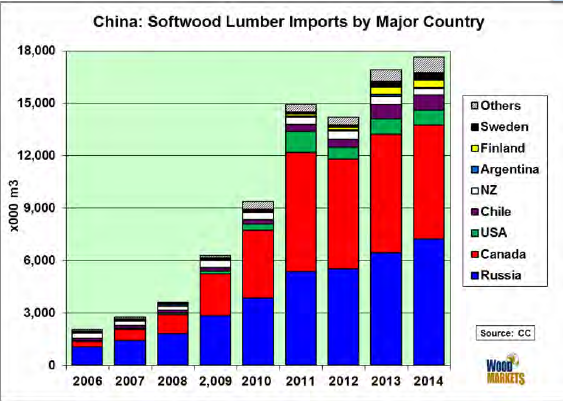
China Wood markets

Qingdao

Qingdao is a major city in eastern Shandong Province.  Qingdao has jurisdiction over seven districts and five county-level cities. According to the 2010 census, the built-up (or metro) area made up of 6 urban districts and Jimo City had 5,764,384 inhabitants, while the total population of the sub-provincial city is up to 8.71 million. Lying across the Shandong Peninsula and looking out to the Yellow Sea, it borders Yantai to the northeast, Weifang to the west and Rizhao to the southwest.

Qingdao is a major seaport, naval base, and industrial centre. The world’s longest sea bridge, the Jiaozhou Bay Bridge, links the main urban area of Qingdao with Huangdao district, straddling the Jiaozhou Bay sea areas.[4] It is also the site of the Tsingtao Brewery, the second largest brewery in China.

In 2007, Qingdao was named as among China’s top ten cities by the Chinese Cities Brand Value Report, which was released at the 2007 Beijing Summit of China Cities Forum. In 2009, Qingdao was named China’s most livable city by the Chinese Institute of City Competitiveness


Living standards are among the highest of leading Chinese cities due to the strong export economy and relatively high family wages.

Qingdao is home to 38  Chinese ethnic minorities, which account for 0.14% of the city’s total population.

There is a large Korean community in Qingdao. By 2009, there are approximately 100,000 Koreans working, studying and living in Qingdao, which makes Qingdao the second in terms of Korean population in China, following Beijing which has about 200,000 Koreans.

Economy

An important region in Eastern China, Shandong Province has seen substantial change in its economic landscape in recent years. Much of this development has been concentrated in Qingdao. Qingdao has seen rapid development. With an annual growth rate of 18.9 percent in 2006, the city’s GDP reached 42.3 billion, ranking first in Shandong Province and tenth out of China’s top 20 cities.  GDP per capita comprised RMB¥52,895 (US$7,616) in 2008. The GDP has grown steadily at an average pace of 16% annually. In 2006, Qingdao was ranked one of six “golden cities” by the World Bank, out of 120 Chinese cities assessed on factors including investment climate and government effectiveness.

Internationally, Qingdao is perhaps best known for its Tsingtao Brewery, founded by a German-British joint venture in 1903 that produces Tsingtao beer, the best-known Chinese export beer. It is also home to Haier, a large white goods manufacturer, and Hisense, a major electronics company. In 2002 guitar manufacturers Epiphone opened a factory in Qingdao.

In 1984 the Chinese government named a district of Qingdao a Special Economic and Technology Development Zone (SETDZ). Along with this district, the entire city had gone through amazing development of secondary and tertiary industries. As an important trading port in the province, Qingdao flourishes with foreign investment and international trade. South Korea and Japan in particular made extensive investment in the city. Approximately 80,000 South Korean citizens reside there. Construction proceeds at a relatively fast pace in Qingdao.

Qingdao Port

Capture 3

The Port of Qingdao is a seaport on the Yellow Sea in the vicinity of Qingdao, Shandong Province, People’s Republic of China. It is one of the ten busiest ports in the world (7th in 2010 considering total cargo volume according to the Institute of Shipping Economics & Logistics).

Beside including the Qingdao Qianwan Container Terminal and the Qingdao Cosport International Container Terminal, located in different areas, Qingdao also has a large terminal for handling iron ore.

Qingdao Qianwan Container Terminal is a port of China, located at Qianwan (literally The Front Bay), Qingdao, Shandong province. Qingdao Port ranked 10th in 2008 world’s busiest container ports with 10,320 thousands TEU, current projects were expected to raise the capacity to 15,000 thousands or more.

Phase 2 & 3 were held by Qingdao Qianwan Container Terminal Co.,Ltd (QQCT), a joint venture of Qingdao Port (Group) Co. Ltd. (31%), Dubai Ports World (was held by P&O) (29%), COSCO Pacific (20% interests, 18.18% voting power) and A. P. Moller-Maersk Group (20%). Phase 2 and 3 had 11 berths.

Phase 4, as Qingdao New Qianwan Terminal (QQCTN), located in south bank, was a joint venture of Qingdao Qianwan Container Terminal Co.,Ltd, (80% interests) and Pan Asia International Shipping Ltd.(20% interests), which started to build in 2007. In 2009, the first 4 out of 10 berths started to operate.

Co-currently, China Merchants Holdings (International) reached an agreement with Qingdao Qianwan International Logistic Park to build a port for the Logistic Park in September 2003.,[  which had 5 berths dedicated for container (which CMHI holds 100% interests) and 2 multi-purpose berths. The whole project CMHI holds 90.1% interests. The project started the construction in 2005.

In December 2009, China Merchants International Container Terminal (Qingdao) Co.,Ltd., the wholly subsidiary of CMHI, reached an agreement with QQCTN to set up a new joint venture company Qingdao Qianwan United Container Terminal Co., Ltd., (QQCTU) to engaged in the construction, operation and management current and future projects in the south bank, and take-over the current berths of China Merchants (5 berths) and QQCTN (4 berths).

In 1984 the Chinese government named a district of Qingdao a Special Economic and Technology Development Zone (SETDZ). Along with this district, the entire city had gone through amazing development of secondary and tertiary industries. As an important trading port in the province, Qingdao flourishes with foreign investment and international trade. South Korea and Japan in particular made extensive investment in the city. Approximately 80,000 South Korean citizens reside there. Construction proceeds at a relatively fast pace in Qingdao.

China International Exhibition on Housing (CIEHI) and BCWood Show Report
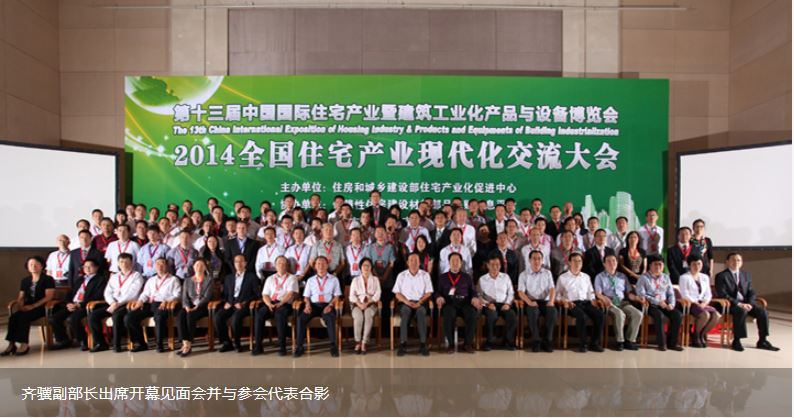
CHIE

Exhibition: The 13th China International Exposition of Housing Industry & Products and Equipment of Building Industrialization

Show Date: September 16–18, 2014

Over View:   Total Exhibit Area: almost 30000 sqm  Exhibitors: about 600

Organizers: The Center for Technology and industrialization development, the Ministry of Housing and Urban-Rural Development, China Real Estate Association,China Architectural Culture Center, Beijing Municipal Commission of Housing and Urban-Rural Development

Executive organizer:    Beijing Zhongjianwenbo Exhibition Co.,Ltd

Official Site:     http://www.ciehi.tv/en/

About the show:

BCWood organize the Canadian Pavilion that included QWeb and one of their member (Modulex Homes) joined Viceroy homes and Big Foot log homes (BCWood members). The AFPA shared a booth with BCWood.

20140916_100335

CIEHI show is a 3 days event, with over 45000 visitors to about 700 exhibit booths.The BCWood /

Canada Wood organized a seminar: Wooden construction development and innovation China seminar in the afternoon of Sep. 17, which is the second day of the show, and invited about 60 customers into the seminar.

BCWood AFPA China Wood Poduct Mission June 2014

JUne 2014 seminar locations


AFPA – BCWood China Mission June 5-16 2014. Mission Itinerary

Key Outcomes

1) Work with BCWood at three grading seminars at Hefei, Xiamen, and Shunde Foshan. Completed

2) Make two presentations at each seminar. a)Present on overview of Alberta’s forests and industry and how it works with Canada Wood; and b)Present an overview of AFPA Grading system (building faith in grading system and standards) Completed. 

3) Carry out contact sessions with seminar attendees and bring back list of suitable buyers for companies after the mission. Completed.

4) Assess wood market areas where time permits. Assessment below.

5) Meet with Canada Wood and BCWood in Shanghai and review program plans in China for this year. Summary below

6) Meet new Alberta Shanghai Trade Officer Yvonna Zhu. Completed

7) Meet with Christopher Liu and Gary Mar on AFPA activities in China and North Asia for this year. (Christopher will attend the Shunde seminar.) Completed

8) Meet with DFAIT Guangzhou staff who will likely attend the Shunde seminar. Contact made but insufficient time to brief. Promised to copy on report.

Total AFPA costs for Mission were $ 6,467.52.

Mission Summary

Meeting with Canada Wood and BCWood and Yvonna Zhu (Alberta Shanghai Trade Office)

Fred Spokes was in Canada during visit. Met with Helen Guo (Code and Standard Specialist) and Brad Spencer program Director for China. Yvonna Zhu is new in her Trade Officer position. Canada Wood and BCWood gave a quick overview of their programs in China. Canada Wood is facing budget cuts and several positions have not been filled through attrition process. There is a medium term goal of filling all positions with nationals as Canadian expats leave to take advantage of other opportunities. Program highlights for this year includes increased architect and carpentry school training, continue work on National Fire Building Code and preparation for Premier Minister Thomson mission in the fall. BCWood will be having booths at Beijing China Housing Industry Exhibition (CHIE) in September, Yiwu International Wood Market Fair in early November, CIFM / Interzum Guangzhou 2014 – China International Woodworking Machinery & Furniture Raw Material Materials Fair. These events will have a Canada Wood\ BC Wood booth(s). Alberta ESRD or AFPA will share the booth space with BCWood. ESRD attended the 2014 Interzum and Yiwu Fairs. AFPA will be attending the CHIE with BCWood.


Market Assessment

BCWood targets China cities for their seminars with emerging wood product markets that will provide new demand for western Canada wood products. Wood buyers are interested in sourcing our wood but lack full knowledge of the products, the industry and best use of wood species. Wood manufacturing is moving out of tier one city areas as result of rising wages, land prices and taxes. Cities like Hefei, Xiamen and Shunde Foshan are growing rapidly and have quickly developing middle classes. Wood manufacturing markets will shift to the domestic needs of the emerging middle class.


Mission stops shown in picture below.

Hefei formerly known as Ho-fei, Luzhou, or Luchow is the capital and largest city of Anhui Province in Eastern China. A prefecture-level city, it is the political, economic, and cultural centre of Anhui. Located in the central portion of the province, it borders Huainan to the north, Chuzhou to the northeast, Chaohu to the southeast and Lu’an to the west.

Hefei has an area of 11,323 km2) and, as of 2013 Census, a population of 7,611,000 inhabitants. Its built-up area (“metro”) is home to 3,352,076 inhabitants encompassing all urban districts.

The GDP per capita was ¥61,500 (ca. US$10,141) in 2013.

Before the Chinese civil war Hefei was a town whose main industry was agriculture. Soon after the founding of the People’s Republic of China, the capital of Anhui was moved from Anqing to Hefei. To assist the development of the city, many talented people were sent in from other parts of the country. Modern-day Hefei has machinery, electronics, chemistry, steel, textile, wood and cigarette industries, among others.

Hefei has been identified by the Economist Intelligence Unit in the November 2010 Access China White Paper as a member of the CHAMPS (Chongqing, Hefei, Anshan, MA’ Anshan, Pingdingshan and Shenyang) , an economic profile of the top 20 emerging cities in China.[9]

Hefei has been identified by The Economist in the December 2012 as the world’s No.1 fastest growing metropolitan economy

Hefei does not have direct port access but is well connected by new high speed highway access to the Yangtze River and port areas in Nanjing and Shanghai. Many of the new wood manufacturing factories are associated with Shanghai businesses and source wood and other materials from this port. Nanjing and Shanghai are the number 1 and 2 entry points for Western Canada SPF Lumber. Nanjing is the number I port of entry for Canada softwood logs.

Hefei wood manufacturing covers a broad spectrum of products from low grade construction material, to block board, wall strips, wood packaging, furniture, flooring, wood saunas, outdoor furniture and landscaping materials. The market has been principally for coastal wood species and logs. Market demand for SPF lumber is

Xiamen

Xiamen, also known as Amoy is a major city on the southeast (Taiwan Strait) coast of the People’s Republic of China. It is administered as a sub-provincial city of Fujian province with an area of 1,699.39 square kilometres (656.14 sq mi) and population of 3,531,347 at the 2010 Census. The city’s urban area includes the old urban island area and covers all six districts of Xiamen (Huli, Siming, Jimei, Tong’an, Haicang and recently Xiang’an), and has a total urban population of 1,861,289. It also borders Quanzhou to the north and Zhangzhou making this a unique built up area of more than five million people. The Jinmen (Kinmen) Islands administered by the Republic of China (Taiwan) are less than 10 kilometres (6.2 mi) away.

Xiamen and the surrounding southern Fujian countryside are the ancestral home to large communities of overseas Chinese in Southeast Asia. The city was a treaty port in the 19th century and one of the four original Special Economic Zones opened to foreign investment and trade when China began economic reforms in the early 1980s. It is endowed with educational and cultural institutions supported by the overseas Chinese diaspora. In 2006, Xiamen was ranked as China’s second “most suitable city for living”.

Xiamen has a diverse and well-developed economy. Primary economic activities include fishing, shipbuilding, food processing, tanning, textiles, machine tool manufacturing, wood manufacturing, chemical industries, telecommunications and financial services. The city has economic and trade relations with 162 countries and regions worldwide, and benefits from foreign investment, particularly capital from Hong Kong, Macau and Taiwan.

In 2008, a total of 356 projects with foreign direct investment had been approved in the city, with a contractual foreign investment amount of US$1.896 billion and an actual foreign investment amount of US$2.042 billion.[14] In 1992, Xiamen was ranked among the top 10 Chinese cities in relation to comprehensive strengths with its GDP increasing by an average of over 20% annually. In 2008, Xiamen’s GDP amounted to 156 billion Yuan, an increase of 11.1% over the previous year; and the per-capita GDP was 62,651 yuan (US$9,017). Further economic reforms were introduced, and this brought the total volume of imports and exports in 2008 to US$45.4 billion, while that of exports totalled US$29.4 billion.

Xiamen is also the host of the China International Fair for Investment and Trade held annually in early September to attract foreign direct investment into the Chinese mainland.

Xiamen has excellent road, rail, air and port infrastructure. In the last few years, Xiamen has invested more than RMB30 billion in infrastructure construction.

The Port of Xiamen is an important deep water port located in the mouth of the Jiulongjiang River. It is one of the trunk line ports in the Asia-Pacific region. It is ranked the 8th largest container port in the PRC, and ranks 17th among the world’s top 100. It is the 4th port in the PRC with the capacity to handle the sixth-generation large container vessels. In 2013, Xiamen handled 191 million tons of cargo, including 8.08 million TEUs of containers. In 31 August 2013, Xiamen Port incorporated the neighboring port of Zhangzhou to form the largest port of China’s Southeast. This was a relatively uncommon case of ports merging across jurisdictions.

Xiamen is a well-developed first-class port. Dongdu harbor is located on Haicang district which is on the mainland. The coast line in the harbor area stretches for 30 kilometres (19 mi), and the depth of water reaches up to 17 metres (56 ft). The port offers 74 berths. One can handle vessels of 100,000 or more tonnes, 23 berths are for 10,000 or more tonnes, and two handle vessels between berths for 5,000 and 10,000 tonnes. There are nine container terminals. Xiamen is the first mainland port to start the direct shipment of cargo to Kaohsiung in Taiwan. The initial cargo handling capacity totalled 1.34 million TEUs of containers.

The port comprises twelve areas: Heping, Dongdu, Haitian, Shihushan, Gaoqi, Liuwudian (in Tong’an District).[3]

The world’s top 20 shipping companies have all established major shipping routes and operations in Xiamen. A total of 68 shipping routes serve over 50 countries to almost all the major ports in the world, yielding an average 469 ship calls at the port each month. In addition, passenger services also operate from Xiamen to Hong Kong, Guangzhou, Shanghai and Wenzhou, as well as frequent ferry service to the Shuitou terminal in Taiwan

The port is owned and operated by Xiamen Port Authority which is a department of the Xiamen Municipal Government.

There are a significant number of wood product import/export companies located in various areas adjacent the port districts. There are primary breakdown facilities that make veneer and plywood, block board for use as interior core for wall panels, flooring, internal furniture structuring, dunnage and pallets. Lumber is used for block board, wall strips, and pallets. Associated with these distribution and primary breakdown centers are a large variety of wood manufacturers for furniture, flooring, wall panels, window casings, doors cores, CNC produced wood products, outdoor decking, pre-fabricated Scandinavian log cabins. Xiamen is also a center for wood manufacturing machine product such as CNC machines, routers,

Shunde County Foshan District

Shunde District, is a district in the city of Foshan in the Pearl River Delta, Guangdong Province, China. Once a traditional agricultural county, it has become one of the most affluent counties in Guangdong and mainland China. Since 2009, it is administrated independently of Foshan city, answerable directly to the Guangdong provincial government.

Shunde was approved as a pilot city for the comprehensive reform of Guangdong in 1993, and also for taking the lead in accomplishing modernization in 1999. From 2000 to 2003, Shunde was ranked first among China’s top 100 counties for Basic Economic Competitiveness for four consecutive years (released by National Bureau of Statistics of China). In 2005, Shunde achieved a GDP of 2170.13 billion.

Situated in the fertile Pearl River Delta, the economy was once dominated by agriculture, fisheries and silk farming. Since the Chinese economic reform, this has been superseded by industrial manufacturing and development, especially the manufacturing of furniture and electric appliances.[4] Some mainland Chinese product brands like Kelon or Midea are made in Shunde. Recently a new technology industrial park has also been opened in this area, featuring car manufacturers such as Toyota.

Today, this area has become one of the most affluent counties in Guangdong and mainland China (according to official information from the Chinese government and the United Nations).[citation needed] The GDP reached 127.5 billion yuan in 2007, an annual increase of 18%, and GDP per capita reached 107,991 yuan (ca. US $14,200).

Shunde, China Furniture Wholesale Market

Shunde, China Furniture Wholesale Market is located at Shunde district which connects Lecong town and Longjiang town along the 10 km highway, Foshan City, Guangdong Province, China. Shunde has become the largest furniture wholesale market and distribution center in China and the world. It claims to be the The World Largest Furniture Wholesale Market. Shunde was named as the China Furniture Business and Trading Capital by the China National Light Industry Council and China National Furniture Association. It covers a total area of approximately 32.3 million square feet (3 million square meter) and it includes more than 200 modern furniture sales buildings, such as Sunlink Group, Lecong International Furniture Exhibition Center, Shunde Empire Group, Tuanyi International Furniture City and others.

The furniture wholesale market extends more than 5 km and is arranged by 12 rows and 20 streets. There are over 3,300 domestic and foreign furniture dealers and more than 1,500 furniture manufacturers. Jointly they display over 20,000 types of furniture and products ranging from living room furniture, dining room furniture, bedroom furniture, kitchen furniture, and hotel furniture, hotel mattress, contract furniture, and restaurant furniture, cafe chairs, bar stools, bathroom furniture, sanitary ware, furniture accessories, material & hardware. The market is open year round with furniture trading more than USD1 billion in sales volume each year.

There are two major furniture exhibitions held in March and August each year at Longjiang town of Shunde district. The Dragon Furniture Fair has a famous reputation of professional fair at home and abroad.

Being located at Guangdong province, close to Hong Kong and Macau, the market offers convenient transportation and well-developed infrastructure.

Shunde Port is a passenger port and is located at the right side of Wusha Bridge in on the Tanzhou Waterway. It provides daily passenger vessel service between Shunde and Hong Kong. Shunde does not have direct container port access but is connected by rail and excellent highway systems. Shunde does access wood and wood products from the Prefecture level City of Dongguan which is found on the west side of the Tanzhou Waterway approximately 25

Dongguan

Dongguan is a prefecture-level city in central Guangdong province, People’s Republic of China. An important industrial city located in the Pearl River Delta, Dongguan borders the provincial capital of Guangzhou to the north, Huizhou to the northeast, Shenzhen to the south, and the Pearl River to the west. The three neighboring municipalities of Guangzhou, Dongguan, and Shenzhen are home to over 25 million residents, accounting for a large proportion of the Pearl River Delta Region’s population. City administration is considered especially progressive in seeking foreign direct investment in Asia and Europe. Dongguan ranks behind only Shenzhen, Shanghai and Suzhou in exports among Chinese cities, with $65.54 billion Yuan in shipments. It is home to one of the world’s largest, though largely empty, shopping malls New South China Mall.

Dongguan earned city status in 1985, and was upgraded to prefecture city status three years later. During the period the city changed its focus from an agricultural town into a manufacturing hub, with an average annual growth of up to 18%. The city ranked 13th in Forbes China’s listing of the most innovative mainland cities, as well as 18th in Foreign Policy’s listing of the most dynamic cities in the world.

Dongguan serves as one of the regional railway hubs in Guangdong, where the Guangzhou-Kowloon Railway, Guangzhou-Meizhou-Shantou Railway and the Beijing-Kowloon converge. Rail services in and out of the city call at Dongguan railway station where there are direct train services to Guangzhou East railway station in Guangzhou; and Hung Hom Railway station in Hong Kong.

The Humen Pearl River Bridge is a suspension bridge over the Pearl River. Completed in 1997, it has a main span of 888 metres (2,913 ft). Construction work on the Second Humen Pearl River Bridge will start in early 2014.

Among the four railway lines (R1-R4) planned for the Dongguan Metro, R2 line is presently under construction and is scheduled to open for operations in early 2015. The R2 Line will link towns in Western Dongguan, thereby promoting the connection of the entire downtown area with Houjie, Humen and Chang’an. It will also support Dongguan’s regional transportation with other cities such as Guangzhou, Shenzhen, Hong Kong by joining with the rail transit junctions of the Pearl River Delta.

Dongguan is a major manufacturing hub, although it suffered significant loss of economic activity from the impact of the 2008 financial crisis. The largest industrial sector is manufacturing of electronics and communications equipment; international companies with facilities in Dongguan include DuPont, Samsung Electronics, Nokia, Coca-Cola, Nestlé and Maersk.

BCWood and ESRD did a grading seminar in Dongguan area in November 2013. This seminar was co-hosted hosted by the Dongguan Timber Association.

 Biggest Wood Distribution center in South China. Annual sales 10 billion Yuan annually. Sell lumber, veneer, MDF, panel product, carts. No Canadian OSB sold here. (German pine OSB) Buy wood products from around the world. Going forward they are interested in selling and distributing SPF and Canadian OSB panel board.

They plan to move entire timber market to new location. (At the Dongshun Container Flooring Facility) The existing timber market will feature SE Asia and Africa “red woods” hardwood.

The Mother company has global investments in many different commodities and technologies. The Dongguan operation has control of rail and dock side logistics for most of the furniture companies –in the region.

Houjie Town is located at the east bank of the Pearl River Delta, the middle section of the Guangzhou-Shenzhen economic corridor. In the south it borders Humen Port, and in the north it links to the Dongguan city proper. There is a total area of 126.15 square kilometers under its jurisdiction, with a permanent population of 93,000, and more than 400,000 as a temporary population. It is a town of old and prosperous business and trade, rich in products like Guancao (Dongguan Grass). Its industrial, commercial and trading enterprises were all set up and developed from traditional lines and are thriving and deeply rooted in Houjie Town. Throughout 30 years of reform and opening up, rural industrialization and urbanization were achieved, making the town a new modernized industrial town of the Pearl River Delta region. In recent years it has been successfully honored as a “Town of Hygiene in China”, “Famous Town of Exhibitions in China”, “Town with the Strongest Education in Guangdong”, and a “Civilized Town of Dong City”. Houjie town is famous for shoes design and manufacturing center.

Latest Wood MarketTrip to Japan Nov 3-15

Courtesy Rory Thompson

Mission Objectives and Key Results:

Promote Canada Wood and profile AFPA member companies at the Japan Home Show in Tokyo This includes finding out Japan’s wood product user needs and educating them on Alberta’s forest industry and products.

Completed. This years show featured new permanent display materials that have been left with BCWood. New companion brochure to the Alberta Wood Product Buyers Guide released that provides a tabular explanation of NLGA grading system. A Japanese AFPA card handed out to hundreds of Home Show attendees. New AFPA display materials featured at the Canada pavilion. Over eighty companies visited the booth with 50 companies provided detailed information and BC and Albert forest company sales contact information

Continue business contact building by visiting key companies and associations in central Japan. Make contact with various Japanese wood consuming companies to gather information as to how we can work with them and the Alberta wood producers to expand our market into Japan.

Thirteen key lumber and panel companies in central japan visited in Tokyo, Nagoya, Osaka and Kyoto. Detailed briefings given on Alberta’s forest industry and wood manufacturing sector. Follow-ups have been completed on any information or business contact requests

Evaluate manufactured home and building component opportunities for Alberta companies GOA)

Several companies were briefed on Alberta’s manufactured home sector by Roy Thompson. One company Tsuda requested to visit Alberta and visit several home and building component manufacturers in Alberta

Make contact and brief Alberta Trade office and Canadian Trade Embassy staff located in Japan

Met with Japan Trade Office staff and trade embassy staff in Tokyo and Nagoya. Alberta Trade Office staff requested assistance from ESRD and AFPA on wood promotion associated with the 35th anniversary of Alberta-Hokkaido Prefecture Twinning

General Observations

The Consumption Tax has reduced spending in Japan and impacted some Japanese from entering the real estate market. The Consumption Tax is now at 8% and the government is considering the desirability of raising it to 10% in 2015. The housing market has seen a reduction of up to 15% in housing starts for 2014.

In 2013 the Japan’s Ministry of Agriculture, Forestry, and Fisheries (MAFF) prepared a budget of approximately $400 million to promote the use of domestic wood in both new home starts as well as renovation work.  The program allows for subsidies of Y300, 000 per home to the end-users, which means there is enough budget this year for over 100,000 starts under it.

The average house size in Japan is 1100 square feet no basements (earthquakes) and cost approximately $380,000. Mortgage rates are around 2%.

Japan housing generated 940000 housing starts in 2013.

Demand and prices for J-grade lumber (the main product on the market from western Canada) and wood frame housing construction are trending downward due to these policies and the economic situation described further in this report.

Courtesy Mr. Mita Tokyo Lumber Terminal

Economic Report Canada Wood Japan Blog Courtesy Shawn Lawlor Japan Director Canada Wood

After the 7.1% GDP contraction in Q2, Japan’s economy continued to move sideways through September. The trade deficit for the first half of 2014 reach a record 5.4 trillion yen. Although exports increased 1.7%, rising fuel imports compounded by a weakening yen added to the overall trade deficit. The Nikkei 225 equities index fell 6.0% from the beginning to late October. The Japanese yen firmed to the 107-108 to USD level.

Despite recent meetings in Sydney, Japanese and US trade officials failed to make any breakthroughs on the TPP negotiations. More importantly in a bid to rein in spending the Finance Ministry is now examining plans to increase the minimum number of pupils per class in elementary schools from 35 to 40. The move is expected to result in the layoff of 4,000 teachers nationwide. In addition the Ministry is reviewing plans to close up to 3,325 schools across Japan and lay off up to 18,000 teachers in areas with dwindling populations. However, these proposed cuts have yet to be confirmed.

Japan Housing Starts Summary

Japan total housing starts dropped 12.5% to 73,771 units in August, posting the sixth consecutive monthly decline. Owner occupied starts fell 22.7% in contrast to rental units which retreated 3.8%. Total wooden starts fell 15.1% to 40,667 units.

By housing type post and beam dropped 16.6% to 30,239 units; pre-fab fell 12.0% to 10,727 units and platform frame starts eased off 9.4% to 9,183 units. By segment 2×4 starts fell 16.5% for owner occupied custom homes, 14.1% for built for sale spec homes and 3.9% rental housing. Average floor area also experienced declines of 4% for post and beam, 5.2% for pre-fab and 3.3% for 2×4.

Softwood Exports to Japan

August BC softwood exports to Japan totaled 166,723m3, down 25% of year prior results. The value of August BC softwood exports fell to $56.4 million from $73.6 million the year prior. Year to date BC exports through until the end of August totaled 1,404,883m3 compared to 1,770,725m3 over the same period in 2013.

Courtesy Canada Wood Japan

Japan Home Show

The Canadian Pavilion at the Japan Home show was top notch, well designed and well attended. Thanks to BCWood for excellent mission support and hosting the Japan Home Show Pavilion.

Jim Ivanoff and Miho Ohashi

.Four days were spent setting up and manning the booth at the Japan Home Trade Show. The AFPA, ESRD and BC Wood had booths beside each other at the trade show located at the Big Site in Tokyo. Over the three day period there were many people that stopped by our booth out of those that walked by we actually sat down and talked to about 30 different companies regarding Alberta forest products. We have been in contact with those people through emails as a follow up to the show.

Designed by FPInnovations and ESRD
developed by FPInnovations and Alberta ESRD

Mugsy’s Winter of Our Discontent

I have been away a lot on business this winter. My wife misses me quite a bit but I think my cat misses me more. He follows me around the house giving me heck. MeOOOOWAHWOOWeeeYow!!!!!

…Cats have quite the vocabulary when they are not ignoring you…

Mugsy likes to be outside. Winter means no place to wander and no place to go to the bathroom. He gets quite anxious and paces the house when it is too cold to go outside. Meow! meoww!!! MEOWWWWW!!!!!!  He still goes out until his ears freeze and he is standing on just one foot…We let him out many many times… He always “forgets” he was out recently…

His desire to mark his territory means he does it inside instead of outside. BAD CAT! We will replace our old carpet after Mugsy has passed on. He loves shredding the indoor outdoor with his claws BAD CAT!!! I keep his kitty litter box cleaned but sometimes yah gottah make your mark in life…

He throws up on the rug-poor guy…. Katie doesn’t like cleaning the sick up. We give Sears carpet cleaning a lot of business…. I really love when the sick up contains mousey or birdy bits..yum yum…

He likes to get up on the kitchen counter at lick the butter dish ugggh. BAD CAT!!! It does motivate us to keep the kitchen clean and put away food promptly.

He will be 15 years old this summer. I keep waiting for him to slow down. He still leaps over the fence and visits the neighbours yards and leaves his signature mounds.

He does a really great job catching mice and voles in the yard. He sits on the crusty spring snow and listens for the mice nests and traffic. His ears twitch back and forth, back and forth….

In the spring and fall our yard is a killing field.Headless little torsos lined up on the patio. Or even better displayed in the hallway. There is nothing like stepping on a gushy mouse body in the middle of the night in bare feet…..

With all that said. I will miss him when he is gone. When he looks at me with his big green eyes, I know what he is thinking…what are you doing for me lately? …or I am your god worship me!!!! But when you have  had a crappy day …he is there to sit in your lap and be adored. No time to feel sorry for yourself….

Here is to Sir Mugsy. Live long and prosper my friend…May spring come early this yearIMG_0402